
the Creative Commons Attribution 4.0 License.
the Creative Commons Attribution 4.0 License.
 | 09 Feb 2026
Applying Satellite Observations to Improve Bottom-Up National Emission Inventories for Methane: Application to Colombia
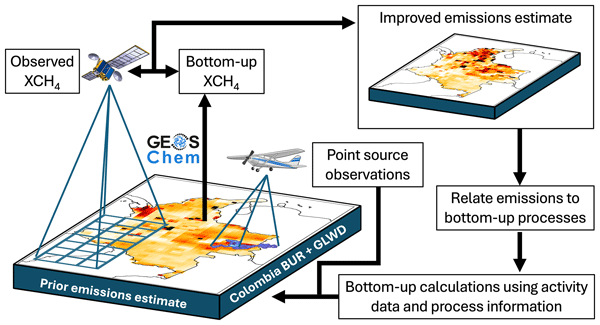
Abstract. Countries report bottom-up inventories of methane emissions under the Paris Agreement to the United Nations Framework Convention on Climate Change (UNFCCC), but these inventories can have large uncertainties in activity data and emission factors. Top-down information from inversion of satellite observations can provide valuable constraints to improve these estimates, but has been limited by coarse resolution and the use of inadequate emission inventories as prior estimates. Here, we combine inventory and atmospheric data to quantify 2023 national emissions in Colombia. We use satellite observations from TROPOMI, GOSAT, and point source imagers (GHGSat, EMIT, aircraft AVIRIS-NG) in an analytical inversion at ≈12×12 km2 resolution with the Integrated Methane Inversion v2.0 framework. We construct a spatially-resolved version of the national bottom-up emission inventory from the Biennial Update Report (BUR) to the UNFCCC for use as prior estimate in the inversion, and combine it with high-resolution wetland extent data (GLWDv2) to separate anthropogenic from wetland emissions. Total posterior methane emissions are 8.9 (8.7–9.1) Tg a-1 contributed by wetlands (5.7 (5.5–6.0) Tg a-1) and anthropogenic emissions (3.2 (3.1–3.2) Tg a-1), mainly livestock (2.0 (1.9–2.1) Tg a-1) and waste (0.76 (0.74–0.76) Tg a-1). Adjustments relative to the BUR are +18 % for livestock, +19 % for waste, +60 % for oil/gas, and +92 % for coal. We provide recommendations to improve the BUR, offering a blueprint for combining satellite observations with national inventory data to produce sectorally and spatially resolved emissions estimates that can inform mitigation planning.
-
Notice on discussion status
The requested preprint has a corresponding peer-reviewed final revised paper. You are encouraged to refer to the final revised version.
-
Preprint
(6509 KB)
-
Supplement
(1537 KB)
-
The requested preprint has a corresponding peer-reviewed final revised paper. You are encouraged to refer to the final revised version.
- Preprint
(6509 KB) - Metadata XML
-
Supplement
(1537 KB) - BibTeX
- EndNote
- Final revised paper


Journal article(s) based on this preprint
Interactive discussion
Status: closed
- RC1: 'Comment on egusphere-2025-5478', Anonymous Referee #1, 31 Mar 2026
-
RC2: 'Comment on egusphere-2025-5478', Anonymous Referee #2, 15 Apr 2026
This manuscript presents a 12 km x 12 km methane inversion over Colombia using Integrated Methane Inversion framework. The study combines satellite measurements from TROPOMI and GOSAT with their national bottom-up inventory from the Biennial Update Report and GLWDv2 inventory for wetland emissions. The inferred posterior emission fluxes indicate substantial upward revisions in the anthropogenic emissions, particularly in oil & gas, and coal sectors. The study is timely and relevant, and can be accepted after addressing the following comments:
Line 85: The authors claim that the high resolution allows them to directly attribute their posterior emission to specific sectors. However, 12 km is still too coarse to resolve all of the sectors. As a result, authors merge several collocated sectors in this study. I recommend that the authors rephrase this claim to avoid overstatement and more explicitly acknowledge that sectoral attribution is only partially resolved at this scale, and in some cases relies on prior information or aggregation assumptions.
Line 101: The prior inventory is constructed to match the national total in BUR, which introduces an implicit constraint on the overall emission magnitude. This raises concern regarding the interpretation of posterior uncertainties. For example, if the national total in BUR is underestimated, the prior uncertainties will be underestimated as well. Typically, the posterior uncertainties are smaller than the prior uncertainties and that will mean that posterior uncertainties will be underestimated in that case. A sensitivity analysis using an alternative prior would help assess the robustness of the inferred emissions and their uncertainties. If that is computationally expensive to run, then I would recommend conducting sensitivity analysis with scaling the prior and evaluating on independent observations similar to Figure 7.
Line 104: Were the emissions from the point sources assumed constant or did they have temporal variability based on persistence or repeated observations? Additionally, if the BUR total emissions were preserved, does that mean increasing oil and gas emissions require decreasing other sector emissions?
Line 203: Minor grammatical error: “national total estimate of of 0.049 Tg a-1”.
Line 242: The analysis focuses on the year 2023, however, the rationale for selecting this specific year is not clearly justified. Given that TROPOMI measurements are available from 2018 onward, it would be valuable to understand why a longer temporal analysis was not conducted. Extending this study period could help assess the robustness of the results, capture interannual variability, and better constrain sector emissions. The authors should clarify their choice of 2023 and discuss whether their framework could be applied to a multi-year analysis.
Line 297: Why both prior and observational error covariance matrices are assumed to be diagonal? Not having off-diagonal terms in the error covariance matrices can limit the inversion’s ability to correct structural biases, and the posterior fluxes may retain spatial patterns from the prior.
Figure 6: The spatial structures in the posterior emissions look very much similar to the prior, given the limited observations, off-diagonal terms in the error covariance matrices may help in constraining the posterior fluxes better.
Line 340: The authors used the posterior uncertainty as the evaluation metric to select the best posterior estimate of emissions. Does the comparison between model simulated and observed concentrations also follow the same order of performance?
Line 350: The authors compare the GEOS-Chem model bias relative to the TROPOMI and GOSAT observations and highlight significant improvements over the bottom-up inventory. However, it is not clear if the observations used in this analysis and Figure 7 are independent observations from this inversion or not. I strongly recommend using independent observations as typically the observations used in the flux inversion will have a better fit.
Line 512: Can there be any physical reasoning behind the decrease in the reservoir emissions? For example, reservoir emissions are generally the highest in the first two decades and decrease over time after that.
Citation: https://doi.org/10.5194/egusphere-2025-5478-RC2 - AC1: 'Comment on egusphere-2025-5478', Sarah Hancock, 28 Apr 2026
Peer review completion


Interactive discussion
Status: closed
-
RC1: 'Comment on egusphere-2025-5478', Anonymous Referee #1, 31 Mar 2026
This manuscripts uses TROPOMI and GOSAT observations to constrain methane emissions in Colombia at high resolution for 2023. The authors develop a high-resolution gridded bottom-up inventory of methane emissions. Using GEOS-Chem as a forward model, they solve an analytical Bayesian inversion to update the bottom-up inventory. The main value is the development of a high-resolution gridded emissions inventory constrained by satellite observations that yield specific suggestions for improving bottom-up estimation methods. I find the work to be novel, well-written, a valuable addition to the field, and suitable for ACP. However, I have major questions regarding validation of posterior emissions and robustness of the sector attribution.
Major comments:
1. L341-342: This argument makes sense. However, I do not believe the posterior error variance is shown in the main text or SI. Could the authors provide further justification of this claim by comparing posterior error variance at each grid cell to the variance of the inversion ensemble, perhaps in the supplement? Additionally, it would be useful to see a comparison of the prior and posterior error variance at each grid cell.
2. The posterior emissions would be more compelling if they were independently validated. To my understanding, only in-sample validation has been shown (Figure 7). Could the authors show that the posterior emissions improve simulation of TROPOMI and GOSAT observations that are held out of the inversion? Either in 2023 or in a different year?
3. Figure 6: it looks like the largest changes to the emissions occurred in regions coincident with observations (Figure 7). Could the authors show a map of the diagonal elements of the averaging kernel (i.e., Aii) or DOFS averaged over regions to show where posterior emissions are constrained by observations? If there are regions that are not constrained well by the observations, can the authors discuss them? This is partially addressed with the discussion of Carbon-I (L538) but it would be clearer if this was directly shown.
4. In general, I am skeptical of the posterior sector attribution for non-point sources (wetlands, livestock, rice) in regions where these emissions are co-located (e.g., wetland emissions in the La Mojana region and Magdalena River with livestock emission in Figs. 4 and 3). The authors assume that posterior sector emissions in each grid cell are proportional to prior sector emissions. While total sector emissions errors are generally uncorrelated (Figure S2), this does not mean that finer-scale attribution is correct. High uncertainty in the spatial distribution of prior non-point source emissions will propagate to the posterior sector emissions. The following comments relate to this point:
a. The authors briefly discuss this uncertainty in L548-550. However, because this is a key assumption affecting interpretation, the sector attribution method should be made clearer in the abstract and conclusion.
b. Figure S2 shows low posterior error correlations between sectors, but this does not necessarily demonstrate that sectors are independently constrained by the observations. Could the authors provide the sector-resolved averaging kernel (i.e., WAWT) as another diagnostic to assess whether co-located sectors can be meaningfully distinguished (e.g., whether the diagonal elements are large and off-diagonal elements are small), or whether sector attribution is primarily driven by prior assumptions?
c. Can the authors provide more discussion of how the uncertainty in the distribution of the prior wetland emissions could affect posterior sector emissions? While sensitivity tests using global inventories (Figure S2) are helpful, the problem remains underdetermined, and these tests may not fully explore the uncertainty space.
d. Figure 8: Could the high posterior emissions factor in Magdalena Medio have been a misattribution of wetland emissions to livestock emissions? The GLWD + LPJ prior shows weak but notable emissions in that region. If the prior wetland emissions were biased low or too spatially concentrated, could the posterior livestock emissions be biased high?
e. It would be useful to see a map of the change in prior and posterior sector emissions to better evaluate sector attribution. This is done for the wetland emissions in the La Mojana region (Figure S4), but difference plots would be useful for the sector emissions in general.
Minor comments:
5. It would be nice to see an explicit comparison of the spatial distribution of wetland emissions from GLWD + LPJ compared to LPJ alone. e.g., a difference plot.
6. It is not clear to me how the seasonal cycle of wetland emissions is considered in the inversion. I assume that the K matrix contains this information via the time-resolved forward model? If that is the case, could the authors make that clearer?
Citation: https://doi.org/10.5194/egusphere-2025-5478-RC1 -
RC2: 'Comment on egusphere-2025-5478', Anonymous Referee #2, 15 Apr 2026
This manuscript presents a 12 km x 12 km methane inversion over Colombia using Integrated Methane Inversion framework. The study combines satellite measurements from TROPOMI and GOSAT with their national bottom-up inventory from the Biennial Update Report and GLWDv2 inventory for wetland emissions. The inferred posterior emission fluxes indicate substantial upward revisions in the anthropogenic emissions, particularly in oil & gas, and coal sectors. The study is timely and relevant, and can be accepted after addressing the following comments:
Line 85: The authors claim that the high resolution allows them to directly attribute their posterior emission to specific sectors. However, 12 km is still too coarse to resolve all of the sectors. As a result, authors merge several collocated sectors in this study. I recommend that the authors rephrase this claim to avoid overstatement and more explicitly acknowledge that sectoral attribution is only partially resolved at this scale, and in some cases relies on prior information or aggregation assumptions.
Line 101: The prior inventory is constructed to match the national total in BUR, which introduces an implicit constraint on the overall emission magnitude. This raises concern regarding the interpretation of posterior uncertainties. For example, if the national total in BUR is underestimated, the prior uncertainties will be underestimated as well. Typically, the posterior uncertainties are smaller than the prior uncertainties and that will mean that posterior uncertainties will be underestimated in that case. A sensitivity analysis using an alternative prior would help assess the robustness of the inferred emissions and their uncertainties. If that is computationally expensive to run, then I would recommend conducting sensitivity analysis with scaling the prior and evaluating on independent observations similar to Figure 7.
Line 104: Were the emissions from the point sources assumed constant or did they have temporal variability based on persistence or repeated observations? Additionally, if the BUR total emissions were preserved, does that mean increasing oil and gas emissions require decreasing other sector emissions?
Line 203: Minor grammatical error: “national total estimate of of 0.049 Tg a-1”.
Line 242: The analysis focuses on the year 2023, however, the rationale for selecting this specific year is not clearly justified. Given that TROPOMI measurements are available from 2018 onward, it would be valuable to understand why a longer temporal analysis was not conducted. Extending this study period could help assess the robustness of the results, capture interannual variability, and better constrain sector emissions. The authors should clarify their choice of 2023 and discuss whether their framework could be applied to a multi-year analysis.
Line 297: Why both prior and observational error covariance matrices are assumed to be diagonal? Not having off-diagonal terms in the error covariance matrices can limit the inversion’s ability to correct structural biases, and the posterior fluxes may retain spatial patterns from the prior.
Figure 6: The spatial structures in the posterior emissions look very much similar to the prior, given the limited observations, off-diagonal terms in the error covariance matrices may help in constraining the posterior fluxes better.
Line 340: The authors used the posterior uncertainty as the evaluation metric to select the best posterior estimate of emissions. Does the comparison between model simulated and observed concentrations also follow the same order of performance?
Line 350: The authors compare the GEOS-Chem model bias relative to the TROPOMI and GOSAT observations and highlight significant improvements over the bottom-up inventory. However, it is not clear if the observations used in this analysis and Figure 7 are independent observations from this inversion or not. I strongly recommend using independent observations as typically the observations used in the flux inversion will have a better fit.
Line 512: Can there be any physical reasoning behind the decrease in the reservoir emissions? For example, reservoir emissions are generally the highest in the first two decades and decrease over time after that.
Citation: https://doi.org/10.5194/egusphere-2025-5478-RC2 - AC1: 'Comment on egusphere-2025-5478', Sarah Hancock, 28 Apr 2026
Peer review completion
Journal article(s) based on this preprint
Viewed
| HTML | XML | Total | Supplement | BibTeX | EndNote | |
|---|---|---|---|---|---|---|
| 1,704 | 1,067 | 120 | 2,891 | 213 | 240 | 318 |
- HTML: 1,704
- PDF: 1,067
- XML: 120
- Total: 2,891
- Supplement: 213
- BibTeX: 240
- EndNote: 318
Viewed (geographical distribution)
| Country | # | Views | % |
|---|
| Total: | 0 |
| HTML: | 0 |
| PDF: | 0 |
| XML: | 0 |
- 1
Sarah E. Hancock

Daniel J. Jacob
Rodrigo Jimenez
Andrés Ardila
Luis Morales-Rincon
Néstor Rojas
Lucas A. Estrada
Nicholas Balasus
James D. East
Melissa P. Sulprizio
Xiaolin Wang
James L. France
Lauren Potyk
Elise Penn
Zichong Chen
Daniel J. Varon
Christian Frankenberg
Marci Baranski
Andreea Calcan
Robert J. Parker
The requested preprint has a corresponding peer-reviewed final revised paper. You are encouraged to refer to the final revised version.
- Preprint
(6509 KB) - Metadata XML
-
Supplement
(1537 KB) - BibTeX
- EndNote
- Final revised paper
This manuscripts uses TROPOMI and GOSAT observations to constrain methane emissions in Colombia at high resolution for 2023. The authors develop a high-resolution gridded bottom-up inventory of methane emissions. Using GEOS-Chem as a forward model, they solve an analytical Bayesian inversion to update the bottom-up inventory. The main value is the development of a high-resolution gridded emissions inventory constrained by satellite observations that yield specific suggestions for improving bottom-up estimation methods. I find the work to be novel, well-written, a valuable addition to the field, and suitable for ACP. However, I have major questions regarding validation of posterior emissions and robustness of the sector attribution.
Major comments:
1. L341-342: This argument makes sense. However, I do not believe the posterior error variance is shown in the main text or SI. Could the authors provide further justification of this claim by comparing posterior error variance at each grid cell to the variance of the inversion ensemble, perhaps in the supplement? Additionally, it would be useful to see a comparison of the prior and posterior error variance at each grid cell.
2. The posterior emissions would be more compelling if they were independently validated. To my understanding, only in-sample validation has been shown (Figure 7). Could the authors show that the posterior emissions improve simulation of TROPOMI and GOSAT observations that are held out of the inversion? Either in 2023 or in a different year?
3. Figure 6: it looks like the largest changes to the emissions occurred in regions coincident with observations (Figure 7). Could the authors show a map of the diagonal elements of the averaging kernel (i.e., Aii) or DOFS averaged over regions to show where posterior emissions are constrained by observations? If there are regions that are not constrained well by the observations, can the authors discuss them? This is partially addressed with the discussion of Carbon-I (L538) but it would be clearer if this was directly shown.
4. In general, I am skeptical of the posterior sector attribution for non-point sources (wetlands, livestock, rice) in regions where these emissions are co-located (e.g., wetland emissions in the La Mojana region and Magdalena River with livestock emission in Figs. 4 and 3). The authors assume that posterior sector emissions in each grid cell are proportional to prior sector emissions. While total sector emissions errors are generally uncorrelated (Figure S2), this does not mean that finer-scale attribution is correct. High uncertainty in the spatial distribution of prior non-point source emissions will propagate to the posterior sector emissions. The following comments relate to this point:
a. The authors briefly discuss this uncertainty in L548-550. However, because this is a key assumption affecting interpretation, the sector attribution method should be made clearer in the abstract and conclusion.
b. Figure S2 shows low posterior error correlations between sectors, but this does not necessarily demonstrate that sectors are independently constrained by the observations. Could the authors provide the sector-resolved averaging kernel (i.e., WAWT) as another diagnostic to assess whether co-located sectors can be meaningfully distinguished (e.g., whether the diagonal elements are large and off-diagonal elements are small), or whether sector attribution is primarily driven by prior assumptions?
c. Can the authors provide more discussion of how the uncertainty in the distribution of the prior wetland emissions could affect posterior sector emissions? While sensitivity tests using global inventories (Figure S2) are helpful, the problem remains underdetermined, and these tests may not fully explore the uncertainty space.
d. Figure 8: Could the high posterior emissions factor in Magdalena Medio have been a misattribution of wetland emissions to livestock emissions? The GLWD + LPJ prior shows weak but notable emissions in that region. If the prior wetland emissions were biased low or too spatially concentrated, could the posterior livestock emissions be biased high?
e. It would be useful to see a map of the change in prior and posterior sector emissions to better evaluate sector attribution. This is done for the wetland emissions in the La Mojana region (Figure S4), but difference plots would be useful for the sector emissions in general.
Minor comments:
5. It would be nice to see an explicit comparison of the spatial distribution of wetland emissions from GLWD + LPJ compared to LPJ alone. e.g., a difference plot.
6. It is not clear to me how the seasonal cycle of wetland emissions is considered in the inversion. I assume that the K matrix contains this information via the time-resolved forward model? If that is the case, could the authors make that clearer?