
the Creative Commons Attribution 4.0 License.
the Creative Commons Attribution 4.0 License.
 | 11 Jan 2026
Investigating the zero transmission problem in satellite solar occultation measurements in the context of possible stratospheric aerosol injections
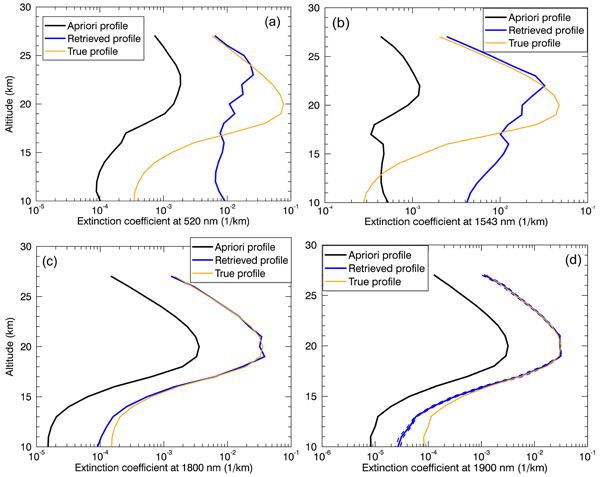
Abstract. Stratospheric aerosol injections have been proposed to mitigate the effects of global warming. The injection of sulphur dioxide into the stratosphere is one possible idea. However, depending on the latitude, high emission rates can lead to very low transmissions from the perspective of a typical satellite solar occultation instrument, leading to the so-called zero transmission problem. Consequently, it is highly unlikely that a physically meaningful retrieval of the stratospheric aerosol extinction profiles is possible, depending on the latitude and wavelength. The current study analyses, using MAECHAM5-HAM and SCIATRAN, continuous injections of 30 Tg S/y as a hypothetical large-scale stratospheric aerosol injection scenario. For this purpose, sulphur dioxide was continuously injected at an altitude of 60 hPa (about 19 km) into one grid box (2.8°x 2.8°) centred on the Equator at 121°E. Specifically, it is investigated which wavelengths, depending on the latitude, are necessary for plausible aerosol extinction profile retrievals. While a wavelength of 520 nm is insufficient for the retrieval for 5°N, the opposite can be concluded for 75°N and 75°S. For the latitudes 45°N and 45°S, a wavelength of at least 1543 nm is necessary. In contrast, 1900 nm is sufficient for 15°N and 15°S, as well as 5°N. Simulation results for an emission rate of 10 Tg S/y show that a minimum wavelength of 1543 nm is already sufficient for 5°N. The results emphasize that the zero transmission problem does not mean that solar occultation measurements are entirely useless. Consistent with expectations, a longer wavelength is required for the latitude range of and near the injection. These findings are therefore also relevant for satellite solar occultation measurements after major volcanic eruptions.
Competing interests: Christian von Savigny is an editor of Atmospheric Measurement Techniques.
Publisher's note: Copernicus Publications remains neutral with regard to jurisdictional claims made in the text, published maps, institutional affiliations, or any other geographical representation in this paper. While Copernicus Publications makes every effort to include appropriate place names, the final responsibility lies with the authors. Views expressed in the text are those of the authors and do not necessarily reflect the views of the publisher.-
Notice on discussion status
The requested preprint has a corresponding peer-reviewed final revised paper. You are encouraged to refer to the final revised version.
-
Preprint
(4958 KB)
-
The requested preprint has a corresponding peer-reviewed final revised paper. You are encouraged to refer to the final revised version.
- Preprint
(4958 KB) - Metadata XML
- BibTeX
- EndNote
- Final revised paper


Journal article(s) based on this preprint
Interactive discussion
Status: closed
-
RC1: 'Comment on egusphere-2025-5446', Anonymous Referee #1, 23 Jan 2026
The comment was uploaded in the form of a supplement: https://egusphere.copernicus.org/preprints/2026/egusphere-2025-5446/egusphere-2025-5446-RC1-supplement.pdfCitation: https://doi.org/
10.5194/egusphere-2025-5446-RC1 -
AC2: 'Reply on RC1', Anna Lange, 05 Mar 2026
The comment was uploaded in the form of a supplement: https://egusphere.copernicus.org/preprints/2026/egusphere-2025-5446/egusphere-2025-5446-AC2-supplement.pdf
-
AC2: 'Reply on RC1', Anna Lange, 05 Mar 2026
-
RC2: 'Comment on egusphere-2025-5446', Anonymous Referee #3, 09 Feb 2026
The comment was uploaded in the form of a supplement: https://egusphere.copernicus.org/preprints/2026/egusphere-2025-5446/egusphere-2025-5446-RC2-supplement.pdf
-
AC1: 'Reply on RC2', Anna Lange, 05 Mar 2026
The comment was uploaded in the form of a supplement: https://egusphere.copernicus.org/preprints/2026/egusphere-2025-5446/egusphere-2025-5446-AC1-supplement.pdf
-
AC1: 'Reply on RC2', Anna Lange, 05 Mar 2026
-
CC1: 'Comment on egusphere-2025-5446', Robert Damadeo, 12 Feb 2026
This study is an interesting one, but ultimately its messaging and perhaps methodologies might be misguided.
I agree with Referee #2, that, if the authors find an extreme case to be too limiting, that perhaps a range of injection mass rates should be explored.
One of the issues I have here, is that the "solar occultation" retrieval algorithm is a nonlinear inversion technique that requires an a priori under an extreme case and subsequently demonstrates the lack of efficacy of the technique under these circumstances. However, a proper solar occultation retrieval is a well-posed linear problem that does not require an a priori, so it's possible the solution would be better behaved.
Additionally, I would like to point out that the "zero transmission" problem very much depends upon the instrument's capabilities. While it is true that SAGE II could not see through the injected aerosol layer from Mt Pinatubo, ultimately what dictates this is the instrument's signal-to-noise ratio in its measurements and its maximum dynamic range. It is entirely possible, using currently available technology, to achieve meaningful measurements through much higher maximum line-of-sight optical depths than what SAGE II was capable of.
I think the high-level message is clear and unquestionable: Namely that an instrument can make measurements when the signal is not saturated. Since aerosol extinction is naturally lower at longer wavelengths, it is easier to measure under extreme loading conditions than at lower wavelengths. Of course, it is harder to measure under background or slightly elevated conditions. Generally speaking, there is value in aerosol measurements across the visible and IR spectra. I also believe it is worthwhile to discuss the potential limitations of different observation techniques under different atmospheric scenarios. However, ultimately the capability to make measurements depends upon the unique configuration and capability of the individual instrument. One can certainly perform such a study for an already existing instrument with known performance parameters, but one cannot make a blanket statement about a technique in general without testing the range of what is currently and technologically possible.
Citation: https://doi.org/10.5194/egusphere-2025-5446-CC1 -
AC3: 'Reply on CC1', Anna Lange, 05 Mar 2026
The comment was uploaded in the form of a supplement: https://egusphere.copernicus.org/preprints/2026/egusphere-2025-5446/egusphere-2025-5446-AC3-supplement.pdf
-
AC3: 'Reply on CC1', Anna Lange, 05 Mar 2026


Interactive discussion
Status: closed
-
RC1: 'Comment on egusphere-2025-5446', Anonymous Referee #1, 23 Jan 2026
The comment was uploaded in the form of a supplement: https://egusphere.copernicus.org/preprints/2026/egusphere-2025-5446/egusphere-2025-5446-RC1-supplement.pdf
-
AC2: 'Reply on RC1', Anna Lange, 05 Mar 2026
The comment was uploaded in the form of a supplement: https://egusphere.copernicus.org/preprints/2026/egusphere-2025-5446/egusphere-2025-5446-AC2-supplement.pdf
-
AC2: 'Reply on RC1', Anna Lange, 05 Mar 2026
-
RC2: 'Comment on egusphere-2025-5446', Anonymous Referee #3, 09 Feb 2026
The comment was uploaded in the form of a supplement: https://egusphere.copernicus.org/preprints/2026/egusphere-2025-5446/egusphere-2025-5446-RC2-supplement.pdf
-
AC1: 'Reply on RC2', Anna Lange, 05 Mar 2026
The comment was uploaded in the form of a supplement: https://egusphere.copernicus.org/preprints/2026/egusphere-2025-5446/egusphere-2025-5446-AC1-supplement.pdf
-
AC1: 'Reply on RC2', Anna Lange, 05 Mar 2026
-
CC1: 'Comment on egusphere-2025-5446', Robert Damadeo, 12 Feb 2026
This study is an interesting one, but ultimately its messaging and perhaps methodologies might be misguided.
I agree with Referee #2, that, if the authors find an extreme case to be too limiting, that perhaps a range of injection mass rates should be explored.
One of the issues I have here, is that the "solar occultation" retrieval algorithm is a nonlinear inversion technique that requires an a priori under an extreme case and subsequently demonstrates the lack of efficacy of the technique under these circumstances. However, a proper solar occultation retrieval is a well-posed linear problem that does not require an a priori, so it's possible the solution would be better behaved.
Additionally, I would like to point out that the "zero transmission" problem very much depends upon the instrument's capabilities. While it is true that SAGE II could not see through the injected aerosol layer from Mt Pinatubo, ultimately what dictates this is the instrument's signal-to-noise ratio in its measurements and its maximum dynamic range. It is entirely possible, using currently available technology, to achieve meaningful measurements through much higher maximum line-of-sight optical depths than what SAGE II was capable of.
I think the high-level message is clear and unquestionable: Namely that an instrument can make measurements when the signal is not saturated. Since aerosol extinction is naturally lower at longer wavelengths, it is easier to measure under extreme loading conditions than at lower wavelengths. Of course, it is harder to measure under background or slightly elevated conditions. Generally speaking, there is value in aerosol measurements across the visible and IR spectra. I also believe it is worthwhile to discuss the potential limitations of different observation techniques under different atmospheric scenarios. However, ultimately the capability to make measurements depends upon the unique configuration and capability of the individual instrument. One can certainly perform such a study for an already existing instrument with known performance parameters, but one cannot make a blanket statement about a technique in general without testing the range of what is currently and technologically possible.
Citation: https://doi.org/10.5194/egusphere-2025-5446-CC1 -
AC3: 'Reply on CC1', Anna Lange, 05 Mar 2026
The comment was uploaded in the form of a supplement: https://egusphere.copernicus.org/preprints/2026/egusphere-2025-5446/egusphere-2025-5446-AC3-supplement.pdf
-
AC3: 'Reply on CC1', Anna Lange, 05 Mar 2026
Peer review completion
Journal article(s) based on this preprint
Viewed
| HTML | XML | Total | BibTeX | EndNote | |
|---|---|---|---|---|---|
| 418 | 147 | 43 | 608 | 24 | 21 |
- HTML: 418
- PDF: 147
- XML: 43
- Total: 608
- BibTeX: 24
- EndNote: 21
Viewed (geographical distribution)
| Country | # | Views | % |
|---|
| Total: | 0 |
| HTML: | 0 |
| PDF: | 0 |
| XML: | 0 |
- 1
Ulrike Niemeier
Alexei Rozanov
Christian von Savigny
The requested preprint has a corresponding peer-reviewed final revised paper. You are encouraged to refer to the final revised version.
- Preprint
(4958 KB) - Metadata XML