
the Creative Commons Attribution 4.0 License.
the Creative Commons Attribution 4.0 License.
 | 30 Jan 2026
Gas Migration and Slope Instability in the Danube Fan: Insights from integrated OBS-MCS Seismic Analysis
Abstract. Gas hydrates and deltaic deep-sea fans are main features in continental margin systems, influencing slope stability, fluid migration, and carbon cycling. In the northwestern Black Sea, the Danube Fan remains poorly constrained with respect to subsurface structure, sediment strength, and hydrate dynamics. Here, we present high-resolution multichannel seismic (MCS) and ocean-bottom seismometer (OBS) data to characterise sedimentary structure and fluid-related features. Two integrated OBS–MCS profiles reveal underconsolidated, clay-rich levee deposits interspersed with mass-transport units, chaotic facies, and gas-related anomalies. Derived P- and S-wave velocity models indicate low shear strength and high Vp/Vs-ratios in shallow units, consistent with soft, water-saturated sediments. Deeper layers display compaction-driven velocity increases but remain mechanically weak, rendering the slope prone to failure. Our findings suggest that vertical gas migration is widespread, expressed by seismic chimneys, polarity reversals, and velocity pull-downs, with free gas confined below bottom simulating reflectors and in stratigraphic traps. Hydrates likely occur as sparse, patchy pore-filling accumulations, and the lack of S-wave velocity anomalies suggests they do not act as cementing phases, implying little direct influence on sediment strength or slope stability. The hydrate system appears hydrate-poor, possibly reflecting post-glacial re-equilibration. Overall, lithology, gas migration pathways, and high sedimentation rates emerge as primary controls on hydrate formation and slope instability in the Danube Fan.
-
Notice on discussion status
The requested preprint has a corresponding peer-reviewed final revised paper. You are encouraged to refer to the final revised version.
-
Preprint
(2765 KB)
-
Supplement
(946 KB)
-
The requested preprint has a corresponding peer-reviewed final revised paper. You are encouraged to refer to the final revised version.
- Preprint
(2765 KB) - Metadata XML
-
Supplement
(946 KB) - BibTeX
- EndNote
- Final revised paper


Journal article(s) based on this preprint
Interactive discussion
Status: closed
-
RC1: 'Comment on egusphere-2025-5275', Leon Thomsen, 09 Feb 2026
-
AC1: 'Reply on RC1', Helene-Sophie Hilbert, 12 May 2026
We thank Reviewer Dr. Leon Thomsen for the careful reading, constructive comments, and his continued engagement with the manuscript, which has significantly helped to improve the clarity and robustness of the study. Below we address each point to improve and clarify the addressed points of the discussion. Thereby, we note that one remaining aspect of the OBS processing and interpretation workflow is currently being further refined and will be discussed with the following reply soon and included in the revised manuscript.
Line 97 – GHSZ We have defined the acronym “GHSZ” as “gas hydrate stability zone” at its first occurrence.
Line 101 – gas flares We clarified the terminology: “gas flares” refer to gas emissions observed in the water column during MSM-34, rather than open flames. A brief description has been added to avoid ambiguity inside the manuscript.
Line 109 – MB-systems
Line 143 – IHS Kingdom
Data Availability Section - References to commercial software (MB-System) have been removed as suggested within the main text body. The text now refers to generic processing software without commercial attribution. But we kept the original software names within the data availability statement to ensure reproducibility of the processing steps.Figure 3b/d – plane-wave reflection at normal incidence
We thank the reviewer’s observation and included a short paragraph about this observation in Section 3.1. In simple-plane wave theory, the wave reflection coefficient approaches zero at normal incidence (Stein & Wysession, 2003; Yilmaz. 2001). We have clarified that our data do not represent true plane-wave normal-incidence conditions: the OBS receivers are positioned at water depths of ~600-800 m, placing them in the transition zone between near- and far-field of the seismic source. In this zone, the wavefield is strongly non-planar, and near-field contributions dominate the horizontal particle motion.
As the seismic source, towed by the research vessel, passes the instrument, the recorded wavefield is affected by near-field terms, finite source effects, and local instrument coupling (such as instrument tilt), which together generate significant horizontal motion even at nominal zero offsets (e.g., Essing et al., 2021; Duennebier & Sutton, 1995). Additional contributions may arise from local sediment heterogeneity, imperfect seafloor coupling, and instrument design.
This has been documented in previous OBS studies (e.g., Bünz et al., 2005; Exley et al., 2010; Wang et al., 2018) and reflects the complexity of the geological setting. We now include a short discussion in the manuscript that explains why the amplitude does not smoothly trend to zero during the source transit, and why horizontally polarised arrivals appear prominently at these offsets.
Additionally, several well-documented effects at the seafloor contribute to the observed non-zero horizontal motion at nominal normal incidence. Free-surface interference, impedance-contrast amplification within soft sediments, ray-angle projection effects, and shallow converted phases have all been shown to enhance horizontal particle motion at OBS sites (e.g., Shearer & Orcutt, 1987). These processes reinforce the dominant contribution from near-field and finite-source effects and therefore further explain why the horizontal components do not vanish at the source transit.
Figure 4 – BSR “BSR” has been defined as “Bottom Simulating Reflector” at first occurrence.
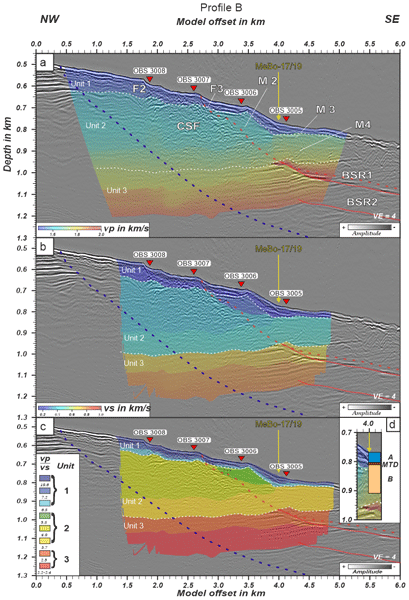
We have updated the figure caption and added reference to Fig.6, where the P-wave velocity decrease is visualised the first time. The BSR is observed as a distinct reflection with reversed polarity relative to the seafloor reflection, consistent with a P-wave velocity decrease below the reflector due to potential free-gas accumulations (Fig. 6). No significant change is observed in S-wave velocities, indicating that the shear modulus of the sediments is largely unaffected. Free gas reduces the acoustic impedance relative to the overlying sediments, producing the polarity reversal, while leaving the shear properties largely unchanged (see Section 5.2 for further discussion; lines 367-370: ‘BSRs with reversed polarity are present in profile B…’ and lines 396-402: ‘Although slightly elevated P-wave velocities were observed...’).
Figure 5 – MTD / BSR accuracy We thank the reviewer for this comment. We have updated the figure caption to define MTD as “mass-transport deposit” and clarified the BSR interpretation. Specifically, the BSR in this section marks the upper limit (outcropping) of the gas hydrate stability zone (GHSZ). At this shallow depth, conditions are no longer fully stable, so the BSR does not precisely follow the seafloor as it controlled by the physical parameters pressure and temperature (Sloan & Koh, 2008).
Figure 6 – blue dashes / constant velocity The blue dashed lines represent the theoretical GHSZ base under each OBS (Badhani, 2016), which varies slightly along the profiles due to local pressure and temperature conditions. The observed depth differences in Profile B are caused mainly by the different depths of the OBS stations 3005 and 3006, which affects the GHSZ depths (e.g., Zander et al., 2017, 2018). The observed BSR at OBS 3005 indicates where gas hydrates are sufficiently abundant to produce a clear reversed reflection within the seismic data. Differences in depth of the theoretical GHSZ are therefore expected and consistent with physical controls on hydrate stability. These effects are stronger than within a stable gas hydrate regime since the conditions close to the upper limit of the GHSZ become unstable. We added a sentence to the caption for better understanding of this physical connection.
Line 230 – active gas flares near faults F2/F3 We thank the reviewer for raising this point. “Active gas flares” refer to gas bubble emissions observed in the water column during the MSM-34 expedition. These were detected using acoustic backscatter (echo-sounder), as reported by Bialas et al. (2014) and Hillman et al. (2018). We have updated the manuscript to clarify this, providing the observational context and references to support the statement.
Figure 7 – BSRs do not simulate the bottom The term BSR (bottom-simulating reflector) has been clarified in the figure caption. We note that the observed BSRs in profile B do not perfectly mimic the seafloor topography, particularly where they intersect sloping or disturbed units (Fig. 7). This behaviour is expected at the upper limit of the gas hydrate stability zone (GHSZ), where free gas accumulations occur beneath low-permeability sediments. In this depth range, small variations in temperature and pressure directly control whether gas hydrates are stable. Where conditions reach the limit of hydrate stability, the BSR no longer mimics the seafloor and can ‘outcrop’ within the sediment column. The pressure and temperature conditions within the upper hundred meters of the seafloor are strongly affected by local variations and gas hydrate stability is directly responding to it by gas hydrate dissolution at unstable conditions (e.g., Zander et al., 2017, 2018) and is consistent with the crossing of BSRs across stratigraphic units observed in our profile. The red dashed lines in Figure 7 represent the theoretical extent of the GHSZ and shall support the reader to understand this effect. For a better understanding we added a short explanation to the captions.
Line 361 / line 381 – gas concentration and overpressure We thank the reviewer for pointing out the imprecise wording in this section. We agree that “gas concentration” is not the correct physical parameter to describe the driving mechanism of vertical migration. We have revised the text to clarify that the formation of vertical fluid pathways is controlled by the accumulation of gas beneath low-permeability layers, which generates local overpressure capable of exceeding hydrostatic and capillary entry pressures, enabling episodic upward migration. The limited lateral extent of these accumulations indicates that overpressure is locally confined, restricting gas migration to discrete pathways rather than widespread flow.
Line 510 – add to “In contrast” Text has been revised to include the suggested continuation, improving the comparison between hydrate-rich and hydrate-poor systems.
As mentioned, we will address the point of vector fidelity within the following reply.
References:
Badhani, S.: Slope failure and gas hydrate dissociation in the Danube deep-sea fan, NW Black Sea, Master’s Thesis, Christian-Albrechts-Universität zu Kiel, GEOMAR Helmholtz-Centre For Ocean Research Kiel, 88 pp., 2016.
Bialas, J., Klaucke, I., and Haeckel, M.: FS MARIA S. MERIAN Fahrtbericht / Cruise Report MSM34/1 & 2 - SUGAR Site ; Varna – Varna, 06.12.13 – 16.01.14, GEOMAR Helmholtz-Zentrum für Ozeanforschung Kiel, 2014.
Bünz, S., Mienert, J., Vanneste, M., and Andreassen, K.: Gas hydrates at the Storegga Slide: Constraints from an analysis of multicomponent, wide-angle seismic data, GEOPHYSICS, 70, B19–B34, https://doi.org/10.1190/1.2073887, 2005.
Duennebier, F. K. and Sutton, G. H.: Fidelity of ocean bottom seismic observations, Mar Geophys Res, 17, 535–555, https://doi.org/10.1007/BF01204343, 1995.
Essing, D., Schlindwein, V., Schmidt-Aursch, M. C., Hadziioannou, C., and Stähler, S. C.: Characteristics of Current-Induced Harmonic Tremor Signals in Ocean-Bottom Seismometer Records, Seismological Research Letters, 92, 3100–3112, https://doi.org/10.1785/0220200397, 2021.
Exley, R. J. K., Westbrook, G. K., Haacke, R. R., and Peacock, S.: Detection of seismic anisotropy using ocean bottom seismometers: a case study from the northern headwall of the Storegga Slide: Detecting seismic anisotropy using OBS, Geophysical Journal International, 183, 188–210, https://doi.org/10.1111/j.1365-246X.2010.04730.x, 2010.
Hillman, J. I. T., Klaucke, I., Bialas, J., Feldman, H., Drexler, T., Awwiller, D., Atgin, O., Çifçi, G., and Badhani, S.: Gas migration pathways and slope failures in the Danube Fan, Black Sea, Marine and Petroleum Geology, 92, 1069–1084, https://doi.org/10.1016/j.marpetgeo.2018.03.025, 2018.
Shearer, P. M. and Orcutt, J. A.: Surface and near-surface effects on seismic waves—theory and borehole seismometer results, Bulletin of the Seismological Society of America, 77, 1168–1196, https://doi.org/10.1785/BSSA0770041168, 1987.
Sloan, E. D. and Koh, C. A.: Clathrate hydrates of natural gases., CRC Press, Boca Raton, FL, 2008.
Stein, S. and Wysession, M.: An introduction to seismology, earthquakes, and earth structure, Blackwell Pub, Malden, MA, 498 pp., 2003.
Wang, X., Piao, S., Lei, Y., and Li, N.: In Design of an Ocean Bottom Seismometer Sensor: Minimize Vibration Experienced by Underwater Low-Frequency Noise, Sensors, 18, 3446, https://doi.org/10.3390/s18103446, 2018.
Yilmaz, Ö.: Seismic Data Analysis: Processing, Inversion, and Interpretation of Seismic Data, Society of Exploration Geophysicists, https://doi.org/10.1190/1.9781560801580, 2001.
Zander, T., Haeckel, M., Berndt, C., Chi, W.-C., Klaucke, I., Bialas, J., Klaeschen, D., Koch, S., and Atgın, O.: On the origin of multiple BSRs in the Danube deep-sea fan, Black Sea, Earth and Planetary Science Letters, 462, 15–25, https://doi.org/10.1016/j.epsl.2017.01.006, 2017.
Zander, T., Choi, J. C., Vanneste, M., Berndt, C., Dannowski, A., Carlton, B., and Bialas, J.: Potential impacts of gas hydrate exploitation on slope stability in the Danube deep-sea fan, Black Sea, Marine and Petroleum Geology, 92, 1056–1068, https://doi.org/10.1016/j.marpetgeo.2017.08.010, 2018.
Citation: https://doi.org/10.5194/egusphere-2025-5275-AC1 -
AC2: 'Reply on RC1 - Part 2', Helene-Sophie Hilbert, 08 Jun 2026
Answer regarding the vector fidelity and OBS rotation:
We thank Reviewer Dr. Leon Thomsen for this important and highly relevant comment regarding the assumption of vector fidelity in the rotation of horizontal components. As stated previously we address the discussion point of vector fidelity and OBS rotation.
The rotation of the recorded horizontal components into radial and transverse components is based on a two-step approach: (i) a geometry-driven estimation of the dominant source–receiver azimuth derived from the acquisition layout, and (ii) a data-driven refinement of the rotation angle through a systematic angular sweep maximizing horizontal component energy (i.e., variance concentration after rotation) (Jurkevics, 1988). This approach is therefore not a purely geometric transformation, but explicitly constrained by the recorded wavefield itself.
Regarding the concern of vector fidelity, we fully agree that component rotation implicitly assumes that the three recorded channels represent consistent projections of the same physical wavefield vector (Stein and Wysession, 2009; Yilmaz, 2001). In the present case, all three components originate from the same OBS recording system and are processed with identical instrument response corrections and filtering steps prior to rotation (Bialas et al., 2014). While this does not eliminate the inherent limitations of real-world sensor response, it ensures that no component is preferentially treated in the rotation procedure (Havskov and Alguacil, 2016; Havskov and Ottemoller, 2010). We have clarified this assumption in the revised supplement and explicitly state that the validity of the rotation relies on consistent instrument response across components rather than ideal vector-perfect recording conditions. The placement in the supplement allowed a more detailed description of this critical aspect and is linked inside the manuscript.
Concerning the basis of the rotation, the angle determination is not performed on an arbitrary time interval but is constrained to the direct water-wave arrival. This phase is selected because it represents the earliest, highest signal-to-noise arrival with the most stable and linear particle motion, making it the most appropriate phase for estimating the dominant propagation direction. This choice has been clarified in the revised text to avoid ambiguity.
We have revised the manuscript accordingly to (1) explicitly state the assumptions underlying vector rotation in OBS data, and (2) clarify that the rotation angle is derived from the direct arrival window rather than the full waveform. We believe that this will allow the reader to better understand the critical steps of OBS component rotation.
References
Bialas, J., Klaucke, I., and Haeckel, M.: FS MARIA S. MERIAN Fahrtbericht / Cruise Report MSM34/1 & 2 - SUGAR Site ; Varna – Varna, 06.12.13 – 16.01.14, GEOMAR Helmholtz-Zentrum für Ozeanforschung Kiel, 2014.
Havskov, J. and Alguacil, G.: Instrumentation in Earthquake Seismology, 2nd ed., Springer International Publishing, Cham, https://doi.org/10.1007/978-3-319-21314-9, 2016.
Havskov, J. and Ottemoller, L.: Routine Data Processing in Earthquake Seismology, Springer Netherlands, Dordrecht, 347 pp., 2010.
Jurkevics, A.: Polarization analysis of three-component array data, 78, 1725–1743, https://doi.org/10.1785/BSSA0780051725, 1988.
Stein, S. and Wysession, M.: An introduction to seismology, earthquakes, and earth structure, 9. [pr.]., Blackwell, Malden, Mass. Berlin, 498 pp., 2009.
Yilmaz, Ö.: Seismic Data Analysis: Processing, Inversion, and Interpretation of Seismic Data, Society of Exploration Geophysicists, https://doi.org/10.1190/1.9781560801580, 2001.
Citation: https://doi.org/10.5194/egusphere-2025-5275-AC2
-
AC1: 'Reply on RC1', Helene-Sophie Hilbert, 12 May 2026
-
RC2: 'Comment on egusphere-2025-5275', Anonymous Referee #2, 28 Mar 2026
Review report
This manuscript presents an integrated analysis of high-resolution MCS and OBS data to investigate sedimentary architecture, gas migration, hydrate occurrence, and slope instability in the Danube Fan, northwestern Black Sea. The study is valuable because it combines P- and S-wave information with seismic stratigraphic interpretation and existing drilling constraints to address an important geohazard problem. The paper is also potentially significant in that it characterizes a hydrate-poor but gas-active endmember, which is less commonly documented than hydrate-rich continental margins. Overall, the dataset is interesting and the manuscript has clear potential for publication.
However, in its present form, several important aspects of the interpretation are not yet sufficiently demonstrated. In particular, the paper needs a clearer explanation of the S-wave phase identification procedure, stronger and more quantitative linkage between the seismic/velocity observations and the geological interpretations, a more explicit integration of the MeBo200 drilling results, and a more cautious justification of the “velocity pull-down / seismic chimney” interpretation given the resolution of the velocity models. I therefore recommend major revision.
Major comments
- The procedure for identifying converted S-wave phases needs to be explained much more clearly.
The manuscript correctly states that assigning converted S-wave phases to the same reflectors is “the most critical” step of the analysis, but the present description is too brief for the reader to understand how this was actually done and how robust the identification is. The authors should explain, in a more step-by-step manner, how the P-wave phases were transferred to the radial component, how conversion points were treated, how ambiguities were resolved, and what criteria were used to reject alternative phase assignments. Since much of the Vp/Vs interpretation depends on this step, this issue is central to the paper. - Several key interpreted features are difficult to see in the figures, and the figures need improvement.
The manuscript discusses features such as the seismic chimney, localized high amplitudes, polarity reversals, and related gas indicators, but in the current figures some of these features are not easy to identify visually. This weakens the persuasiveness of the interpretation. The authors should improve figure clarity, for example by enlarging key panels, adding zoom-ins and arrows. If the “SC” and related anomalies are central to the argument, the figures should allow the reader to recognize them much more easily. - The difference in model expression between Vp and Vs should be explained.
From the presented figures, the Vp models appear to increase relatively smoothly with depth, whereas the Vs models appear more discontinuous or layer-stepped. The manuscript should explain why the two models are represented differently. Is this caused by differences in data coverage, resolution, picking confidence, parameterization, or the modelling strategy for S-wave conversion phases? Without such an explanation, readers may wonder whether the apparent Vs discontinuities are geologically meaningful or simply artefacts of the inversion/model-building procedure. - The comparison with MeBo200 drilling results should be strengthened substantially.
The discussion repeatedly refers to previous MeBo200 drilling results, but the connection remains too general. Because the drilling information is an important ground truth for lithology, porosity, gas occurrence, and hydrate interpretation, the manuscript should specify more clearly where the drill sites are relative to the OBS/MCS lines, what depths were sampled, and which lithologic or physical-property observations are directly relevant to the interpreted units. It would greatly improve the paper if a simplified stratigraphic or lithologic column from MeBo200 were added to Fig. 7 or a discussion figure, especially near OBS 3005 where the comparison appears most relevant. - The discussion is currently too qualitative and should be made more quantitative.
At present, the discussion often moves quickly from observed seismic or velocity features to fairly broad geological interpretations. The paper would be much stronger if the authors more explicitly stated what aspect of the interpretation is directly constrained by the new results, what is only suggestive, and what is inferred mainly from analogy with previous work. For example, how strongly do the observed Vp/Vs values constrain sediment consolidation state, free-gas occurrence, hydrate distribution, or mechanical weakness? Can the authors provide thresholds, ranges, or quantitative comparisons with literature and drilling results? At present it is difficult to judge how much of the final interpretation is uniquely supported by the dataset. - The interpretation of a velocity pull-down / seismic chimney requires more careful justification.
The manuscript interprets a feature beneath profile A as a seismic chimney associated with a velocity pull-down, and the discussion further uses this feature as evidence for vertical gas migration. However, given the stated model limitations — only four OBS stations per line, limited offsets, no clear refracted phases across the array, and a modelling approach that is local beneath each instrument — it is not obvious that the velocity model has sufficient lateral resolution to resolve a true pull-down effect in a robust manner. The authors should clarify what evidence specifically supports this interpretation. Is the pull-down seen primarily in the MCS image, in the velocity model, or both? Could it instead reflect imaging artefacts, structural complexity, or local stratigraphic effects? The interpretation may still be reasonable, but it currently appears more certain than the underlying resolution would justify.
Minor comments
- The uncertainty discussion is useful, but it would help to distinguish more explicitly between uncertainty in travel-time fit, model parameter uncertainty, and interpretational uncertainty. Low RMS and χ² values do not automatically imply uniqueness of the geological interpretation.
- The manuscript should more clearly separate observations from interpretations in the Results section. In several places, features are already assigned specific geological meanings before the reader is shown the reasoning in the Discussion.
Citation: https://doi.org/10.5194/egusphere-2025-5275-RC2 -
AC3: 'Reply on RC2', Helene-Sophie Hilbert, 08 Jun 2026
We thank the anonymous Reviewer for the careful reading and constructive comments. Below we address each point to improve and clarify the addressed points of the discussion.
The procedure for identifying converted S-wave phases needs to be explained much more clearly.
We thank the reviewer for this important comment. We agree that the identification of converted S-wave phases is a critical step of the analysis and that the original manuscript did not sufficiently describe the procedure. We have therefore substantially expanded the methodology in the revised Supplement and clarified the workflow used for PS-wave identification and phase assignment.
The procedure was performed in a stepwise manner. First, P-wave reflection arrivals were identified on the hydrophone component using coincident multichannel seismic (MCS) data as structural guidance. Reflectors were selected based on their continuity in the MCS section, their visibility in the OBS records, and their geological significance within the sedimentary succession.
Subsequently, converted PS-wave arrivals were identified on the rotated radial component. The interpretation followed a layer-stripping approach, beginning with the shallowest reflector and proceeding successively to greater depths. Candidate PS arrivals were selected based on waveform continuity, relative amplitude characteristics, moveout behaviour, and consistency with the previously identified P-wave reflector geometry.
Because P- and PS-wave reflections originate from the same subsurface interface but possess different conversion points, exact spatial coincidence was not assumed. Instead, reflector association was evaluated through forward modelling, taking into account the expected kinematic behaviour of converted waves. During modelling, interface geometries and P-wave velocities derived from the P-wave model were kept fixed, whereas Poisson’s ratio and the corresponding S-wave velocities were adjusted to match the observed PS travel times.
To reduce ambiguity, several candidate arrivals were tested for each reflector. Alternative interpretations were rejected when they required unrealistic Vp/Vs ratios, produced inconsistent travel-time fits across offsets or stations, or resulted in geologically implausible velocity structures. As an additional consistency check, the resulting Vp/Vs ratios were compared with published values for comparable marine sedimentary environments (Hamilton, 1979b). This comparison was not used as a modelling constraint but served as an independent plausibility assessment.
The robustness of the interpretation was further evaluated by considering phase continuity across multiple OBS stations, consistency with reflector geometries observed in the MCS data, and the overall agreement between observed and calculated travel times. We now explicitly discuss these criteria and the associated uncertainties in the revised Supplement.
Several key interpreted features are difficult to see in the figures, and the figures need improvement.
We thank the reviewer for this helpful comment. For a better visualisation and interpretation for the readers, we have introduced dedicated enlarged views of the main seismic anomalies in figures 8 and 9. The enlarged panels are shown in figure 10, which highlights key interpreted features including the seismic chimney (SC), high-amplitude anomalies, polarity reversals, and mass-transport deposits. Figure 10 is directly linked to the corresponding sections in Figures 8 and 9, where boxed areas indicate the enlarged subsections. This improves the visibility and traceability of the interpreted features and strengthens the connection between seismic observations and geological interpretation, we grouped the panels into structural deformation features and fluid-related features.
The difference in model expression between Vp and Vs:
We thank the reviewer for this comment. The differences in model expression between Vp and Vs reflect the inherent differences in wave propagation geometry and data constraints associated with P- and S-wave reflections, rather than methodological inconsistencies.
The velocity models are derived using 2-D ray-based forward modelling constrained by P- and P-to-S converted phases. Due to the acquisition geometry and the strong attenuation in water-saturated fine-grained sediments of the Danube Fan, no refracted arrivals are observed in the dataset. Consequently, a tomographic approach based on first-arrival refraction is not feasible, and the limited depth penetration prevents using crossing-ray coverage to the necessary extent.
In this context, forward modelling requires the incorporation of a-priori structural information to define a physically meaningful starting model. In this study, the seismic stratigraphy derived from high-resolution MCS profiles, together with constraints from MeBo200 drilling results, provides the necessary structural framework for model construction. Further, previously published seismic velocities for similar Black Sea sediments were used to guide initial parametrisation, which was subsequently refined during iterative modelling. Without such constraints, the inverse problem would be non-unique and not physically bounded to the geologic setting.
P-wave reflections exhibit a broader effective aperture due to higher signal-to-noise ratios and a lager usable offset range (~1.2 km), which results in a more laterally continuous ray coverage and consequently smoother velocity variations. Further, the P-wave reflections can be directly correlated with the identified seismic layers within the MCS profiles, which further reduces picking uncertainty.
In contrast, S-wave phases are derived from P-to-S converted arrivals, which are only observable over a more limited offset range (~0.9 km). This leads to a narrower effective ray aperture and a more restricted distribution of ray paths. Moreover, conversion efficiency depends on local impedance contrasts, which further limits the number of usable S-wave arrivals.
In an iterative forward-modeling workflow, introducing additional degrees of freedom in the S-wave model would not be justified by the available data. Although the modelling software allows specifying independent top and bottom Vp/Vs-ratios per layer, the narrow aperture and limited offset range of the converted phases do not provide sufficient constraints to resolve such vertical gradients. Adding more parametrisation would therefore increase non-uniqueness and risk generating artefacts unrelated to the actual subsurface structure. To maintain interpretational transparency and ensure that the derived Vs structure remains directly linked to the observable travel-time behaviour, we intentionally used a single Vp/Vs value per layer. This choice inherently produces a more step-like Vs model, but avoids imposing poorly constrained variability that the data cannot support.
The observed differences therefore reflect the resolution limits and modelling strategy inherent to reflection-based forward modelling. The displayed Vp and Vs model cover identical spatial extents and are restricted to the area constrained by available ray coverage.
A corresponding paragraph clarifying the parametrisation strategy for the S-wave model has been added to Section 3.4 Forward Modelling.
The comparison with MeBo200 drilling results should be strengthened substantially.
We agree that the link between the MeBo200 drilling results (Bohrmann et al., 2018; Riedel et al., 2020, 2021) and the OBS/MCS interpretations requires more explicit spatial and stratigraphic context. In the revised manuscript, we will strengthen this comparison in three ways.
First, we will explicitly specify the spatial relationship between the MeBo200 boreholes and the seismic profiles. The MeBo-17/19 drilling sites are located in close proximity to OBS 3005 along profile B, with a lateral offset of approximately ~125 m northwest of the OBS position (projected distance), and ~250 m from the seismic profile trace. Given the high lateral continuity of the seismic stratigraphy at the scale of the resolution, this allows a direct lithological comparison within the constraints of seismic resolution.
Second, we will clarify the depth intervals sampled by MeBo200 and their correspondence to the seismic units defined in this study. Shallow borehole sections correspond to Unit 1 (hemipelagic clays and silty levee deposits), intermediate intervals correspond to Unit 2 (disturbed and partially reworked sediments associated with chaotic seismic facies and mass-transport deposits), and deeper sections correspond to Unit 3 (more compacted levee/channel-related deposits). We will explicitly include this stratigraphic correlation in the revised text to improve traceability between borehole observations and seismic interpretation.
Third, we will strengthen the presentation of the MeBo200 physical-property data by adding a simplified lithological and stratigraphic column to the relevant figure (Fig. 7).
Together, these revisions will provide a more explicit ground-truth linkage between borehole observations and geophysical interpretation, reducing ambiguity and strengthening the constraints on lithology, consolidation state, and fluid-related anomalies in the seismic models.
The discussion is currently too qualitative and should be made more quantitative.
We appreciate this comment, as it addresses a central limitation of the interpretation. We clarify the extent to which Vp/Vs ratios provide direct quantitative constraints versus supporting evidence for sediment consolidation state, fluid occurrence, hydrate distribution, and mechanical weakness.
Vp/Vs ratios in marine unconsolidated sediments primarily provide a robust first-order proxy for effective stress and compaction state, but they are not uniquely diagnostic for fluid phase identification. In the present dataset, the observed range from ~10.6 to ~2.2 spans the expected compaction trend for fine-grained marine sediments (Hamilton, 1979a, b), allowing a quantitative classification of consolidation state. Specifically, values >~6 are consistent with very weakly consolidated, water-rich sediments with high porosity and low effective stress, whereas values between ~5 and ~3 indicate intermediate compaction and partial dewatering, and values approaching ~2.5–3 are consistent with more compacted but still clay-dominated marine sediments. This comparison provides a direct, literature-constrained constraint on mechanical state, supported independently by MeBo200 porosity and shear strength data (Riedel et al., 2020).
In contrast, Vp/Vs ratios alone do not uniquely resolve free gas or hydrate occurrence. Gas effects are inferred only indirectly through localised deviations from the compaction trend. In the dataset, P-wave velocity reductions of up to ~5–15% (~80–190 m/s) occur in spatially restricted zones associated with seismic disturbance and amplitude anomalies. These magnitudes are consistent with low gas saturations in unconsolidated marine sediments reported in experimental and field studies (e.g., Lee, 2008; Sava and Hardage, 2009). However, because corresponding S-wave velocities do not show systematic reductions, these anomalies cannot be uniquely attributed to gas-charged layers alone and may also reflect local structural heterogeneity or scattering effects.
For gas hydrates, the constraint is primarily negative rather than positive. The absence of systematic Vp/Vs or Vs increases provides an upper bound on hydrate saturation. Laboratory and field studies indicate that elastic stiffening effects in unconsolidated sediments become detectable only above ~10–15% pore saturation for pore-filling or grain-contacting hydrate morphologies (Collett et al., 2009; Lee and Collett, 2001; Yun et al., 2005). Because no such coherent shear-wave velocity increase or consistent Vp/Vs reduction is observed across the hydrate stability zone, hydrate presence, if any, is constrained to below this threshold and is likely patchy and non-cementing. Independent observations from MeBo200 boreholes and nearby regional studies (Bohrmann et al., 2018; Ker and Riboulot, 2015) indicate that gas hydrates in this sector of the margin occur spatially heterogeneous and are commonly disseminated or void-filling with non-cementing morphologies. Because these sites are located outside the direct OBS transects, they are used here only as a regional analogue to constrain plausible hydrate habit, not as direct ground truth for the study area.
Accordingly, the dataset provides strong quantitative constraints on sediment consolidation state (directly from Vp/Vs trends relative to reference compaction curves), moderate but non-unique constraints on gas occurrence (through localised Vp perturbations), and only upper-bound constraints on hydrate distribution (from absence of expected elastic signatures). Mechanical weakness is therefore not inferred from a single proxy but from the integrated convergence of (i) low consolidation state from Vp/Vs, (ii) lithological evidence from drilling, and (iii) structural and seismic indicators of disturbed and reworked sediments.
The interpretation of a velocity pull-down / seismic chimney requires more careful justification.
This comment highlights an important point regarding the distinction between seismic observations, velocity model results, and geological interpretation, particularly for the seismic chimney and associated velocity pull-down. The manuscript have been revised to improve this separation. In the Results section, the feature is now described strictly in terms of observed seismic characteristics (reflection disruption, amplitude anomalies) and model-derived velocity variations, without assigning a genetic interpretation. The term “seismic chimney” is now used more cautiously in the Results and is not presented as an interpreted structure at that stage. Instead, it is introduced in the Discussion where its interpretation is evaluated together with model resolution, ray coverage, and alternative explanations.
The Discussion now explicitly addresses the limitations of the dataset in resolving localised pull-down effects. It is clarified that the observed anomaly is constrained by limited offset range and spatial sampling, and that equivalent expressions could arise from stratigraphic heterogeneity, structural complexity, or imaging effects. The interpretation of focused fluid migration is therefore presented as the most consistent explanation with the available dataset. Further, a linkage with similar observations from the Danube Fan region and other Black Sea areas is included (Hillman et al., 2018; Nasif et al., 2020; Özel et al., 2022; Riedel et al., 2021).
Minor Comments – Uncertainty Discussion:
We thank the reviewer for highlighting this point. We agree that low RMS and χ²-values quantify traveltime fit, but do not constrain model uniqueness. In the revised manuscript, the uncertainty section (4.5) has been restructured to explicitly differentiate between (i) uncertainty in traveltime fitting, (ii) model parameter uncertainty arising from ray coverage, node spacing, and velocity-depth trade-offs, and (iii) interpretational uncertainty related to the geological assignment of velocity contrasts.
The revised text clarifies that model non-uniqueness remains inherent to reflection-based forward modelling and that the geological interpretation is constrained, but not uniquely determined, by the available seismic, stratigraphic, and drilling information (Dannowski et al., 2016; Popescu et al., 2006; Riedel et al., 2020; Winguth, 1998; Zander et al., 2017). We hope this more explicit distinction improves the transparency and addresses the reviewer’s concern.
Minor Comments – Separation observations and interpretations:
We are grateful for this constructive comment. We agree that the distinction between observations and interpretations is essential in the Results section, particularly in a study combining seismic observations with velocity modelling.
In the revised manuscript, we have carefully restructured the Results section to ensure a clearer separation between observed data and interpretative statements. Specifically, we have removed or reformulated interpretative language (e.g., causal or process-related interpretations of seismic features and velocity variations) and restricted the Results section to descriptive and data-based statements.
Interpretations regarding geological implications of seismic facies, velocity structures, and anomalies (e.g., gas migration, lithological controls, and slope instability processes) have been moved or more clearly confined to the Discussion section.
We believe this revision improves the clarity of the manuscript and ensures a more transparent separation between data presentation and geological interpretation.
References:
Bohrmann, G., Ahrlich, F., Bachmann, K., Bergenthal, M., Beims, M., Betzler, C., Brünjes, J., Deusner, C., Domeyer, B., Düßmann, R., Ewert, J., Gaide, S., Frank, C., Freudenthal, T., Fröhlich, S., Greindl, T., Haeckel, M., Heitmann-Bacza, C., Ion, G., Kaszemeik, K., Keil, H., Kinski, O., Klein, T., Kossel, E., Linowski, E., Malnati, J., Mau, S., Meyer, B., Pape, T., Popa, A., Renken, J., Reuter, J., Reuter, M., Riedel, M., Riemer, P., Rohleder, C., Rosiak, U., Rotaru, S.-G., Rothenwänder, T., Stachowski, A., Schmidt, W., Seiter, C., Utecht, C., Vasilev, A., Wallmann, K., Wegwert, A., Wintersteller, P., and Wunsch, D.: R/V METEOR cruise report M142, drilling gas hydrates in the Danube deep-sea fan, Black Sea, Varna-Varna, 04 November - 22 November - 09 December 2017., Fachbereich Geowissenschaften, Universität Bremen, 2018.
Collett, T., Johnson, A., Knapp, C., and Boswell, R.: Natural Gas Hydrates—Energy Resource Potential and Associated Geologic Hazards, American Association of Petroleum Geologists, 2009.
Dannowski, A., Bialas, J., Zander, T., Klaeschen, D., and Koch, S.: High resolution shear wave modelling of OBS data in a gas hydrate environment in the Danube deep-sea fan, Black Sea. [Poster], CIESM Congress, 2016.
Hamilton, E. L.: Sound velocity gradients in marine sediments, J. Acoust. Soc. Am., 65, 909–922, https://doi.org/10.1121/1.382594, 1979a.
Hamilton, E. L.: Vp/Vs and Poisson’s ratios in marine sediments and rocks, J. Acoust. Soc. Am., 66, 1093–1101, https://doi.org/10.1121/1.383344, 1979b.
Hillman, J. I. T., Klaucke, I., Bialas, J., Feldman, H., Drexler, T., Awwiller, D., Atgin, O., Çifçi, G., and Badhani, S.: Gas migration pathways and slope failures in the Danube Fan, Black Sea, Mar. Pet. Geol., 92, 1069–1084, https://doi.org/10.1016/j.marpetgeo.2018.03.025, 2018.
Ker, S. and Riboulot, V.: GHASS cruise report, Ifremer, 2015.
Lee, M. W.: Models for gas hydrate-bearing sediments inferred from hydraulic permeability and elastic velocities, 1st ed., U.S. Geological Survey, 2008.
Lee, M. W. and Collett, T. S.: Elastic properties of gas hydrate‐bearing sediments, GEOPHYSICS, 66, 763–771, https://doi.org/10.1190/1.1444966, 2001.
Nasif, A., Özel, F. E., and Dondurer, D.: Seismic identification of gas hydrates: A case study from Sakarya Canyon, western Black Sea, Turk. J. EARTH Sci., 29, https://doi.org/10.3906/yer-1909-2, 2020.
Özel, Ö., Dondurur, D., and Klaucke, I.: Seismic and geoacoustic evidence for subsurface fluid flow and seepage offshore Akçakoca, Southwestern Black Sea, Turkey, Geo-Mar. Lett., 42, 17, https://doi.org/10.1007/s00367-022-00740-z, 2022.
Popescu, I., De Batist, M., Lericolais, G., Nouzé, H., Poort, J., Panin, N., Versteeg, W., and Gillet, H.: Multiple bottom-simulating reflections in the Black Sea: Potential proxies of past climate conditions, Mar. Geol., 227, 163–176, https://doi.org/10.1016/j.margeo.2005.12.006, 2006.
Riedel, M., Freudenthal, T., Bergenthal, M., Haeckel, M., Wallmann, K., Spangenberg, E., Bialas, J., and Bohrmann, G.: Physical properties and core-log seismic integration from drilling at the Danube deep-sea fan, Black Sea, Mar. Pet. Geol., 114, 104192, https://doi.org/10.1016/j.marpetgeo.2019.104192, 2020.
Riedel, M., Hähnel, L., Bialas, J., Bachmann, A. K., Gaide, S., Wintersteller, P., Klaucke, I., and Bohrmann, G.: Controls on Gas Emission Distribution on the Continental Slope of the Western Black Sea, Front. Earth Sci., 8, 601254, https://doi.org/10.3389/feart.2020.601254, 2021.
Sava, D. and Hardage, B.: Rock-physics Model for Gas-hydrate Systems Associated with Unconsolidated Marine Sediments, in: Natural Gas Hydrates - Energy Resource Potential and Associated Geologic Hazards, vol. 89, edited by: Collett, T., Johnson, A., Knapp, C., and Boswell, R., American Association of Petroleum Geologists, Tulsa, Oklahoma, 505–524, 2009.
Winguth, C.: Pleistozäne Meeresspiegelschwankungen und Sedimentation im nordwestlichen Schwarzen Meer, Dissertation, Institut für Biogeochemie und Meereschemie, Hamburg, 128 pp., 1998.
Yun, T. S., Francisca, F. M., Santamarina, J. C., and Ruppel, C.: Compressional and shear wave velocities in uncemented sediment containing gas hydrate, Geophys. Res. Lett., 32, L10609-(1-5), https://doi.org/10.1029/2005GL022607, 2005.
Zander, T., Haeckel, M., Berndt, C., Chi, W.-C., Klaucke, I., Bialas, J., Klaeschen, D., Koch, S., and Atgın, O.: On the origin of multiple BSRs in the Danube deep-sea fan, Black Sea, Earth Planet. Sci. Lett., 462, 15–25, https://doi.org/10.1016/j.epsl.2017.01.006, 2017.
Citation: https://doi.org/10.5194/egusphere-2025-5275-AC3
- The procedure for identifying converted S-wave phases needs to be explained much more clearly.
Peer review completion


Interactive discussion
Status: closed
-
RC1: 'Comment on egusphere-2025-5275', Leon Thomsen, 09 Feb 2026
This is a useful study, and should be published, subject addressing of the following technica l issues:
*Line 121. The vector rotation implied here seems to be innocuous, a simple mathematical operation. But it assumes that the rotated data is a vector. While the incoming wave is certainly a vector, the data as recorded may not be, since the various recorded components may have different instrumental responses. This is called the issue of vector infidelity. Each recorded component is certainly unfaithful (an input impulse does result in a recorded impulse), but this does not lead to vector infidelity, if each component is unfaithful in the same way. The ms does not show data or discussion to give the reader confidence on this issue.
Separately, the ms does not indicate which part of the data provide the basis for the rotation. Is it the direct arrival through the water?*Fig. 3bd. The figure shows the polarity reversing at normal incidence, as the source passes the instrument; this is as it should be. But the data should (according to simple theory) go smoothly to zero during this transit; instead the data show strong horizontally-polarized arrivals at normal incidence. This behavior has been noted previously, and deserves a substantive discussion here.
*Fig.4. The caption here refers to a velocity decrease, which is not shown in Fig. 6. Please discuss.
*Fig. 5. The so-called BSR's do not simulate the bottom very accurately. Please discuss.
Also, minor issues are noted in the attached ms.
-
AC1: 'Reply on RC1', Helene-Sophie Hilbert, 12 May 2026
We thank Reviewer Dr. Leon Thomsen for the careful reading, constructive comments, and his continued engagement with the manuscript, which has significantly helped to improve the clarity and robustness of the study. Below we address each point to improve and clarify the addressed points of the discussion. Thereby, we note that one remaining aspect of the OBS processing and interpretation workflow is currently being further refined and will be discussed with the following reply soon and included in the revised manuscript.
Line 97 – GHSZ We have defined the acronym “GHSZ” as “gas hydrate stability zone” at its first occurrence.
Line 101 – gas flares We clarified the terminology: “gas flares” refer to gas emissions observed in the water column during MSM-34, rather than open flames. A brief description has been added to avoid ambiguity inside the manuscript.
Line 109 – MB-systems
Line 143 – IHS Kingdom
Data Availability Section - References to commercial software (MB-System) have been removed as suggested within the main text body. The text now refers to generic processing software without commercial attribution. But we kept the original software names within the data availability statement to ensure reproducibility of the processing steps.Figure 3b/d – plane-wave reflection at normal incidence
We thank the reviewer’s observation and included a short paragraph about this observation in Section 3.1. In simple-plane wave theory, the wave reflection coefficient approaches zero at normal incidence (Stein & Wysession, 2003; Yilmaz. 2001). We have clarified that our data do not represent true plane-wave normal-incidence conditions: the OBS receivers are positioned at water depths of ~600-800 m, placing them in the transition zone between near- and far-field of the seismic source. In this zone, the wavefield is strongly non-planar, and near-field contributions dominate the horizontal particle motion.
As the seismic source, towed by the research vessel, passes the instrument, the recorded wavefield is affected by near-field terms, finite source effects, and local instrument coupling (such as instrument tilt), which together generate significant horizontal motion even at nominal zero offsets (e.g., Essing et al., 2021; Duennebier & Sutton, 1995). Additional contributions may arise from local sediment heterogeneity, imperfect seafloor coupling, and instrument design.
This has been documented in previous OBS studies (e.g., Bünz et al., 2005; Exley et al., 2010; Wang et al., 2018) and reflects the complexity of the geological setting. We now include a short discussion in the manuscript that explains why the amplitude does not smoothly trend to zero during the source transit, and why horizontally polarised arrivals appear prominently at these offsets.
Additionally, several well-documented effects at the seafloor contribute to the observed non-zero horizontal motion at nominal normal incidence. Free-surface interference, impedance-contrast amplification within soft sediments, ray-angle projection effects, and shallow converted phases have all been shown to enhance horizontal particle motion at OBS sites (e.g., Shearer & Orcutt, 1987). These processes reinforce the dominant contribution from near-field and finite-source effects and therefore further explain why the horizontal components do not vanish at the source transit.
Figure 4 – BSR “BSR” has been defined as “Bottom Simulating Reflector” at first occurrence.
We have updated the figure caption and added reference to Fig.6, where the P-wave velocity decrease is visualised the first time. The BSR is observed as a distinct reflection with reversed polarity relative to the seafloor reflection, consistent with a P-wave velocity decrease below the reflector due to potential free-gas accumulations (Fig. 6). No significant change is observed in S-wave velocities, indicating that the shear modulus of the sediments is largely unaffected. Free gas reduces the acoustic impedance relative to the overlying sediments, producing the polarity reversal, while leaving the shear properties largely unchanged (see Section 5.2 for further discussion; lines 367-370: ‘BSRs with reversed polarity are present in profile B…’ and lines 396-402: ‘Although slightly elevated P-wave velocities were observed...’).
Figure 5 – MTD / BSR accuracy We thank the reviewer for this comment. We have updated the figure caption to define MTD as “mass-transport deposit” and clarified the BSR interpretation. Specifically, the BSR in this section marks the upper limit (outcropping) of the gas hydrate stability zone (GHSZ). At this shallow depth, conditions are no longer fully stable, so the BSR does not precisely follow the seafloor as it controlled by the physical parameters pressure and temperature (Sloan & Koh, 2008).
Figure 6 – blue dashes / constant velocity The blue dashed lines represent the theoretical GHSZ base under each OBS (Badhani, 2016), which varies slightly along the profiles due to local pressure and temperature conditions. The observed depth differences in Profile B are caused mainly by the different depths of the OBS stations 3005 and 3006, which affects the GHSZ depths (e.g., Zander et al., 2017, 2018). The observed BSR at OBS 3005 indicates where gas hydrates are sufficiently abundant to produce a clear reversed reflection within the seismic data. Differences in depth of the theoretical GHSZ are therefore expected and consistent with physical controls on hydrate stability. These effects are stronger than within a stable gas hydrate regime since the conditions close to the upper limit of the GHSZ become unstable. We added a sentence to the caption for better understanding of this physical connection.
Line 230 – active gas flares near faults F2/F3 We thank the reviewer for raising this point. “Active gas flares” refer to gas bubble emissions observed in the water column during the MSM-34 expedition. These were detected using acoustic backscatter (echo-sounder), as reported by Bialas et al. (2014) and Hillman et al. (2018). We have updated the manuscript to clarify this, providing the observational context and references to support the statement.
Figure 7 – BSRs do not simulate the bottom The term BSR (bottom-simulating reflector) has been clarified in the figure caption. We note that the observed BSRs in profile B do not perfectly mimic the seafloor topography, particularly where they intersect sloping or disturbed units (Fig. 7). This behaviour is expected at the upper limit of the gas hydrate stability zone (GHSZ), where free gas accumulations occur beneath low-permeability sediments. In this depth range, small variations in temperature and pressure directly control whether gas hydrates are stable. Where conditions reach the limit of hydrate stability, the BSR no longer mimics the seafloor and can ‘outcrop’ within the sediment column. The pressure and temperature conditions within the upper hundred meters of the seafloor are strongly affected by local variations and gas hydrate stability is directly responding to it by gas hydrate dissolution at unstable conditions (e.g., Zander et al., 2017, 2018) and is consistent with the crossing of BSRs across stratigraphic units observed in our profile. The red dashed lines in Figure 7 represent the theoretical extent of the GHSZ and shall support the reader to understand this effect. For a better understanding we added a short explanation to the captions.
Line 361 / line 381 – gas concentration and overpressure We thank the reviewer for pointing out the imprecise wording in this section. We agree that “gas concentration” is not the correct physical parameter to describe the driving mechanism of vertical migration. We have revised the text to clarify that the formation of vertical fluid pathways is controlled by the accumulation of gas beneath low-permeability layers, which generates local overpressure capable of exceeding hydrostatic and capillary entry pressures, enabling episodic upward migration. The limited lateral extent of these accumulations indicates that overpressure is locally confined, restricting gas migration to discrete pathways rather than widespread flow.
Line 510 – add to “In contrast” Text has been revised to include the suggested continuation, improving the comparison between hydrate-rich and hydrate-poor systems.
As mentioned, we will address the point of vector fidelity within the following reply.
References:
Badhani, S.: Slope failure and gas hydrate dissociation in the Danube deep-sea fan, NW Black Sea, Master’s Thesis, Christian-Albrechts-Universität zu Kiel, GEOMAR Helmholtz-Centre For Ocean Research Kiel, 88 pp., 2016.
Bialas, J., Klaucke, I., and Haeckel, M.: FS MARIA S. MERIAN Fahrtbericht / Cruise Report MSM34/1 & 2 - SUGAR Site ; Varna – Varna, 06.12.13 – 16.01.14, GEOMAR Helmholtz-Zentrum für Ozeanforschung Kiel, 2014.
Bünz, S., Mienert, J., Vanneste, M., and Andreassen, K.: Gas hydrates at the Storegga Slide: Constraints from an analysis of multicomponent, wide-angle seismic data, GEOPHYSICS, 70, B19–B34, https://doi.org/10.1190/1.2073887, 2005.
Duennebier, F. K. and Sutton, G. H.: Fidelity of ocean bottom seismic observations, Mar Geophys Res, 17, 535–555, https://doi.org/10.1007/BF01204343, 1995.
Essing, D., Schlindwein, V., Schmidt-Aursch, M. C., Hadziioannou, C., and Stähler, S. C.: Characteristics of Current-Induced Harmonic Tremor Signals in Ocean-Bottom Seismometer Records, Seismological Research Letters, 92, 3100–3112, https://doi.org/10.1785/0220200397, 2021.
Exley, R. J. K., Westbrook, G. K., Haacke, R. R., and Peacock, S.: Detection of seismic anisotropy using ocean bottom seismometers: a case study from the northern headwall of the Storegga Slide: Detecting seismic anisotropy using OBS, Geophysical Journal International, 183, 188–210, https://doi.org/10.1111/j.1365-246X.2010.04730.x, 2010.
Hillman, J. I. T., Klaucke, I., Bialas, J., Feldman, H., Drexler, T., Awwiller, D., Atgin, O., Çifçi, G., and Badhani, S.: Gas migration pathways and slope failures in the Danube Fan, Black Sea, Marine and Petroleum Geology, 92, 1069–1084, https://doi.org/10.1016/j.marpetgeo.2018.03.025, 2018.
Shearer, P. M. and Orcutt, J. A.: Surface and near-surface effects on seismic waves—theory and borehole seismometer results, Bulletin of the Seismological Society of America, 77, 1168–1196, https://doi.org/10.1785/BSSA0770041168, 1987.
Sloan, E. D. and Koh, C. A.: Clathrate hydrates of natural gases., CRC Press, Boca Raton, FL, 2008.
Stein, S. and Wysession, M.: An introduction to seismology, earthquakes, and earth structure, Blackwell Pub, Malden, MA, 498 pp., 2003.
Wang, X., Piao, S., Lei, Y., and Li, N.: In Design of an Ocean Bottom Seismometer Sensor: Minimize Vibration Experienced by Underwater Low-Frequency Noise, Sensors, 18, 3446, https://doi.org/10.3390/s18103446, 2018.
Yilmaz, Ö.: Seismic Data Analysis: Processing, Inversion, and Interpretation of Seismic Data, Society of Exploration Geophysicists, https://doi.org/10.1190/1.9781560801580, 2001.
Zander, T., Haeckel, M., Berndt, C., Chi, W.-C., Klaucke, I., Bialas, J., Klaeschen, D., Koch, S., and Atgın, O.: On the origin of multiple BSRs in the Danube deep-sea fan, Black Sea, Earth and Planetary Science Letters, 462, 15–25, https://doi.org/10.1016/j.epsl.2017.01.006, 2017.
Zander, T., Choi, J. C., Vanneste, M., Berndt, C., Dannowski, A., Carlton, B., and Bialas, J.: Potential impacts of gas hydrate exploitation on slope stability in the Danube deep-sea fan, Black Sea, Marine and Petroleum Geology, 92, 1056–1068, https://doi.org/10.1016/j.marpetgeo.2017.08.010, 2018.
Citation: https://doi.org/10.5194/egusphere-2025-5275-AC1 -
AC2: 'Reply on RC1 - Part 2', Helene-Sophie Hilbert, 08 Jun 2026
Answer regarding the vector fidelity and OBS rotation:
We thank Reviewer Dr. Leon Thomsen for this important and highly relevant comment regarding the assumption of vector fidelity in the rotation of horizontal components. As stated previously we address the discussion point of vector fidelity and OBS rotation.
The rotation of the recorded horizontal components into radial and transverse components is based on a two-step approach: (i) a geometry-driven estimation of the dominant source–receiver azimuth derived from the acquisition layout, and (ii) a data-driven refinement of the rotation angle through a systematic angular sweep maximizing horizontal component energy (i.e., variance concentration after rotation) (Jurkevics, 1988). This approach is therefore not a purely geometric transformation, but explicitly constrained by the recorded wavefield itself.
Regarding the concern of vector fidelity, we fully agree that component rotation implicitly assumes that the three recorded channels represent consistent projections of the same physical wavefield vector (Stein and Wysession, 2009; Yilmaz, 2001). In the present case, all three components originate from the same OBS recording system and are processed with identical instrument response corrections and filtering steps prior to rotation (Bialas et al., 2014). While this does not eliminate the inherent limitations of real-world sensor response, it ensures that no component is preferentially treated in the rotation procedure (Havskov and Alguacil, 2016; Havskov and Ottemoller, 2010). We have clarified this assumption in the revised supplement and explicitly state that the validity of the rotation relies on consistent instrument response across components rather than ideal vector-perfect recording conditions. The placement in the supplement allowed a more detailed description of this critical aspect and is linked inside the manuscript.
Concerning the basis of the rotation, the angle determination is not performed on an arbitrary time interval but is constrained to the direct water-wave arrival. This phase is selected because it represents the earliest, highest signal-to-noise arrival with the most stable and linear particle motion, making it the most appropriate phase for estimating the dominant propagation direction. This choice has been clarified in the revised text to avoid ambiguity.
We have revised the manuscript accordingly to (1) explicitly state the assumptions underlying vector rotation in OBS data, and (2) clarify that the rotation angle is derived from the direct arrival window rather than the full waveform. We believe that this will allow the reader to better understand the critical steps of OBS component rotation.
References
Bialas, J., Klaucke, I., and Haeckel, M.: FS MARIA S. MERIAN Fahrtbericht / Cruise Report MSM34/1 & 2 - SUGAR Site ; Varna – Varna, 06.12.13 – 16.01.14, GEOMAR Helmholtz-Zentrum für Ozeanforschung Kiel, 2014.
Havskov, J. and Alguacil, G.: Instrumentation in Earthquake Seismology, 2nd ed., Springer International Publishing, Cham, https://doi.org/10.1007/978-3-319-21314-9, 2016.
Havskov, J. and Ottemoller, L.: Routine Data Processing in Earthquake Seismology, Springer Netherlands, Dordrecht, 347 pp., 2010.
Jurkevics, A.: Polarization analysis of three-component array data, 78, 1725–1743, https://doi.org/10.1785/BSSA0780051725, 1988.
Stein, S. and Wysession, M.: An introduction to seismology, earthquakes, and earth structure, 9. [pr.]., Blackwell, Malden, Mass. Berlin, 498 pp., 2009.
Yilmaz, Ö.: Seismic Data Analysis: Processing, Inversion, and Interpretation of Seismic Data, Society of Exploration Geophysicists, https://doi.org/10.1190/1.9781560801580, 2001.
Citation: https://doi.org/10.5194/egusphere-2025-5275-AC2
-
AC1: 'Reply on RC1', Helene-Sophie Hilbert, 12 May 2026
-
RC2: 'Comment on egusphere-2025-5275', Anonymous Referee #2, 28 Mar 2026
Review report
This manuscript presents an integrated analysis of high-resolution MCS and OBS data to investigate sedimentary architecture, gas migration, hydrate occurrence, and slope instability in the Danube Fan, northwestern Black Sea. The study is valuable because it combines P- and S-wave information with seismic stratigraphic interpretation and existing drilling constraints to address an important geohazard problem. The paper is also potentially significant in that it characterizes a hydrate-poor but gas-active endmember, which is less commonly documented than hydrate-rich continental margins. Overall, the dataset is interesting and the manuscript has clear potential for publication.
However, in its present form, several important aspects of the interpretation are not yet sufficiently demonstrated. In particular, the paper needs a clearer explanation of the S-wave phase identification procedure, stronger and more quantitative linkage between the seismic/velocity observations and the geological interpretations, a more explicit integration of the MeBo200 drilling results, and a more cautious justification of the “velocity pull-down / seismic chimney” interpretation given the resolution of the velocity models. I therefore recommend major revision.
Major comments
- The procedure for identifying converted S-wave phases needs to be explained much more clearly.
The manuscript correctly states that assigning converted S-wave phases to the same reflectors is “the most critical” step of the analysis, but the present description is too brief for the reader to understand how this was actually done and how robust the identification is. The authors should explain, in a more step-by-step manner, how the P-wave phases were transferred to the radial component, how conversion points were treated, how ambiguities were resolved, and what criteria were used to reject alternative phase assignments. Since much of the Vp/Vs interpretation depends on this step, this issue is central to the paper. - Several key interpreted features are difficult to see in the figures, and the figures need improvement.
The manuscript discusses features such as the seismic chimney, localized high amplitudes, polarity reversals, and related gas indicators, but in the current figures some of these features are not easy to identify visually. This weakens the persuasiveness of the interpretation. The authors should improve figure clarity, for example by enlarging key panels, adding zoom-ins and arrows. If the “SC” and related anomalies are central to the argument, the figures should allow the reader to recognize them much more easily. - The difference in model expression between Vp and Vs should be explained.
From the presented figures, the Vp models appear to increase relatively smoothly with depth, whereas the Vs models appear more discontinuous or layer-stepped. The manuscript should explain why the two models are represented differently. Is this caused by differences in data coverage, resolution, picking confidence, parameterization, or the modelling strategy for S-wave conversion phases? Without such an explanation, readers may wonder whether the apparent Vs discontinuities are geologically meaningful or simply artefacts of the inversion/model-building procedure. - The comparison with MeBo200 drilling results should be strengthened substantially.
The discussion repeatedly refers to previous MeBo200 drilling results, but the connection remains too general. Because the drilling information is an important ground truth for lithology, porosity, gas occurrence, and hydrate interpretation, the manuscript should specify more clearly where the drill sites are relative to the OBS/MCS lines, what depths were sampled, and which lithologic or physical-property observations are directly relevant to the interpreted units. It would greatly improve the paper if a simplified stratigraphic or lithologic column from MeBo200 were added to Fig. 7 or a discussion figure, especially near OBS 3005 where the comparison appears most relevant. - The discussion is currently too qualitative and should be made more quantitative.
At present, the discussion often moves quickly from observed seismic or velocity features to fairly broad geological interpretations. The paper would be much stronger if the authors more explicitly stated what aspect of the interpretation is directly constrained by the new results, what is only suggestive, and what is inferred mainly from analogy with previous work. For example, how strongly do the observed Vp/Vs values constrain sediment consolidation state, free-gas occurrence, hydrate distribution, or mechanical weakness? Can the authors provide thresholds, ranges, or quantitative comparisons with literature and drilling results? At present it is difficult to judge how much of the final interpretation is uniquely supported by the dataset. - The interpretation of a velocity pull-down / seismic chimney requires more careful justification.
The manuscript interprets a feature beneath profile A as a seismic chimney associated with a velocity pull-down, and the discussion further uses this feature as evidence for vertical gas migration. However, given the stated model limitations — only four OBS stations per line, limited offsets, no clear refracted phases across the array, and a modelling approach that is local beneath each instrument — it is not obvious that the velocity model has sufficient lateral resolution to resolve a true pull-down effect in a robust manner. The authors should clarify what evidence specifically supports this interpretation. Is the pull-down seen primarily in the MCS image, in the velocity model, or both? Could it instead reflect imaging artefacts, structural complexity, or local stratigraphic effects? The interpretation may still be reasonable, but it currently appears more certain than the underlying resolution would justify.
Minor comments
- The uncertainty discussion is useful, but it would help to distinguish more explicitly between uncertainty in travel-time fit, model parameter uncertainty, and interpretational uncertainty. Low RMS and χ² values do not automatically imply uniqueness of the geological interpretation.
- The manuscript should more clearly separate observations from interpretations in the Results section. In several places, features are already assigned specific geological meanings before the reader is shown the reasoning in the Discussion.
Citation: https://doi.org/10.5194/egusphere-2025-5275-RC2 -
AC3: 'Reply on RC2', Helene-Sophie Hilbert, 08 Jun 2026
We thank the anonymous Reviewer for the careful reading and constructive comments. Below we address each point to improve and clarify the addressed points of the discussion.
The procedure for identifying converted S-wave phases needs to be explained much more clearly.
We thank the reviewer for this important comment. We agree that the identification of converted S-wave phases is a critical step of the analysis and that the original manuscript did not sufficiently describe the procedure. We have therefore substantially expanded the methodology in the revised Supplement and clarified the workflow used for PS-wave identification and phase assignment.
The procedure was performed in a stepwise manner. First, P-wave reflection arrivals were identified on the hydrophone component using coincident multichannel seismic (MCS) data as structural guidance. Reflectors were selected based on their continuity in the MCS section, their visibility in the OBS records, and their geological significance within the sedimentary succession.
Subsequently, converted PS-wave arrivals were identified on the rotated radial component. The interpretation followed a layer-stripping approach, beginning with the shallowest reflector and proceeding successively to greater depths. Candidate PS arrivals were selected based on waveform continuity, relative amplitude characteristics, moveout behaviour, and consistency with the previously identified P-wave reflector geometry.
Because P- and PS-wave reflections originate from the same subsurface interface but possess different conversion points, exact spatial coincidence was not assumed. Instead, reflector association was evaluated through forward modelling, taking into account the expected kinematic behaviour of converted waves. During modelling, interface geometries and P-wave velocities derived from the P-wave model were kept fixed, whereas Poisson’s ratio and the corresponding S-wave velocities were adjusted to match the observed PS travel times.
To reduce ambiguity, several candidate arrivals were tested for each reflector. Alternative interpretations were rejected when they required unrealistic Vp/Vs ratios, produced inconsistent travel-time fits across offsets or stations, or resulted in geologically implausible velocity structures. As an additional consistency check, the resulting Vp/Vs ratios were compared with published values for comparable marine sedimentary environments (Hamilton, 1979b). This comparison was not used as a modelling constraint but served as an independent plausibility assessment.
The robustness of the interpretation was further evaluated by considering phase continuity across multiple OBS stations, consistency with reflector geometries observed in the MCS data, and the overall agreement between observed and calculated travel times. We now explicitly discuss these criteria and the associated uncertainties in the revised Supplement.
Several key interpreted features are difficult to see in the figures, and the figures need improvement.
We thank the reviewer for this helpful comment. For a better visualisation and interpretation for the readers, we have introduced dedicated enlarged views of the main seismic anomalies in figures 8 and 9. The enlarged panels are shown in figure 10, which highlights key interpreted features including the seismic chimney (SC), high-amplitude anomalies, polarity reversals, and mass-transport deposits. Figure 10 is directly linked to the corresponding sections in Figures 8 and 9, where boxed areas indicate the enlarged subsections. This improves the visibility and traceability of the interpreted features and strengthens the connection between seismic observations and geological interpretation, we grouped the panels into structural deformation features and fluid-related features.
The difference in model expression between Vp and Vs:
We thank the reviewer for this comment. The differences in model expression between Vp and Vs reflect the inherent differences in wave propagation geometry and data constraints associated with P- and S-wave reflections, rather than methodological inconsistencies.
The velocity models are derived using 2-D ray-based forward modelling constrained by P- and P-to-S converted phases. Due to the acquisition geometry and the strong attenuation in water-saturated fine-grained sediments of the Danube Fan, no refracted arrivals are observed in the dataset. Consequently, a tomographic approach based on first-arrival refraction is not feasible, and the limited depth penetration prevents using crossing-ray coverage to the necessary extent.
In this context, forward modelling requires the incorporation of a-priori structural information to define a physically meaningful starting model. In this study, the seismic stratigraphy derived from high-resolution MCS profiles, together with constraints from MeBo200 drilling results, provides the necessary structural framework for model construction. Further, previously published seismic velocities for similar Black Sea sediments were used to guide initial parametrisation, which was subsequently refined during iterative modelling. Without such constraints, the inverse problem would be non-unique and not physically bounded to the geologic setting.
P-wave reflections exhibit a broader effective aperture due to higher signal-to-noise ratios and a lager usable offset range (~1.2 km), which results in a more laterally continuous ray coverage and consequently smoother velocity variations. Further, the P-wave reflections can be directly correlated with the identified seismic layers within the MCS profiles, which further reduces picking uncertainty.
In contrast, S-wave phases are derived from P-to-S converted arrivals, which are only observable over a more limited offset range (~0.9 km). This leads to a narrower effective ray aperture and a more restricted distribution of ray paths. Moreover, conversion efficiency depends on local impedance contrasts, which further limits the number of usable S-wave arrivals.
In an iterative forward-modeling workflow, introducing additional degrees of freedom in the S-wave model would not be justified by the available data. Although the modelling software allows specifying independent top and bottom Vp/Vs-ratios per layer, the narrow aperture and limited offset range of the converted phases do not provide sufficient constraints to resolve such vertical gradients. Adding more parametrisation would therefore increase non-uniqueness and risk generating artefacts unrelated to the actual subsurface structure. To maintain interpretational transparency and ensure that the derived Vs structure remains directly linked to the observable travel-time behaviour, we intentionally used a single Vp/Vs value per layer. This choice inherently produces a more step-like Vs model, but avoids imposing poorly constrained variability that the data cannot support.
The observed differences therefore reflect the resolution limits and modelling strategy inherent to reflection-based forward modelling. The displayed Vp and Vs model cover identical spatial extents and are restricted to the area constrained by available ray coverage.
A corresponding paragraph clarifying the parametrisation strategy for the S-wave model has been added to Section 3.4 Forward Modelling.
The comparison with MeBo200 drilling results should be strengthened substantially.
We agree that the link between the MeBo200 drilling results (Bohrmann et al., 2018; Riedel et al., 2020, 2021) and the OBS/MCS interpretations requires more explicit spatial and stratigraphic context. In the revised manuscript, we will strengthen this comparison in three ways.
First, we will explicitly specify the spatial relationship between the MeBo200 boreholes and the seismic profiles. The MeBo-17/19 drilling sites are located in close proximity to OBS 3005 along profile B, with a lateral offset of approximately ~125 m northwest of the OBS position (projected distance), and ~250 m from the seismic profile trace. Given the high lateral continuity of the seismic stratigraphy at the scale of the resolution, this allows a direct lithological comparison within the constraints of seismic resolution.
Second, we will clarify the depth intervals sampled by MeBo200 and their correspondence to the seismic units defined in this study. Shallow borehole sections correspond to Unit 1 (hemipelagic clays and silty levee deposits), intermediate intervals correspond to Unit 2 (disturbed and partially reworked sediments associated with chaotic seismic facies and mass-transport deposits), and deeper sections correspond to Unit 3 (more compacted levee/channel-related deposits). We will explicitly include this stratigraphic correlation in the revised text to improve traceability between borehole observations and seismic interpretation.
Third, we will strengthen the presentation of the MeBo200 physical-property data by adding a simplified lithological and stratigraphic column to the relevant figure (Fig. 7).
Together, these revisions will provide a more explicit ground-truth linkage between borehole observations and geophysical interpretation, reducing ambiguity and strengthening the constraints on lithology, consolidation state, and fluid-related anomalies in the seismic models.
The discussion is currently too qualitative and should be made more quantitative.
We appreciate this comment, as it addresses a central limitation of the interpretation. We clarify the extent to which Vp/Vs ratios provide direct quantitative constraints versus supporting evidence for sediment consolidation state, fluid occurrence, hydrate distribution, and mechanical weakness.
Vp/Vs ratios in marine unconsolidated sediments primarily provide a robust first-order proxy for effective stress and compaction state, but they are not uniquely diagnostic for fluid phase identification. In the present dataset, the observed range from ~10.6 to ~2.2 spans the expected compaction trend for fine-grained marine sediments (Hamilton, 1979a, b), allowing a quantitative classification of consolidation state. Specifically, values >~6 are consistent with very weakly consolidated, water-rich sediments with high porosity and low effective stress, whereas values between ~5 and ~3 indicate intermediate compaction and partial dewatering, and values approaching ~2.5–3 are consistent with more compacted but still clay-dominated marine sediments. This comparison provides a direct, literature-constrained constraint on mechanical state, supported independently by MeBo200 porosity and shear strength data (Riedel et al., 2020).
In contrast, Vp/Vs ratios alone do not uniquely resolve free gas or hydrate occurrence. Gas effects are inferred only indirectly through localised deviations from the compaction trend. In the dataset, P-wave velocity reductions of up to ~5–15% (~80–190 m/s) occur in spatially restricted zones associated with seismic disturbance and amplitude anomalies. These magnitudes are consistent with low gas saturations in unconsolidated marine sediments reported in experimental and field studies (e.g., Lee, 2008; Sava and Hardage, 2009). However, because corresponding S-wave velocities do not show systematic reductions, these anomalies cannot be uniquely attributed to gas-charged layers alone and may also reflect local structural heterogeneity or scattering effects.
For gas hydrates, the constraint is primarily negative rather than positive. The absence of systematic Vp/Vs or Vs increases provides an upper bound on hydrate saturation. Laboratory and field studies indicate that elastic stiffening effects in unconsolidated sediments become detectable only above ~10–15% pore saturation for pore-filling or grain-contacting hydrate morphologies (Collett et al., 2009; Lee and Collett, 2001; Yun et al., 2005). Because no such coherent shear-wave velocity increase or consistent Vp/Vs reduction is observed across the hydrate stability zone, hydrate presence, if any, is constrained to below this threshold and is likely patchy and non-cementing. Independent observations from MeBo200 boreholes and nearby regional studies (Bohrmann et al., 2018; Ker and Riboulot, 2015) indicate that gas hydrates in this sector of the margin occur spatially heterogeneous and are commonly disseminated or void-filling with non-cementing morphologies. Because these sites are located outside the direct OBS transects, they are used here only as a regional analogue to constrain plausible hydrate habit, not as direct ground truth for the study area.
Accordingly, the dataset provides strong quantitative constraints on sediment consolidation state (directly from Vp/Vs trends relative to reference compaction curves), moderate but non-unique constraints on gas occurrence (through localised Vp perturbations), and only upper-bound constraints on hydrate distribution (from absence of expected elastic signatures). Mechanical weakness is therefore not inferred from a single proxy but from the integrated convergence of (i) low consolidation state from Vp/Vs, (ii) lithological evidence from drilling, and (iii) structural and seismic indicators of disturbed and reworked sediments.
The interpretation of a velocity pull-down / seismic chimney requires more careful justification.
This comment highlights an important point regarding the distinction between seismic observations, velocity model results, and geological interpretation, particularly for the seismic chimney and associated velocity pull-down. The manuscript have been revised to improve this separation. In the Results section, the feature is now described strictly in terms of observed seismic characteristics (reflection disruption, amplitude anomalies) and model-derived velocity variations, without assigning a genetic interpretation. The term “seismic chimney” is now used more cautiously in the Results and is not presented as an interpreted structure at that stage. Instead, it is introduced in the Discussion where its interpretation is evaluated together with model resolution, ray coverage, and alternative explanations.
The Discussion now explicitly addresses the limitations of the dataset in resolving localised pull-down effects. It is clarified that the observed anomaly is constrained by limited offset range and spatial sampling, and that equivalent expressions could arise from stratigraphic heterogeneity, structural complexity, or imaging effects. The interpretation of focused fluid migration is therefore presented as the most consistent explanation with the available dataset. Further, a linkage with similar observations from the Danube Fan region and other Black Sea areas is included (Hillman et al., 2018; Nasif et al., 2020; Özel et al., 2022; Riedel et al., 2021).
Minor Comments – Uncertainty Discussion:
We thank the reviewer for highlighting this point. We agree that low RMS and χ²-values quantify traveltime fit, but do not constrain model uniqueness. In the revised manuscript, the uncertainty section (4.5) has been restructured to explicitly differentiate between (i) uncertainty in traveltime fitting, (ii) model parameter uncertainty arising from ray coverage, node spacing, and velocity-depth trade-offs, and (iii) interpretational uncertainty related to the geological assignment of velocity contrasts.
The revised text clarifies that model non-uniqueness remains inherent to reflection-based forward modelling and that the geological interpretation is constrained, but not uniquely determined, by the available seismic, stratigraphic, and drilling information (Dannowski et al., 2016; Popescu et al., 2006; Riedel et al., 2020; Winguth, 1998; Zander et al., 2017). We hope this more explicit distinction improves the transparency and addresses the reviewer’s concern.
Minor Comments – Separation observations and interpretations:
We are grateful for this constructive comment. We agree that the distinction between observations and interpretations is essential in the Results section, particularly in a study combining seismic observations with velocity modelling.
In the revised manuscript, we have carefully restructured the Results section to ensure a clearer separation between observed data and interpretative statements. Specifically, we have removed or reformulated interpretative language (e.g., causal or process-related interpretations of seismic features and velocity variations) and restricted the Results section to descriptive and data-based statements.
Interpretations regarding geological implications of seismic facies, velocity structures, and anomalies (e.g., gas migration, lithological controls, and slope instability processes) have been moved or more clearly confined to the Discussion section.
We believe this revision improves the clarity of the manuscript and ensures a more transparent separation between data presentation and geological interpretation.
References:
Bohrmann, G., Ahrlich, F., Bachmann, K., Bergenthal, M., Beims, M., Betzler, C., Brünjes, J., Deusner, C., Domeyer, B., Düßmann, R., Ewert, J., Gaide, S., Frank, C., Freudenthal, T., Fröhlich, S., Greindl, T., Haeckel, M., Heitmann-Bacza, C., Ion, G., Kaszemeik, K., Keil, H., Kinski, O., Klein, T., Kossel, E., Linowski, E., Malnati, J., Mau, S., Meyer, B., Pape, T., Popa, A., Renken, J., Reuter, J., Reuter, M., Riedel, M., Riemer, P., Rohleder, C., Rosiak, U., Rotaru, S.-G., Rothenwänder, T., Stachowski, A., Schmidt, W., Seiter, C., Utecht, C., Vasilev, A., Wallmann, K., Wegwert, A., Wintersteller, P., and Wunsch, D.: R/V METEOR cruise report M142, drilling gas hydrates in the Danube deep-sea fan, Black Sea, Varna-Varna, 04 November - 22 November - 09 December 2017., Fachbereich Geowissenschaften, Universität Bremen, 2018.
Collett, T., Johnson, A., Knapp, C., and Boswell, R.: Natural Gas Hydrates—Energy Resource Potential and Associated Geologic Hazards, American Association of Petroleum Geologists, 2009.
Dannowski, A., Bialas, J., Zander, T., Klaeschen, D., and Koch, S.: High resolution shear wave modelling of OBS data in a gas hydrate environment in the Danube deep-sea fan, Black Sea. [Poster], CIESM Congress, 2016.
Hamilton, E. L.: Sound velocity gradients in marine sediments, J. Acoust. Soc. Am., 65, 909–922, https://doi.org/10.1121/1.382594, 1979a.
Hamilton, E. L.: Vp/Vs and Poisson’s ratios in marine sediments and rocks, J. Acoust. Soc. Am., 66, 1093–1101, https://doi.org/10.1121/1.383344, 1979b.
Hillman, J. I. T., Klaucke, I., Bialas, J., Feldman, H., Drexler, T., Awwiller, D., Atgin, O., Çifçi, G., and Badhani, S.: Gas migration pathways and slope failures in the Danube Fan, Black Sea, Mar. Pet. Geol., 92, 1069–1084, https://doi.org/10.1016/j.marpetgeo.2018.03.025, 2018.
Ker, S. and Riboulot, V.: GHASS cruise report, Ifremer, 2015.
Lee, M. W.: Models for gas hydrate-bearing sediments inferred from hydraulic permeability and elastic velocities, 1st ed., U.S. Geological Survey, 2008.
Lee, M. W. and Collett, T. S.: Elastic properties of gas hydrate‐bearing sediments, GEOPHYSICS, 66, 763–771, https://doi.org/10.1190/1.1444966, 2001.
Nasif, A., Özel, F. E., and Dondurer, D.: Seismic identification of gas hydrates: A case study from Sakarya Canyon, western Black Sea, Turk. J. EARTH Sci., 29, https://doi.org/10.3906/yer-1909-2, 2020.
Özel, Ö., Dondurur, D., and Klaucke, I.: Seismic and geoacoustic evidence for subsurface fluid flow and seepage offshore Akçakoca, Southwestern Black Sea, Turkey, Geo-Mar. Lett., 42, 17, https://doi.org/10.1007/s00367-022-00740-z, 2022.
Popescu, I., De Batist, M., Lericolais, G., Nouzé, H., Poort, J., Panin, N., Versteeg, W., and Gillet, H.: Multiple bottom-simulating reflections in the Black Sea: Potential proxies of past climate conditions, Mar. Geol., 227, 163–176, https://doi.org/10.1016/j.margeo.2005.12.006, 2006.
Riedel, M., Freudenthal, T., Bergenthal, M., Haeckel, M., Wallmann, K., Spangenberg, E., Bialas, J., and Bohrmann, G.: Physical properties and core-log seismic integration from drilling at the Danube deep-sea fan, Black Sea, Mar. Pet. Geol., 114, 104192, https://doi.org/10.1016/j.marpetgeo.2019.104192, 2020.
Riedel, M., Hähnel, L., Bialas, J., Bachmann, A. K., Gaide, S., Wintersteller, P., Klaucke, I., and Bohrmann, G.: Controls on Gas Emission Distribution on the Continental Slope of the Western Black Sea, Front. Earth Sci., 8, 601254, https://doi.org/10.3389/feart.2020.601254, 2021.
Sava, D. and Hardage, B.: Rock-physics Model for Gas-hydrate Systems Associated with Unconsolidated Marine Sediments, in: Natural Gas Hydrates - Energy Resource Potential and Associated Geologic Hazards, vol. 89, edited by: Collett, T., Johnson, A., Knapp, C., and Boswell, R., American Association of Petroleum Geologists, Tulsa, Oklahoma, 505–524, 2009.
Winguth, C.: Pleistozäne Meeresspiegelschwankungen und Sedimentation im nordwestlichen Schwarzen Meer, Dissertation, Institut für Biogeochemie und Meereschemie, Hamburg, 128 pp., 1998.
Yun, T. S., Francisca, F. M., Santamarina, J. C., and Ruppel, C.: Compressional and shear wave velocities in uncemented sediment containing gas hydrate, Geophys. Res. Lett., 32, L10609-(1-5), https://doi.org/10.1029/2005GL022607, 2005.
Zander, T., Haeckel, M., Berndt, C., Chi, W.-C., Klaucke, I., Bialas, J., Klaeschen, D., Koch, S., and Atgın, O.: On the origin of multiple BSRs in the Danube deep-sea fan, Black Sea, Earth Planet. Sci. Lett., 462, 15–25, https://doi.org/10.1016/j.epsl.2017.01.006, 2017.
Citation: https://doi.org/10.5194/egusphere-2025-5275-AC3
- The procedure for identifying converted S-wave phases needs to be explained much more clearly.
Peer review completion
Journal article(s) based on this preprint
Data sets
2D multichannel seismic profiles during Maria S. Merian cruise MSM34, Black Sea J. Bialas and M. Riedel https://doi.org/10.1594/PANGAEA.921576
3D P-cable seismic data during Maria S. Merian cruise MSM34, Black Sea J. Bialas et al. https://doi.org/10.1594/PANGAEA.921631
Viewed
| HTML | XML | Total | Supplement | BibTeX | EndNote | |
|---|---|---|---|---|---|---|
| 1,089 | 337 | 125 | 1,551 | 229 | 182 | 170 |
- HTML: 1,089
- PDF: 337
- XML: 125
- Total: 1,551
- Supplement: 229
- BibTeX: 182
- EndNote: 170
Viewed (geographical distribution)
| Country | # | Views | % |
|---|
| Total: | 0 |
| HTML: | 0 |
| PDF: | 0 |
| XML: | 0 |
- 1

Anke Dannowski
Jörg Bialas
Felix Gross
Jasper Hoffmann
Dirk Kläschen
Christian Berndt
The requested preprint has a corresponding peer-reviewed final revised paper. You are encouraged to refer to the final revised version.
- Preprint
(2765 KB) - Metadata XML
-
Supplement
(946 KB) - BibTeX
- EndNote
- Final revised paper
This is a useful study, and should be published, subject addressing of the following technica l issues:
*Line 121. The vector rotation implied here seems to be innocuous, a simple mathematical operation. But it assumes that the rotated data is a vector. While the incoming wave is certainly a vector, the data as recorded may not be, since the various recorded components may have different instrumental responses. This is called the issue of vector infidelity. Each recorded component is certainly unfaithful (an input impulse does result in a recorded impulse), but this does not lead to vector infidelity, if each component is unfaithful in the same way. The ms does not show data or discussion to give the reader confidence on this issue.
Separately, the ms does not indicate which part of the data provide the basis for the rotation. Is it the direct arrival through the water?
*Fig. 3bd. The figure shows the polarity reversing at normal incidence, as the source passes the instrument; this is as it should be. But the data should (according to simple theory) go smoothly to zero during this transit; instead the data show strong horizontally-polarized arrivals at normal incidence. This behavior has been noted previously, and deserves a substantive discussion here.
*Fig.4. The caption here refers to a velocity decrease, which is not shown in Fig. 6. Please discuss.
*Fig. 5. The so-called BSR's do not simulate the bottom very accurately. Please discuss.
Also, minor issues are noted in the attached ms.