
The Path to FAIR Research Models: Lessons Learned
Abstract. Numerical modeling of Earth surface processes emerged as an important scientific tool in the late 1960s to mid-1970s, driven by the development of finite element methods in computer science. These advancements, initially applied in civil engineering, enabled scientists to simulate complex geological phenomena. At that time, models were often only described in publications, access was limited to researchers with direct connections to the developers, and the code was rarely documented for reuse, limiting their application beyond the original research context. The FAIR principles (Findability, Accessibility, Interoperability, and Reusability) as applied to data began to take shape in the 21st century with the rise of open science, digital repositories, and standardized data sharing frameworks. In the late 2010s, grassroots movements began to apply some of the FAIRness goals to numerical models. Subsequently, more formalized FAIR model principles were developed that addressed the specific needs of the scientific modeling community, resulting in the formulation of the FAIR principles for research software (FAIR4RS).
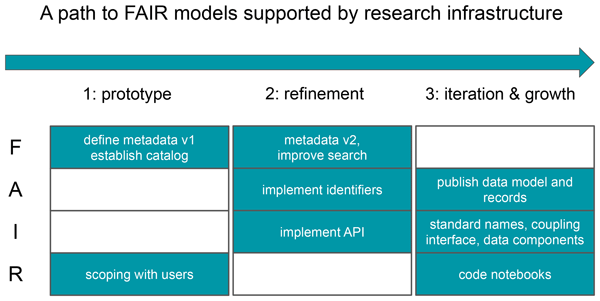
In this study, we examine the development and implementation of strategies by two geoscience research infrastructures – the CSDMS (Community Surface Dynamics Modeling System) Model Repository and the U.S. Geological Survey Model Catalog – to enhance the FAIRness of models guided by FAIR4RS. Some of the development and implementation efforts described predate the formalization of FAIR and FAIR4RS principles, making this an ongoing and adaptive process. We evaluate the temporal progression towards increased FAIR4RS alignment across three phases of research infrastructure development: prototype, refinement, and growth & iteration. Although certain principles were more straightforward to implement early in prototypes of the catalog infrastructures, others required broader community collaboration during refinement, and some continue to pose practical challenges in the growth and iteration phase. By tracing these dynamics, our aim is to provide insights that can guide other modeling initiatives in effectively adopting FAIR4RS principles within their communities.
-
Notice on discussion status
The requested preprint has a corresponding peer-reviewed final revised paper. You are encouraged to refer to the final revised version.
-
Preprint
(747 KB)
-
Supplement
(109 KB)
-
The requested preprint has a corresponding peer-reviewed final revised paper. You are encouraged to refer to the final revised version.
- Preprint
(747 KB) - Metadata XML
-
Supplement
(109 KB) - BibTeX
- EndNote
- Final revised paper


Journal article(s) based on this preprint
Interactive discussion
Status: closed
-
RC1: 'Comment on egusphere-2025-5256', Daniel Katz, 13 Jan 2026
Overall, I appreciate this content of this paper / study and the work that the authors did in it and in writing it up. I think this is a valuable resource for the software and information science community, and hope that it will be circulated more widely than in just in the Earth science community.
In particular, Section 3.1 is quite useful.
General comments:
The authors could mention CIG (https://community.geodynamics.org) somewhere as complementary to the work studied in this paper.
Adding blank lines to separate new paragraphs would be helpful. This is done in some parts of the paper, but not others. In particular, it would be helpful in the references section.
I find some of the terminology here a little confusing. When I heat models today, I think of machine learning or AI. The models here are more modeling/simulation programs or functions. Note that the FAIR4RS principles are about Research Software. There is also a group working on FAIR4ML, where ML is machine learning models. If the authors want to keep using "models", it should clearly be defined at the start.
Similarly, when looking at Figure 2, it's unclear to me if "publish data model and records" is discussing the software or the data that it produces. And in the F row, what metadata is being discussed? Metadata about data or metadata about the software? This is made more clear in the paper text, but the figure/caption could also be clarified.
Specific comments (with line numbers):
46 - perhaps mention https://www.researchsoft.org/tf-actionable-fair4rs/
75 - Please add the names of the two model catalogs to the caption
332 - I strongly disagree with idea here that using a CC0 dedication/license is appropriate. While Creative Commons says this can be done (https://wiki.creativecommons.org/wiki/CC0_FAQ#May_I_apply_CC0_to_computer_software.3F_If_so.2C_is_there_a_recommended_implementation.3F), it mentions that OSI does not approve this, and given that many projects consider the use of an OSI-approved license the definition of open source, software that has a CC0 dedication may not be considered open source. Also, even CC says that CC0 is a dedication, not a license. See https://opensource.org/blog/public-domain-is-not-open-source for OSI's view.
455 - it might be worth mentioning LLMs here, as this is the technology that is being most tested for this purpose.
551 - JOSS could be cited - One recent paper is https://doi.org/10.31274/jlsc.18285 (Note that I am an author of this.)
577 - It would be useful to mention SciCodes.org here, and for the authors to participate in it if they don't already, or at least to make sure that their lessons get back to that community.
Citation: https://doi.org/10.5194/egusphere-2025-5256-RC1 - AC1: 'Reply on RC1', Albert J. Kettner, 17 Apr 2026
-
CEC1: 'Comment on egusphere-2025-5256', Juan Antonio Añel, 11 Feb 2026
Dear authors,
I have gone through your manuscript, and I would like to point out that the "Code and Data Availability" section, in its current form, is misleading. The section is there to declare he provenance and where to get the software necessary to replicate the presented work. Your manuscript discusses software, but does not depends on the mentioned ones to replicate it. Therefore, in this case, it is more accurate that declare in the section that no code is necessary to produce the discussion and results presented in your manuscript.
If I am wrong and I have missed any piece of code or model that you really use, then of course you should cite it, but GitHub sites and others not accepted according the policy of the journal are not valid.
Juan A. Añel
Geosci. Model Dev. Executive Editor
Citation: https://doi.org/10.5194/egusphere-2025-5256-CEC1 - AC2: 'Reply on CEC1', Albert J. Kettner, 17 Apr 2026
-
RC2: 'Comment on egusphere-2025-5256', Anonymous Referee #2, 09 Mar 2026
Summary and feedback:
The manuscript demonstrates how the FAIR4RS principles can be applied to numerical models, offering a clear and practical framework for other modeling initiatives to follow. The paper compares the Community Surface Dynamics Modeling System (CSDMS) Model Repository and the U.S. Geological Survey (USGS) Model Catalog and provides valuable real-world case studies that highlight both successes and challenges in implementing FAIR principles. This comparison allows readers to understand the practical applications and benefits of the FAIR principles in different organizational contexts. Additionally, the paper emphasizes the importance of community engagement and user feedback in developing solutions that are tailored to the needs of the scientific modeling community.
Comments:
- From the perspective of a model user, easy installation and clear instructions for the setup and execution are critical for effective reuse. Even when models are openly available, complex installation procedures or incomplete documentation can make them difficult to adopt in practice. Users benefit greatly from straightforward installation processes, well-documented dependencies, and clear guides for running and adapting the model. Including example workflows or usage demonstration can further help new users understand how to use the model. Emphasizing how these aspects are done by the two catalogues will strength the discussion of the model adoption and reuse (Reusability)
- In section 2.4, the paper could include more examples of how models have been reused across projects or disciplines to illustrate the practical benefits of FAIR principles. The example could include: workflow, required adaptations, and the time saved compared with a “pre‑FAIR” approach.
- The paper has omitted in the “Interoperability & reusability” discussion the portable images using containerization technologies like Docker and Apptainer. These tools are essential for enhancing the FAIR aspects and enabling easier access and functionality for model users. These technologies facilitate the creation and sharing of reproducible research environments. For instance, Docker allows user to package applications with their dependencies into portable containers and makes them accessible across various systems. Similarly, Apptainer emphasizes security and use in high-performance computing context.
Recommendation:
The manuscript is well organized and easy to read, and offers a valuable, community‑oriented account of how FAIR‑4RS can be used for Earth‑surface models. I recommend minor revision based on my previous points.
Citation: https://doi.org/10.5194/egusphere-2025-5256-RC2 - AC3: 'Reply on RC2', Albert J. Kettner, 17 Apr 2026
Peer review completion


Interactive discussion
Status: closed
-
RC1: 'Comment on egusphere-2025-5256', Daniel Katz, 13 Jan 2026
Overall, I appreciate this content of this paper / study and the work that the authors did in it and in writing it up. I think this is a valuable resource for the software and information science community, and hope that it will be circulated more widely than in just in the Earth science community.
In particular, Section 3.1 is quite useful.
General comments:
The authors could mention CIG (https://community.geodynamics.org) somewhere as complementary to the work studied in this paper.
Adding blank lines to separate new paragraphs would be helpful. This is done in some parts of the paper, but not others. In particular, it would be helpful in the references section.
I find some of the terminology here a little confusing. When I heat models today, I think of machine learning or AI. The models here are more modeling/simulation programs or functions. Note that the FAIR4RS principles are about Research Software. There is also a group working on FAIR4ML, where ML is machine learning models. If the authors want to keep using "models", it should clearly be defined at the start.
Similarly, when looking at Figure 2, it's unclear to me if "publish data model and records" is discussing the software or the data that it produces. And in the F row, what metadata is being discussed? Metadata about data or metadata about the software? This is made more clear in the paper text, but the figure/caption could also be clarified.
Specific comments (with line numbers):
46 - perhaps mention https://www.researchsoft.org/tf-actionable-fair4rs/
75 - Please add the names of the two model catalogs to the caption
332 - I strongly disagree with idea here that using a CC0 dedication/license is appropriate. While Creative Commons says this can be done (https://wiki.creativecommons.org/wiki/CC0_FAQ#May_I_apply_CC0_to_computer_software.3F_If_so.2C_is_there_a_recommended_implementation.3F), it mentions that OSI does not approve this, and given that many projects consider the use of an OSI-approved license the definition of open source, software that has a CC0 dedication may not be considered open source. Also, even CC says that CC0 is a dedication, not a license. See https://opensource.org/blog/public-domain-is-not-open-source for OSI's view.
455 - it might be worth mentioning LLMs here, as this is the technology that is being most tested for this purpose.
551 - JOSS could be cited - One recent paper is https://doi.org/10.31274/jlsc.18285 (Note that I am an author of this.)
577 - It would be useful to mention SciCodes.org here, and for the authors to participate in it if they don't already, or at least to make sure that their lessons get back to that community.
Citation: https://doi.org/10.5194/egusphere-2025-5256-RC1 - AC1: 'Reply on RC1', Albert J. Kettner, 17 Apr 2026
-
CEC1: 'Comment on egusphere-2025-5256', Juan Antonio Añel, 11 Feb 2026
Dear authors,
I have gone through your manuscript, and I would like to point out that the "Code and Data Availability" section, in its current form, is misleading. The section is there to declare he provenance and where to get the software necessary to replicate the presented work. Your manuscript discusses software, but does not depends on the mentioned ones to replicate it. Therefore, in this case, it is more accurate that declare in the section that no code is necessary to produce the discussion and results presented in your manuscript.
If I am wrong and I have missed any piece of code or model that you really use, then of course you should cite it, but GitHub sites and others not accepted according the policy of the journal are not valid.
Juan A. Añel
Geosci. Model Dev. Executive Editor
Citation: https://doi.org/10.5194/egusphere-2025-5256-CEC1 - AC2: 'Reply on CEC1', Albert J. Kettner, 17 Apr 2026
-
RC2: 'Comment on egusphere-2025-5256', Anonymous Referee #2, 09 Mar 2026
Summary and feedback:
The manuscript demonstrates how the FAIR4RS principles can be applied to numerical models, offering a clear and practical framework for other modeling initiatives to follow. The paper compares the Community Surface Dynamics Modeling System (CSDMS) Model Repository and the U.S. Geological Survey (USGS) Model Catalog and provides valuable real-world case studies that highlight both successes and challenges in implementing FAIR principles. This comparison allows readers to understand the practical applications and benefits of the FAIR principles in different organizational contexts. Additionally, the paper emphasizes the importance of community engagement and user feedback in developing solutions that are tailored to the needs of the scientific modeling community.
Comments:
- From the perspective of a model user, easy installation and clear instructions for the setup and execution are critical for effective reuse. Even when models are openly available, complex installation procedures or incomplete documentation can make them difficult to adopt in practice. Users benefit greatly from straightforward installation processes, well-documented dependencies, and clear guides for running and adapting the model. Including example workflows or usage demonstration can further help new users understand how to use the model. Emphasizing how these aspects are done by the two catalogues will strength the discussion of the model adoption and reuse (Reusability)
- In section 2.4, the paper could include more examples of how models have been reused across projects or disciplines to illustrate the practical benefits of FAIR principles. The example could include: workflow, required adaptations, and the time saved compared with a “pre‑FAIR” approach.
- The paper has omitted in the “Interoperability & reusability” discussion the portable images using containerization technologies like Docker and Apptainer. These tools are essential for enhancing the FAIR aspects and enabling easier access and functionality for model users. These technologies facilitate the creation and sharing of reproducible research environments. For instance, Docker allows user to package applications with their dependencies into portable containers and makes them accessible across various systems. Similarly, Apptainer emphasizes security and use in high-performance computing context.
Recommendation:
The manuscript is well organized and easy to read, and offers a valuable, community‑oriented account of how FAIR‑4RS can be used for Earth‑surface models. I recommend minor revision based on my previous points.
Citation: https://doi.org/10.5194/egusphere-2025-5256-RC2 - AC3: 'Reply on RC2', Albert J. Kettner, 17 Apr 2026
Peer review completion
Journal article(s) based on this preprint
Viewed
| HTML | XML | Total | Supplement | BibTeX | EndNote | |
|---|---|---|---|---|---|---|
| 1,462 | 598 | 129 | 2,189 | 214 | 118 | 110 |
- HTML: 1,462
- PDF: 598
- XML: 129
- Total: 2,189
- Supplement: 214
- BibTeX: 118
- EndNote: 110
Viewed (geographical distribution)
| Country | # | Views | % |
|---|
| Total: | 0 |
| HTML: | 0 |
| PDF: | 0 |
| XML: | 0 |
- 1
Albert J. Kettner

Leslie Hsu
Brandon S. Serna
The requested preprint has a corresponding peer-reviewed final revised paper. You are encouraged to refer to the final revised version.
- Preprint
(747 KB) - Metadata XML
-
Supplement
(109 KB) - BibTeX
- EndNote
- Final revised paper