
the Creative Commons Attribution 4.0 License.
the Creative Commons Attribution 4.0 License.
 | 30 Jan 2026
Evaluation of the LandscapeDNDC model for drained peatland forest managements, LDNDC v1.35.2 (revision 11434)
Abstract. Rotational forestry (RF) is the prevailing management practice on drained peatlands in Finland, while continuous cover forestry (CCF) is increasingly studied for its potential climate benefits. We applied the process-based LandscapeDNDC model, for the first time, to simulate experimental peatland forest stands under three different managements: RF, CCF and non-managed control. Mixed-species stands of pine, spruce, and birch were initialized, with management, partial harvest of pine in CCF and clear-cut harvest of all species in RF, leading to species shifts toward spruce–birch dominance in CCF and birch seedlings in RF. The primary objective of this study was to evaluate the performance of LandscapeDNDC model in forested drained peatlands. To this aim, we quantified the differences in gas exchange and water balance originating from differences in species composition and management methods. We also implemented modification to dynamic water table (WT) calculations and improved humus pool partitioning based on soil carbon-to-nitrogen ratios. Model evaluation against field data showed strong agreement for daily net ecosystem exchange (correlation 0.84–0.88; Nash–Sutcliffe efficiency 0.66–0.75). Modeled leaf area index (LAI) closely matched site estimates before management and Sentinel-2 satellite estimated LAI afterwards. Soil moisture and WT dynamics were realistically reproduced. Methane flux patterns were accurately captured in the control and CCF stands. Moreover, the methane flux was found to be sensitive to the WT after clear-cut in the RF stand. Modeled annual carbon balances were consistent with measurements and indicated that CCF became a carbon sink more rapidly than RF. These results demonstrate that LandscapeDNDC can reliably simulate the biogeochemical and hydrological consequences of alternative peatland forest management scenarios. The model therefore provides a valuable tool for developing climate-smart management strategies on drained peat soils.
-
Notice on discussion status
The requested preprint has a corresponding peer-reviewed final revised paper. You are encouraged to refer to the final revised version.
-
Preprint
(6450 KB)
-
Supplement
(5317 KB)
-
The requested preprint has a corresponding peer-reviewed final revised paper. You are encouraged to refer to the final revised version.
- Preprint
(6450 KB) - Metadata XML
-
Supplement
(5317 KB) - BibTeX
- EndNote
- Final revised paper


Journal article(s) based on this preprint
Interactive discussion
Status: closed
-
CEC1: 'Comment on egusphere-2025-5197 - No compliance with the policy of the journal', Juan Antonio Añel, 11 Mar 2026
-
AC1: 'Reply on CEC1', Ahmed Shahriyer, 13 Mar 2026
Dear Chief Editor,
Thank you for informing us about the noncompliance of our manuscript regarding the GMD code and data policy.
We have now uploaded the SPOTPY version that we used in this study to Zenedo along with the codes we used to run SPOTPY. Here is the DOI https://doi.org/10.5281/zenodo.18982316
LDNDC source code in the radar4kit is under processing for publication, maybe because of this the DOI link is not working. But through this link https://www.radar-service.eu/radar/en/dataset/8w3v0bf96c2xzenj?token=gekSBjqBudDNCrBOiiSX the source code can be accessed for review purposes and once our manuscript is published the source code in the radar4kit will also be published and the source code DOI (10.35097/8w3v0bf96c2xzenj) will also work.
Additionally, Christof Lorenz, one of the RADAR data managers/curators informed us about these links regarding radar4kit complying with the GMD data and code policy.
-For published data an actual retention period of at least 25 years is guaranteed (source: https://www.bibliothek.kit.edu/english/radar-faq.php)
- Data packages in permanent memory cannot be changed. In justified exceptional cases, data packages can be blocked by the administrator. (source: https://www.bibliothek.kit.edu/english/radar-description.php)
- RADAR4KIT assigns a Persistent Identifier (here: Digital Object Identifier, in short DOI) for each published data package and registers it with DataCite (source: https://www.bibliothek.kit.edu/english/radar-description.php)
please let us know if we need to provide any more information.
Best regards,
Ahmed Shahriyer
Citation: https://doi.org/10.5194/egusphere-2025-5197-AC1 -
CEC2: 'Reply on AC1', Juan Antonio Añel, 13 Mar 2026
Dear authors,
Thanks for your quick reply. Unfortunately, we can not consider that radar-service.eu complies with the policy of the journal. Radar4KIT and Radar-Service.eu seem to be maintained by different institutions. Meanwhile we can accept Radar4KIT, we can not accept radar-service.eu. It is our understaning that the policies published by Radar4KIT do not apply to Radar-Service, as they are not listed in their webpage. Please, store your assets in a repository that we can accept.
Juan A. Añel
Geosci. Model Dev. Executive Editor
Citation: https://doi.org/10.5194/egusphere-2025-5197-CEC2 -
AC2: 'Reply on CEC2', Ahmed Shahriyer, 16 Mar 2026
Dear Juan A. Añel,
Thank you for your message and the clarification regarding the repository policy. To address your concern: the model has been uploaded to Radar4KIT and not Radar-Service.eu. Radar-Service.eu is only a catalog/front-end that lists content hosted on, among others, Radar4KIT; it is not a separate repository with its own policies. At the moment, the corresponding Radar4KIT entry is in “under review” status. In this status we can still make adjustments, such as linking the record to other work (via DOI and/or title). For example, if the manuscript title changes during the review process, we can update the Radar4KIT record accordingly before final publication. Of course, we fully intend to set the entry to a permanent, final state before the article is finally published. Could you please let us know if the “under review” status in Radar4KIT is acceptable for the purposes of the journal’s policy? If this is not acceptable, we are willing to change the status to “permanent” immediately, with the understanding that this will no longer allow us to adapt the repository entry to any further changes arising during the review process. We would appreciate a final statement on whether changing the status to “permanent” is required.
Kind regards,
Ahmed Shahriyer
Citation: https://doi.org/10.5194/egusphere-2025-5197-AC2 -
CEC3: 'Reply on AC2', Juan Antonio Añel, 16 Mar 2026
Dear authors,
We can not accept that the repository is under review. Code and Data repositories must be public, final, and without possibility to modify them before submitting manuscripts to the journal, and manuscript should not be submitted until all these requirements are fulfilled. Therefore, make your repository definitive as soon as possible, and reply to this comment with the new text for the "Code and Data Availability" policy, so that we can check if it complies with the requirements of the journal.
Juan A. Añel
Geosci. Model Dev. Executive Editor
Citation: https://doi.org/10.5194/egusphere-2025-5197-CEC3 -
AC3: 'Reply on CEC3', Ahmed Shahriyer, 20 Mar 2026
Dear Chief Editor,
We fully understand and appreciate the journal’s policy that code and data should be public and not subject to modification. Our intention in using the “review” status of the repository was to follow a practice, where this status is specifically designed to allow datasets to be stored in a permanent infrastructure while still enabling improvements during the peer-review process. This approach has been developed and discussed within the context of other Copernicus journals such as ESSD. However, we completely agree that compliance with the journal’s requirements is essential. Therefore, in response to your comment, we have now made the repository fully public and definitive: DOI: 10.35097/8w3v0bf96c2xzenj.
As requested here is the new code and data availability section.
Code and data availability: Simulation and measurement data, python codes for analysis and codes for running SPOTPY are available at https://doi.org/10.5281/zenodo.17397308 and https://doi.org/10.5281/zenodo.18982316. Simulation setup can be found at https://doi.org/10.5281/zenodo.17987219. Model source code can be found at https://doi.org/10.5281/10.35097/8w3v0bf96c2xzenj.
Please let me know if there any issue. All links should be working now.
Best regards,
Shahriyer
Citation: https://doi.org/10.5194/egusphere-2025-5197-AC3 -
CEC4: 'Reply on AC3', Juan Antonio Añel, 20 Mar 2026
Dear authors,
Thanks for your reply. Unfortunately, the last version of the Code and Data Availability section that you have posted contains a mistake. The DOI for the last repository that you mention reads "https://doi.org/10.5281/10.35097/8w3v0bf96c2xzenj", which is wrong. The correct DOI that should appeear is "https://doi.org/10.35097/8w3v0bf96c2xzenj". Please, correct it.
If this issue is solved, we could consider the current version of your manuscript in compliance with the Code and Data policy of the journal.
Juan A. Añel
Geosci. Model Dev. Executive Editor
Citation: https://doi.org/10.5194/egusphere-2025-5197-CEC4 -
AC4: 'Reply on CEC4', Ahmed Shahriyer, 20 Mar 2026
Dear Chief editor,
Thank you for pointing the mistake, here is the correct version,
Code and data availability: Simulation and measurement data, python codes for analysis and codes for running SPOTPY are available at https://doi.org/10.5281/zenodo.17397308 and https://doi.org/10.5281/zenodo.18982316. Simulation setup can be found at https://doi.org/10.5281/zenodo.17987219. Model source code can be found at https://doi.org/10.35097/8w3v0bf96c2xzenj.
Best regards,
Shahriyer
Citation: https://doi.org/10.5194/egusphere-2025-5197-AC4
-
AC4: 'Reply on CEC4', Ahmed Shahriyer, 20 Mar 2026
-
CEC4: 'Reply on AC3', Juan Antonio Añel, 20 Mar 2026
-
AC3: 'Reply on CEC3', Ahmed Shahriyer, 20 Mar 2026
-
CEC3: 'Reply on AC2', Juan Antonio Añel, 16 Mar 2026
-
AC2: 'Reply on CEC2', Ahmed Shahriyer, 16 Mar 2026
-
CEC2: 'Reply on AC1', Juan Antonio Añel, 13 Mar 2026
-
AC1: 'Reply on CEC1', Ahmed Shahriyer, 13 Mar 2026
-
RC1: 'Comment on egusphere-2025-5197', Anonymous Referee #1, 22 Mar 2026
Shahriyer et al. modified the water table calculation in the LandscapeDNDC model, reliably simulating changes in LAI, the water table, CH4 flux, CO2 flux and soil C storage along the forest development trajectory under different management regimes (continuous cover vs. rotational forestry) on drained peatlands. The model parameter setting and performance are well supported by field observations. As the first model being able to simulate such changes along the conversion of peatland to forests, this modification of LDNDC may provide important implications for forest management strategies in drained peatlands. However, I would suggest that the authors expand the scope of their discussion and explicitly introduce the pros and cons of different forest management strategies, as well as the limitations of the current simulations (see my specific comments). Other than this, I recommend accepting the paper for publication following minor revisions.
Specific comments:
• L30: I think you can be specific here. C:N is an indicator for the “nitrogen” status.
• L147: Why did you use RCP4.5 instead of the actual observations of atmospheric CO2 levels, given that no future climate scenario forecasting was conducted in this study?
• Table 1: Some other publications may contain layer-specific C, N, C:N information, such as Peltoniemi et al. (2023). However, as the values may not vary much across layers, the current setting (where the same value is used for 0-90 cm) is probably okay.
• Fig. 1: There appears to be a mismatch in the seasonal patterns between the observations and the simulated variables here (especially in the autumn), as well as in Fig. 5. Is this my illusion or could there be an explanation for this?
• L250: What do you mean by “during harvest and infect spruce LAI…”?
• L259: the “modeled” 10cm…
• Figs. 6&7: It seems that the high values of GPP are overestimated by the model, especially in postharvest rotational forests. This was explained in L372 that the discrepancy arose from the overestimated recovery speed of vegetation. However, I think exploring a bit more into potential processes would be helpful for future improvement of the model. For example, could high photosynthesis or low self-thinning be responsible for the overestimation of GPP?
• Discussion: It is good that the authors compared their simulations with various field observations. However, I feel that the current discussion focuses only on the reliability of the simulated variables (which is good). Additionally, it would be valuable to see the practical implications of the model outputs, as well as the limitations/future perspective of LDNDC.
(1) Practical implications: The authors did interesting simulations of different management practices (i.e., continuous cover vs. rotational forestry). I believe a section/paragraph dedicated to summarizing the pros and cons (in terms of carbon and water cycles) of the two practices may provide valuable information for the management of drained peatland ecosystems.
(2) Model limitations: The authors noted the current model’s failure to capture the effect of drought, which may explain why the CO2 balance in 2018 was not accurately represented. This highlights the need for the model to better represent drought-induced tree mortality. Additionally, I wonder if mismatched seasonality (of LAI or CH4 flux, see my previous comment) could be due to the function used to simulate vegetation phenology. By examining the simulated output variables and intermediate parameters more closely, I believe the authors can identify the modules/functions that are underperforming. Discussing such limitations could have important implications for future model development.References
Peltoniemi, M., Li, Q., Turunen, P., Tupek, B., Mäkiranta, P., Leppä, K., et al. (2023). Soil GHG dynamics after water level rise – Impacts of selection harvesting in peatland forests. Science of the Total Environment, 901, 165421. https://www.sciencedirect.com/science/article/pii/S0048969723040445Citation: https://doi.org/10.5194/egusphere-2025-5197-RC1 - AC5: 'Reply on RC1', Ahmed Shahriyer, 25 May 2026
-
RC2: 'Comment on egusphere-2025-5197', Anonymous Referee #2, 31 Mar 2026
Evaluation of the LandscapeDNDC model for drained peatland forest managements, LDNDC v1.35.2 (revision 11434)
The manuscript by Ahmed Hasan Shahriyer et al. describes developments of the LandscapeDNDC model targeting the representation of forestry on drained peatlands in Finland. The authors present extensions to the LDNDC model to represent lateral water movement as a consequence of drainage, and they alter the behaviour of the recalcitrant humus pool to better capture the CO2 dynamics. In addition, they provide a parameterization of the model to capture these conditions, and optimize a large set of parameters to capture soil processes.The manuscript provides an overall detailed assessment of the model's ability to capture the impacts of draining on the hydrology of the sites, as well as observed fluxes of CO2 and CH4 in the different sites. While the development of the new lateral water movement is well tested and illustrated in the manuscript (with a possibility to strengthen this even more by moving the simulated WT results from the Supplementary material to the main text), I miss a rationale and analysis of the changes in the recalcitrant humus pool: Why were these changes made, and how does this alter the model's ability to capture this system?
The manuscript is written in a nice and clear manner, and provides a good overview of the changes. I would like to suggest to improve the description of the sensitivity tests (detailed comments below), and a general review of the figures would be welcome (variables and units on the axes, add sufficient information to the figure captions). Moreover, the current discussion largely repeats the results and does not address uncertainties and shortcomings in the model very well, nor does it provide a good comparison with the literature.
Once these points are addressed, I expect that the manuscript will be acceptable for publication in Geoscientific Model Development and will be a good basis for future research with this constellation of the LDNDC model.
Detailed comments
L. 27: The contrast between nutrient-rich and nutrient-poor forested peat soils is not entirely clear in this section - maybe in partly because of missing literature. I trust that the statement that drainage of nutrient-rich soils is a source of CO2 would also apply to nutrient-poor soils? And do the authors have sources for the impacts on both types (both the effect of drainage, and the offsetting effect of forestry)?
L. 47: There seem to be two contradicting arguments in this paragraph: On the one hand, CCF maintains a higher WT (L. 48), but the transpiration is large enough to keep a low WT that avoids hindering tree growth (L. 51). I think it would be nice to clarify this, and provide a good overview of the trade-offs affected by WT here (peat degradation, tree growth, methanogenesis).
L. 55: The Lettosuo site has not been introduced here yet - maybe provide a brief description of the site.
L. 111 and elsewhere: To enhance understanding, I would recommend to add the units of the variables in the explanation of the equations.
L. 112: Defining negative zgw as below the surface seems to contradict with the definition in Eq. 1 (q will only be >0 if zgw is more negative than the reference level Zgw)
L. 114: Please explain the scaling of the recalcitrant old humus pool. I trust that the pool is computed dynamically, so where is the scaling happening, and how is excess C treated? And which shortcoming in the model is this change trying to resolve?
Fig. A1: Please add a scale. Also, it would be interesting to add the date of the photo in the caption (for comparison with the management dates in section 2.2).
L. 147: Please clarify the CO2 driving data: RCP 4.5 does not start in 1963. Also, please add a reference.
Section 2.3: It would be nice to distinguish here between data used to drive the LDNDC model, and data used for evaluation
Table A1: Please add units for the variables. The ranges are hard to interpret without knowing the unit in the model.
L. 194: An NSE value for "good" model performance ought to be variable-specific: Some variables are much harder to capture in models than others.
L. 225: The parameter optimization method needs to be described in more detail. It is unclear to me how the best parameter value for an individual parameter can be found while varying a set of parameter values at once. Is there any optimization involved, or are you simply treating all sets of parameters as samples? In the case of the latter, the number of simulations could be worryingly low, given the high dimensionality of the problem (3 sets of 9 parameters to vary at the same time). But I may misunderstand the exact method used here.
Also, it is unclear whether NEE is the only variable used to optimize against in the sensitivity analysis. It would also be good to report the default value used in set 2 and 3 while varying set 1.
Finally, it would be nice to not only provide the ranges of parameter values that you apply in the sensitivity tests, but also the final values that you end up using.Fig. 2: What is "soil moisture" here referring to? Volumetric moisture content or saturation of the pore volume? The modelled value for 20 cm depth seems to peak around 60%, but there is one episode in May 2018 where it suddenly rises to 80% - it would be nice if the authors could investigate why the model produces this peak. Also, It would be interesting to see the model performance outside the growing season: Does LDNDC capture the freeze-thaw dynamics, too? And what causes the model to be so water-conserving in the 2018 drought?
L. 269: I like Fig. S5 and would urge the authors to bring it into the main manuscript (and include a description of it). The figure displays the difference between the three setups, and hence illustrates both the lateral groundwater movement that was introduced in LDNDC in this manuscript, and the difference in influence of the forest practice on water dynamics, which is one of the key arguments in the introduction.
Section 3.3: It would be nice to describe the two simulations with different water tables in more detail. How was the WT variation imposed (varying Zgw?), and what was the rationale for these changes?
Figure 5: It would be nice to have the legend outside the figure box, or with a box around it - to ensure that there is a clear difference between observation points and legend.
L. 283: There is an interesting difference in the simulated and observed timing of CH4 fluxes. The authors describe this to some extent, but do not comment on it or provide possible explanations. It would be nice to hear whether the authors have a possible explanation for it (this could also be a part in the Discussion).
Fig. 6: Is this based on the half-hourly data, or the daily averages? Please add this information to the figure caption.
Fig. 7: "Uncertainties in the EC-based NEE [...] are shown with the error bars". Please explain how these uncertainties were derived.
Section 3.4: The analysis is based primarily on a comparison between daily (or subdaily?) model and observation estimates (Fig. 6) and annual sums (Fig. 7). It would be interesting to learn a bit more on the seasonality in the CO2 fluxes: How well are these captured, and how well does the model capture differences between individual summers (similar to the analysis of the CH4 flux in section 3.3)?
Section 3.5: It would be nice to see an analysis that describes the impact of the changes made to the model. You have captured the description of the drainage nicely by showing differences in hydrology between the sites. What has been the impact of the changes in the recalcitrant humus pool? Has this been improving the seasonal behaviour, the long-term trend, or both?
Section 4: The discussion is mainly used to highlight results, and to describe the comparison between simulation results and observations. It would be nice to strengthen it by (1) discussing the importance of the model developments (new functionality, altered parameterization) made in this study, (2) comparing the results more to other studies, and (3) highlighting potential use of the model with this new functionality.
Language editing:L. 93: replace "differentiated" with "are differentiated"
L. 95: "matter": should this read "organic matter"?
L. 97: what is meant with CH4 deposition here?
L. 97: Check sentence "and as well as CH4 oxidation"
L. 138: Replace "were used" by "was used"
Table 1: Please finalise the sentence in the figure caption
L. 205: replace "was also calculated" with "were also calculated"
L. 214: check spelling of "python"
Fig. 1: The difference between stars and circles is difficult to recognize.
L. 339: replace "did not gave" with "did not give". Also, consider explaining what you mean with "did not give the same perspective".Citation: https://doi.org/10.5194/egusphere-2025-5197-RC2 - AC6: 'Reply on RC2', Ahmed Shahriyer, 25 May 2026
Peer review completion


Interactive discussion
Status: closed
-
CEC1: 'Comment on egusphere-2025-5197 - No compliance with the policy of the journal', Juan Antonio Añel, 11 Mar 2026
Dear authors,
Unfortunately, after checking your manuscript, it has come to our attention that it does not comply with our "Code and Data Policy".
https://www.geoscientific-model-development.net/policies/code_and_data_policy.html
You have archived your code on sites that do not comply with the policy of the journal. Namely, for the SPOTPY library you cite a paper that cites python.org. For the LandscapeDNDC model you have used radar-service.eu. However, none of them is a suitable repository for scientific publication. They do not fulfil GMD’s requirements for a persistent data archive because:
- They do not appear to have a published policy for data preservation over many years or decades (some flexibility exists over the precise length of preservation, but the policy must exist).
- They do not appear to have a published mechanism for preventing authors from unilaterally removing material. Archives must have a policy which makes removal of materials only possible in exceptional circumstances and subject to an independent curatorial decision,
- They do not appear to issue a persistent identifier such as a DOI or Handle for each precise dataset.If we have missed a published policy which does in fact address this matter satisfactorily, please post a response linking to it. If you have any questions about this issue, please post them in a reply.
The GMD review and publication process depends on reviewers and community commentators being able to access, during the discussion phase, the code and data on which a manuscript depends, and on ensuring the provenance of replicability of the published papers for years after their publication. No manuscript can undergo Discussions or peer review in the journal before it fully complies with the Code and Data policy. Therefore, the current situation with your manuscript is irregular.
Please, therefore, publish your code and data in one of the appropriate repositories and reply to this comment with the relevant information (link and a permanent identifier for it (e.g. DOI)) as soon as possible.
The 'Code and Data Availability’ section must also be modified to cite the new repository locations, and corresponding references added to the bibliography.
I must note that if you do not fix this problem, we cannot continue with the peer-review process or accept your manuscript for publication in GMD.
Juan A. Añel
Geosci. Model Dev. Executive EditorCitation: https://doi.org/10.5194/egusphere-2025-5197-CEC1 -
AC1: 'Reply on CEC1', Ahmed Shahriyer, 13 Mar 2026
Dear Chief Editor,
Thank you for informing us about the noncompliance of our manuscript regarding the GMD code and data policy.
We have now uploaded the SPOTPY version that we used in this study to Zenedo along with the codes we used to run SPOTPY. Here is the DOI https://doi.org/10.5281/zenodo.18982316
LDNDC source code in the radar4kit is under processing for publication, maybe because of this the DOI link is not working. But through this link https://www.radar-service.eu/radar/en/dataset/8w3v0bf96c2xzenj?token=gekSBjqBudDNCrBOiiSX the source code can be accessed for review purposes and once our manuscript is published the source code in the radar4kit will also be published and the source code DOI (10.35097/8w3v0bf96c2xzenj) will also work.
Additionally, Christof Lorenz, one of the RADAR data managers/curators informed us about these links regarding radar4kit complying with the GMD data and code policy.
-For published data an actual retention period of at least 25 years is guaranteed (source: https://www.bibliothek.kit.edu/english/radar-faq.php)
- Data packages in permanent memory cannot be changed. In justified exceptional cases, data packages can be blocked by the administrator. (source: https://www.bibliothek.kit.edu/english/radar-description.php)
- RADAR4KIT assigns a Persistent Identifier (here: Digital Object Identifier, in short DOI) for each published data package and registers it with DataCite (source: https://www.bibliothek.kit.edu/english/radar-description.php)
please let us know if we need to provide any more information.
Best regards,
Ahmed Shahriyer
Citation: https://doi.org/10.5194/egusphere-2025-5197-AC1 -
CEC2: 'Reply on AC1', Juan Antonio Añel, 13 Mar 2026
Dear authors,
Thanks for your quick reply. Unfortunately, we can not consider that radar-service.eu complies with the policy of the journal. Radar4KIT and Radar-Service.eu seem to be maintained by different institutions. Meanwhile we can accept Radar4KIT, we can not accept radar-service.eu. It is our understaning that the policies published by Radar4KIT do not apply to Radar-Service, as they are not listed in their webpage. Please, store your assets in a repository that we can accept.
Juan A. Añel
Geosci. Model Dev. Executive Editor
Citation: https://doi.org/10.5194/egusphere-2025-5197-CEC2 -
AC2: 'Reply on CEC2', Ahmed Shahriyer, 16 Mar 2026
Dear Juan A. Añel,
Thank you for your message and the clarification regarding the repository policy. To address your concern: the model has been uploaded to Radar4KIT and not Radar-Service.eu. Radar-Service.eu is only a catalog/front-end that lists content hosted on, among others, Radar4KIT; it is not a separate repository with its own policies. At the moment, the corresponding Radar4KIT entry is in “under review” status. In this status we can still make adjustments, such as linking the record to other work (via DOI and/or title). For example, if the manuscript title changes during the review process, we can update the Radar4KIT record accordingly before final publication. Of course, we fully intend to set the entry to a permanent, final state before the article is finally published. Could you please let us know if the “under review” status in Radar4KIT is acceptable for the purposes of the journal’s policy? If this is not acceptable, we are willing to change the status to “permanent” immediately, with the understanding that this will no longer allow us to adapt the repository entry to any further changes arising during the review process. We would appreciate a final statement on whether changing the status to “permanent” is required.
Kind regards,
Ahmed Shahriyer
Citation: https://doi.org/10.5194/egusphere-2025-5197-AC2 -
CEC3: 'Reply on AC2', Juan Antonio Añel, 16 Mar 2026
Dear authors,
We can not accept that the repository is under review. Code and Data repositories must be public, final, and without possibility to modify them before submitting manuscripts to the journal, and manuscript should not be submitted until all these requirements are fulfilled. Therefore, make your repository definitive as soon as possible, and reply to this comment with the new text for the "Code and Data Availability" policy, so that we can check if it complies with the requirements of the journal.
Juan A. Añel
Geosci. Model Dev. Executive Editor
Citation: https://doi.org/10.5194/egusphere-2025-5197-CEC3 -
AC3: 'Reply on CEC3', Ahmed Shahriyer, 20 Mar 2026
Dear Chief Editor,
We fully understand and appreciate the journal’s policy that code and data should be public and not subject to modification. Our intention in using the “review” status of the repository was to follow a practice, where this status is specifically designed to allow datasets to be stored in a permanent infrastructure while still enabling improvements during the peer-review process. This approach has been developed and discussed within the context of other Copernicus journals such as ESSD. However, we completely agree that compliance with the journal’s requirements is essential. Therefore, in response to your comment, we have now made the repository fully public and definitive: DOI: 10.35097/8w3v0bf96c2xzenj.
As requested here is the new code and data availability section.
Code and data availability: Simulation and measurement data, python codes for analysis and codes for running SPOTPY are available at https://doi.org/10.5281/zenodo.17397308 and https://doi.org/10.5281/zenodo.18982316. Simulation setup can be found at https://doi.org/10.5281/zenodo.17987219. Model source code can be found at https://doi.org/10.5281/10.35097/8w3v0bf96c2xzenj.
Please let me know if there any issue. All links should be working now.
Best regards,
Shahriyer
Citation: https://doi.org/10.5194/egusphere-2025-5197-AC3 -
CEC4: 'Reply on AC3', Juan Antonio Añel, 20 Mar 2026
Dear authors,
Thanks for your reply. Unfortunately, the last version of the Code and Data Availability section that you have posted contains a mistake. The DOI for the last repository that you mention reads "https://doi.org/10.5281/10.35097/8w3v0bf96c2xzenj", which is wrong. The correct DOI that should appeear is "https://doi.org/10.35097/8w3v0bf96c2xzenj". Please, correct it.
If this issue is solved, we could consider the current version of your manuscript in compliance with the Code and Data policy of the journal.
Juan A. Añel
Geosci. Model Dev. Executive Editor
Citation: https://doi.org/10.5194/egusphere-2025-5197-CEC4 -
AC4: 'Reply on CEC4', Ahmed Shahriyer, 20 Mar 2026
Dear Chief editor,
Thank you for pointing the mistake, here is the correct version,
Code and data availability: Simulation and measurement data, python codes for analysis and codes for running SPOTPY are available at https://doi.org/10.5281/zenodo.17397308 and https://doi.org/10.5281/zenodo.18982316. Simulation setup can be found at https://doi.org/10.5281/zenodo.17987219. Model source code can be found at https://doi.org/10.35097/8w3v0bf96c2xzenj.
Best regards,
Shahriyer
Citation: https://doi.org/10.5194/egusphere-2025-5197-AC4
-
AC4: 'Reply on CEC4', Ahmed Shahriyer, 20 Mar 2026
-
CEC4: 'Reply on AC3', Juan Antonio Añel, 20 Mar 2026
-
AC3: 'Reply on CEC3', Ahmed Shahriyer, 20 Mar 2026
-
CEC3: 'Reply on AC2', Juan Antonio Añel, 16 Mar 2026
-
AC2: 'Reply on CEC2', Ahmed Shahriyer, 16 Mar 2026
-
CEC2: 'Reply on AC1', Juan Antonio Añel, 13 Mar 2026
-
AC1: 'Reply on CEC1', Ahmed Shahriyer, 13 Mar 2026
-
RC1: 'Comment on egusphere-2025-5197', Anonymous Referee #1, 22 Mar 2026
Shahriyer et al. modified the water table calculation in the LandscapeDNDC model, reliably simulating changes in LAI, the water table, CH4 flux, CO2 flux and soil C storage along the forest development trajectory under different management regimes (continuous cover vs. rotational forestry) on drained peatlands. The model parameter setting and performance are well supported by field observations. As the first model being able to simulate such changes along the conversion of peatland to forests, this modification of LDNDC may provide important implications for forest management strategies in drained peatlands. However, I would suggest that the authors expand the scope of their discussion and explicitly introduce the pros and cons of different forest management strategies, as well as the limitations of the current simulations (see my specific comments). Other than this, I recommend accepting the paper for publication following minor revisions.
Specific comments:
• L30: I think you can be specific here. C:N is an indicator for the “nitrogen” status.
• L147: Why did you use RCP4.5 instead of the actual observations of atmospheric CO2 levels, given that no future climate scenario forecasting was conducted in this study?
• Table 1: Some other publications may contain layer-specific C, N, C:N information, such as Peltoniemi et al. (2023). However, as the values may not vary much across layers, the current setting (where the same value is used for 0-90 cm) is probably okay.
• Fig. 1: There appears to be a mismatch in the seasonal patterns between the observations and the simulated variables here (especially in the autumn), as well as in Fig. 5. Is this my illusion or could there be an explanation for this?
• L250: What do you mean by “during harvest and infect spruce LAI…”?
• L259: the “modeled” 10cm…
• Figs. 6&7: It seems that the high values of GPP are overestimated by the model, especially in postharvest rotational forests. This was explained in L372 that the discrepancy arose from the overestimated recovery speed of vegetation. However, I think exploring a bit more into potential processes would be helpful for future improvement of the model. For example, could high photosynthesis or low self-thinning be responsible for the overestimation of GPP?
• Discussion: It is good that the authors compared their simulations with various field observations. However, I feel that the current discussion focuses only on the reliability of the simulated variables (which is good). Additionally, it would be valuable to see the practical implications of the model outputs, as well as the limitations/future perspective of LDNDC.
(1) Practical implications: The authors did interesting simulations of different management practices (i.e., continuous cover vs. rotational forestry). I believe a section/paragraph dedicated to summarizing the pros and cons (in terms of carbon and water cycles) of the two practices may provide valuable information for the management of drained peatland ecosystems.
(2) Model limitations: The authors noted the current model’s failure to capture the effect of drought, which may explain why the CO2 balance in 2018 was not accurately represented. This highlights the need for the model to better represent drought-induced tree mortality. Additionally, I wonder if mismatched seasonality (of LAI or CH4 flux, see my previous comment) could be due to the function used to simulate vegetation phenology. By examining the simulated output variables and intermediate parameters more closely, I believe the authors can identify the modules/functions that are underperforming. Discussing such limitations could have important implications for future model development.References
Peltoniemi, M., Li, Q., Turunen, P., Tupek, B., Mäkiranta, P., Leppä, K., et al. (2023). Soil GHG dynamics after water level rise – Impacts of selection harvesting in peatland forests. Science of the Total Environment, 901, 165421. https://www.sciencedirect.com/science/article/pii/S0048969723040445Citation: https://doi.org/10.5194/egusphere-2025-5197-RC1 - AC5: 'Reply on RC1', Ahmed Shahriyer, 25 May 2026
-
RC2: 'Comment on egusphere-2025-5197', Anonymous Referee #2, 31 Mar 2026
Evaluation of the LandscapeDNDC model for drained peatland forest managements, LDNDC v1.35.2 (revision 11434)
The manuscript by Ahmed Hasan Shahriyer et al. describes developments of the LandscapeDNDC model targeting the representation of forestry on drained peatlands in Finland. The authors present extensions to the LDNDC model to represent lateral water movement as a consequence of drainage, and they alter the behaviour of the recalcitrant humus pool to better capture the CO2 dynamics. In addition, they provide a parameterization of the model to capture these conditions, and optimize a large set of parameters to capture soil processes.The manuscript provides an overall detailed assessment of the model's ability to capture the impacts of draining on the hydrology of the sites, as well as observed fluxes of CO2 and CH4 in the different sites. While the development of the new lateral water movement is well tested and illustrated in the manuscript (with a possibility to strengthen this even more by moving the simulated WT results from the Supplementary material to the main text), I miss a rationale and analysis of the changes in the recalcitrant humus pool: Why were these changes made, and how does this alter the model's ability to capture this system?
The manuscript is written in a nice and clear manner, and provides a good overview of the changes. I would like to suggest to improve the description of the sensitivity tests (detailed comments below), and a general review of the figures would be welcome (variables and units on the axes, add sufficient information to the figure captions). Moreover, the current discussion largely repeats the results and does not address uncertainties and shortcomings in the model very well, nor does it provide a good comparison with the literature.
Once these points are addressed, I expect that the manuscript will be acceptable for publication in Geoscientific Model Development and will be a good basis for future research with this constellation of the LDNDC model.
Detailed comments
L. 27: The contrast between nutrient-rich and nutrient-poor forested peat soils is not entirely clear in this section - maybe in partly because of missing literature. I trust that the statement that drainage of nutrient-rich soils is a source of CO2 would also apply to nutrient-poor soils? And do the authors have sources for the impacts on both types (both the effect of drainage, and the offsetting effect of forestry)?
L. 47: There seem to be two contradicting arguments in this paragraph: On the one hand, CCF maintains a higher WT (L. 48), but the transpiration is large enough to keep a low WT that avoids hindering tree growth (L. 51). I think it would be nice to clarify this, and provide a good overview of the trade-offs affected by WT here (peat degradation, tree growth, methanogenesis).
L. 55: The Lettosuo site has not been introduced here yet - maybe provide a brief description of the site.
L. 111 and elsewhere: To enhance understanding, I would recommend to add the units of the variables in the explanation of the equations.
L. 112: Defining negative zgw as below the surface seems to contradict with the definition in Eq. 1 (q will only be >0 if zgw is more negative than the reference level Zgw)
L. 114: Please explain the scaling of the recalcitrant old humus pool. I trust that the pool is computed dynamically, so where is the scaling happening, and how is excess C treated? And which shortcoming in the model is this change trying to resolve?
Fig. A1: Please add a scale. Also, it would be interesting to add the date of the photo in the caption (for comparison with the management dates in section 2.2).
L. 147: Please clarify the CO2 driving data: RCP 4.5 does not start in 1963. Also, please add a reference.
Section 2.3: It would be nice to distinguish here between data used to drive the LDNDC model, and data used for evaluation
Table A1: Please add units for the variables. The ranges are hard to interpret without knowing the unit in the model.
L. 194: An NSE value for "good" model performance ought to be variable-specific: Some variables are much harder to capture in models than others.
L. 225: The parameter optimization method needs to be described in more detail. It is unclear to me how the best parameter value for an individual parameter can be found while varying a set of parameter values at once. Is there any optimization involved, or are you simply treating all sets of parameters as samples? In the case of the latter, the number of simulations could be worryingly low, given the high dimensionality of the problem (3 sets of 9 parameters to vary at the same time). But I may misunderstand the exact method used here.
Also, it is unclear whether NEE is the only variable used to optimize against in the sensitivity analysis. It would also be good to report the default value used in set 2 and 3 while varying set 1.
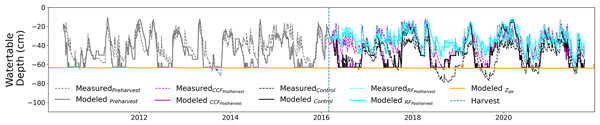
Finally, it would be nice to not only provide the ranges of parameter values that you apply in the sensitivity tests, but also the final values that you end up using.Fig. 2: What is "soil moisture" here referring to? Volumetric moisture content or saturation of the pore volume? The modelled value for 20 cm depth seems to peak around 60%, but there is one episode in May 2018 where it suddenly rises to 80% - it would be nice if the authors could investigate why the model produces this peak. Also, It would be interesting to see the model performance outside the growing season: Does LDNDC capture the freeze-thaw dynamics, too? And what causes the model to be so water-conserving in the 2018 drought?
L. 269: I like Fig. S5 and would urge the authors to bring it into the main manuscript (and include a description of it). The figure displays the difference between the three setups, and hence illustrates both the lateral groundwater movement that was introduced in LDNDC in this manuscript, and the difference in influence of the forest practice on water dynamics, which is one of the key arguments in the introduction.
Section 3.3: It would be nice to describe the two simulations with different water tables in more detail. How was the WT variation imposed (varying Zgw?), and what was the rationale for these changes?
Figure 5: It would be nice to have the legend outside the figure box, or with a box around it - to ensure that there is a clear difference between observation points and legend.
L. 283: There is an interesting difference in the simulated and observed timing of CH4 fluxes. The authors describe this to some extent, but do not comment on it or provide possible explanations. It would be nice to hear whether the authors have a possible explanation for it (this could also be a part in the Discussion).
Fig. 6: Is this based on the half-hourly data, or the daily averages? Please add this information to the figure caption.
Fig. 7: "Uncertainties in the EC-based NEE [...] are shown with the error bars". Please explain how these uncertainties were derived.
Section 3.4: The analysis is based primarily on a comparison between daily (or subdaily?) model and observation estimates (Fig. 6) and annual sums (Fig. 7). It would be interesting to learn a bit more on the seasonality in the CO2 fluxes: How well are these captured, and how well does the model capture differences between individual summers (similar to the analysis of the CH4 flux in section 3.3)?
Section 3.5: It would be nice to see an analysis that describes the impact of the changes made to the model. You have captured the description of the drainage nicely by showing differences in hydrology between the sites. What has been the impact of the changes in the recalcitrant humus pool? Has this been improving the seasonal behaviour, the long-term trend, or both?
Section 4: The discussion is mainly used to highlight results, and to describe the comparison between simulation results and observations. It would be nice to strengthen it by (1) discussing the importance of the model developments (new functionality, altered parameterization) made in this study, (2) comparing the results more to other studies, and (3) highlighting potential use of the model with this new functionality.
Language editing:L. 93: replace "differentiated" with "are differentiated"
L. 95: "matter": should this read "organic matter"?
L. 97: what is meant with CH4 deposition here?
L. 97: Check sentence "and as well as CH4 oxidation"
L. 138: Replace "were used" by "was used"
Table 1: Please finalise the sentence in the figure caption
L. 205: replace "was also calculated" with "were also calculated"
L. 214: check spelling of "python"
Fig. 1: The difference between stars and circles is difficult to recognize.
L. 339: replace "did not gave" with "did not give". Also, consider explaining what you mean with "did not give the same perspective".Citation: https://doi.org/10.5194/egusphere-2025-5197-RC2 - AC6: 'Reply on RC2', Ahmed Shahriyer, 25 May 2026
Peer review completion
Journal article(s) based on this preprint
Viewed
| HTML | XML | Total | Supplement | BibTeX | EndNote | |
|---|---|---|---|---|---|---|
| 1,538 | 583 | 234 | 2,355 | 247 | 146 | 246 |
- HTML: 1,538
- PDF: 583
- XML: 234
- Total: 2,355
- Supplement: 247
- BibTeX: 146
- EndNote: 246
Viewed (geographical distribution)
| Country | # | Views | % |
|---|
| Total: | 0 |
| HTML: | 0 |
| PDF: | 0 |
| XML: | 0 |
- 1
Ahmed Hasan Shahriyer

David Kraus
Tiina Markkanen
Mika Korkiakoski
Helena Rautakoski
Suvi Orttenvuori
Henri Kajasilta
Rüdiger Grote
Annalea Lohila
Tuula Aalto
The requested preprint has a corresponding peer-reviewed final revised paper. You are encouraged to refer to the final revised version.
- Preprint
(6450 KB) - Metadata XML
-
Supplement
(5317 KB) - BibTeX
- EndNote
- Final revised paper
Dear authors,
Unfortunately, after checking your manuscript, it has come to our attention that it does not comply with our "Code and Data Policy".
https://www.geoscientific-model-development.net/policies/code_and_data_policy.html
You have archived your code on sites that do not comply with the policy of the journal. Namely, for the SPOTPY library you cite a paper that cites python.org. For the LandscapeDNDC model you have used radar-service.eu. However, none of them is a suitable repository for scientific publication. They do not fulfil GMD’s requirements for a persistent data archive because:
- They do not appear to have a published policy for data preservation over many years or decades (some flexibility exists over the precise length of preservation, but the policy must exist).
- They do not appear to have a published mechanism for preventing authors from unilaterally removing material. Archives must have a policy which makes removal of materials only possible in exceptional circumstances and subject to an independent curatorial decision,
- They do not appear to issue a persistent identifier such as a DOI or Handle for each precise dataset.
If we have missed a published policy which does in fact address this matter satisfactorily, please post a response linking to it. If you have any questions about this issue, please post them in a reply.
The GMD review and publication process depends on reviewers and community commentators being able to access, during the discussion phase, the code and data on which a manuscript depends, and on ensuring the provenance of replicability of the published papers for years after their publication. No manuscript can undergo Discussions or peer review in the journal before it fully complies with the Code and Data policy. Therefore, the current situation with your manuscript is irregular.
Please, therefore, publish your code and data in one of the appropriate repositories and reply to this comment with the relevant information (link and a permanent identifier for it (e.g. DOI)) as soon as possible.
The 'Code and Data Availability’ section must also be modified to cite the new repository locations, and corresponding references added to the bibliography.
I must note that if you do not fix this problem, we cannot continue with the peer-review process or accept your manuscript for publication in GMD.
Juan A. Añel
Geosci. Model Dev. Executive Editor