
the Creative Commons Attribution 4.0 License.
the Creative Commons Attribution 4.0 License.
 | 19 Jan 2026
Hybrid methodology for optimised water vapour mixing ratio profiles from Raman lidar measurements
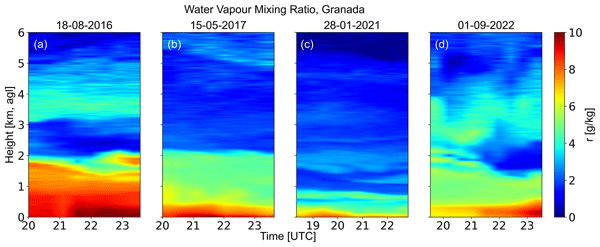
Abstract. This study presents a hybrid methodology to obtain high temporal resolution calibration constants for water vapour Raman lidar measurements, and posteriorly retrieve high accuracy water vapour mixing ratio profiles. The hybrid method combines correlative measurements of collocated precipitable water vapour and Numerical Weather Prediction data to reconstruct the profile within the incomplete overlap region. The hybrid methodology is applied to the MULHACEN Raman lidar system, which operated at the EARLINET/ACTRIS station of the University of Granada, Spain for the period 2009–2022. The system has been continuously updated to meet EARLINET/ACTRIS requirements for aerosol measurements, but the hybrid method has allowed tracking the impact of these changes on calibration constants for water vapour retrievals, and consequently to exploit water vapour mixing ratio profiles that were previously unavailable. The hybrid method was optimised for the Granada station by selecting Global Navigation Satellite System precipitable water vapour data as the most appropriate due to its better agreement with collocated and simultaneous radiosonde data (coefficient of determination of 0.95). Furthermore, the ERA5 reanalysis model was selected as the most appropriate because of its better temporal and spatial resolution and its accuracy when evaluated against radiosonde data. The advantages of the hybrid methodology were evaluated in comparison to traditional calibration methods such as those based on radiosondes or precipitable water vapour data assuming a constant water vapour mixing ratio in the incomplete overlap region. Although all methods generally provided good calibration constants, the hybrid method presented the best assessments under conditions where atmospheric layers were not well-mixed. Comparison with radiosonde data revealed excellent agreement, with a mean bias of -0.1 ± 0.3 g/kg, a standard deviation of 1.0 ± 0.4 g/kg and a coefficient of determination of 0.87 across the entire period and vertical range (0–6 km agl). The most important result of this study is the ability to continuously evaluate calibration constants in a system that has been changing its configuration over 14 years of operation. This new methodology expanded the dataset from 31 initial cases using collocated radiosondes to more than 2000 values through the hybrid methodology. The posterior application of the hybrid methodology to all MULHACEN measurements enabled the generation of a comprehensive database of water vapour mixing ratio profiles for the entire period 2009–2022. Illustrative cases under different atmospheric conditions are presented to showcase the potential of MULHACEN measurements in monitoring water vapour and to investigate its role in climate dynamics and weather prediction.
Competing interests: At least one of the (co-)authors is a member of the editorial board of Atmospheric Measurement Techniques.
Publisher's note: Copernicus Publications remains neutral with regard to jurisdictional claims made in the text, published maps, institutional affiliations, or any other geographical representation in this paper. While Copernicus Publications makes every effort to include appropriate place names, the final responsibility lies with the authors. Views expressed in the text are those of the authors and do not necessarily reflect the views of the publisher.-
Notice on discussion status
The requested preprint has a corresponding peer-reviewed final revised paper. You are encouraged to refer to the final revised version.
-
Preprint
(8499 KB)
-
The requested preprint has a corresponding peer-reviewed final revised paper. You are encouraged to refer to the final revised version.
- Preprint
(8499 KB) - Metadata XML
- BibTeX
- EndNote
- Final revised paper


Journal article(s) based on this preprint
Interactive discussion
Status: closed
-
RC1: 'Comment on egusphere-2025-5035', Anonymous Referee #2, 02 Feb 2026
-
AC1: 'Reply on RC1', Arlett Díaz Zurita, 10 Apr 2026
Response to Referee # 2 Comments
Hybrid methodology for optimised water vapour mixing ratio profiles from Raman lidar measurements
Referee Report
The manuscript represents a substantial contribution to scientific progress within the scope of this journal, introducing a new method that combines correlative measurements of collocated precipitable water vapour and Numerical Weather Prediction data to reconstruct the profile within the incomplete overlap region of a lidar system, improving the calculation of the calibration constants and the water vapour mixing ratio profiles. The scientific approaches, the applied method, the results, and conclusions are well discussed and well structured. However, the English language needs some small corrections, mostly due to typos. So, I have some suggestions to improve the text
Response
We sincerely thank the referee for his/her time and suggestions, which have greatly contributed to improving the quality of this study. All the points raised have been carefully considered, and the corresponding revisions have been incorporated into the manuscript. Below we provide detailed, point-by-point responses to each comment (in blue).
Scientific Questions:
- Based on your research, the GNSS operates in most weather conditions, but the clear-sky conditions are preferred for optimum radiosonde comparisons. Can the Hybrid method be applied for a partly cloudy sky?
We appreciate the referee’s suggestion. Numerous previous studies have shown that the most suitable conditions for accurate water vapour Raman lidar calibration are those with a high signal-to-noise ratio (SNR) in the lidar measurements. A high SNR is more feasible under night-time and clear-sky conditions, as these minimise daylight background noise, signal contamination, and cloud-induced biases in lidar retrievals. All these issues are particularly critical for our water vapour Raman lidar; it should be noted that the achievable SNR depends strongly on specific system characteristics, such as laser power, optical configuration, and detector performance. Therefore, the hybrid methodology can be applied under partly cloudy conditions but depends explicitly on these system characteristics.
The hybrid methodology relies on the accurate computation of precipitable water vapour (PWV) from lidar measurements. Thus, it is essential that the lidar measurements adequately represent the entire atmospheric profile used for PWV integration. While clear-sky conditions are mainly to avoid limitations associated with noisy profiles during vertical integration, the methodology can also be applied under partly cloudy conditions, if the cloud base is located above the altitude range used for PWV integration and if the lidar SNR remains sufficiently high. Its applicability in the presence of low clouds depends on the size, frequency, and distribution of cloud-free gaps. Provided these gaps are sufficiently large and frequent, the lidar can acquire measurements with adequate SNR, enabling reliable vertical integration and temporal averaging.
In our revised manuscript, we will include minor modifications to clarify this point.
- Lines 230-235. Have you considered getting the aerosol contribution from the other inversion algorithm? For example, the GRASP code.
Response
We thank the referee for the suggestion. GRASP could be used to retrieve the aerosol concentration profile and, consequently, estimate the aerosol extinction profile. However, this requires accurate backscattered signals, which may not always be available (Lopatin et al., 2013).
Due to lidar overlap issues in backscattered signal at 355 nm, we preferred to use the approach proposed in our previous study (Díaz-Zurita et al., 2025), in which an approach based on AOD from AERONET sun photometer measurements was applied. Although not ideal, this method minimises the effect of systematic uncertainties. It is also well suited for very large databases, such as the one used in our study. Furthermore, the required symmetry in sky radiances for GRASP inversions, including sun photometry measurements, implies that many partly cloudy days are rejected.
We would also like to mention that in previous analyses we explored model-based approaches, such as CAMS, and simulated the aerosol effect using a step-function aerosol profile, assuming a well-mixed aerosol layer confined to the atmospheric boundary layer (ABL) with an approximately homogeneous vertical aerosol distribution. The resulting calculations closely matched lidar inversions. However, in the presence of decoupled aerosol layers above the ABL—which frequently occur at our station—the step-function approach is less accurate. Further details can be found in Díaz-Zurita et al. (2025).
Díaz-Zurita, A., Naval-Hernández, V. M., Whiteman, D. N., Rodríguez-Navarro, O., Muñiz-Rosado, J., Pérez-Ramírez, D., Alados-Arboledas, L., and Navas-Guzmán, F.: Sensitivity Analysis of the Differential Atmospheric Transmission in Water Vapour Mixing Ratio Retrieval from Raman Lidar Measurements, Remote Sensing, 17, 3444, 2025. https://doi.org/10.3390/rs17203444
Lopatin, A., Dubovik, O., Chaikovsky, A., Goloub, P., Lapyonok, T., Tanré, D., & Litvinov, P. (2013). Enhancement of aerosol characterization using synergy of lidar and sun-photometer coincident observations: The GARRLiC algorithm. Atmospheric Measurement Techniques, 6, 2065–2088. https://doi.org/10.5194/amt-6-2065-2013
- Regarding Table 4, why separate it into two periods, since the sample size seems insufficient (N=31) for estimating the statistical parameters? There are slight differences between k1, k2, and k3 in the second period for all ranges, and between k3 in the first and the entire period for all ranges.
Response
We appreciate this valuable question. The dataset was separated into two periods due to significant instrumental changes in the Raman lidar configuration, which importantly affect the calibration constant retrievals and, consequently, the water vapour mixing ratio profiles. It should be noted that, due to the different upgrades of the lidar system, there were changes in the region affected by incomplete overlap. Specifically, before May 2017 the system exhibited a significantly larger incomplete overlap region (around 700 m agl), whereas after June 2017, optical realignments and configuration upgrades reduced this region to around 300 m agl. In addition, the molecular reference channel was modified, changing from a vibrational–rotational nitrogen Raman channel at 387 nm to a pure rotational Raman configuration (nitrogen and oxygen at 354 nm), which directly affects the calibration constants.
Separating the dataset into two periods allows us to assess the sensitivity of the different calibration methods to these instrumental changes. Although the total number of radiosonde-lidar simultaneous measurements is limited (N = 31), this separation enables an evaluation of the impact of the system upgrades on the calibration performance and on the relative behaviour of the different calibration approaches. The observed behaviour is physically consistent: differences between K1, K2 and K3 are larger in the first period and become smaller and more stable in the second period, most likely due to improved system optimisation that resulted in a smaller overlap region. This result is illustrated in Figs. 2 and 7, where the calibration constants exhibit significant temporal variability, which can be explained by the modifications introduced in the Raman lidar optical configuration and the larger incomplete overlap region during the first period. Similar variability in calibration constants associated with changes in system design has also been reported for other lidar systems within the EARLINET network (e.g. Stachlewska et al., 2017).
In our revised manuscript, we will clarify why two different periods were used in the analyses.
Stachlewska, I. S., Costa-Surós, M., and Althausen, D.: Raman lidar water vapor profiling over Warsaw, Poland, Atmos Res, 194, https://doi.org/10.1016/j.atmosres.2017.05.004, 201.
- Is it possible to calculate a profile of calibration constants instead of one calibration constant, since the precipitable water vapour varies in height?
Response
We appreciate this question. The calibration constant in a Raman lidar system for water vapour measurement depends on the characteristics of the lidar system and is consequently height-independent proportionality factor. It accounts for the fractional volume of nitrogen in the atmosphere, the ratio of molecular masses, the range-independent calibration constants of the molecular reference and water vapour channels, and the range-independent Raman backscatter cross sections. Any observed variability in this calibration constant arises from uncertainties in its determination rather than from a true altitude dependence (Whiteman et al., 1992).
Whiteman, D. N., Melfi, S. H., & Ferrare, R. A. (1992). Raman lidar system for the measurement of water vapor and aerosols in the Earth's atmosphere. Applied Optics, 31(16), 3068–3082. https://doi.org/10.1364/AO.31.003068.
Technical Corrections
We again appreciate the referee for their efforts in pointing out these technical issues. We have carefully implemented the corrections in the revised manuscript.
-
AC1: 'Reply on RC1', Arlett Díaz Zurita, 10 Apr 2026
-
RC2: 'Comment on egusphere-2025-5035', Anonymous Referee #3, 01 Apr 2026
Dear Authors,
Congratulations on your excellent article. It's a pleasure to see how you've contributed to one of the outstanding problems: the calibration of lidar systems using hybrid methods involving different sensors. The article is well-written and clear, the methodology is robust, and the results are well-interpreted.
I only have a few minor comments, mostly about the figures.
1) L4: please define the MULHACEN (if it is ana Acronimum) for the reader the first time that it is used.2) L59: propably is De Rosa et ala. (2020)
3) L115 It would be better to introduce a a much more readable and immediate table with the system characteristics, instead the
Please specify better the type of conditions under which you operated and whether the statistical results are confirmed for all conditions or only in particular conditions.( Maybe in the some Table or in cocnlusion!!): I think the reader may be interested in understanding whether the uncertainty between Calibration of a Lidar System between Radiosondes and ERA5 also depends on meteorological conditions.
Citation: https://doi.org/10.5194/egusphere-2025-5035-RC2 -
RC3: 'Reply on RC2', Anonymous Referee #3, 10 Apr 2026
Dear Authors,
Congratulations on your excellent article. It's a pleasure to see how you've contributed to one of the outstanding problems: the calibration of lidar systems using hybrid methods involving different sensors. The article is well-written and clear, the methodology is robust, and the results are well-interpreted.
I only have a few minor comments.
1) L4: please define the MULHACEN (if it is ana Acronimum) for the reader the first time that it is used.2) L59: propably is De Rosa et ala. (2020)
3) L115: It would be better to introduce a much more readable and immediate table with the system characteristics, instead of a list of characteristics written in the text, or possibly both, simply by adding a table before point 2.4 (Model Data).
Please specify better the type of conditions under which you operated and whether the statistical results are confirmed for all conditions or only in particular conditions.( Maybe in the some Table or in cocnlusion!!): I think the reader may be interested in understanding whether the uncertainty between Calibration of a Lidar System between Radiosondes and ERA5 also depends on meteorological conditions.Citation: https://doi.org/10.5194/egusphere-2025-5035-RC3 -
AC2: 'Reply on RC3', Arlett Díaz Zurita, 10 Apr 2026
Response to Referee #3 Comments
Hybrid methodology for optimised water vapour mixing ratio profiles from Raman lidar measurements
Dear Authors,
Congratulations on your excellent article. It's a pleasure to see how you've contributed to one of the outstanding problems: the calibration of lidar systems using hybrid methods involving different sensors. The article is well-written and clear, the methodology is robust, and the results are well-interpreted.
I only have a few minor comments.
Response
Thank you very much for taking the time to review this manuscript. We sincerely appreciate your comments. Your feedback has been very valuable in helping us clarify important points and enhance the overall quality of the manuscript. Our detailed, point-by-point responses to your specific comments are provided below (in blue).
Specific comments:
1) L4: please define the MULHACEN (if it is ana Acronimum) for the reader the first time that it is used.
Response
Thank you for this helpful suggestion. MULHACEN is not an acronym and does not correspond to any technical aspect of the lidar technique. Rather, it is the given name of the first multiwavelength Raman lidar operated at the UGR urban station (Spain). Our lidar system is a commercial model by Raymetrics S.A., Greece (LR331D400). To avoid any confusion, we have removed the acronym MULHACEN from the revised manuscript.
2) L59: propably is De Rosa et ala. (2020)
Response
Thank you very much for pointing this out. We appreciate your careful reading and helpful comment. This was a LaTeX compilation error, and we have corrected it to De Rosa et al. (2020) in the revised manuscript.
3) L115 It would be better to introduce a much more readable and immediate table with the system characteristics, instead of a list of characteristics written in the text, or possibly both, simply by adding a table before point 2.4 (Model Data).
Response
Thank you very much for this valuable suggestion. We have introduced a new table summarising the main characteristics of the MULHACEN Raman lidar system in Section 2.2 to improve the clarity and readability of the manuscript.
4) Please specify better the type of conditions under which you operated and whether the statistical results are confirmed for all conditions or only in particular conditions.( Maybe in the some Table or in cocnlusion!!): I think the reader may be interested in understanding whether the uncertainty between Calibration of a Lidar System between Radiosondes and ERA5 also depends on meteorological conditions.
Response
Thank you very much for this relevant comment. The validation analysis of the calibrated water vapour profiles presented in this study is based on 31 simultaneous Raman lidar and radiosonde (RS) profiles, obtained during nighttime clear-sky conditions, which are typically associated with more stable atmospheric conditions. Although both the integrated column and the hybrid methods generally provide good calibration constants and show good agreement with radiosonde measurements, the results in Table 5 do not show statistically significant differences between the two methods. However, it is important to note that Precipitable Water Vapour (PWV) ranged from 0.5 to 25 mm, which corresponds to the typical range of minimum and maximum PWV registered at the Granada station (Navas-Guzman et al., 2014) and these extremes correspond to very different meteorological conditions.
Meteorological conditions can, however, influence the behaviour of water vapour profiles in the incomplete lidar overlap region and, consequently, in the PWV computation. Figure 5 illustrates that, within the incomplete overlap region, significant differences arise: when the atmospheric boundary layer (ABL) was well mixed (e.g., 19 May 2016, Fig. 5b, associated with anticyclones), both methods provide adequate profiles. By contrast, when the conditions were not well mixed (panels a, c, and d, associated with dissipating cold fronts and upper-level troughs), the hybrid method shows the best agreement, with SDs of 0.9, 1.0, and 0.4 g/kg, compared to 1.7, 1.4, and 0.3 g/kg when assuming constant values. In these cases, significant differences in calibration constants were observed: K₂ = 172 ± 3 g/kg and K₃ = 164 ± 2.4 g/kg on 25 July 2011, and K₂ = 93.5 ± 1.7 g/kg and K₃ = 88.7 ± 1.6 g/kg on 25 July 2016. This demonstrates that the hybrid methodology allows a reliable estimation of the vertical distribution of water vapour in the lower layers and of the calibration constant, under both stable and unstable conditions. The individual cases analysed (Figs. 5 and 8) include a variety of synoptic situations, such as anticyclones, dissipating cold fronts, upper-level troughs, extratropical low-pressure systems with associated cold fronts, and strong winds at mid- and upper levels (300 and 200 hPa, approximately 9.5–12 km asl).
Furthermore, the validation of the ERA5 model against radiosondes (Table 4 and Fig. 4) shows that the model can reproduce the behaviour of profiles in the incomplete overlap region, both day and night, across a wide range of meteorological conditions (148 profiles analysed from 2011–2023), which suggests that the applicability of the hybrid methodology is largely independent of meteorological conditions. In particular, Figure 8 shows that month-to-month variations of the calibration constants remain within the uncertainties of the method, except during periods with significant changes in system configuration. The low standard deviations in the monthly values further support the robustness and feasibility of the method.
The main objective of this analysis is not to establish a statistical dependence of calibration uncertainty on specific meteorological conditions, which would require a much larger RS dataset, but to demonstrate the robustness of the hybrid method under different atmospheric situations, enabling the reconstruction of the incomplete overlap region (Fig. 5 and 8) without assuming constant values, which are not always appropriate. This approach allows obtaining a calibration constant for each uncalibrated profile, provided the signal-to-noise ratio is adequate.
Navas-Guzmán, F., Fernández-Gálvez, J., Granados-Muñoz, M. J., Guerrero-Rascado, J. L., Bravo-Aranda, J. A., and Alados-Arboledas, L. (2014). Tropospheric water vapour and relative humidity profiles from lidar and microwave radiometry. Atmospheric Measurement Techniques, 7, 1201–1240. https://doi.org/10.5194/amt-7-1201-2014
All the points commented on here will be implemented in the revised manuscript, particularly in the conclusion section, as the referee suggests.
-
AC2: 'Reply on RC3', Arlett Díaz Zurita, 10 Apr 2026
-
RC3: 'Reply on RC2', Anonymous Referee #3, 10 Apr 2026
Peer review completion


Interactive discussion
Status: closed
-
RC1: 'Comment on egusphere-2025-5035', Anonymous Referee #2, 02 Feb 2026
GENERAL COMMENTS
The manuscript represents a substantial contribution to scientific progress within the scope of this journal, introducing a new method that combines correlative measurements of collocated precipitable water vapour and Numerical Weather Prediction data to reconstruct the profile within the incomplete overlap region of a lidar system, improving the calculation of the calibration constants and the water vapour mixing ratio profiles. The scientific approaches, the applied method, the results, and conclusions are well discussed and well structured. However, the English language needs some small corrections, mostly due to typos. So, I have some suggestions to improve the text.
SPECIFIC COMMENTS
Based on your research, the GNSS operates in most weather conditions, but the clear-sky conditions are preferred for optimum radiosonde comparisons. Can the Hybrid method be applied for a partly cloudy sky?
Lines 230-235. Have you considered getting the aerosol contribution from the other inversion algorithm? For example, the GRASP code.
Regarding Table 4, why separate it into two periods, since the sample size seems insufficient (N=31) for estimating the statistical parameters? There are slight differences between k1, k2, and k3 in the second period for all ranges, and between k3 in the first and the entire period for all ranges.
Is it possible to calculate a profile of calibration constants instead of one calibration constant, since the precipitable water vapour varies in height?
TECHNICAL CORRECTIONS
- Line 5: Consider putting a comma after Spain.
- Line 18: Shouldn’t it be better ‘its configuration has been changing’?
- Line 38, 143, 380, 411, and 413: Consider putting a comma after ‘i.e.’. Standardize it like the other sentences.
- Line 61. Consider putting a comma after ‘nonetheless’.
- Line 69. Is it well-characterised or well characterised?
- Hyphenate the adjectives in ‘trajectory based methods’ in Line 73, ‘long term trend’ and ‘first principles calibration’ in Line 74, ‘column integrated precipitable’ in Line 79, ‘long term stability’ in Line 87, ‘long term database’ in Line 98, ‘medium size city’ in Line 109, ‘Ground based GNSS’ in Line 157, ‘fifth generation European Centre’ in Line 171, ‘Medium Range Weather Forecasts’ in Line 171 (see this name in https://www.ecmwf.int/en/about), ‘range independent Raman‘ in Line 199 and 207, ‘temperature dependent functions’ in Line 205, ‘lidar derived water’ in Line 315, ‘high accuracy water’ in Line 394, ‘GNSS derived W’ in Line 450, ‘cloud free conditions’ in Line 536, and ‘low pressure system’ in Line 592.
- Line 75. Maybe a comma after ‘practice’.
- Line 76. If you define RS as radiosonde, I think it isn’t necessary to repeat radiosonde in ‘radiosonde RS profiles’.
- Line 95. Maybe a period after ‘(Wandinger et al., 2018)’.
- Line 104. A period after ‘work’.
- Line 132. Is it ‘used of’ correct?
- Line 140. Consider deleting the comma after ‘pressure’ and putting an ‘and’ before relative humidity.
- Line 142. Who is the manufacturer?
- Line 144. Consider putting a comma after ‘total’.
- Line 165. ‘Measurements’ should be singular.
- Line 166. ‘Long term’ is an adjective, so it should be hyphenated in this case. Check the other ‘long term’.
- Line 175. Consider putting ‘hour’ instead of hourly.
- Line 180. The parentheses need to be closed.
- Line 191. You have already defined Molecular Reference as MR before. Maybe ‘MR species’ fits better.
- Line 219. ‘They’ fits better than ‘we’, but if Díaz-Zurita et al. (2025) have the same authors, you may keep ‘we’.
- To standardize your writing, you can delete ‘URL’ in Line 230 or put ‘URL’ in ‘ECMWF documentation (https://…’ in Line 179. Check the other citations.
- Lines 239-240. I could not find the unit explanation in this reference. You could cite the American Meteorological Society again with another link because the unit explanation is not in the same link as the precipitable water vapour definition.
- Line 247. Consider changing ‘that typically is’ to ‘which is typically’.
- Line 251. Maybe ‘the SNR of the lidar water vapour mixing ratio profile’ fits better.
- Line 294. Which reference instrument? Can you put it in parentheses?
- Line 323. Didn’t you mean ‘whose’?
- Line 331. I did not understand this sentence: ‘The days selected day’.
- Line 346. Consider putting a comma after ‘(blcak curve)’.
- Figure 1. Consider putting the unit of the uncalibrated r in the second column.
- Table 1. Consider changing ‘excluded in’ to ‘excluded from’.
- Line 366. Correction of the verb to be and the pronoun those. As the subject is ‘The difference’, the verb and pronoun should be in singular: 2x was and that (instead of 2x were and those).
- Line 368. Consider changing ‘less appropriated’ to ‘less appropriate’ because appropriate is the adjective form.
- Line 382. Consider deleting ‘respectively’. I did not understand it.
- Line 405. Consider deleting the parentheses in ‘(Wrs, Wi)’ or deleting ‘of’.
- Line 405. Is that ‘non’ or ‘known’? Because we know the sources (GNSS, MWR, ERA5, CAMS, and MERRA2). Is this correct?
- Line 419. Consider putting a comma after ‘Table 2’.
- Lines 424-425. Consider not separating the subject and the verb in this sentence.
- Line 437. Consider changing ‘show’ to shows.
- Line 439. There is an extra parenthesis. Consider deleting it.
- Line 440. Consider putting ‘agreement’ in plural because there is more than one agreement.
- Line 442. Consider changing ‘an slight’ to ‘a slight’.
- Line 448. Consider putting a comma after ‘Huang et al. (2021)’.
- Line 468. Consider putting ‘were’ after ‘conditions’.
- Line 477. Maybe ‘during nighttime and clear-sky conditions’ or ‘during nighttime clear-sky conditions’ make the sentence clearer.
- Line 493. ‘With’ is spelled wrong.
- Line 504. ‘Method’ must be in plural.
- Line 510. Consider putting an ‘and’ before ‘Zhu et al. (2022)’.
- Line 532. Consider changing ‘expanding’ to ‘expands’.
- Line 534. Consider changing ‘and by’ to ‘due to’ or other synonyms.
- Line 574. Consider putting a comma after ‘profiles’.
- Line 579. Consider putting a comma after ‘(Fig. 8a)’.
- Consider changing ‘were originated’ to originating in Line 596, and ‘masses originated’ to masses originating in Lines 603-604.
- Lines 605-606. Please, correct the parentheses.
- Line 612. Consider putting a comma after ‘(Fig. 8d)’.
- Line 628. Consider deleting ‘with’.
- Line 633. Consider changing ‘while optimising’ to ‘and optimise’.
- Line 644. Consider putting a comma after ‘period 2009-2022’.
- Line 650. Consider putting a comma after ‘overlap region’.
- Line 659. Consider changing ‘study cases’ to ‘case studies’.
Citation: https://doi.org/10.5194/egusphere-2025-5035-RC1 -
AC1: 'Reply on RC1', Arlett Díaz Zurita, 10 Apr 2026
Response to Referee # 2 Comments
Hybrid methodology for optimised water vapour mixing ratio profiles from Raman lidar measurements
Referee Report
The manuscript represents a substantial contribution to scientific progress within the scope of this journal, introducing a new method that combines correlative measurements of collocated precipitable water vapour and Numerical Weather Prediction data to reconstruct the profile within the incomplete overlap region of a lidar system, improving the calculation of the calibration constants and the water vapour mixing ratio profiles. The scientific approaches, the applied method, the results, and conclusions are well discussed and well structured. However, the English language needs some small corrections, mostly due to typos. So, I have some suggestions to improve the text
Response
We sincerely thank the referee for his/her time and suggestions, which have greatly contributed to improving the quality of this study. All the points raised have been carefully considered, and the corresponding revisions have been incorporated into the manuscript. Below we provide detailed, point-by-point responses to each comment (in blue).
Scientific Questions:
- Based on your research, the GNSS operates in most weather conditions, but the clear-sky conditions are preferred for optimum radiosonde comparisons. Can the Hybrid method be applied for a partly cloudy sky?
We appreciate the referee’s suggestion. Numerous previous studies have shown that the most suitable conditions for accurate water vapour Raman lidar calibration are those with a high signal-to-noise ratio (SNR) in the lidar measurements. A high SNR is more feasible under night-time and clear-sky conditions, as these minimise daylight background noise, signal contamination, and cloud-induced biases in lidar retrievals. All these issues are particularly critical for our water vapour Raman lidar; it should be noted that the achievable SNR depends strongly on specific system characteristics, such as laser power, optical configuration, and detector performance. Therefore, the hybrid methodology can be applied under partly cloudy conditions but depends explicitly on these system characteristics.
The hybrid methodology relies on the accurate computation of precipitable water vapour (PWV) from lidar measurements. Thus, it is essential that the lidar measurements adequately represent the entire atmospheric profile used for PWV integration. While clear-sky conditions are mainly to avoid limitations associated with noisy profiles during vertical integration, the methodology can also be applied under partly cloudy conditions, if the cloud base is located above the altitude range used for PWV integration and if the lidar SNR remains sufficiently high. Its applicability in the presence of low clouds depends on the size, frequency, and distribution of cloud-free gaps. Provided these gaps are sufficiently large and frequent, the lidar can acquire measurements with adequate SNR, enabling reliable vertical integration and temporal averaging.
In our revised manuscript, we will include minor modifications to clarify this point.
- Lines 230-235. Have you considered getting the aerosol contribution from the other inversion algorithm? For example, the GRASP code.
Response
We thank the referee for the suggestion. GRASP could be used to retrieve the aerosol concentration profile and, consequently, estimate the aerosol extinction profile. However, this requires accurate backscattered signals, which may not always be available (Lopatin et al., 2013).
Due to lidar overlap issues in backscattered signal at 355 nm, we preferred to use the approach proposed in our previous study (Díaz-Zurita et al., 2025), in which an approach based on AOD from AERONET sun photometer measurements was applied. Although not ideal, this method minimises the effect of systematic uncertainties. It is also well suited for very large databases, such as the one used in our study. Furthermore, the required symmetry in sky radiances for GRASP inversions, including sun photometry measurements, implies that many partly cloudy days are rejected.
We would also like to mention that in previous analyses we explored model-based approaches, such as CAMS, and simulated the aerosol effect using a step-function aerosol profile, assuming a well-mixed aerosol layer confined to the atmospheric boundary layer (ABL) with an approximately homogeneous vertical aerosol distribution. The resulting calculations closely matched lidar inversions. However, in the presence of decoupled aerosol layers above the ABL—which frequently occur at our station—the step-function approach is less accurate. Further details can be found in Díaz-Zurita et al. (2025).
Díaz-Zurita, A., Naval-Hernández, V. M., Whiteman, D. N., Rodríguez-Navarro, O., Muñiz-Rosado, J., Pérez-Ramírez, D., Alados-Arboledas, L., and Navas-Guzmán, F.: Sensitivity Analysis of the Differential Atmospheric Transmission in Water Vapour Mixing Ratio Retrieval from Raman Lidar Measurements, Remote Sensing, 17, 3444, 2025. https://doi.org/10.3390/rs17203444
Lopatin, A., Dubovik, O., Chaikovsky, A., Goloub, P., Lapyonok, T., Tanré, D., & Litvinov, P. (2013). Enhancement of aerosol characterization using synergy of lidar and sun-photometer coincident observations: The GARRLiC algorithm. Atmospheric Measurement Techniques, 6, 2065–2088. https://doi.org/10.5194/amt-6-2065-2013
- Regarding Table 4, why separate it into two periods, since the sample size seems insufficient (N=31) for estimating the statistical parameters? There are slight differences between k1, k2, and k3 in the second period for all ranges, and between k3 in the first and the entire period for all ranges.
Response
We appreciate this valuable question. The dataset was separated into two periods due to significant instrumental changes in the Raman lidar configuration, which importantly affect the calibration constant retrievals and, consequently, the water vapour mixing ratio profiles. It should be noted that, due to the different upgrades of the lidar system, there were changes in the region affected by incomplete overlap. Specifically, before May 2017 the system exhibited a significantly larger incomplete overlap region (around 700 m agl), whereas after June 2017, optical realignments and configuration upgrades reduced this region to around 300 m agl. In addition, the molecular reference channel was modified, changing from a vibrational–rotational nitrogen Raman channel at 387 nm to a pure rotational Raman configuration (nitrogen and oxygen at 354 nm), which directly affects the calibration constants.
Separating the dataset into two periods allows us to assess the sensitivity of the different calibration methods to these instrumental changes. Although the total number of radiosonde-lidar simultaneous measurements is limited (N = 31), this separation enables an evaluation of the impact of the system upgrades on the calibration performance and on the relative behaviour of the different calibration approaches. The observed behaviour is physically consistent: differences between K1, K2 and K3 are larger in the first period and become smaller and more stable in the second period, most likely due to improved system optimisation that resulted in a smaller overlap region. This result is illustrated in Figs. 2 and 7, where the calibration constants exhibit significant temporal variability, which can be explained by the modifications introduced in the Raman lidar optical configuration and the larger incomplete overlap region during the first period. Similar variability in calibration constants associated with changes in system design has also been reported for other lidar systems within the EARLINET network (e.g. Stachlewska et al., 2017).
In our revised manuscript, we will clarify why two different periods were used in the analyses.
Stachlewska, I. S., Costa-Surós, M., and Althausen, D.: Raman lidar water vapor profiling over Warsaw, Poland, Atmos Res, 194, https://doi.org/10.1016/j.atmosres.2017.05.004, 201.
- Is it possible to calculate a profile of calibration constants instead of one calibration constant, since the precipitable water vapour varies in height?
Response
We appreciate this question. The calibration constant in a Raman lidar system for water vapour measurement depends on the characteristics of the lidar system and is consequently height-independent proportionality factor. It accounts for the fractional volume of nitrogen in the atmosphere, the ratio of molecular masses, the range-independent calibration constants of the molecular reference and water vapour channels, and the range-independent Raman backscatter cross sections. Any observed variability in this calibration constant arises from uncertainties in its determination rather than from a true altitude dependence (Whiteman et al., 1992).
Whiteman, D. N., Melfi, S. H., & Ferrare, R. A. (1992). Raman lidar system for the measurement of water vapor and aerosols in the Earth's atmosphere. Applied Optics, 31(16), 3068–3082. https://doi.org/10.1364/AO.31.003068.
Technical Corrections
We again appreciate the referee for their efforts in pointing out these technical issues. We have carefully implemented the corrections in the revised manuscript.
-
RC2: 'Comment on egusphere-2025-5035', Anonymous Referee #3, 01 Apr 2026
Dear Authors,
Congratulations on your excellent article. It's a pleasure to see how you've contributed to one of the outstanding problems: the calibration of lidar systems using hybrid methods involving different sensors. The article is well-written and clear, the methodology is robust, and the results are well-interpreted.
I only have a few minor comments, mostly about the figures.
1) L4: please define the MULHACEN (if it is ana Acronimum) for the reader the first time that it is used.2) L59: propably is De Rosa et ala. (2020)
3) L115 It would be better to introduce a a much more readable and immediate table with the system characteristics, instead the
Please specify better the type of conditions under which you operated and whether the statistical results are confirmed for all conditions or only in particular conditions.( Maybe in the some Table or in cocnlusion!!): I think the reader may be interested in understanding whether the uncertainty between Calibration of a Lidar System between Radiosondes and ERA5 also depends on meteorological conditions.
Citation: https://doi.org/10.5194/egusphere-2025-5035-RC2 -
RC3: 'Reply on RC2', Anonymous Referee #3, 10 Apr 2026
Dear Authors,
Congratulations on your excellent article. It's a pleasure to see how you've contributed to one of the outstanding problems: the calibration of lidar systems using hybrid methods involving different sensors. The article is well-written and clear, the methodology is robust, and the results are well-interpreted.
I only have a few minor comments.
1) L4: please define the MULHACEN (if it is ana Acronimum) for the reader the first time that it is used.2) L59: propably is De Rosa et ala. (2020)
3) L115: It would be better to introduce a much more readable and immediate table with the system characteristics, instead of a list of characteristics written in the text, or possibly both, simply by adding a table before point 2.4 (Model Data).
Please specify better the type of conditions under which you operated and whether the statistical results are confirmed for all conditions or only in particular conditions.( Maybe in the some Table or in cocnlusion!!): I think the reader may be interested in understanding whether the uncertainty between Calibration of a Lidar System between Radiosondes and ERA5 also depends on meteorological conditions.Citation: https://doi.org/10.5194/egusphere-2025-5035-RC3 -
AC2: 'Reply on RC3', Arlett Díaz Zurita, 10 Apr 2026
Response to Referee #3 Comments
Hybrid methodology for optimised water vapour mixing ratio profiles from Raman lidar measurements
Dear Authors,
Congratulations on your excellent article. It's a pleasure to see how you've contributed to one of the outstanding problems: the calibration of lidar systems using hybrid methods involving different sensors. The article is well-written and clear, the methodology is robust, and the results are well-interpreted.
I only have a few minor comments.
Response
Thank you very much for taking the time to review this manuscript. We sincerely appreciate your comments. Your feedback has been very valuable in helping us clarify important points and enhance the overall quality of the manuscript. Our detailed, point-by-point responses to your specific comments are provided below (in blue).
Specific comments:
1) L4: please define the MULHACEN (if it is ana Acronimum) for the reader the first time that it is used.
Response
Thank you for this helpful suggestion. MULHACEN is not an acronym and does not correspond to any technical aspect of the lidar technique. Rather, it is the given name of the first multiwavelength Raman lidar operated at the UGR urban station (Spain). Our lidar system is a commercial model by Raymetrics S.A., Greece (LR331D400). To avoid any confusion, we have removed the acronym MULHACEN from the revised manuscript.
2) L59: propably is De Rosa et ala. (2020)
Response
Thank you very much for pointing this out. We appreciate your careful reading and helpful comment. This was a LaTeX compilation error, and we have corrected it to De Rosa et al. (2020) in the revised manuscript.
3) L115 It would be better to introduce a much more readable and immediate table with the system characteristics, instead of a list of characteristics written in the text, or possibly both, simply by adding a table before point 2.4 (Model Data).
Response
Thank you very much for this valuable suggestion. We have introduced a new table summarising the main characteristics of the MULHACEN Raman lidar system in Section 2.2 to improve the clarity and readability of the manuscript.
4) Please specify better the type of conditions under which you operated and whether the statistical results are confirmed for all conditions or only in particular conditions.( Maybe in the some Table or in cocnlusion!!): I think the reader may be interested in understanding whether the uncertainty between Calibration of a Lidar System between Radiosondes and ERA5 also depends on meteorological conditions.
Response
Thank you very much for this relevant comment. The validation analysis of the calibrated water vapour profiles presented in this study is based on 31 simultaneous Raman lidar and radiosonde (RS) profiles, obtained during nighttime clear-sky conditions, which are typically associated with more stable atmospheric conditions. Although both the integrated column and the hybrid methods generally provide good calibration constants and show good agreement with radiosonde measurements, the results in Table 5 do not show statistically significant differences between the two methods. However, it is important to note that Precipitable Water Vapour (PWV) ranged from 0.5 to 25 mm, which corresponds to the typical range of minimum and maximum PWV registered at the Granada station (Navas-Guzman et al., 2014) and these extremes correspond to very different meteorological conditions.
Meteorological conditions can, however, influence the behaviour of water vapour profiles in the incomplete lidar overlap region and, consequently, in the PWV computation. Figure 5 illustrates that, within the incomplete overlap region, significant differences arise: when the atmospheric boundary layer (ABL) was well mixed (e.g., 19 May 2016, Fig. 5b, associated with anticyclones), both methods provide adequate profiles. By contrast, when the conditions were not well mixed (panels a, c, and d, associated with dissipating cold fronts and upper-level troughs), the hybrid method shows the best agreement, with SDs of 0.9, 1.0, and 0.4 g/kg, compared to 1.7, 1.4, and 0.3 g/kg when assuming constant values. In these cases, significant differences in calibration constants were observed: K₂ = 172 ± 3 g/kg and K₃ = 164 ± 2.4 g/kg on 25 July 2011, and K₂ = 93.5 ± 1.7 g/kg and K₃ = 88.7 ± 1.6 g/kg on 25 July 2016. This demonstrates that the hybrid methodology allows a reliable estimation of the vertical distribution of water vapour in the lower layers and of the calibration constant, under both stable and unstable conditions. The individual cases analysed (Figs. 5 and 8) include a variety of synoptic situations, such as anticyclones, dissipating cold fronts, upper-level troughs, extratropical low-pressure systems with associated cold fronts, and strong winds at mid- and upper levels (300 and 200 hPa, approximately 9.5–12 km asl).
Furthermore, the validation of the ERA5 model against radiosondes (Table 4 and Fig. 4) shows that the model can reproduce the behaviour of profiles in the incomplete overlap region, both day and night, across a wide range of meteorological conditions (148 profiles analysed from 2011–2023), which suggests that the applicability of the hybrid methodology is largely independent of meteorological conditions. In particular, Figure 8 shows that month-to-month variations of the calibration constants remain within the uncertainties of the method, except during periods with significant changes in system configuration. The low standard deviations in the monthly values further support the robustness and feasibility of the method.
The main objective of this analysis is not to establish a statistical dependence of calibration uncertainty on specific meteorological conditions, which would require a much larger RS dataset, but to demonstrate the robustness of the hybrid method under different atmospheric situations, enabling the reconstruction of the incomplete overlap region (Fig. 5 and 8) without assuming constant values, which are not always appropriate. This approach allows obtaining a calibration constant for each uncalibrated profile, provided the signal-to-noise ratio is adequate.
Navas-Guzmán, F., Fernández-Gálvez, J., Granados-Muñoz, M. J., Guerrero-Rascado, J. L., Bravo-Aranda, J. A., and Alados-Arboledas, L. (2014). Tropospheric water vapour and relative humidity profiles from lidar and microwave radiometry. Atmospheric Measurement Techniques, 7, 1201–1240. https://doi.org/10.5194/amt-7-1201-2014
All the points commented on here will be implemented in the revised manuscript, particularly in the conclusion section, as the referee suggests.
-
AC2: 'Reply on RC3', Arlett Díaz Zurita, 10 Apr 2026
-
RC3: 'Reply on RC2', Anonymous Referee #3, 10 Apr 2026
Peer review completion
Journal article(s) based on this preprint
Viewed
| HTML | XML | Total | BibTeX | EndNote | |
|---|---|---|---|---|---|
| 1,439 | 492 | 140 | 2,071 | 155 | 158 |
- HTML: 1,439
- PDF: 492
- XML: 140
- Total: 2,071
- BibTeX: 155
- EndNote: 158
Viewed (geographical distribution)
| Country | # | Views | % |
|---|
| Total: | 0 |
| HTML: | 0 |
| PDF: | 0 |
| XML: | 0 |
- 1
Arlett Díaz-Zurita
Daniel Pérez-Ramírez
David N. Whiteman
Onel Rodríguez-Navarro
Víctor Manuel Naval-Hernández
Jorge Andrés Muñiz-Rosado
María Soledad Fernández-Carvelo
Jesús Abril-Gago
Ana del Águila
Pablo Ortiz-Amezcua
Juan Antonio Bravo-Aranda
María José Granados-Muñoz
Juan Luis Guerrero-Rascado
Manuel Antón
Javier Vaquero-Martínez
Inmaculada Foyo-Moreno
José Antonio Benavent-Oltra
Lucas Alados-Arboledas

The requested preprint has a corresponding peer-reviewed final revised paper. You are encouraged to refer to the final revised version.
- Preprint
(8499 KB) - Metadata XML
GENERAL COMMENTS
The manuscript represents a substantial contribution to scientific progress within the scope of this journal, introducing a new method that combines correlative measurements of collocated precipitable water vapour and Numerical Weather Prediction data to reconstruct the profile within the incomplete overlap region of a lidar system, improving the calculation of the calibration constants and the water vapour mixing ratio profiles. The scientific approaches, the applied method, the results, and conclusions are well discussed and well structured. However, the English language needs some small corrections, mostly due to typos. So, I have some suggestions to improve the text.
SPECIFIC COMMENTS
Based on your research, the GNSS operates in most weather conditions, but the clear-sky conditions are preferred for optimum radiosonde comparisons. Can the Hybrid method be applied for a partly cloudy sky?
Lines 230-235. Have you considered getting the aerosol contribution from the other inversion algorithm? For example, the GRASP code.
Regarding Table 4, why separate it into two periods, since the sample size seems insufficient (N=31) for estimating the statistical parameters? There are slight differences between k1, k2, and k3 in the second period for all ranges, and between k3 in the first and the entire period for all ranges.
Is it possible to calculate a profile of calibration constants instead of one calibration constant, since the precipitable water vapour varies in height?
TECHNICAL CORRECTIONS