
the Creative Commons Attribution 4.0 License.
the Creative Commons Attribution 4.0 License.
 | 13 Jan 2026
This is FRIDA
Abstract. FRIDA is a new contribution to the portfolio of integrated assessment models (IAMs) that address the climate – energy – economy – and society nexus. The FRIDA acronym stands for Feedback-based knowledge Repository for IntegrateD Assessments. By naming it a "knowledge repository" we signal that the FRIDA model is never finished; it represents the current state of knowledge of the development team at any given time. We aim to continually integrate new scientific findings to keep the FRIDA up to date.
FRIDA comes with a learning environment that, together with the model's low computational cost, makes it a useful tool for education. It can be used in the classroom setting in interdisciplinary climate science courses and will allow students to understand how their discipline is intricately woven into the rest of the climate science disciplines. This feature set makes FRIDA accessible to a wider range of users than just researchers and scientists. Our aim is to lower the barrier to entry of using this model so that even lay people are able to use the model to build an understanding of the interconnectedness of climate and humans. Additionally, the low computational burden allows for uncertainty exploration by varying model parameters.
In this collection of papers in the Geoscientific Model Development (GMD) journal we intend to document the developments of FRIDA, from its origin in the years 2023–2026 within the European Horizon project "WorldTrans – Transparent Assessments for Real People" (FRIDA version 2.1 and FRIDA V3); and (hopefully) future versions that the spirited (and growing) development team will hopefully ensure. The intention of this brief introductory paper is to provide the contextual framework for the original model, and to explicitly state the original requirements.
-
Notice on discussion status
The requested preprint has a corresponding peer-reviewed final revised paper. You are encouraged to refer to the final revised version.
-
Preprint
(1101 KB)
-
The requested preprint has a corresponding peer-reviewed final revised paper. You are encouraged to refer to the final revised version.
- Preprint
(1101 KB) - Metadata XML
- BibTeX
- EndNote
- Final revised paper


Journal article(s) based on this preprint
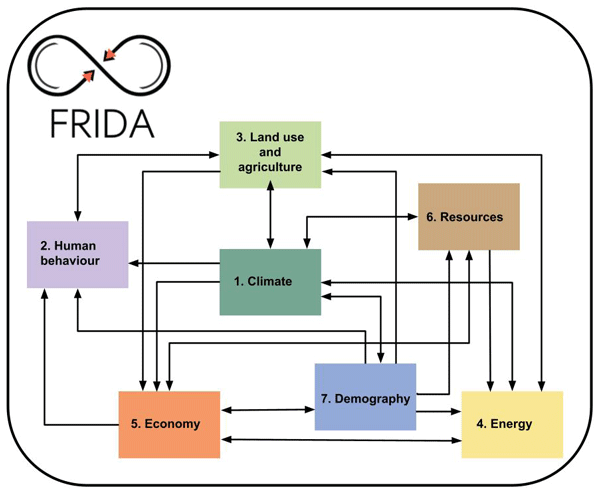
The FRIDA model. FRIDA integrates climate forcing, human behavior, land use, energy, resources, demography, and the economy on equal footing. It is computationally light, transparent in design, and accessible to both expert and non-expert users. The model captures cascading socioeconomic risks and systemic feedbacks, which have been identified by the IPCC (Intergovernmental Panel on Climate Change) as among the most urgent and uncertain climate research issues.
Interactive discussion
Status: closed
-
RC1: 'Comment on egusphere-2025-4881', Page Kyle, 21 Feb 2026
-
AC1: 'Reply on RC1', Cecilie Mauritzen, 22 Apr 2026
Dear Reviewer 1,
I thank you greatly for your constructive review of the “This is FRIDA” manuscript, and have done my best to respond to your comments. I will address each one in the following.
- Authorship. I have added info briefly in the abstract. This in addition to the statement in the acknowledgements. The alternative was to include 35 co-authors, which seemed an overkill for such a light paper (but It can obviously be done if that is preferrable).
- informal language. I have removed the “do remember”-statements, and other informal statements that I found going through the manuscript.
- line 56: fixed
- lines 59-60: sentence removed.
- lines 51-54: fixed
- Credibility of projections.
- comparison of projections. done
- data input. done
- how many equations developed by team vs pulled from literature? the exact number not easy to determine, but I have added much information to exemplify what we’ve done.
- are the parameterizations designed with reference to existing projections from other models? no
- show some comparisons somewhere (figure 7 can’t be read). If done in subsequent papers then no issue. I’ve removed figure 7 (in fact, I’ve only kept two figures) but added a section on comparisons and many references to where the information can be found.
- endogenous vs external. Make discussion. done, see in particular the final section.
In addition I edited the manuscript wrt to comments from the second reviewer and updated the paper slightly based on new submissions to GMD after the first submission of this manuscript.
Citation: https://doi.org/10.5194/egusphere-2025-4881-AC1
-
AC1: 'Reply on RC1', Cecilie Mauritzen, 22 Apr 2026
-
RC2: 'Comment on egusphere-2025-4881', Anonymous Referee #2, 24 Mar 2026
This paper acts as an overview of a collection of papers for the FRIDA model. As such it is not an original research article, but rather a high-level overview of the FRIDA model, with more details provided in relevant paper. As such my comments do not focus on the scientific aspects of FRIDA, but rather on the clarity of this manuscript as such an overview.
While the paper does indeed cover most of the aspects one would expect from an overview, I feel that the current structure of document is not helpful in order to convey a clear message. It seems to me that information is not given in a clear order, and some sections seems bit out of place. Section 3 doesn’t seem to have a clear purpose and gives snippets of information with no clear reasoning. Furthermore, section 5 provides a deep dive on the drivers of climate change, which seems a bit superfluous and not necessary for this paper.
I would propose the author considers revising the paper in order to provide a clearer structure. While reading the paper I felt that something along the lines of my below proposal (with relevant sub-sections) might make sense. I am not suggesting the author takes on my suggestion as is, but I think they should seriously consider how information is communicated to the reader, and the below can perhaps be a guide. If the Authors think the current structure has merit, I am also OK with that, but then a lot of the wording would have to improve to make this clear. My proposed structure has 6 sections, each with a specific goal, and in the sub-bullets I indicate how the sections of the current draft may fit in this revised structure.
- Knowledge gap FRIDA aims to cover, including the shortcomings of existing models/scenarios
- Current section 1
- Design and requirements of FRIDA
- Current introduction to section 2, and first paragraph of section 2.1
- Structure of the model
- Section 4
- First two paragraphs of section 3
- Short sub-sections for each of the systems shown in figure 3. These sub-sections can include a lot of what is currently in section 6 (for the climate module) and perhaps figures 4 and 5)
- Running, validation, and calibration
- Section 7
- Second paragraph of section 2.1
- 3rd paragraph of section 3 (with more detail)
- Using FRIDA
- 4th paragraph of section 3
- Current sections 8 and 9
- Part of my motivation of combining section 8 and 9 is that given the low geographic resolution of FRIDA, as well as its highly stylized design, giving precise policy advice is limited. However FRIDA is extremely powerful as an educational tool
- How FRIDA complements existing models/scenarios
- What has Frida brought to the table that was missing? Snippets of this information is provided throughout the current draft, but it would be useful to bring is all together in one clear place.
- Most of section 10
- Current lines: 207-211, 224, 259, 271,
Finally, as this paper acts as an introduction to a collection of papers, it would be really nice if at the end there was a paragraph highlighting what is available in the collection. Perhaps one sentence per paper, indicating what the reader can find within the collection.
Detailed comments:
- Lines 29-30: Please provide a reference for the “already observed” dangerous climate change impacts
- In figure 2 it is mentioned that the model is “calibrated with observations from the period 1980 to 2023”. More information on calibration would be very useful so readers can understand the purpose of the model better. What are the main inputs/outputs that are calibrated? What are the datasets? Is any specific processing done during calibration?
- Lines 134-135: Validation is mentioned, but not elaborated upon. As mentioned, I understand that calibration, validation and uncertainty are described in Schoenberg et al (2025), but it would be useful in this overview paper to have a very brief overview of these aspects. Just a few sentences would be enough to convey the message, and readers interested in more details can consult the specific paper.
Citation: https://doi.org/10.5194/egusphere-2025-4881-RC2 -
AC2: 'Reply on RC2', Cecilie Mauritzen, 22 Apr 2026
Dear Reviewer 2,
I thank you greatly for your constructive review of the “This is FRIDA” manuscript, and have done my best to respond to your comments. I will address each one in the following.
- Structure of paper: I do agree that the structure can be improved in order to clarify the messages, and I am grateful for you proposed order, which I have followed, except for a couple of places:
- I cannot present “running the model” together with “calibration and validation” - the latter is a specific process, which - although it includes running the model - is must be done before one can run the model for analysis and experimentation. I hope that makes sense,
- Since the FRIDA collection in GMD has progressed greatly since the submission of this introductory paper, I have chosen to make references to the individual module documentations instead of describing each module.
- Combine sections 8 and 9. Done.
- Mention each of the papers in the the collection. I have made these references much more systematically.
- On the detailed comments:
- reference to “already observed dangerous climate change impacts: done
- calibration and uncertainty: I have added a section to explain these work processes, and made the reference to the Schoenberg et al paper more visible. I decided not to dwell on the validation process because it is more straight-forward and fully explained in the Schoenberg paper. Hope this makes sense.
In addition I edited the manuscript wrt to comments from the first reviewer and updated the paper slightly based on new submissions to GMD after the first submission of this manuscript.
Citation: https://doi.org/10.5194/egusphere-2025-4881-AC2
- Knowledge gap FRIDA aims to cover, including the shortcomings of existing models/scenarios


Interactive discussion
Status: closed
-
RC1: 'Comment on egusphere-2025-4881', Page Kyle, 21 Feb 2026
For this paper as a stand-alone paper, I don't have much to recommend for revisions; as noted in the section 1 (Introduction), this paper is intended itself as a preliminary introduction to a number of papers, some of which are already written and available online. I did not review those other papers in support of providing these comments, so I don't know if any changes are warranted, to address my questions below.
The paper is written as if by a team ("we"), but there is only one author listed. Perhaps it should be clarified up-front that this author is writing on behalf of a larger team? The language is at times informal, not consistent with how scientific papers are normally written ("Do remember, though,..."). There's an uncapitalized sentence fragment in line 56, and an underlined sentence in lines 59-60. Lines 51-54 have two back-to-back single-sentence paragraphs.
My biggest questions pertain to the credibility of the projections coming from the model. However, this specific introductory paper is probably not the place to address this concern, and to provide the comparisons between FRIDA and the existing body of projections to 2100. Similarly I am wondering about the key data inputs to the model. Is it trained purely on statistical and historical data? How many of the equations used for projections were pulled from the literature or other models, as opposed to developed by this team? Are the parameterization designed with reference to existing projections from other models?
Within the paper, the only results shown are in Figure 7, where the figure is too small/blurry to interpret; the purpose of the figure seems primarily to show that results can be produced. Still, for a paper documenting the existence of a new model, it seems pretty basic that some projections of common scenarios ought to be run and compared with the existing published body of scenarios (e.g., AR6). Again, if this is done in subsequent papers then there is no issue here.
On a similar note, the author continually stresses the very high portion of endogenous variables in the model, i.e. that there are very few exogenous variable specified. This seems a worthy aspiration in general, but care should be taken to ensure that making a variable endogenous actually improves the quality of the projected outcomes. In the current generation of IA models, the major exogenous assumptions (e.g., population, GDP, techno-economic characteristics of energy technologies) can act as guardrails on future modeled outcomes. Some acknowledgment of this fact seems warranted, along with discussion of whether constraints on variables were applied, whether exogenously or simply within the equations used for projecting.
Citation: https://doi.org/10.5194/egusphere-2025-4881-RC1 -
AC1: 'Reply on RC1', Cecilie Mauritzen, 22 Apr 2026
Dear Reviewer 1,
I thank you greatly for your constructive review of the “This is FRIDA” manuscript, and have done my best to respond to your comments. I will address each one in the following.
- Authorship. I have added info briefly in the abstract. This in addition to the statement in the acknowledgements. The alternative was to include 35 co-authors, which seemed an overkill for such a light paper (but It can obviously be done if that is preferrable).
- informal language. I have removed the “do remember”-statements, and other informal statements that I found going through the manuscript.
- line 56: fixed
- lines 59-60: sentence removed.
- lines 51-54: fixed
- Credibility of projections.
- comparison of projections. done
- data input. done
- how many equations developed by team vs pulled from literature? the exact number not easy to determine, but I have added much information to exemplify what we’ve done.
- are the parameterizations designed with reference to existing projections from other models? no
- show some comparisons somewhere (figure 7 can’t be read). If done in subsequent papers then no issue. I’ve removed figure 7 (in fact, I’ve only kept two figures) but added a section on comparisons and many references to where the information can be found.
- endogenous vs external. Make discussion. done, see in particular the final section.
In addition I edited the manuscript wrt to comments from the second reviewer and updated the paper slightly based on new submissions to GMD after the first submission of this manuscript.
Citation: https://doi.org/10.5194/egusphere-2025-4881-AC1
-
AC1: 'Reply on RC1', Cecilie Mauritzen, 22 Apr 2026
-
RC2: 'Comment on egusphere-2025-4881', Anonymous Referee #2, 24 Mar 2026
This paper acts as an overview of a collection of papers for the FRIDA model. As such it is not an original research article, but rather a high-level overview of the FRIDA model, with more details provided in relevant paper. As such my comments do not focus on the scientific aspects of FRIDA, but rather on the clarity of this manuscript as such an overview.
While the paper does indeed cover most of the aspects one would expect from an overview, I feel that the current structure of document is not helpful in order to convey a clear message. It seems to me that information is not given in a clear order, and some sections seems bit out of place. Section 3 doesn’t seem to have a clear purpose and gives snippets of information with no clear reasoning. Furthermore, section 5 provides a deep dive on the drivers of climate change, which seems a bit superfluous and not necessary for this paper.
I would propose the author considers revising the paper in order to provide a clearer structure. While reading the paper I felt that something along the lines of my below proposal (with relevant sub-sections) might make sense. I am not suggesting the author takes on my suggestion as is, but I think they should seriously consider how information is communicated to the reader, and the below can perhaps be a guide. If the Authors think the current structure has merit, I am also OK with that, but then a lot of the wording would have to improve to make this clear. My proposed structure has 6 sections, each with a specific goal, and in the sub-bullets I indicate how the sections of the current draft may fit in this revised structure.
- Knowledge gap FRIDA aims to cover, including the shortcomings of existing models/scenarios
- Current section 1
- Design and requirements of FRIDA
- Current introduction to section 2, and first paragraph of section 2.1
- Structure of the model
- Section 4
- First two paragraphs of section 3
- Short sub-sections for each of the systems shown in figure 3. These sub-sections can include a lot of what is currently in section 6 (for the climate module) and perhaps figures 4 and 5)
- Running, validation, and calibration
- Section 7
- Second paragraph of section 2.1
- 3rd paragraph of section 3 (with more detail)
- Using FRIDA
- 4th paragraph of section 3
- Current sections 8 and 9
- Part of my motivation of combining section 8 and 9 is that given the low geographic resolution of FRIDA, as well as its highly stylized design, giving precise policy advice is limited. However FRIDA is extremely powerful as an educational tool
- How FRIDA complements existing models/scenarios
- What has Frida brought to the table that was missing? Snippets of this information is provided throughout the current draft, but it would be useful to bring is all together in one clear place.
- Most of section 10
- Current lines: 207-211, 224, 259, 271,
Finally, as this paper acts as an introduction to a collection of papers, it would be really nice if at the end there was a paragraph highlighting what is available in the collection. Perhaps one sentence per paper, indicating what the reader can find within the collection.
Detailed comments:
- Lines 29-30: Please provide a reference for the “already observed” dangerous climate change impacts
- In figure 2 it is mentioned that the model is “calibrated with observations from the period 1980 to 2023”. More information on calibration would be very useful so readers can understand the purpose of the model better. What are the main inputs/outputs that are calibrated? What are the datasets? Is any specific processing done during calibration?
- Lines 134-135: Validation is mentioned, but not elaborated upon. As mentioned, I understand that calibration, validation and uncertainty are described in Schoenberg et al (2025), but it would be useful in this overview paper to have a very brief overview of these aspects. Just a few sentences would be enough to convey the message, and readers interested in more details can consult the specific paper.
Citation: https://doi.org/10.5194/egusphere-2025-4881-RC2 -
AC2: 'Reply on RC2', Cecilie Mauritzen, 22 Apr 2026
Dear Reviewer 2,
I thank you greatly for your constructive review of the “This is FRIDA” manuscript, and have done my best to respond to your comments. I will address each one in the following.
- Structure of paper: I do agree that the structure can be improved in order to clarify the messages, and I am grateful for you proposed order, which I have followed, except for a couple of places:
- I cannot present “running the model” together with “calibration and validation” - the latter is a specific process, which - although it includes running the model - is must be done before one can run the model for analysis and experimentation. I hope that makes sense,
- Since the FRIDA collection in GMD has progressed greatly since the submission of this introductory paper, I have chosen to make references to the individual module documentations instead of describing each module.
- Combine sections 8 and 9. Done.
- Mention each of the papers in the the collection. I have made these references much more systematically.
- On the detailed comments:
- reference to “already observed dangerous climate change impacts: done
- calibration and uncertainty: I have added a section to explain these work processes, and made the reference to the Schoenberg et al paper more visible. I decided not to dwell on the validation process because it is more straight-forward and fully explained in the Schoenberg paper. Hope this makes sense.
In addition I edited the manuscript wrt to comments from the first reviewer and updated the paper slightly based on new submissions to GMD after the first submission of this manuscript.
Citation: https://doi.org/10.5194/egusphere-2025-4881-AC2
- Knowledge gap FRIDA aims to cover, including the shortcomings of existing models/scenarios
Peer review completion


Journal article(s) based on this preprint
The FRIDA model. FRIDA integrates climate forcing, human behavior, land use, energy, resources, demography, and the economy on equal footing. It is computationally light, transparent in design, and accessible to both expert and non-expert users. The model captures cascading socioeconomic risks and systemic feedbacks, which have been identified by the IPCC (Intergovernmental Panel on Climate Change) as among the most urgent and uncertain climate research issues.
Viewed
| HTML | XML | Total | BibTeX | EndNote | |
|---|---|---|---|---|---|
| 1,395 | 761 | 133 | 2,289 | 84 | 82 |
- HTML: 1,395
- PDF: 761
- XML: 133
- Total: 2,289
- BibTeX: 84
- EndNote: 82
Viewed (geographical distribution)
| Country | # | Views | % |
|---|
| Total: | 0 |
| HTML: | 0 |
| PDF: | 0 |
| XML: | 0 |
- 1
The requested preprint has a corresponding peer-reviewed final revised paper. You are encouraged to refer to the final revised version.
- Preprint
(1101 KB) - Metadata XML
For this paper as a stand-alone paper, I don't have much to recommend for revisions; as noted in the section 1 (Introduction), this paper is intended itself as a preliminary introduction to a number of papers, some of which are already written and available online. I did not review those other papers in support of providing these comments, so I don't know if any changes are warranted, to address my questions below.
The paper is written as if by a team ("we"), but there is only one author listed. Perhaps it should be clarified up-front that this author is writing on behalf of a larger team? The language is at times informal, not consistent with how scientific papers are normally written ("Do remember, though,..."). There's an uncapitalized sentence fragment in line 56, and an underlined sentence in lines 59-60. Lines 51-54 have two back-to-back single-sentence paragraphs.
My biggest questions pertain to the credibility of the projections coming from the model. However, this specific introductory paper is probably not the place to address this concern, and to provide the comparisons between FRIDA and the existing body of projections to 2100. Similarly I am wondering about the key data inputs to the model. Is it trained purely on statistical and historical data? How many of the equations used for projections were pulled from the literature or other models, as opposed to developed by this team? Are the parameterization designed with reference to existing projections from other models?
Within the paper, the only results shown are in Figure 7, where the figure is too small/blurry to interpret; the purpose of the figure seems primarily to show that results can be produced. Still, for a paper documenting the existence of a new model, it seems pretty basic that some projections of common scenarios ought to be run and compared with the existing published body of scenarios (e.g., AR6). Again, if this is done in subsequent papers then there is no issue here.
On a similar note, the author continually stresses the very high portion of endogenous variables in the model, i.e. that there are very few exogenous variable specified. This seems a worthy aspiration in general, but care should be taken to ensure that making a variable endogenous actually improves the quality of the projected outcomes. In the current generation of IA models, the major exogenous assumptions (e.g., population, GDP, techno-economic characteristics of energy technologies) can act as guardrails on future modeled outcomes. Some acknowledgment of this fact seems warranted, along with discussion of whether constraints on variables were applied, whether exogenously or simply within the equations used for projecting.