
the Creative Commons Attribution 4.0 License.
the Creative Commons Attribution 4.0 License.
 | 15 Jan 2026
Implementation of a three-dimensional planetary boundary layer parameterization in a coupled modeling system and evaluation of "gray zone" simulations of a wind-wave event off the U.S. California Coast using observations
Abstract. A three-dimensional (3D) planetary boundary layer (PBL) parameterization was added to the Coupled Ocean Atmosphere Wave Sediment Transport (COAWST) model and the first coupled atmosphere/wave "gray zone" simulations were carried out using the 3D PBL parameterization. A case study of a significant wind-wave event from Nov. 4–8, 2020 off the U.S. west coast was examined, with a focus on the impacts of the event within an approximate 280 × 280 km central California coastal region covering the Bureau of Ocean Energy Management Morro Bay wind energy lease area. Simulations with both one-dimensional (1D; Yonsei University) and 3D PBL parameterizations were examined in this nest with Δx = 400 m. Two way coupling was active, with near-surface winds feeding back to the wave model and bulk wave statistics feeding back to the atmospheric model. Both simulations compared favorably with buoy observations in capturing the timing and magnitude of wind speed, temperature, dewpoint, and significant wave height, as the front associated with the maritime weather system moved southward across coastal California. However, wind speed errors over land were larger. Time series of the vertical profile of winds below z = 250 m from the simulations compared favorably with observations from the U. S. Dept. of Energy Morro Bay Doppler lidar buoy. Differences between the coupled 1D and 3D PBL simulations were minor. The most notable difference was that the simulation using the 3D PBL parameterization had approximately 10 % weaker winds at the peak of the event causing 10 % lower significant wave heights. This difference was shown to be mostly due to differences in the vertical mixing treatment between the parameterizations, in particular the nonlocal downward mixing of higher momentum air in the 1D Yonsei University parameterization in convective conditions. Overall, this work demonstrates that the 3D PBL parameterization can be used in a coupled atmosphere / wave modeling framework with similar behaviors as traditional PBL parameterizations that don't provide horizontal turbulent variances and fluxes.
-
Notice on discussion status
The requested preprint has a corresponding peer-reviewed final revised paper. You are encouraged to refer to the final revised version.
-
Preprint
(25871 KB)
-
The requested preprint has a corresponding peer-reviewed final revised paper. You are encouraged to refer to the final revised version.
- Preprint
(25871 KB) - Metadata XML
- BibTeX
- EndNote
- Final revised paper


Journal article(s) based on this preprint
Interactive discussion
Status: closed
-
CEC1: 'Comment on egusphere-2025-4862 - No compliance with the policy of the journal', Juan Antonio Añel, 11 Feb 2026
-
AC1: 'Reply on CEC1', Eric Hendricks, 11 Feb 2026
Dear Chief Editor,
Our responses to your comments are given below in bold.
You have archived your code and data in web pages and sites, such as GitHub or NCAR webs, which do not comply with the requirements of the policy of the journal. Given this, your manuscript should have not been accepted for peer-review and Discussions in the journal. Therefore, the current situation is irregular.
We are sorry for the confusion. The code and data have been archived on Zenodo at https://doi.org/10.5281/zenodo.18157794. Additionally, we provide Github and dataset URLs. However, everything in the Github and other URLs are self-contained in the Zenodo archive, which is one of the suitable archival locations listed in the journal guidance page.
The GMD review and publication process depends on reviewers and community commentators being able to access, during the discussion phase, the code and data on which a manuscript depends, and on ensuring the provenance and replicability of the papers published years after its publication. Please, therefore, publish your code and data in one of the appropriate repositories and reply to this comment with the relevant information (link and a permanent identifier for it (e.g. DOI)) as soon as possible. We cannot have manuscripts under discussion that do not comply with our policy.
We published our code and data in the Zenodo archive with the permanent DOI identifier, so this comment is incorrect. We are complying with the journal policy.
The 'Code and Data Availability’ section must also be modified to cite the new repository locations, and corresponding references added to the bibliography.
The Chief Editor is correct, and unfortunately the Zenodo archive was accidentally not added to the bibliography. I will address this comment by changing the statement in 'Code and Data Availability' to:
The namelists, observations, forcing files, and COAWST codebases used in this study have been archived to Zenodo at https://doi.org/10.5281/zenodo.18157794 (COAWST 1D and 3D PBL simulation codebases, namelists, and observations).
The following will be added to the references in the revision:
COAWST 1D and 3D PBL simulation codebases, namelists and observations Zenodo [data set], https://doi.org/10.5281/zenodo.18157794, 2026.
Sincerely,
Eric HendricksCitation: https://doi.org/10.5194/egusphere-2025-4862-AC1 -
CEC2: 'Reply on AC1', Juan Antonio Añel, 11 Feb 2026
Dear authors,
Many thanks for the quick reply. Please, to avoid additional confusion, remove from the text all the citations and links to sites that do not serve the purpose of the Code and Data Availability policy of the journal. However, it is not clear right now if the Zenodo repository that you mention contains the data from the third party sites necessary to replicate your work that you mention. Please, clarify it.
Juan A. Añel
Geosci. Model Dev. Executive Editor
Citation: https://doi.org/10.5194/egusphere-2025-4862-CEC2 -
AC2: 'Reply on CEC2', Eric Hendricks, 12 Feb 2026
Dear Chief Editor,
In our revision, we will make sure to remove from the text all the citations and links to sites that do not serve the purpose of the Code and Data Availability policy. The Zenodo repository contains the data from the third party sites necessary to replicate our work. We will be sure to clarify that.
Eric Hendricks
Citation: https://doi.org/10.5194/egusphere-2025-4862-AC2
-
AC2: 'Reply on CEC2', Eric Hendricks, 12 Feb 2026
-
CEC2: 'Reply on AC1', Juan Antonio Añel, 11 Feb 2026
-
AC1: 'Reply on CEC1', Eric Hendricks, 11 Feb 2026
-
RC1: 'Comment on egusphere-2025-4862', Anonymous Referee #1, 16 Feb 2026
This paper documents the validation of a relatively new 3D PBL scheme in an offshore application
coupled to a wave model making it a state-of-the-science study well worth publishing. All my
comments on this are relatively minor and I will list them below.1. The main thing I would like to have seen is how the coupling is done to the wave model. This
is something still not seen very often and it would be helpful to spell it out. I am aware that
directional drags could also be implemented in such coupling and whether or not this is done
should be mentioned. I assume the wave height and period come into the roughness length somehow.
I believe this would add to the completeness of the paper.2. Figure 6. Caption does not mention that potential temperature is also shown.
3. Line 209 and Figure 10. "1800 UTC Nov 6". The observed winds don't show a maximum at that
time (or any observations).4. Line 229 and Figure 12. "0600 UTC Nov 6". This is not a time shown in Figure 12.
5. Line 261. "full 3D PBL". May be helpful to add a "wherein..." here as I had to search back
through the paper to find what the full option was.6. Overall while the differences were marginal, it was good to see the surface and lidar data
validating the coupled model. If any simulations were carried out without coupling the wave
model, it would have been interesting to see a note on whether that helped or why a wave
model was coupled.Citation: https://doi.org/10.5194/egusphere-2025-4862-RC1 - AC3: 'Reply on RC1', Eric Hendricks, 13 May 2026
-
RC2: 'Comment on egusphere-2025-4862', Anonymous Referee #2, 07 Apr 2026
This study is valuable in that it applies and evaluates the performance of a 3D PBL scheme with high potential at a time when high-resolution simulations are predominant. I provide several minor comments below.
Specific comments:
Fig. 1a: It would be beneficial to replace this with a higher-resolution figure. Improving the overall visual quality would help (e.g., adding latitude/longitude labels and making key information readily visible before reading the caption).
Fig. 2: Axis titles and units for the color bar should be clearly indicated. The presence of an outer map may lead to a misunderstanding that domains 1 and 2 are configured in a particular way. It might be clearer to present the full domains (d01 and d02) alongside a zoomed-in view of domain 2 in parallel.
L121: Please clarify under what assumptions the approximated 3D PBL parameterization can be applied.
L137: The phrase “region of interest near the WRF model d02” is somewhat ambiguous. Is domain 2 not the primary region of interest? A more explicit description or a corresponding map would improve clarity.L149: Please revise to explicitly state “less westerly and stronger over the ocean *than the 3D PBL.*”
L149: The hub height of 206.5 m—what is the basis for this value, and how is it derived within the model?
Fig. 6: The repeated references to time in the caption could be streamlined. Additionally, please clarify the meaning of each line shown in the figure.
Figs. 7, 8, 9: It would be preferable to place labels on the first panel rather than the middle. Also, repeating the terms “Bias/MAE” on every panel seems unnecessary.
Fig. 7: Is it appropriate to directly compare 10-m wind with wind at buoy measurement height?
L209–210: Is this analysis valid without observational data? It is unclear whether winds in domain 1 are consistently underestimated beyond the MRY site.
L210, Fig. 10: The SPB site was previously abbreviated as SBP; please ensure consistency.
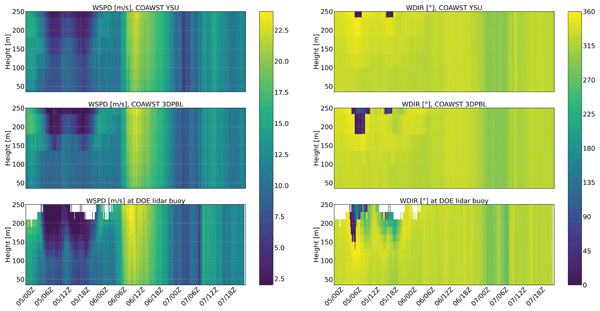
Sections 3.4–3.5: The comparison with buoy and Doppler lidar observations lacks a clear emphasis or key takeaway, and currently reads as largely descriptive.
L271: Please clearly denote this as the “approximated 3D PBL.”
L301: It appears that the 3D PBL code is not included in commit #843f8be. Please update this to reflect the most recent commit hash.
Citation: https://doi.org/10.5194/egusphere-2025-4862-RC2 -
RC3: 'Reply on RC2', Anonymous Referee #2, 09 Apr 2026
I would like to offer a few additional comments.
- L87: Please specify the version of the model used in this study.
- L92: Since ERA5 has a horizontal resolution of 0.25°, it would be helpful to clarify whether it is appropriate to run the experiment at such a high resolution (2 km) directly in d01.
- L94: Please provide the model top (upper bound) value.
- Figure 3: Please indicate the reference vector in the figure.
- Overall: If the differences among the experiments are explained solely in terms of non-local mixing term, the justification for using the 3D PBL parameterization may appear somewhat limited. It may therefore be beneficial to further interpret the results from the perspective of horizontal turbulence as well.
Citation: https://doi.org/10.5194/egusphere-2025-4862-RC3 - AC4: 'Reply on RC3', Eric Hendricks, 13 May 2026
-
RC3: 'Reply on RC2', Anonymous Referee #2, 09 Apr 2026
Peer review completion


Interactive discussion
Status: closed
-
CEC1: 'Comment on egusphere-2025-4862 - No compliance with the policy of the journal', Juan Antonio Añel, 11 Feb 2026
Dear authors,
Unfortunately, after checking your manuscript, it has come to our attention that it does not comply with our "Code and Data Policy".
https://www.geoscientific-model-development.net/policies/code_and_data_policy.html
You have archived your code and data in web pages and sites, such as GitHub or NCAR webs, which do not comply with the requirements of the policy of the journal. Given this, your manuscript should have not been accepted for peer-review and Discussions in the journal. Therefore, the current situation is irregular.
The GMD review and publication process depends on reviewers and community commentators being able to access, during the discussion phase, the code and data on which a manuscript depends, and on ensuring the provenance and replicability of the papers published years after its publication. Please, therefore, publish your code and data in one of the appropriate repositories and reply to this comment with the relevant information (link and a permanent identifier for it (e.g. DOI)) as soon as possible. We cannot have manuscripts under discussion that do not comply with our policy.
The 'Code and Data Availability’ section must also be modified to cite the new repository locations, and corresponding references added to the bibliography.
I must note that if you do not fix this problem, we cannot continue with the peer-review process or accept your manuscript for publication in GMD.
Juan A. Añel
Geosci. Model Dev. Executive EditorCitation: https://doi.org/10.5194/egusphere-2025-4862-CEC1 -
AC1: 'Reply on CEC1', Eric Hendricks, 11 Feb 2026
Dear Chief Editor,
Our responses to your comments are given below in bold.
You have archived your code and data in web pages and sites, such as GitHub or NCAR webs, which do not comply with the requirements of the policy of the journal. Given this, your manuscript should have not been accepted for peer-review and Discussions in the journal. Therefore, the current situation is irregular.
We are sorry for the confusion. The code and data have been archived on Zenodo at https://doi.org/10.5281/zenodo.18157794. Additionally, we provide Github and dataset URLs. However, everything in the Github and other URLs are self-contained in the Zenodo archive, which is one of the suitable archival locations listed in the journal guidance page.
The GMD review and publication process depends on reviewers and community commentators being able to access, during the discussion phase, the code and data on which a manuscript depends, and on ensuring the provenance and replicability of the papers published years after its publication. Please, therefore, publish your code and data in one of the appropriate repositories and reply to this comment with the relevant information (link and a permanent identifier for it (e.g. DOI)) as soon as possible. We cannot have manuscripts under discussion that do not comply with our policy.
We published our code and data in the Zenodo archive with the permanent DOI identifier, so this comment is incorrect. We are complying with the journal policy.
The 'Code and Data Availability’ section must also be modified to cite the new repository locations, and corresponding references added to the bibliography.
The Chief Editor is correct, and unfortunately the Zenodo archive was accidentally not added to the bibliography. I will address this comment by changing the statement in 'Code and Data Availability' to:
The namelists, observations, forcing files, and COAWST codebases used in this study have been archived to Zenodo at https://doi.org/10.5281/zenodo.18157794 (COAWST 1D and 3D PBL simulation codebases, namelists, and observations).
The following will be added to the references in the revision:
COAWST 1D and 3D PBL simulation codebases, namelists and observations Zenodo [data set], https://doi.org/10.5281/zenodo.18157794, 2026.
Sincerely,
Eric HendricksCitation: https://doi.org/10.5194/egusphere-2025-4862-AC1 -
CEC2: 'Reply on AC1', Juan Antonio Añel, 11 Feb 2026
Dear authors,
Many thanks for the quick reply. Please, to avoid additional confusion, remove from the text all the citations and links to sites that do not serve the purpose of the Code and Data Availability policy of the journal. However, it is not clear right now if the Zenodo repository that you mention contains the data from the third party sites necessary to replicate your work that you mention. Please, clarify it.
Juan A. Añel
Geosci. Model Dev. Executive Editor
Citation: https://doi.org/10.5194/egusphere-2025-4862-CEC2 -
AC2: 'Reply on CEC2', Eric Hendricks, 12 Feb 2026
Dear Chief Editor,
In our revision, we will make sure to remove from the text all the citations and links to sites that do not serve the purpose of the Code and Data Availability policy. The Zenodo repository contains the data from the third party sites necessary to replicate our work. We will be sure to clarify that.
Eric Hendricks
Citation: https://doi.org/10.5194/egusphere-2025-4862-AC2
-
AC2: 'Reply on CEC2', Eric Hendricks, 12 Feb 2026
-
CEC2: 'Reply on AC1', Juan Antonio Añel, 11 Feb 2026
-
AC1: 'Reply on CEC1', Eric Hendricks, 11 Feb 2026
-
RC1: 'Comment on egusphere-2025-4862', Anonymous Referee #1, 16 Feb 2026
This paper documents the validation of a relatively new 3D PBL scheme in an offshore application
coupled to a wave model making it a state-of-the-science study well worth publishing. All my
comments on this are relatively minor and I will list them below.1. The main thing I would like to have seen is how the coupling is done to the wave model. This
is something still not seen very often and it would be helpful to spell it out. I am aware that
directional drags could also be implemented in such coupling and whether or not this is done
should be mentioned. I assume the wave height and period come into the roughness length somehow.
I believe this would add to the completeness of the paper.2. Figure 6. Caption does not mention that potential temperature is also shown.
3. Line 209 and Figure 10. "1800 UTC Nov 6". The observed winds don't show a maximum at that
time (or any observations).4. Line 229 and Figure 12. "0600 UTC Nov 6". This is not a time shown in Figure 12.
5. Line 261. "full 3D PBL". May be helpful to add a "wherein..." here as I had to search back
through the paper to find what the full option was.6. Overall while the differences were marginal, it was good to see the surface and lidar data
validating the coupled model. If any simulations were carried out without coupling the wave
model, it would have been interesting to see a note on whether that helped or why a wave
model was coupled.Citation: https://doi.org/10.5194/egusphere-2025-4862-RC1 - AC3: 'Reply on RC1', Eric Hendricks, 13 May 2026
-
RC2: 'Comment on egusphere-2025-4862', Anonymous Referee #2, 07 Apr 2026
This study is valuable in that it applies and evaluates the performance of a 3D PBL scheme with high potential at a time when high-resolution simulations are predominant. I provide several minor comments below.
Specific comments:
Fig. 1a: It would be beneficial to replace this with a higher-resolution figure. Improving the overall visual quality would help (e.g., adding latitude/longitude labels and making key information readily visible before reading the caption).
Fig. 2: Axis titles and units for the color bar should be clearly indicated. The presence of an outer map may lead to a misunderstanding that domains 1 and 2 are configured in a particular way. It might be clearer to present the full domains (d01 and d02) alongside a zoomed-in view of domain 2 in parallel.
L121: Please clarify under what assumptions the approximated 3D PBL parameterization can be applied.
L137: The phrase “region of interest near the WRF model d02” is somewhat ambiguous. Is domain 2 not the primary region of interest? A more explicit description or a corresponding map would improve clarity.L149: Please revise to explicitly state “less westerly and stronger over the ocean *than the 3D PBL.*”
L149: The hub height of 206.5 m—what is the basis for this value, and how is it derived within the model?
Fig. 6: The repeated references to time in the caption could be streamlined. Additionally, please clarify the meaning of each line shown in the figure.
Figs. 7, 8, 9: It would be preferable to place labels on the first panel rather than the middle. Also, repeating the terms “Bias/MAE” on every panel seems unnecessary.
Fig. 7: Is it appropriate to directly compare 10-m wind with wind at buoy measurement height?
L209–210: Is this analysis valid without observational data? It is unclear whether winds in domain 1 are consistently underestimated beyond the MRY site.
L210, Fig. 10: The SPB site was previously abbreviated as SBP; please ensure consistency.
Sections 3.4–3.5: The comparison with buoy and Doppler lidar observations lacks a clear emphasis or key takeaway, and currently reads as largely descriptive.
L271: Please clearly denote this as the “approximated 3D PBL.”
L301: It appears that the 3D PBL code is not included in commit #843f8be. Please update this to reflect the most recent commit hash.
Citation: https://doi.org/10.5194/egusphere-2025-4862-RC2 -
RC3: 'Reply on RC2', Anonymous Referee #2, 09 Apr 2026
I would like to offer a few additional comments.
- L87: Please specify the version of the model used in this study.
- L92: Since ERA5 has a horizontal resolution of 0.25°, it would be helpful to clarify whether it is appropriate to run the experiment at such a high resolution (2 km) directly in d01.
- L94: Please provide the model top (upper bound) value.
- Figure 3: Please indicate the reference vector in the figure.
- Overall: If the differences among the experiments are explained solely in terms of non-local mixing term, the justification for using the 3D PBL parameterization may appear somewhat limited. It may therefore be beneficial to further interpret the results from the perspective of horizontal turbulence as well.
Citation: https://doi.org/10.5194/egusphere-2025-4862-RC3 - AC4: 'Reply on RC3', Eric Hendricks, 13 May 2026
-
RC3: 'Reply on RC2', Anonymous Referee #2, 09 Apr 2026
Peer review completion
Journal article(s) based on this preprint
Viewed
| HTML | XML | Total | BibTeX | EndNote | |
|---|---|---|---|---|---|
| 1,468 | 744 | 192 | 2,404 | 142 | 177 |
- HTML: 1,468
- PDF: 744
- XML: 192
- Total: 2,404
- BibTeX: 142
- EndNote: 177
Viewed (geographical distribution)
| Country | # | Views | % |
|---|
| Total: | 0 |
| HTML: | 0 |
| PDF: | 0 |
| XML: | 0 |
- 1

Timothy W. Juliano
Branko Kosović
Sue Haupt
Brian J. Gaudet
The requested preprint has a corresponding peer-reviewed final revised paper. You are encouraged to refer to the final revised version.
- Preprint
(25871 KB) - Metadata XML
Dear authors,
Unfortunately, after checking your manuscript, it has come to our attention that it does not comply with our "Code and Data Policy".
https://www.geoscientific-model-development.net/policies/code_and_data_policy.html
You have archived your code and data in web pages and sites, such as GitHub or NCAR webs, which do not comply with the requirements of the policy of the journal. Given this, your manuscript should have not been accepted for peer-review and Discussions in the journal. Therefore, the current situation is irregular.
The GMD review and publication process depends on reviewers and community commentators being able to access, during the discussion phase, the code and data on which a manuscript depends, and on ensuring the provenance and replicability of the papers published years after its publication. Please, therefore, publish your code and data in one of the appropriate repositories and reply to this comment with the relevant information (link and a permanent identifier for it (e.g. DOI)) as soon as possible. We cannot have manuscripts under discussion that do not comply with our policy.
The 'Code and Data Availability’ section must also be modified to cite the new repository locations, and corresponding references added to the bibliography.
I must note that if you do not fix this problem, we cannot continue with the peer-review process or accept your manuscript for publication in GMD.
Juan A. Añel
Geosci. Model Dev. Executive Editor