
the Creative Commons Attribution 4.0 License.
the Creative Commons Attribution 4.0 License.
 | 09 Feb 2026
The NASA-GISS ModelE2.1-CC2 ESM: development and simulations
Abstract. This paper describes the NASA Goddard Institute for Space Studies (GISS) ModelE2.1-Carbon Cycle version 2 Earth System Model (NASA GISS E2.1-CC2 ESM), assesses its skill against observations and reports on its performance under future climate scenarios. The first version of GISS ESM (GISS‐E2.1‐G‐CC) was introduced in CMIP6, and therefore ModelE2.1-CC2 is a post CMIP6 release that includes the same physical climate model E2.1-G, updated ocean and land carbon cycle and longer equilibrium simulations. While the focus here is on the land and ocean carbon components and their interactions with atmosphere and ice, we also describe in detail the physical coupled model for consistency and ease of reference. We detail parameterizations, tuning, and conservation diagnostics that are relevant to the global (land & ocean) carbon cycle. We also describe a full suite of simulations performed with this model, including pre-industrial control, historical, and future climate scenarios. The model is an improvement to prior releases, has been better tuned and exhibits smaller drifts. However some persistent biases remain, particularly with regards to low ocean and land primary production. Results shown here are compared to previous versions of the model, as well as the state-of-the art in Earth system modeling via community intercomparisons.
-
Notice on discussion status
The requested preprint has a corresponding peer-reviewed final revised paper. You are encouraged to refer to the final revised version.
-
Preprint
(17741 KB)
-
Supplement
(9916 KB)
-
The requested preprint has a corresponding peer-reviewed final revised paper. You are encouraged to refer to the final revised version.
- Preprint
(17741 KB) - Metadata XML
-
Supplement
(9916 KB) - BibTeX
- EndNote
- Final revised paper


Journal article(s) based on this preprint
Interactive discussion
Status: closed
-
CEC1: 'Comment on egusphere-2025-4839 - No compliance with the policy of the journal', Juan Antonio Añel, 25 Mar 2026
-
AC1: 'Reply on CEC1', Anastasia Romanou, 26 Mar 2026
Hello, I am not sure what this is referring to. We have provided model code, software code and a zenodo link for data availability at the end of the manuscript. Let us know if you need more information.
Citation: https://doi.org/10.5194/egusphere-2025-4839-AC1 -
CEC2: 'Reply on AC1', Juan Antonio Añel, 26 Mar 2026
Dear authors,
Thanks for the quick reply. I had not seen the data.tar file in the Zenodo repository, and as in the Data Availability section you state that the provided links contains code, not data (you should fix it in a potentially reviewed version of your manuscript) and that "Data from these simulations are also available per request to the main author", I got confused. Apologies.
I can confirm that the current repositories provided contain the reasonable code and data to comply with the policy of the journal, and you can dismiss my previous comment.
Juan A. Añel
Geosci. Model Dev. Executive Editor
Citation: https://doi.org/10.5194/egusphere-2025-4839-CEC2 -
AC2: 'Reply on CEC2', Anastasia Romanou, 26 Mar 2026
No problem at all! Thank you for resolving this so quickly!
Citation: https://doi.org/10.5194/egusphere-2025-4839-AC2
-
AC2: 'Reply on CEC2', Anastasia Romanou, 26 Mar 2026
-
CEC2: 'Reply on AC1', Juan Antonio Añel, 26 Mar 2026
-
AC1: 'Reply on CEC1', Anastasia Romanou, 26 Mar 2026
-
RC1: 'Comment on egusphere-2025-4839', Anonymous Referee #1, 06 Apr 2026
Review of “The NASA-GISS ModelE2.1-1 CC2 ESM: development and simulations” by Romanou et al. submitted to GMD
Overview:
This manuscript presents the GISS ModelE2.1-CC2 Earth system model, a post-CMIP6 configuration with updated carbon cycle components, revised tuning, and extended equilibration. The documentation of model structure, tuning, and conservation is thorough and transparent, which is a clear strength and supports its use for long-term carbon cycle studies. However, the manuscript is overly long and attempts to address too many objectives, weakening its focus. The main scientific contributions are not clearly synthesized, and some limitations are not fully reflected in the interpretation. I therefore recommend major revision.
Major:
- The manuscript is overly long and lacks focus. It attempts to serve simultaneously as a model description, tuning documentation, conservation analysis, historical evaluation, and projection study, which diffuses the narrative and obscures the main contributions. Streamlining background material and emphasizing the new developments would improve clarity and impact. In particular, the section on future projections feels beyond the core scope of this work. The authors may consider separating the future scenario analysis into a standalone study, which would allow both manuscripts to present their key results more clearly and effectively.
- Several physical climate biases remain, including Arctic temperature, tropical precipitation, wind, and SST biases. These have direct implications for carbon cycle processes, yet their impacts are not clearly synthesized. A more integrated discussion linking physical biases to carbon cycle behavior is needed.
Other:
- Line 22: Please clarify what is meant by “particularly with regards to low ocean and land primary production.” It would be helpful to specify whether this refers to global mean biases, regional patterns, or comparisons with observations.
- Figure 6: The caption refers to fluxes at the ocean surface, yet the strongest signals appear over land regions (e.g., the Sahara). Please clarify what is being plotted and how land signals relate to ocean deposition.
- Starting with Figure 10: These figures appear to present the core results of the study and could be considered central to the manuscript. It is therefore unclear why earlier figures are given more prominence, as some seem more suitable for supplementary material. The overall figure hierarchy should be reconsidered to better highlight the main findings.
- Figures 10–11: It may be useful to include precipitation, as it is a key variable linking physical climate biases to both land and ocean carbon cycle processes.
- Lines 1051–1055: The discussion of model SST would benefit from including trends over the historical period. How do simulated SST trends compare with observations? In addition, the manuscript reports substantial mean-state SST biases, yet the current tuning strategy does not appear to prioritize their reduction. Given that SST is a primary driver of the climate system and strongly influences carbon cycle processes, the authors should clarify the rationale behind this choice and discuss its implications.
- Have you considered about a more direct comparison between this model and the first version model GISS-E2.1-G-CC?
Citation: https://doi.org/10.5194/egusphere-2025-4839-RC1 -
AC3: 'Reply on RC1', Anastasia Romanou, 16 Jun 2026
(Our responses shown in bold below)
Major:
- The manuscript is overly long and lacks focus. It attempts to serve simultaneously as a model description, tuning documentation, conservation analysis, historical evaluation, and projection study, which diffuses the narrative and obscures the main contributions. Streamlining background material and emphasizing the new developments would improve clarity and impact. In particular, the section on future projections feels beyond the core scope of this work. The authors may consider separating the future scenario analysis into a standalone study, which would allow both manuscripts to present their key results more clearly and effectively.
We thank the reviewer for the patience to go through such a long manuscript and the pertinent advice. In recognition of the reviewer’s request, we have shortened the text and include only the historical evaluation of the model, as well as the comparison with the previous version of the model that was submitted in CMIP6 (Ito et al, 2020). Therefore, the focus is clear, and hopefully more concise.
- Several physical climate biases remain, including Arctic temperature, tropical precipitation, wind, and SST biases. These have direct implications for carbon cycle processes, yet their impacts are not clearly synthesized. A more integrated discussion linking physical biases to carbon cycle behavior is needed.
Indeed the reviewer is correct, some of the biases remain – e.g. the Arctic distributions which are mostly affected by the physical model biases in the Arctic and which in turn are due to the fact that sea ice in E2.1 is part of the atmospheric grid, which is more coarse, and therefore unable to resolve sea ice movement across straits etc. This fact also distorts the ice-ocean fluxes as they are too smooth and not consistent with the higher resolution ocean currents.
Other:
oLine 22: Please clarify what is meant by “particularly with regards to low ocean and land primary production.” It would be helpful to specify whether this refers to global mean biases, regional patterns, or comparisons with observations.
This is now at the end of the abstract. The land carbon flux underestimation appears mainly in the Tropical rainforest regions due to physical model biases there (precipitation deficits) but also lack of complexity of Ent, which prescribes leaf area index and does not include deforestation, nitrogen fertilization and other processes. On the other hand the ocean carbon flux lies within the observational uncertainty defined from SOM-FFN and Carbon Tracker. Positive biases are associated with the convection sites in the North Atlantic where mixing is too deep. Net primary productivity in the ocean is underestimated everywhere compared to CAFÉ observations due to an problematic representation of the radiative transfer within the ocean and due to missing photoacclimation of phytoplankton. We have added this to the text and also in the abstract.
oFigure 6: The caption refers to fluxes at the ocean surface, yet the strongest signals appear over land regions (e.g., the Sahara). Please clarify what is being plotted and how land signals relate to ocean deposition.
Indeed, these are dust flux as they are generated from our atmospheric model and which are prescribed as a seasonal climatology to the ocean. This is now clarified in the text. The figure is in the Supplement (Fig. S1).
oStarting with Figure 10: These figures appear to present the core results of the study and could be considered central to the manuscript. It is therefore unclear why earlier figures are given more prominence, as some seem more suitable for supplementary material. The overall figure hierarchy should be reconsidered to better highlight the main findings.
We now have moved most of the introductory figures to the Supplemental material and focus on the PI and historical simulations analysis. Since the focus is not purely model evaluation the focus is placed on the historical simulation performance and secondarily the drift in the PI.
oFigures 10–11: It may be useful to include precipitation, as it is a key variable linking physical climate biases to both land and ocean carbon cycle processes.
Yes we now include global mean precipitation for the PI (Fig. 3). For the historical we show maps (Fig.5).
oLines 1051–1055: The discussion of model SST would benefit from including trends over the historical period. How do simulated SST trends compare with observations? In addition, the manuscript reports substantial mean-state SST biases, yet the current tuning strategy does not appear to prioritize their reduction. Given that SST is a primary driver of the climate system and strongly influences carbon cycle processes, the authors should clarify the rationale behind this choice and discuss its implications.
The SST trends are shown in the papers Kelley et al 2020 and Miller et al 2021. We only show global mean trends. The tuning process in E2.1 is (unfortunately) sequential. First the atmospheric component is tuned to prescribed SST and then the atmosphere is coupled to an abiotic ocean, where tuning targets net heat flux at the surface. SST is not specifically tuned. The equilibrated atmosphere-ocean model is then coupled to the carbon cycle. Therefore, although we agree with the reviewer, that the SST biases are paramount for the ocean carbon cycle performance, and while E2.1 has significant biases, the tuning process does not involve our simulations or the carbon cycle. In future versions of the model, we intend to tune atmosphere-ocean-carbon cycle together which would prioritize SST biases.
oHave you considered about a more direct comparison between this model and the first version model GISS-E2.1-G-CC?
Yes, indeed. We now include the comparison between CC and CC2 for both the PI and the historical simulations.
Citation: https://doi.org/10.5194/egusphere-2025-4839-AC3
-
RC2: 'Comment on egusphere-2025-4839', Anonymous Referee #2, 10 Apr 2026
This manuscript presents the development, configuration, tuning, and evaluation of the NASA-GISS ModelE2.1-CC2 Earth System Model, a post-CMIP6 update of the earlier GISS carbon-cycle ESM. It documents the physical climate model together with the updated land and ocean carbon-cycle components, and evaluates the system using preindustrial control, historical, and future scenario simulations. This is comprehensive and useful as a model-description paper because it provides detailed information on parameterizations, tuning strategy, conservation diagnostics, and the full experimental framework. The authors also position the model relative to the previous GISS release and broader community benchmarks, and they show that the new version achieves improved equilibration, smaller drift, and updated component formulations compared with the prior release.
Major comments
This is a model description paper with large volume of information and many figures. I hope, however, it'll highlight what's updated from its predecessor. In other words, the main weakness of the manuscript is not the existence of remaining model biases, since such biases are expected in a new Earth system model release and do not by themselves undermine the value of a model-description paper. Rather, the key weakness is that the manuscript does not sufficiently distill and quantify what the new version advances relative to the previous release. Although the paper repeatedly states that ModelE2.1-CC2 is improved, better tuned, and exhibits smaller drift, the presentation is so broad and documentation-heavy that the central message of version advancement remains somewhat diffuse.
In particular, the manuscript would be stronger if it more clearly separated three elements: first, what is newly developed or changed in ModelE2.1-CC2; second, which of those changes lead to demonstrable performance gains; and third, which long-standing limitations remain unresolved. At present, these elements are all discussed, but they are not synthesized sharply enough for the reader to quickly understand the practical significance of this new release beyond it being a more updated and thoroughly equilibrated configuration. This is especially important because the paper itself emphasizes that the physical climate formulation is largely unchanged from the earlier version, while the principal updates lie in the carbon-cycle components, forcings, and equilibration strategy.
Once again, I understand this could be challenging considering the large amount of information provided. A concise summary table or dedicated synthesis section identifying the major updates, the specific improvements achieved, and the important remaining limitations would substantially strengthen the manuscript. As written, the paper is valuable and publishable as a reference description of the model, but its main scientific and practical advance is not articulated as clearly as it could be.
Citation: https://doi.org/10.5194/egusphere-2025-4839-RC2 -
AC4: 'Reply on RC2', Anastasia Romanou, 16 Jun 2026
Our responses are in bold face type below:
This is a model description paper with large volume of information and many figures. I hope, however, it'll highlight what's updated from its predecessor. In other words, the main weakness of the manuscript is not the existence of remaining model biases, since such biases are expected in a new Earth system model release and do not by themselves undermine the value of a model-description paper. Rather, the key weakness is that the manuscript does not sufficiently distill and quantify what the new version advances relative to the previous release. Although the paper repeatedly states that ModelE2.1-CC2 is improved, better tuned, and exhibits smaller drift, the presentation is so broad and documentation-heavy that the central message of version advancement remains somewhat diffuse.
In particular, the manuscript would be stronger if it more clearly separated three elements: first, what is newly developed or changed in ModelE2.1-CC2; second, which of those changes lead to demonstrable performance gains; and third, which long-standing limitations remain unresolved. At present, these elements are all discussed, but they are not synthesized sharply enough for the reader to quickly understand the practical significance of this new release beyond it being a more updated and thoroughly equilibrated configuration. This is especially important because the paper itself emphasizes that the physical climate formulation is largely unchanged from the earlier version, while the principal updates lie in the carbon-cycle components, forcings, and equilibration strategy.
Once again, I understand this could be challenging considering the large amount of information provided. A concise summary table or dedicated synthesis section identifying the major updates, the specific improvements achieved, and the important remaining limitations would substantially strengthen the manuscript. As written, the paper is valuable and publishable as a reference description of the model, but its main scientific and practical advance is not articulated as clearly as it could be.
We thank the reviewer for the time they invested in this review as well as the thoughtful and constructive suggestions they make. We have taken the following steps to sharpen the focus of the paper
1) We removed the future projections description and focused on model evaluation in the historical period and demonstration of key conservation diagnostics
2) We focus on the PI simulation to assess the drift & improvements due to better tuning and,
3) Analyze the historical simulation from the previous and the current version of the model to show the biases as well as the improvements in the skill.
The discussion of the findings is now shorter and more targeted to the skill of the model and the goals of future development.
Citation: https://doi.org/10.5194/egusphere-2025-4839-AC4
-
AC4: 'Reply on RC2', Anastasia Romanou, 16 Jun 2026
-
EC1: 'Comment on egusphere-2025-4839', Richard Neale, 09 Jul 2026
Hi Anastasia,
Just wanted to let you know I have sent the paper out for review again, but only asked the reviewers to briefly confirm the structure changes are fine. It was the only way I good do it within the system. So hopefully it won't take long.
Thanks
Rich
Citation: https://doi.org/10.5194/egusphere-2025-4839-EC1 -
AC5: 'Reply on EC1', Anastasia Romanou, 10 Jul 2026
Thank you! We are looking forward to the reviewers' comments.
Citation: https://doi.org/10.5194/egusphere-2025-4839-AC5
-
AC5: 'Reply on EC1', Anastasia Romanou, 10 Jul 2026
Peer review completion


Interactive discussion
Status: closed
-
CEC1: 'Comment on egusphere-2025-4839 - No compliance with the policy of the journal', Juan Antonio Añel, 25 Mar 2026
Dear authors,
Unfortunately, after checking your manuscript, it has come to our attention that it does not comply with our "Code and Data Policy".
https://www.geoscientific-model-development.net/policies/code_and_data_policy.html
In the Data Availability section of your manuscript, you state that the data from the simulations is available upon request. We can not accept this. We can understand that full model output files can be too large to be stored in a permanent public repository (for example, several hundreds of GBs). I guess that this could be the case for your manuscript, but it would be good that you clarify it. However, at minimum, we would expect that you store files containing the data for the variables discussed in the results of your manuscript.
The GMD review and publication process depends on reviewers and community commentators being able to access, during the discussion phase, the code and data on which a manuscript depends, and on ensuring the provenance of replicability of the published papers for years after their publication. Please, therefore, publish the requested data in one of the appropriate repositories and reply to this comment with the relevant information (link and a permanent identifier for it (e.g. DOI)) as soon as possible. We cannot have manuscripts under discussion that do not comply with our policy.
The 'Code and Data Availability’ section must also be modified to cite the new repository locations, and corresponding references added to the bibliography.
I must note that if you do not fix this problem, we cannot continue with the peer-review process or accept your manuscript for publication in GMD.
Juan A. Añel
Geosci. Model Dev. Executive EditorCitation: https://doi.org/10.5194/egusphere-2025-4839-CEC1 -
AC1: 'Reply on CEC1', Anastasia Romanou, 26 Mar 2026
Hello, I am not sure what this is referring to. We have provided model code, software code and a zenodo link for data availability at the end of the manuscript. Let us know if you need more information.
Citation: https://doi.org/10.5194/egusphere-2025-4839-AC1 -
CEC2: 'Reply on AC1', Juan Antonio Añel, 26 Mar 2026
Dear authors,
Thanks for the quick reply. I had not seen the data.tar file in the Zenodo repository, and as in the Data Availability section you state that the provided links contains code, not data (you should fix it in a potentially reviewed version of your manuscript) and that "Data from these simulations are also available per request to the main author", I got confused. Apologies.
I can confirm that the current repositories provided contain the reasonable code and data to comply with the policy of the journal, and you can dismiss my previous comment.
Juan A. Añel
Geosci. Model Dev. Executive Editor
Citation: https://doi.org/10.5194/egusphere-2025-4839-CEC2 -
AC2: 'Reply on CEC2', Anastasia Romanou, 26 Mar 2026
No problem at all! Thank you for resolving this so quickly!
Citation: https://doi.org/10.5194/egusphere-2025-4839-AC2
-
AC2: 'Reply on CEC2', Anastasia Romanou, 26 Mar 2026
-
CEC2: 'Reply on AC1', Juan Antonio Añel, 26 Mar 2026
-
AC1: 'Reply on CEC1', Anastasia Romanou, 26 Mar 2026
-
RC1: 'Comment on egusphere-2025-4839', Anonymous Referee #1, 06 Apr 2026
Review of “The NASA-GISS ModelE2.1-1 CC2 ESM: development and simulations” by Romanou et al. submitted to GMD
Overview:
This manuscript presents the GISS ModelE2.1-CC2 Earth system model, a post-CMIP6 configuration with updated carbon cycle components, revised tuning, and extended equilibration. The documentation of model structure, tuning, and conservation is thorough and transparent, which is a clear strength and supports its use for long-term carbon cycle studies. However, the manuscript is overly long and attempts to address too many objectives, weakening its focus. The main scientific contributions are not clearly synthesized, and some limitations are not fully reflected in the interpretation. I therefore recommend major revision.
Major:
- The manuscript is overly long and lacks focus. It attempts to serve simultaneously as a model description, tuning documentation, conservation analysis, historical evaluation, and projection study, which diffuses the narrative and obscures the main contributions. Streamlining background material and emphasizing the new developments would improve clarity and impact. In particular, the section on future projections feels beyond the core scope of this work. The authors may consider separating the future scenario analysis into a standalone study, which would allow both manuscripts to present their key results more clearly and effectively.
- Several physical climate biases remain, including Arctic temperature, tropical precipitation, wind, and SST biases. These have direct implications for carbon cycle processes, yet their impacts are not clearly synthesized. A more integrated discussion linking physical biases to carbon cycle behavior is needed.
Other:
- Line 22: Please clarify what is meant by “particularly with regards to low ocean and land primary production.” It would be helpful to specify whether this refers to global mean biases, regional patterns, or comparisons with observations.
- Figure 6: The caption refers to fluxes at the ocean surface, yet the strongest signals appear over land regions (e.g., the Sahara). Please clarify what is being plotted and how land signals relate to ocean deposition.
- Starting with Figure 10: These figures appear to present the core results of the study and could be considered central to the manuscript. It is therefore unclear why earlier figures are given more prominence, as some seem more suitable for supplementary material. The overall figure hierarchy should be reconsidered to better highlight the main findings.
- Figures 10–11: It may be useful to include precipitation, as it is a key variable linking physical climate biases to both land and ocean carbon cycle processes.
- Lines 1051–1055: The discussion of model SST would benefit from including trends over the historical period. How do simulated SST trends compare with observations? In addition, the manuscript reports substantial mean-state SST biases, yet the current tuning strategy does not appear to prioritize their reduction. Given that SST is a primary driver of the climate system and strongly influences carbon cycle processes, the authors should clarify the rationale behind this choice and discuss its implications.
- Have you considered about a more direct comparison between this model and the first version model GISS-E2.1-G-CC?
Citation: https://doi.org/10.5194/egusphere-2025-4839-RC1 -
AC3: 'Reply on RC1', Anastasia Romanou, 16 Jun 2026
(Our responses shown in bold below)
Major:
- The manuscript is overly long and lacks focus. It attempts to serve simultaneously as a model description, tuning documentation, conservation analysis, historical evaluation, and projection study, which diffuses the narrative and obscures the main contributions. Streamlining background material and emphasizing the new developments would improve clarity and impact. In particular, the section on future projections feels beyond the core scope of this work. The authors may consider separating the future scenario analysis into a standalone study, which would allow both manuscripts to present their key results more clearly and effectively.
We thank the reviewer for the patience to go through such a long manuscript and the pertinent advice. In recognition of the reviewer’s request, we have shortened the text and include only the historical evaluation of the model, as well as the comparison with the previous version of the model that was submitted in CMIP6 (Ito et al, 2020). Therefore, the focus is clear, and hopefully more concise.
- Several physical climate biases remain, including Arctic temperature, tropical precipitation, wind, and SST biases. These have direct implications for carbon cycle processes, yet their impacts are not clearly synthesized. A more integrated discussion linking physical biases to carbon cycle behavior is needed.
Indeed the reviewer is correct, some of the biases remain – e.g. the Arctic distributions which are mostly affected by the physical model biases in the Arctic and which in turn are due to the fact that sea ice in E2.1 is part of the atmospheric grid, which is more coarse, and therefore unable to resolve sea ice movement across straits etc. This fact also distorts the ice-ocean fluxes as they are too smooth and not consistent with the higher resolution ocean currents.
Other:
oLine 22: Please clarify what is meant by “particularly with regards to low ocean and land primary production.” It would be helpful to specify whether this refers to global mean biases, regional patterns, or comparisons with observations.
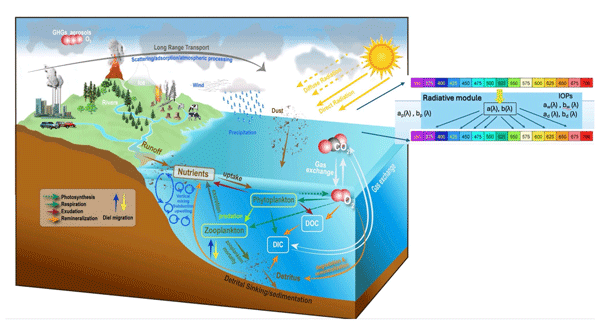
This is now at the end of the abstract. The land carbon flux underestimation appears mainly in the Tropical rainforest regions due to physical model biases there (precipitation deficits) but also lack of complexity of Ent, which prescribes leaf area index and does not include deforestation, nitrogen fertilization and other processes. On the other hand the ocean carbon flux lies within the observational uncertainty defined from SOM-FFN and Carbon Tracker. Positive biases are associated with the convection sites in the North Atlantic where mixing is too deep. Net primary productivity in the ocean is underestimated everywhere compared to CAFÉ observations due to an problematic representation of the radiative transfer within the ocean and due to missing photoacclimation of phytoplankton. We have added this to the text and also in the abstract.
oFigure 6: The caption refers to fluxes at the ocean surface, yet the strongest signals appear over land regions (e.g., the Sahara). Please clarify what is being plotted and how land signals relate to ocean deposition.
Indeed, these are dust flux as they are generated from our atmospheric model and which are prescribed as a seasonal climatology to the ocean. This is now clarified in the text. The figure is in the Supplement (Fig. S1).
oStarting with Figure 10: These figures appear to present the core results of the study and could be considered central to the manuscript. It is therefore unclear why earlier figures are given more prominence, as some seem more suitable for supplementary material. The overall figure hierarchy should be reconsidered to better highlight the main findings.
We now have moved most of the introductory figures to the Supplemental material and focus on the PI and historical simulations analysis. Since the focus is not purely model evaluation the focus is placed on the historical simulation performance and secondarily the drift in the PI.
oFigures 10–11: It may be useful to include precipitation, as it is a key variable linking physical climate biases to both land and ocean carbon cycle processes.
Yes we now include global mean precipitation for the PI (Fig. 3). For the historical we show maps (Fig.5).
oLines 1051–1055: The discussion of model SST would benefit from including trends over the historical period. How do simulated SST trends compare with observations? In addition, the manuscript reports substantial mean-state SST biases, yet the current tuning strategy does not appear to prioritize their reduction. Given that SST is a primary driver of the climate system and strongly influences carbon cycle processes, the authors should clarify the rationale behind this choice and discuss its implications.
The SST trends are shown in the papers Kelley et al 2020 and Miller et al 2021. We only show global mean trends. The tuning process in E2.1 is (unfortunately) sequential. First the atmospheric component is tuned to prescribed SST and then the atmosphere is coupled to an abiotic ocean, where tuning targets net heat flux at the surface. SST is not specifically tuned. The equilibrated atmosphere-ocean model is then coupled to the carbon cycle. Therefore, although we agree with the reviewer, that the SST biases are paramount for the ocean carbon cycle performance, and while E2.1 has significant biases, the tuning process does not involve our simulations or the carbon cycle. In future versions of the model, we intend to tune atmosphere-ocean-carbon cycle together which would prioritize SST biases.
oHave you considered about a more direct comparison between this model and the first version model GISS-E2.1-G-CC?
Yes, indeed. We now include the comparison between CC and CC2 for both the PI and the historical simulations.
Citation: https://doi.org/10.5194/egusphere-2025-4839-AC3
-
RC2: 'Comment on egusphere-2025-4839', Anonymous Referee #2, 10 Apr 2026
This manuscript presents the development, configuration, tuning, and evaluation of the NASA-GISS ModelE2.1-CC2 Earth System Model, a post-CMIP6 update of the earlier GISS carbon-cycle ESM. It documents the physical climate model together with the updated land and ocean carbon-cycle components, and evaluates the system using preindustrial control, historical, and future scenario simulations. This is comprehensive and useful as a model-description paper because it provides detailed information on parameterizations, tuning strategy, conservation diagnostics, and the full experimental framework. The authors also position the model relative to the previous GISS release and broader community benchmarks, and they show that the new version achieves improved equilibration, smaller drift, and updated component formulations compared with the prior release.
Major comments
This is a model description paper with large volume of information and many figures. I hope, however, it'll highlight what's updated from its predecessor. In other words, the main weakness of the manuscript is not the existence of remaining model biases, since such biases are expected in a new Earth system model release and do not by themselves undermine the value of a model-description paper. Rather, the key weakness is that the manuscript does not sufficiently distill and quantify what the new version advances relative to the previous release. Although the paper repeatedly states that ModelE2.1-CC2 is improved, better tuned, and exhibits smaller drift, the presentation is so broad and documentation-heavy that the central message of version advancement remains somewhat diffuse.
In particular, the manuscript would be stronger if it more clearly separated three elements: first, what is newly developed or changed in ModelE2.1-CC2; second, which of those changes lead to demonstrable performance gains; and third, which long-standing limitations remain unresolved. At present, these elements are all discussed, but they are not synthesized sharply enough for the reader to quickly understand the practical significance of this new release beyond it being a more updated and thoroughly equilibrated configuration. This is especially important because the paper itself emphasizes that the physical climate formulation is largely unchanged from the earlier version, while the principal updates lie in the carbon-cycle components, forcings, and equilibration strategy.
Once again, I understand this could be challenging considering the large amount of information provided. A concise summary table or dedicated synthesis section identifying the major updates, the specific improvements achieved, and the important remaining limitations would substantially strengthen the manuscript. As written, the paper is valuable and publishable as a reference description of the model, but its main scientific and practical advance is not articulated as clearly as it could be.
Citation: https://doi.org/10.5194/egusphere-2025-4839-RC2 -
AC4: 'Reply on RC2', Anastasia Romanou, 16 Jun 2026
Our responses are in bold face type below:
This is a model description paper with large volume of information and many figures. I hope, however, it'll highlight what's updated from its predecessor. In other words, the main weakness of the manuscript is not the existence of remaining model biases, since such biases are expected in a new Earth system model release and do not by themselves undermine the value of a model-description paper. Rather, the key weakness is that the manuscript does not sufficiently distill and quantify what the new version advances relative to the previous release. Although the paper repeatedly states that ModelE2.1-CC2 is improved, better tuned, and exhibits smaller drift, the presentation is so broad and documentation-heavy that the central message of version advancement remains somewhat diffuse.
In particular, the manuscript would be stronger if it more clearly separated three elements: first, what is newly developed or changed in ModelE2.1-CC2; second, which of those changes lead to demonstrable performance gains; and third, which long-standing limitations remain unresolved. At present, these elements are all discussed, but they are not synthesized sharply enough for the reader to quickly understand the practical significance of this new release beyond it being a more updated and thoroughly equilibrated configuration. This is especially important because the paper itself emphasizes that the physical climate formulation is largely unchanged from the earlier version, while the principal updates lie in the carbon-cycle components, forcings, and equilibration strategy.
Once again, I understand this could be challenging considering the large amount of information provided. A concise summary table or dedicated synthesis section identifying the major updates, the specific improvements achieved, and the important remaining limitations would substantially strengthen the manuscript. As written, the paper is valuable and publishable as a reference description of the model, but its main scientific and practical advance is not articulated as clearly as it could be.
We thank the reviewer for the time they invested in this review as well as the thoughtful and constructive suggestions they make. We have taken the following steps to sharpen the focus of the paper
1) We removed the future projections description and focused on model evaluation in the historical period and demonstration of key conservation diagnostics
2) We focus on the PI simulation to assess the drift & improvements due to better tuning and,
3) Analyze the historical simulation from the previous and the current version of the model to show the biases as well as the improvements in the skill.
The discussion of the findings is now shorter and more targeted to the skill of the model and the goals of future development.
Citation: https://doi.org/10.5194/egusphere-2025-4839-AC4
-
AC4: 'Reply on RC2', Anastasia Romanou, 16 Jun 2026
-
EC1: 'Comment on egusphere-2025-4839', Richard Neale, 09 Jul 2026
Hi Anastasia,
Just wanted to let you know I have sent the paper out for review again, but only asked the reviewers to briefly confirm the structure changes are fine. It was the only way I good do it within the system. So hopefully it won't take long.
Thanks
Rich
Citation: https://doi.org/10.5194/egusphere-2025-4839-EC1 -
AC5: 'Reply on EC1', Anastasia Romanou, 10 Jul 2026
Thank you! We are looking forward to the reviewers' comments.
Citation: https://doi.org/10.5194/egusphere-2025-4839-AC5
-
AC5: 'Reply on EC1', Anastasia Romanou, 10 Jul 2026
Peer review completion
Journal article(s) based on this preprint
Viewed
| HTML | XML | Total | Supplement | BibTeX | EndNote | |
|---|---|---|---|---|---|---|
| 1,674 | 1,825 | 148 | 3,647 | 315 | 224 | 227 |
- HTML: 1,674
- PDF: 1,825
- XML: 148
- Total: 3,647
- Supplement: 315
- BibTeX: 224
- EndNote: 227
Viewed (geographical distribution)
| Country | # | Views | % |
|---|
| Total: | 0 |
| HTML: | 0 |
| PDF: | 0 |
| XML: | 0 |
- 1
Cited


Anastasia Romanou

Paul Lerner
Nancy Kiang
Igor Aleinov
Maxwell Kelley
Roland Miller
Gary Russell
Reto Ruedy
Gavin Schmidt
Maria Hakuba
The requested preprint has a corresponding peer-reviewed final revised paper. You are encouraged to refer to the final revised version.
- Preprint
(17741 KB) - Metadata XML
-
Supplement
(9916 KB) - BibTeX
- EndNote
- Final revised paper
Dear authors,
Unfortunately, after checking your manuscript, it has come to our attention that it does not comply with our "Code and Data Policy".
https://www.geoscientific-model-development.net/policies/code_and_data_policy.html
In the Data Availability section of your manuscript, you state that the data from the simulations is available upon request. We can not accept this. We can understand that full model output files can be too large to be stored in a permanent public repository (for example, several hundreds of GBs). I guess that this could be the case for your manuscript, but it would be good that you clarify it. However, at minimum, we would expect that you store files containing the data for the variables discussed in the results of your manuscript.
The GMD review and publication process depends on reviewers and community commentators being able to access, during the discussion phase, the code and data on which a manuscript depends, and on ensuring the provenance of replicability of the published papers for years after their publication. Please, therefore, publish the requested data in one of the appropriate repositories and reply to this comment with the relevant information (link and a permanent identifier for it (e.g. DOI)) as soon as possible. We cannot have manuscripts under discussion that do not comply with our policy.
The 'Code and Data Availability’ section must also be modified to cite the new repository locations, and corresponding references added to the bibliography.
I must note that if you do not fix this problem, we cannot continue with the peer-review process or accept your manuscript for publication in GMD.
Juan A. Añel
Geosci. Model Dev. Executive Editor