
the Creative Commons Attribution 4.0 License.
the Creative Commons Attribution 4.0 License.
 | 20 Feb 2026
Implementation of the Generalized Double-Moment Scaling Normalization Method for Raindrop Size Distribution in a WRF 4.3.1 Bulk-Type Cloud Microphysics Scheme: A Case Study over the Korean Peninsula
Abstract. This study is the first to adopt the Generalized Double-Moment scaling Normalization (GDMN) method to represent the rain Drop Size Distribution (DSD) in a bulk-type cloud microphysics scheme, specifically the Weather Research and Forecasting (WRF) Double-moment 6-class (WDM6) scheme. The modified scheme, referred to as WDM6-GDMN, is evaluated through simulations of an isolated summer convection case over the Korean Peninsula, using the universal double-moment normalized DSD function, h(x), derived from rain DSDs observed in the Boseong region during the summers of 2018 and 2019. WDM6-GDMN provides a more realistic spatial distribution of surface precipitation by better simulating convection-cell movement. Although none of the cloud microphysics parameterizations, including the bin-type scheme, reproduce the observed convection that developed in the southeast of the analysis domain, only WDM6-GDMN successfully captures this feature. Microphysical analysis demonstrates that, in WDM6-GDMN, enhanced cloud production due to stronger upward motion leads to the formation of more raindrops and, consequently, greater surface precipitation over southeastern region. Furthermore, the contoured frequency by altitude diagrams for the WDM6-GDMN reveals slower particle growth and weaker reflectivity in the lower atmosphere compared with the original scheme, in better agreement with observations.
-
Notice on discussion status
The requested preprint has a corresponding peer-reviewed final revised paper. You are encouraged to refer to the final revised version.
-
Preprint
(6185 KB)
-
The requested preprint has a corresponding peer-reviewed final revised paper. You are encouraged to refer to the final revised version.
- Preprint
(6185 KB) - Metadata XML
- BibTeX
- EndNote
- Final revised paper


Journal article(s) based on this preprint
Interactive discussion
Status: closed
-
RC1: 'Comment on egusphere-2025-4548', Anonymous Referee #1, 25 Mar 2026
- AC1: 'Reply on RC1', Kyo-Sun Lim, 16 May 2026
-
RC2: 'Comment on egusphere-2025-4548', Anonymous Referee #2, 09 Apr 2026
The comment was uploaded in the form of a supplement: https://egusphere.copernicus.org/preprints/2026/egusphere-2025-4548/egusphere-2025-4548-RC2-supplement.pdf
- AC2: 'Reply on RC2', Kyo-Sun Lim, 16 May 2026
Peer review completion


Interactive discussion
Status: closed
-
RC1: 'Comment on egusphere-2025-4548', Anonymous Referee #1, 25 Mar 2026
Review of “Implementation of the Generalized Double-Moment Scaling Normalization Method for Raindrop Size Distribution in a WRF 4.3.1 Bulk-Type Cloud Microphysics Scheme: A Case Study over the Korean Peninsula” by Jo et al.
Overall assessment
This manuscript implements an observation-constrained generalized double-moment scaling normalization (GDMN) representation of the raindrop size distribution (DSD) within the WDM6 bulk microphysics scheme and evaluates its impact using a convection-permitting real-case simulation over the Korean Peninsula.
The study is technically sound, clearly structured, and addresses an important limitation of conventional bulk microphysics schemes, specifically the use of fixed DSD shape parameters. The integration of an observation-derived normalized DSD function h(x), based on Boseong 2DVD measurements (2018–2019), into an operational modeling framework represents a meaningful and non-trivial contribution. The results demonstrate consistent improvements in convective cell propagation and in the vertical reflectivity structure (CFAD), indicating that the modified DSD representation affects both microphysical processes and storm-scale dynamics.
The contribution is best understood as a practical, model-embedded implementation and evaluation of GDMN within an operationally relevant framework (WDM6), rather than a conceptual introduction of scaling normalization.
With several targeted clarifications, primarily concerning the novelty statement and the robustness of the observation-derived DSD representation, the manuscript is suitable for publication in Geoscientific Model Development after minor revision.
Szyrmer, W., Laroche, S., and Zawadzki, I.: A microphysical bulk formulation based on scaling normalization of the particle size distribution. Part I: Description, J. Atmos. Sci., 62, 4206–4221, 2005.
Primary comments
- Refinement of the “first” claim (Abstract)
The current “first” claim should be refined to better reflect the actual scope of the contribution. As written, it may be interpreted as implying conceptual novelty of scaling-normalization approaches in bulk microphysics. However, the principal novelty of this study lies in the observation-constrained implementation of GDMN within WRF WDM6 and its evaluation in a convection-permitting real-case simulation.
This can be addressed without weakening the manuscript by restricting the scope of the claim and briefly acknowledging related prior work. The following wording is recommended:
“To our knowledge, this study presents the first implementation of an observation-constrained GDMN-based rain DSD representation within WRF WDM6 and evaluates its impacts in a convection-permitting real-case simulation; related scaling-normalization bulk formulations exist (e.g., Szyrmer et al., 2005).”
This revision maintains the manuscript’s originality while ensuring consistency with the existing literature.
- Stability of the observation-derived normalized DSD function h(x)
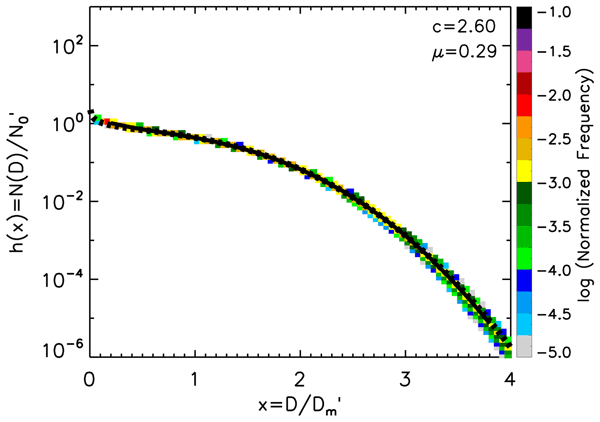
The central modification in this study relies on the observation-derived normalized DSD function h(x) and its associated parameters (c, μ). Therefore, it would be beneficial to provide additional evidence for the stability of this representation.
I encourage the authors to quantify the robustness of h(x), for example through a simple cross-validation between the 2018 and 2019 datasets, or by referring to relevant supporting studies. This addition would substantially improve confidence that the observation-derived DSD representation is sufficiently stable for the intended modeling application.
- Robustness of model results to parameter uncertainty
The conclusions of the manuscript depend on how the modified DSD representation affects microphysical processes, particularly rain evaporation and its impact on near-surface cooling and convective propagation. It is therefore important to demonstrate that the reported improvements are not sensitive to a specific parameter choice.
To further support the robustness of the proposed mechanism, the authors may consider a limited set of sensitivity experiments in which (c, μ) are perturbed within a plausible observational range. It would then be useful to show how the principal outcomes respond, particularly in terms of accumulated precipitation distribution, statistical skill scores, and CFAD-based diagnostics.
If the main conclusions remain qualitatively consistent across these perturbations, this would strengthen the physical interpretation and reduce concerns regarding parameter sensitivity. In this context, it is worth noting that previous studies have shown that gamma DSD parameters may exhibit variability and interdependence depending on fitting approaches and observational uncertainty (e.g., McFarquhar et al., 2015), which further motivates demonstrating robustness with respect to parameter choice.
In addition, it is noted that slightly different values of (c, μ) arise during the derivation of the normalized DSD (e.g., c = 2.70, μ = 0.24 in intermediate steps and c = 2.60, μ = 0.29 in the final formulation). A brief clarification of whether similar simulation outcomes are obtained when using alternative parameter values would further support the consistency and robustness of the proposed approach.
McFarquhar, G. M., Hsieh, T.-L., Freer, M., Mascio, J., and Jewett, B. F.: The characterization of ice hydrometeor gamma size distributions as volumes in N0–λ–μ phase space: Implications for microphysical process modeling, J. Atmos. Sci., 72, 892-909, https://doi.org/10.1175/jas-d-14-0011.1, 2015.
Secondary comments
- 4. Additional quantitative support for propagation improvement
The manuscript argues that WDM6-GDMN improves convective cell movement and propagation. While the qualitative analysis is convincing, this conclusion would benefit from limited quantitative support.
It is recommended to include at least one object-based metric (e.g., centroid displacement or cell tracking) and one neighborhood-based verification metric, such as the Fractions Skill Score (FSS). These additions would provide a clearer and more robust assessment of spatial forecast skill.
- Clarification of the physical mechanism (cold-pool perspective)
The manuscript attributes improved propagation to enhanced near-surface cooling associated with increased rain evaporation (e.g., Figs. 9–12). This interpretation is physically plausible and well supported qualitatively.
However, the causal linkage would be strengthened by including a simple cold-pool diagnostic, such as near-surface temperature (or virtual potential temperature) deficit and a qualitative estimate of propagation speed. Such diagnostics can be derived from existing model output and would help directly connect microphysical changes to dynamical responses.
- Typographical and grammatical corrections
Several minor errors should be corrected:
Line 394: “Numerial” -> “Numerical”
Line 396: “alleviates limitation” -> “alleviates limitations”
Line 405: “overestimate reflectivity” -> “overestimates reflectivity”
Line 409: “us more realistically” -> “is more realistically”
Citation: https://doi.org/10.5194/egusphere-2025-4548-RC1 - AC1: 'Reply on RC1', Kyo-Sun Lim, 16 May 2026
-
RC2: 'Comment on egusphere-2025-4548', Anonymous Referee #2, 09 Apr 2026
The comment was uploaded in the form of a supplement: https://egusphere.copernicus.org/preprints/2026/egusphere-2025-4548/egusphere-2025-4548-RC2-supplement.pdf
- AC2: 'Reply on RC2', Kyo-Sun Lim, 16 May 2026
Peer review completion
Journal article(s) based on this preprint
Viewed
| HTML | XML | Total | BibTeX | EndNote | |
|---|---|---|---|---|---|
| 1,008 | 469 | 95 | 1,572 | 113 | 156 |
- HTML: 1,008
- PDF: 469
- XML: 95
- Total: 1,572
- BibTeX: 113
- EndNote: 156
Viewed (geographical distribution)
| Country | # | Views | % |
|---|
| Total: | 0 |
| HTML: | 0 |
| PDF: | 0 |
| XML: | 0 |
- 1
Joonghyun Jo
Kyo-Sun Sunny Lim

Sun-Young Park
Juhee Kwon
Wonbae Bang
Hyang Suk Park
Jae-Young Byon
Hyun-Suk Kang
Gyuwon Lee
The requested preprint has a corresponding peer-reviewed final revised paper. You are encouraged to refer to the final revised version.
- Preprint
(6185 KB) - Metadata XML
Review of “Implementation of the Generalized Double-Moment Scaling Normalization Method for Raindrop Size Distribution in a WRF 4.3.1 Bulk-Type Cloud Microphysics Scheme: A Case Study over the Korean Peninsula” by Jo et al.
Overall assessment
This manuscript implements an observation-constrained generalized double-moment scaling normalization (GDMN) representation of the raindrop size distribution (DSD) within the WDM6 bulk microphysics scheme and evaluates its impact using a convection-permitting real-case simulation over the Korean Peninsula.
The study is technically sound, clearly structured, and addresses an important limitation of conventional bulk microphysics schemes, specifically the use of fixed DSD shape parameters. The integration of an observation-derived normalized DSD function h(x), based on Boseong 2DVD measurements (2018–2019), into an operational modeling framework represents a meaningful and non-trivial contribution. The results demonstrate consistent improvements in convective cell propagation and in the vertical reflectivity structure (CFAD), indicating that the modified DSD representation affects both microphysical processes and storm-scale dynamics.
The contribution is best understood as a practical, model-embedded implementation and evaluation of GDMN within an operationally relevant framework (WDM6), rather than a conceptual introduction of scaling normalization.
With several targeted clarifications, primarily concerning the novelty statement and the robustness of the observation-derived DSD representation, the manuscript is suitable for publication in Geoscientific Model Development after minor revision.
Szyrmer, W., Laroche, S., and Zawadzki, I.: A microphysical bulk formulation based on scaling normalization of the particle size distribution. Part I: Description, J. Atmos. Sci., 62, 4206–4221, 2005.
Primary comments
The current “first” claim should be refined to better reflect the actual scope of the contribution. As written, it may be interpreted as implying conceptual novelty of scaling-normalization approaches in bulk microphysics. However, the principal novelty of this study lies in the observation-constrained implementation of GDMN within WRF WDM6 and its evaluation in a convection-permitting real-case simulation.
This can be addressed without weakening the manuscript by restricting the scope of the claim and briefly acknowledging related prior work. The following wording is recommended:
“To our knowledge, this study presents the first implementation of an observation-constrained GDMN-based rain DSD representation within WRF WDM6 and evaluates its impacts in a convection-permitting real-case simulation; related scaling-normalization bulk formulations exist (e.g., Szyrmer et al., 2005).”
This revision maintains the manuscript’s originality while ensuring consistency with the existing literature.
The central modification in this study relies on the observation-derived normalized DSD function h(x) and its associated parameters (c, μ). Therefore, it would be beneficial to provide additional evidence for the stability of this representation.
I encourage the authors to quantify the robustness of h(x), for example through a simple cross-validation between the 2018 and 2019 datasets, or by referring to relevant supporting studies. This addition would substantially improve confidence that the observation-derived DSD representation is sufficiently stable for the intended modeling application.
The conclusions of the manuscript depend on how the modified DSD representation affects microphysical processes, particularly rain evaporation and its impact on near-surface cooling and convective propagation. It is therefore important to demonstrate that the reported improvements are not sensitive to a specific parameter choice.
To further support the robustness of the proposed mechanism, the authors may consider a limited set of sensitivity experiments in which (c, μ) are perturbed within a plausible observational range. It would then be useful to show how the principal outcomes respond, particularly in terms of accumulated precipitation distribution, statistical skill scores, and CFAD-based diagnostics.
If the main conclusions remain qualitatively consistent across these perturbations, this would strengthen the physical interpretation and reduce concerns regarding parameter sensitivity. In this context, it is worth noting that previous studies have shown that gamma DSD parameters may exhibit variability and interdependence depending on fitting approaches and observational uncertainty (e.g., McFarquhar et al., 2015), which further motivates demonstrating robustness with respect to parameter choice.
In addition, it is noted that slightly different values of (c, μ) arise during the derivation of the normalized DSD (e.g., c = 2.70, μ = 0.24 in intermediate steps and c = 2.60, μ = 0.29 in the final formulation). A brief clarification of whether similar simulation outcomes are obtained when using alternative parameter values would further support the consistency and robustness of the proposed approach.
McFarquhar, G. M., Hsieh, T.-L., Freer, M., Mascio, J., and Jewett, B. F.: The characterization of ice hydrometeor gamma size distributions as volumes in N0–λ–μ phase space: Implications for microphysical process modeling, J. Atmos. Sci., 72, 892-909, https://doi.org/10.1175/jas-d-14-0011.1, 2015.
Secondary comments
The manuscript argues that WDM6-GDMN improves convective cell movement and propagation. While the qualitative analysis is convincing, this conclusion would benefit from limited quantitative support.
It is recommended to include at least one object-based metric (e.g., centroid displacement or cell tracking) and one neighborhood-based verification metric, such as the Fractions Skill Score (FSS). These additions would provide a clearer and more robust assessment of spatial forecast skill.
The manuscript attributes improved propagation to enhanced near-surface cooling associated with increased rain evaporation (e.g., Figs. 9–12). This interpretation is physically plausible and well supported qualitatively.
However, the causal linkage would be strengthened by including a simple cold-pool diagnostic, such as near-surface temperature (or virtual potential temperature) deficit and a qualitative estimate of propagation speed. Such diagnostics can be derived from existing model output and would help directly connect microphysical changes to dynamical responses.
Several minor errors should be corrected:
Line 394: “Numerial” -> “Numerical”
Line 396: “alleviates limitation” -> “alleviates limitations”
Line 405: “overestimate reflectivity” -> “overestimates reflectivity”
Line 409: “us more realistically” -> “is more realistically”