
the Creative Commons Attribution 4.0 License.
the Creative Commons Attribution 4.0 License.
 | 14 Jan 2026
Global transport of upper-tropospheric tropical tracers: multi-year insights from idealized simulations
Abstract. Recent studies suggest that significant aerosol formation occurs in the tropical upper troposphere (UT). However, the impact of these particles at lower levels remains poorly understood. We present results from multi-year global EMAC simulations investigating the downward transport of UT tracers and their resulting spatial distribution. Nineteen idealized tracers were released in the tropical UT and subjected to resolved-scale advection, parameterized convection, turbulent mixing, and wet/dry deposition. Transport timescales are highly sensitive to source extent: the age of air at 500 hPa is ≈ 45 days for tropical-wide tracers, compared to over 250 days for regional continental sources, reflecting the importance of mixing and dilution. A complementary time-to-threshold diagnostic reveals faster transport pathways, with all source regions exhibiting descent times shorter than 7 days to reach 10 % of the source average. Advection dominates vertical transport, with convective and vertical diffusion parameterizations contributing marginally. Injection height exerts a stronger influence on descent time than parameterized transport or particle size in the 20–100 nm range. Tracer maxima are typically advected east of their source centers, resulting in significant concentrations (~10–15 % of source values) in the mid-troposphere. Offline calculations show that, for initial particle numbers below ~6 × 10⁷ kg-1, the mid-troposphere values predicted by the model are reduced by less than 10 % when coagulation is considered, but substantial deviations occur at higher concentrations. These results provide quantitative constraints on particle transport efficiency and inform expectations for aerosol distributions following UT nucleation events.
Competing interests: Two co-authors of the manuscript are topical editors of the journal.
Publisher's note: Copernicus Publications remains neutral with regard to jurisdictional claims made in the text, published maps, institutional affiliations, or any other geographical representation in this paper. While Copernicus Publications makes every effort to include appropriate place names, the final responsibility lies with the authors. Views expressed in the text are those of the authors and do not necessarily reflect the views of the publisher.-
Notice on discussion status
The requested preprint has a corresponding peer-reviewed final revised paper. You are encouraged to refer to the final revised version.
-
Preprint
(4953 KB)
-
The requested preprint has a corresponding peer-reviewed final revised paper. You are encouraged to refer to the final revised version.
- Preprint
(4953 KB) - Metadata XML
- BibTeX
- EndNote
- Final revised paper


Journal article(s) based on this preprint
Interactive discussion
Status: closed
- RC1: 'Comment on egusphere-2025-4338', Anonymous Referee #2, 08 Mar 2026
-
RC2: 'Comment on egusphere-2025-4338', Anonymous Referee #3, 14 Apr 2026
This study examines the downward transport of upper-tropospheric tracers in the tropics using idealized tracers in a global model. The manuscript is concise and generally well written. The method is valid and the results are generally clearly presented. The study is within the scope of Atmospheric Chemistry and Physics. I have the following minor comments for the authors to consider before publication.
Why do the authors choose 500 hPa, instead of lower troposphere, as the target receptor region?
Could the authors comment on how uncertainties in the related EMAC parameterizations (e.g., deposition, turbulent mixing, etc.) may affect their results?
Title: This study mainly examines the transport from upper troposphere (200-300 hPa and 150-250 hPa) to 500 hPa. Therefore, “Downward transport” may be more suitable than “Global transport” for the title.
L84, L152, and others: Is sedimentation part of dry deposition?
L102: Since it is mentioned that the simulations start from a specific date (1/1/1998), are the meteorology of the two simulations driven by or nudged to reanalysis data? Or do the authors just use the initial conditions from this date (L112)?
L172-173: It is not clear how Nstgrd is set. My understanding is that the staggered tracers are initialized twelve times on the first day of each month in 1999. If so, the description that “t0 is the first day of each month …” is not accurate. According to Eq. 3, this sounds more like Nstgrd is initialized after the first day of each month (when t > t0). Also, one may need to assume that t only ranges from the beginning to the end of the month.
L195-197: The τ for regional tracers is five times older than the tropical tracer. This comparison may be misleading. Does it indicate the regional tracers have five times weaker downward transport than the tropical tracers? Also, this difference is ascribed to stronger dilution in the manuscript. Is this right? I think the larger τ of the regional tracers is possibly because the regional source is smaller compared to the tropical tracer, and the corresponding receptor at 500 hPa also receives aerosols from other tropical sources.
Fonts are too small for Figures 5 and 6.
Citation: https://doi.org/10.5194/egusphere-2025-4338-RC2 -
AC1: 'Comment on egusphere-2025-4338', Lianet Hernández Pardo, 10 Jun 2026
The comment was uploaded in the form of a supplement: https://egusphere.copernicus.org/preprints/2026/egusphere-2025-4338/egusphere-2025-4338-AC1-supplement.pdf
Peer review completion


Interactive discussion
Status: closed
-
RC1: 'Comment on egusphere-2025-4338', Anonymous Referee #2, 08 Mar 2026
This paper investigates the timescales and pathways of downward transport from tropical upper troposphere to the middle troposphere. Using simulations of 19 idealized upper tropospheric tracers, the timescales and spatial distributions of the downward transport are characterized. It is found that the downward transport timescales are sensitive to the size and altitude of source region. The downward transport is dominated by resolved large-scale advection with minor roles from parameterized convection and diffusion.
Overall, the paper is easy to read. The method is appropriate and the results contribute to our understanding of downward transport. However, more explanations of the model results are needed. Also, results of downward transport to the lower troposphere should be presented.
Comments:
The motivation of the paper is to understand whether the downward transport of the tropical upper troposphere aerosols is a source of boundary layer aerosols. Therefore, I am surprised that the authors only show results in the middle troposphere (500 hPa). I strongly suggest showing results in the boundary layer, e.g., repeating all the figures for the lower troposphere.
Lines 171-172: The “staggered” tracer are used to produce the age spectrum, right? I would suggest showing and explaining the age spectrum, for example, over the entire tropics and the three chosen land regions.
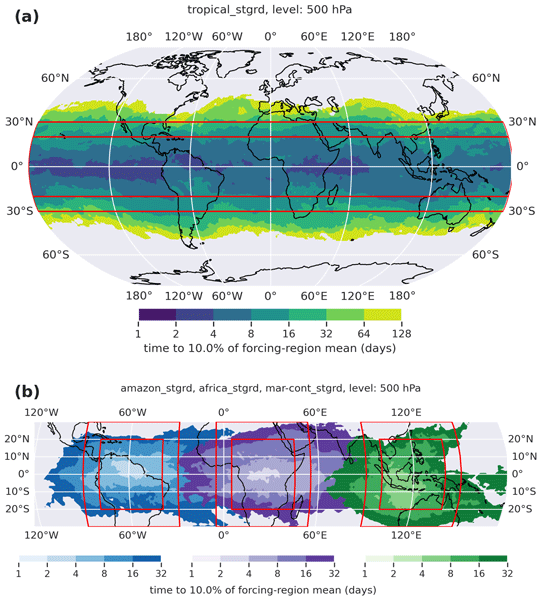
Line 215: Explain why young air is predominately near the Equator. It appears that the large-scale sink motion is dominated by the subsidence of the Walker Circulation. But how about meridional transport of the Hadley Cell? I would expect that the sinking branches of the Hadley Cell bring young air to the subtropics. Why are the effects of Hadley Cell not seen in the timescales?
The authors attribute the much longer transport timescales for the regional emission sources to mixing and dilution. This explanation is not complete. I think an important implication is that for a given region, downward transport directly from the upper troposphere of that region is not an important pathway. In other words, most of the downward transport comes from outside of that region. Therefore, I suspect that the 3 regional upper tropospheric emissions would have stronger downward transport influences on areas downstream of the emission regions than areas directly below the emissions. To test this, I suggest showing mean age over the entire tropics for the regional emissions. This will show what region is mostly sensitive to the downward transport for each of the regional emissions.
Citation: https://doi.org/10.5194/egusphere-2025-4338-RC1 -
RC2: 'Comment on egusphere-2025-4338', Anonymous Referee #3, 14 Apr 2026
This study examines the downward transport of upper-tropospheric tracers in the tropics using idealized tracers in a global model. The manuscript is concise and generally well written. The method is valid and the results are generally clearly presented. The study is within the scope of Atmospheric Chemistry and Physics. I have the following minor comments for the authors to consider before publication.
Why do the authors choose 500 hPa, instead of lower troposphere, as the target receptor region?
Could the authors comment on how uncertainties in the related EMAC parameterizations (e.g., deposition, turbulent mixing, etc.) may affect their results?
Title: This study mainly examines the transport from upper troposphere (200-300 hPa and 150-250 hPa) to 500 hPa. Therefore, “Downward transport” may be more suitable than “Global transport” for the title.
L84, L152, and others: Is sedimentation part of dry deposition?
L102: Since it is mentioned that the simulations start from a specific date (1/1/1998), are the meteorology of the two simulations driven by or nudged to reanalysis data? Or do the authors just use the initial conditions from this date (L112)?
L172-173: It is not clear how Nstgrd is set. My understanding is that the staggered tracers are initialized twelve times on the first day of each month in 1999. If so, the description that “t0 is the first day of each month …” is not accurate. According to Eq. 3, this sounds more like Nstgrd is initialized after the first day of each month (when t > t0). Also, one may need to assume that t only ranges from the beginning to the end of the month.
L195-197: The τ for regional tracers is five times older than the tropical tracer. This comparison may be misleading. Does it indicate the regional tracers have five times weaker downward transport than the tropical tracers? Also, this difference is ascribed to stronger dilution in the manuscript. Is this right? I think the larger τ of the regional tracers is possibly because the regional source is smaller compared to the tropical tracer, and the corresponding receptor at 500 hPa also receives aerosols from other tropical sources.
Fonts are too small for Figures 5 and 6.
Citation: https://doi.org/10.5194/egusphere-2025-4338-RC2 -
AC1: 'Comment on egusphere-2025-4338', Lianet Hernández Pardo, 10 Jun 2026
The comment was uploaded in the form of a supplement: https://egusphere.copernicus.org/preprints/2026/egusphere-2025-4338/egusphere-2025-4338-AC1-supplement.pdf
Peer review completion
Journal article(s) based on this preprint
Viewed
| HTML | XML | Total | BibTeX | EndNote | |
|---|---|---|---|---|---|
| 1,277 | 516 | 172 | 1,965 | 188 | 162 |
- HTML: 1,277
- PDF: 516
- XML: 172
- Total: 1,965
- BibTeX: 188
- EndNote: 162
Viewed (geographical distribution)
| Country | # | Views | % |
|---|
| Total: | 0 |
| HTML: | 0 |
| PDF: | 0 |
| XML: | 0 |
- 1
Lianet Hernández Pardo

Joachim Curtius
Patrick Jöckel
Moritz Menken
Anna Possner
The requested preprint has a corresponding peer-reviewed final revised paper. You are encouraged to refer to the final revised version.
- Preprint
(4953 KB) - Metadata XML
This paper investigates the timescales and pathways of downward transport from tropical upper troposphere to the middle troposphere. Using simulations of 19 idealized upper tropospheric tracers, the timescales and spatial distributions of the downward transport are characterized. It is found that the downward transport timescales are sensitive to the size and altitude of source region. The downward transport is dominated by resolved large-scale advection with minor roles from parameterized convection and diffusion.
Overall, the paper is easy to read. The method is appropriate and the results contribute to our understanding of downward transport. However, more explanations of the model results are needed. Also, results of downward transport to the lower troposphere should be presented.
Comments:
The motivation of the paper is to understand whether the downward transport of the tropical upper troposphere aerosols is a source of boundary layer aerosols. Therefore, I am surprised that the authors only show results in the middle troposphere (500 hPa). I strongly suggest showing results in the boundary layer, e.g., repeating all the figures for the lower troposphere.
Lines 171-172: The “staggered” tracer are used to produce the age spectrum, right? I would suggest showing and explaining the age spectrum, for example, over the entire tropics and the three chosen land regions.
Line 215: Explain why young air is predominately near the Equator. It appears that the large-scale sink motion is dominated by the subsidence of the Walker Circulation. But how about meridional transport of the Hadley Cell? I would expect that the sinking branches of the Hadley Cell bring young air to the subtropics. Why are the effects of Hadley Cell not seen in the timescales?
The authors attribute the much longer transport timescales for the regional emission sources to mixing and dilution. This explanation is not complete. I think an important implication is that for a given region, downward transport directly from the upper troposphere of that region is not an important pathway. In other words, most of the downward transport comes from outside of that region. Therefore, I suspect that the 3 regional upper tropospheric emissions would have stronger downward transport influences on areas downstream of the emission regions than areas directly below the emissions. To test this, I suggest showing mean age over the entire tropics for the regional emissions. This will show what region is mostly sensitive to the downward transport for each of the regional emissions.