
the Creative Commons Attribution 4.0 License.
the Creative Commons Attribution 4.0 License.
 | 06 Mar 2025
Arctic regional changes revealed by clustering of sea-ice observations
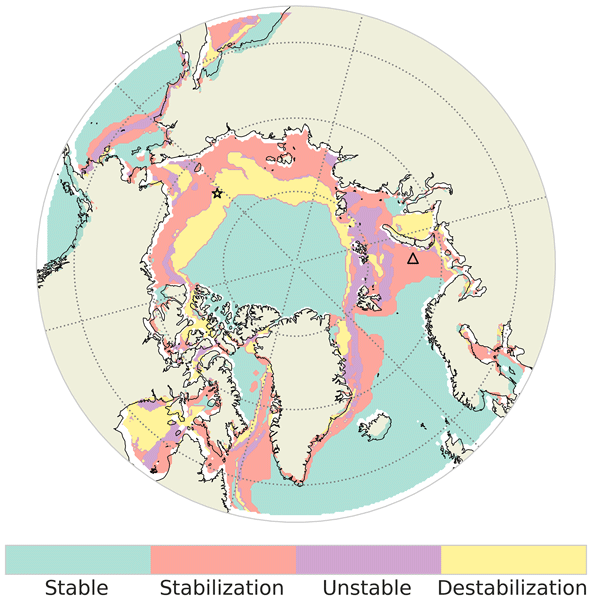
Abstract. Understanding the evolution of Arctic sea-ice is crucial due to its climatic and socio-economic impacts. Usual descriptors (e.g., sea-ice extent, sea-ice age, and ice-free duration) quantify changes but do not account for the full seasonal cycle. Here, using satellite observations of sea-ice concentration over 1979–2023, we perform a k-means clustering of the Arctic sea-ice seasonal cycle, initializing with equal quantile separation and using Mahalanobis distance. We identify four optimal seasonal cycle clusters: open-ocean (no ice year-round), permanent sea-ice (full coverage with a minimum of 70 % sea-ice concentration), and two clusters showing ice-free conditions, namely partial and full winter freezing. The latter has larger sea-ice concentration in winter, more abrupt melting and freezing periods, and a shorter ice-free season than the former. The probability of belonging to the open-ocean cluster increased by 1.6 % per decade mostly due to cluster spatial expansion on the Eurasian side. The permanent sea-ice decreased by 1.5 % per decade with a likelihood reduction in the Canadian side. The partial and full winter freezing clusters do not exhibit any trend but spatial shifts occur. We further diagnose cluster transitions and subsequently infer regions of stabilization and destabilization. The East Siberian and Laptev seas are destabilizing (losing their typical permanent sea-ice seasonal cycle) while the Kara and Chukchi seas have stabilized (experiencing a new typical seasonal cycle, corresponding to the partial winter-freezing cluster). This work provides a new way to describe Arctic regional changes using a statistical framework based on physical behaviours of sea-ice.
-
Notice on discussion status
The requested preprint has a corresponding peer-reviewed final revised paper. You are encouraged to refer to the final revised version.
-
Preprint
(4200 KB)
-
The requested preprint has a corresponding peer-reviewed final revised paper. You are encouraged to refer to the final revised version.
- Preprint
(4200 KB) - Metadata XML
- BibTeX
- EndNote
- Final revised paper


Journal article(s) based on this preprint
Interactive discussion
Status: closed
-
RC1: 'Comment on egusphere-2025-704', Francois Massonnet, 04 Apr 2025
-
AC2: 'Reply on RC1', Amelie Simon, 05 Aug 2025
The comment was uploaded in the form of a supplement: https://egusphere.copernicus.org/preprints/2025/egusphere-2025-704/egusphere-2025-704-AC2-supplement.pdf
-
AC2: 'Reply on RC1', Amelie Simon, 05 Aug 2025
-
RC2: 'Comment on egusphere-2025-704', Anonymous Referee #2, 10 Apr 2025
The comment was uploaded in the form of a supplement: https://egusphere.copernicus.org/preprints/2025/egusphere-2025-704/egusphere-2025-704-RC2-supplement.pdf
-
AC1: 'Reply on RC2', Amelie Simon, 05 Aug 2025
The comment was uploaded in the form of a supplement: https://egusphere.copernicus.org/preprints/2025/egusphere-2025-704/egusphere-2025-704-AC1-supplement.pdf
-
AC1: 'Reply on RC2', Amelie Simon, 05 Aug 2025
-
RC3: 'Comment on egusphere-2025-704', Marion Lebrun, 29 Apr 2025
Interactive comment on
"Arctic regional changes revealed by clustering of sea-ice observations”
by Amélie Simon, Pierre Tandeo, Florian Sévellec and Camille Lique.
General Comments
This paper introduces a novel method for characterizing the seasonality of Arctic sea ice. The k-means clustering method, which has been successfully applied in other contexts, serves as the foundation for this approach. This study enhances the method by incorporating the Mahalanobis distance, providing a more robust physical representation of sea ice seasonal cycles. By applying this refined technique to sea ice concentration data spanning 1979 to 2023, the authors identify four distinct clusters that effectively describe the seasonality of Arctic sea ice.
Building on these results, the authors analyze the probability of individual seasonal cycles within the dataset belonging to each of these four clusters. They also introduce new diagnostic tools to describe the temporal evolution of sea ice seasonal cycles, as well as to pinpoint the moments when a seasonal cycle transitions from one cluster to another.
This study offers an innovative approach that complements previous research on sea ice seasonality. I commend the authors for the thoroughness of their analysis and the clarity of their well-structured manuscript. Overall, I believe this work represents a significant contribution to the field and, with the revisions suggested below, has the potential for a strong impact upon publication.
While the bibliography section requires attention before submission (as detailed later), most of the comments below are intended to enhance the paper's clarity, precision, and relevance. Authors are encouraged to consider these suggestions and apply them at their discretion.
Major Comments
The only major comment regarding this paper concerns the paragraph between lines 325 and 339. In my opinion, this paragraph requires further clarification or a more detailed presentation of the results to be fully convincing. The results presented in this section and reiterated in the conclusion, showing that ice conditions during the summer (or winter) are strongly correlated with the onset of melting (or freezing), are highly interesting for understanding the mechanisms behind the Arctic sea ice seasonal cycle. However, I find that relying solely on clusters to describe these results is limiting.
If I understand correctly, the seasonal cycles of each grid point tend to group around one (or several, considering the results in Section 3.2) cluster. Therefore, I am not fully convinced that the seasonal cycles associated with a particular cluster (as shown in Figure 4b) behave exactly as summarized in this paragraph.
I believe it would be helpful to visually demonstrate this with supporting evidence to strengthen the argument. For example, you could present the interquartile range around each cluster on Figure 4a, using the data already employed to generate Figure 4b. Alternatively, if you prefer not to overload Figure 4a, you could clearly define the melting onset and freezing onset dates here (using concentration thresholds already applied in other studies) and provide statistics of these diagnostics in each cluster. In my opinion, these revisions would significantly enhance the impact and clarity of these results.
Specific Comments
Lines 137-139 and lines 152-157: I feel, with both sentences, that the authors try to highlight the novelty of their method compared to previous studies, but these sentences appear before the work itself is introduced. I am not sure of the relevance of these sentences at this point. This creates some confusion during a first reading. I suggest either removing these sentences or moving them to a later paragraph, ideally after the authors have introduced their work more clearly.
Lines 200-202: This statement could benefit from additional evidence (by including figures or statistics in the supplementary material, for example).
Lines 216-217: It could help the reader if you briefly explain what you mean by “non-zero seasonal cycle.”
Lines 353: “consistent and continuous patterns”, consistent according to what?
Lines 395-397: I find it difficult to discern "the edge of the 0.3 probability" in Figure 5 due to the continuous colorbar. Adding a contour line to indicate this boundary could make it clearer.
Figure 5: I find it difficult to discern the probability differences between clusters when the colorbar changes for each cluster. While I understand your choice to maintain consistency with other figures, for this particular figure, I suggest using a single colorbar for all four clusters to enhance readability.
Paragraph 464-476: The reference to Figure 7 is missing here and should be explicitly mentioned for clarity.
Line 468: “ the trend for the other two clusters are statistically significant”. Does it mean that the trends for the partial and full winter-freezing clusters are not significant?
Lines 476: “and to a smaller extent, of the full winter-freezing cluster”. I am confused by this statement. Earlier (line 466), it was mentioned that the trend for the full winter-freezing cluster was nearly constant, and line 468 suggests that the trend is not significant. This part seems to lack precision to be clearly understood.
Lines 502-503: "while the partial and full winter-freezing clusters remain relatively stable." I find it unclear in Figure 8a that the total area covered by the partial and, in particular, the full-winter cluster is stable. It might be helpful to add the trend for each cluster, as was done in Figure 7, to make this clearer.
Lines 505-509: I find it difficult to discern the nuances between these two sentences. Perhaps the last sentence could be omitted, as it might not add significant value.
Lines 518-519: “Sensitivity tests have been performed on this definition, and the results do not change when we apply small definition changes (i.e., 9 to 11 years minimum length of the same cluster with zero to 2 years of tolerance).” It would be valuable to include the results of these sensitivity tests, perhaps in the supplementary material, to provide additional context and support for this statement.
Lines 522-525: A reference to Figure 9 would enhance clarity here, as the figure significantly helps in understanding the definition of these new diagnostics.
Lines 578-582: I am uncertain about the relevance of this paragraph, as all the information presented here seems to be already covered in the previous paragraph.
References section :
I noticed that several references cited in the paper are missing from the reference list. I’ve compiled a list of the missing references I found, but I strongly recommend that the author carefully review this section, as there may be other errors that I may have missed. Additionally, the format of the references is not consistent throughout the section. For example, the publication date is sometimes listed immediately after the authors' names, and in other cases, it appears at the end of the reference. To ensure consistency, I suggest following the EGU standardized citation format.
Missing reference in the references section :
Ardyna and Arrigo, 2020: line 83
Eisenman, 2010: line 439 ; 693
Eyring et al., 2021: line 77
Lebrun et al., 2019: line 125 ; 137 ; 631 ; 648
Meier et al., 2007: line 146
Markus et al., 2009: line 127 ; 629
Maze et al., 2017: line 161
Parkinson and Cavalieri, 2008: line 678
Parkinson et al., 1987: line 304
Parkinson et al., 1999: line 677
Parkinson, 2014: line 127
Peixoto and Oort, 1992: line 683
Peng and Meier, 2018: line 146
Regan et al., 2023: line 119
Lines 803-805: Houghton and Wilson 2020 should appears before Huntington et al., 2017
Citation: https://doi.org/10.5194/egusphere-2025-704-RC3 -
AC3: 'Reply on RC3', Amelie Simon, 05 Aug 2025
The comment was uploaded in the form of a supplement: https://egusphere.copernicus.org/preprints/2025/egusphere-2025-704/egusphere-2025-704-AC3-supplement.pdf
-
AC3: 'Reply on RC3', Amelie Simon, 05 Aug 2025


Interactive discussion
Status: closed
-
RC1: 'Comment on egusphere-2025-704', Francois Massonnet, 04 Apr 2025
-
AC2: 'Reply on RC1', Amelie Simon, 05 Aug 2025
The comment was uploaded in the form of a supplement: https://egusphere.copernicus.org/preprints/2025/egusphere-2025-704/egusphere-2025-704-AC2-supplement.pdf
-
AC2: 'Reply on RC1', Amelie Simon, 05 Aug 2025
-
RC2: 'Comment on egusphere-2025-704', Anonymous Referee #2, 10 Apr 2025
The comment was uploaded in the form of a supplement: https://egusphere.copernicus.org/preprints/2025/egusphere-2025-704/egusphere-2025-704-RC2-supplement.pdf
-
AC1: 'Reply on RC2', Amelie Simon, 05 Aug 2025
The comment was uploaded in the form of a supplement: https://egusphere.copernicus.org/preprints/2025/egusphere-2025-704/egusphere-2025-704-AC1-supplement.pdf
-
AC1: 'Reply on RC2', Amelie Simon, 05 Aug 2025
-
RC3: 'Comment on egusphere-2025-704', Marion Lebrun, 29 Apr 2025
Interactive comment on
"Arctic regional changes revealed by clustering of sea-ice observations”
by Amélie Simon, Pierre Tandeo, Florian Sévellec and Camille Lique.
General Comments
This paper introduces a novel method for characterizing the seasonality of Arctic sea ice. The k-means clustering method, which has been successfully applied in other contexts, serves as the foundation for this approach. This study enhances the method by incorporating the Mahalanobis distance, providing a more robust physical representation of sea ice seasonal cycles. By applying this refined technique to sea ice concentration data spanning 1979 to 2023, the authors identify four distinct clusters that effectively describe the seasonality of Arctic sea ice.
Building on these results, the authors analyze the probability of individual seasonal cycles within the dataset belonging to each of these four clusters. They also introduce new diagnostic tools to describe the temporal evolution of sea ice seasonal cycles, as well as to pinpoint the moments when a seasonal cycle transitions from one cluster to another.
This study offers an innovative approach that complements previous research on sea ice seasonality. I commend the authors for the thoroughness of their analysis and the clarity of their well-structured manuscript. Overall, I believe this work represents a significant contribution to the field and, with the revisions suggested below, has the potential for a strong impact upon publication.
While the bibliography section requires attention before submission (as detailed later), most of the comments below are intended to enhance the paper's clarity, precision, and relevance. Authors are encouraged to consider these suggestions and apply them at their discretion.
Major Comments
The only major comment regarding this paper concerns the paragraph between lines 325 and 339. In my opinion, this paragraph requires further clarification or a more detailed presentation of the results to be fully convincing. The results presented in this section and reiterated in the conclusion, showing that ice conditions during the summer (or winter) are strongly correlated with the onset of melting (or freezing), are highly interesting for understanding the mechanisms behind the Arctic sea ice seasonal cycle. However, I find that relying solely on clusters to describe these results is limiting.
If I understand correctly, the seasonal cycles of each grid point tend to group around one (or several, considering the results in Section 3.2) cluster. Therefore, I am not fully convinced that the seasonal cycles associated with a particular cluster (as shown in Figure 4b) behave exactly as summarized in this paragraph.
I believe it would be helpful to visually demonstrate this with supporting evidence to strengthen the argument. For example, you could present the interquartile range around each cluster on Figure 4a, using the data already employed to generate Figure 4b. Alternatively, if you prefer not to overload Figure 4a, you could clearly define the melting onset and freezing onset dates here (using concentration thresholds already applied in other studies) and provide statistics of these diagnostics in each cluster. In my opinion, these revisions would significantly enhance the impact and clarity of these results.
Specific Comments
Lines 137-139 and lines 152-157: I feel, with both sentences, that the authors try to highlight the novelty of their method compared to previous studies, but these sentences appear before the work itself is introduced. I am not sure of the relevance of these sentences at this point. This creates some confusion during a first reading. I suggest either removing these sentences or moving them to a later paragraph, ideally after the authors have introduced their work more clearly.
Lines 200-202: This statement could benefit from additional evidence (by including figures or statistics in the supplementary material, for example).
Lines 216-217: It could help the reader if you briefly explain what you mean by “non-zero seasonal cycle.”
Lines 353: “consistent and continuous patterns”, consistent according to what?
Lines 395-397: I find it difficult to discern "the edge of the 0.3 probability" in Figure 5 due to the continuous colorbar. Adding a contour line to indicate this boundary could make it clearer.
Figure 5: I find it difficult to discern the probability differences between clusters when the colorbar changes for each cluster. While I understand your choice to maintain consistency with other figures, for this particular figure, I suggest using a single colorbar for all four clusters to enhance readability.
Paragraph 464-476: The reference to Figure 7 is missing here and should be explicitly mentioned for clarity.
Line 468: “ the trend for the other two clusters are statistically significant”. Does it mean that the trends for the partial and full winter-freezing clusters are not significant?
Lines 476: “and to a smaller extent, of the full winter-freezing cluster”. I am confused by this statement. Earlier (line 466), it was mentioned that the trend for the full winter-freezing cluster was nearly constant, and line 468 suggests that the trend is not significant. This part seems to lack precision to be clearly understood.
Lines 502-503: "while the partial and full winter-freezing clusters remain relatively stable." I find it unclear in Figure 8a that the total area covered by the partial and, in particular, the full-winter cluster is stable. It might be helpful to add the trend for each cluster, as was done in Figure 7, to make this clearer.
Lines 505-509: I find it difficult to discern the nuances between these two sentences. Perhaps the last sentence could be omitted, as it might not add significant value.
Lines 518-519: “Sensitivity tests have been performed on this definition, and the results do not change when we apply small definition changes (i.e., 9 to 11 years minimum length of the same cluster with zero to 2 years of tolerance).” It would be valuable to include the results of these sensitivity tests, perhaps in the supplementary material, to provide additional context and support for this statement.
Lines 522-525: A reference to Figure 9 would enhance clarity here, as the figure significantly helps in understanding the definition of these new diagnostics.
Lines 578-582: I am uncertain about the relevance of this paragraph, as all the information presented here seems to be already covered in the previous paragraph.
References section :
I noticed that several references cited in the paper are missing from the reference list. I’ve compiled a list of the missing references I found, but I strongly recommend that the author carefully review this section, as there may be other errors that I may have missed. Additionally, the format of the references is not consistent throughout the section. For example, the publication date is sometimes listed immediately after the authors' names, and in other cases, it appears at the end of the reference. To ensure consistency, I suggest following the EGU standardized citation format.
Missing reference in the references section :
Ardyna and Arrigo, 2020: line 83
Eisenman, 2010: line 439 ; 693
Eyring et al., 2021: line 77
Lebrun et al., 2019: line 125 ; 137 ; 631 ; 648
Meier et al., 2007: line 146
Markus et al., 2009: line 127 ; 629
Maze et al., 2017: line 161
Parkinson and Cavalieri, 2008: line 678
Parkinson et al., 1987: line 304
Parkinson et al., 1999: line 677
Parkinson, 2014: line 127
Peixoto and Oort, 1992: line 683
Peng and Meier, 2018: line 146
Regan et al., 2023: line 119
Lines 803-805: Houghton and Wilson 2020 should appears before Huntington et al., 2017
Citation: https://doi.org/10.5194/egusphere-2025-704-RC3 -
AC3: 'Reply on RC3', Amelie Simon, 05 Aug 2025
The comment was uploaded in the form of a supplement: https://egusphere.copernicus.org/preprints/2025/egusphere-2025-704/egusphere-2025-704-AC3-supplement.pdf
-
AC3: 'Reply on RC3', Amelie Simon, 05 Aug 2025
Peer review completion


Journal article(s) based on this preprint
Viewed
| HTML | XML | Total | BibTeX | EndNote | |
|---|---|---|---|---|---|
| 890 | 170 | 39 | 1,099 | 24 | 43 |
- HTML: 890
- PDF: 170
- XML: 39
- Total: 1,099
- BibTeX: 24
- EndNote: 43
Viewed (geographical distribution)
| Country | # | Views | % |
|---|
| Total: | 0 |
| HTML: | 0 |
| PDF: | 0 |
| XML: | 0 |
- 1
Pierre Tandeo
Florian Sévellec
Camille Lique
The requested preprint has a corresponding peer-reviewed final revised paper. You are encouraged to refer to the final revised version.
- Preprint
(4200 KB) - Metadata XML
Please see attachment.