
the Creative Commons Attribution 4.0 License.
the Creative Commons Attribution 4.0 License.
 | 30 Dec 2025
Towards a parametric Kalman filter for operational wildfire plume assimilation: Formulation of the forecast step
Abstract. This study introduces a simple parametric Kalman Filter (PKF) specifically tailored to the requirements of operational air quality data assimilation under highly uncertain emissions like wildfire smoke events. Operational smoke plume assimilation systems require fast, yet accurate error estimations to represent the large, case-dependent and spatio-temporally varying uncertainties. The PKF offers a computationally efficient alternative to existing ensemble approaches, where the dynamics of error parameters (such as error standard deviations) are explicitly evolved numerically at a fraction of the cost of ensemble-based methods. This study focuses on the forecast step of the PKF by evolving error standard deviations in the Canadian operational air quality model GEM-MACH. It includes the following three steps: 1) theoretical derivation of forecast dynamics tailored to near-surface air quality applications with uncertain emissions, 2) implementation into the GEM-MACH modeling system, 3) application to surface PM2.5 in eastern Canada during a wildfire episode in July 2023.
The theoretical investigation conducted in this study suggests that error standard deviation is a more suitable parameter than error variance for operational models. This is due to improved process-understanding, numerical accuracy, and a simpler form of the forecast equation that can be implemented with minor modifications of the forecasting model. Implementing diffusion and emission processes of errors in a state-of-the-science atmospheric model for the first-time demonstrates their sensitivity to other error parameters, state error correlation and emission error, respectively. Although the setup of the error forecast remains highly simplified, the case study results show significant impacts on hourly PM2.5 analysis increments compared to the operational setup. These differences can be related to the ability of the simple PKF to attribute large analysis increments to highly uncertain areas like wildfire plumes far away from observation locations. Thus, spreading sparse observation information much more efficiently in a highly case-dependent and anisotropic way only though improved variance fields.
-
Notice on discussion status
The requested preprint has a corresponding peer-reviewed final revised paper. You are encouraged to refer to the final revised version.
-
Preprint
(2665 KB)
-
The requested preprint has a corresponding peer-reviewed final revised paper. You are encouraged to refer to the final revised version.
- Preprint
(2665 KB) - Metadata XML
- BibTeX
- EndNote
- Final revised paper


Journal article(s) based on this preprint
Interactive discussion
Status: closed
-
RC1: 'Comment on egusphere-2025-6386', Anonymous Referee #1, 20 Feb 2026
-
AC1: 'Reply on RC1', Annika Vogel, 27 Apr 2026
The comment was uploaded in the form of a supplement: https://egusphere.copernicus.org/preprints/2025/egusphere-2025-6386/egusphere-2025-6386-AC1-supplement.pdf
-
AC1: 'Reply on RC1', Annika Vogel, 27 Apr 2026
-
RC2: 'Comment on egusphere-2025-6386', Anonymous Referee #2, 10 Mar 2026
General comments:
This study presents a simple parametric Kalman Filter (PKF) specifically tailored to the requirements of operational air quality data data assimilation under highly uncertain emission like wildfire smoke events. The study focuses on the forecast step of the PKF by evolving error standard deviations in the Canadian operational air quality model GEM-MACH. The results of a case study during a wildfire episode in July 2023 in eastern Canada show the simple PKF can significantly impact the hourly PM2.5 analysis increments compared to the operational setup. The differences can be related to the ability of the simple PKF to attribute large analysis increments to highly uncertain areas like wildfire plumes far away from observation locations. However, the study is limited to only one case study of one day.
Major comments:
- How much uncertainty is the used wildfire emissions from CFFEPS for the case study? Is it consistent with the estimated uncertainty proposed with the linear relation between emissions and concentrations in section 3.3?
- It is better to firstly give a figure shown the wildfire emissions for the studied case. Where and when the wirdfire hoppen during the studied case?
- It is sugguested to add the meteorological fields in Figure 2 to see how the emitted PM2.5 from the wirdfire are transported.
- In section 4.3, it is recommended to quantitative evaluation of the analysis increments with assimilated observations of the two experiments to see whether the PKF is superior to the operional one.
- In section 4.3, the analysis increments like wildfire plumes far away from observation locations could be evaluated with satellite observed optical properties.
Citation: https://doi.org/10.5194/egusphere-2025-6386-RC2 -
AC2: 'Reply on RC2', Annika Vogel, 27 Apr 2026
The comment was uploaded in the form of a supplement: https://egusphere.copernicus.org/preprints/2025/egusphere-2025-6386/egusphere-2025-6386-AC2-supplement.pdf
Peer review completion


Interactive discussion
Status: closed
-
RC1: 'Comment on egusphere-2025-6386', Anonymous Referee #1, 20 Feb 2026
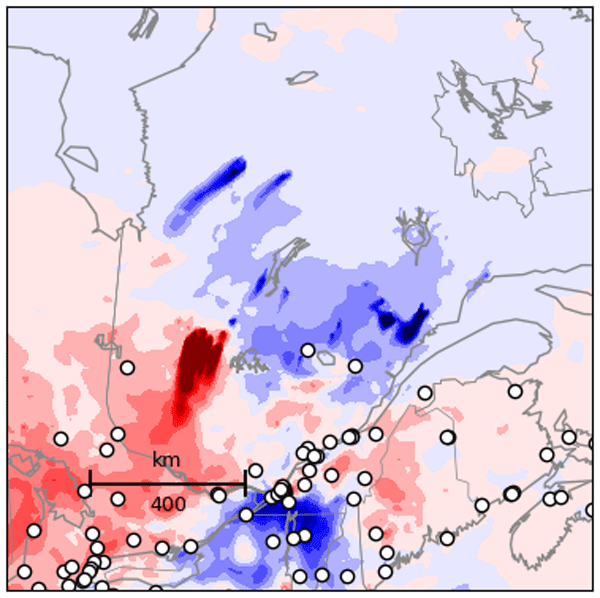
This manuscript developed a series of theoretical derivation for background error standard deviation (BESD) from processes including advection, vertical diffusion, point emission etc. These dynamic BESD has case-dependent and anisotropic features. There are two major issues in this manuscript. The theoretical derivation used some assumptions, like “assuming concentration errors at emission locations to be highly correlated to local emission errors” (line 661). This assumed condition is usually valid only for short-lived species emitted from isolated point sources, such as SO2 or NOx from power plants. Applying this assumption to wildfire aerosols needs some justifications, considering that PM2.5 aerosols are relatively long-lived species and the impact of upstream emissions could be significant, especial for the forest fires where the fire spots are usually adjacent. Other important factors, such as fire plume rises, were not mentioned. The changed BESD should also affect the assimilation in elevated layers, but this study and discussion are limited in surface PM2.5 only, without touching anything about aerosol optical depth, an important wildfire plume indicator. Another issue is that this manuscript lacks observation-based verification, and study period is too short. The case study application (section 4) only shows the one-day BESD and analysis increment (June 06, 2023), compared with the operational setup. There is no evaluation using observations.
Here are some specific comments.
Section 2.1. For the advection of error field, how to consider the wind field error? This derivation assumes no error on meteorological field. However, in real situation, this error should exist.
Section 2.2 The vertical diffusion of errors only consider the simplest K-theory diffusion. For big wildfire, the plume rise and convection could be the major factor affecting the pollutant’s vertical distribution.
Section 2.3 As the wildfire spots are usually adjacent, the simple assumption of local emission determining local PM2.5 concentrations could have issues.
Section 3.1 Insufficient detail on model configuration (e.g., resolution, chemistry scheme, boundary conditions, emissions treatment).
Section 4. The case study is only limited to one-day event, and there is no direct evaluation against observations.
Citation: https://doi.org/10.5194/egusphere-2025-6386-RC1 -
AC1: 'Reply on RC1', Annika Vogel, 27 Apr 2026
The comment was uploaded in the form of a supplement: https://egusphere.copernicus.org/preprints/2025/egusphere-2025-6386/egusphere-2025-6386-AC1-supplement.pdf
-
AC1: 'Reply on RC1', Annika Vogel, 27 Apr 2026
-
RC2: 'Comment on egusphere-2025-6386', Anonymous Referee #2, 10 Mar 2026
General comments:
This study presents a simple parametric Kalman Filter (PKF) specifically tailored to the requirements of operational air quality data data assimilation under highly uncertain emission like wildfire smoke events. The study focuses on the forecast step of the PKF by evolving error standard deviations in the Canadian operational air quality model GEM-MACH. The results of a case study during a wildfire episode in July 2023 in eastern Canada show the simple PKF can significantly impact the hourly PM2.5 analysis increments compared to the operational setup. The differences can be related to the ability of the simple PKF to attribute large analysis increments to highly uncertain areas like wildfire plumes far away from observation locations. However, the study is limited to only one case study of one day.
Major comments:
- How much uncertainty is the used wildfire emissions from CFFEPS for the case study? Is it consistent with the estimated uncertainty proposed with the linear relation between emissions and concentrations in section 3.3?
- It is better to firstly give a figure shown the wildfire emissions for the studied case. Where and when the wirdfire hoppen during the studied case?
- It is sugguested to add the meteorological fields in Figure 2 to see how the emitted PM2.5 from the wirdfire are transported.
- In section 4.3, it is recommended to quantitative evaluation of the analysis increments with assimilated observations of the two experiments to see whether the PKF is superior to the operional one.
- In section 4.3, the analysis increments like wildfire plumes far away from observation locations could be evaluated with satellite observed optical properties.
Citation: https://doi.org/10.5194/egusphere-2025-6386-RC2 -
AC2: 'Reply on RC2', Annika Vogel, 27 Apr 2026
The comment was uploaded in the form of a supplement: https://egusphere.copernicus.org/preprints/2025/egusphere-2025-6386/egusphere-2025-6386-AC2-supplement.pdf
Peer review completion
Journal article(s) based on this preprint
Viewed
| HTML | XML | Total | BibTeX | EndNote | |
|---|---|---|---|---|---|
| 1,274 | 593 | 168 | 2,035 | 443 | 480 |
- HTML: 1,274
- PDF: 593
- XML: 168
- Total: 2,035
- BibTeX: 443
- EndNote: 480
Viewed (geographical distribution)
| Country | # | Views | % |
|---|
| Total: | 0 |
| HTML: | 0 |
| PDF: | 0 |
| XML: | 0 |
- 1
Cited



Richard Ménard
James Abu
Jack Chen
The requested preprint has a corresponding peer-reviewed final revised paper. You are encouraged to refer to the final revised version.
- Preprint
(2665 KB) - Metadata XML
This manuscript developed a series of theoretical derivation for background error standard deviation (BESD) from processes including advection, vertical diffusion, point emission etc. These dynamic BESD has case-dependent and anisotropic features. There are two major issues in this manuscript. The theoretical derivation used some assumptions, like “assuming concentration errors at emission locations to be highly correlated to local emission errors” (line 661). This assumed condition is usually valid only for short-lived species emitted from isolated point sources, such as SO2 or NOx from power plants. Applying this assumption to wildfire aerosols needs some justifications, considering that PM2.5 aerosols are relatively long-lived species and the impact of upstream emissions could be significant, especial for the forest fires where the fire spots are usually adjacent. Other important factors, such as fire plume rises, were not mentioned. The changed BESD should also affect the assimilation in elevated layers, but this study and discussion are limited in surface PM2.5 only, without touching anything about aerosol optical depth, an important wildfire plume indicator. Another issue is that this manuscript lacks observation-based verification, and study period is too short. The case study application (section 4) only shows the one-day BESD and analysis increment (June 06, 2023), compared with the operational setup. There is no evaluation using observations.
Here are some specific comments.
Section 2.1. For the advection of error field, how to consider the wind field error? This derivation assumes no error on meteorological field. However, in real situation, this error should exist.
Section 2.2 The vertical diffusion of errors only consider the simplest K-theory diffusion. For big wildfire, the plume rise and convection could be the major factor affecting the pollutant’s vertical distribution.
Section 2.3 As the wildfire spots are usually adjacent, the simple assumption of local emission determining local PM2.5 concentrations could have issues.
Section 3.1 Insufficient detail on model configuration (e.g., resolution, chemistry scheme, boundary conditions, emissions treatment).
Section 4. The case study is only limited to one-day event, and there is no direct evaluation against observations.