
the Creative Commons Attribution 4.0 License.
the Creative Commons Attribution 4.0 License.
 | 30 Dec 2025
Leaching Behavior of Steelmaking Slag Fertilizer under Repeated Wetting and Drying Conditions Simulating Upland Soil
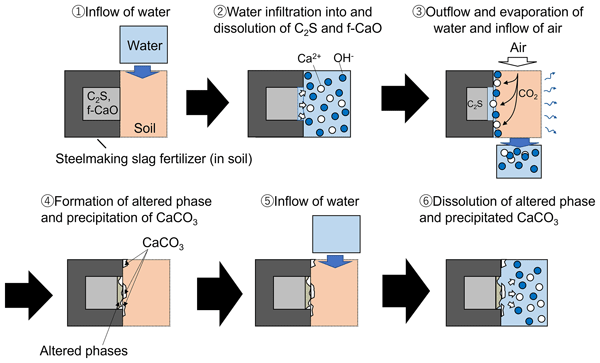
Abstract. To determine how steelmaking slag dissolves and modulates soil acidity and exchangeable cations under upland-like repeated wetting–drying conditions, we conducted a soil-column experiment. Specifically, we aimed to identify the Ca-supplying phases responsible for pH correction, evaluate their persistence during extended leaching, and define the layer-scale reach of the effect to inform application planning (rate, placement, and maintenance). Soil columns incorporating discrete slag-amended layers were prepared together with unamended controls. A repeated wetting–drying leaching test was run up to 24 weeks; after termination, each column was sampled by layer, and soil pH and exchangeable CaO were measured. Additionally, surfaces and cross-sections of slag particles embedded in the columns were observed to identify dissolving phases and secondary precipitates. In the control columns, soil pH remained in the acidic range (4.8–5.5), whereas slag-amended layers maintained pH 6.0–6.5 for 24 weeks in the test columns. Adjacent unamended layers in the test columns showed no detectable change, indicating that the effect was confined to the amended layers. Exchangeable CaO increased in soils mixed with slag. Microstructural observations revealed alteration and dissolution of free lime (f-CaO) and dicalcium silicate (2CaO·SiO2), with CaCO3 precipitates on particle surfaces. These Ca-supplying phases persisted after 24 weeks of leaching. Sustained Ca release from f-CaO and 2CaO·SiO2, together with CaCO3 precipitation, produced localized, durable pH correction in slag-amended layers while leaving adjacent layers unchanged. The defined reach and persistence provide a mechanistic basis for application planning in acidic upland soils – informing rate, placement within the profile, and maintenance intervals.
-
Notice on discussion status
The requested preprint has a corresponding peer-reviewed final revised paper. You are encouraged to refer to the final revised version.
-
Preprint
(1528 KB)
-
The requested preprint has a corresponding peer-reviewed final revised paper. You are encouraged to refer to the final revised version.
- Preprint
(1528 KB) - Metadata XML
- BibTeX
- EndNote
- Final revised paper


Journal article(s) based on this preprint
Interactive discussion
Status: closed
-
RC1: 'Comment on egusphere-2025-6356', Anonymous Referee #1, 08 Jan 2026
-
AC1: 'Reply on RC1', Takayuki Iwama, 28 Feb 2026
Thank you for reviewing. Please confirm attachment.
-
AC3: 'Reply on AC1', Takayuki Iwama, 05 Mar 2026
The comment was uploaded in the form of a supplement: https://egusphere.copernicus.org/preprints/2025/egusphere-2025-6356/egusphere-2025-6356-AC3-supplement.pdf
-
AC3: 'Reply on AC1', Takayuki Iwama, 05 Mar 2026
-
AC1: 'Reply on RC1', Takayuki Iwama, 28 Feb 2026
-
RC2: 'Comment on egusphere-2025-6356', Anonymous Referee #2, 17 Feb 2026
The authors extend the study of steel slag weathering to different soil system and perform some nice column and block weathering experiments. The behaviour of steel slag in soils and the hydration mechanisms have been previous well studied so the extent of novelty seems relatively low. Also the experimental methods and data are somewhat poorly explained in the manuscript.
L28 –however its main components typically include lime (CaO), silica (SiO2), iron oxide (FeOx), magnesia (MgO), manganese oxide (MnO),and phosphate (P2O5)’ – I find this phrasing misleading as this appears to be a list of nominal chemical determinants, typically from XRF analysis. Yes steel slags contain Si, but very little if any SiO2 as silica (it is primarily present in Ca-silicates). Perhaps phrase this as a list of elements (Ca, Si, Fe etc.) or rephrase as a list of primary phases (lime, larnite, brownmillerite etc.).
L60 – at least mention some studies of toxic trace element release and mobility in your review of previous work – it is my understanding that leaching of trace metals has been a persistent concern where slag has been previously applied to agriculture land. Why have you omitted the study of potentially toxic trace metal behaviour from this study?
L95 – ‘A broad halo pattern was also observed between 25° and 40°, suggesting the presence of an amorphous glass phase’. This is not very apparent in the actual diffractogram. Could the higher baseline observed at 32-34 degree 2 theta simply be do to the presence of multiple overlapping peaks in this area. I don’t think the presence of a glass phase is supported on the XRD evidence alone. (BOF slags are generally air cooled, which does not typically result in the preservation of a glass phase in the final product).
L119 – what was the pore size of the gauze and plastic mesh used for soil retention and separation?
Fig. 4 – explain a bit more how the layer analysis was produced – were separate columns sacrificed at different ages or were the same 2 columns subsampled at different weeks (and if so, how?)?
L260 – is the slight increase in plan available P statistically important or just the normal variation in measurement between replicates?
L275 – perhaps consider adding mineral names and chemical compositions at first use of the cement notations in the text – not all readers will be familiar with these phases.
L280 – how was the quantitate C analysis achieved and calibrated.
Table 2 – what are the units of this analysis and have the data been normalised or presented as weight or atomic basis?
L338 – how was the sectioning of slag blocks achieved to protect the surfaces from water?
L345 – do you observe the formation of a C-S-H phase on the surface of the slag blocks that limit the weathering depth over time? Also how does the depth of the altered surface layer compare to the size of the particles of crushed slag used? Would you expect full reaction of the crushed particles?
L480 – superscript in CaCO3.
L525 – is the free lime and C2S in the particle centres not to a certain extent hindered from dissolution by the formation of lower solubility reaction products such that the rate of Ca release is expected to reduce over time (and hence the effectiveness as a soil amendment will also reduce.
Citation: https://doi.org/10.5194/egusphere-2025-6356-RC2 - AC2: 'Reply on RC2', Takayuki Iwama, 28 Feb 2026


Interactive discussion
Status: closed
-
RC1: 'Comment on egusphere-2025-6356', Anonymous Referee #1, 08 Jan 2026
This is a good manuscript with interesting methodology and results. I have mostly minor comments:
- 1: Have the authors considered quantifying the different mineral phases and amorphous phase of the slag fertilizer used? Utilizing e.g. the Rietveld method by addition of an internal standard mineral it is possible to quantitatively determine the concentrations of the identified mineral and amorphous phases. XRD analyses before and after the leaching process could provide insights into which mineral phases are dissolving and/or forming.
- 4: Have the authors performed replicate experiments or sampling? Especially in the case of the concentration of plant-available phosphorus, it is difficult to judge whether the observed differences are significant without knowing the variability of the results as the values are very close together. The observation that phosphorus was more-or-less uniform throughout all columns seems to indicate that the slags are not contributing significantly to phosphorus release.
- 5: From the SE and BSE images, significant surface roughening is observed after the experiment. Can the quantitative results for carbon be reliable considering the slag is embedded in a polymer based-matrix? Could the increase in C be due to contamination from the C-rich resin as a result of the surface degradation during the experiment?
- The points indicated in the BSE image are rather small. A suggestion would be to increase the overall size of the figure or increase the label size of the respective points.
- 7: The 24 week sample seems to contain more Ca-rich regions than the 2 other samples. One would expect this sample to be the most heavily depleted of Ca. Is this simply a sampling artifact or do the authors expect this to be observed consistently? If so, can the authors hypothesize as to why this occurs?
- Line 376: Will the dissolution of precipitated CaCO3 be significant enough to provide a sustained source of Ca release into the soil? According to the thermodynamic solubility results in Fig. 8, it can be seen that out of all phases CaCO3 is the least soluble. Slag addition also increases local pH around slag particles, lowering solubility even further.
- Line 481: CaCO3 instead of CaCO3, superscript should be changed to subscript.
- Line 550: MgCO3 is notoriously difficult to precipitate due to the high hydration activity of Mg2+ The authors could check for embedding of Mg2+ ions into the calcium carbonate matrix. The authors could also measure the solution chemistry of the water drained out during the wetting phases to ensure certain elements are not being flushed out when water is poured into the column.
- The “Others” category in Table 1 presumably also includes heavy metals such as chromium and vanadium, which steel slags are known to contain. It seems that this study has excluded these components from its scope. Have the authors considered that these components can also leach into the soil, potentially leading to problematic environmental consequences?
Citation: https://doi.org/10.5194/egusphere-2025-6356-RC1 -
AC1: 'Reply on RC1', Takayuki Iwama, 28 Feb 2026
Thank you for reviewing. Please confirm attachment.
-
AC3: 'Reply on AC1', Takayuki Iwama, 05 Mar 2026
The comment was uploaded in the form of a supplement: https://egusphere.copernicus.org/preprints/2025/egusphere-2025-6356/egusphere-2025-6356-AC3-supplement.pdf
-
AC3: 'Reply on AC1', Takayuki Iwama, 05 Mar 2026
-
RC2: 'Comment on egusphere-2025-6356', Anonymous Referee #2, 17 Feb 2026
The authors extend the study of steel slag weathering to different soil system and perform some nice column and block weathering experiments. The behaviour of steel slag in soils and the hydration mechanisms have been previous well studied so the extent of novelty seems relatively low. Also the experimental methods and data are somewhat poorly explained in the manuscript.
L28 –however its main components typically include lime (CaO), silica (SiO2), iron oxide (FeOx), magnesia (MgO), manganese oxide (MnO),and phosphate (P2O5)’ – I find this phrasing misleading as this appears to be a list of nominal chemical determinants, typically from XRF analysis. Yes steel slags contain Si, but very little if any SiO2 as silica (it is primarily present in Ca-silicates). Perhaps phrase this as a list of elements (Ca, Si, Fe etc.) or rephrase as a list of primary phases (lime, larnite, brownmillerite etc.).
L60 – at least mention some studies of toxic trace element release and mobility in your review of previous work – it is my understanding that leaching of trace metals has been a persistent concern where slag has been previously applied to agriculture land. Why have you omitted the study of potentially toxic trace metal behaviour from this study?
L95 – ‘A broad halo pattern was also observed between 25° and 40°, suggesting the presence of an amorphous glass phase’. This is not very apparent in the actual diffractogram. Could the higher baseline observed at 32-34 degree 2 theta simply be do to the presence of multiple overlapping peaks in this area. I don’t think the presence of a glass phase is supported on the XRD evidence alone. (BOF slags are generally air cooled, which does not typically result in the preservation of a glass phase in the final product).
L119 – what was the pore size of the gauze and plastic mesh used for soil retention and separation?
Fig. 4 – explain a bit more how the layer analysis was produced – were separate columns sacrificed at different ages or were the same 2 columns subsampled at different weeks (and if so, how?)?
L260 – is the slight increase in plan available P statistically important or just the normal variation in measurement between replicates?
L275 – perhaps consider adding mineral names and chemical compositions at first use of the cement notations in the text – not all readers will be familiar with these phases.
L280 – how was the quantitate C analysis achieved and calibrated.
Table 2 – what are the units of this analysis and have the data been normalised or presented as weight or atomic basis?
L338 – how was the sectioning of slag blocks achieved to protect the surfaces from water?
L345 – do you observe the formation of a C-S-H phase on the surface of the slag blocks that limit the weathering depth over time? Also how does the depth of the altered surface layer compare to the size of the particles of crushed slag used? Would you expect full reaction of the crushed particles?
L480 – superscript in CaCO3.
L525 – is the free lime and C2S in the particle centres not to a certain extent hindered from dissolution by the formation of lower solubility reaction products such that the rate of Ca release is expected to reduce over time (and hence the effectiveness as a soil amendment will also reduce.
Citation: https://doi.org/10.5194/egusphere-2025-6356-RC2 - AC2: 'Reply on RC2', Takayuki Iwama, 28 Feb 2026
Peer review completion


Journal article(s) based on this preprint
Viewed
| HTML | XML | Total | BibTeX | EndNote | |
|---|---|---|---|---|---|
| 228 | 114 | 43 | 385 | 90 | 90 |
- HTML: 228
- PDF: 114
- XML: 43
- Total: 385
- BibTeX: 90
- EndNote: 90
Viewed (geographical distribution)
| Country | # | Views | % |
|---|
| Total: | 0 |
| HTML: | 0 |
| PDF: | 0 |
| XML: | 0 |
- 1
Takayuki Iwama
Shohei Koizumi
Megumi Obara
Shigeru Ueda
The requested preprint has a corresponding peer-reviewed final revised paper. You are encouraged to refer to the final revised version.
- Preprint
(1528 KB) - Metadata XML
This is a good manuscript with interesting methodology and results. I have mostly minor comments: