
the Creative Commons Attribution 4.0 License.
the Creative Commons Attribution 4.0 License.
 | 28 Dec 2025
The impact of suspended sediments on exchange flow in a macrotidal, hyperturbid estuary
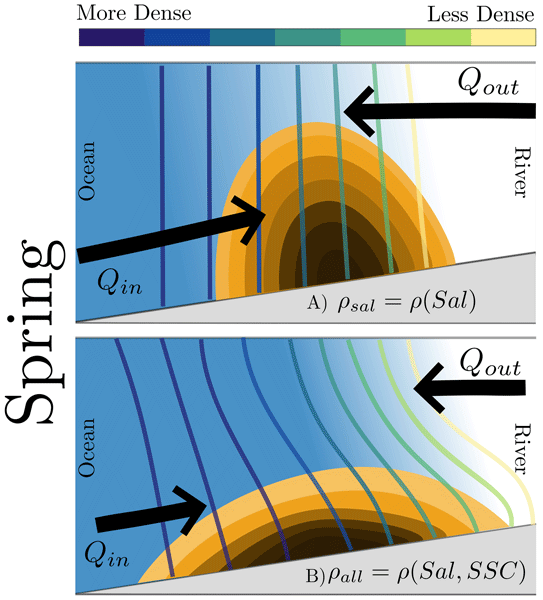
Abstract. This study investigates the sensitivity of the total exchange flow (TEF) to the consideration of suspended sediment concentrations (SSC) in water density calculations. We consider two model scenarios of an idealized model based on a macrotidal, highly turbid estuary: one where density depends on both salinity and SSC and another where density depends only on salinity. These models are used to understand how TEF volume inflow (Qin) varies along the estuary over fortnightly and monthly time scales. The inflow TEF bulk-values between the two model scenarios show small differences (less than 4%) over 5 months. However, differences in TEF bulk volume inflow reach 7% downstream of the estuarine turbidity maximum (ETM), 22% at the ETM, and nearly 70% upstream of the ETM when quantified only over spring tides. The gradient Richardson number indicates that sediment-induced stratification suppress shear production ∼30 km further upstream when suspended sediments are an active tracer. The most profound impact on TEF occur during spring tides at -and upstream of- the ETM where sediment contributions to density exceed those from salinity. The sediment contribution leads to increased stratification in the upper-reaches of the estuary, effectively reducing the longitudinal density gradient and therefore the exchange flow as much as 2000 m3 s−1, indicating a dominant role of suspended sediments in attenuating exchange in hyperturbid estuaries. The results from this work highlight the importance of the consideration of SSC on density calculations on estuarine studies of the exchange flow.
-
Notice on discussion status
The requested preprint has a corresponding peer-reviewed final revised paper. You are encouraged to refer to the final revised version.
-
Preprint
(5899 KB)
-
The requested preprint has a corresponding peer-reviewed final revised paper. You are encouraged to refer to the final revised version.
- Preprint
(5899 KB) - Metadata XML
- BibTeX
- EndNote
- Final revised paper


Journal article(s) based on this preprint
Interactive discussion
Status: closed
-
RC1: 'Comment on egusphere-2025-6311', Anonymous Referee #1, 07 Feb 2026
- AC1: 'Reply on RC2', Cristian Rojas, 17 Mar 2026
-
RC2: 'Comment on egusphere-2025-6311', Claire Beraud, 13 Feb 2026
The comment was uploaded in the form of a supplement: https://egusphere.copernicus.org/preprints/2025/egusphere-2025-6311/egusphere-2025-6311-RC2-supplement.pdf
- AC1: 'Reply on RC2', Cristian Rojas, 17 Mar 2026


Interactive discussion
Status: closed
-
RC1: 'Comment on egusphere-2025-6311', Anonymous Referee #1, 07 Feb 2026
- AC1: 'Reply on RC2', Cristian Rojas, 17 Mar 2026
-
RC2: 'Comment on egusphere-2025-6311', Claire Beraud, 13 Feb 2026
The comment was uploaded in the form of a supplement: https://egusphere.copernicus.org/preprints/2025/egusphere-2025-6311/egusphere-2025-6311-RC2-supplement.pdf
- AC1: 'Reply on RC2', Cristian Rojas, 17 Mar 2026
Peer review completion


Journal article(s) based on this preprint
Viewed
| HTML | XML | Total | BibTeX | EndNote | |
|---|---|---|---|---|---|
| 629 | 383 | 85 | 1,097 | 106 | 105 |
- HTML: 629
- PDF: 383
- XML: 85
- Total: 1,097
- BibTeX: 106
- EndNote: 105
Viewed (geographical distribution)
| Country | # | Views | % |
|---|
| Total: | 0 |
| HTML: | 0 |
| PDF: | 0 |
| XML: | 0 |
- 1
Cristian M. Rojas
Lauren Ross
Betty John Kaimathuruthy
Isabel Jalón-Rojas
Aldo Sottolichio
Nicolas Huybrechts
The requested preprint has a corresponding peer-reviewed final revised paper. You are encouraged to refer to the final revised version.
- Preprint
(5899 KB) - Metadata XML
Please see the attached pdf file.