
the Creative Commons Attribution 4.0 License.
the Creative Commons Attribution 4.0 License.
 | 27 Dec 2025
Gas-phase products from nitrate radical oxidation of five monoterpenes: insights from free-jet flow-tube experiments
Abstract. Formation of secondary organic aerosol (SOA), which affects climate and health, is largely driven by the gas-particle transfer of highly oxygenated organic molecules (HOMs). These HOMs form via autoxidation following reactions of volatile organic compounds (VOCs) with atmospheric oxidants. While the oxidation of monoterpenes, the most important biogenic VOCs for SOA formation, by ozone (O3) and hydroxyl radicals (OH) is well-studied, the role of the nitrate radical (NO3), a crucial nighttime oxidant, remains less understood.
This study investigated NO3-initated oxidation of five monoterpenes: α-pinene (AP), Δ-3-carene, limonene, β-pinene (BP), and β-myrcene. Using a newly built free-jet flow-tube system (8.8 s reaction time) and chemical ionization mass spectrometry (amine/nitrate ionization), we observed a wide range of peroxy radicals and closed-shell products. Product closure was reasonably achieved for AP, limonene, and myrcene (estimated to 50%–70%), but was lower for carene and BP (20%–40%). AP and limonene predominantly yielded C10H16O2 (molar yields > 50%), while a notably high signal for carene was the peroxy radical C10H16NO8, for myrcene the radical C10H16NO7, and for BP the accretion product C20H32N2O8. The distinct HOM yields further emphasize highly structure-dependent oxidation pathways: 6.5% (myrcene), 6.1% (carene), 1.8% (BP), 1.1% (limonene), and 0.8% (AP). The HOM yields differ from those of ozonolysis, but overall HOM yields from NO3 oxidation are comparable in magnitude (0–10%). This study provides comprehensive and quantitative distributions of NO3 oxidation products for the most common monoterpenes, providing important knowledge of their fast (aut)oxidation pathways.
-
Notice on discussion status
The requested preprint has a corresponding peer-reviewed final revised paper. You are encouraged to refer to the final revised version.
-
Preprint
(3314 KB)
-
Supplement
(5827 KB)
-
The requested preprint has a corresponding peer-reviewed final revised paper. You are encouraged to refer to the final revised version.
- Preprint
(3314 KB) - Metadata XML
-
Supplement
(5827 KB) - BibTeX
- EndNote
- Final revised paper


Journal article(s) based on this preprint
Interactive discussion
Status: closed
- RC1: 'Comment on egusphere-2025-6255', Anonymous Referee #1, 23 Jan 2026
-
RC2: 'Comment on egusphere-2025-6255', Anonymous Referee #2, 16 Feb 2026
This study presents early-stage HOMs products and their yields from NO3 + five monoterpenes using flow-tube experiments. The authors were able to distinguish NO3 products from O3/OH oxidation products, derived individual product yields and constrained total HOMs yields from NO3 oxidation of different monoterpenes. By using two ionization schemes, they were able to detect a wide range of close-shell compounds and RO2 that provided insights into the reaction mechanisms. Overall this manuscript is well written and is suitable for ACP. I only have a few comments.
- Line 131, regarding CIMS calibrations, was the DEA mode also calibrated using sulfuric acid and was the sensitivity factor applied universally to the wide range of species detected? How large was the uncertainty in sensitivity?
- Line 360, did the Vocus see one O-atom products? If so, do they fill the gap in the product closure and explain the mechanism?
- Figure 2B, at around 11am, is there a reason for the increase and then decrease in C10H14O7 and several other species?
- What were the NO mixing ratios in these experiments? Likely low but a sentence mentioning NO would be helpful.
- Line 274-277, can the box model estimate HO2 concentration and understand whether HO2 is an important RO2 sink?
Citation: https://doi.org/10.5194/egusphere-2025-6255-RC2 - AC1: 'Comment on egusphere-2025-6255', Jiangyi Zhang, 06 Mar 2026


Interactive discussion
Status: closed
-
RC1: 'Comment on egusphere-2025-6255', Anonymous Referee #1, 23 Jan 2026
The authors present an experimental study using a newly built free-jet flow-tube experimental setup that enables measurement of oxygenated organic compounds with close to no wall interaction. The specific setup aims to investigate the initial gas-phase oxidation stages with a short reaction time of 8.8s. In contrast to many other setups, this widely suppresses contribution of multi-generational oxidation as well as heterogeneous artefacts. In the presented work, the nitrate radical oxidation of 5 major monoterpene (MT) compounds are presented, which remains understudied compared to OH oxidation and ozonolysis. The results of this study are very helpful to improve our understanding of the formation of secondary organic aerosol precursor compounds in the atmosphere, linking structural differences to different HOM yields. The paper is well written and follows a clear logic. I have a few comments about the applied quantification and the interpretation of the results. I recommend publication once these comments have been addressed:
- I was surprised to see the comparatively high starting levels of MT, as the authors discuss the competition of bimolecular reaction and unimolecular termination or isomerization. The experimental setup seems to allow for lower concentrations and it seems to me, that compared to other studies, the instrumental limits of detection are not as severe in this work. Is there a specific reason the authors chose the mixing ratios, which are high compared to typical atmospheric mixing ratios?
- More to that point, the presented DEA-CIMS spectra reach comparatively high normalized values, some signals appear to be as high as 0.15 ncps. At this level, the primary ion signal might decrease and the instrument signal might not show a linear correlation to the concentration anymore. Did the authors observe a drop in the primary ion signal?
- Did the authors test if some of the observed dimer signals can be formed during the ionization process and are actually artefacts from cluster formation of two monomers with DEA. There are some discrepancies between the nitrate-CIMS and the DEA dimer distribution in the spectra that might be affected by different primary ion concentrations. Furthermore, the authors describe limitations during the applications of a dilution tube, it would be interesting to see if all signals were affected similarly.
- The authors attempt a mass closure using both DEA and NO3 CIMS signals, both linked to calibration of the instrument with sulfuric acid. Considering that the calculated levels should be regarded as lower limits, which is stated by the authors, the results agree surprisingly well, but depending on the DEA primary ion signal behavior the strength of the presented mass closure might be doubtful. Small differences in the cluster stability might lead to large uncertainties.
- During the experiments, a VOCUS PTR was monitoring the MT concentrations. Did the authors check for compounds with one or two oxygen atoms to support their hypothesis, that C10H16O contributes to the mass closure of some MT?
- The nitrate radical is commonly assumed to initiate the reaction with AP by adding to the double bond. However, there is some work that suggests the contribution of H-abstraction pathways to AP degradation.
Vereecken, L.; Peeters, J. Theoretical Study of the Formation of Acetone in the OH-Initiated Atmospheric Oxidation of α-Pinene. J Phys Chem A 2000, 104 (47), 11140–11146. https://doi.org/10.1021/jp0025173
Shen, H.; Vereecken, L.; Kang, S.; Pullinen, I.; Fuchs, H.; Zhao, D.; Mentel, T. F. Unexpected Significance of a Minor Reaction Pathway in Daytime Formation of Biogenic Highly Oxygenated Organic Compounds. Sci Adv 2024, 8 (42), eabp8702. https://doi.org/10.1126/sciadv.abp8702
The authors observed the formation of C10H16O2 during the oxidation of AP and carene and suggest the contribution of C10H16O. I suggest including a discussion about previously discussed H-abstraction pathways as well.
- A 0-D box model was used to calculate the oxidant levels at the start of the reaction based on gas-phase reactions. It seems like upon dilution after the reaction chamber as well as upon mixing in the flow tube itself, a major fraction of the nitrate radicals is derived from N2O5, as the dilution of the NO3 level would result in much lower mixing ratios. Did the authors estimate the loss fraction of N2O5 to surfaces and how much that could influence the oxidant levels in the setup?
- Could a heterogeneous reaction of N2O5 explain nitrate formation? What was the humidity level reached during the experiments?
- Mainly in Figure 4 but also in S9, there are more arrows than corresponding formulas, which makes it quite hard to read the plot, I suggest to remove ‘empty arrows’.
- The first part of the ‘Implications’ section actually reads very similar to a conclusions section. Maybe the authors could emphasize more the implications for SOA formations, that these results might comprise. Can we expect the SOA formation to change between night and daytime using the presented results?
Minor comments:
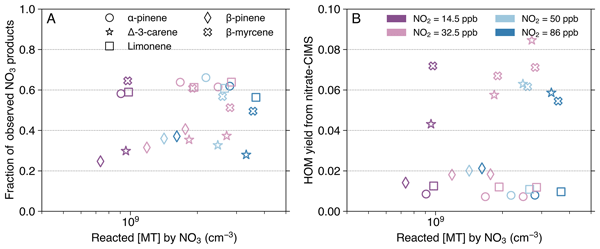
I would suggest to use a different color for the two data points with the same NO2 concentration in figures 6 and S8 to make it easier to read and understand the plots.
L193: should read “we used the following criteria”
L 289: should read “than its corresponding RO2 C10H16NO5”
L247: should read “the comparatively low signals”
L275: I think the RO2 radical should be the corresponding C10H16NO5
L282: should read “It is present even…”
Citation: https://doi.org/10.5194/egusphere-2025-6255-RC1 -
RC2: 'Comment on egusphere-2025-6255', Anonymous Referee #2, 16 Feb 2026
This study presents early-stage HOMs products and their yields from NO3 + five monoterpenes using flow-tube experiments. The authors were able to distinguish NO3 products from O3/OH oxidation products, derived individual product yields and constrained total HOMs yields from NO3 oxidation of different monoterpenes. By using two ionization schemes, they were able to detect a wide range of close-shell compounds and RO2 that provided insights into the reaction mechanisms. Overall this manuscript is well written and is suitable for ACP. I only have a few comments.
- Line 131, regarding CIMS calibrations, was the DEA mode also calibrated using sulfuric acid and was the sensitivity factor applied universally to the wide range of species detected? How large was the uncertainty in sensitivity?
- Line 360, did the Vocus see one O-atom products? If so, do they fill the gap in the product closure and explain the mechanism?
- Figure 2B, at around 11am, is there a reason for the increase and then decrease in C10H14O7 and several other species?
- What were the NO mixing ratios in these experiments? Likely low but a sentence mentioning NO would be helpful.
- Line 274-277, can the box model estimate HO2 concentration and understand whether HO2 is an important RO2 sink?
Citation: https://doi.org/10.5194/egusphere-2025-6255-RC2 - AC1: 'Comment on egusphere-2025-6255', Jiangyi Zhang, 06 Mar 2026
Peer review completion


Journal article(s) based on this preprint
Data sets
Dataset for article "Gas-phase products from nitrate radical oxidation of five monoterpenes: insights from free-jet flow-tube experiments" Jiangyi Zhang et al. https://doi.org/10.5281/zenodo.17250832
Viewed
| HTML | XML | Total | Supplement | BibTeX | EndNote | |
|---|---|---|---|---|---|---|
| 441 | 195 | 35 | 671 | 107 | 48 | 44 |
- HTML: 441
- PDF: 195
- XML: 35
- Total: 671
- Supplement: 107
- BibTeX: 48
- EndNote: 44
Viewed (geographical distribution)
| Country | # | Views | % |
|---|
| Total: | 0 |
| HTML: | 0 |
| PDF: | 0 |
| XML: | 0 |
- 1
Yi Zhang
Hannu Koskenvaara
Jian Zhao
The requested preprint has a corresponding peer-reviewed final revised paper. You are encouraged to refer to the final revised version.
- Preprint
(3314 KB) - Metadata XML
-
Supplement
(5827 KB) - BibTeX
- EndNote
- Final revised paper
The authors present an experimental study using a newly built free-jet flow-tube experimental setup that enables measurement of oxygenated organic compounds with close to no wall interaction. The specific setup aims to investigate the initial gas-phase oxidation stages with a short reaction time of 8.8s. In contrast to many other setups, this widely suppresses contribution of multi-generational oxidation as well as heterogeneous artefacts. In the presented work, the nitrate radical oxidation of 5 major monoterpene (MT) compounds are presented, which remains understudied compared to OH oxidation and ozonolysis. The results of this study are very helpful to improve our understanding of the formation of secondary organic aerosol precursor compounds in the atmosphere, linking structural differences to different HOM yields. The paper is well written and follows a clear logic. I have a few comments about the applied quantification and the interpretation of the results. I recommend publication once these comments have been addressed:
Vereecken, L.; Peeters, J. Theoretical Study of the Formation of Acetone in the OH-Initiated Atmospheric Oxidation of α-Pinene. J Phys Chem A 2000, 104 (47), 11140–11146. https://doi.org/10.1021/jp0025173
Shen, H.; Vereecken, L.; Kang, S.; Pullinen, I.; Fuchs, H.; Zhao, D.; Mentel, T. F. Unexpected Significance of a Minor Reaction Pathway in Daytime Formation of Biogenic Highly Oxygenated Organic Compounds. Sci Adv 2024, 8 (42), eabp8702. https://doi.org/10.1126/sciadv.abp8702
The authors observed the formation of C10H16O2 during the oxidation of AP and carene and suggest the contribution of C10H16O. I suggest including a discussion about previously discussed H-abstraction pathways as well.
Minor comments:
I would suggest to use a different color for the two data points with the same NO2 concentration in figures 6 and S8 to make it easier to read and understand the plots.
L193: should read “we used the following criteria”
L 289: should read “than its corresponding RO2 C10H16NO5”
L247: should read “the comparatively low signals”
L275: I think the RO2 radical should be the corresponding C10H16NO5
L282: should read “It is present even…”