
the Creative Commons Attribution 4.0 License.
the Creative Commons Attribution 4.0 License.
 | 18 Dec 2025
Petrogenesis and geodynamic implications of Ediacaran rocks from the Sirwa massif (Central Anti-Atlas); insights from U-Pb geochronology, whole-rock geochemistry, and Sm-Nd isotopes
Abstract. The geodynamic evolution of the Anti-Atlas belt post-Pan-African orogeny (~650 Ma) remains debated, particularly regarding the basement beneath the Central Anti-Atlas, and the geological processes leading to the formation of the Ediacaran Saghro Group (SG), and Ouarzazate Group (OG). New LA-ICP-MS U-Pb ages of 575 ± 3 Ma and 564 ± 2 Ma were obtained respectively from samples Zg-106, and Zg-119 from the OG. In addition, detrital zircons from SG sediments yield a prominent 2.1 Ga age peak, indicating local recycling of Paleoproterozoic basement material. Geochemically, two magmatic series are identified : (i) a SG mafic-intermediate calc-alkaline series with Nb-Ta and Ti negative anomalies from early back-arc basin setting; and (ii) a felsic-intermediate high-K calc-alkaline to shoshonitic series of the OG, exhibiting continental magmatic arc signatures. Isotope data (εNd (t): +3.2 to +4.5, TDM = 1431 − 1197 Ma for SG; εNd (t): −0.9 to +1.1, TDM = 1526− 1252 Ma for OG), indicates that the SG formed from a dominantly juvenile, mantle-derived source, with limited crustal contribution; while the slightly younger OG involved significant reworking of older, evolved continental crustal material.
These findings sustain a model where Early Ediacaran SG sediments and associated mafic-intermediate volcanics were formed in a back-arc basin. During this basin development, its shoulders were locally formed by the 2.1 Ga Paleoproterozoic basement, supplying Paleoproterozoic zircons to the Saghro host basin. This, further supports the occurrence of the Eburnian basement north of the Anti-Atlas Major Fault (AAMF). Additionally, the younger OG reflects a Late Ediacaran continental crust collapse event involving widespread crustal reworking and the emplacement of a Silicic Large Igneous Province (SLIP).
-
Notice on discussion status
The requested preprint has a corresponding peer-reviewed final revised paper. You are encouraged to refer to the final revised version.
-
Preprint
(5009 KB)
-
Supplement
(1243 KB)
-
The requested preprint has a corresponding peer-reviewed final revised paper. You are encouraged to refer to the final revised version.
- Preprint
(5009 KB) - Metadata XML
-
Supplement
(1243 KB) - BibTeX
- EndNote
- Final revised paper


Journal article(s) based on this preprint
Interactive discussion
Status: closed
-
RC1: 'Comment on egusphere-2025-6178', Vojtěch Janoušek, 16 Jan 2026
-
AC1: 'Reply on RC1', Abdelhay Ben-tami, 01 Jun 2026
The comment was uploaded in the form of a supplement: https://egusphere.copernicus.org/preprints/2025/egusphere-2025-6178/egusphere-2025-6178-AC1-supplement.pdf
-
AC3: 'Reply on RC1_updated', Abdelhay Ben-tami, 18 Jun 2026
The comment was uploaded in the form of a supplement: https://egusphere.copernicus.org/preprints/2025/egusphere-2025-6178/egusphere-2025-6178-AC3-supplement.pdf
-
AC3: 'Reply on RC1_updated', Abdelhay Ben-tami, 18 Jun 2026
-
AC1: 'Reply on RC1', Abdelhay Ben-tami, 01 Jun 2026
-
RC2: 'Comment on egusphere-2025-6178', Anonymous Referee #2, 29 Jan 2026
The manuscript entitled “Petrogenesis and geodynamic implications of Ediacaran rocks from the Sirwa massif (Central Anti-Atlas); insights from U-Pb geochronology, whole-rock geochemistry, and Sm-Nd isotopes“ presents a geochronological and whole-rock geochemical data from two units of the Central Anti-Atlas. The data are used to disccus magmatic and sedimentary development of region and to discover the Ediacaran orogenic evolution. The geochronological and geochemical data look high-quality and the dataset used is robust. The data presented are interesting, improve knowledge of the region and can contribute to a better understanding of the geodynamic history of this part of Central Anti-Atlas. The manuscript is basically structured quite logically, but in some cases it is somewhat messy and it's very hard to follow. In some cases the description and interpretation of the data are mixed and some results could be discussed in more depth. Some passages are unnecessarily detailed and could be condensed. The manuscript contains a number of minor language and formatting faults. The specific parts have their own weaknesses as described below. I especially find problematic the lack of description of field relationships, the insufficient description and discussion of U-Pb data, and the poorly explained final geotectonic model.
I find the data and results interesting and deserving to be published. However, in my opinion, current state of paper needs to be modified and some parts of the manuscript should be strongly revised before publication. Due to the extent of the problematic parts, I recommend major revisions. With suggested modifications, I recommend to accept this paper for publication.
The following are my comments that should be addressed in this manuscript.
Major comments:
Abstract and Introduction
In my opinion, the term "Pan-African orogeny" is used confusingly in the paper in several places. This usually refers to the Neoproterozoic internal collisonal orogenic systems developed between individual cratons during Gondwana formation (Trans-Saharan, Mozambique, Kaoko, Damara belts etc.). However, if I understand your model correctly, in your case it is a peripheral active continental margin along West African Craton. The term Cadomian Orogeny is used for the identical setting in current European parts of northern Gondwana, as you correctly mention later in the text. In the case of Pan-African, it is unclear what you mean, and this should be clearly explained.
Line 34: write the rock types rather than the sample numbers.
Line 39: The entire history is significantly older, there is already the Paleoproterozoic basement there.
Line 40: Here you write that the formation of passive margin and island arc in the Tonian-Cryogenian is recorded. This seems like a contradiction (passive margin and subduction together). Are these not rather two models from different authors/papers?
Line 46: Add references to the paleogeographic models and correlations mentioned.
Lines 47–48: What means peri-Gondwana terranes accreted in Ediacaran? It is commonly used for crustal fragments lately separated from the northern Gondwana. Additionally, I disagree with the statement that the Cadomian subduction was responsible for the amalgamation of Gondwana. Pan-African collisions resulted into Gondwana formation. Cadomian belt developed at the similar time as accretionary system along Gondwana periphery.
Geological setting
The geological setting is quite detailed and bit chaotic, and readers who are not familiar with the geology of region may find it difficult to understand the division of units. This chapter needs to be simplified and made more systematic. There are also many regional names that are not on the map.
Results
A fundamental problem is the absence of description of field macro scale geological relationships. Without field information, it is impossible to correctly interpret your data. It is not clear from the petrological description which lithologies are present in the individual units. It is unclear whether the description covers all the rocks represented or only your samples.
L 170: Write directly rock types instead general volcanics. Moreover, gabbro is not volcanic rock.
L177: Describe the relationship between sedimentary parts and magmatic rocks of the Saghro Group. This is crucial in the context of your geochronological results.
L179–181: Interpretation of depositional environment belongs to the discussion.
L194–199: Again, it is necessary to clarify the relationships between plutonic and volcanic members of the Ouarzazate Group before in the new separate subchapter.
I would transfer the Table 1 to the supplements.
Cathodoluminescence (CL) imaging and LA-ICP-MS U-Pb zircon geochronology
The description of the U-Pb data is quite unsystematic. I would recommend to start with description of the crystal shapes and textures of zircons, followed by the U-Pb data and Th/U ratios itself. Another important weakness is that not all data are described. You only deal with the data used for the weighted mean age calculation (21 from 40 for the first sample). How did you select the data for this calculation, and what is the age distribution of the other data? Especially for detrital populations, the youngest part of the age spectrum is crucial for determining the time of sedimentation. For one detrital sample, it would be useful to calculate Maximum Depositional Age (e.g. Dickinson and Gehrels, 2009) and later discuss it thoroughly.
L215–219: This section describing structural relationships and petrography belongs somewhere at the beginning, or possibly also to the discussion.
L219: You probably meant Th/U.
L221–223: Move the description of the method of data selection according to concordance to the methodology section so that it does not have to be repeated each time.
L234–235, 237: You consider the wide age range to be a consequence of Pb loss and inheritance. Do these youngest and oldest zircons have any specific textural features or compositions that would support these interpretations? This needs to be added and explained.
L238: rather detritic signature of magma source
L240–241: The statement that older zircons are not inherited contradicts the inferred magmatic age. This needs to be clarified. Furthermore, the conclusion that inherited grains are not apparent in CL would be beneficial to prove. However, in Figure 4 2a, the zircons are only from the cluster around the calculated magmatic age, and the older ones are missing.
L243: Ag-Hg is probably mineralization
L244–245: direction of what? Bedding? This should be described in the field observations.
L245–248: interpretations – move to the Geological Setting or Discussion
Significance of Sm-Nd isotopic data
I believe that, at least for some samples (crustaly derived), it would be more appropriate to use two-stage Nd model ages. Data should also be presented as εNd vs. age plot.
L341–346: interpretations – move to the Discussion
L353: I don't understand what is meant by this effect is limited. Moreover, potential presence of the Mesoproterozoic crust in the WAC is very interesting and important. Could it be a mixed value caused by a combination of young mantle source and involved Paleoproterozoic crust? This issue needs to be carefully explained and discussed.
L353–359: interpretations – move to the Discussion
Discussion
Discussion and particulary last subchapter are rather confusing. It is difficult to trace how the proposed model in Figure 13 is related to the data from this study and what is based on published opinions. It is not clear to me, for example, on what basis the final phase of collapse is deduced. The last subchapter needs to be completely reworked to make the sequence of arguments and the final model clear and straightforwardly explained.
I see the interpretation of the magmatic age of rhyolitic sample and detrital zircon age pattern of sedimentary sample as a major problems. If the sample Zg-106 is a dyke that crosscut the Tittalt Formation, then it cannot be taken as the age of this formation. Especially if the sequence is deformed, which is not fully clear from the text, then the rhyolite is significantly younger. Similarly, from the text, it seems that you interpret sedimentation age of the dated sandstone as Ediacaran. However, this requires showing the youngest part of the population and MDA, as I mentioned above. In the case of back-arc basin, it is highly unlikely that material from active extensional magmatism would not be recorded. Mentioned structural record and detrital age population suggest that it most likely represents older Paleoproterozoic or Mesoproterozoic succession, intruded by Edicaran magmas. In my opinion, sandstone is only slightly younger than single Paleoproterozoic magmatic source of detritus, which was very proximal (euhedral zircons indicate very short transport). For the correct interpretation of these data, it is necessary to consider field geological context.
L559–560: not only Iberia, also to many other parts of Variscan belt
L562–577: Entire section is too detailed and unnecessary. It can be condensed to three sentences and few references.
Minor comments:
For ranges (e.g. age or values), use en dash instead hyphen everywhere.
Unify the use of early vs. Early vs. lower, late vs Late (e.g. L30 vs L66 vs L86 vs L98 vs L99).
Formatting of references in the text is inconsistent. Please edit according to the journal's instructions.
English is poor in many places and definitely needs careful language correction.
Figures:
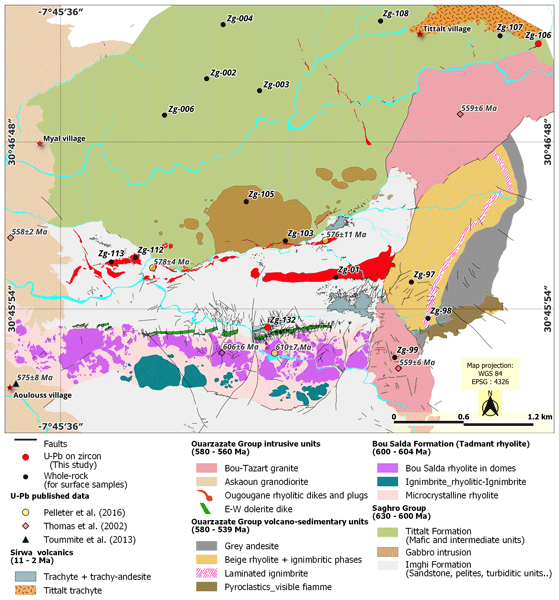
The map Fig. 2 lacks many regional names used in the text, which must be corrected. Add ages (periods) for the main units in legend.
Fig. 4: explain the abbreviation KDE.
Dickinson, W.R., Gehrels, G.E., 2009. Use of U–Pb ages of detrital zircons to infer maximum depositional ages of strata: a test against a Colorado Plateau Mesozoic database. Earth Planet. Sci. Lett. 288, 115–125. https://doi.org/10.1016/j.epsl.2009.09.013.
Citation: https://doi.org/10.5194/egusphere-2025-6178-RC2 -
AC2: 'Reply on RC2', Abdelhay Ben-tami, 01 Jun 2026
The comment was uploaded in the form of a supplement: https://egusphere.copernicus.org/preprints/2025/egusphere-2025-6178/egusphere-2025-6178-AC2-supplement.pdf
-
AC4: 'Reply on RC2_updtaed', Abdelhay Ben-tami, 18 Jun 2026
The comment was uploaded in the form of a supplement: https://egusphere.copernicus.org/preprints/2025/egusphere-2025-6178/egusphere-2025-6178-AC4-supplement.pdf
-
AC4: 'Reply on RC2_updtaed', Abdelhay Ben-tami, 18 Jun 2026
-
AC2: 'Reply on RC2', Abdelhay Ben-tami, 01 Jun 2026
Peer review completion


Interactive discussion
Status: closed
-
RC1: 'Comment on egusphere-2025-6178', Vojtěch Janoušek, 16 Jan 2026
Dear Editor,
Manuscript “Petrogenesis and geodynamic implications of Ediacaran rocks from the Sirwa massif (Central Anti-Atlas); insights from U-Pb geochronology, whole-rock geochemistry, and Sm-Nd isotopes” by Abdelhay Ben-Tami and co-workers represents a potentially interesting contribution to the ongoing discussion concerned with the nature and petrogenesis of Neoproterozoic (Pan-African) magmatic and sedimentary rocks in the Anti-Atlas Belt (Morocco), and their geodynamic significance. The text brings new, precise whole-rock geochemical dataset, including some Nd isotopic compositions, in situ LA ICP MS U–Pb ages of zircon. However, the presentation, interpretation and discussion of these data could be improved significantly.
The text is in places confusing, wordy, and/or difficult to follow. Also, the petrogenetic models should be better introduced and justified. The same is valid also for the geodynamic setting. In fact, after reading the manuscript carefully, I am still not sure what the preferred scenario is.
Hereafter I give some, usually more general comments; for the more concrete remarks/edits, please refer to the attached annotated PDF document.
To sum up, I cannot recommend the publication of the reviewed manuscript in the present form, nad requires revision. I trust that the authors will be able to revise the manuscript fundamentally, incorporating most of the changes and addressing my criticism, so that it could be published and find its interested readers.
Prof. Vojtěch Janoušek
Czech Geological Survey/Charles University, Prague
###############################################################
See attached PDF file for the complete, formatted review, including the figures.
###############################################################
General comments to the style, language and grammar of the manuscript
- The Results and Discussion parts should be strictly separated.
- The manuscript is written in English with numerous mistakes. The language requires revision by native speaker. The text tends to wordy and repetitive, and in places does not flow linearly. It can be certainly condensed substantially without a loss of its informative value. Currently it is extensively long. I urge the senior co-authors (and native speakers among them) to take care of these issues.
- Reduce, if possible, the plethora of local names. All of these remaining need to be shown on some map.
- Consider capitalization of the whole formal names, including words such as Orogeny, Group, Pluton or Complex.
- All abbreviations are to be explained just once, at the first occurrence. Except in figure captions, where I would always explain all of those present.
- Past tense should be used always when referring to events in geological past or previous publications.
- Hypotheses should be expressed by some element of uncertainty, e.g. by conditionals.
- In English text (e.g., Table 2), one should use exclusively decimal points, and not commas.
- All the measured/calculated values should be rounded up to their precision.
- All Figures (and their parts), Tables and electronic supplementary materials (ESM) should be quoted in the text, and exactly in the correct sequence.
- Define how you calculate some geochemical parameters. For Eu anomalies, use the standard Eu/Eu* notation. Add all these extra parameters to the data table.
Graphics
- The quality and readability of all graphs should be improved. The isotopic plots are terrible.
- Plotting symbols/colours should be chosen carefully and kept the same for all plots.
- In geochemical plots, label the samples specifically mentioned in the text.
- Add references as appropriate, including those referring to the plotted geochemical reservoirs and trends. Format those on plots according to the Journal in house rules.
- Avoid using underscore, _ as a replacement for space.
- In some figures (most notably Fig. 1), text seems to be interlaced, and is very difficult to read. But maybe it is just some compatibility issue.
Typography
- More attention should be paid to correct, and consistent, typography, placing spaces where necessary, correctly using hyphens and en dashes, etc. For example, the ranges should be indicated by en-dashes, without spaces around. Minus is en-dash, with no space following.
- Special care should be paid to correctly marking super- and subscripts, e.g. in names of major-element oxides.
- There should be always a space between a number and unit, or a percent symbol. There is no space before punctuation marks such as .:;.
- There should be no space between a sign and the number, e.g. +5.5 or –2.7.
References
- The authors should adhere strictly to the journal’s style as given in the Instructions to authors.
- What is the logic behind ordering of multiple references in the text? I would say that they are currently completely erratic. Order them consistently; chronologically, or alphabetically, depending on your preference.
- The same applies for Bibliography. See https://www.solid-earth.net/submission.html#references. Check that if there is more than one paper in the same year for a first author (independent of the rest of the team), a letter (a, b, c) is added to the year both in the in-text citation as well as in the reference list.
- The bibliography is rather accurate; there is only a handful of references missing in the list, see the annotated PDF.
Abstract
[23] Instead of sample names, specify the lithologies dated.
[28] Formed from a dominantly juvenile, mantle-derived source – confusing. Do you mean direct contribution of mantle-derived basaltic melts or remelting of metabasic crust?
Introduction
[39–43] Complex sentence, revise.
[47–48] Repetitive. It was said above, combine.
[58] Sirwa or Siroua as on the map?
[60] Mafic and intermediate units? Please be more specific.
Geological setting
[73] Distinguish between orogeny (the orogenic process) and orogen (its product).
[114–148] Are all these details and local names indeed necessary?
[128] Provide errors of age determinations, and dated material/method, whenever possible.
[128] Slightly younger? Probably identical within the error.
[Table 1] Should be moved to electronic supplement. What is the logic behind ordering the individual samples?
U–Pb zircon geochronology – methodology
[154] Show sample Zg-119 on the map.
[159] ± 2 sigma error?
Petrography
[175] I would rather call this texture ophitic(?)
[189] pyroxene? Could you please be more concrete, or at least to write “clinopyroxene”?
[189] List the minerals in the order of decreasing modal abundance.
U–Pb zircon geochronology
[220] Moderate in size? Please be more concrete.
The CL images are too tiny to see any detail.[235–236] Both? What do you refer to?
[238] Poor style. The age of the sandstone Zg 132 has not been introduced yet.
[243–252] Perhaps it would be interesting to discuss the youngest zircons constraining the maximum age of sedimentation.
Whole-rock geochemistry
[265] But, if I understand it right, a lot of them are altered.
[274] In general, label the samples specifically mentioned in the text on the geochemical plots.
[280 and elsewhere] The Eu anomalies should be expressed in consistent way. δEu, Eu/Eu*)N Eu/Eu* are all used. Eu/Eu* is the standard.
[284] Be specific: what is the “early gabbro sample from Sirwa”?
[296] What is the unit of Na2O + K2O? Is their ratio calculated by weight?
[297–298] These rock groups are not distinguished in the plot.
[299] Some nomenclature diagram is to be shown to name the rocks discussed in this text.
[309] This is a hypothesis that should not appear in the Results, but in Discussion. K-feldspar fractionation would have the same effect.
[316–320] Very confusing. First of all, such a discussion is out of scope of the Results section. There is a lot of local information we are not familiar with and these analyses are not plotted here.
ESM 4
- In text and in the relevant ESM table: round off all the data to match the precision of each of the oxides/elements (some are precise to three decimal places, others to none, I suspect). Even add trailing zeroes whenever needed to indicate the real precision.
- Mg numbers are calculated wrongly! The calculation should be based on molar and not weight percentages.
Sm–Nd isotopes
- The Analytical techniques (ESM 2) lack the necessary details of Nd isotopic data recalculation, including the relevant references for decay constant, CHUR composition and model ages computations.
Table 2
- Sample names should come into the first column.
- Add a column with age (Ma) used for correction each of the analyses.
- Format all super- and subscripts as appropriate.
- Show initial Nd ratios, but not the present-day epsilon values.
- The column with initial ratios should be labelled or similar. Some analyses were not recalculated to 570 Ma.
- Model ages should be given in Ga and rounded to two decimal places.
- What is the difference between TDM (Goldstein) Ma and TDM Ga? Are these single- or two-stage models?
Give all these details of model age calculations in the Analytical techniques. As you know, single-stage ones are more appropriate for mantle-derived, mafic rocks, two-stage model ages (Liew and Hofmann 1988) for crustally-derived, felsic rocks. - The initial ratios of Nd isotopes and epsilon values should have a consistent – and simple – symbology. Ideally, they should be labelled by subscripts ‘570’ or ‘620’, directly indicating the age used for their correction. E.g. .
[338] There are just two values for Saghro rocks, it is thus misleading to describe them as an interval.
[341–343] This is misconception! Intermediate positive epsilon values per se may be equally well explained by derivation from less depleted mantle domains, or remelting of fairly juvenile metabasic crust. Additional evidence is needed.
[345–346] This, and some other parts of this section, should move to Discussion.
[351–352] This again should be moved to the Discussion, and additional petrological and geochemical evidence should be considered, also from literature.
What do you mean, a mantle source contaminated by older crustal component? On which evidence? Why not, for instance, AFC or assimilation of crustal material during ascent of doleritic magmas? What compositions of mantle and crust do you envisage? Was the mantle close to canonical depleted mantle, or CHUR-like? Do you really assume that the felsic magmas were generated from mantle-sourced magmas? Or did they come from remelting of a pre-existing crust?[352–353] If the dolerite came from CHUR-like mantle, the DM model age is just meaningless.
[352–359] Again, this belongs to Discussion.
[358–359] Last sentence seems an overinterpretation of your data.
Figure 8:
- Plotting symbols/colours should be the same like in other plots. Here are even used the same symbols in panels a–b vs. c–d for different things!
- It is graphically very poor, having been apparently exported directly from Excel. It lacks any formatting – superscripts, epsilon letters etc. Needs to be redrawn.
- I suggest a better representation – in the form of two plots: (1) a Nd growth diagram (age vs. epsilon Nd, it can also incorporate the model ages and (2) some independent geochemical parameter (e.g., SiO2), vs. initial epsilon Nd values. See below, BTW graphs were generated by our software GCDkit (Janoušek et al. 2006) and obviously would need to be supplemented by literature data.
Discussion – Petrogenesis
This chapter is very confusing and scientific argumentation is not sufficient or misleading. It needs to be rewritten completely.
[374–380] There are no such plots shown, neither in the text, nor in the ESM 4. So, the hypothesis cannot be tested. Add these plots, justify your model and do not forget to consider alternatives, such as partial melting. Perhaps better would be diagrams against Mg#, rather than Zr.
[380–385] Mg# are calculated wrongly, so this paragraph needs to be rewritten. What is the evidence for this mixing?
[386] I do not know this “contamination-sensitive” diagram. Contamination by what material? How is it supposed to work? Give a reference. Note that in most magmatic rocks, La and Ce will be strongly corelated and behaving very similarly during fractional crystallization or partial melting. I guess this projection is of very little value in distinguishing closed-system differentiation from continental crustal contamination and I would drop it.
Using Nd isotopes for this purpose is definitely a much more powerful approach.
[389–392] But not like this! The “mixing model” in ESM 4 is calculated without taking the contrasting Nd concentrations (ppm) in the both end-members. The correct approach is summarized in Janoušek et al. (2016) (see PDF).
[398–340] I cannot see this, rephrase. Perhaps this is not the best projection, either.
[402–403] This diagram is designed solely to judge the nature of crustal protoliths melted. It does not make sense for mantle-derived rocks and also does not show any effects of fractional crystallization and contamination of primary magmas. Revise.
[404] Enriched in what sense? Enriched mantle? The whole sentence is a bit daring and premature. Neodymium isotopes need to be assessed first.
Fig. 9
- I would omit literature data, as only several points are plotted on a single panel.
- Instead of panels a, b I would rather plot Nb/Yb vs. Th/Yb and Nb/Yb vs. TiO2/Yb (Pearce 2008) – the first you have as a current Fig. 12b.
- Panel b: normalized by what (reference).
- Panel c: IAT is not shown.
- All abbreviations need to be explained. Give references for compositions of each of the reservoirs plotted.
[411] Why there are not discussed effects of alteration like in the case of SG above?
[414] Again, these diagrams are not plotted.
[421] Calcic phase? Feldspars.
[423–425] High LREE contents can be also due to direct derivation from crustal sources and would be further modified by fractional crystallization.
[424–425] Speculations.
[427] The “trend” is too scattered to reveal anything. The plutonic rocks are not distinguished on the plot.
[431–432] Hydrous metasomatism? What do you mean? Why should be P anomalies linked to Nb and Ti depletions?
[442] Or Nb and Ti anomalies can reflect subduction setting.
[443–444] I cannot understand the bit starting from “as supported by epsilon Nd values…”
Fig. 10
- Not only OG, but also SG rocks. Add legend.
- Technically speaking, Harker plots are binary diagrams of SiO2 major elements, not traces.
- Nickel will not show anything else than Cr, and determinations of the former are rounded to tens ppm, so rather imprecise. Omit. Are the rocks fresh enough so that Rb and Ba can be used?
- How were the BA, AFC and FC trends obtained? Reference? Assimilation of what? How much? Fractional crystallization of what minerals and in which proportions? What was the degree of crystallization? What Kd values were used (references)?
- Panel b – for intermediate and felsic rocks, the La concentration will be controlled, to a large extent, by accessories, such as allanite or monazite.
- Panel c – why Y/Nb of 1.2? Would not be Nd isotopes much better for this purpose?
[445] What is “enriched continental crust”?
[448] Moderate epsilon Nd values? Not clear, be more specific. Everything depends on local mantle composition, it could have been CHUR-like easily.
[450] What is “sediment zone enrichment”?
[448–452] I am completely lost. What is your preferred scenario? Genesis from earlier (oceanic) subduction-modified mantle or contamination (AFC) of E-MORB-like melts by continental crust?
Fig. 11
- Explain all abbreviations and give the references for compositions of various average mantle and crustal reservoirs.
- Panel c: missing is explanation of the trends for various processes. How were they constructed (see also my previous comment)? BABB symbols look just terrible.
Fig. 12
- Explain all abbreviations and give the references for compositions of various average mantle and crustal reservoirs.
- What is the difference between the Ta/Yb vs. Th/Yb and Nb/Yb vs. Th/Yb projections? Should be giving moreless the same information….
- Panel a: missing is reference, explanation of the trends. How were they constructed?
Discussion – Geodynamic implications
Again, this section requires a thorough revision.
[466] Show it! This is not acceptable.
[469] Or simply rifting. I would suggest some other diagrams that could help you resolving the geodynamic setting, namely those of Wood (1980), Cabanis and Lecolle (1989), Pearce et al. (2021) or Shervais (2022). Surprisingly, the basic rocks of the SG and OG look like continental flood basalts in the Ti/V vs. Th/Nb plot of Shervais (2022). I do not know much about local geology, but is any role of plume ruled out?
[472] Why is low U/Th ratio indicative of active margin signature?
[473–474] Normalized to what? To my eyes, the SG nicely follow the NMORB–OIB array. CAB should have higher ThN.
[476–479] References missing.
[501] A fragment, a sentence should have a verb. Rephrase. Fig. 11a shows Y vs. Zr, not K, Rb, Ba etc. Plus, these are extremely mobile elements, could not they be compromised by alteration?
[508] Be specific, how?
[510] And what was the cause of such post-collisional event?
[515] evolution?
Discussion – U–Pb ages
[518] Please specify the sample lithologies, this is more important than the sample numbers.
[520] Extension of the magmatism? Rephrase.
[532] How about the dating by Ferraq et al. (2024)?
[535] What is sub-alkaline-calcic?
[538] Did you observe any inheritance?
[549] What is “a prolonged tectono-magmatic event emplaced over multiple pulses over the whole Anti-Atlas belt”?
[551] “SLIP deposited in a strictly continental environment”? I cannot follow this.
[551–556] Tedious and repetitive. Condense.
[558–560] Rephrase and expand the part dealing with regional correlation of the Cadomian arc magmatism and how does it relate to the inferred geodynamic setting of the studied rock units.
[590–593] I cannot follow this argument. Clarify.
[595] “The mono-peak…” does not make any sense to me.
[601] Cryogenian should be older than 635 Ma. These sediments are Ediacaran, or younger.
[610] Reference missing here.
Fig. 12
Explain all the abbreviations.
Conclusions
[627–628] What is the evidence for contamination of the mantle source by continental crust? How does it go with the presumed oceanic subduction context?
[636] How about your sediments?
[637–638] “post-collisional syn-orogenic magmatism (WACadomian arc)”? I am again lost. Regardless, how can you infer this from U–Pb ages only?
References used
Cabanis B, Lecolle M (1989) Le diagramme La/10–Y/15–Nb/8: un outil pour la discrimination des séries volcaniques et la mise en évidence des processus de mélange et/ou de contamination crustale (The La/10-Y/15-Nb/8 diagram: a tool for discrimination volcanic series and evidencing continental crust magmatic mixtures and/or contamination). C R Acad Sci Paris, Série II 309:2023–2029
Faure G (1986) Principles of Isotope Geology. 2 edn. John Wiley & Sons, Chichester
Ferraq M, Belkacim S, Cheng L-Z, Davies JHFL, Perrot MG, Ben-Tami A, Bouabdellah M (2024) New geochemical and geochronological constraints on the genesis of the Imourkhssen Cu±Mo±Au±Ag porphyry deposit (Ouzellagh-Siroua Salient, Anti-Atlas, Morocco): geodynamic and metallogenic implications. Minerals 14:832
Janoušek V, Farrow CM, Erban V (2006) Interpretation of whole-rock geochemical data in igneous geochemistry: introducing Geochemical Data Toolkit (GCDkit). J Petrol 47:1255–1259
Janoušek V, Moyen JF, Martin H, Erban V, Farrow C (2016) Geochemical Modelling of Igneous Processes – Principles and Recipes in R Language. Bringing the Power of R to a Geochemical Community. Springer, Berlin
Liew TC, Hofmann AW (1988) Precambrian crustal components, plutonic associations, plate environment of the Hercynian Fold Belt of Central Europe: indications from a Nd and Sr isotopic study. Contrib Mineral Petrol 98:129–138
Pearce JA (2008) Geochemical fingerprinting of oceanic basalts with applications to ophiolite classification and the search for Archean oceanic crust. Lithos 100:14–48
Pearce JA, Ernst RE, Peate DW, Rogers C (2021) LIP printing: use of immobile element proxies to characterize Large Igneous Provinces in the geologic record. Lithos 392–393:106068
Shervais JW (2022) The petrogenesis of modern and ophiolitic lavas reconsidered: Ti-V and Nb-Th. Geosci Front 13:101319
Wood DA (1980) The application of a Th–Hf–Ta diagram to problems of tectonomagmatic classification and to establishing the nature of crustal contamination of basaltic lavas of the British Tertiary volcanic province. Earth Planet Sci Lett 50:11–30
-
AC1: 'Reply on RC1', Abdelhay Ben-tami, 01 Jun 2026
The comment was uploaded in the form of a supplement: https://egusphere.copernicus.org/preprints/2025/egusphere-2025-6178/egusphere-2025-6178-AC1-supplement.pdf
-
AC3: 'Reply on RC1_updated', Abdelhay Ben-tami, 18 Jun 2026
The comment was uploaded in the form of a supplement: https://egusphere.copernicus.org/preprints/2025/egusphere-2025-6178/egusphere-2025-6178-AC3-supplement.pdf
-
AC3: 'Reply on RC1_updated', Abdelhay Ben-tami, 18 Jun 2026
-
RC2: 'Comment on egusphere-2025-6178', Anonymous Referee #2, 29 Jan 2026
The manuscript entitled “Petrogenesis and geodynamic implications of Ediacaran rocks from the Sirwa massif (Central Anti-Atlas); insights from U-Pb geochronology, whole-rock geochemistry, and Sm-Nd isotopes“ presents a geochronological and whole-rock geochemical data from two units of the Central Anti-Atlas. The data are used to disccus magmatic and sedimentary development of region and to discover the Ediacaran orogenic evolution. The geochronological and geochemical data look high-quality and the dataset used is robust. The data presented are interesting, improve knowledge of the region and can contribute to a better understanding of the geodynamic history of this part of Central Anti-Atlas. The manuscript is basically structured quite logically, but in some cases it is somewhat messy and it's very hard to follow. In some cases the description and interpretation of the data are mixed and some results could be discussed in more depth. Some passages are unnecessarily detailed and could be condensed. The manuscript contains a number of minor language and formatting faults. The specific parts have their own weaknesses as described below. I especially find problematic the lack of description of field relationships, the insufficient description and discussion of U-Pb data, and the poorly explained final geotectonic model.
I find the data and results interesting and deserving to be published. However, in my opinion, current state of paper needs to be modified and some parts of the manuscript should be strongly revised before publication. Due to the extent of the problematic parts, I recommend major revisions. With suggested modifications, I recommend to accept this paper for publication.
The following are my comments that should be addressed in this manuscript.
Major comments:
Abstract and Introduction
In my opinion, the term "Pan-African orogeny" is used confusingly in the paper in several places. This usually refers to the Neoproterozoic internal collisonal orogenic systems developed between individual cratons during Gondwana formation (Trans-Saharan, Mozambique, Kaoko, Damara belts etc.). However, if I understand your model correctly, in your case it is a peripheral active continental margin along West African Craton. The term Cadomian Orogeny is used for the identical setting in current European parts of northern Gondwana, as you correctly mention later in the text. In the case of Pan-African, it is unclear what you mean, and this should be clearly explained.
Line 34: write the rock types rather than the sample numbers.
Line 39: The entire history is significantly older, there is already the Paleoproterozoic basement there.
Line 40: Here you write that the formation of passive margin and island arc in the Tonian-Cryogenian is recorded. This seems like a contradiction (passive margin and subduction together). Are these not rather two models from different authors/papers?
Line 46: Add references to the paleogeographic models and correlations mentioned.
Lines 47–48: What means peri-Gondwana terranes accreted in Ediacaran? It is commonly used for crustal fragments lately separated from the northern Gondwana. Additionally, I disagree with the statement that the Cadomian subduction was responsible for the amalgamation of Gondwana. Pan-African collisions resulted into Gondwana formation. Cadomian belt developed at the similar time as accretionary system along Gondwana periphery.
Geological setting
The geological setting is quite detailed and bit chaotic, and readers who are not familiar with the geology of region may find it difficult to understand the division of units. This chapter needs to be simplified and made more systematic. There are also many regional names that are not on the map.
Results
A fundamental problem is the absence of description of field macro scale geological relationships. Without field information, it is impossible to correctly interpret your data. It is not clear from the petrological description which lithologies are present in the individual units. It is unclear whether the description covers all the rocks represented or only your samples.
L 170: Write directly rock types instead general volcanics. Moreover, gabbro is not volcanic rock.
L177: Describe the relationship between sedimentary parts and magmatic rocks of the Saghro Group. This is crucial in the context of your geochronological results.
L179–181: Interpretation of depositional environment belongs to the discussion.
L194–199: Again, it is necessary to clarify the relationships between plutonic and volcanic members of the Ouarzazate Group before in the new separate subchapter.
I would transfer the Table 1 to the supplements.
Cathodoluminescence (CL) imaging and LA-ICP-MS U-Pb zircon geochronology
The description of the U-Pb data is quite unsystematic. I would recommend to start with description of the crystal shapes and textures of zircons, followed by the U-Pb data and Th/U ratios itself. Another important weakness is that not all data are described. You only deal with the data used for the weighted mean age calculation (21 from 40 for the first sample). How did you select the data for this calculation, and what is the age distribution of the other data? Especially for detrital populations, the youngest part of the age spectrum is crucial for determining the time of sedimentation. For one detrital sample, it would be useful to calculate Maximum Depositional Age (e.g. Dickinson and Gehrels, 2009) and later discuss it thoroughly.
L215–219: This section describing structural relationships and petrography belongs somewhere at the beginning, or possibly also to the discussion.
L219: You probably meant Th/U.
L221–223: Move the description of the method of data selection according to concordance to the methodology section so that it does not have to be repeated each time.
L234–235, 237: You consider the wide age range to be a consequence of Pb loss and inheritance. Do these youngest and oldest zircons have any specific textural features or compositions that would support these interpretations? This needs to be added and explained.
L238: rather detritic signature of magma source
L240–241: The statement that older zircons are not inherited contradicts the inferred magmatic age. This needs to be clarified. Furthermore, the conclusion that inherited grains are not apparent in CL would be beneficial to prove. However, in Figure 4 2a, the zircons are only from the cluster around the calculated magmatic age, and the older ones are missing.
L243: Ag-Hg is probably mineralization
L244–245: direction of what? Bedding? This should be described in the field observations.
L245–248: interpretations – move to the Geological Setting or Discussion
Significance of Sm-Nd isotopic data
I believe that, at least for some samples (crustaly derived), it would be more appropriate to use two-stage Nd model ages. Data should also be presented as εNd vs. age plot.
L341–346: interpretations – move to the Discussion
L353: I don't understand what is meant by this effect is limited. Moreover, potential presence of the Mesoproterozoic crust in the WAC is very interesting and important. Could it be a mixed value caused by a combination of young mantle source and involved Paleoproterozoic crust? This issue needs to be carefully explained and discussed.
L353–359: interpretations – move to the Discussion
Discussion
Discussion and particulary last subchapter are rather confusing. It is difficult to trace how the proposed model in Figure 13 is related to the data from this study and what is based on published opinions. It is not clear to me, for example, on what basis the final phase of collapse is deduced. The last subchapter needs to be completely reworked to make the sequence of arguments and the final model clear and straightforwardly explained.
I see the interpretation of the magmatic age of rhyolitic sample and detrital zircon age pattern of sedimentary sample as a major problems. If the sample Zg-106 is a dyke that crosscut the Tittalt Formation, then it cannot be taken as the age of this formation. Especially if the sequence is deformed, which is not fully clear from the text, then the rhyolite is significantly younger. Similarly, from the text, it seems that you interpret sedimentation age of the dated sandstone as Ediacaran. However, this requires showing the youngest part of the population and MDA, as I mentioned above. In the case of back-arc basin, it is highly unlikely that material from active extensional magmatism would not be recorded. Mentioned structural record and detrital age population suggest that it most likely represents older Paleoproterozoic or Mesoproterozoic succession, intruded by Edicaran magmas. In my opinion, sandstone is only slightly younger than single Paleoproterozoic magmatic source of detritus, which was very proximal (euhedral zircons indicate very short transport). For the correct interpretation of these data, it is necessary to consider field geological context.
L559–560: not only Iberia, also to many other parts of Variscan belt
L562–577: Entire section is too detailed and unnecessary. It can be condensed to three sentences and few references.
Minor comments:
For ranges (e.g. age or values), use en dash instead hyphen everywhere.
Unify the use of early vs. Early vs. lower, late vs Late (e.g. L30 vs L66 vs L86 vs L98 vs L99).
Formatting of references in the text is inconsistent. Please edit according to the journal's instructions.
English is poor in many places and definitely needs careful language correction.
Figures:
The map Fig. 2 lacks many regional names used in the text, which must be corrected. Add ages (periods) for the main units in legend.
Fig. 4: explain the abbreviation KDE.
Dickinson, W.R., Gehrels, G.E., 2009. Use of U–Pb ages of detrital zircons to infer maximum depositional ages of strata: a test against a Colorado Plateau Mesozoic database. Earth Planet. Sci. Lett. 288, 115–125. https://doi.org/10.1016/j.epsl.2009.09.013.
Citation: https://doi.org/10.5194/egusphere-2025-6178-RC2 -
AC2: 'Reply on RC2', Abdelhay Ben-tami, 01 Jun 2026
The comment was uploaded in the form of a supplement: https://egusphere.copernicus.org/preprints/2025/egusphere-2025-6178/egusphere-2025-6178-AC2-supplement.pdf
-
AC4: 'Reply on RC2_updtaed', Abdelhay Ben-tami, 18 Jun 2026
The comment was uploaded in the form of a supplement: https://egusphere.copernicus.org/preprints/2025/egusphere-2025-6178/egusphere-2025-6178-AC4-supplement.pdf
-
AC4: 'Reply on RC2_updtaed', Abdelhay Ben-tami, 18 Jun 2026
-
AC2: 'Reply on RC2', Abdelhay Ben-tami, 01 Jun 2026
Peer review completion
Journal article(s) based on this preprint
Viewed
| HTML | XML | Total | Supplement | BibTeX | EndNote | |
|---|---|---|---|---|---|---|
| 1,968 | 1,123 | 237 | 3,328 | 361 | 180 | 210 |
- HTML: 1,968
- PDF: 1,123
- XML: 237
- Total: 3,328
- Supplement: 361
- BibTeX: 180
- EndNote: 210
Viewed (geographical distribution)
| Country | # | Views | % |
|---|
| Total: | 0 |
| HTML: | 0 |
| PDF: | 0 |
| XML: | 0 |
- 1
Abdelhay Ben-Tami

Said Belkacim
Jamal El Kabouri
Bouchra Baidada
Joshua H. F. L. Davies
Morgann G. Perrot
Mohamed Bhilisse
Mohamed Assalmi
Mariam Ferraq
Mohamed Bouabdellah
David Lalonde
The requested preprint has a corresponding peer-reviewed final revised paper. You are encouraged to refer to the final revised version.
- Preprint
(5009 KB) - Metadata XML
-
Supplement
(1243 KB) - BibTeX
- EndNote
- Final revised paper
Dear Editor,
Manuscript “Petrogenesis and geodynamic implications of Ediacaran rocks from the Sirwa massif (Central Anti-Atlas); insights from U-Pb geochronology, whole-rock geochemistry, and Sm-Nd isotopes” by Abdelhay Ben-Tami and co-workers represents a potentially interesting contribution to the ongoing discussion concerned with the nature and petrogenesis of Neoproterozoic (Pan-African) magmatic and sedimentary rocks in the Anti-Atlas Belt (Morocco), and their geodynamic significance. The text brings new, precise whole-rock geochemical dataset, including some Nd isotopic compositions, in situ LA ICP MS U–Pb ages of zircon. However, the presentation, interpretation and discussion of these data could be improved significantly.
The text is in places confusing, wordy, and/or difficult to follow. Also, the petrogenetic models should be better introduced and justified. The same is valid also for the geodynamic setting. In fact, after reading the manuscript carefully, I am still not sure what the preferred scenario is.
Hereafter I give some, usually more general comments; for the more concrete remarks/edits, please refer to the attached annotated PDF document.
To sum up, I cannot recommend the publication of the reviewed manuscript in the present form, nad requires revision. I trust that the authors will be able to revise the manuscript fundamentally, incorporating most of the changes and addressing my criticism, so that it could be published and find its interested readers.
Prof. Vojtěch Janoušek
Czech Geological Survey/Charles University, Prague
###############################################################
See attached PDF file for the complete, formatted review, including the figures.
###############################################################
General comments to the style, language and grammar of the manuscript
Graphics
Typography
References
Abstract
[23] Instead of sample names, specify the lithologies dated.
[28] Formed from a dominantly juvenile, mantle-derived source – confusing. Do you mean direct contribution of mantle-derived basaltic melts or remelting of metabasic crust?
Introduction
[39–43] Complex sentence, revise.
[47–48] Repetitive. It was said above, combine.
[58] Sirwa or Siroua as on the map?
[60] Mafic and intermediate units? Please be more specific.
Geological setting
[73] Distinguish between orogeny (the orogenic process) and orogen (its product).
[114–148] Are all these details and local names indeed necessary?
[128] Provide errors of age determinations, and dated material/method, whenever possible.
[128] Slightly younger? Probably identical within the error.
[Table 1] Should be moved to electronic supplement. What is the logic behind ordering the individual samples?
U–Pb zircon geochronology – methodology
[154] Show sample Zg-119 on the map.
[159] ± 2 sigma error?
Petrography
[175] I would rather call this texture ophitic(?)
[189] pyroxene? Could you please be more concrete, or at least to write “clinopyroxene”?
[189] List the minerals in the order of decreasing modal abundance.
U–Pb zircon geochronology
[220] Moderate in size? Please be more concrete.
The CL images are too tiny to see any detail.
[235–236] Both? What do you refer to?
[238] Poor style. The age of the sandstone Zg 132 has not been introduced yet.
[243–252] Perhaps it would be interesting to discuss the youngest zircons constraining the maximum age of sedimentation.
Whole-rock geochemistry
[265] But, if I understand it right, a lot of them are altered.
[274] In general, label the samples specifically mentioned in the text on the geochemical plots.
[280 and elsewhere] The Eu anomalies should be expressed in consistent way. δEu, Eu/Eu*)N Eu/Eu* are all used. Eu/Eu* is the standard.
[284] Be specific: what is the “early gabbro sample from Sirwa”?
[296] What is the unit of Na2O + K2O? Is their ratio calculated by weight?
[297–298] These rock groups are not distinguished in the plot.
[299] Some nomenclature diagram is to be shown to name the rocks discussed in this text.
[309] This is a hypothesis that should not appear in the Results, but in Discussion. K-feldspar fractionation would have the same effect.
[316–320] Very confusing. First of all, such a discussion is out of scope of the Results section. There is a lot of local information we are not familiar with and these analyses are not plotted here.
ESM 4
Sm–Nd isotopes
Table 2
Give all these details of model age calculations in the Analytical techniques. As you know, single-stage ones are more appropriate for mantle-derived, mafic rocks, two-stage model ages (Liew and Hofmann 1988) for crustally-derived, felsic rocks.
[338] There are just two values for Saghro rocks, it is thus misleading to describe them as an interval.
[341–343] This is misconception! Intermediate positive epsilon values per se may be equally well explained by derivation from less depleted mantle domains, or remelting of fairly juvenile metabasic crust. Additional evidence is needed.
[345–346] This, and some other parts of this section, should move to Discussion.
[351–352] This again should be moved to the Discussion, and additional petrological and geochemical evidence should be considered, also from literature.
What do you mean, a mantle source contaminated by older crustal component? On which evidence? Why not, for instance, AFC or assimilation of crustal material during ascent of doleritic magmas? What compositions of mantle and crust do you envisage? Was the mantle close to canonical depleted mantle, or CHUR-like? Do you really assume that the felsic magmas were generated from mantle-sourced magmas? Or did they come from remelting of a pre-existing crust?
[352–353] If the dolerite came from CHUR-like mantle, the DM model age is just meaningless.
[352–359] Again, this belongs to Discussion.
[358–359] Last sentence seems an overinterpretation of your data.
Figure 8:
Discussion – Petrogenesis
This chapter is very confusing and scientific argumentation is not sufficient or misleading. It needs to be rewritten completely.
[374–380] There are no such plots shown, neither in the text, nor in the ESM 4. So, the hypothesis cannot be tested. Add these plots, justify your model and do not forget to consider alternatives, such as partial melting. Perhaps better would be diagrams against Mg#, rather than Zr.
[380–385] Mg# are calculated wrongly, so this paragraph needs to be rewritten. What is the evidence for this mixing?
[386] I do not know this “contamination-sensitive” diagram. Contamination by what material? How is it supposed to work? Give a reference. Note that in most magmatic rocks, La and Ce will be strongly corelated and behaving very similarly during fractional crystallization or partial melting. I guess this projection is of very little value in distinguishing closed-system differentiation from continental crustal contamination and I would drop it.
Using Nd isotopes for this purpose is definitely a much more powerful approach.
[389–392] But not like this! The “mixing model” in ESM 4 is calculated without taking the contrasting Nd concentrations (ppm) in the both end-members. The correct approach is summarized in Janoušek et al. (2016) (see PDF).
[398–340] I cannot see this, rephrase. Perhaps this is not the best projection, either.
[402–403] This diagram is designed solely to judge the nature of crustal protoliths melted. It does not make sense for mantle-derived rocks and also does not show any effects of fractional crystallization and contamination of primary magmas. Revise.
[404] Enriched in what sense? Enriched mantle? The whole sentence is a bit daring and premature. Neodymium isotopes need to be assessed first.
Fig. 9
[411] Why there are not discussed effects of alteration like in the case of SG above?
[414] Again, these diagrams are not plotted.
[421] Calcic phase? Feldspars.
[423–425] High LREE contents can be also due to direct derivation from crustal sources and would be further modified by fractional crystallization.
[424–425] Speculations.
[427] The “trend” is too scattered to reveal anything. The plutonic rocks are not distinguished on the plot.
[431–432] Hydrous metasomatism? What do you mean? Why should be P anomalies linked to Nb and Ti depletions?
[442] Or Nb and Ti anomalies can reflect subduction setting.
[443–444] I cannot understand the bit starting from “as supported by epsilon Nd values…”
Fig. 10
[445] What is “enriched continental crust”?
[448] Moderate epsilon Nd values? Not clear, be more specific. Everything depends on local mantle composition, it could have been CHUR-like easily.
[450] What is “sediment zone enrichment”?
[448–452] I am completely lost. What is your preferred scenario? Genesis from earlier (oceanic) subduction-modified mantle or contamination (AFC) of E-MORB-like melts by continental crust?
Fig. 11
Fig. 12
Discussion – Geodynamic implications
Again, this section requires a thorough revision.
[466] Show it! This is not acceptable.
[469] Or simply rifting. I would suggest some other diagrams that could help you resolving the geodynamic setting, namely those of Wood (1980), Cabanis and Lecolle (1989), Pearce et al. (2021) or Shervais (2022). Surprisingly, the basic rocks of the SG and OG look like continental flood basalts in the Ti/V vs. Th/Nb plot of Shervais (2022). I do not know much about local geology, but is any role of plume ruled out?
[472] Why is low U/Th ratio indicative of active margin signature?
[473–474] Normalized to what? To my eyes, the SG nicely follow the NMORB–OIB array. CAB should have higher ThN.
[476–479] References missing.
[501] A fragment, a sentence should have a verb. Rephrase. Fig. 11a shows Y vs. Zr, not K, Rb, Ba etc. Plus, these are extremely mobile elements, could not they be compromised by alteration?
[508] Be specific, how?
[510] And what was the cause of such post-collisional event?
[515] evolution?
Discussion – U–Pb ages
[518] Please specify the sample lithologies, this is more important than the sample numbers.
[520] Extension of the magmatism? Rephrase.
[532] How about the dating by Ferraq et al. (2024)?
[535] What is sub-alkaline-calcic?
[538] Did you observe any inheritance?
[549] What is “a prolonged tectono-magmatic event emplaced over multiple pulses over the whole Anti-Atlas belt”?
[551] “SLIP deposited in a strictly continental environment”? I cannot follow this.
[551–556] Tedious and repetitive. Condense.
[558–560] Rephrase and expand the part dealing with regional correlation of the Cadomian arc magmatism and how does it relate to the inferred geodynamic setting of the studied rock units.
[590–593] I cannot follow this argument. Clarify.
[595] “The mono-peak…” does not make any sense to me.
[601] Cryogenian should be older than 635 Ma. These sediments are Ediacaran, or younger.
[610] Reference missing here.
Fig. 12
Explain all the abbreviations.
Conclusions
[627–628] What is the evidence for contamination of the mantle source by continental crust? How does it go with the presumed oceanic subduction context?
[636] How about your sediments?
[637–638] “post-collisional syn-orogenic magmatism (WACadomian arc)”? I am again lost. Regardless, how can you infer this from U–Pb ages only?
References used
Cabanis B, Lecolle M (1989) Le diagramme La/10–Y/15–Nb/8: un outil pour la discrimination des séries volcaniques et la mise en évidence des processus de mélange et/ou de contamination crustale (The La/10-Y/15-Nb/8 diagram: a tool for discrimination volcanic series and evidencing continental crust magmatic mixtures and/or contamination). C R Acad Sci Paris, Série II 309:2023–2029
Faure G (1986) Principles of Isotope Geology. 2 edn. John Wiley & Sons, Chichester
Ferraq M, Belkacim S, Cheng L-Z, Davies JHFL, Perrot MG, Ben-Tami A, Bouabdellah M (2024) New geochemical and geochronological constraints on the genesis of the Imourkhssen Cu±Mo±Au±Ag porphyry deposit (Ouzellagh-Siroua Salient, Anti-Atlas, Morocco): geodynamic and metallogenic implications. Minerals 14:832
Janoušek V, Farrow CM, Erban V (2006) Interpretation of whole-rock geochemical data in igneous geochemistry: introducing Geochemical Data Toolkit (GCDkit). J Petrol 47:1255–1259
Janoušek V, Moyen JF, Martin H, Erban V, Farrow C (2016) Geochemical Modelling of Igneous Processes – Principles and Recipes in R Language. Bringing the Power of R to a Geochemical Community. Springer, Berlin
Liew TC, Hofmann AW (1988) Precambrian crustal components, plutonic associations, plate environment of the Hercynian Fold Belt of Central Europe: indications from a Nd and Sr isotopic study. Contrib Mineral Petrol 98:129–138
Pearce JA (2008) Geochemical fingerprinting of oceanic basalts with applications to ophiolite classification and the search for Archean oceanic crust. Lithos 100:14–48
Pearce JA, Ernst RE, Peate DW, Rogers C (2021) LIP printing: use of immobile element proxies to characterize Large Igneous Provinces in the geologic record. Lithos 392–393:106068
Shervais JW (2022) The petrogenesis of modern and ophiolitic lavas reconsidered: Ti-V and Nb-Th. Geosci Front 13:101319
Wood DA (1980) The application of a Th–Hf–Ta diagram to problems of tectonomagmatic classification and to establishing the nature of crustal contamination of basaltic lavas of the British Tertiary volcanic province. Earth Planet Sci Lett 50:11–30