
the Creative Commons Attribution 4.0 License.
the Creative Commons Attribution 4.0 License.
 | 17 Dec 2025
A cyclone phase space dedicated to extratropical cyclones
Abstract. Despite intensive research on midlatitude cyclones since the mid-twentieth century, open questions on their structure and development remain, like the question of their core temperature. It is not clear yet what the proportion of cold-core and warm-core cyclones in midlatitudes is, if occluded cyclones are cold-core or warm-core cyclones and how different the processes leading to cold-core and warm-core cyclones are. To address these questions, a new cyclone phase space denoted as ETC-CPS and adapted to extratropical cyclones is developed by introducing three parameters: the core temperature, the thermal asymmetry and the baroclinic conversion rate. Differences with existing cyclone phase spaces are detailed by analyzing two consecutive storms in the North Atlantic, one ending with a warm seclusion and another with an occlusion. ETC-CPS is then applied to all midlatitude cyclones of the Northern Hemisphere (NH) tracked during winter and summer using ERA5 reanalysis.
The results highlight that most of midlatitude NH cyclones are asymmetric warm-core cyclones. At the time of maximum intensity, the fraction of cyclones with a cold core temperature in the lower troposphere fluctuates around 10–15 % depending on the season while that of warm core cyclones is around 85–90 %. It indicates that, in addition to warm-seclusion cyclones, most occluded cyclones have also a warm core. Both cold-core and warm-core cyclones undergo a well-marked baroclinic growth phase before reaching their maximum intensity but their vertical structure differs during that phase. Warm-core cyclones exhibit a clear vertical westward tilt of the geopotential height anomaly contours as in the classical picture of a developing baroclinic unstable mode. In contrast, cold-core cyclones have a funnel-like vertical structure with the anomalous geopotential height field leaning more westward than eastward which makes them also grow baroclinically but with a non-standard baroclinic structure. Differences between seasons are also noticeable. During winter, cold-core cyclones have much weaker intensity than warm-core cyclones and preferentially develop over continental regions whereas warm-core cyclones develop over the oceanic storm tracks. During summer, both types of cyclones preferentially develop over the oceanic storm tracks and have similar intensities.
-
Notice on discussion status
The requested preprint has a corresponding peer-reviewed final revised paper. You are encouraged to refer to the final revised version.
-
Preprint
(4179 KB)
-
Supplement
(414 KB)
-
The requested preprint has a corresponding peer-reviewed final revised paper. You are encouraged to refer to the final revised version.
- Preprint
(4179 KB) - Metadata XML
-
Supplement
(414 KB) - BibTeX
- EndNote
- Final revised paper


Journal article(s) based on this preprint
Interactive discussion
Status: closed
- RC1: 'Comment on egusphere-2025-6174', Anonymous Referee #1, 18 Feb 2026
-
RC2: 'Comment on egusphere-2025-6174', Ambrogio Volonté, 20 Feb 2026
The comment was uploaded in the form of a supplement: https://egusphere.copernicus.org/preprints/2025/egusphere-2025-6174/egusphere-2025-6174-RC2-supplement.pdf
- AC1: 'Comment on egusphere-2025-6174', Myriam Besson, 19 Mar 2026
Peer review completion


Interactive discussion
Status: closed
-
RC1: 'Comment on egusphere-2025-6174', Anonymous Referee #1, 18 Feb 2026
This is a very nice addition to the literature on extratropical cyclone classification and development. It presents a new method of determining whether a cyclone is warm or cold core and makes use of the phase space ideas of Hart (2003) to group cyclones. The paper presents two case studies and then climatological analysis of the groups for winter and summer.
The paper is well presented and nicely written and I have mostly minor comments, suggestions, and queries.
Major comment
- Given some of the findings about the cold-core versus warm-core cyclone intensities, I find myself wondering if the comparisons between the subgroups when it comes to baroclinic conversion are entirely fair. Would it be fairer to compare this aspect for a subset of each group with the same intensities? This might also be addressed using a case study analysis as I think it would be very useful to show a case of a cold-core cyclone. So, for two cyclones (or two small subsets) with similar intensities, does the baroclinic conversion show up as being much higher for the warm-core group despite the same intensity?
Minor comments
- Line 66 – since this question about occluded cyclones is not really fully answered in the paper, I wonder if the emphasis on these should be removed.
- Line 89 – why is the end date of 2014 chosen when ERA5 data are available to the end of 2025.
- Line 138 – When you say “largely different” do you mean that they vary widely?
- Line 240-241 – The sentence is confusing. It is hard to know whether you are comparing the storms or the CPS diagrams here.
- Line 257 – make clear this is just the Northern Hemsiphere.
- Line 259 – rather than the differences being opposite in sign, I think you mean the differences are sometimes negative.
- Line 266 – Add “whereas DTL is representative of the difference between the center and the average around a 5 degree radius circle.
- Section 3.2.1 Make it clear at the start that Figure 3 and the description is purely for illustrative purposes and is not any new information.
- Figure 3 – I wonder why you chose to plot the 200hPa zonal wind. This is much more indicative of the subtropical jet, rather than the eddy driven jet that is strongly related to the stormtracks.
- Figure 4 – Can you explain why you have chosen to look at the maximum intensity in this figure?
- Line 345-350 – To what figure does this paragraph refer?
- Line 356 – Is this shown? Please refer to a figure.
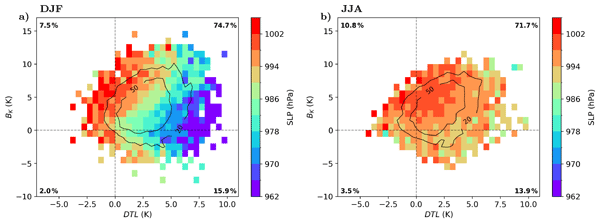
- Figure 9 – Can you explain why you have chosen to plot BC versus BK instead of versus DTL?
- Line 457 – Is this a fair comparison due to the sample size and overall higher intensity of warm core cyclones?
- Line 470 – What about winter?
Typographical comments
- Line 98 – consist in -> consist of.
- Line 98 - times -> time.
- Line 116 – lies -> lie.
- Line 117 – originates -> originate.
- Line 127 (and elsewhere) – please avoid using the brackets with (resp. cold) etc. It is much clearer to write out the full sentence.
- Line 133 – circle -> radius.
- Line 322 – smaller -> lower.
- Line 331 – higher -> larger.
- Line 355 – reference to positive values of omega representing ascent and negative values representing descent should be the other way round.
Citation: https://doi.org/10.5194/egusphere-2025-6174-RC1 -
RC2: 'Comment on egusphere-2025-6174', Ambrogio Volonté, 20 Feb 2026
The comment was uploaded in the form of a supplement: https://egusphere.copernicus.org/preprints/2025/egusphere-2025-6174/egusphere-2025-6174-RC2-supplement.pdf
- AC1: 'Comment on egusphere-2025-6174', Myriam Besson, 19 Mar 2026
Peer review completion
Journal article(s) based on this preprint
Viewed
| HTML | XML | Total | Supplement | BibTeX | EndNote | |
|---|---|---|---|---|---|---|
| 1,698 | 1,460 | 173 | 3,331 | 240 | 174 | 152 |
- HTML: 1,698
- PDF: 1,460
- XML: 173
- Total: 3,331
- Supplement: 240
- BibTeX: 174
- EndNote: 152
Viewed (geographical distribution)
| Country | # | Views | % |
|---|
| Total: | 0 |
| HTML: | 0 |
| PDF: | 0 |
| XML: | 0 |
- 1
Gwendal Rivière
Sébastien Fromang
The requested preprint has a corresponding peer-reviewed final revised paper. You are encouraged to refer to the final revised version.
- Preprint
(4179 KB) - Metadata XML
-
Supplement
(414 KB) - BibTeX
- EndNote
- Final revised paper
This is a very nice addition to the literature on extratropical cyclone classification and development. It presents a new method of determining whether a cyclone is warm or cold core and makes use of the phase space ideas of Hart (2003) to group cyclones. The paper presents two case studies and then climatological analysis of the groups for winter and summer.
The paper is well presented and nicely written and I have mostly minor comments, suggestions, and queries.
Major comment
Minor comments
Typographical comments