
the Creative Commons Attribution 4.0 License.
the Creative Commons Attribution 4.0 License.
 | 15 Dec 2025
Comparative Mesoscale Eddy Dynamics under Geostrophic versus Cyclogeostrophic Balance from Satellite Altimetry
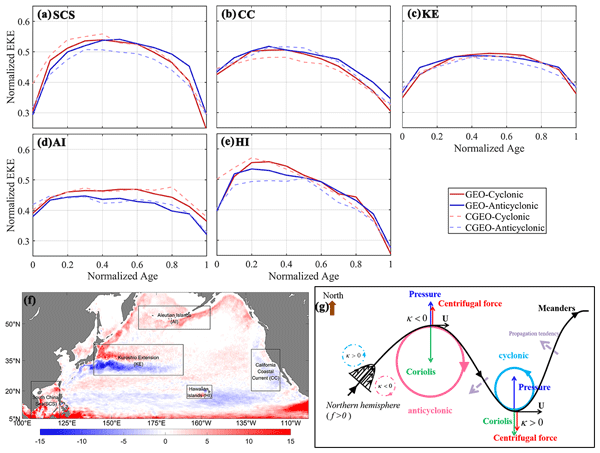
Abstract. Under quasi-steady conditions, excluding the influence of surface wind stress, the mesoscale meandering current should represent a balance among the pressure gradient force, the Coriolis force, and the centrifugal force. For mesoscale eddies, the nonlinear term induced owing to the local curvature of streamlines is non-negligible. Based on satellite-altimeter-derived geostrophic velocities and their cyclogeostrophic-corrected velocities, this study investigates the statistical characteristics of kinematic parameters and the differences in dynamical parameters of mesoscale eddies under two balanced frameworks, across five subregions of the North Pacific Ocean with the strongest eddy activity: the Aleutian Islands, the Kuroshio Extension, the South China Sea, the California Coastal Current, and the Hawaiian Islands. Results indicate that the cyclogeostrophic correction yields a 35.65 % reduction in total eddy count compared to the geostrophic framework. Additionally, the cyclogeostrophic-adjusted currents are more likely to detect eddies characterized by larger radii and shorter lifetimes. The difference in eddy kinetic energy shows significant regional variability, with cyclonic and anticyclonic eddies exhibiting opposite biases in Eddy Kinetic Energy. Cyclogeostrophic correction tends to slow the decay rate of eddy energy. Eddies predominantly propagate westward. Under cyclogeostrophic conditions, velocity fluctuations are amplified, and the correction has a more pronounced effect on the translation speed of cyclonic eddies than on anticyclonic ones. Cyclogeostrophically derived vorticity is more stable, while the strain rate demonstrates stronger shear stability within the current field. Case studies further indicate that cyclogeostrophic correction is particularly significant for anticyclonic eddies: when curvature effects are included, anticyclonic eddies translate faster, possess stronger eddy potential energy, yet become less stable, more deformable, and more susceptible to dissipation. In contrast, cyclonic eddies move more slowly, and eddy–eddy as well as eddy–current interactions are weakened, leading to enhanced eddy stability.
-
Notice on discussion status
The requested preprint has a corresponding peer-reviewed final revised paper. You are encouraged to refer to the final revised version.
-
Preprint
(3482 KB)
-
The requested preprint has a corresponding peer-reviewed final revised paper. You are encouraged to refer to the final revised version.
- Preprint
(3482 KB) - Metadata XML
- BibTeX
- EndNote
- Final revised paper


Journal article(s) based on this preprint
Interactive discussion
Status: closed
-
RC1: 'Comment on egusphere-2025-6070', Anonymous Referee #1, 13 Jan 2026
-
AC1: 'Reply on RC1', xinman zhu, 16 Jan 2026
Dear Anonymous Referee, the responses to your comments are enclosed in the attachment.
- AC3: 'Reply on AC1', xinman zhu, 12 Feb 2026
-
AC1: 'Reply on RC1', xinman zhu, 16 Jan 2026
-
RC2: 'Comment on egusphere-2025-6070', Anonymous Referee #2, 16 Jan 2026
The comment was uploaded in the form of a supplement: https://egusphere.copernicus.org/preprints/2025/egusphere-2025-6070/egusphere-2025-6070-RC2-supplement.pdf
- AC2: 'Reply on RC2', xinman zhu, 31 Jan 2026


Interactive discussion
Status: closed
-
RC1: 'Comment on egusphere-2025-6070', Anonymous Referee #1, 13 Jan 2026
-
AC1: 'Reply on RC1', xinman zhu, 16 Jan 2026
Dear Anonymous Referee, the responses to your comments are enclosed in the attachment.
- AC3: 'Reply on AC1', xinman zhu, 12 Feb 2026
-
AC1: 'Reply on RC1', xinman zhu, 16 Jan 2026
-
RC2: 'Comment on egusphere-2025-6070', Anonymous Referee #2, 16 Jan 2026
The comment was uploaded in the form of a supplement: https://egusphere.copernicus.org/preprints/2025/egusphere-2025-6070/egusphere-2025-6070-RC2-supplement.pdf
- AC2: 'Reply on RC2', xinman zhu, 31 Jan 2026
Peer review completion


Journal article(s) based on this preprint
Viewed
| HTML | XML | Total | BibTeX | EndNote | |
|---|---|---|---|---|---|
| 218 | 102 | 41 | 361 | 28 | 19 |
- HTML: 218
- PDF: 102
- XML: 41
- Total: 361
- BibTeX: 28
- EndNote: 19
Viewed (geographical distribution)
| Country | # | Views | % |
|---|
| Total: | 0 |
| HTML: | 0 |
| PDF: | 0 |
| XML: | 0 |
- 1
Xinman Zhu
Linxiao Liu
Yigang Deng
Ruixiang Liu
Zhiwei You
The requested preprint has a corresponding peer-reviewed final revised paper. You are encouraged to refer to the final revised version.
- Preprint
(3482 KB) - Metadata XML
See attachment