
the Creative Commons Attribution 4.0 License.
the Creative Commons Attribution 4.0 License.
 | 12 Dec 2025
Contrasting impact of different Mediterranean cyclones on the hydrological cycle and ocean heat content
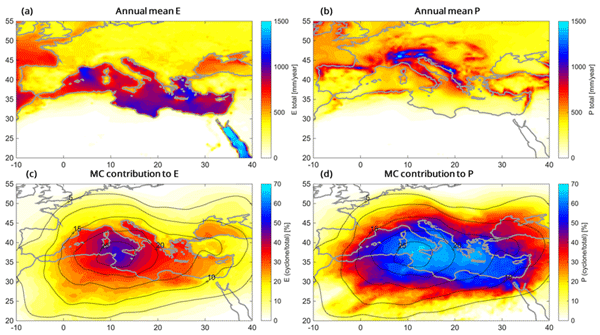
Abstract. Mediterranean cyclones (MCs) play a crucial role in the Mediterranean hydrological cycle (MHC), driving up to 70 % of precipitation and 50 % of evaporation totals, and larger fractions of their extremes. Therefore, regional sensitivity to warming is often associated with long-term changes of MCs. These may lead to regional climate feedback through pathways linked directly or indirectly to the MHC: from decreasing cloud cover and precipitation to increased water-vapor uptake. However, the ability of MCs to generate coherent climate feedback is under ongoing debate. Moreover, given the large diversity of processes driving MCs, the role of each in the MHC and their variability remains unexplored. Our recent process-based MC classification allows the breakdown of MC’s contribution to the MHC under different dominant cyclogenetic processes. Based on 1-hourly ECMWF ERA5 reanalysis data (1979–2020), 3190 MC tracks are analyzed. We first quantify the total contribution of MCs to the MHC following the cyclone tracks. We analyze the spatial and temporal patterns of the annually accumulated cyclone-induced precipitation (P) and surface evaporation (E). The process-based classification allows the quantification of independent contributions from various cyclone drivers to cyclone-induced P and E and their long-term trends. The results show that the overall annual P-E residual associated with MCs is positive but decreases over time, losing ~0.5 mm/yr per year. The classification reveals opposing roles and long-term trends in the annual contributions of each cyclone driver, shifting the balance between cyclone-induced P and E from P-dominated towards E-dominated MCs. These changes are primarily due to reduced precipitation associated with double-jet MCs and daughter cyclones and increased evaporation associated with thermal lows (−0.2 mm/year, each), alternately driven by changes in frequency and/or flux intensities of specific cyclone drivers. Mainly, a sharp rise in frequency affects heat lows, while double-jet cyclones are mostly affected by decreasing precipitation rates. The downward impact of MCs on the Mediterranean Sea heat content also varies sharply between MC types: while MCs generally draw heat from the Mediterranean, certain MC types have the opposing effect, adding further heat. Beyond providing a framework for follow-up analysis of MC impact on the MHC in future climate simulations, the results highlight the independent and opposing contributions of different MC drivers to the Mediterranean heat content, enhancing our understanding of their dynamic response to warming and its impact on society.
Competing interests: At least one of the (co-)authors is a member of the editorial board of Weather and Climate Dynamics.
Publisher's note: Copernicus Publications remains neutral with regard to jurisdictional claims made in the text, published maps, institutional affiliations, or any other geographical representation in this paper. While Copernicus Publications makes every effort to include appropriate place names, the final responsibility lies with the authors. Views expressed in the text are those of the authors and do not necessarily reflect the views of the publisher.-
Notice on discussion status
The requested preprint has a corresponding peer-reviewed final revised paper. You are encouraged to refer to the final revised version.
-
Preprint
(2290 KB)
-
The requested preprint has a corresponding peer-reviewed final revised paper. You are encouraged to refer to the final revised version.
- Preprint
(2290 KB) - Metadata XML
- BibTeX
- EndNote
- Final revised paper


Journal article(s) based on this preprint
Interactive discussion
Status: closed
-
RC1: 'Comment on egusphere-2025-6061', Anonymous Referee #1, 15 Jan 2026
A review of “Contrasting impact of different Mediterranean cyclones on the hydrological cycle and ocean heat content” by Yonatan Givon et al. (2025)
Recommendation: Minor revisions
Givon et al., (2025) leverages previous work on identifying distinct categories of Mediterranean cyclones to assess how these cyclones impact precipitation and evaporation rates across the Mediterranean basin. Through this analysis, the trend of precipitation and evaporation rates are found to differ across cyclone types, which can then inform future work on regional climate risk.
The figures and research are all high caliber and the paper flows as a coherent scientific story, for which I commend the authors. My main critique for this paper is with how much contextual information is not included to understand the discussion of this paper. I find this information necessary to interpret some of the main findings of the paper and to understand some of the points in the discussion section of the paper.
Main/general comments
When describing some of your results, you allude to results from your previous paper discussing the clustering of your cyclones. Often there are references to seasonality or large-scale flow configurations that I cannot deduce without examining your previous paper. An examples where I wanted additional context is lines 244–257 (referencing clusters as summer or winter, or the double jet configuration not shown in this paper). I think figures 3 and 6 from Givon et al., (2024a), as well as a brief summary of the results of these figures, should be incorporated into the paper or included in the supplemental information to give the reader more context on your previous work.
I also found that several points included in the discussion were not properly supported by the research presented earlier in the text. Some examples include:
- Line 365: referencing double jets when none are shown
- Line 382: non-linear PV dynamics are not discussed before, so the statement feels unsubstantiated
- Lines 394–395: “drivers” of the cyclones have not been discussed, nor have the ways in which those drivers may change with additional warming
I can understand the desire to place this work into a larger context, but as it stands currently, I find many of the claims related to the results of Givon et al., (2024a) rather than your current paper. I think these instances need to be rewritten to explicitly link back to your previous work.
Line by line comments
- Line 54: “more of it” is ambiguous, is this referencing more frequent MCs? More precipitation generally?
- Line 266: I am not sure what you mean by “local effects” in t
Citation: https://doi.org/10.5194/egusphere-2025-6061-RC1 -
RC2: 'Reply on RC1', Anonymous Referee #1, 15 Jan 2026
Apologies, the end of my last comment was cut off. It is included below.
- Line 266: I am not sure what you mean by “local effects” in this context.
Citation: https://doi.org/10.5194/egusphere-2025-6061-RC2
-
RC3: 'Comment on egusphere-2025-6061', Anonymous Referee #2, 23 Jan 2026
The paper by Givon et al. details the contribution of different Mediterranean cyclone types (obtained using a potential-vorticity based classification) to the Mediterranean Hydrological Cycle (MHC) and to the Ocean Heat Content (OHC) of the same basin. The employed approach is particularly fruitful, as it allows to attribute trends in evaporation P, precipitation E and net precipitation (P-E) to the different frequency and intensity changes of each cyclone category. Of particular interest is the observation that the impact of Mediterranean cyclones on MHC and OHC can substantially vary according to the cyclone type. The results also elucidate some region-specific characteristics of the MHC, with implications for the understanding of climate-change related trends.
I enjoyed reading this manuscript, and my comments mostly concern suggestions to improve readability and clarity of the manuscript. There is only one point that I feel needs to be checked or discussed, which concerns the effect of the seasonal cycle on the results obtained.
Major comment
- This analysis considers annual frequency, but the characteristics of the land surface with respect to the Mediterranean Sea vary substantially across months. For instance, cyclones in the same cluster might lead to OHC enhancement in the warm season and OHC depletion in the cold season. How would the results change if the analysis were to be repeated separately for NDJFM and MJJAS? Isolating the effect of the seasonal cycle would help contextualizing interesting results, such as the capability of cyclones in increasing OHC.
Minor comments
Line 56: A terminology clarification: as water uptake from the sea is determined by the dryness of the overlying air mass and not by its air temperature, I would suggest to replace “increased water-vapor uptake” with “increased water content” (unless the authors meant the increase in sea-surface temperatures with global warming, in that case it is correct but it would be better to specify it)
Line 58: “meridional shift” is general, can the authors specify whether poleward or equatorward and provide references? Unless the Mediterranean is in a “optimum” state for which any meridional shift would result in a reduction in precipitation.
Line 61-62: I don’t fully understand the point about the necessity of strong E to sustain cyclones, do the authors refer to tropical cyclones here? Maybe a citation would also help to clarify the argument being made.
Line 64-65: the authors could consider adding the paper by Papritz and Aemisegger on evaporation hot spots.
Line 68: I do not understand the use of the formulation “extratropical-like cyclones (most comparable to extratropical cyclones)” in particular what would be their implied difference with respect to extratropical cyclones?
Line 160-161: which frequency is referred to here? The normalized one or the annual one?
Lines 228-229, 236: these sentences (and others in the paragraph) imply some knowledge of the geographical distribution of the clusters, that needs to be gained by reading previous work -- Givon et al. (2024a). To improve readability, I suggest exchanging the discussion of Fig. 4 and Fig. 3.
Line 255: this is the first time that the “double-jet” is introduced, there is a risk of confusion with the same “double jet” patterns related to heatwaves by recent work (e.g., Rousi et al. 2022). Consider avoiding this terminology or explaining it briefly with respect to the concept of “AWB+CWB”.
Lines 267-269: interesting, indeed. Are these cyclones related to cut-off lows? There is plenty of literature connecting Rossby wave breaking to precipitation extremes in the subtropics (e.g., the work of Andres de Vries), maybe it would deserve a citation to contextualize a result that would look otherwise quite “off”.
Figures 7,8, and lines 306-307: consider depicting with (1) significant upward trend and with (-1) significant downward trends in quantities to further improve readability and allow to assess immediately the contributions of individual P and E trends to P-E.
Lines 311-314: would it be possible to highlight in some way, in some of the plots, which clusters are the winter and summer ones? This would avoid again the reader the trip to Givon et al. (2024a) or to a Supplementary Information (that this paper, miraculously, does not have yet).
Table 1: the first column tells that Mediterranean cyclones (at least in the classification used here) only occur in 13.4% of the considered days, correct? But still, they contribute to 24.1% of the P-E in the basin. Wouldn’t those numbers be a bit low, especially for what concerns the precipitation?
Lines 340-342: would it be possible to see analogous composites of radiative and turbulent fluxes comparing a OHC-enhancing and a OHC-depleting cluster? This analysis might complement and show nicely this interesting feature of summer cyclones.
Line 360 (and see my comment about Table 1): here values around 50% and 70% are mentioned, it sounds a bit confusing. Please consider specifying (here or at Table 1) the values with respect to which those percentages refer.
Line 380-382: the general linkage between nonlinear PV dynamics and OHC is not immediately obvious, could the authors further elaborate on it?
Line 384: this is the first time that the “Mediterranean precipitation paradox” is mentioned here, what is it? Please introduce this (seemingly complex) conundrum in the Introduction.
Lines 389-392: please give more details here or in the Introduction about the problem of this “all-quartile increase”, which might not need be known to the reader.
Line 394: “Each driver”, do the authors mean “Each cyclone type”, or something more than that?
Line 395: “warming buffer”: this term is introduced here for the first time, do the authors mean that MC act to counteract global warming, in the sense of reduction of temperature?
Line 396: this is the first mention of “nonlinearity”, to what nonlinearity do the authors refer? I am rather sure that you would like to bring forward an interesting point, but I encourage them (see also previous comments) to outline their reasoning in a slightly less minimalistic way also for readers who are not familiar with MHC-specific jargon or issues.
Technical/Typos
Line 57: “grow less” -> “become less”
Line 79: “are associated”
Line 90: “were revealed” in the aforementioned studies, or “are/will be revealed” in the current study?
Line 104: in which sense “impair the climatological role”?
Line 215: consider adding short sub-titles next to (a) (b), etc… to increase readability of the figure.
Citation: https://doi.org/10.5194/egusphere-2025-6061-RC3 - AC1: 'Comment on egusphere-2025-6061', Yonatan Givon, 10 Feb 2026


Interactive discussion
Status: closed
-
RC1: 'Comment on egusphere-2025-6061', Anonymous Referee #1, 15 Jan 2026
A review of “Contrasting impact of different Mediterranean cyclones on the hydrological cycle and ocean heat content” by Yonatan Givon et al. (2025)
Recommendation: Minor revisions
Givon et al., (2025) leverages previous work on identifying distinct categories of Mediterranean cyclones to assess how these cyclones impact precipitation and evaporation rates across the Mediterranean basin. Through this analysis, the trend of precipitation and evaporation rates are found to differ across cyclone types, which can then inform future work on regional climate risk.
The figures and research are all high caliber and the paper flows as a coherent scientific story, for which I commend the authors. My main critique for this paper is with how much contextual information is not included to understand the discussion of this paper. I find this information necessary to interpret some of the main findings of the paper and to understand some of the points in the discussion section of the paper.
Main/general comments
When describing some of your results, you allude to results from your previous paper discussing the clustering of your cyclones. Often there are references to seasonality or large-scale flow configurations that I cannot deduce without examining your previous paper. An examples where I wanted additional context is lines 244–257 (referencing clusters as summer or winter, or the double jet configuration not shown in this paper). I think figures 3 and 6 from Givon et al., (2024a), as well as a brief summary of the results of these figures, should be incorporated into the paper or included in the supplemental information to give the reader more context on your previous work.
I also found that several points included in the discussion were not properly supported by the research presented earlier in the text. Some examples include:
- Line 365: referencing double jets when none are shown
- Line 382: non-linear PV dynamics are not discussed before, so the statement feels unsubstantiated
- Lines 394–395: “drivers” of the cyclones have not been discussed, nor have the ways in which those drivers may change with additional warming
I can understand the desire to place this work into a larger context, but as it stands currently, I find many of the claims related to the results of Givon et al., (2024a) rather than your current paper. I think these instances need to be rewritten to explicitly link back to your previous work.
Line by line comments
- Line 54: “more of it” is ambiguous, is this referencing more frequent MCs? More precipitation generally?
- Line 266: I am not sure what you mean by “local effects” in t
Citation: https://doi.org/10.5194/egusphere-2025-6061-RC1 -
RC2: 'Reply on RC1', Anonymous Referee #1, 15 Jan 2026
Apologies, the end of my last comment was cut off. It is included below.
- Line 266: I am not sure what you mean by “local effects” in this context.
Citation: https://doi.org/10.5194/egusphere-2025-6061-RC2
-
RC3: 'Comment on egusphere-2025-6061', Anonymous Referee #2, 23 Jan 2026
The paper by Givon et al. details the contribution of different Mediterranean cyclone types (obtained using a potential-vorticity based classification) to the Mediterranean Hydrological Cycle (MHC) and to the Ocean Heat Content (OHC) of the same basin. The employed approach is particularly fruitful, as it allows to attribute trends in evaporation P, precipitation E and net precipitation (P-E) to the different frequency and intensity changes of each cyclone category. Of particular interest is the observation that the impact of Mediterranean cyclones on MHC and OHC can substantially vary according to the cyclone type. The results also elucidate some region-specific characteristics of the MHC, with implications for the understanding of climate-change related trends.
I enjoyed reading this manuscript, and my comments mostly concern suggestions to improve readability and clarity of the manuscript. There is only one point that I feel needs to be checked or discussed, which concerns the effect of the seasonal cycle on the results obtained.
Major comment
- This analysis considers annual frequency, but the characteristics of the land surface with respect to the Mediterranean Sea vary substantially across months. For instance, cyclones in the same cluster might lead to OHC enhancement in the warm season and OHC depletion in the cold season. How would the results change if the analysis were to be repeated separately for NDJFM and MJJAS? Isolating the effect of the seasonal cycle would help contextualizing interesting results, such as the capability of cyclones in increasing OHC.
Minor comments
Line 56: A terminology clarification: as water uptake from the sea is determined by the dryness of the overlying air mass and not by its air temperature, I would suggest to replace “increased water-vapor uptake” with “increased water content” (unless the authors meant the increase in sea-surface temperatures with global warming, in that case it is correct but it would be better to specify it)
Line 58: “meridional shift” is general, can the authors specify whether poleward or equatorward and provide references? Unless the Mediterranean is in a “optimum” state for which any meridional shift would result in a reduction in precipitation.
Line 61-62: I don’t fully understand the point about the necessity of strong E to sustain cyclones, do the authors refer to tropical cyclones here? Maybe a citation would also help to clarify the argument being made.
Line 64-65: the authors could consider adding the paper by Papritz and Aemisegger on evaporation hot spots.
Line 68: I do not understand the use of the formulation “extratropical-like cyclones (most comparable to extratropical cyclones)” in particular what would be their implied difference with respect to extratropical cyclones?
Line 160-161: which frequency is referred to here? The normalized one or the annual one?
Lines 228-229, 236: these sentences (and others in the paragraph) imply some knowledge of the geographical distribution of the clusters, that needs to be gained by reading previous work -- Givon et al. (2024a). To improve readability, I suggest exchanging the discussion of Fig. 4 and Fig. 3.
Line 255: this is the first time that the “double-jet” is introduced, there is a risk of confusion with the same “double jet” patterns related to heatwaves by recent work (e.g., Rousi et al. 2022). Consider avoiding this terminology or explaining it briefly with respect to the concept of “AWB+CWB”.
Lines 267-269: interesting, indeed. Are these cyclones related to cut-off lows? There is plenty of literature connecting Rossby wave breaking to precipitation extremes in the subtropics (e.g., the work of Andres de Vries), maybe it would deserve a citation to contextualize a result that would look otherwise quite “off”.
Figures 7,8, and lines 306-307: consider depicting with (1) significant upward trend and with (-1) significant downward trends in quantities to further improve readability and allow to assess immediately the contributions of individual P and E trends to P-E.
Lines 311-314: would it be possible to highlight in some way, in some of the plots, which clusters are the winter and summer ones? This would avoid again the reader the trip to Givon et al. (2024a) or to a Supplementary Information (that this paper, miraculously, does not have yet).
Table 1: the first column tells that Mediterranean cyclones (at least in the classification used here) only occur in 13.4% of the considered days, correct? But still, they contribute to 24.1% of the P-E in the basin. Wouldn’t those numbers be a bit low, especially for what concerns the precipitation?
Lines 340-342: would it be possible to see analogous composites of radiative and turbulent fluxes comparing a OHC-enhancing and a OHC-depleting cluster? This analysis might complement and show nicely this interesting feature of summer cyclones.
Line 360 (and see my comment about Table 1): here values around 50% and 70% are mentioned, it sounds a bit confusing. Please consider specifying (here or at Table 1) the values with respect to which those percentages refer.
Line 380-382: the general linkage between nonlinear PV dynamics and OHC is not immediately obvious, could the authors further elaborate on it?
Line 384: this is the first time that the “Mediterranean precipitation paradox” is mentioned here, what is it? Please introduce this (seemingly complex) conundrum in the Introduction.
Lines 389-392: please give more details here or in the Introduction about the problem of this “all-quartile increase”, which might not need be known to the reader.
Line 394: “Each driver”, do the authors mean “Each cyclone type”, or something more than that?
Line 395: “warming buffer”: this term is introduced here for the first time, do the authors mean that MC act to counteract global warming, in the sense of reduction of temperature?
Line 396: this is the first mention of “nonlinearity”, to what nonlinearity do the authors refer? I am rather sure that you would like to bring forward an interesting point, but I encourage them (see also previous comments) to outline their reasoning in a slightly less minimalistic way also for readers who are not familiar with MHC-specific jargon or issues.
Technical/Typos
Line 57: “grow less” -> “become less”
Line 79: “are associated”
Line 90: “were revealed” in the aforementioned studies, or “are/will be revealed” in the current study?
Line 104: in which sense “impair the climatological role”?
Line 215: consider adding short sub-titles next to (a) (b), etc… to increase readability of the figure.
Citation: https://doi.org/10.5194/egusphere-2025-6061-RC3 - AC1: 'Comment on egusphere-2025-6061', Yonatan Givon, 10 Feb 2026
Peer review completion


Journal article(s) based on this preprint
Viewed
| HTML | XML | Total | BibTeX | EndNote | |
|---|---|---|---|---|---|
| 265 | 152 | 43 | 460 | 37 | 38 |
- HTML: 265
- PDF: 152
- XML: 43
- Total: 460
- BibTeX: 37
- EndNote: 38
Viewed (geographical distribution)
| Country | # | Views | % |
|---|
| Total: | 0 |
| HTML: | 0 |
| PDF: | 0 |
| XML: | 0 |
- 1
Yonatan Givon
Douglas Keller
Philippe Drobinski
Shira Raveh-Rubin
The requested preprint has a corresponding peer-reviewed final revised paper. You are encouraged to refer to the final revised version.
- Preprint
(2290 KB) - Metadata XML