
the Creative Commons Attribution 4.0 License.
the Creative Commons Attribution 4.0 License.
 | 12 Dec 2025
High-Latitude Eddy Statistics from SWOT assessed by in situ observations
Abstract. Mesoscale eddies play a key role in the transport of heat, salt, and momentum, yet their statistical characterization at high latitudes has remained elusive due to the coarse resolution of conventional satellite altimetry. Here we present the first statistical description of mesoscale eddies in the Labrador Sea using observations from the Surface Water and Ocean Topography (SWOT) mission. We apply an eddy-detection algorithm directly to the native 2-km SWOT swaths, without gridding or assimilation, and validate the detections against in situ measurements from shipboard current profiler data from one cruise in 2024, as well as against a statistically derived shipboard current-profiler–based eddy census. The comparison demonstrates excellent agreement in eddy size and intensity, confirming SWOT’s ability to resolve high-latitude mesoscale structures previously undetectable in gridded altimetry. The SWOT-derived eddy census based on a full-calendar year reveals a predominance of energetic anticyclones (Irminger Rings) in the basin interior and smaller cyclones along the continental slopes, with clear seasonal variability linked to boundary current instability. These findings provide the first observational benchmark for mesoscale activity in the Labrador Sea and illustrate SWOT’s potential to extend eddy statistics to high-latitude and ice-influenced regions, opening the way for a global assessment of mesoscale variability.
-
Notice on discussion status
The requested preprint has a corresponding peer-reviewed final revised paper. You are encouraged to refer to the final revised version.
-
Preprint
(7508 KB)
-
The requested preprint has a corresponding peer-reviewed final revised paper. You are encouraged to refer to the final revised version.
- Preprint
(7508 KB) - Metadata XML
- BibTeX
- EndNote
- Final revised paper


Journal article(s) based on this preprint
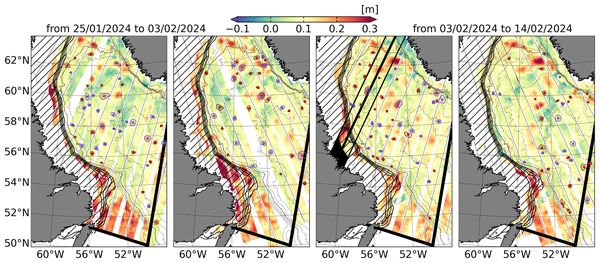
We use new observations from the Surface Water and Ocean Topography Mission (SWOT) satellite to reveal the structure of ocean eddies in the Labrador Sea at unprecedented resolution. By comparison with ship-based measurements, we show that SWOT reliably detects these features even at high latitudes, where conventional altimetry is limited. Our results provide the first detailed view of mesoscale eddies in the Labrador Sea and highlight SWOT's potential in polar regions.
Interactive discussion
Status: closed
-
RC1: 'Comment on egusphere-2025-6055', Jan Klaus Rieck, 04 Feb 2026
Review of "High-Latitude Eddy Statistics from SWOT assessed by in situ observations" by de Marez et al.
The authors use ungridded, along-track satellite altimetry data from SWOT to detect mesoscale eddies in the Labrador Sea and compare individual eddies and eddy statistics compiled over a full year to eddies detected from in-situ, shipboard ADCP measurements, as well as gridded, lower resolution altimetry data. The study confirms existing knowledge about various types of mesoscale eddies in the Labrador Sea but a longer study period would be necessary to really assess this with confidence. However, the main advancement of the study is the methodolgy of detecting eddies from along-track satellite altimetry, allowing to detect smaller features than from gridded altimetry products. Both, this new detection method and its application to SWOT data make this study a significant contribution to our knowledge of mesoscale eddies.
The manuscript is well structured and written and I only have a few, relatively minor comments.
General comments
- In the introduction as well as the discussion, the authors highlight SWOT's potential ability to investigate eddies in "ice-influenced" regions or "seasonally ice covered zones where altimetric data were previously unusable". However, their analysis excludes eddies in areas with >15% sea ice cover, so that it seems that this aforementioned potential is purely hypothetic. I do not see the value in emphasizing this unless the authors show how a seasonal ice cover can inhibit eddy detection in lower resolution altmitry data even at times when no ice is present.
- The method of filling using "biharmonic inpainting" seems to be uncertain to me. It is not well explained in the text but looking at Fig. 1 this "filling" is an extrapolation over a distance of ~50% of the original width of the satellite swath. I assume that this introduces a lot of uncertainty even though only eddies that are mostly outside of those extrapolated regions are considered. I strongly suggest the authors do some sensitivty testing with different extrapolation methods, or present results if testing was already done. Even better would be to take a dummy dataset, i.e. a gridded SSH dataset or model output, subsample some artificial SWOT swaths and then detect eddies in those and compare to an eddy detection performed on the original complete, gridded dataset.
Specific Comments
Title: This might be irrelevant as I am not a native english speaker but "assessed by in situ observations" seems to not convey what the authors want to say. I suggest replacing by "compared to in situ observations" or something similar.
l. 2: I suggest adding "in the ocean" after "momentum" in the introductory sentence.
ll. 19-20: I find this slightly misleading as the automatic detection of eddies can be performed on mooring or ADCP data etc. What has been made possible through the gridded products is global detection of eddies.
ll. 23-24: I suggeset rephrasing to "The ability of gridded SLA fields to represent the eddy field has previously been questioned, as they have largely distorted eddy characteristics" unless this distorts the intended meaning.
ll. 33-41: The authors mention two environments where eddies are abundant, they then go on to describe the processes in the MIZ in detail but do not describe anything about the boundary currents. I strongly suggest to add some information on what the eddies do in boundary currents. Also see my General comment 1.
ll. 69-75: It is not clear to me how the reduction of overall energy does not have implications for the presented analysis. I do believe this is true but the authors should rephrase this part and include an explanation of why it is true.
l. 99: If possible, include those datasets in the references.
ll. 120-128: The explanation of the padding and filling is not clear to me from the text alone. I suggest the authors rephrase this in order to avoid that the readers have to switch back between the text and Fig. 1 to understand the process.
ll. 123-128: See General comment 2.
l. 168: Why was the SWOT-detected eddy from June 27 used while the one from June 25 would be closer in time to the ins situ-detected eddy on June 24? Is there an automatic algorithm that decides which of the duplicate detections to keep or is this chosen manually? I suggest the authors describe this process.
ll. 182-183: Are the "shallow eddies" here the ones that are detected in areas where the water depth is < 2000 m? If this is the case I suggest the authors rephrase this, as "shallow eddies detected above depth < 2000 m" gives the impression that the eddies themselves are above 2000 m in the water column.
l. 188: Global datasets of mesoscale eddies (and their statistics) are available from lower resolution altimetry data, e.g. Ioannou et al. (2024), extending to similarly high latitudes. While the higher resolution of SWOT certainly makes the presented statisitcs more valuable, it is not the first time that those statistics are derived.
ll. 198-199: I suggest the authors add a reference that supports their statement that "AEs are less susceptible to steering by background currents and less prone to instability-driven decay".
ll. 204-205: The fact that the eddies are stronger near the slopes might also reflect the fact that those eddies are generated in those regions and are necessarily weaker away from them as they decay.
Fig. 4: I suggest the authors use a plotting algorithm without interpolation such that the 2x1 degree boxes are visually identifiable on the maps.
ll. 209-220: I suspect that the western and eastern regions got mixed up here as the West Greenland current is not in the western region and the eastern region is not the one with the weakest eddies. I suggest the authors check this and also make sure that the western and eastern region are correctly attributed to the columns in Fig. 5.
ll. 214-215: Does the average westward propagation speed of Irminger Rings support the connection between a winter maximum of their generation in the east and the presented spring-autumn maximum in the central region?
l. 227: I suggest removing "(surface-intensified)" as not all the types of eddies mentioned are surface-intensified (convective lenses).
l. 250: Not all datasets used in this study are mentioned here. If the code for the detection from SWOT data is available this should be added here as it is certainly of great interest to the community.
References: In general, I suggest the authors add DOIs to all references.
Minor Comments
l. 25 add a comma after "to be resolved, ..."
l. 34 "sea-ice melt generates"
l. 68: "preserving the balanced"
l. 86: is a duplicate of line 84
l. 99: "Other datasets"
l. 106: some formatting issue with "no—KaRIn—measurements"
l. 115: "MIOST" has not been introduced
l. 149: I suggest replacing "in front of" with "using"
l. 160: "tracks"
l. 232: "detection"
l. 284: Use the final published version.
l. 341: citation has no journal
l. 346: Use the final published version.
ReferencesIoannou, A., Guez, L., Laxenaire, R., & Speich, S. (2024). Global Assessment of Mesoscale Eddies with TOEddies: Comparison Between Multiple Datasets and Colocation with In Situ Measurements. Remote Sensing, 16(22), 4336. https://doi.org/10.3390/rs16224336
Citation: https://doi.org/10.5194/egusphere-2025-6055-RC1 -
AC1: 'Reply on general comments from RC1', Charly de Marez, 10 Feb 2026
We thank the reviewer for their careful reading of the manuscript and for the constructive comments provided. At this stage of the review process, we have received the report from one reviewer and are providing this preliminary response so that both the reviewer and the editor can see how we address these points while the review is still ongoing. Here, we focus on addressing the general comments of RC1, which we consider the most important at this stage. The remaining, more specific comments will be addressed comprehensively once the full set of reviews and the editor’s feedback have been received, in the revised manuscript and final response to reviewers.
General comment #1
We do not intend to suggest that SWOT allows us to observe eddies under sea ice or that previous altimeter were less prone to observe the sea surface height in such region. Rather, our point concerns eddies located in regions that are seasonally ice-covered, i.e. areas that are ice-free during part of the year but where classical altimetry has historically been of limited use.
In these regions, the limitation of conventional gridded altimetry products is not primarily the presence of ice at the time of observation, but the fact that the dominant eddies are too small to be properly resolved by the effective resolution of these products. As a result, mesoscale activity in the seasonal ice zone has remained largely undocumented, even during ice-free periods. SWOT, thanks to its much finer spatial resolution and along-track sampling, allows us to observe these small eddies during the ice-free season in regions that are otherwise considered poorly observable with traditional altimetry. This is the aspect we intended to highlight.
Note that even when the area is ice-free, it remains influenced by sea ice processes. This is where seasonal melting occurs, generating sharp temperature and salinity gradients that are known to favor the development of small-scale, energetic eddies. The observed eddies are therefore linked to the seasonal ice cover, yet remain largely invisible to conventional altimetry.
The text will be revised in both the Introduction and the Discussion to clarify this point and avoid any confusion with the idea of observing eddies beneath sea ice.General comment #2
We agree that the impact of the biharmonic inpainting on eddy detection needed to be quantitatively assessed, and we have performed a sensitivity test using a high-resolution numerical simulation as a controlled reference dataset. Our sensitivity test shows that the inpainting method does not introduce any significant bias in our results for the eddies considered in this study. We refer the reviewer to the attached pdf document including figures from the sensitivity test.
We used outputs from the GIGATL1 simulation (1 km horizontal resolution, 100 vertical levels), which fully resolves the mesoscale dynamics in the subpolar Atlantic, including in regions where the first baroclinic Rossby radius is O(10–15 km) (de Marez et al., 2025). Two representative areas were selected.The method is as follows. The SSH fields (from the simulation) were first interpolated onto a 2-km grid to match SWOT’s effective resolution. From these, we extracted N × 128 domains, which we refer to as the “truth” fields. We then constructed synthetic SWOT-like swaths by introducing gaps corresponding to the nadir region and the swath edges, reproducing the exact data geometry encountered in the real SWOT observations. This produced datasets with the same grid and missing-data structure as those used in our detection method. These gapped fields were subsequently filled using the same biharmonic inpainting procedure as in the manuscript, yielding what we refer to as the “swotlike” fields. Eddy detection was then applied independently to the truth and swotlike fields. This procedure was repeated weekly over one year for the two synthetic passes, allowing a statistical comparison of eddy properties derived from complete versus inpainted data.
The comparison shows that the distributions of eddy amplitude and radius obtained from the truth and swotlike datasets are very similar. For the individual passes where detections do not perfectly coincide, the misdetection rate remains below ~5% over the entire swath. Therefore, over the annual sampling, the statistical distributions of eddy properties are not significantly altered by the inpainting procedure (see histograms in attached document).
A trend nevertheless seems to appear: discrepancies (difference of the number of detected eddies using the two arrays) increase with eddy radius. This behavior is physically expected. Larger eddies have a broader spatial imprint and therefore intersect the gapped regions more frequently, making their reconstruction more sensitive to the inpainting. In contrast, eddies with radii smaller than ~15 km (i.e. diameters smaller than approximately half the swath width) remain mostly constrained by observed data and are only weakly affected by the extrapolation.
These additional diagnostics demonstrate that the biharmonic inpainting does not significantly bias the eddy statistics in the size range primarily analyzed in this study (O(15 km) radius). The method is robust for eddies whose characteristic scale is smaller than half the swath width, which corresponds precisely to the population of eddies that SWOT allows us to observe and that are the focus of this paper.
The manuscript will be revised accordingly. We will in particular mention this sensitivity study with the method section, and emphasize the limitations of the method for eddies with R>15 km. -
AC2: 'Common reply on RC1, RC2, and RC3', Charly de Marez, 07 Apr 2026
The comment was uploaded in the form of a supplement: https://egusphere.copernicus.org/preprints/2025/egusphere-2025-6055/egusphere-2025-6055-AC2-supplement.pdf
-
RC2: 'Comment on egusphere-2025-6055', Anonymous Referee #2, 25 Mar 2026
Eddies are smaller in high latitudes due to the change of the deformation radius. The eddies in these latitudes are, however, important influencing deep-water formation, carbon uptake, and sea-ice melt. The manuscript shows that the new SWOT satellite enables robust, quantitative eddy detection in polar and subpolar oceans. I find the manuscript scientifically sound and well written. Only a few minor correction seems needed before publication.
(relatively major) comments
In Section 3.1 (methodology), the geostrophic balance is implicitly assumed. In scales much smaller than the deformation radius, it is not obvious that the velocity field is dominated by geostrophic flows. A short discussion to justify the geostrophic balance at these scales might be needed.L.198, AE/CE asymmetry is mentioned here. Fig.3 of Chelton et al. (2011, https://doi.org/10.1016/j.pocean.2011.01.002) indicates that the asymmetry shows up after travelling > 2000 km. Is this the situation in the Labrador Sea (not obvious from Fig.4)? Or do you have any better reference? Later at L.211, it seems a local generation along the W.Greenland Current is suggested. Does this agree with the AE/CE asymmetry?
minor comments
L.95 "from classical a" → from a classical
L.177 and Fig.3e, How is the Rossby number defined here?
Fig.2 caption, 3 lines from the bottom. The subscript 1 and 4 are connected by a strange character.
L.250, the website shown at "data availability" section is not a link to the data. Maybe this one? https://doi.org/10.24400/527896/A01-2023.017
Citation: https://doi.org/10.5194/egusphere-2025-6055-RC2 -
AC2: 'Common reply on RC1, RC2, and RC3', Charly de Marez, 07 Apr 2026
The comment was uploaded in the form of a supplement: https://egusphere.copernicus.org/preprints/2025/egusphere-2025-6055/egusphere-2025-6055-AC2-supplement.pdf
-
AC2: 'Common reply on RC1, RC2, and RC3', Charly de Marez, 07 Apr 2026
-
RC3: 'Comment on egusphere-2025-6055', Anonymous Referee #3, 25 Mar 2026
General assessment
This manuscript presents a study using SWOT swath data to characterize mesoscale eddies in the Labrador Sea. The use of native-resolution SWOT observations combined with in situ SADCP data provides a promising framework to investigate mesoscale dynamics at high latitudes, where conventional altimetry has long been limited.
However, several aspects of the methodology, validation strategy, and interpretation of the results require clarification and strengthening.
Major comments
1. Detection on SLA field
It has been previously assessed that the detection should preferably be done on ADT field rather than SLA field as in Pegliasco, C., Chaigneau, A., Morrow, R., & Dumas, F. (2021). Detection and tracking of mesoscale eddies in the Mediterranean Sea: A comparison between the Sea Level Anomaly and the Absolute Dynamic Topography fields. Advances in Space Research, 68(2), 401-419. Most recent global eddies atlas perform the detection on the ADT field as in ToEddies (Ioannou, A., Guez, L., Laxenaire, R., & Speich, S. (2024). Global assessment of mesoscale eddies with TOEddies: comparison between multiple datasets and colocation with in situ measurements. Remote Sensing, 16(22), 4336.) or META atlases (Gamot, J., Delepoulle, A., Nencioli, F., Pujol, M. I., & Dibarboure, G. (2026). META4. 0: a new mesoscale eddy network atlas derived from altimetry. Earth System Science Data Discussions, 2026, 1-31). This can, for example, explain the AE/CE asymmetry.
I strongly recommend performing the detection on the ADT field as prescribed by previous studies.
2. Choice of reference altimetry product
The comparison with mapped altimetry relies on the CMEMS 1/4° product (as performed in Bendinger et al., 2025). However, more recent higher-resolution products (e.g., DUACS DT2024 1/8°) are available for this region. Given that eddy detectability is strongly resolution-dependent, this choice may artificially enhance the contrast between SWOT and CMEMS.
In addition, eddy detection strongly depends on the algorithm and parameter settings. The detection method applied to the CMEMS dataset should therefore be clearly specified, and the results interpreted in the light of these methodological choices.
Please justify the use of the 1/4° product, specify the exact CMEMS product and detection configuration used, and discuss whether using higher-resolution products (e.g., 1/8°) would affect the conclusions. The use of the last altimetry product should be considered in order to improve the quality of the comparisons.
3. Missing key parameter: shape error
The shape error parameter in pyeddytracker is not documented. This parameter strongly controls the acceptable deviation from circularity, and the sensitivity of detection to noise and interpolation artifacts.
Please provide and justify the value used, and indicate whether sensitivity tests to this parameter were performed. This would enhance the reproducibility of the method.
4. Value of the amplitude threshold
The amplitude threshold parameter in the detection procedure is set to 1 cm, while in other and global eddy atlases it is set to 0.4 cm (META), 0.25 cm (TIAN) and 0.1 cm (ToEddies) (as reported for instance in "Ioannou, A.; Guez, L.; Laxenaire, R.; Speich, S. Global Assessment of Mesoscale Eddies with TOEddies: Comparison Between Multiple Datasets and Colocation with In Situ Measurements. Remote Sens. 2024, 16, 4336. https://doi.org/10.3390/rs16224336"). For submesoscale eddies, this amplitude threshold appears to be a bit high and may affect the detection rate.
I recommend using an amplitude threshold closer than the ones used in other atlases (1 to a few millimeters appears to be more appropriate for high-latitudes eddies).
5. Justification of tiling strategy
The choice to divide SWOT swaths into overlapping 128×128 tiles is not justified, while pyeddytracker can operate directly on full grids. This tiling strategy may introduce artificial boundary effects, and additional complexity in the merging procedure.
Please justify why detection on the full swaths was not used and discuss the potential impact of tiling on detection results.
6. Inpainting method
The choice of the biharmonic inpainting method is critical, as it directly affects the reconstructed height fields and therefore the eddy detection.
Please justify the choice of this specific method, indicate whether alternative inpainting approaches were tested and discuss its potential impact on eddy properties (e.g., amplitude, radius, detection rate).
Indeed, this gap filling process may induce many erroneous closed contours, especially at the edges of the swaths where the field is extrapolated.
The inpainting method (ideally) or the eddies concerned by this bias should be validated. At least, this should be discussed in the article.
7. Duplicate removal methodology
The duplicate removal procedure is custom-built, with several criteria, whereas pyeddytracker provides a native eddy matching algorithm based notably on an overlap score threshold. In addition, it is unclear which criteria are used to select one eddy among duplicates (both between overlapping tiles and between swaths within the same cycle), and how this choice may affect eddy characteristics.
Please clarify why the built-in matching routine was not used, and describe the selection criteria for retained eddies, and discuss the sensitivity of the results to these choices.
Moreover, Figure 1 does not clearly illustrate duplicate detections before and after merging, particularly for overlapping tiles and multiple swaths within a cycle.
Please include a concrete example showing duplicated eddies, and how they are identified and removed in the final detection.
8. Biases introduced by gap-related filtering criteria
The exclusion of eddies with more than 40–60% of their contour located in missing data regions likely introduces a systematic detection bias. Indeed, this approach tends to remove eddies crossing the nadir gap, remove large eddies spanning swaths and favor small, compact eddies fully contained within a single swath. This creates a structural asymmetry with altimetry (e.g., CMEMS) products, which tend to detect larger and smoother eddies due to their lower resolution.
Please explicitly acknowledge this bias, and assess its potential impact on the statistics presented in Figures 3, 4, and 5.
9. Validation strategy
The validation is interesting but remains largely qualitative:
- Limited sample size: only 4 eddies are used for direct comparison;
- No quantitative metrics (e.g., bias, standard deviation, RMSE, correlation…) ;
- Temporal mismatch between SWOT and ADCP observations
Please include simple quantitative metrics, discuss the uncertainty associated with temporal mismatch, and moderate statements such as “excellent agreement” in the light of these limitations.
10. Missing visual intercomparison (SWOT vs ADCP vs CMEMS)
The manuscript lacks direct visual comparisons of the same eddies across datasets.
Please include case(s) study showing matching and mismatching eddies from the several datasets.
Suggestion: As mentioned above, pyeddytracker includes built-in matching tools that allow for systematic comparisons between datasets. These tools can be used, for instance, to identify eddies detected in multiple datasets in front of those detected in only one dataset, and to compare their spatial distribution and dynamical characteristics.
Such an analysis would provide a more quantitative assessment of the similarities and differences between SWOT, CMEMS, and in situ detections, and would help better identify the respective strengths and limitations of each dataset.
11. Missing of CMEMS curves in Fig. 3 (panels a & e)
CMEMS results are discussed but not shown in Figure 3 for eddy polarity and Rossby number.
Please include these curves or explain their absence.
12. SWOT Cal/Val phase validation
The SWOT Cal/Val phase provides higher temporal sampling, which offers an opportunity to assess whether the same eddy is consistently detected across successive passes and evaluate the sensitivity of the detection to variations in SWOT sampling (e.g., swath geometry and data gaps).
Please explain why this dataset was not used for validation or for assessing detection robustness, and eventually use it to complete the validation.
13. Interpretation of seasonal results
The seasonal variability analysis is based on a single year (2024).
Please explicitly acknowledge this limitation and interpret the results accordingly.
14. Suggestion on the dataset availability
Would it be possible to share publicly the eddy detection dataset? This would allow users to perform comparison, validation and statistics with other atlases or personal data.
Minor Comments
General: The statement “first statistical description” should be nuanced. Previous studies based on in situ observations and numerical models have already provided partial statistical characterizations of eddies in the Labrador Sea.
Please clarify that the novelty of this work lies in providing a SWOT-based, high-resolution, etc statistical description, rather than the first statistical description overall.
Note that I am not an English native speaker so some of the following remarks can be irrelevant:
l.34 : generateS
l.60 : “see some background in e.g., Morrow et al., 2019” to “see, e.g., Morrow et al. (2019) for background” or something similar (for the use of e.g.)
l.71 : “this has no implications for our analysis” to “this is not expected to significantly affect our analysis” or something similar to nuance the sentence.
l.78 : which represents
l.124 : “the latter reconstructs”
l.135 : “sensitivity tests to this parameters were done”: “sensitivity tests for these parameters were performed” ?
l.136 : WAS obtained
Figure 2 : the units in the table should be given.
Conclusions
In summary, this study is promising and addresses a relevant topic with a novel dataset. The approach has strong potential, and the results are encouraging. However, the current version of the manuscript lacks sufficient methodological justification and quantitative validation to fully support the conclusions.
I recommend major revisions, with particular attention to:
- performing the detection on the ADT field rather than the SLA;
- clarifying and justifying methodological choice;
- strengthening the validation and results;
- and moderating some interpretations in light of the current limitations.
Addressing these points would significantly improve the robustness and impact of the study.
Citation: https://doi.org/10.5194/egusphere-2025-6055-RC3 -
AC2: 'Common reply on RC1, RC2, and RC3', Charly de Marez, 07 Apr 2026
The comment was uploaded in the form of a supplement: https://egusphere.copernicus.org/preprints/2025/egusphere-2025-6055/egusphere-2025-6055-AC2-supplement.pdf
Peer review completion


Interactive discussion
Status: closed
-
RC1: 'Comment on egusphere-2025-6055', Jan Klaus Rieck, 04 Feb 2026
Review of "High-Latitude Eddy Statistics from SWOT assessed by in situ observations" by de Marez et al.
The authors use ungridded, along-track satellite altimetry data from SWOT to detect mesoscale eddies in the Labrador Sea and compare individual eddies and eddy statistics compiled over a full year to eddies detected from in-situ, shipboard ADCP measurements, as well as gridded, lower resolution altimetry data. The study confirms existing knowledge about various types of mesoscale eddies in the Labrador Sea but a longer study period would be necessary to really assess this with confidence. However, the main advancement of the study is the methodolgy of detecting eddies from along-track satellite altimetry, allowing to detect smaller features than from gridded altimetry products. Both, this new detection method and its application to SWOT data make this study a significant contribution to our knowledge of mesoscale eddies.
The manuscript is well structured and written and I only have a few, relatively minor comments.
General comments
- In the introduction as well as the discussion, the authors highlight SWOT's potential ability to investigate eddies in "ice-influenced" regions or "seasonally ice covered zones where altimetric data were previously unusable". However, their analysis excludes eddies in areas with >15% sea ice cover, so that it seems that this aforementioned potential is purely hypothetic. I do not see the value in emphasizing this unless the authors show how a seasonal ice cover can inhibit eddy detection in lower resolution altmitry data even at times when no ice is present.
- The method of filling using "biharmonic inpainting" seems to be uncertain to me. It is not well explained in the text but looking at Fig. 1 this "filling" is an extrapolation over a distance of ~50% of the original width of the satellite swath. I assume that this introduces a lot of uncertainty even though only eddies that are mostly outside of those extrapolated regions are considered. I strongly suggest the authors do some sensitivty testing with different extrapolation methods, or present results if testing was already done. Even better would be to take a dummy dataset, i.e. a gridded SSH dataset or model output, subsample some artificial SWOT swaths and then detect eddies in those and compare to an eddy detection performed on the original complete, gridded dataset.
Specific Comments
Title: This might be irrelevant as I am not a native english speaker but "assessed by in situ observations" seems to not convey what the authors want to say. I suggest replacing by "compared to in situ observations" or something similar.
l. 2: I suggest adding "in the ocean" after "momentum" in the introductory sentence.
ll. 19-20: I find this slightly misleading as the automatic detection of eddies can be performed on mooring or ADCP data etc. What has been made possible through the gridded products is global detection of eddies.
ll. 23-24: I suggeset rephrasing to "The ability of gridded SLA fields to represent the eddy field has previously been questioned, as they have largely distorted eddy characteristics" unless this distorts the intended meaning.
ll. 33-41: The authors mention two environments where eddies are abundant, they then go on to describe the processes in the MIZ in detail but do not describe anything about the boundary currents. I strongly suggest to add some information on what the eddies do in boundary currents. Also see my General comment 1.
ll. 69-75: It is not clear to me how the reduction of overall energy does not have implications for the presented analysis. I do believe this is true but the authors should rephrase this part and include an explanation of why it is true.
l. 99: If possible, include those datasets in the references.
ll. 120-128: The explanation of the padding and filling is not clear to me from the text alone. I suggest the authors rephrase this in order to avoid that the readers have to switch back between the text and Fig. 1 to understand the process.
ll. 123-128: See General comment 2.
l. 168: Why was the SWOT-detected eddy from June 27 used while the one from June 25 would be closer in time to the ins situ-detected eddy on June 24? Is there an automatic algorithm that decides which of the duplicate detections to keep or is this chosen manually? I suggest the authors describe this process.
ll. 182-183: Are the "shallow eddies" here the ones that are detected in areas where the water depth is < 2000 m? If this is the case I suggest the authors rephrase this, as "shallow eddies detected above depth < 2000 m" gives the impression that the eddies themselves are above 2000 m in the water column.
l. 188: Global datasets of mesoscale eddies (and their statistics) are available from lower resolution altimetry data, e.g. Ioannou et al. (2024), extending to similarly high latitudes. While the higher resolution of SWOT certainly makes the presented statisitcs more valuable, it is not the first time that those statistics are derived.
ll. 198-199: I suggest the authors add a reference that supports their statement that "AEs are less susceptible to steering by background currents and less prone to instability-driven decay".
ll. 204-205: The fact that the eddies are stronger near the slopes might also reflect the fact that those eddies are generated in those regions and are necessarily weaker away from them as they decay.
Fig. 4: I suggest the authors use a plotting algorithm without interpolation such that the 2x1 degree boxes are visually identifiable on the maps.
ll. 209-220: I suspect that the western and eastern regions got mixed up here as the West Greenland current is not in the western region and the eastern region is not the one with the weakest eddies. I suggest the authors check this and also make sure that the western and eastern region are correctly attributed to the columns in Fig. 5.
ll. 214-215: Does the average westward propagation speed of Irminger Rings support the connection between a winter maximum of their generation in the east and the presented spring-autumn maximum in the central region?
l. 227: I suggest removing "(surface-intensified)" as not all the types of eddies mentioned are surface-intensified (convective lenses).
l. 250: Not all datasets used in this study are mentioned here. If the code for the detection from SWOT data is available this should be added here as it is certainly of great interest to the community.
References: In general, I suggest the authors add DOIs to all references.
Minor Comments
l. 25 add a comma after "to be resolved, ..."
l. 34 "sea-ice melt generates"
l. 68: "preserving the balanced"
l. 86: is a duplicate of line 84
l. 99: "Other datasets"
l. 106: some formatting issue with "no—KaRIn—measurements"
l. 115: "MIOST" has not been introduced
l. 149: I suggest replacing "in front of" with "using"
l. 160: "tracks"
l. 232: "detection"
l. 284: Use the final published version.
l. 341: citation has no journal
l. 346: Use the final published version.
ReferencesIoannou, A., Guez, L., Laxenaire, R., & Speich, S. (2024). Global Assessment of Mesoscale Eddies with TOEddies: Comparison Between Multiple Datasets and Colocation with In Situ Measurements. Remote Sensing, 16(22), 4336. https://doi.org/10.3390/rs16224336
Citation: https://doi.org/10.5194/egusphere-2025-6055-RC1 -
AC1: 'Reply on general comments from RC1', Charly de Marez, 10 Feb 2026
We thank the reviewer for their careful reading of the manuscript and for the constructive comments provided. At this stage of the review process, we have received the report from one reviewer and are providing this preliminary response so that both the reviewer and the editor can see how we address these points while the review is still ongoing. Here, we focus on addressing the general comments of RC1, which we consider the most important at this stage. The remaining, more specific comments will be addressed comprehensively once the full set of reviews and the editor’s feedback have been received, in the revised manuscript and final response to reviewers.
General comment #1
We do not intend to suggest that SWOT allows us to observe eddies under sea ice or that previous altimeter were less prone to observe the sea surface height in such region. Rather, our point concerns eddies located in regions that are seasonally ice-covered, i.e. areas that are ice-free during part of the year but where classical altimetry has historically been of limited use.
In these regions, the limitation of conventional gridded altimetry products is not primarily the presence of ice at the time of observation, but the fact that the dominant eddies are too small to be properly resolved by the effective resolution of these products. As a result, mesoscale activity in the seasonal ice zone has remained largely undocumented, even during ice-free periods. SWOT, thanks to its much finer spatial resolution and along-track sampling, allows us to observe these small eddies during the ice-free season in regions that are otherwise considered poorly observable with traditional altimetry. This is the aspect we intended to highlight.
Note that even when the area is ice-free, it remains influenced by sea ice processes. This is where seasonal melting occurs, generating sharp temperature and salinity gradients that are known to favor the development of small-scale, energetic eddies. The observed eddies are therefore linked to the seasonal ice cover, yet remain largely invisible to conventional altimetry.
The text will be revised in both the Introduction and the Discussion to clarify this point and avoid any confusion with the idea of observing eddies beneath sea ice.General comment #2
We agree that the impact of the biharmonic inpainting on eddy detection needed to be quantitatively assessed, and we have performed a sensitivity test using a high-resolution numerical simulation as a controlled reference dataset. Our sensitivity test shows that the inpainting method does not introduce any significant bias in our results for the eddies considered in this study. We refer the reviewer to the attached pdf document including figures from the sensitivity test.
We used outputs from the GIGATL1 simulation (1 km horizontal resolution, 100 vertical levels), which fully resolves the mesoscale dynamics in the subpolar Atlantic, including in regions where the first baroclinic Rossby radius is O(10–15 km) (de Marez et al., 2025). Two representative areas were selected.The method is as follows. The SSH fields (from the simulation) were first interpolated onto a 2-km grid to match SWOT’s effective resolution. From these, we extracted N × 128 domains, which we refer to as the “truth” fields. We then constructed synthetic SWOT-like swaths by introducing gaps corresponding to the nadir region and the swath edges, reproducing the exact data geometry encountered in the real SWOT observations. This produced datasets with the same grid and missing-data structure as those used in our detection method. These gapped fields were subsequently filled using the same biharmonic inpainting procedure as in the manuscript, yielding what we refer to as the “swotlike” fields. Eddy detection was then applied independently to the truth and swotlike fields. This procedure was repeated weekly over one year for the two synthetic passes, allowing a statistical comparison of eddy properties derived from complete versus inpainted data.
The comparison shows that the distributions of eddy amplitude and radius obtained from the truth and swotlike datasets are very similar. For the individual passes where detections do not perfectly coincide, the misdetection rate remains below ~5% over the entire swath. Therefore, over the annual sampling, the statistical distributions of eddy properties are not significantly altered by the inpainting procedure (see histograms in attached document).
A trend nevertheless seems to appear: discrepancies (difference of the number of detected eddies using the two arrays) increase with eddy radius. This behavior is physically expected. Larger eddies have a broader spatial imprint and therefore intersect the gapped regions more frequently, making their reconstruction more sensitive to the inpainting. In contrast, eddies with radii smaller than ~15 km (i.e. diameters smaller than approximately half the swath width) remain mostly constrained by observed data and are only weakly affected by the extrapolation.
These additional diagnostics demonstrate that the biharmonic inpainting does not significantly bias the eddy statistics in the size range primarily analyzed in this study (O(15 km) radius). The method is robust for eddies whose characteristic scale is smaller than half the swath width, which corresponds precisely to the population of eddies that SWOT allows us to observe and that are the focus of this paper.
The manuscript will be revised accordingly. We will in particular mention this sensitivity study with the method section, and emphasize the limitations of the method for eddies with R>15 km. -
AC2: 'Common reply on RC1, RC2, and RC3', Charly de Marez, 07 Apr 2026
The comment was uploaded in the form of a supplement: https://egusphere.copernicus.org/preprints/2025/egusphere-2025-6055/egusphere-2025-6055-AC2-supplement.pdf
-
RC2: 'Comment on egusphere-2025-6055', Anonymous Referee #2, 25 Mar 2026
Eddies are smaller in high latitudes due to the change of the deformation radius. The eddies in these latitudes are, however, important influencing deep-water formation, carbon uptake, and sea-ice melt. The manuscript shows that the new SWOT satellite enables robust, quantitative eddy detection in polar and subpolar oceans. I find the manuscript scientifically sound and well written. Only a few minor correction seems needed before publication.
(relatively major) comments
In Section 3.1 (methodology), the geostrophic balance is implicitly assumed. In scales much smaller than the deformation radius, it is not obvious that the velocity field is dominated by geostrophic flows. A short discussion to justify the geostrophic balance at these scales might be needed.L.198, AE/CE asymmetry is mentioned here. Fig.3 of Chelton et al. (2011, https://doi.org/10.1016/j.pocean.2011.01.002) indicates that the asymmetry shows up after travelling > 2000 km. Is this the situation in the Labrador Sea (not obvious from Fig.4)? Or do you have any better reference? Later at L.211, it seems a local generation along the W.Greenland Current is suggested. Does this agree with the AE/CE asymmetry?
minor comments
L.95 "from classical a" → from a classical
L.177 and Fig.3e, How is the Rossby number defined here?
Fig.2 caption, 3 lines from the bottom. The subscript 1 and 4 are connected by a strange character.
L.250, the website shown at "data availability" section is not a link to the data. Maybe this one? https://doi.org/10.24400/527896/A01-2023.017
Citation: https://doi.org/10.5194/egusphere-2025-6055-RC2 -
AC2: 'Common reply on RC1, RC2, and RC3', Charly de Marez, 07 Apr 2026
The comment was uploaded in the form of a supplement: https://egusphere.copernicus.org/preprints/2025/egusphere-2025-6055/egusphere-2025-6055-AC2-supplement.pdf
-
AC2: 'Common reply on RC1, RC2, and RC3', Charly de Marez, 07 Apr 2026
-
RC3: 'Comment on egusphere-2025-6055', Anonymous Referee #3, 25 Mar 2026
General assessment
This manuscript presents a study using SWOT swath data to characterize mesoscale eddies in the Labrador Sea. The use of native-resolution SWOT observations combined with in situ SADCP data provides a promising framework to investigate mesoscale dynamics at high latitudes, where conventional altimetry has long been limited.
However, several aspects of the methodology, validation strategy, and interpretation of the results require clarification and strengthening.
Major comments
1. Detection on SLA field
It has been previously assessed that the detection should preferably be done on ADT field rather than SLA field as in Pegliasco, C., Chaigneau, A., Morrow, R., & Dumas, F. (2021). Detection and tracking of mesoscale eddies in the Mediterranean Sea: A comparison between the Sea Level Anomaly and the Absolute Dynamic Topography fields. Advances in Space Research, 68(2), 401-419. Most recent global eddies atlas perform the detection on the ADT field as in ToEddies (Ioannou, A., Guez, L., Laxenaire, R., & Speich, S. (2024). Global assessment of mesoscale eddies with TOEddies: comparison between multiple datasets and colocation with in situ measurements. Remote Sensing, 16(22), 4336.) or META atlases (Gamot, J., Delepoulle, A., Nencioli, F., Pujol, M. I., & Dibarboure, G. (2026). META4. 0: a new mesoscale eddy network atlas derived from altimetry. Earth System Science Data Discussions, 2026, 1-31). This can, for example, explain the AE/CE asymmetry.
I strongly recommend performing the detection on the ADT field as prescribed by previous studies.
2. Choice of reference altimetry product
The comparison with mapped altimetry relies on the CMEMS 1/4° product (as performed in Bendinger et al., 2025). However, more recent higher-resolution products (e.g., DUACS DT2024 1/8°) are available for this region. Given that eddy detectability is strongly resolution-dependent, this choice may artificially enhance the contrast between SWOT and CMEMS.
In addition, eddy detection strongly depends on the algorithm and parameter settings. The detection method applied to the CMEMS dataset should therefore be clearly specified, and the results interpreted in the light of these methodological choices.
Please justify the use of the 1/4° product, specify the exact CMEMS product and detection configuration used, and discuss whether using higher-resolution products (e.g., 1/8°) would affect the conclusions. The use of the last altimetry product should be considered in order to improve the quality of the comparisons.
3. Missing key parameter: shape error
The shape error parameter in pyeddytracker is not documented. This parameter strongly controls the acceptable deviation from circularity, and the sensitivity of detection to noise and interpolation artifacts.
Please provide and justify the value used, and indicate whether sensitivity tests to this parameter were performed. This would enhance the reproducibility of the method.
4. Value of the amplitude threshold
The amplitude threshold parameter in the detection procedure is set to 1 cm, while in other and global eddy atlases it is set to 0.4 cm (META), 0.25 cm (TIAN) and 0.1 cm (ToEddies) (as reported for instance in "Ioannou, A.; Guez, L.; Laxenaire, R.; Speich, S. Global Assessment of Mesoscale Eddies with TOEddies: Comparison Between Multiple Datasets and Colocation with In Situ Measurements. Remote Sens. 2024, 16, 4336. https://doi.org/10.3390/rs16224336"). For submesoscale eddies, this amplitude threshold appears to be a bit high and may affect the detection rate.
I recommend using an amplitude threshold closer than the ones used in other atlases (1 to a few millimeters appears to be more appropriate for high-latitudes eddies).
5. Justification of tiling strategy
The choice to divide SWOT swaths into overlapping 128×128 tiles is not justified, while pyeddytracker can operate directly on full grids. This tiling strategy may introduce artificial boundary effects, and additional complexity in the merging procedure.
Please justify why detection on the full swaths was not used and discuss the potential impact of tiling on detection results.
6. Inpainting method
The choice of the biharmonic inpainting method is critical, as it directly affects the reconstructed height fields and therefore the eddy detection.
Please justify the choice of this specific method, indicate whether alternative inpainting approaches were tested and discuss its potential impact on eddy properties (e.g., amplitude, radius, detection rate).
Indeed, this gap filling process may induce many erroneous closed contours, especially at the edges of the swaths where the field is extrapolated.
The inpainting method (ideally) or the eddies concerned by this bias should be validated. At least, this should be discussed in the article.
7. Duplicate removal methodology
The duplicate removal procedure is custom-built, with several criteria, whereas pyeddytracker provides a native eddy matching algorithm based notably on an overlap score threshold. In addition, it is unclear which criteria are used to select one eddy among duplicates (both between overlapping tiles and between swaths within the same cycle), and how this choice may affect eddy characteristics.
Please clarify why the built-in matching routine was not used, and describe the selection criteria for retained eddies, and discuss the sensitivity of the results to these choices.
Moreover, Figure 1 does not clearly illustrate duplicate detections before and after merging, particularly for overlapping tiles and multiple swaths within a cycle.
Please include a concrete example showing duplicated eddies, and how they are identified and removed in the final detection.
8. Biases introduced by gap-related filtering criteria
The exclusion of eddies with more than 40–60% of their contour located in missing data regions likely introduces a systematic detection bias. Indeed, this approach tends to remove eddies crossing the nadir gap, remove large eddies spanning swaths and favor small, compact eddies fully contained within a single swath. This creates a structural asymmetry with altimetry (e.g., CMEMS) products, which tend to detect larger and smoother eddies due to their lower resolution.
Please explicitly acknowledge this bias, and assess its potential impact on the statistics presented in Figures 3, 4, and 5.
9. Validation strategy
The validation is interesting but remains largely qualitative:
- Limited sample size: only 4 eddies are used for direct comparison;
- No quantitative metrics (e.g., bias, standard deviation, RMSE, correlation…) ;
- Temporal mismatch between SWOT and ADCP observations
Please include simple quantitative metrics, discuss the uncertainty associated with temporal mismatch, and moderate statements such as “excellent agreement” in the light of these limitations.
10. Missing visual intercomparison (SWOT vs ADCP vs CMEMS)
The manuscript lacks direct visual comparisons of the same eddies across datasets.
Please include case(s) study showing matching and mismatching eddies from the several datasets.
Suggestion: As mentioned above, pyeddytracker includes built-in matching tools that allow for systematic comparisons between datasets. These tools can be used, for instance, to identify eddies detected in multiple datasets in front of those detected in only one dataset, and to compare their spatial distribution and dynamical characteristics.
Such an analysis would provide a more quantitative assessment of the similarities and differences between SWOT, CMEMS, and in situ detections, and would help better identify the respective strengths and limitations of each dataset.
11. Missing of CMEMS curves in Fig. 3 (panels a & e)
CMEMS results are discussed but not shown in Figure 3 for eddy polarity and Rossby number.
Please include these curves or explain their absence.
12. SWOT Cal/Val phase validation
The SWOT Cal/Val phase provides higher temporal sampling, which offers an opportunity to assess whether the same eddy is consistently detected across successive passes and evaluate the sensitivity of the detection to variations in SWOT sampling (e.g., swath geometry and data gaps).
Please explain why this dataset was not used for validation or for assessing detection robustness, and eventually use it to complete the validation.
13. Interpretation of seasonal results
The seasonal variability analysis is based on a single year (2024).
Please explicitly acknowledge this limitation and interpret the results accordingly.
14. Suggestion on the dataset availability
Would it be possible to share publicly the eddy detection dataset? This would allow users to perform comparison, validation and statistics with other atlases or personal data.
Minor Comments
General: The statement “first statistical description” should be nuanced. Previous studies based on in situ observations and numerical models have already provided partial statistical characterizations of eddies in the Labrador Sea.
Please clarify that the novelty of this work lies in providing a SWOT-based, high-resolution, etc statistical description, rather than the first statistical description overall.
Note that I am not an English native speaker so some of the following remarks can be irrelevant:
l.34 : generateS
l.60 : “see some background in e.g., Morrow et al., 2019” to “see, e.g., Morrow et al. (2019) for background” or something similar (for the use of e.g.)
l.71 : “this has no implications for our analysis” to “this is not expected to significantly affect our analysis” or something similar to nuance the sentence.
l.78 : which represents
l.124 : “the latter reconstructs”
l.135 : “sensitivity tests to this parameters were done”: “sensitivity tests for these parameters were performed” ?
l.136 : WAS obtained
Figure 2 : the units in the table should be given.
Conclusions
In summary, this study is promising and addresses a relevant topic with a novel dataset. The approach has strong potential, and the results are encouraging. However, the current version of the manuscript lacks sufficient methodological justification and quantitative validation to fully support the conclusions.
I recommend major revisions, with particular attention to:
- performing the detection on the ADT field rather than the SLA;
- clarifying and justifying methodological choice;
- strengthening the validation and results;
- and moderating some interpretations in light of the current limitations.
Addressing these points would significantly improve the robustness and impact of the study.
Citation: https://doi.org/10.5194/egusphere-2025-6055-RC3 -
AC2: 'Common reply on RC1, RC2, and RC3', Charly de Marez, 07 Apr 2026
The comment was uploaded in the form of a supplement: https://egusphere.copernicus.org/preprints/2025/egusphere-2025-6055/egusphere-2025-6055-AC2-supplement.pdf
Peer review completion
Journal article(s) based on this preprint
We use new observations from the Surface Water and Ocean Topography Mission (SWOT) satellite to reveal the structure of ocean eddies in the Labrador Sea at unprecedented resolution. By comparison with ship-based measurements, we show that SWOT reliably detects these features even at high latitudes, where conventional altimetry is limited. Our results provide the first detailed view of mesoscale eddies in the Labrador Sea and highlight SWOT's potential in polar regions.
Viewed
| HTML | XML | Total | BibTeX | EndNote | |
|---|---|---|---|---|---|
| 1,973 | 1,939 | 248 | 4,160 | 143 | 144 |
- HTML: 1,973
- PDF: 1,939
- XML: 248
- Total: 4,160
- BibTeX: 143
- EndNote: 144
Viewed (geographical distribution)
| Country | # | Views | % |
|---|
| Total: | 0 |
| HTML: | 0 |
| PDF: | 0 |
| XML: | 0 |
- 1
Charly de Marez

Arne Bendinger
Ahmad Fehmi Dilmahamod
The requested preprint has a corresponding peer-reviewed final revised paper. You are encouraged to refer to the final revised version.
- Preprint
(7508 KB) - Metadata XML