
the Creative Commons Attribution 4.0 License.
the Creative Commons Attribution 4.0 License.
 | 18 Dec 2025
Gas-particle partitioning of pesticides in the atmosphere of the North China Plain
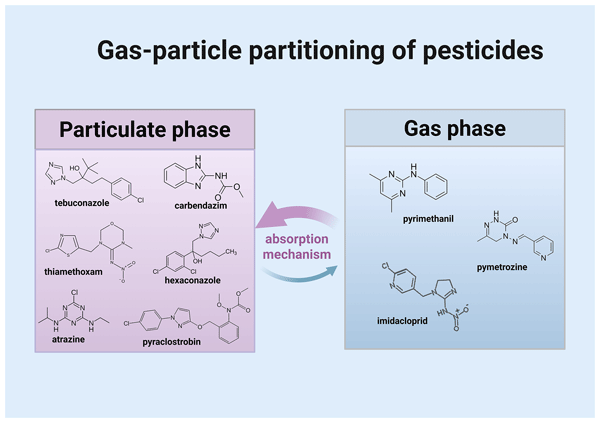
Abstract. Pesticide residues are ubiquitous in the atmosphere in the North China Plain (NCP), with concentrations largely determined by application patterns and physicochemical parameters such as persistence and volatility. However, knowledge of gas-particle partitioning of pesticides remains limited, hindering a comprehensive understanding of their abundance, transport, and health risks. Here, we aim to elucidate the underlying mechanism of gas-particle partitioning for pesticides. In this study, 14 pairs of air and particulate matter samples were collected simultaneously in Quzhou County, the NCP. A total of 19 pesticides were observed in both gas and particulate-phases. Average pesticide concentrations in particulate phase (2025.76 ± 1048.83 pg/m³) were significantly higher than in gas phase (143.38 ± 146.31 pg/m³), accounting for 93.4 % of the total atmospheric pesticide mass. Tebuconazole (662.49 ± 448.52 pg/m³), pyraclostrobin (212.01 ± 119.70 pg/m³), and carbendazim (158.68 ± 86.54 pg/m³) exhibited the highest concentrations in the particulate phase, whereas pyrimethanil (93.00 ± 79.18 pg/m³), pymetrozine (22.96 ± 21.50 pg/m³), and imidacloprid (5.78 ± 2.64 pg/m³) were predominant in the gas phase. A positive correlation between temperature and particulate-phase pesticide concentrations was found, as indicated by rising of logKp values which is likely attributable to an interplay of pesticide physicochemical properties, ambient relative humidity, particle phase state and pesticide use patterns. Gas-particle partitioning model simulations showed absorption as the main mechanism of gas-particle partitioning, indicating atmospheric pesticides are absorbed into the interior organic film of particulate matter.
-
Notice on discussion status
The requested preprint has a corresponding peer-reviewed final revised paper. You are encouraged to refer to the final revised version.
-
Preprint
(1654 KB)
-
Supplement
(1155 KB)
-
The requested preprint has a corresponding peer-reviewed final revised paper. You are encouraged to refer to the final revised version.
- Preprint
(1654 KB) - Metadata XML
-
Supplement
(1155 KB) - BibTeX
- EndNote
- Final revised paper


Journal article(s) based on this preprint
Interactive discussion
Status: closed
- RC1: 'Comment on egusphere-2025-6023', Anonymous Referee #1, 16 Jan 2026
-
RC2: 'Comment on egusphere-2025-6023', Anonymous Referee #2, 19 Jan 2026
The study by Guo et al. simultaneously collected gas- and particle-phase pesticides in the atmosphere at a rural site in the North China Plain (NCP) at weekly intervals from February to May and analyzed the gas-particle partitioning of pesticides. Based on the data from continuously collected gas- and particle-phase samples, the authors explored the distribution profiles of 33 pesticides in the gas and particle phases and then assessed the effects of meteorological factors on pesticide concentrations, and compared the gas-particle partitioning behavior of pesticides using three models, explaining the underlying mechanisms. This study provides valuable new data on the atmospheric fate of pesticides and employs appropriate statistical and modeling tools. The manuscript is generally well organized and written in a professional tone. Below, I offer specific comments to strengthen the work. With these revisions, I believe the paper will be suitable for Atmospheric Chemistry and Physics.
Specific comments:
- Line 63: The phrase “gas-particle partitioning” in the sentence “The conventional Junge-Pankow model attributes particle/gas partitioning” should be consistent with the term “gas-particle partitioning” used throughout the text. Please review all relevant instances in the manuscript.
- Lines 109–115: In this study, a high-vol sampler fitted with PUF and filter was used to collect both gas- and aerosol-phase pesticides. I am wondering which component was positioned upstream in the sampling line—that is, was the PUF fitted first, followed by the filter, or vice versa? This should be clearly specified.
- Lines 112-113: The seven-day integrated sampling period may allow for redistribution or chemical changes on the samplers. It would be helpful to elaborate on how this could bias the gas/particle ratio, perhaps by comparing the results with those from shorter-duration studies.
- Line 169: It would be beneficial to first explain why the Junge-Pankow (J-P) adsorption model, Harner-Bidleman (H-B) Koa absorption model, and L-M-Y model were selected to simulate the gas-particle phase distribution of pesticides, followed by a separate introduction of each model.
- Lines 282-291: The formats of “48.00 pg/m³, 17.70 pg/m³, 7.20 pg/m³, and 7.95 pg/m³” and “21.66, 114.72, 96.19, and 2.17 pg/m³” are inconsistent, please ensure consistent unit formatting for all concentration values throughout the text.
- Line 311: It contains a spelling error: “soi to the atmosphere” should be “soil to the atmosphere”.
- Section 3.4: The authors mention that rising temperature promotes particle-phase concentration, which is counterintuitive since higher temperatures typically drive partitioning toward the gas phase. Although the authors provide some explanation, a more detailed and clearer clarification is needed.
- Section 3.5: All models assume equilibrium; however, field conditions may not be at equilibrium, as the authors note. It would be helpful to clarify how this limitation affects the comparison. For example, the L-M-Y model (non-equilibrium steady state) underestimates φ. Do the authors conclude that equilibrium is more appropriate for this dataset? They suggest that equilibrium conditions were closer than steady state, which is reasonable, but they could further explain why short-range local sources might drive quasi-equilibrium partitioning.
Citation: https://doi.org/10.5194/egusphere-2025-6023-RC2 - AC1: 'Comment on egusphere-2025-6023', Kai Wang, 09 Feb 2026


Interactive discussion
Status: closed
-
RC1: 'Comment on egusphere-2025-6023', Anonymous Referee #1, 16 Jan 2026
This study analyzed the pesticides in the gas and particle phase of air samples collected in the North China Plain and then investigated the gas-particle partitioning of pesticides by applying models, showing absorption as the main mechanism of gas-particle partitioning. Pesticides are a typical class of organic pollutants in the atmosphere, especially in the rural and agricultural production regions. Studying the abundance and gas-particle partitioning of atmospheric pesticides will enhance our understanding of organic pollutants in the atmosphere. The manuscript was well written and fits the scope of ACP. Therefore, I recommend the publication of this manuscript after the following questions are addressed.
Specific comment:
1. Introduction: The author stated that a large amount of pesticides release to atmosphere. However, there is no data presented. I suggest to present the data of concentration of pesticides in the atmosphere.
2. Line 97-106: The author showed the information of the geographical information of Quzhou County. But it did not tell us the amount of pesticides used in this county and the pesticide utilization rate, which is more relevant to this study.
3. Line 132: why these 38 pesticides were selected for the method development?
4. Line 191: The proportions of organic matter used in the model simulations were set to 5%–30%. Although these values were not based on actual measurements, it would be better to provide supporting references. It is recommended to refer to the reported ranges of organic matter content in particulate matter from the literature to strengthen the relevant discussion.
5. Line256-258: “… attributed to its high vapor pressure-second only to propamocarb-facilitating its volatilization…”, this sentence is not clear. Please rephrase it.
6. Line 271-293: The concentration of atmospheric pesticides varied between different sampling dates. I suggest to present the sampling dates of previous studies for a better comparison.
7. Line 311: replace “soi” by “soil”.
8. Figure 2, S1 and S2: Is it possible to mark the date of booting and heading stages of wheat in the figures? Then the readers can clearly see how the pesticides application affect the concentration of atmospheric pesticides.
9. Figure S5: the color refers to the relative humidity during the sampling day? Is it an averaged relative humidity? Please clarify it in the figure caption.
10. Figure 5: It looks busy. I suggest to clarify/improve the figure caption to make it more understandable.
11. Limitation: I suggest to conduct the similar experiment in different seasons in the future, since the gas-particle partitioning of pesticides in the atmosphere is influenced by pesticide application and meteorology.Citation: https://doi.org/10.5194/egusphere-2025-6023-RC1 -
RC2: 'Comment on egusphere-2025-6023', Anonymous Referee #2, 19 Jan 2026
The study by Guo et al. simultaneously collected gas- and particle-phase pesticides in the atmosphere at a rural site in the North China Plain (NCP) at weekly intervals from February to May and analyzed the gas-particle partitioning of pesticides. Based on the data from continuously collected gas- and particle-phase samples, the authors explored the distribution profiles of 33 pesticides in the gas and particle phases and then assessed the effects of meteorological factors on pesticide concentrations, and compared the gas-particle partitioning behavior of pesticides using three models, explaining the underlying mechanisms. This study provides valuable new data on the atmospheric fate of pesticides and employs appropriate statistical and modeling tools. The manuscript is generally well organized and written in a professional tone. Below, I offer specific comments to strengthen the work. With these revisions, I believe the paper will be suitable for Atmospheric Chemistry and Physics.
Specific comments:
- Line 63: The phrase “gas-particle partitioning” in the sentence “The conventional Junge-Pankow model attributes particle/gas partitioning” should be consistent with the term “gas-particle partitioning” used throughout the text. Please review all relevant instances in the manuscript.
- Lines 109–115: In this study, a high-vol sampler fitted with PUF and filter was used to collect both gas- and aerosol-phase pesticides. I am wondering which component was positioned upstream in the sampling line—that is, was the PUF fitted first, followed by the filter, or vice versa? This should be clearly specified.
- Lines 112-113: The seven-day integrated sampling period may allow for redistribution or chemical changes on the samplers. It would be helpful to elaborate on how this could bias the gas/particle ratio, perhaps by comparing the results with those from shorter-duration studies.
- Line 169: It would be beneficial to first explain why the Junge-Pankow (J-P) adsorption model, Harner-Bidleman (H-B) Koa absorption model, and L-M-Y model were selected to simulate the gas-particle phase distribution of pesticides, followed by a separate introduction of each model.
- Lines 282-291: The formats of “48.00 pg/m³, 17.70 pg/m³, 7.20 pg/m³, and 7.95 pg/m³” and “21.66, 114.72, 96.19, and 2.17 pg/m³” are inconsistent, please ensure consistent unit formatting for all concentration values throughout the text.
- Line 311: It contains a spelling error: “soi to the atmosphere” should be “soil to the atmosphere”.
- Section 3.4: The authors mention that rising temperature promotes particle-phase concentration, which is counterintuitive since higher temperatures typically drive partitioning toward the gas phase. Although the authors provide some explanation, a more detailed and clearer clarification is needed.
- Section 3.5: All models assume equilibrium; however, field conditions may not be at equilibrium, as the authors note. It would be helpful to clarify how this limitation affects the comparison. For example, the L-M-Y model (non-equilibrium steady state) underestimates φ. Do the authors conclude that equilibrium is more appropriate for this dataset? They suggest that equilibrium conditions were closer than steady state, which is reasonable, but they could further explain why short-range local sources might drive quasi-equilibrium partitioning.
Citation: https://doi.org/10.5194/egusphere-2025-6023-RC2 - AC1: 'Comment on egusphere-2025-6023', Kai Wang, 09 Feb 2026
Peer review completion
Journal article(s) based on this preprint
Viewed
| HTML | XML | Total | Supplement | BibTeX | EndNote | |
|---|---|---|---|---|---|---|
| 307 | 150 | 24 | 481 | 48 | 42 | 35 |
- HTML: 307
- PDF: 150
- XML: 24
- Total: 481
- Supplement: 48
- BibTeX: 42
- EndNote: 35
Viewed (geographical distribution)
| Country | # | Views | % |
|---|
| Total: | 0 |
| HTML: | 0 |
| PDF: | 0 |
| XML: | 0 |
- 1
Liping Guo
Shuping Shi
Martin Brüggemann
Mingyu Zhao
Hongyu Mu
Daniel M. Figueiredo
Junxue Wu
The requested preprint has a corresponding peer-reviewed final revised paper. You are encouraged to refer to the final revised version.
- Preprint
(1654 KB) - Metadata XML
-
Supplement
(1155 KB) - BibTeX
- EndNote
- Final revised paper
This study analyzed the pesticides in the gas and particle phase of air samples collected in the North China Plain and then investigated the gas-particle partitioning of pesticides by applying models, showing absorption as the main mechanism of gas-particle partitioning. Pesticides are a typical class of organic pollutants in the atmosphere, especially in the rural and agricultural production regions. Studying the abundance and gas-particle partitioning of atmospheric pesticides will enhance our understanding of organic pollutants in the atmosphere. The manuscript was well written and fits the scope of ACP. Therefore, I recommend the publication of this manuscript after the following questions are addressed.
Specific comment:
1. Introduction: The author stated that a large amount of pesticides release to atmosphere. However, there is no data presented. I suggest to present the data of concentration of pesticides in the atmosphere.
2. Line 97-106: The author showed the information of the geographical information of Quzhou County. But it did not tell us the amount of pesticides used in this county and the pesticide utilization rate, which is more relevant to this study.
3. Line 132: why these 38 pesticides were selected for the method development?
4. Line 191: The proportions of organic matter used in the model simulations were set to 5%–30%. Although these values were not based on actual measurements, it would be better to provide supporting references. It is recommended to refer to the reported ranges of organic matter content in particulate matter from the literature to strengthen the relevant discussion.
5. Line256-258: “… attributed to its high vapor pressure-second only to propamocarb-facilitating its volatilization…”, this sentence is not clear. Please rephrase it.
6. Line 271-293: The concentration of atmospheric pesticides varied between different sampling dates. I suggest to present the sampling dates of previous studies for a better comparison.
7. Line 311: replace “soi” by “soil”.
8. Figure 2, S1 and S2: Is it possible to mark the date of booting and heading stages of wheat in the figures? Then the readers can clearly see how the pesticides application affect the concentration of atmospheric pesticides.
9. Figure S5: the color refers to the relative humidity during the sampling day? Is it an averaged relative humidity? Please clarify it in the figure caption.
10. Figure 5: It looks busy. I suggest to clarify/improve the figure caption to make it more understandable.
11. Limitation: I suggest to conduct the similar experiment in different seasons in the future, since the gas-particle partitioning of pesticides in the atmosphere is influenced by pesticide application and meteorology.