
the Creative Commons Attribution 4.0 License.
the Creative Commons Attribution 4.0 License.
 | 23 Dec 2025
Updated global and regional trends of stratospheric ozone profiles
Abstract. We present an updated evaluation of stratospheric ozone profile trends in the 60°S–60°N latitude range using long-term ground-based and satellite climate data records, as well as simulations by chemistry-climate models. The trends are evaluated using the LOTUS (Long-term Ozone Trends and Uncertainties in the Stratosphere) regression model.
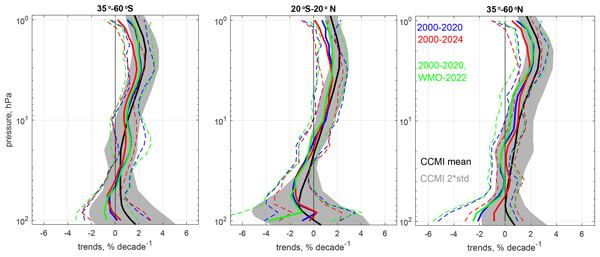
Analyses of satellite data confirm statistically significant positive ozone trends in the period 2000–2024 in the upper stratosphere of ~1–3% decade-1, with larger trends at mid-latitudes compared to the tropics. The trends are slightly positive or close to zero in the middle stratosphere, and mostly negative, −1–2% decade-1, in the lower stratosphere; but they are not statistically significant. The ozone trends are similar to previous analyses (2000–2020 trends).
Ozone trends in 2000–2024 predicted by climate model simulations are in good agreement with combined satellite trends. In the upper stratosphere, models predict a slightly stronger ozone recovery than observations. In the lower stratosphere, both models and satellite observations report negative trends of in the tropics, while modelled ozone trends are slightly positive at mid-latitudes.
Ozone profile trends over several stations estimated from ground-based records capture the same overall vertical pattern of ozone trends as merged gridded satellite datasets.
Analyses of regional ozone trends in 2003–2024 using merged satellite datasets confirmed the previous observations of a longitudinal structure in ozone trends in the NH mid-latitude stratosphere, with positive trends over Scandinavia and negative trends over Siberia. However, the magnitude of this dipole-like structure is reduced compared to previous analyses.
-
Notice on discussion status
The requested preprint has a corresponding peer-reviewed final revised paper. You are encouraged to refer to the final revised version.
-
Preprint
(1776 KB)
-
Supplement
(862 KB)
-
The requested preprint has a corresponding peer-reviewed final revised paper. You are encouraged to refer to the final revised version.
- Preprint
(1776 KB) - Metadata XML
-
Supplement
(862 KB) - BibTeX
- EndNote
- Final revised paper


Journal article(s) based on this preprint
Interactive discussion
Status: closed
-
RC1: 'Comment on egusphere-2025-5963', Anonymous Referee #1, 23 Jan 2026
- AC2: 'Reply on RC1', Viktoria Sofieva, 30 Mar 2026
-
RC2: 'Comment on egusphere-2025-5963', Anonymous Referee #2, 31 Jan 2026
- AC1: 'Reply on RC2', Viktoria Sofieva, 30 Mar 2026
-
RC3: 'Comment on egusphere-2025-5963', Anonymous Referee #3, 01 Feb 2026
Review of Viktoria F. Sofieva et al., Updated global and regional trends of stratospheric ozone profiles
Overview
This is an important paper on a fundamental topic of atmospheric science, namely determining changes in vertically-resolved stratospheric ozone over the satellite era, based primarily on combining long-term satellite observations, but also with some long-term ground-based observations.
The manuscript is clearly and carefully written and the methods well developed, following on from a long line of previous work, and I expect extensive use will be made of it in the next Ozone Assessment. The methods employed are not necessarily the best or the final word of course, but are all readily defensible and represent the current community standard approach.
I have no hesitation in recommending publication in ACP, once the general comments below have been addressed.
General comments
The manuscript is clearly and carefully written and I have very few minor comments at all, but do have some overall comments to make.
The current work is clearly, and is stated to be, a follow-up to previous LOTUS work, but is also a direct descendant of the preceding work in Harris et al. 2015 and Steinbrecht et al. 2017 (and these papers should be cited), and I would say goes back to Harris et al. 1998.
The authors therefore have apparently made a decision to reduce the scope to that of an update. This is quite understandable but in one or two places I think some things have been missed that needed to have been included (if only briefly). In my view the paper does need to be able to stand alone to some extent. It certainly doesn't need to repeat everything from previous work but the fundamental points should be covered.
The first example is the lack of discussion of the decision made by the LOTUS team not to include one or more proxies to represent the strength of the Brewer-Dobson circulation in the regression. This is an idiosyncratic choice because such a term is usually considered very important if the overall goal is to assess how ozone has changed due to chemical changes. If the goal is just to see how ozone has changed then you don't need any proxies at all of course. The QBO, ENSO and Solar Cycle terms will approximately even out over a long time period (although I note they are not shown in the current work) in contrast to circulation changes which potentially have a major influence on trends. To be clear I am not requesting that the analysis be re-performed with dynamical proxies but I do think there needs to be some discussion of this fundamental point of why they were not included, as it is closely tied to the purpose of the trend analysis, that is, what exactly are you trying to show?
Secondly there doesn't seem to be any indication given of how well the regression model performs. This is particularly pertinent with the recent unusual ozone years in both the northern and southern mid-latitudes. I would expect the QBO and ENSO proxies would have very different effects at different latitudes and altitudes but this is not represented anywhere. Previously (eg the supplement for Godin-Beekmann et al. 2022) the pre-1997 trends were shown in the latitude-height plane which is an important indication of the usefulness of the whole approach. One thing very helpful about the Weber et al. 2022 style of presentation for total ozone is that the reader can see at a glance how well the regression model has performed over the whole period and can visually assess the significance of the post 2000 trends in the different latitude ranges. This is a lot simpler to do for total ozone of course, but you could do it for a small number of selected height and latitude ranges. This would be very interesting for the NH lower stratosphere, for instance.
Thirdly, table 1 lists no less than ten different merged satellite datasets (only eight are shown in figures 1 and 2) but I can't find any discussion of what the scientific value really is in having different groups create these merged datasets from different combinations of the same set of instruments. You should give the reader some brief indication of why this is worth doing. In lines 233-235 it is stated that two of these datasets give noticeably larger trends in the northern hemisphere upper stratosphere than the others, and in lines 275-277 you also say there are some differences in the southern hemisphere middle stratosphere. It would be important to investigate these further but I can understand that you might consider it to be out of scope for the present work.
The discussion of the longitudinally resolved trends (in particular over the Antarctic) and the comparisons of ground-based instruments are also treated fairly cursorily, and I hope will be further investigated in more detail in other work. There is a statement (line 363) that discrepancies between the instruments at Lauder is greater than at the other two ground-based locations, but there has been some recent work specifically done on this topic motivated by SG 2022 which you don't consider or cite (Björklund et al. 2024 , Zhang et al. 2024 ).
These comments will all be quick and easy to address.
I think the set-up of the trends with the flat "gap" period in the regression model is very appropriate, and should lead to realistic fittings of the proxy terms (that is, it will give better results than trying to fit ozone to a V-shape).
Figures 3b and 3c are excellent, for many readers these will really be the key findings, especially that the southern hemisphere stratospheric ozone column shows a positive trend all the way from 20° S to 60° S.
Including the previous results in Figure 5 is very helpful for those interested in how the new results differ from the old ones, such as for the Ozone Assessment, along with the discussion in lines 239 to 260 and the supplement.
I was also very pleased to see Figure 7 with the representation of latitude dependent changes.
Specific comments
Line 41 "good agreement". I am not sure this is a justifiable statement but perhaps it is. There are some important differences between the model trends and the observations and the uncertainty ranges for both observations and models are still frustratingly large.
Line 84 "new datasets have become available" – explain what this means (new instruments, newly reprocessed versions of the data, new combinations of data, etc)?
Lines 1-89 Somewhere in here you should mention the previous work on vertically resolved trends (at a minimum: Harris et al. 1998, Harris et al. 2015 , Steinbrecht et al. 2017).
Table 1 – I am not sure saying "present" is the best way to express this. For one thing, this paper will be published in 2026 but the datasets are only analyzed up to 2024. Secondly, people reading the paper in future years would probably prefer to know the actual year that was included.
Table 2 Isn't there also an ozone Lidar at Lauder?
Lines 115-132 There is no discussion of ozonesondes here even though we know the homogenization is a major issue and a lot of work has been done. (I suspect this might have been an accident).
Line 135 Should "CCMI" be "CCMI-2022"? I am a little bit confused on this point because I wasn't clear if you were using the newer model runs.
Line 139 "newly developed" - is this old text copied from an old document?
Line 148 "a reference model dataset for comparison with observations" – this is what you're doing in the current work, isn't it? You should say that. Has there been other work to assess the models against observations?
Lines 149-150 This is an important point, to list what has changed since GB22, however I think you need a few more words to flesh out each of the four items listed.
Line 164 – were the other datasets deseasonalized with respect to 1998-2008 as well?
Equation 1 – I don't understand why the beta terms are said to be a function of time? Wouldn't they be a function of height and latitude but not time?
Lines 222-223 "the uncertainties calculated with error propagation" – please clarify this statement
Line 341 "CCMI" – again this should be "CCMI 2022", shouldn't it be?
Lines 361-362 Unfortunately, for me this statement "opens a can of worms". If the sampling is different, and that difference affects the trends, then doesn't that mean this comparison shouldn't be done at all unless the sampling effects are investigated and taken into account in some way? (Eg by using satellite data only on the day of each ozonesonde flight).
Line 363 As mentioned above, you should at least mention Björklund et al. 2024 and Zhang et al. 2024 here.
Lines 376-377 Isn't the agreement better at the European sites because multiple records have been combined (2 or 3 of everything) over dispersed locations and so smoothed out rather than one each at single points?
Line 419 In the figure I can only see a negative trend in SCIAMACHY-OMPS, not "especially".
Minor comments
Line 88 "… the climate models" replace with "coupled climate chemistry models"
Line 104 Improve the wording of "(But Aura MLS v4 …) "
Line 110 "is done" – replace with "was found by" or similar words.
Line 157 Insert "and" before "stratospheric"
Line 188 Delete "the" before "zenith sky".
Line 232 Replace "they are" with "which are"
Line 236 Insert "the" before "majority"
Line 237 Insert "the" before "uncertainties"
Line 399 Insert "the" or "these" before "aforementioned"
Line 401 Insert "the" before "shorter"
Line 402 Insert "of" after "poleward"
Line 404 Insert "the" before "2003-2018".
References
Björklund, R., Vigouroux, C., Effertz, P., García, O. E., Geddes, A., Hannigan, J., Miyagawa, K., Kotkamp, M., Langerock, B., Nedoluha, G., Ortega, I., Petropavlovskikh, I., Poyraz, D., Querel, R., Robinson, J., Shiona, H., Smale, D., Smale, P., Van Malderen, R., and De Mazière, M.: Intercomparison of long-term ground-based measurements of total, tropospheric, and stratospheric ozone at Lauder, New Zealand, Atmos. Meas. Tech., 17, 6819–6849, https://doi.org/10.5194/amt-17-6819-2024, 2024.
Harris, N. R. P., Hudson, R., and Phillips, C. (Eds.): Assessment of trends in the vertical distribution of ozone, Stratospheric Processes and Their Role in Climate/International Ozone Commission/Global Atmospheric Watch (SPARC/IO3C/ GAW) Report 1, World Meteorol. Organ. Ozone Res. and Monit. Proj. Rep. 43, 289 pp., Geneva, 1998.
Harris, N. R. P., Hassler, B., Tummon, F., Bodeker, G. E., Hubert, D., Petropavlovskikh, I., Steinbrecht, W., Anderson, J., Bhartia, P. K., Boone, C. D., Bourassa, A., Davis, S. M., Degenstein, D., Delcloo, A., Frith, S. M., Froidevaux, L., Godin-Beekmann, S., Jones, N., Kurylo, M. J., Kyrölä, E., Laine, M., Leblanc, S. T., Lambert, J.-C., Liley, B., Mahieu, E., Maycock, A., de Mazière, M., Parrish, A., Querel, R., Rosenlof, K. H., Roth, C., Sioris, C., Staehelin, J., Stolarski, R. S., Stübi, R., Tamminen, J., Vigouroux, C., Walker, K. A., Wang, H. J., Wild, J., and Zawodny, J. M.: Past changes in the vertical distribution of ozone – Part 3: Analysis and interpretation of trends, Atmos. Chem. Phys., 15, 9965–9982, https://doi.org/10.5194/acp-15-9965-2015, 2015.
Steinbrecht, W., Froidevaux, L., Fuller, R., Wang, R., Anderson, J., Roth, C., Bourassa, A., Degenstein, D., Damadeo, R., Zawodny, J., Frith, S., McPeters, R., Bhartia, P., Wild, J., Long, C., Davis, S., Rosenlof, K., Sofieva, V., Walker, K., Rahpoe, N., Rozanov, A., Weber, M., Laeng, A., von Clarmann, T., Stiller, G., Kramarova, N., Godin-Beekmann, S., Leblanc, T., Querel, R., Swart, D., Boyd, I., Hocke, K., Kämpfer, N., Maillard Barras, E., Moreira, L., Nedoluha, G., Vigouroux, C., Blumenstock, T., Schneider, M., García, O., Jones, N., Mahieu, E., Smale, D., Kotkamp, M., Robinson, J., Petropavlovskikh, I., Harris, N., Hassler, B., Hubert, D., and Tummon, F.: An update on ozone profile trends for the period 2000 to 2016, Atmos. Chem. Phys., 17, 10675–10690, https://doi.org/10.5194/acp-17-10675-2017, 2017.
Zeng, G., Querel, R., Shiona, H., Poyraz, D., Van Malderen, R., Geddes, A., Smale, P., Smale, D., Robinson, J., and Morgenstern, O.: Analysis of a newly homogenised ozonesonde dataset from Lauder, New Zealand, Atmos. Chem. Phys., 24, 6413–6432, https://doi.org/10.5194/acp-24-6413-2024, 2024.
Citation: https://doi.org/10.5194/egusphere-2025-5963-RC3 - AC3: 'Reply on RC3', Viktoria Sofieva, 31 Mar 2026
Peer review completion


Interactive discussion
Status: closed
-
RC1: 'Comment on egusphere-2025-5963', Anonymous Referee #1, 23 Jan 2026
Review of “Updated global and regional trends of stratospheric ozone profiles” by Sofieva et al. (2026)
General Comments:
This study presents updated analysis of global ozone trends based on the collection of comprehensive measurements data, merged datasets and chemistry-climate model outputs in detail. The analyses were done carefully, and the results were produced based on robust statistical techniques. I believe the information presented in this work will be used widely within a broad scientific community. However, I think it would be even more useful if information about scientific contexts to the ozone changes are also included throughout this work. For instance, would atmospheric phenomena, such as large volcanic eruptions or wildfires, affect the ozone trends between 2020-2024? Was the ozone trend expected to be consistent between 2000-2020 and 2000-2024? What are the physical processes controlling the ozone trend in the upper/mid stratosphere and troposphere? What are the expectations for the ozone trends in the future? I think adding some of the scientific backgrounds of ozone trends would make this work even more valuable.
Specific Comments:
P2, Abstract: Adding some comments about the significance of this work in the context of the importance of long-term measurements of ozone, impact on climate, and potential improvements of atmospheric processes represented in global models would make the abstract more compelling.
P2, L55: Antarctic ozone hole (Farman et al., 1985).
P2, L56: References should be chronologically ordered. (?)
P2, L57-60: Consider including citations supporting the information listed here.
P2, L63: ‘Progressing’ is vague. I recommend replacing it with a bit more quantitative statement.
P3, L80: In addition to updating the ozone trends, adding some context in terms of changes in the atmospheric circulation since the last publication would be desirable. For instance, did the Hunga-Tonga eruption play any role in ozone trends?
P3, L84: Adding some examples of the new datasets or citations would be helpful.
P4, L101: Reference for the OMPS-LP would be useful.
P4, Table 1: I wonder why a reference for the SBUV-COH is not listed here.
P5, L117: Is there a reference for this information?
P6, Table 2: Is there a website where one can download the ‘Alpine’ ground-based ozone profiles?
P7, L136: data -> outputs
P7, L149: Compared to GB22... -> This sentence is vague. Please add more information, such as, how the GHG and ozone scenarios have changed? Is aerosol forcing only included in the refD2?
P8, L180: Was the 1985-2024 period also used for the ground-based observations?
P10, L221: Does this mean 8 models and one ensemble mean?
P11, L233-235: What could be the reason for the differences in trends diagnosed from these two datasets? Are these consistent with the previous results?
P11, L241: There could be some contributions from changes in atmospheric circulation or events that could have impacted ozone in the stratosphere.
P11, L248: “changes in…” – Describe what this means or include a citation here.
P12, L276: “vary across the datasets,” – What could be the possible reason for this?
P16, L342: Can we explain why the CCMI models can reproduce the observed ozone trends in general?
P18, L402: A strong…observed. –>A strong…in the NH extratropics (at latitudes…) and below 40 km is observed.
P20, L449: Please add a sentence explaining why trends are unchanged in the tropics and SH mid-latitudes but became less negative in NH mid-latitudes.
P21, L464: Please add some information about the importance of the ozone measurements network, comprehensive analyses of the data, and perspective of ozone changes in the future.
Citation: https://doi.org/10.5194/egusphere-2025-5963-RC1 - AC2: 'Reply on RC1', Viktoria Sofieva, 30 Mar 2026
-
RC2: 'Comment on egusphere-2025-5963', Anonymous Referee #2, 31 Jan 2026
- AC1: 'Reply on RC2', Viktoria Sofieva, 30 Mar 2026
-
RC3: 'Comment on egusphere-2025-5963', Anonymous Referee #3, 01 Feb 2026
Review of Viktoria F. Sofieva et al., Updated global and regional trends of stratospheric ozone profiles
Overview
This is an important paper on a fundamental topic of atmospheric science, namely determining changes in vertically-resolved stratospheric ozone over the satellite era, based primarily on combining long-term satellite observations, but also with some long-term ground-based observations.
The manuscript is clearly and carefully written and the methods well developed, following on from a long line of previous work, and I expect extensive use will be made of it in the next Ozone Assessment. The methods employed are not necessarily the best or the final word of course, but are all readily defensible and represent the current community standard approach.
I have no hesitation in recommending publication in ACP, once the general comments below have been addressed.
General comments
The manuscript is clearly and carefully written and I have very few minor comments at all, but do have some overall comments to make.
The current work is clearly, and is stated to be, a follow-up to previous LOTUS work, but is also a direct descendant of the preceding work in Harris et al. 2015 and Steinbrecht et al. 2017 (and these papers should be cited), and I would say goes back to Harris et al. 1998.
The authors therefore have apparently made a decision to reduce the scope to that of an update. This is quite understandable but in one or two places I think some things have been missed that needed to have been included (if only briefly). In my view the paper does need to be able to stand alone to some extent. It certainly doesn't need to repeat everything from previous work but the fundamental points should be covered.
The first example is the lack of discussion of the decision made by the LOTUS team not to include one or more proxies to represent the strength of the Brewer-Dobson circulation in the regression. This is an idiosyncratic choice because such a term is usually considered very important if the overall goal is to assess how ozone has changed due to chemical changes. If the goal is just to see how ozone has changed then you don't need any proxies at all of course. The QBO, ENSO and Solar Cycle terms will approximately even out over a long time period (although I note they are not shown in the current work) in contrast to circulation changes which potentially have a major influence on trends. To be clear I am not requesting that the analysis be re-performed with dynamical proxies but I do think there needs to be some discussion of this fundamental point of why they were not included, as it is closely tied to the purpose of the trend analysis, that is, what exactly are you trying to show?
Secondly there doesn't seem to be any indication given of how well the regression model performs. This is particularly pertinent with the recent unusual ozone years in both the northern and southern mid-latitudes. I would expect the QBO and ENSO proxies would have very different effects at different latitudes and altitudes but this is not represented anywhere. Previously (eg the supplement for Godin-Beekmann et al. 2022) the pre-1997 trends were shown in the latitude-height plane which is an important indication of the usefulness of the whole approach. One thing very helpful about the Weber et al. 2022 style of presentation for total ozone is that the reader can see at a glance how well the regression model has performed over the whole period and can visually assess the significance of the post 2000 trends in the different latitude ranges. This is a lot simpler to do for total ozone of course, but you could do it for a small number of selected height and latitude ranges. This would be very interesting for the NH lower stratosphere, for instance.
Thirdly, table 1 lists no less than ten different merged satellite datasets (only eight are shown in figures 1 and 2) but I can't find any discussion of what the scientific value really is in having different groups create these merged datasets from different combinations of the same set of instruments. You should give the reader some brief indication of why this is worth doing. In lines 233-235 it is stated that two of these datasets give noticeably larger trends in the northern hemisphere upper stratosphere than the others, and in lines 275-277 you also say there are some differences in the southern hemisphere middle stratosphere. It would be important to investigate these further but I can understand that you might consider it to be out of scope for the present work.
The discussion of the longitudinally resolved trends (in particular over the Antarctic) and the comparisons of ground-based instruments are also treated fairly cursorily, and I hope will be further investigated in more detail in other work. There is a statement (line 363) that discrepancies between the instruments at Lauder is greater than at the other two ground-based locations, but there has been some recent work specifically done on this topic motivated by SG 2022 which you don't consider or cite (Björklund et al. 2024 , Zhang et al. 2024 ).
These comments will all be quick and easy to address.
I think the set-up of the trends with the flat "gap" period in the regression model is very appropriate, and should lead to realistic fittings of the proxy terms (that is, it will give better results than trying to fit ozone to a V-shape).
Figures 3b and 3c are excellent, for many readers these will really be the key findings, especially that the southern hemisphere stratospheric ozone column shows a positive trend all the way from 20° S to 60° S.
Including the previous results in Figure 5 is very helpful for those interested in how the new results differ from the old ones, such as for the Ozone Assessment, along with the discussion in lines 239 to 260 and the supplement.
I was also very pleased to see Figure 7 with the representation of latitude dependent changes.
Specific comments
Line 41 "good agreement". I am not sure this is a justifiable statement but perhaps it is. There are some important differences between the model trends and the observations and the uncertainty ranges for both observations and models are still frustratingly large.
Line 84 "new datasets have become available" – explain what this means (new instruments, newly reprocessed versions of the data, new combinations of data, etc)?
Lines 1-89 Somewhere in here you should mention the previous work on vertically resolved trends (at a minimum: Harris et al. 1998, Harris et al. 2015 , Steinbrecht et al. 2017).
Table 1 – I am not sure saying "present" is the best way to express this. For one thing, this paper will be published in 2026 but the datasets are only analyzed up to 2024. Secondly, people reading the paper in future years would probably prefer to know the actual year that was included.
Table 2 Isn't there also an ozone Lidar at Lauder?
Lines 115-132 There is no discussion of ozonesondes here even though we know the homogenization is a major issue and a lot of work has been done. (I suspect this might have been an accident).
Line 135 Should "CCMI" be "CCMI-2022"? I am a little bit confused on this point because I wasn't clear if you were using the newer model runs.
Line 139 "newly developed" - is this old text copied from an old document?
Line 148 "a reference model dataset for comparison with observations" – this is what you're doing in the current work, isn't it? You should say that. Has there been other work to assess the models against observations?
Lines 149-150 This is an important point, to list what has changed since GB22, however I think you need a few more words to flesh out each of the four items listed.
Line 164 – were the other datasets deseasonalized with respect to 1998-2008 as well?
Equation 1 – I don't understand why the beta terms are said to be a function of time? Wouldn't they be a function of height and latitude but not time?
Lines 222-223 "the uncertainties calculated with error propagation" – please clarify this statement
Line 341 "CCMI" – again this should be "CCMI 2022", shouldn't it be?
Lines 361-362 Unfortunately, for me this statement "opens a can of worms". If the sampling is different, and that difference affects the trends, then doesn't that mean this comparison shouldn't be done at all unless the sampling effects are investigated and taken into account in some way? (Eg by using satellite data only on the day of each ozonesonde flight).
Line 363 As mentioned above, you should at least mention Björklund et al. 2024 and Zhang et al. 2024 here.
Lines 376-377 Isn't the agreement better at the European sites because multiple records have been combined (2 or 3 of everything) over dispersed locations and so smoothed out rather than one each at single points?
Line 419 In the figure I can only see a negative trend in SCIAMACHY-OMPS, not "especially".
Minor comments
Line 88 "… the climate models" replace with "coupled climate chemistry models"
Line 104 Improve the wording of "(But Aura MLS v4 …) "
Line 110 "is done" – replace with "was found by" or similar words.
Line 157 Insert "and" before "stratospheric"
Line 188 Delete "the" before "zenith sky".
Line 232 Replace "they are" with "which are"
Line 236 Insert "the" before "majority"
Line 237 Insert "the" before "uncertainties"
Line 399 Insert "the" or "these" before "aforementioned"
Line 401 Insert "the" before "shorter"
Line 402 Insert "of" after "poleward"
Line 404 Insert "the" before "2003-2018".
References
Björklund, R., Vigouroux, C., Effertz, P., García, O. E., Geddes, A., Hannigan, J., Miyagawa, K., Kotkamp, M., Langerock, B., Nedoluha, G., Ortega, I., Petropavlovskikh, I., Poyraz, D., Querel, R., Robinson, J., Shiona, H., Smale, D., Smale, P., Van Malderen, R., and De Mazière, M.: Intercomparison of long-term ground-based measurements of total, tropospheric, and stratospheric ozone at Lauder, New Zealand, Atmos. Meas. Tech., 17, 6819–6849, https://doi.org/10.5194/amt-17-6819-2024, 2024.
Harris, N. R. P., Hudson, R., and Phillips, C. (Eds.): Assessment of trends in the vertical distribution of ozone, Stratospheric Processes and Their Role in Climate/International Ozone Commission/Global Atmospheric Watch (SPARC/IO3C/ GAW) Report 1, World Meteorol. Organ. Ozone Res. and Monit. Proj. Rep. 43, 289 pp., Geneva, 1998.
Harris, N. R. P., Hassler, B., Tummon, F., Bodeker, G. E., Hubert, D., Petropavlovskikh, I., Steinbrecht, W., Anderson, J., Bhartia, P. K., Boone, C. D., Bourassa, A., Davis, S. M., Degenstein, D., Delcloo, A., Frith, S. M., Froidevaux, L., Godin-Beekmann, S., Jones, N., Kurylo, M. J., Kyrölä, E., Laine, M., Leblanc, S. T., Lambert, J.-C., Liley, B., Mahieu, E., Maycock, A., de Mazière, M., Parrish, A., Querel, R., Rosenlof, K. H., Roth, C., Sioris, C., Staehelin, J., Stolarski, R. S., Stübi, R., Tamminen, J., Vigouroux, C., Walker, K. A., Wang, H. J., Wild, J., and Zawodny, J. M.: Past changes in the vertical distribution of ozone – Part 3: Analysis and interpretation of trends, Atmos. Chem. Phys., 15, 9965–9982, https://doi.org/10.5194/acp-15-9965-2015, 2015.
Steinbrecht, W., Froidevaux, L., Fuller, R., Wang, R., Anderson, J., Roth, C., Bourassa, A., Degenstein, D., Damadeo, R., Zawodny, J., Frith, S., McPeters, R., Bhartia, P., Wild, J., Long, C., Davis, S., Rosenlof, K., Sofieva, V., Walker, K., Rahpoe, N., Rozanov, A., Weber, M., Laeng, A., von Clarmann, T., Stiller, G., Kramarova, N., Godin-Beekmann, S., Leblanc, T., Querel, R., Swart, D., Boyd, I., Hocke, K., Kämpfer, N., Maillard Barras, E., Moreira, L., Nedoluha, G., Vigouroux, C., Blumenstock, T., Schneider, M., García, O., Jones, N., Mahieu, E., Smale, D., Kotkamp, M., Robinson, J., Petropavlovskikh, I., Harris, N., Hassler, B., Hubert, D., and Tummon, F.: An update on ozone profile trends for the period 2000 to 2016, Atmos. Chem. Phys., 17, 10675–10690, https://doi.org/10.5194/acp-17-10675-2017, 2017.
Zeng, G., Querel, R., Shiona, H., Poyraz, D., Van Malderen, R., Geddes, A., Smale, P., Smale, D., Robinson, J., and Morgenstern, O.: Analysis of a newly homogenised ozonesonde dataset from Lauder, New Zealand, Atmos. Chem. Phys., 24, 6413–6432, https://doi.org/10.5194/acp-24-6413-2024, 2024.
Citation: https://doi.org/10.5194/egusphere-2025-5963-RC3 - AC3: 'Reply on RC3', Viktoria Sofieva, 31 Mar 2026
Peer review completion
Journal article(s) based on this preprint
Viewed
| HTML | XML | Total | Supplement | BibTeX | EndNote | |
|---|---|---|---|---|---|---|
| 2,709 | 985 | 217 | 3,911 | 368 | 285 | 297 |
- HTML: 2,709
- PDF: 985
- XML: 217
- Total: 3,911
- Supplement: 368
- BibTeX: 285
- EndNote: 297
Viewed (geographical distribution)
| Country | # | Views | % |
|---|
| Total: | 0 |
| HTML: | 0 |
| PDF: | 0 |
| XML: | 0 |
- 1
Viktoria F. Sofieva

Monika E. Szelag
Natalia Kramarova
Robert Damadeo
Wolfgang Steinbrecht
Irina Petropavlovskikh
Corinne Vigouroux
Eliane Maillard Barras
Daniel Zawada
Kleareti Tourpali
Stacey M. Frith
Jeannette D. Wild
Sean M. Davis
Carlo Arosio
Mark Weber
Alexei Rozanov
Brian Auffarth
Lucien Froidevaux
Ryan Fuller
Doug Degenstein
Kimberlee Dube
Peter Effertz
Thierry Leblanc
Gérard Ancellet
Sophie Godin-Beekmann
Glen McConville
Richard Querel
Dan Smale
Marie-Renee DeBacker
Emmanuel Mahieu
Ralf Sussmann
The requested preprint has a corresponding peer-reviewed final revised paper. You are encouraged to refer to the final revised version.
- Preprint
(1776 KB) - Metadata XML
-
Supplement
(862 KB) - BibTeX
- EndNote
- Final revised paper
Review of “Updated global and regional trends of stratospheric ozone profiles” by Sofieva et al. (2026)
General Comments:
This study presents updated analysis of global ozone trends based on the collection of comprehensive measurements data, merged datasets and chemistry-climate model outputs in detail. The analyses were done carefully, and the results were produced based on robust statistical techniques. I believe the information presented in this work will be used widely within a broad scientific community. However, I think it would be even more useful if information about scientific contexts to the ozone changes are also included throughout this work. For instance, would atmospheric phenomena, such as large volcanic eruptions or wildfires, affect the ozone trends between 2020-2024? Was the ozone trend expected to be consistent between 2000-2020 and 2000-2024? What are the physical processes controlling the ozone trend in the upper/mid stratosphere and troposphere? What are the expectations for the ozone trends in the future? I think adding some of the scientific backgrounds of ozone trends would make this work even more valuable.
Specific Comments:
P2, Abstract: Adding some comments about the significance of this work in the context of the importance of long-term measurements of ozone, impact on climate, and potential improvements of atmospheric processes represented in global models would make the abstract more compelling.
P2, L55: Antarctic ozone hole (Farman et al., 1985).
P2, L56: References should be chronologically ordered. (?)
P2, L57-60: Consider including citations supporting the information listed here.
P2, L63: ‘Progressing’ is vague. I recommend replacing it with a bit more quantitative statement.
P3, L80: In addition to updating the ozone trends, adding some context in terms of changes in the atmospheric circulation since the last publication would be desirable. For instance, did the Hunga-Tonga eruption play any role in ozone trends?
P3, L84: Adding some examples of the new datasets or citations would be helpful.
P4, L101: Reference for the OMPS-LP would be useful.
P4, Table 1: I wonder why a reference for the SBUV-COH is not listed here.
P5, L117: Is there a reference for this information?
P6, Table 2: Is there a website where one can download the ‘Alpine’ ground-based ozone profiles?
P7, L136: data -> outputs
P7, L149: Compared to GB22... -> This sentence is vague. Please add more information, such as, how the GHG and ozone scenarios have changed? Is aerosol forcing only included in the refD2?
P8, L180: Was the 1985-2024 period also used for the ground-based observations?
P10, L221: Does this mean 8 models and one ensemble mean?
P11, L233-235: What could be the reason for the differences in trends diagnosed from these two datasets? Are these consistent with the previous results?
P11, L241: There could be some contributions from changes in atmospheric circulation or events that could have impacted ozone in the stratosphere.
P11, L248: “changes in…” – Describe what this means or include a citation here.
P12, L276: “vary across the datasets,” – What could be the possible reason for this?
P16, L342: Can we explain why the CCMI models can reproduce the observed ozone trends in general?
P18, L402: A strong…observed. –>A strong…in the NH extratropics (at latitudes…) and below 40 km is observed.
P20, L449: Please add a sentence explaining why trends are unchanged in the tropics and SH mid-latitudes but became less negative in NH mid-latitudes.
P21, L464: Please add some information about the importance of the ozone measurements network, comprehensive analyses of the data, and perspective of ozone changes in the future.