
the Creative Commons Attribution 4.0 License.
the Creative Commons Attribution 4.0 License.
 | 17 Dec 2025
Deducing spatial characteristics of global thunderstorm activity using the observed Schumann resonance frequencies
Abstract. The paper addresses a new methodology of studying the global Schumann Resonance, an electromagnetic phenomenon driven by thunderstorms worldwide. We present a new concept and derive formulae for the simultaneous assessment of the effective source–observer distance- and the spatial extent of the area covered by global thunderstorm activity. We demonstrate that this task requires the simultaneous recording of the diurnal patterns of the peak frequencies for the first and second resonance modes in either the vertical electric or the horizontal magnetic field components. Alternatively, this problem can be solved by simultaneous monitoring for the first mode frequency in both the vertical electric and horizontal magnetic fields. Calibration curves based on a realistic model of the Earth-ionosphere cavity are provided as well.
-
Notice on discussion status
The requested preprint has a corresponding peer-reviewed final revised paper. You are encouraged to refer to the final revised version.
-
Preprint
(1656 KB)
-
The requested preprint has a corresponding peer-reviewed final revised paper. You are encouraged to refer to the final revised version.
- Preprint
(1656 KB) - Metadata XML
- BibTeX
- EndNote
- Final revised paper


Journal article(s) based on this preprint
Interactive discussion
Status: closed
-
RC1: 'Comment on egusphere-2025-5961', Anonymous Referee #1, 22 Jan 2026
-
RC2: 'Reply on RC1', Anonymous Referee #2, 27 Mar 2026
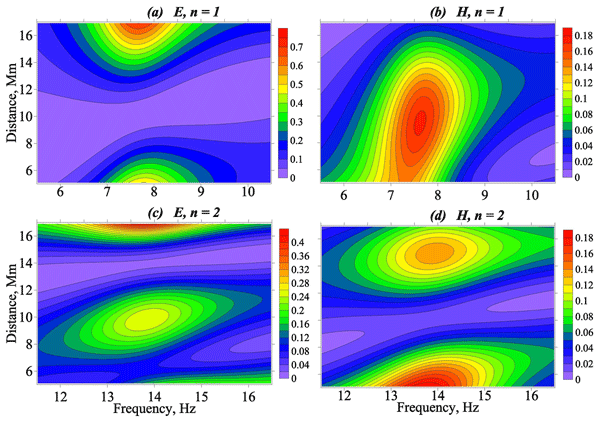
This paper considers theoretically the n = 1 and 2 Schumann resonances of the Earth-ionosphere cavity, in particular the power contained in the vertical electric field and the horizontal magnetic field at different distances from the lightning (considered to be vertical dipoles) which excites the cavity. A relative minimum of the fields is found at a distance of ~ 10,000 km, one quarter of the Earth's circumference. The longitudinal size (breadth) of the source region, in hours, is also considered.
Section 3 uses this theory to calibrate horizontal magnetic field measurements made at the Akademik Vernadsky station in Antarctica. There is the potential to use this theory for other Schumann resonance receiving stations around the world.
Fig. A1 presents the global average vertical profile of atmospheric electric conductivity (in S/m) for ground level up to an altitude of 110 km that is used in the calculations. The right-hand panels of Fig. A2 show the frequency dependence of the real and imaginary parts of the complex propagation constant nu(f) at these extremely low frequencies.
The paper contains a useful set of references for readers.
Citation: https://doi.org/10.5194/egusphere-2025-5961-RC2 -
AC2: 'Reply on RC2', Oleksandr Koloskov, 10 May 2026
Dear Referee,
On behalf of all co-authors, I would like to thank the Referee for the careful review of our manuscript and the positive evaluation of our work.
We appreciate the Referee's concise summary of the key findings, including our theoretical approach to analyzing the power distribution of the first two Schumann resonance modes and the determination of the field nodal zones. We are also pleased that the Referee noted the practical potential of the proposed calibration method for the global network of SR receiving stations beyond the Akademik Vernadsky station.
Since the Referee has no specific comments or suggested corrections, we maintain the manuscript in its current form and look forward to the next stage of the publication process.
Thank you for your time and professional feedback.
Kind regards,
Oleksandr Koloskov
(on behalf of the co-authors)
Citation: https://doi.org/10.5194/egusphere-2025-5961-AC2
-
AC2: 'Reply on RC2', Oleksandr Koloskov, 10 May 2026
-
AC1: 'Reply on RC1', Oleksandr Koloskov, 10 May 2026
The comment was uploaded in the form of a supplement: https://egusphere.copernicus.org/preprints/2025/egusphere-2025-5961/egusphere-2025-5961-AC1-supplement.pdf
-
RC2: 'Reply on RC1', Anonymous Referee #2, 27 Mar 2026
Peer review completion


Interactive discussion
Status: closed
-
RC1: 'Comment on egusphere-2025-5961', Anonymous Referee #1, 22 Jan 2026
-
RC2: 'Reply on RC1', Anonymous Referee #2, 27 Mar 2026
This paper considers theoretically the n = 1 and 2 Schumann resonances of the Earth-ionosphere cavity, in particular the power contained in the vertical electric field and the horizontal magnetic field at different distances from the lightning (considered to be vertical dipoles) which excites the cavity. A relative minimum of the fields is found at a distance of ~ 10,000 km, one quarter of the Earth's circumference. The longitudinal size (breadth) of the source region, in hours, is also considered.
Section 3 uses this theory to calibrate horizontal magnetic field measurements made at the Akademik Vernadsky station in Antarctica. There is the potential to use this theory for other Schumann resonance receiving stations around the world.
Fig. A1 presents the global average vertical profile of atmospheric electric conductivity (in S/m) for ground level up to an altitude of 110 km that is used in the calculations. The right-hand panels of Fig. A2 show the frequency dependence of the real and imaginary parts of the complex propagation constant nu(f) at these extremely low frequencies.
The paper contains a useful set of references for readers.
Citation: https://doi.org/10.5194/egusphere-2025-5961-RC2 -
AC2: 'Reply on RC2', Oleksandr Koloskov, 10 May 2026
Dear Referee,
On behalf of all co-authors, I would like to thank the Referee for the careful review of our manuscript and the positive evaluation of our work.
We appreciate the Referee's concise summary of the key findings, including our theoretical approach to analyzing the power distribution of the first two Schumann resonance modes and the determination of the field nodal zones. We are also pleased that the Referee noted the practical potential of the proposed calibration method for the global network of SR receiving stations beyond the Akademik Vernadsky station.
Since the Referee has no specific comments or suggested corrections, we maintain the manuscript in its current form and look forward to the next stage of the publication process.
Thank you for your time and professional feedback.
Kind regards,
Oleksandr Koloskov
(on behalf of the co-authors)
Citation: https://doi.org/10.5194/egusphere-2025-5961-AC2
-
AC2: 'Reply on RC2', Oleksandr Koloskov, 10 May 2026
-
AC1: 'Reply on RC1', Oleksandr Koloskov, 10 May 2026
The comment was uploaded in the form of a supplement: https://egusphere.copernicus.org/preprints/2025/egusphere-2025-5961/egusphere-2025-5961-AC1-supplement.pdf
-
RC2: 'Reply on RC1', Anonymous Referee #2, 27 Mar 2026
Peer review completion
Journal article(s) based on this preprint
Viewed
| HTML | XML | Total | BibTeX | EndNote | |
|---|---|---|---|---|---|
| 1,921 | 1,368 | 181 | 3,470 | 252 | 274 |
- HTML: 1,921
- PDF: 1,368
- XML: 181
- Total: 3,470
- BibTeX: 252
- EndNote: 274
Viewed (geographical distribution)
| Country | # | Views | % |
|---|
| Total: | 0 |
| HTML: | 0 |
| PDF: | 0 |
| XML: | 0 |
- 1
Oleksandr Koloskov

Masashi Hayakawa
Alexander P. Nickolaenko
The requested preprint has a corresponding peer-reviewed final revised paper. You are encouraged to refer to the final revised version.
- Preprint
(1656 KB) - Metadata XML
Please find my review attached.