
the Creative Commons Attribution 4.0 License.
the Creative Commons Attribution 4.0 License.
 | 16 Dec 2025
Estimation of vertical profiles of raindrop size distribution and cloud microphysical processes in stratiform rainfall using vertical-pointing X- and VHF-band radars
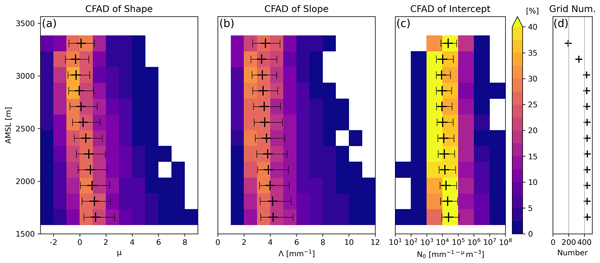
Abstract. Simultaneous vertical pointing observations by X- and VHF-band radars were conducted in Japan, and these data were used to estimate vertical profiles of drop size distribution (DSD) parameters of raindrops, assuming a gamma distribution, for a stratiform rainfall event. We used X-band reflectivity, vertical Doppler velocity, and spectral width, combined with VHF-band vertical air motion data. The estimation considers non-Rayleigh scattering and the influence of vertical air motion, and accounts for the contamination of spectral broadening using a forward convolution technique. We demonstrated that for stratiform rainfall, broadening by wind shear may be neglected, even with a relatively coarse radar range resolution of 150 metres. Cloud physical quantities (median volume diameter, liquid water content, normalised intercept parameter) retrieved from the estimated DSD parameters were compared with operational X-band polarimetric radar data and found to be highly accurate. We also point out the potential applicability of this method to satellite-borne radars. Among the estimated parameters, the shape and slope parameters generally increased with decreasing altitude. These changes are attributed to collision-coalescence and breakup based on variations in the cloud physical quantities, likely due to the humid environment. This study suggests that retrieving cloud physical quantities from DSD parameters estimated from vertical observations enables robust discussions on cloud physical processes.
-
Notice on discussion status
The requested preprint has a corresponding peer-reviewed final revised paper. You are encouraged to refer to the final revised version.
-
Preprint
(2894 KB)
-
The requested preprint has a corresponding peer-reviewed final revised paper. You are encouraged to refer to the final revised version.
- Preprint
(2894 KB) - Metadata XML
- BibTeX
- EndNote
- Final revised paper


Journal article(s) based on this preprint
Interactive discussion
Status: closed
-
RC1: 'Comment on egusphere-2025-5944', Anonymous Referee #1, 05 Jan 2026
- AC1: 'Reply on RC1', Yusuke Goto, 20 Jan 2026
-
RC2: 'Comment on egusphere-2025-5944', Anonymous Referee #2, 09 Jan 2026
This manuscript describes a method to estimate the gamma raindrop size distribution parameters using moments from a vertically pointing X-band radar and the air motion retrieved from a VHF wind profiler. Since the X-band radar did not record the Doppler velocity spectra, the DSD parameters were retrieved from measured moments of reflectivity, mean Doppler velocity, and spectrum width. The manuscript does a nice job of describing the spectrum broadening terms (i.e., due to horizontal wind, turbulence, and shear) that contribute to the measured spectrum width, provides an error analysis, and estimates the DSD uncertainties when not including those correction terms. After clarifying a couple minor items, I believe this manuscript would be ready for publication.
Specific Comments:
1. Equation (4). I do not think equations (4) and (8) are correct. From Fukao and Hamazu, the spectrum width is given by equation (5.102). The second term in equations (4) and (8) appear consistent with (5.102), but the first term is not consistent with equation (5.102). Also, to me, it does not look correct to have the mean air motion V_a(overbar) included in the spectrum width estimate. The spectrum width calculation is the width of the rain portion in the spectrum (see Fukao and Hamazu, Fig. 5.10). If V_a(overbar) is replaced with V_tz^nonRay(overbar) in equation (8), then would the spectrum width be just the first term in equation (8)? For equation (4), the text would need to define a similar variable called V_tz^Ray(overbar) for equation (4). Please examine equations (4) and (8) and make changes where needed.
2. Lines 246-247. As written, I thought the phrase 'liquid phase' is referring to the Rayleigh scattering peak observed by the MU radar, but it appears to refer to the height region containing rain drops (aka, liquid phase). Please clarify that the 'liquid phase' refers to a height region containing liquid phase hydrometeors and not to the hydrometeors themselves.
3. Line 370. Is a word missing? How about, '...found that the XRAIN K_DP is sensitive..."
4. Line 518. Attenuation in TAMX is discussed, but attenuation in NUX is not discussed. At these short ranges and larger particle regimes during stratiform rain, I do not believe that attenuation will impact the N0 estimate very much. But please confirm that assumption and please provide a sentence or two near equation (20) that discusses how attenuation in the measured NUX reflectivity is ignored or included in the estimate of N0.
Citation: https://doi.org/10.5194/egusphere-2025-5944-RC2 - AC2: 'Reply on RC2', Yusuke Goto, 20 Jan 2026


Interactive discussion
Status: closed
-
RC1: 'Comment on egusphere-2025-5944', Anonymous Referee #1, 05 Jan 2026
General comments:
The authors proposed a method for estimating the vertical distributions of DSD parameters and cloud microphysics-related parameters for layered rainfall events using vertically pointing observations from X-band and VHF-band radars. Although the validation was limited to specific regions and cases, their analysis was conducted with great care and is considered highly valuable. However, whilst the technical steps undertaken are listed in the main text, the reasons for undertaking them and their advantages are generally absent, and the relationships between them remain unclear, rendering the text very difficult to read. Consequently, the novelty of this research is hard to discern. There must be pros and cons associated with each radar used; these should be explicitly stated whilst reviewing relevant prior research.
Furthermore, the advantages gained from combining these radars and how they differ from previous research should be clearly stated in the introduction. Relatedly, within the methodology section, it would be preferable to include a brief explanatory sentence at the beginning of each subsection to clarify the context within the text.Specific comments:
- L34-63: This section should outline what is known from ground-based drop-size distribution observations and their limitations, and subsequent sections should highlight the importance of the vertical distribution of cloud microphysical properties.
- L66-67: Please briefly state why the Rayleigh approximation allows the average vertical flow to be negligible.
- L-103: Having read this far, I could not discern why synchronised observations of X- and VHF-band radars are practical. As noted in the general comments, the introduction requires restructuring to state the pros/cons of X-band and VHF-band explicitly, and to clarify the advantages of combining them. Furthermore, mention should be made of why a stratiform rain event is the focus.
- Section 4.1: Could you show the horizontal distribution of horizontally polarised reflectivity at the peak time for the case study? With only the vertical distribution, readers, including me, cannot fully grasp what kind of case study is being targeted.
- L587-589: It is the distribution shape that approaches equilibrium, not the state. Therefore, it would be preferable to describe 'equilibrium shape'.
- Figure 15: Why was the delta cut-off set between 2500 and 2750 m? Looking at Figs 11, 13 and 14, there appears to be no apparent kink in the vertical distributions. If there is some intention behind this, it should be explicitly stated.
- Figure 16: Why was ERA5 data used instead of Japanese reanalysis data? Furthermore, has the accuracy been verified regardless of the reanalysis data used? For instance, near Shigaraki, I found an upper-air sounding site called Shionomisaki. I strongly recommend checking the scatter plot of relative humidity for the neighbouring grid of the reanalysis data at this site, which would enhance the reliability of this figure and strengthen the authors' arguments.
Technical Corrections:
- L27, 371, 374, 376, 378, 385, 390, 394, 555, 578, Table 3, Figure 11, Figure 14: LWC [gm-3] should be LWC [g m-3].
- L29, 148: mm6m-3 should be mm6 m-3 (space required between units).
- L34: N(D) should be defined; e.g., ... a gamma distribution to show DSD (N(D)), whichi is ...
- L35: mm-1-µm-3 should be mm-1-µ m-3 (space required between units).
- L42, 580, Table 3, Figure 11: mm-1m-3 should be mm-1 m-3 (space required between units)
- L67, 132, 134, 149, 556, Table 2: m/s needs to be m s-1.
- L88: How large is it?
- L92: ... of raindrops?
- L175: Here, N(D) should explicitly state which function is assumed.
- L185: kg/m3 should be kg m-3.
- L271: m2/s2 needs to be m2 s-2.
- L370, 371: °/km should be degree km-1.
- L411: UTC+9 should be UTC + 9 hours. which may apply the other place in the main text.
- L519: dB/km should be dB km-1.
- Figure 9: 1/mm should be mm-1
- Figure 12: deg./km should be degree km-1
Citation: https://doi.org/10.5194/egusphere-2025-5944-RC1 - AC1: 'Reply on RC1', Yusuke Goto, 20 Jan 2026
-
RC2: 'Comment on egusphere-2025-5944', Anonymous Referee #2, 09 Jan 2026
This manuscript describes a method to estimate the gamma raindrop size distribution parameters using moments from a vertically pointing X-band radar and the air motion retrieved from a VHF wind profiler. Since the X-band radar did not record the Doppler velocity spectra, the DSD parameters were retrieved from measured moments of reflectivity, mean Doppler velocity, and spectrum width. The manuscript does a nice job of describing the spectrum broadening terms (i.e., due to horizontal wind, turbulence, and shear) that contribute to the measured spectrum width, provides an error analysis, and estimates the DSD uncertainties when not including those correction terms. After clarifying a couple minor items, I believe this manuscript would be ready for publication.
Specific Comments:
1. Equation (4). I do not think equations (4) and (8) are correct. From Fukao and Hamazu, the spectrum width is given by equation (5.102). The second term in equations (4) and (8) appear consistent with (5.102), but the first term is not consistent with equation (5.102). Also, to me, it does not look correct to have the mean air motion V_a(overbar) included in the spectrum width estimate. The spectrum width calculation is the width of the rain portion in the spectrum (see Fukao and Hamazu, Fig. 5.10). If V_a(overbar) is replaced with V_tz^nonRay(overbar) in equation (8), then would the spectrum width be just the first term in equation (8)? For equation (4), the text would need to define a similar variable called V_tz^Ray(overbar) for equation (4). Please examine equations (4) and (8) and make changes where needed.
2. Lines 246-247. As written, I thought the phrase 'liquid phase' is referring to the Rayleigh scattering peak observed by the MU radar, but it appears to refer to the height region containing rain drops (aka, liquid phase). Please clarify that the 'liquid phase' refers to a height region containing liquid phase hydrometeors and not to the hydrometeors themselves.
3. Line 370. Is a word missing? How about, '...found that the XRAIN K_DP is sensitive..."
4. Line 518. Attenuation in TAMX is discussed, but attenuation in NUX is not discussed. At these short ranges and larger particle regimes during stratiform rain, I do not believe that attenuation will impact the N0 estimate very much. But please confirm that assumption and please provide a sentence or two near equation (20) that discusses how attenuation in the measured NUX reflectivity is ignored or included in the estimate of N0.
Citation: https://doi.org/10.5194/egusphere-2025-5944-RC2 - AC2: 'Reply on RC2', Yusuke Goto, 20 Jan 2026
Peer review completion


Journal article(s) based on this preprint
Viewed
| HTML | XML | Total | BibTeX | EndNote | |
|---|---|---|---|---|---|
| 261 | 140 | 29 | 430 | 70 | 70 |
- HTML: 261
- PDF: 140
- XML: 29
- Total: 430
- BibTeX: 70
- EndNote: 70
Viewed (geographical distribution)
| Country | # | Views | % |
|---|
| Total: | 0 |
| HTML: | 0 |
| PDF: | 0 |
| XML: | 0 |
- 1
Taro Shinoda
Haruya Minda
Moeto Kyushima
Hiroyuki Hashiguchi
Nozomu Toda
Shoichi Shige
The requested preprint has a corresponding peer-reviewed final revised paper. You are encouraged to refer to the final revised version.
- Preprint
(2894 KB) - Metadata XML
General comments:
The authors proposed a method for estimating the vertical distributions of DSD parameters and cloud microphysics-related parameters for layered rainfall events using vertically pointing observations from X-band and VHF-band radars. Although the validation was limited to specific regions and cases, their analysis was conducted with great care and is considered highly valuable. However, whilst the technical steps undertaken are listed in the main text, the reasons for undertaking them and their advantages are generally absent, and the relationships between them remain unclear, rendering the text very difficult to read. Consequently, the novelty of this research is hard to discern. There must be pros and cons associated with each radar used; these should be explicitly stated whilst reviewing relevant prior research.
Furthermore, the advantages gained from combining these radars and how they differ from previous research should be clearly stated in the introduction. Relatedly, within the methodology section, it would be preferable to include a brief explanatory sentence at the beginning of each subsection to clarify the context within the text.
Specific comments:
Technical Corrections: