
the Creative Commons Attribution 4.0 License.
the Creative Commons Attribution 4.0 License.
 | 04 Dec 2025
Controlled chamber formation of per- and polyfluoroalkyl substances (PFAS) aerosols with Pseudomonas fluorescens: size distributions, effects, and inhalation deposition potential
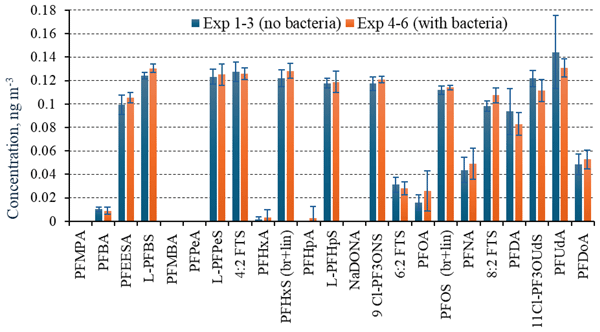
Abstract. Per- and polyfluoroalkyl substances (PFAS) are recognised as atmospheric contaminants, yet processes governing their aerosol formation, size distribution, and interactions with atmospheric particle surfaces remain unknown. We investigated aerosolisation and size-resolved behaviour of 25 PFAS covering short-, medium-, and long-chain perfluoroalkyl carboxylic acids (PFCA), perfluoroalkane sulfonates, fluorotelomer sulfonates and emerging alternatives. Experiments were conducted under controlled chamber conditions using a water–organic solvent system, in the absence/presence of the model bacterium Pseudomonas fluorescens seed, representative of wastewater-impacted environments. Most PFAS exhibited unimodal mass–size distributions peaking at 0.3 µm, indicating dominant association with the fine mode. Sulfonated PFAS showed broadly similar aerosol-phase concentrations regardless of carbon-chain length, whereas PFCA displayed increasing aerosolisation with chain length. Perfluorooctane sulfonic acid (PFOS) showed additional ultrafine enrichment, 6:2 fluorotelomer sulfonate (6:2 FTS) and sodium 4,8-dioxa-3H-perfluorononanoate (NaDONA) exhibited broader size profiles, suggesting compound-specific effects linked to volatility and interfacial behaviour. Pseudomonas fluorescens seed did not enhance PFAS aerosol concentrations through condensation or heterogeneous uptake onto bacterial particles or shift in modal diameters, and no enrichment was observed at bacterial size mode, indicating limited PFAS-bioaerosol association under the tested conditions. Multiple-Path Particle Dosimetry (MPPD) modelling based on the measured size distributions predicted substantial deposition of the aerosol-bound PFAS in the pulmonary region, particularly for compounds enriched in ultrafine particles. Our findings indicate that PFAS aerosol behaviour in mixed-solvent systems is controlled primarily by physical droplet generation and evaporation, with implications for airborne transport and inhalation exposure from contaminated aqueous sources.
Competing interests: At least one of the (co-)authors is a member of the editorial board of Atmospheric Chemistry and Physics. The peer-review process was guided by an independent editor, and the authors also have no other competing interests to declare.}
Publisher's note: Copernicus Publications remains neutral with regard to jurisdictional claims made in the text, published maps, institutional affiliations, or any other geographical representation in this paper. While Copernicus Publications makes every effort to include appropriate place names, the final responsibility lies with the authors. Views expressed in the text are those of the authors and do not necessarily reflect the views of the publisher.-
Notice on discussion status
The requested preprint has a corresponding peer-reviewed final revised paper. You are encouraged to refer to the final revised version.
-
Preprint
(966 KB)
-
Supplement
(314 KB)
-
The requested preprint has a corresponding peer-reviewed final revised paper. You are encouraged to refer to the final revised version.
- Preprint
(966 KB) - Metadata XML
-
Supplement
(314 KB) - BibTeX
- EndNote
- Final revised paper


Journal article(s) based on this preprint
Interactive discussion
Status: closed
-
RC1: 'Comment on egusphere-2025-5936', Anonymous Referee #1, 23 Dec 2025
-
AC2: 'Reply on RC1', Ivan Kourtchev, 23 Jan 2026
Publisher’s note: this comment is a copy of AC4 and its content was therefore removed on 28 January 2026.
Citation: https://doi.org/10.5194/egusphere-2025-5936-AC2 - AC4: 'Reply on RC1', Ivan Kourtchev, 27 Jan 2026
-
AC2: 'Reply on RC1', Ivan Kourtchev, 23 Jan 2026
-
RC2: 'Comment on egusphere-2025-5936', Anonymous Referee #2, 13 Jan 2026
PFAS are synthetic organofluorine compounds widely used in industrial and consumer applications, with ubiquitous prevalence in air, water, and soil. However, limited knowledge on atmospheric transport behavior of PFAS is hindering further evaluation of their impacts on the ecosystem. The manuscript prepared by Kourtchev et al studied the aerosolisation and size-resolved behaviour of 25 PFAS covering short-, medium-, and long-chain perfluoroalkyl carboxylic acids (PFCA), perfluoroalkane sulfonates, fluorotelomer sulfonates and emerging alternatives with the absence/presence of the model bacterium Pseudomonas fluorescens seed. Results from this work provided implications for understanding the physical droplet and evaporation controlled PFAS aerosol behavior in mixed-solvent systems, especially for wastewater treatment plants (WWTPs) enriched with both abundant PFAS and bioaerosol. By illustrating the water-air transformation behavior of PFAS, MPPD calculation was also performed based on the measured PFAS aerosol size distributions, which predicted substantial deposition of aerosol PFAS in the pulmonary region, particularly for PFAS ultrafine particles. In general, this study investigated a novel topic regarding PFAS aerosol with Pseudomonas fluorescens seed during atmospheric transportation, which would benefit future improvements in atmospheric models and exposure assessments. However, the current version of manuscript fits more with a methodological development journal, discussions can be elaborated with in-depth mechanisms to enhance the overall scientific rigor before it can be considered for publication.
Evidence on the mixing state of PFAS aerosol with bioaerosol seed inside the chamber would help interpreting the results.
The authors concluded that the presence of Pseudomonas fluorescens as an aerosol seed did not enhance PFAS aerosolisation or alter modal diameters. This was derived from the methanol:water 4:6 experiments, right? Is this relevant with real waste water treatment environment? How would the authors consider the impacts from experimental PFAS:bioaerosol ratio on this conclusion? Also, would experiment temperature or RH make a difference to these results?
The authors stated that PFAS are known to interact with surfaces and can partition during drying, passing the aerosol through additional tubing or drying devices (e.g., diffusion dryers/denuders) would introduce unnecessary interfaces and increase the risk of losses. But the authors used a fan and different mixing periods for PFAS/bioaerosol in the chamber for a better mixing efficiency. I wonder how these factors would bring uncertainties to the results. Also, it would be helpful to characterize the chamber wall loss of PFAS aerosol.
A Figure of PFAS solubility and loss according to different methanol and ultrapure water ratios would help explaining why this 40:60 (v/v) methanol and ultrapure water ratio was eventually adopted for the experiments. Also, why methanol instead of other organic solvent was used here? Have the authors tried different types of organic solvents to see the different aerosolization efficiencies of PFAS?
MPPD simulations was adopted in this work. However, the results from MPPD are basically based on particle size distribution, and I deduce this would vary with a different solvent (methanol to water ratio, given that they did not dry the particles), experimental flow rate, and even chamber size/tubing length for PFAS aerosol generation. I wonder if the authors have considered/evaluated such variance from experimental conditions in their study. In other words, more characteristic impacts from PFAS chemical composition as well as potential toxicity should be stated in the discussion.
The author stated that this is the first time to explore PFAS aerosol formation with bioaerosol seed. It would be helpful to have a schematic of experimental setup in the method section of this manuscript.
Line 161–164: change to “increase the risks of losses”
Line 127: “5 × 10⁻²” is a typo
Line 197: should mention the storage duration before extraction
Line 367–368: typo in “fluorescens-seeded (average 0.105±0.0043 ng m-3, n=3) and unseeded (0.099±0.008 ng m-3, n=3) “
Figure 3: should be error bars on each data point
Citation: https://doi.org/10.5194/egusphere-2025-5936-RC2 -
AC1: 'Reply on RC2', Ivan Kourtchev, 23 Jan 2026
Publisher’s note: this comment is a copy of AC5 and its content was therefore removed on 28 January 2026.
Citation: https://doi.org/10.5194/egusphere-2025-5936-AC1 - AC5: 'Reply on RC2', Ivan Kourtchev, 27 Jan 2026
-
AC1: 'Reply on RC2', Ivan Kourtchev, 23 Jan 2026
-
RC3: 'Comment on egusphere-2025-5936', Anonymous Referee #3, 19 Jan 2026
General comments
PFAS are present in atmospheric aerosols; however, their interfacial chemistry at aerosol surfaces remains poorly understood. This study investigated the behaviour of PFAS in aerosols in both the absence and presence of Pseudomonas fluorescens as a biological seed. By illustrating a unimodal aerosol PFAS mass distribution, the study showed association of PFAS with the fine particle mode. No effect of Pseudomonas fluorescens addition on aerosol PFAS concentration was observed. The study applied Multiple-Path Particle Dosimetry (MPPD) modeling, based on the measured particle size distributions, to evaluate particle deposition in the respiratory tract.
Research comments
The PFAS-containing mixture introduced into the chamber would be expected to exhibit compound-specific wall deposition, which should be monitored prior to the start of the experiment. Were wall loss deposition rates measured? Stainless steel chambers are known to exhibit significant wall deposition for organic acids and peroxides; could this have affected the experiments? Please comment in detail on the possible contribution of wall losses in relation to compound vapor pressure.
How was dilution due to aerosol sampling corrected? What was the dilution rate during the experiments?
The nebulization process may exert mechanical stress and cause fragmentation of bacteria; however, is this the only explanation for the observed fragmentation of Pseudomonas fluorescens? Could the processes differ under higher relative humidity (RH) conditions?
Smaller aerosol particles experience higher internal pressure due to curvature effects enhanced when PFAS are present. How might this influence the mass accommodation of Pseudomonas fluorescens onto or into PFAS-containing aerosols?
PFAS-containing aerosols may be stable at smaller diameters depending on RH. How would RH affect the reported results? Did the authors perform experiments at different RH levels, and were similar conclusions obtained? Higher RH is expected to promote stronger adhesion, whereas lower RH may result in more reversible interactions.
Minor comments
Line 51: Please check whether “and” should be used instead of “&” for ACP.
Line 138: Consider moving the PFAS mixture description to the Supplementary Information.
Line 174: The unit for liter is given as “L” in the text; please check the use of “lpm.”
Line 197: Please provide information regarding the extraction time and storage period.
Citation: https://doi.org/10.5194/egusphere-2025-5936-RC3 -
AC3: 'Reply on RC3', Ivan Kourtchev, 23 Jan 2026
Publisher’s note: this comment is a copy of AC6 and its content was therefore removed on 28 January 2026.
Citation: https://doi.org/10.5194/egusphere-2025-5936-AC3 - AC6: 'Reply on RC3', Ivan Kourtchev, 27 Jan 2026
-
AC3: 'Reply on RC3', Ivan Kourtchev, 23 Jan 2026


Interactive discussion
Status: closed
-
RC1: 'Comment on egusphere-2025-5936', Anonymous Referee #1, 23 Dec 2025
General comments
This study represents a highly novel and scientifically valuable attempt to experimentally investigate interactions between atmospheric PFAS and bioaerosols (Pseudomonas fluorescens) under controlled chamber conditions. However, there are substantial limitations in how the wastewater treatment plant (WWTP) environment is represented by the experimental design, particularly the use of a 40:60 water–methanol mixed solvent and aerosol generation via a Collison nebulizer.
The reduced surface tension resulting from the presence of methanol creates a physical environment that differs markedly from natural bubble-bursting processes in wastewater aeration basins. As a consequence, the aerosol size distributions observed in this study appear to be strongly governed by the imposed experimental conditions rather than by intrinsic physicochemical properties of the PFAS compounds themselves. The authors are clearly aware of these limitations and have discussed them to some extent, which is appropriate.
The interpretation of the MPPD modeling results raises concerns. The authors conclude that the largely similar size distributions observed across most PFAS, regardless of molecular structure, are a consequence of physical constraints imposed by the nebulization process. If this is indeed the case, then the resulting modeled respiratory deposition should likewise be viewed primarily as an artifact of the experimental setup, rather than as compound-specific behavior. In this context, the subsequent discussion of differential inhalation risks among individual PFAS appears insufficiently justified.
I therefore encourage the authors to more critically acknowledge the dominant role of the experimental configuration in shaping the results and to revise the scope and framing of their interpretation accordingly. On this basis, I recommend Major Revision.
Detailed comments are provided in the PDF file.
-
AC2: 'Reply on RC1', Ivan Kourtchev, 23 Jan 2026
Publisher’s note: this comment is a copy of AC4 and its content was therefore removed on 28 January 2026.
Citation: https://doi.org/10.5194/egusphere-2025-5936-AC2 - AC4: 'Reply on RC1', Ivan Kourtchev, 27 Jan 2026
-
AC2: 'Reply on RC1', Ivan Kourtchev, 23 Jan 2026
-
RC2: 'Comment on egusphere-2025-5936', Anonymous Referee #2, 13 Jan 2026
PFAS are synthetic organofluorine compounds widely used in industrial and consumer applications, with ubiquitous prevalence in air, water, and soil. However, limited knowledge on atmospheric transport behavior of PFAS is hindering further evaluation of their impacts on the ecosystem. The manuscript prepared by Kourtchev et al studied the aerosolisation and size-resolved behaviour of 25 PFAS covering short-, medium-, and long-chain perfluoroalkyl carboxylic acids (PFCA), perfluoroalkane sulfonates, fluorotelomer sulfonates and emerging alternatives with the absence/presence of the model bacterium Pseudomonas fluorescens seed. Results from this work provided implications for understanding the physical droplet and evaporation controlled PFAS aerosol behavior in mixed-solvent systems, especially for wastewater treatment plants (WWTPs) enriched with both abundant PFAS and bioaerosol. By illustrating the water-air transformation behavior of PFAS, MPPD calculation was also performed based on the measured PFAS aerosol size distributions, which predicted substantial deposition of aerosol PFAS in the pulmonary region, particularly for PFAS ultrafine particles. In general, this study investigated a novel topic regarding PFAS aerosol with Pseudomonas fluorescens seed during atmospheric transportation, which would benefit future improvements in atmospheric models and exposure assessments. However, the current version of manuscript fits more with a methodological development journal, discussions can be elaborated with in-depth mechanisms to enhance the overall scientific rigor before it can be considered for publication.
Evidence on the mixing state of PFAS aerosol with bioaerosol seed inside the chamber would help interpreting the results.
The authors concluded that the presence of Pseudomonas fluorescens as an aerosol seed did not enhance PFAS aerosolisation or alter modal diameters. This was derived from the methanol:water 4:6 experiments, right? Is this relevant with real waste water treatment environment? How would the authors consider the impacts from experimental PFAS:bioaerosol ratio on this conclusion? Also, would experiment temperature or RH make a difference to these results?
The authors stated that PFAS are known to interact with surfaces and can partition during drying, passing the aerosol through additional tubing or drying devices (e.g., diffusion dryers/denuders) would introduce unnecessary interfaces and increase the risk of losses. But the authors used a fan and different mixing periods for PFAS/bioaerosol in the chamber for a better mixing efficiency. I wonder how these factors would bring uncertainties to the results. Also, it would be helpful to characterize the chamber wall loss of PFAS aerosol.
A Figure of PFAS solubility and loss according to different methanol and ultrapure water ratios would help explaining why this 40:60 (v/v) methanol and ultrapure water ratio was eventually adopted for the experiments. Also, why methanol instead of other organic solvent was used here? Have the authors tried different types of organic solvents to see the different aerosolization efficiencies of PFAS?
MPPD simulations was adopted in this work. However, the results from MPPD are basically based on particle size distribution, and I deduce this would vary with a different solvent (methanol to water ratio, given that they did not dry the particles), experimental flow rate, and even chamber size/tubing length for PFAS aerosol generation. I wonder if the authors have considered/evaluated such variance from experimental conditions in their study. In other words, more characteristic impacts from PFAS chemical composition as well as potential toxicity should be stated in the discussion.
The author stated that this is the first time to explore PFAS aerosol formation with bioaerosol seed. It would be helpful to have a schematic of experimental setup in the method section of this manuscript.
Line 161–164: change to “increase the risks of losses”
Line 127: “5 × 10⁻²” is a typo
Line 197: should mention the storage duration before extraction
Line 367–368: typo in “fluorescens-seeded (average 0.105±0.0043 ng m-3, n=3) and unseeded (0.099±0.008 ng m-3, n=3) “
Figure 3: should be error bars on each data point
Citation: https://doi.org/10.5194/egusphere-2025-5936-RC2 -
AC1: 'Reply on RC2', Ivan Kourtchev, 23 Jan 2026
Publisher’s note: this comment is a copy of AC5 and its content was therefore removed on 28 January 2026.
Citation: https://doi.org/10.5194/egusphere-2025-5936-AC1 - AC5: 'Reply on RC2', Ivan Kourtchev, 27 Jan 2026
-
AC1: 'Reply on RC2', Ivan Kourtchev, 23 Jan 2026
-
RC3: 'Comment on egusphere-2025-5936', Anonymous Referee #3, 19 Jan 2026
General comments
PFAS are present in atmospheric aerosols; however, their interfacial chemistry at aerosol surfaces remains poorly understood. This study investigated the behaviour of PFAS in aerosols in both the absence and presence of Pseudomonas fluorescens as a biological seed. By illustrating a unimodal aerosol PFAS mass distribution, the study showed association of PFAS with the fine particle mode. No effect of Pseudomonas fluorescens addition on aerosol PFAS concentration was observed. The study applied Multiple-Path Particle Dosimetry (MPPD) modeling, based on the measured particle size distributions, to evaluate particle deposition in the respiratory tract.
Research comments
The PFAS-containing mixture introduced into the chamber would be expected to exhibit compound-specific wall deposition, which should be monitored prior to the start of the experiment. Were wall loss deposition rates measured? Stainless steel chambers are known to exhibit significant wall deposition for organic acids and peroxides; could this have affected the experiments? Please comment in detail on the possible contribution of wall losses in relation to compound vapor pressure.
How was dilution due to aerosol sampling corrected? What was the dilution rate during the experiments?
The nebulization process may exert mechanical stress and cause fragmentation of bacteria; however, is this the only explanation for the observed fragmentation of Pseudomonas fluorescens? Could the processes differ under higher relative humidity (RH) conditions?
Smaller aerosol particles experience higher internal pressure due to curvature effects enhanced when PFAS are present. How might this influence the mass accommodation of Pseudomonas fluorescens onto or into PFAS-containing aerosols?
PFAS-containing aerosols may be stable at smaller diameters depending on RH. How would RH affect the reported results? Did the authors perform experiments at different RH levels, and were similar conclusions obtained? Higher RH is expected to promote stronger adhesion, whereas lower RH may result in more reversible interactions.
Minor comments
Line 51: Please check whether “and” should be used instead of “&” for ACP.
Line 138: Consider moving the PFAS mixture description to the Supplementary Information.
Line 174: The unit for liter is given as “L” in the text; please check the use of “lpm.”
Line 197: Please provide information regarding the extraction time and storage period.
Citation: https://doi.org/10.5194/egusphere-2025-5936-RC3 -
AC3: 'Reply on RC3', Ivan Kourtchev, 23 Jan 2026
Publisher’s note: this comment is a copy of AC6 and its content was therefore removed on 28 January 2026.
Citation: https://doi.org/10.5194/egusphere-2025-5936-AC3 - AC6: 'Reply on RC3', Ivan Kourtchev, 27 Jan 2026
-
AC3: 'Reply on RC3', Ivan Kourtchev, 23 Jan 2026
Peer review completion


Journal article(s) based on this preprint
Data sets
HRMS_Data_TNA Ivan Kourtchev et al. https://doi.org/10.5281/zenodo.17756209
Viewed
| HTML | XML | Total | Supplement | BibTeX | EndNote | |
|---|---|---|---|---|---|---|
| 408 | 223 | 41 | 672 | 75 | 39 | 45 |
- HTML: 408
- PDF: 223
- XML: 41
- Total: 672
- Supplement: 75
- BibTeX: 39
- EndNote: 45
Viewed (geographical distribution)
| Country | # | Views | % |
|---|
| Total: | 0 |
| HTML: | 0 |
| PDF: | 0 |
| XML: | 0 |
- 1
Ivan Kourtchev
Steve Coupe
Allison Buckley
Jishnu Pandamkulangara Kizhakkethil
Elena Gatta
Dario Massabò
Paolo Prati
Virginia Vernocchi
Federico Mazzei
The requested preprint has a corresponding peer-reviewed final revised paper. You are encouraged to refer to the final revised version.
- Preprint
(966 KB) - Metadata XML
-
Supplement
(314 KB) - BibTeX
- EndNote
- Final revised paper
General comments
This study represents a highly novel and scientifically valuable attempt to experimentally investigate interactions between atmospheric PFAS and bioaerosols (Pseudomonas fluorescens) under controlled chamber conditions. However, there are substantial limitations in how the wastewater treatment plant (WWTP) environment is represented by the experimental design, particularly the use of a 40:60 water–methanol mixed solvent and aerosol generation via a Collison nebulizer.
The reduced surface tension resulting from the presence of methanol creates a physical environment that differs markedly from natural bubble-bursting processes in wastewater aeration basins. As a consequence, the aerosol size distributions observed in this study appear to be strongly governed by the imposed experimental conditions rather than by intrinsic physicochemical properties of the PFAS compounds themselves. The authors are clearly aware of these limitations and have discussed them to some extent, which is appropriate.
The interpretation of the MPPD modeling results raises concerns. The authors conclude that the largely similar size distributions observed across most PFAS, regardless of molecular structure, are a consequence of physical constraints imposed by the nebulization process. If this is indeed the case, then the resulting modeled respiratory deposition should likewise be viewed primarily as an artifact of the experimental setup, rather than as compound-specific behavior. In this context, the subsequent discussion of differential inhalation risks among individual PFAS appears insufficiently justified.
I therefore encourage the authors to more critically acknowledge the dominant role of the experimental configuration in shaping the results and to revise the scope and framing of their interpretation accordingly. On this basis, I recommend Major Revision.
Detailed comments are provided in the PDF file.