
the Creative Commons Attribution 4.0 License.
the Creative Commons Attribution 4.0 License.
 | 08 Dec 2025
Enhanced Predictability of Antarctic Sea Ice through Sea Ice Thickness Assimilation
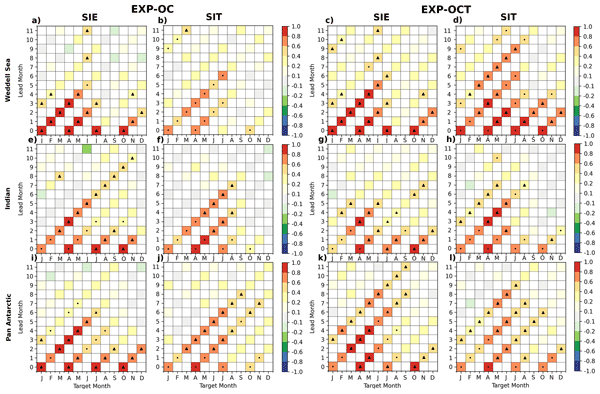
Abstract. Understanding the mechanisms of Antarctic sea ice variability, as well as its predictability, remains a central challenge in climate modelling due to the sparseness of observations and the complex processes involved. This study assesses how incorporating sea ice thickness (SIT) observations can improve the reanalysis and prediction skills of Antarctic sea ice over a period long enough to yield robust conclusions. Two 30-year reanalyses are produced using the Norwegian Climate Prediction Model (NorCPM), with and without LEGOS SIT assimilation, and they are used to initialise year-long hindcasts from 1995–2022 beginning in January, April, July, and October. Assimilation of SIT observations improved estimates of Antarctic sea ice trends, seasonal cycle, and interannual variability - particularly in the West Antarctic and the West Pacific, where sea ice is thick and LEGOS SIT is reliable. The integrated ice edge error (IIEE) was also reduced in the reanalysis during the austral winter and spring, but a degradation was observed during the austral summer. Hindcasts revealed a long SIT memory, with October initialisation resulting in substantial sea ice extent (SIE) skill gains up to 12 months and January initialisation extending prediction skill by 2–3 months in the pan-Antarctic, with strong improvement in the Weddell Sea and the Amundsen-Bellingshausen Seas. The SIE and SIT prediction skill was also improved in the West Pacific during the austral summer and autumn, a region that previously posed a challenge for prediction skill. We show that SIT observations are important for improving Antarctic SIE predictions, especially for minimum SIE forecasts in the austral summer and at longer lead times.
-
Notice on discussion status
The requested preprint has a corresponding peer-reviewed final revised paper. You are encouraged to refer to the final revised version.
-
Preprint
(17079 KB)
-
The requested preprint has a corresponding peer-reviewed final revised paper. You are encouraged to refer to the final revised version.
- Preprint
(17079 KB) - Metadata XML
- BibTeX
- EndNote
- Final revised paper


Journal article(s) based on this preprint
Interactive discussion
Status: closed
-
RC1: 'Comment on egusphere-2025-5920', Anonymous Referee #1, 02 Feb 2026
The comment was uploaded in the form of a supplement: https://egusphere.copernicus.org/preprints/2025/egusphere-2025-5920/egusphere-2025-5920-RC1-supplement.pdfCitation: https://doi.org/
10.5194/egusphere-2025-5920-RC1 - AC1: 'Reply on RC1', Nicholas Williams, 28 Apr 2026
-
RC2: 'Comment on egusphere-2025-5920', Anonymous Referee #2, 14 Feb 2026
The comment was uploaded in the form of a supplement: https://egusphere.copernicus.org/preprints/2025/egusphere-2025-5920/egusphere-2025-5920-RC2-supplement.pdf
- AC2: 'Reply on RC2', Nicholas Williams, 28 Apr 2026
-
RC3: 'Comment on egusphere-2025-5920', Mitchell Bushuk, 17 Feb 2026
The comment was uploaded in the form of a supplement: https://egusphere.copernicus.org/preprints/2025/egusphere-2025-5920/egusphere-2025-5920-RC3-supplement.pdf
- AC3: 'Reply on RC3', Nicholas Williams, 28 Apr 2026
Peer review completion


Interactive discussion
Status: closed
-
RC1: 'Comment on egusphere-2025-5920', Anonymous Referee #1, 02 Feb 2026
The comment was uploaded in the form of a supplement: https://egusphere.copernicus.org/preprints/2025/egusphere-2025-5920/egusphere-2025-5920-RC1-supplement.pdf
- AC1: 'Reply on RC1', Nicholas Williams, 28 Apr 2026
-
RC2: 'Comment on egusphere-2025-5920', Anonymous Referee #2, 14 Feb 2026
The comment was uploaded in the form of a supplement: https://egusphere.copernicus.org/preprints/2025/egusphere-2025-5920/egusphere-2025-5920-RC2-supplement.pdf
- AC2: 'Reply on RC2', Nicholas Williams, 28 Apr 2026
-
RC3: 'Comment on egusphere-2025-5920', Mitchell Bushuk, 17 Feb 2026
The comment was uploaded in the form of a supplement: https://egusphere.copernicus.org/preprints/2025/egusphere-2025-5920/egusphere-2025-5920-RC3-supplement.pdf
- AC3: 'Reply on RC3', Nicholas Williams, 28 Apr 2026
Peer review completion
Journal article(s) based on this preprint
Viewed
| HTML | XML | Total | BibTeX | EndNote | |
|---|---|---|---|---|---|
| 1,617 | 1,515 | 151 | 3,283 | 178 | 163 |
- HTML: 1,617
- PDF: 1,515
- XML: 151
- Total: 3,283
- BibTeX: 178
- EndNote: 163
Viewed (geographical distribution)
| Country | # | Views | % |
|---|
| Total: | 0 |
| HTML: | 0 |
| PDF: | 0 |
| XML: | 0 |
- 1
Nicholas Williams

Yiguo Wang
François Counillon
The requested preprint has a corresponding peer-reviewed final revised paper. You are encouraged to refer to the final revised version.
- Preprint
(17079 KB) - Metadata XML