
the Creative Commons Attribution 4.0 License.
the Creative Commons Attribution 4.0 License.
 | 05 Dec 2025
Assessing the stratospheric temperature response to volcanic sulfate injections by Mt. Pinatubo: insights from the Interactive Stratospheric Aerosol Model Intercomparison Project
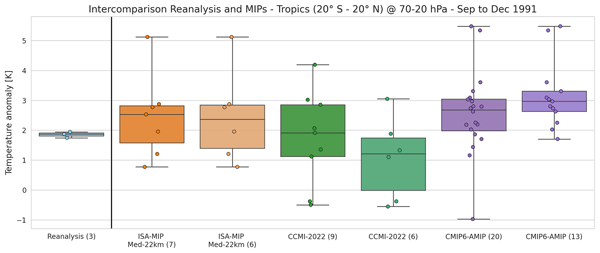
Abstract. Some major volcanic eruptions, such as the one of Mt. Pinatubo in 1991, can inject large amounts of sulfur dioxide (SO2) into the stratosphere, leading to a volcanic aerosol cloud. This dense aerosol cloud induces a radiative heating of the stratosphere, causing ozone and water vapour changes, thereby altering middle atmospheric dynamics and chemistry. The scale of these impacts for varying injection amounts and heights on stratospheric temperature anomalies is still highly uncertain. Here we analyse specially designed chemistry-climate model experiments following the Historical Eruptions SO2 Emission Assessment Protocol (HErSEA) under the Interactive Stratospheric Aerosol Model Intercomparison Project (ISA-MIP). The results confirm our general understanding of the stratospheric aerosol forcing due to extra SO2 injection, while simultaneously highlighting structural differences between models. Overall, for the Pinatubo-like experiments the multi-model mean temperature anomalies agree well with meteorological reanalyses data sets, and we find that in most cases, differences between models are larger than differences for individual models across experiments with varying injection amounts and altitudes. Differences in transport, radiative transfer, and microphysics as well as the characterization of aerosol size distributions play a crucial role for the emergence of the spread in the modelled temperature response. Our results show further, that the sensitivity of the stratospheric temperature response to model selection is also apparent in other MIPs. Hence, we argue for caution in attribution studies and the interpretation of stratospheric aerosol injection experiments relying on individual or few models.
Competing interests: At least one of the (co-)authors is a member of the editorial board of Atmospheric Chemistry and Physics. The peer-review process was guided by an independent editor, and the authors also have no other competing interests to declare.
Publisher's note: Copernicus Publications remains neutral with regard to jurisdictional claims made in the text, published maps, institutional affiliations, or any other geographical representation in this paper. While Copernicus Publications makes every effort to include appropriate place names, the final responsibility lies with the authors. Views expressed in the text are those of the authors and do not necessarily reflect the views of the publisher.-
Notice on discussion status
The requested preprint has a corresponding peer-reviewed final revised paper. You are encouraged to refer to the final revised version.
-
Preprint
(9599 KB)
-
The requested preprint has a corresponding peer-reviewed final revised paper. You are encouraged to refer to the final revised version.
- Preprint
(9599 KB) - Metadata XML
- BibTeX
- EndNote
- Final revised paper


Journal article(s) based on this preprint
Interactive discussion
Status: closed
-
RC1: 'Comment on egusphere-2025-5915', Anonymous Referee #1, 13 Jan 2026
-
AC1: 'Reply on RC1', Katharina Perny, 07 Jul 2026
The comment was uploaded in the form of a supplement: https://egusphere.copernicus.org/preprints/2025/egusphere-2025-5915/egusphere-2025-5915-AC1-supplement.pdf
-
AC1: 'Reply on RC1', Katharina Perny, 07 Jul 2026
-
RC2: 'Comment on egusphere-2025-5915', Anonymous Referee #2, 18 May 2026
Review of “Assessing the stratospheric temperature response to volcanic sulfate injection by Mt. Pinatubo: insights from the Interactive Stratospheric Aerosol Model Intercomparison Project” by Perny et al.
The paper presents an evaluation of the stratospheric temperature response to volcanic aerosol forcing in a series of models that (mostly) adhered to the ISA-MIP HErSEA protocol. The models were mostly multi-member ensembles with interactive aerosols and chemistry run in an AMIP-style with forced SSTs and some care was taken to ensure proper QBO phasing out the outset. Of the simulations performed at set were focused on for analysis based on a 7 Tg sulfur injection to 22 km altitude as those simulations had generally the best agreement with the observed temperature anomalies. However, as is clear through the results and discussion the models differed widely in the simulated temperature response, in terms of magnitude, duration, and even altitude. The main conclusion of the paper is that “…by far the most important factor driving both magnitude and spread of the multi-model distribution in temperature response to volcanic aerosol forcing is model choice.” This appears to be correct, but doesn’t provide much clarity. Several suggestions on improved intercomparisons are put forward.
The paper is well organized and generally well written. My (hopefully) constructive suggestion is it would benefit from presenting more material on the particle size and optical properties. The Quaglia et al. (2023) paper seems to be doing a lot of heavy lifting as it is appealed to at all points where microphysics is brought up. But I have to think the different temperature responses in Figure 3 have some strong correlation with particle size and optical properties. I note that the Quaglia paper did not have MIROC or CARMA results, so it would be fair to in some way restate the microphysics. Can you go beyond effective radius? Could you make a figure analogous to Figure 3 but showing some quantity more directly connected to the forcing the sulfate concentration? How about extinction? Or even mass-extinction efficiency? What are the optical property assumptions of the models? Can any be rejected as incompatible with what we know about sulfate aerosols? Do the models treat sedimentation sufficiently the same (i.e., given the same size particle it falls out at the same rate)? I think the paper will benefit from some further presentation in this space, so I recommend it for revision.
Line 110 - I’m confused here about EMAC vs. EMAC*. You state a few lines earlier that you are only using some of the EMAC output because it did not adhere to the protocol. What is the distinction you are trying to make with EMAC*? Suggest you just call it EMAC.
Lines 194-195 - there is a “(?)” where maybe a citation is intended?
Line 273 - It would seem to me that these initial conditions would be in different phases of the QBO. I didn’t really understand the “reset” to the QBO phase at the time of the injection. How can that be accomplished, and how do you reconcile with the WACCM-CARMA state?
Line 437 - “Latest by November 1991…” reads oddly. Maybe omit “Latest” and just say “By November 1991…”
Line 448 - It is not clear from Figure 2 that there is good agreement between the models and GLOSSAC with respect to placement of highest aerosol loading in the Arctic. The models tend that way, but the GLOSSAC inferred concentrations appear pretty uniform at all longitudes. Maybe another contour interval would help if that’s really the case?
Line 484 - “descent” instead of “descend”
Line 505 - “…enables us to assess…” would read better
Figure A5 - Caption doesn’t make much sense to me. First line: how is this “models in the tropics” when it shows all latitudes? And I don’t see the vertical lines indicated.
Citation: https://doi.org/10.5194/egusphere-2025-5915-RC2 -
AC2: 'Reply on RC2', Katharina Perny, 07 Jul 2026
The comment was uploaded in the form of a supplement: https://egusphere.copernicus.org/preprints/2025/egusphere-2025-5915/egusphere-2025-5915-AC2-supplement.pdf
-
AC2: 'Reply on RC2', Katharina Perny, 07 Jul 2026
Peer review completion


Interactive discussion
Status: closed
-
RC1: 'Comment on egusphere-2025-5915', Anonymous Referee #1, 13 Jan 2026
This paper is an impressive amount of work resulting in a really nice study and a pleasant read. Particularly nice is the massive comparison between models, reanalysis, and observational products. The paper is quite well done. I really like Section 3.1 where you justify the selection of a core experiment. I only have a few minor comments, mostly about clarifying details and improving replicability.
The abstract basically says, “different models have similarities and differences.” Can you be more specific?
Lines 47-54: While I like talking about SAI, this paragraph just sort of seems like a non sequitur. Can you better tie it into the points you’re making?
Section 2.1: You need more details in your experiment descriptions. What year(s) do you use to create the SSTs? Why are you specifying the injection amounts as Tg S if you’re only injecting SO2? Are you injecting throughout the entire altitude range equally, and how do you handle models with different vertical resolutions?
Line 116: What do you mean by reinitialize? To a particular state? And where do you get that state?
Line 145: Was the diffusion changed permanently starting on January 1? Or was it perturbed for a day and then changed back? And if permanently, how might this have affected your results?
Lines 194-195: Some missing references. Also, is ozone prescribed or interactive? You talked about this in the previous subsections.
Lines 222-224: So this is a bulk scheme?
Table 1: It might be useful if you had a column talking about the aerosol scheme, at least talking about bulk, modal, sectional, etc.
Citation: https://doi.org/10.5194/egusphere-2025-5915-RC1 -
AC1: 'Reply on RC1', Katharina Perny, 07 Jul 2026
The comment was uploaded in the form of a supplement: https://egusphere.copernicus.org/preprints/2025/egusphere-2025-5915/egusphere-2025-5915-AC1-supplement.pdf
-
AC1: 'Reply on RC1', Katharina Perny, 07 Jul 2026
-
RC2: 'Comment on egusphere-2025-5915', Anonymous Referee #2, 18 May 2026
Review of “Assessing the stratospheric temperature response to volcanic sulfate injection by Mt. Pinatubo: insights from the Interactive Stratospheric Aerosol Model Intercomparison Project” by Perny et al.
The paper presents an evaluation of the stratospheric temperature response to volcanic aerosol forcing in a series of models that (mostly) adhered to the ISA-MIP HErSEA protocol. The models were mostly multi-member ensembles with interactive aerosols and chemistry run in an AMIP-style with forced SSTs and some care was taken to ensure proper QBO phasing out the outset. Of the simulations performed at set were focused on for analysis based on a 7 Tg sulfur injection to 22 km altitude as those simulations had generally the best agreement with the observed temperature anomalies. However, as is clear through the results and discussion the models differed widely in the simulated temperature response, in terms of magnitude, duration, and even altitude. The main conclusion of the paper is that “…by far the most important factor driving both magnitude and spread of the multi-model distribution in temperature response to volcanic aerosol forcing is model choice.” This appears to be correct, but doesn’t provide much clarity. Several suggestions on improved intercomparisons are put forward.
The paper is well organized and generally well written. My (hopefully) constructive suggestion is it would benefit from presenting more material on the particle size and optical properties. The Quaglia et al. (2023) paper seems to be doing a lot of heavy lifting as it is appealed to at all points where microphysics is brought up. But I have to think the different temperature responses in Figure 3 have some strong correlation with particle size and optical properties. I note that the Quaglia paper did not have MIROC or CARMA results, so it would be fair to in some way restate the microphysics. Can you go beyond effective radius? Could you make a figure analogous to Figure 3 but showing some quantity more directly connected to the forcing the sulfate concentration? How about extinction? Or even mass-extinction efficiency? What are the optical property assumptions of the models? Can any be rejected as incompatible with what we know about sulfate aerosols? Do the models treat sedimentation sufficiently the same (i.e., given the same size particle it falls out at the same rate)? I think the paper will benefit from some further presentation in this space, so I recommend it for revision.
Line 110 - I’m confused here about EMAC vs. EMAC*. You state a few lines earlier that you are only using some of the EMAC output because it did not adhere to the protocol. What is the distinction you are trying to make with EMAC*? Suggest you just call it EMAC.
Lines 194-195 - there is a “(?)” where maybe a citation is intended?
Line 273 - It would seem to me that these initial conditions would be in different phases of the QBO. I didn’t really understand the “reset” to the QBO phase at the time of the injection. How can that be accomplished, and how do you reconcile with the WACCM-CARMA state?
Line 437 - “Latest by November 1991…” reads oddly. Maybe omit “Latest” and just say “By November 1991…”
Line 448 - It is not clear from Figure 2 that there is good agreement between the models and GLOSSAC with respect to placement of highest aerosol loading in the Arctic. The models tend that way, but the GLOSSAC inferred concentrations appear pretty uniform at all longitudes. Maybe another contour interval would help if that’s really the case?
Line 484 - “descent” instead of “descend”
Line 505 - “…enables us to assess…” would read better
Figure A5 - Caption doesn’t make much sense to me. First line: how is this “models in the tropics” when it shows all latitudes? And I don’t see the vertical lines indicated.
Citation: https://doi.org/10.5194/egusphere-2025-5915-RC2 -
AC2: 'Reply on RC2', Katharina Perny, 07 Jul 2026
The comment was uploaded in the form of a supplement: https://egusphere.copernicus.org/preprints/2025/egusphere-2025-5915/egusphere-2025-5915-AC2-supplement.pdf
-
AC2: 'Reply on RC2', Katharina Perny, 07 Jul 2026
Peer review completion
Journal article(s) based on this preprint
Viewed
| HTML | XML | Total | BibTeX | EndNote | |
|---|---|---|---|---|---|
| 2,728 | 1,490 | 224 | 4,442 | 241 | 233 |
- HTML: 2,728
- PDF: 1,490
- XML: 224
- Total: 4,442
- BibTeX: 241
- EndNote: 233
Viewed (geographical distribution)
| Country | # | Views | % |
|---|
| Total: | 0 |
| HTML: | 0 |
| PDF: | 0 |
| XML: | 0 |
- 1
Saved

Katharina Perny

Timofei Sukhodolov
Ales Kuchar
Pavle Arsenovic
Bernadette Rosati
Christoph Brühl
Sandip S. Dhomse
Andrin Jörimann
Anton Laakso
Graham Mann
Ulrike Niemeier
Giovanni Pitari
Ilaria Quaglia
Takashi Sekiya
Kengo Sudo
Claudia Timmreck
Simone Tilmes
Daniele Visioni
Harald E. Rieder
The requested preprint has a corresponding peer-reviewed final revised paper. You are encouraged to refer to the final revised version.
- Preprint
(9599 KB) - Metadata XML
This paper is an impressive amount of work resulting in a really nice study and a pleasant read. Particularly nice is the massive comparison between models, reanalysis, and observational products. The paper is quite well done. I really like Section 3.1 where you justify the selection of a core experiment. I only have a few minor comments, mostly about clarifying details and improving replicability.
The abstract basically says, “different models have similarities and differences.” Can you be more specific?
Lines 47-54: While I like talking about SAI, this paragraph just sort of seems like a non sequitur. Can you better tie it into the points you’re making?
Section 2.1: You need more details in your experiment descriptions. What year(s) do you use to create the SSTs? Why are you specifying the injection amounts as Tg S if you’re only injecting SO2? Are you injecting throughout the entire altitude range equally, and how do you handle models with different vertical resolutions?
Line 116: What do you mean by reinitialize? To a particular state? And where do you get that state?
Line 145: Was the diffusion changed permanently starting on January 1? Or was it perturbed for a day and then changed back? And if permanently, how might this have affected your results?
Lines 194-195: Some missing references. Also, is ozone prescribed or interactive? You talked about this in the previous subsections.
Lines 222-224: So this is a bulk scheme?
Table 1: It might be useful if you had a column talking about the aerosol scheme, at least talking about bulk, modal, sectional, etc.