
the Creative Commons Attribution 4.0 License.
the Creative Commons Attribution 4.0 License.
 | 04 Dec 2025
Impact of future aircraft NOx emissions on atmospheric composition and climate: dependence on background conditions
Abstract. Aviation emissions are predicted to have caused 4 % of anthropogenic warming to date. While aviation CO2 climate effects are well known, the magnitude of non-CO2 effects of aviation are highly uncertain. Nitrogen oxide (NOx) emissions from aircraft affect greenhouse gases: local production of ozone in the short term, and long-term impacts on methane, stratospheric water vapour and ozone. Ozone production is non-linear and depends on the background concentrations of NOx and volatile organic compounds (VOCs). Previous single-model studies have found an increased sensitivity of NOx-induced response to aviation emissions in high-mitigation scenarios compared to low-mitigation scenarios. Here we extend this to a multi-model study, using three models to explore the dependence of aviation NOx effects on background conditions in two future scenarios. We calculate the ozone radiative forcing from a 20 % change in aviation NOx emissions for two different future aviation emission scenarios, running each scenario in a high and low mitigation background. We do not find a consistent sensitivity of ozone response to NOx background between the models used. The inter-model variability in ozone response is larger than the effect of different background scenarios. We calculate a positive net NOx forcing in both future scenarios; in the high mitigation scenario in two of three models the long-term methane forcing is sufficiently negative to make the net NOx forcing negative. There is continued uncertainty in the climate impacts of aviation NOx, and we suggest that more model consensus is required to enable parametrisations of these NOx impacts into simplified models.
-
Notice on discussion status
The requested preprint has a corresponding peer-reviewed final revised paper. You are encouraged to refer to the final revised version.
-
Preprint
(2748 KB)
-
Supplement
(1007 KB)
-
The requested preprint has a corresponding peer-reviewed final revised paper. You are encouraged to refer to the final revised version.
- Preprint
(2748 KB) - Metadata XML
-
Supplement
(1007 KB) - BibTeX
- EndNote
- Final revised paper


Journal article(s) based on this preprint
Interactive discussion
Status: closed
- RC1: 'Comment on egusphere-2025-5914', Charlie Wartnaby, 07 Jan 2026
-
RC2: 'Comment on egusphere-2025-5914', Anonymous Referee #2, 26 Jan 2026
Review of “Impact of future aircraft NOx emissions on atmospheric composition and climate: dependence on background conditions”, by Zosia Staniaszek et al.
General comments
This is a welcome and interesting study that adds important new model results on the topic of aviation NOx and climate. My main concern is that the exact model experiment set-up is not sufficiently well described (in particular how methane is handled – and the consequences of fixing it). The authors conclude that it is important to let methane run free (I completely agree) so that its response can be better modelled. But in the meantime, these experiments where it is fixed need to be better explained so that the total impact of NOx emissions can be analysed and compared between studies. Some early studies that did allow methane to respond are not discussed, and that feels like an important omission. If this can be amended and the manuscript clarified as requested below, then I would be much more likely to be supportive of final publication in ACP.
Specific comments
L86: Somewhere in the Methods section, it should be explained how methane is handled. I believe it is a fixed lower boundary condition, and the methane responses to NOx are estimated indirectly. This should be clarified at an early stage in the paper.
L105: Related to previous comment – if you only run for 4 years (and analyse last 3 years), then my question is: how is methane handled? (And the answer is: it is fixed).
L115 Table 2: Document somewhere (probably in the is table) what the aviation NOx emissions, and the background (total) other NOx emissions, in each scenario/experiment are (in Tg N/yr).
L141: Even if the “method” related to the “non-steady state factor” are described in Berntsen et al. 2005 (etc.), some summary explanation of the method is required here. This is clearly some fudge-factor to cope with having fixed methane, but needing to calculate a methane response.
L145 “…steady state is not reached…” I am unclear what this means, since methane is prescribed, so it won’t respond in the experiments. What is meant by “methane steady state” in this context?
L146 Please explain what “overstates the response” means, and what non-steady state factors of 1.06 and 0.90 mean. I’m guessing if f_non-steady is >1 then assuming steady-state understates (rather than overstates) the response?
L150 Does equation [1] dimensionally balance? Please clarify the units of each term. I’m confused because I thought delta-CH4 was a change in mixing ratio, and the f factors were dimensionless. But then also the change in lifetime must have units of time, so something is wrong…
L155 Equation [2]: be explicit about the units. Are concentrations in ppbv, and RF in W/m^2?
L161 Presumably this conversion of RF -> ERF is also highly uncertain? Please comment on this further source of uncertainty.
L166 It is not entirely clear what “short-term” refers to. In the introduction, you mentioned that “long-term” referred to 5-10 year timescales. So, is short-term <5 years? Or are you equating long-term with the methane-related response, and short-term with everything else? Please clarify.
L 183 Related to previous – here you do define short-term with respect to methane – please say earlier.
L185-187 I wonder if part of the explanation of the model differences is related to model vertical resolution (EMAC has most levels; LMDZ has fewest levels).
191: Clearer to say overestimate UT and underestimate LS
L200 Figure 2. (a) I think a better axis label would be something like “Change in the (short-term) O3 burden due to aviation”. (b) Suggest add zero line (axis). (d) Clarify caption – normalised by change in annual total NOx emissions?
L216 Do you also look at the long-term O3 (via CH4) response?
L222 Document the TgN changes (see comment on Table 2).
L223 Are these global annual mean?
L229 Clarify aircraft emissions
L242 Do you know for sure that the differences due to the model grids being difference are definitely “small”? Perhaps replace small with “some”, unless you have tested this and shown they really are small.
L250 Figure 3. Clarify these are annual mean responses. Can you clarify how seasonal variations in response are averaged, and that seasonal variations do not contribute in any way?
For 3(b) can you comment on how the number of levels contributes to the sharpness of the response in these vertical profiles? (LMDZ-INCA, with the fewest levels, appears to have the broadest response).
L251 …higher changes in ozone concentration due to aircraft…
L253 ..lower changes in ozone…
L261 Figure S4 – I think I’d rather see background zonal mean NOx in SSP1/3 rather than the difference; and a log scale may be useful as I guess there are big differences between changes near the surface and in the UTLS.
L270 Figure 4. I was quite confused by this figure – is it the difference between scenarios of the difference in O3 due to aircraft emissions? Please clarify if it is this.
L277 “a higher background response” – Clarify what is meant. Is it a higher response to varying the background, or a larger change in the background?
L279 Do you mean less transport of surface emissions to the UTLS?
L283 Would it be sensible to normalise the responses? (to the magnitude of the change in aviation emissions)
L304 Clarify by ‘long-term’ ozone, do you mean the ozone related to changes in methane?
L309 Figure 5: By “long-term” do you mean time-integrated to infinity (or 100 years) or what? (Maybe infinity and 100 years are the same).
I suggest remove “Net” from the y-axis label (as net only applies to the dots, and it is in the legend).
If error bars were able to be included on the net terms, would these all span zero? (I suspect so).
L330 The mysterious “steady-state factor” turns out to be rather crucial to your end results… hence the need to clarify what this is earlier.
L338 and L385 I totally agree that methane emission-driven models are important. With this in mind I find it odd that some of the early work on these topics that did use methane emission-driven models (e.g., Wild et al., 2001; Stevenson et al., 2004) is not discussed.
Technical comments
L84-88 (and throughout): capitalize “section” references.
Table 1: The in-table references (Price et al., etc.) are missing from the reference list.
L343 Unger et al. (2013)
References
Stevenson, D. S., R. M. Doherty, M. G. Sanderson, W. J. Collins, C. E. Johnson, and R. G. Derwent (2004), Radiative forcing from aircraft NOx emissions: Mechanisms and seasonal dependence, J. Geophys. Res., 109, D17307, doi:10.1029/2004JD004759.
Wild, O., M. J. Prather, and H. Akimoto (2001), Indirect long-term global radiative cooling from NOx emissions, Geophys. Res. Lett., 28, 1719–1722.
Citation: https://doi.org/10.5194/egusphere-2025-5914-RC2 -
AC1: 'Author response to reviewers', Zosia Staniaszek, 16 Mar 2026
The comment was uploaded in the form of a supplement: https://egusphere.copernicus.org/preprints/2025/egusphere-2025-5914/egusphere-2025-5914-AC1-supplement.pdf
Peer review completion


Interactive discussion
Status: closed
-
RC1: 'Comment on egusphere-2025-5914', Charlie Wartnaby, 07 Jan 2026
General comments (overall quality)
- This paper provides a worthwhile addition to the existing literature concerning the modelled effects of aviation NOx pollution, which has high practical and policy relevance given the likely evolution of air transport and foreseeable attempts to mitigate climate impacts by altering flight profiles.
- This paper provides a useful cautionary lesson that strong variability exists between different atmospheric models, limiting the usefulness of single-model studies, so encouraging care in the use of their results.
- I recommend publication subject to some clarifications and corrections as listed below.
Specific comments (scientific questions/issues)
- L105 "The experiments are all timeslice runs, with present-day meteorology," could you clarify what you mean there? I understand timeslice simulations to use a repeating climatological year of sea/ice surface temperatures and likewise whatever emissions forcing is of interest. But "present-day meteorology" sounds like nudging to reanalysis winds -- for some specific repeated year or a range of years? -- and how would that work for the year 2050, or is it just 2050 scenario emissions feeding historical (2014-2018) simulation years where reanalysis winds are available? So to be clear what inputs are repeated in an annual pattern, which vary year by year, what nudging is done if at all, and what 5 years do the simulations run across, are they all really 2014-2018?
- L131 "The ozone column (in Dobson Units, DU)" I assume that means DU per kernel level; "column" might be interpreted as *total* column (from ground to space), which might be of interest but doesn't go into the kernel-based calculation as I understand it.
- L140 "change in methane lifetime from each simulation (∆𝜏 CH4)" and L150 (equation 1): having looked at this myself recently, to make it clear I think it needs to be the _relative_ change in CH4 lifetime, a unitless quantity. Otherwise the units don't balance in equation 1. It goes back to Holmes (2011) who says "_relative_ change in CH4 lifetime" (my emphasis). If the calculations were done with an absolute change (say in units of years), it wouldn't work.
- L144 "fnon-steady is a factor to correct for the fact that due to its long lifetime methane steady state is not reached". I'm having difficulty relating that to the referenced paper Grewe and Stenke (2008), could you spell out the use of this factor in more detail? (It becomes important later around L330 and again around L383, so we want a really good understanding of it.)
- L160 "For long-term ozone we use a normalized forcing of 0.180 W/m2/CH4 ppbv and for stratospheric water a normalized forcing of 0.058 W/m2/CH4 ppbv." What is the source of those values, do you have a reference?
- L185 "The models show two grouped responses: a stronger ozone response at a higher altitude (LMDZ-INCA, MOZART3, ~200hPa), or a weaker, lower peak ozone response (EMAC and OsloCTM3, ~300hPa, see Fig 2b)." Actually zooming in on Fig 2b I'd say all three of LMDZ-INCA, MOZART3 and EMAC peak at 220-250 hPa; it is only OsloCTM3 that peaks at around 340 hPa, with a notably broader altitude distribution.
- L192 "in the upper troposphere, where the NOx is emitted, ... while in the lowermost stratosphere, the increase is likely a combination of less transport across the tropopause, and less ozone destruction" Well that depends on latitude, a lot of flights will actually cruise in the lower stratosphere. Fig 1a shows present-day aviation emissions centred around 11 km altitude but many will reach 12 km. North of around 30 deg, those altitudes will be in the LS. And a large proportion of flights will be further north than that (Fig 1b). This is something to bear in mind in other places, i.e. aviation emissions are largely at a fixed range of cruise altitudes (9-12 km), which can be in the UT or LS depending on latitude and season.
- L253 "The models all show lower ozone concentrations in the northern mid latitude upper troposphere... under an SSP1 background..." I think it's more complicated than that because we have two deltas going on. Firstly we have deltaO3 = O3 (normal NOx emissions) - O3 (20% reduced emissions), which is positive. Then (say for LMDZ-INCA in the UT) we have an increased deltaO3 (more red) for SSP1 background minus the same thing for SSP3 background. So that's like a deltadeltaO3! So when you finally say "show lower ozone concentrations" that sounds like a simple change in concentration (e.g. from 200 to 150 ppbv), but actually it's a change in sensitivity (how much O3 concentration changes with NOx). So maybe Fig 4a actually tells me something more like "The models all show enhanced ozone production from aviation NOx under an SSP1 (vs SSP3) background in the UT, and reduced production in the LS under SSP1 (vs SSP3) background".
- L263 "LMDZ-INCA simulates lower NOx concentrations in the UTLS region in the SSP1 background" well yes, but most dramatically in Fig S4 above 200 hPa (lower-latitude higher tropopause), so mostly above aircraft cruise altitudes (max ~180 hPa or 41000 ft). Though the NOx is still showing weakly lower around typical 200-300 hPa cruise altitudes so I guess still relevant to aviation.
- L276 "From Cohen et al., 2025b, we know that LMDZ-INCA transports aviation emissions to the UTLS region leading to accumulation there" I had a quick look at Cohen 2025b and failed to identify what you were referring to there. Fig 4 in that paper shows the NOx response to aviation emissions which does indeed peak in the UTLS region at around 50-70 deg, but then that's where it's deposited by aircraft at cruise altitudes, I don't see it being transported anywhere very different for LMDZ-INCA there. But maybe I've missed the part of that paper you're thinking of?
- L281 "This means that the model diversity in ozone RF response (Fig 4b) is smaller than the diversity in ozone mixing ratio response (Fig 4a)." Well maybe, but as they have different units, we can't really tell that from Fig 4 (but you might from your own calculations). If we had proportional/percentage, rather than absolute changes, in O3 concentration response and O3 RF response I guess we could then compare them. I suppose I'm just concerned that the implication is that we can draw that conclusion from the plots mentioned, when I think we can't.
- L352 "The differences are largely attributable to the differences in aviation NOx emissions between these scenarios." Until I got to that sentence, I wasn't clear that the stats in the preceding sentence referred to SSP1 aviation in SSP1 background and SSP3 aviation in SSP3 background, given that you've covered all 4 permutations of background + aviation emissions thus far.
- L375: "as the ozone response to NOx is highly altitude dependent." and perhaps the O3 RF dependence on altitude is still greater (from the Skeie kernel), i.e. even if the amount of ozone generated by a flight didn't vary too much with altitude, the RF effect could still vary noticeably.
- Tables S1, S2: good to have these, they gave me something to check the conclusions text against. But what about the corresponding 'present day' values?
Technical corrections (typos etc)
- Abstract L20 "using three models" but later we have 4 models, e.g. L69 "Here we use MOZART3, LMDZ-INCA, OsloCTM3 and EMAC models..."; but when I get to section 4 I realise only 3 are used for background sensitivity experiments ("excluding EMAC"). Could allude to this in the introduction where the 4 models are introduced, though it's not wrong as it is.
- L64 "quantify [the] climate impacts" missing 'the'?
- L144 "(Sand et al. ,2023)." space/comma issue
- L166 "present-day" shouldn't be hyphenated as a noun (and at L170 has spurious space after hyphen)
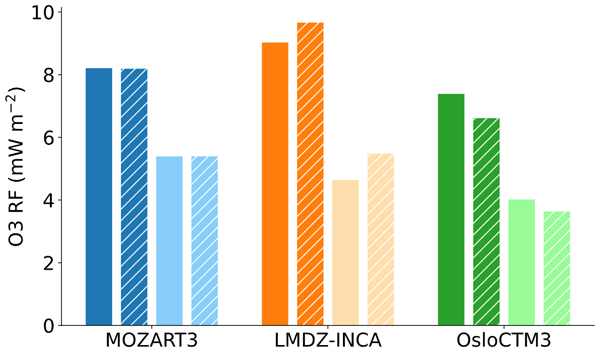
- Fig 3: to be honest I find it hard to keep in mind what the lighter vs darker colours and hatching vs no hatching mean; maybe it's because hatching="darker" doesn't fit with SSP1 (being weaker emissions than SSP3), when dark solid colour goes with SSP3 emissions? I know it's a pain changing figures, and it's not wrong. But if you change it, I would vote for showing hatching(=kind of darker) for "dirtier" SSP3 background emissions, not "cleaner" SSP1 background emissions. (Later: you are consistent though in using hatching for SSP1 background again.)
- Fig 3: in fact the caption currently says "SSP1 and SSP3 (darker and lighter colours respectively)" which I think is the wrong way round.
- L343 "Unger et al. 2013)" spurious parenthesis
- L352 the "m-2" is currently broken across a line at the end, maybe meaning it is the wrong sort of dash/minus sign?
Citation: https://doi.org/10.5194/egusphere-2025-5914-RC1 -
RC2: 'Comment on egusphere-2025-5914', Anonymous Referee #2, 26 Jan 2026
Review of “Impact of future aircraft NOx emissions on atmospheric composition and climate: dependence on background conditions”, by Zosia Staniaszek et al.
General comments
This is a welcome and interesting study that adds important new model results on the topic of aviation NOx and climate. My main concern is that the exact model experiment set-up is not sufficiently well described (in particular how methane is handled – and the consequences of fixing it). The authors conclude that it is important to let methane run free (I completely agree) so that its response can be better modelled. But in the meantime, these experiments where it is fixed need to be better explained so that the total impact of NOx emissions can be analysed and compared between studies. Some early studies that did allow methane to respond are not discussed, and that feels like an important omission. If this can be amended and the manuscript clarified as requested below, then I would be much more likely to be supportive of final publication in ACP.
Specific comments
L86: Somewhere in the Methods section, it should be explained how methane is handled. I believe it is a fixed lower boundary condition, and the methane responses to NOx are estimated indirectly. This should be clarified at an early stage in the paper.
L105: Related to previous comment – if you only run for 4 years (and analyse last 3 years), then my question is: how is methane handled? (And the answer is: it is fixed).
L115 Table 2: Document somewhere (probably in the is table) what the aviation NOx emissions, and the background (total) other NOx emissions, in each scenario/experiment are (in Tg N/yr).
L141: Even if the “method” related to the “non-steady state factor” are described in Berntsen et al. 2005 (etc.), some summary explanation of the method is required here. This is clearly some fudge-factor to cope with having fixed methane, but needing to calculate a methane response.
L145 “…steady state is not reached…” I am unclear what this means, since methane is prescribed, so it won’t respond in the experiments. What is meant by “methane steady state” in this context?
L146 Please explain what “overstates the response” means, and what non-steady state factors of 1.06 and 0.90 mean. I’m guessing if f_non-steady is >1 then assuming steady-state understates (rather than overstates) the response?
L150 Does equation [1] dimensionally balance? Please clarify the units of each term. I’m confused because I thought delta-CH4 was a change in mixing ratio, and the f factors were dimensionless. But then also the change in lifetime must have units of time, so something is wrong…
L155 Equation [2]: be explicit about the units. Are concentrations in ppbv, and RF in W/m^2?
L161 Presumably this conversion of RF -> ERF is also highly uncertain? Please comment on this further source of uncertainty.
L166 It is not entirely clear what “short-term” refers to. In the introduction, you mentioned that “long-term” referred to 5-10 year timescales. So, is short-term <5 years? Or are you equating long-term with the methane-related response, and short-term with everything else? Please clarify.
L 183 Related to previous – here you do define short-term with respect to methane – please say earlier.
L185-187 I wonder if part of the explanation of the model differences is related to model vertical resolution (EMAC has most levels; LMDZ has fewest levels).
191: Clearer to say overestimate UT and underestimate LS
L200 Figure 2. (a) I think a better axis label would be something like “Change in the (short-term) O3 burden due to aviation”. (b) Suggest add zero line (axis). (d) Clarify caption – normalised by change in annual total NOx emissions?
L216 Do you also look at the long-term O3 (via CH4) response?
L222 Document the TgN changes (see comment on Table 2).
L223 Are these global annual mean?
L229 Clarify aircraft emissions
L242 Do you know for sure that the differences due to the model grids being difference are definitely “small”? Perhaps replace small with “some”, unless you have tested this and shown they really are small.
L250 Figure 3. Clarify these are annual mean responses. Can you clarify how seasonal variations in response are averaged, and that seasonal variations do not contribute in any way?
For 3(b) can you comment on how the number of levels contributes to the sharpness of the response in these vertical profiles? (LMDZ-INCA, with the fewest levels, appears to have the broadest response).
L251 …higher changes in ozone concentration due to aircraft…
L253 ..lower changes in ozone…
L261 Figure S4 – I think I’d rather see background zonal mean NOx in SSP1/3 rather than the difference; and a log scale may be useful as I guess there are big differences between changes near the surface and in the UTLS.
L270 Figure 4. I was quite confused by this figure – is it the difference between scenarios of the difference in O3 due to aircraft emissions? Please clarify if it is this.
L277 “a higher background response” – Clarify what is meant. Is it a higher response to varying the background, or a larger change in the background?
L279 Do you mean less transport of surface emissions to the UTLS?
L283 Would it be sensible to normalise the responses? (to the magnitude of the change in aviation emissions)
L304 Clarify by ‘long-term’ ozone, do you mean the ozone related to changes in methane?
L309 Figure 5: By “long-term” do you mean time-integrated to infinity (or 100 years) or what? (Maybe infinity and 100 years are the same).
I suggest remove “Net” from the y-axis label (as net only applies to the dots, and it is in the legend).
If error bars were able to be included on the net terms, would these all span zero? (I suspect so).
L330 The mysterious “steady-state factor” turns out to be rather crucial to your end results… hence the need to clarify what this is earlier.
L338 and L385 I totally agree that methane emission-driven models are important. With this in mind I find it odd that some of the early work on these topics that did use methane emission-driven models (e.g., Wild et al., 2001; Stevenson et al., 2004) is not discussed.
Technical comments
L84-88 (and throughout): capitalize “section” references.
Table 1: The in-table references (Price et al., etc.) are missing from the reference list.
L343 Unger et al. (2013)
References
Stevenson, D. S., R. M. Doherty, M. G. Sanderson, W. J. Collins, C. E. Johnson, and R. G. Derwent (2004), Radiative forcing from aircraft NOx emissions: Mechanisms and seasonal dependence, J. Geophys. Res., 109, D17307, doi:10.1029/2004JD004759.
Wild, O., M. J. Prather, and H. Akimoto (2001), Indirect long-term global radiative cooling from NOx emissions, Geophys. Res. Lett., 28, 1719–1722.
Citation: https://doi.org/10.5194/egusphere-2025-5914-RC2 -
AC1: 'Author response to reviewers', Zosia Staniaszek, 16 Mar 2026
The comment was uploaded in the form of a supplement: https://egusphere.copernicus.org/preprints/2025/egusphere-2025-5914/egusphere-2025-5914-AC1-supplement.pdf
Peer review completion
Journal article(s) based on this preprint
Data sets
Perturbation simulations for aircraft NOx and aerosol emissions in present day and future: multi-model data from the ACACIA EU project Y. Cohen et al. https://zenodo.org/records/16949722
Viewed
| HTML | XML | Total | Supplement | BibTeX | EndNote | |
|---|---|---|---|---|---|---|
| 2,437 | 1,603 | 148 | 4,188 | 627 | 213 | 189 |
- HTML: 2,437
- PDF: 1,603
- XML: 148
- Total: 4,188
- Supplement: 627
- BibTeX: 213
- EndNote: 189
Viewed (geographical distribution)
| Country | # | Views | % |
|---|
| Total: | 0 |
| HTML: | 0 |
| PDF: | 0 |
| XML: | 0 |
- 1
Zosia Staniaszek

Didier A. Hauglustaine
Yann Cohen
Agnieszka Skowron
Sigrun Matthes
Robin Thor
Marianne T. Lund
The requested preprint has a corresponding peer-reviewed final revised paper. You are encouraged to refer to the final revised version.
- Preprint
(2748 KB) - Metadata XML
-
Supplement
(1007 KB) - BibTeX
- EndNote
- Final revised paper
General comments (overall quality)
Specific comments (scientific questions/issues)
Technical corrections (typos etc)