
the Creative Commons Attribution 4.0 License.
the Creative Commons Attribution 4.0 License.
 | 04 Dec 2025
Microbial role in CO2 fluxes along the river-estuary continuum in a rapidly uplifting catchment of eastern Taiwan
Abstract. The contribution of river metabolisms to carbon cycling is an essential issue, but not well examined in the catchment susceptible to the modulation of active tectonics. This study aims to quantify the rates of autotrophy and heterotrophy, and to identify the community compositions and potential members involved in these microbial processes in the Beinan River in eastern Taiwan. To address this, river water samples were collected in both the wet and dry seasons for incubations amended with 13C-labeled dissolved carbon dioxide and amino acids. The analyses revealed a general pattern pointing to the higher rates in the wet season than in the dry season, and for heterotrophy than for autotrophy. The obtained rates were further scaled up, resulting in the catchment-scale CO2 evasion of ~ 107 mole yr-1, a range constituting several percent of the CO2 flux derived from pyrite-induced weathering, oxidation of petrogenic carbon, and the river-air exchange. The community compositions generally varied with season for most upstream sites and with more abundant sulfur or nitrogen metabolizers in the wet season, as opposed to more abundant phototrophs or heterotrophs in the dry season. This study highlights the complex and dynamic nature of river metabolisms that contribute to carbon evasion in oligotrophic mountainous systems prone to the impacts of rapid uplift and erosion.
-
Notice on discussion status
The requested preprint has a corresponding peer-reviewed final revised paper. You are encouraged to refer to the final revised version.
-
Preprint
(6364 KB)
-
Supplement
(6178 KB)
-
The requested preprint has a corresponding peer-reviewed final revised paper. You are encouraged to refer to the final revised version.
- Preprint
(6364 KB) - Metadata XML
-
Supplement
(6178 KB) - BibTeX
- EndNote
- Final revised paper


Journal article(s) based on this preprint
Interactive discussion
Status: closed
-
RC1: 'Comment on egusphere-2025-5904', Anonymous Referee #1, 20 Feb 2026
-
AC1: 'Reply on RC1', Jhennien Chen, 06 Apr 2026
General comments
Comment1: This is a nice and thorough study on metabolic rates in dynamic turbid river systems in a tectonic active area. The use of isotopic labelling of DIC and amino acids in combination with environmental parameter measured in field campaigns and characterisation of the microbial community composition is an impressive achievement. Although at some point it is questionable if all this information in one paper is contributing to the communication of the main message and findings (e.g. are alpha diversity, Shannon index beta diversity needed?). The storyline can be strengthened in the intro and discussion if more focussed hypothesis are formulated.
Reply 1: Thank you for the reviewer’s constructive feedback regarding the focus and storyline of the manuscript. While we agree that the metabolic rates are the primary focus of this study, we have chosen to retain the diversity data (Fig. 4a) as it provides critical evidence for the ecological resilience and metabolic stability of specific sites within this dynamic river system. To address the concern, we have revised the Introduction to provide a better cohesive narrative, specifically investigating whether extreme physical disturbances drive community shifts or if inherent resilience allows for stable carbon transformation. In the revised Discussion (section 4.6), we used these diversity indices to explain two distinct metabolic scenarios: i) seasonal sensitivity at high-sediment MLL01 and LY04 where significant reduction in alpha diversity during the wet season provides the ecological context for more variable metabolic rates; and ii) metabolic versatility at CWL01, where high baseline diversity and a complementary seasonal shift between Cyanobacteria and lithoautotrophs allow for stable carbon transformations despite high turbidity. The revised content (also in the Result, lines 345-348) makes the diversity indices from descriptive statistics into essential mechanistic context for the Beinan River’s carbon cycle.
Comment 2: The objective of this study was to get insights in the role of microbial CO2 fluxes at catchment scale and disentangling the metabolic processes of autotrophic and heterotrophic CO2 exchange in these understudied dynamic mountainous river systems in contrast to the more stable low-land catchments. The sampling strategy and major findings reported (seasonal shifts in metabolic wet-vs dry), although nice, do not seem to fully comply with my view of a study major strength to determine the effect of event-based flushes of groundwater and sediments on CO2 fluxes.
Furthermore, while Wang et al 2024 identified the effects of hot springs on the enrichment of waters with bicarbonate in the same sample locations in the tectonic active Beinan catchment this is not mentioned in this study. Is this not relevant in the total CO2 flux or is it included?
Reply 2: Thank you for the comment on the dynamic nature of the Beinan catchment and the role of groundwater and hot spring inputs. Regarding the sampling strategy, we agree that capturing discrete event-based flushes such as storm-triggered pulses of groundwater and sediment would be an ideal approach when studying CO2 fluxes in mountainous systems. However, the logistical and safety constraints of performing in situ isotope labeling incubations during such extreme flow events is often a challenging consideration to acquire a representative sample. In the mountainous catchments in Taiwan, the high-energy wet season effectively represents a series of frequent event-based flushes that maintain the chronically high turbidity and sediment mobility we observed. Our bi-monthly sampling scheme was designed to establish a systematic seasonal baseline to evaluate metabolic stability across the hydrologic year, capturing the distinct transition between the dry (January - May) and wet (August) seasons of southeastern Taiwan. Notably, the August 2020 sampling coincided with high-turbidity conditions (Fig. S1), providing a representative data point analogous to ‘event-like’ conditions that can be directly contrasted with the lower-flow baseline periods. The sampling strategy has been further clarified in the revised manuscript (lines 120 - 124).
Regarding the potential influence of hot spring inputs, we have carefully evaluated our physicochemical dataset (Table S1) for signatures of hot spring inputs across all sites and seven field campaigns. We observed no localized anomalies in water temperature (T), suggesting that geothermal inputs are primarily limited to the hot spring outcrops, not a prevalent distribution across the whole flow path. While some geochemical signatures (e.g., Cs ions) are sensitive to the detection of hot springs or subsurface high-temperature water-rock interactions in the region (Wang et al., 2024), water chemistry data revealed limited overall contribution of hot spring-sourced ions regardless of seasons. Furthermore, our molecular analyses did not detect a substantial presence of populations specifically originating from hot environments or groundwater. Taken together, geochemical and microbial community data indicate that hot spring or groundwater does not impose a high volumetric contribution to the river water, community composition, metabolism, or even CO2 emission. Their contribution would be more significant at the intersection between hot fluid and river water. Nevertheless, the level of hot spring or groundwater contribution to river metabolism and community composition cannot be quantitatively constrained with the current experimental and sampling framework, and beyond the scope of the current investigation.
Comment 3: What about redox situation in the streams influenced by tectonics? Is CH4 exchange not relevant?”
Reply 3: Thank you for the question regarding the redox status and the potential relevance of CH4 exchange. Our unpublished in situ measurements conducted later (2023-2025) indicate that the Beinan River remains in a consistently oxidizing state, with oxidation-reduction potentials (ORP) staying positive across all sites (+18 to +238 mV). This is consistent with the fact that in such high-energy, turbulent mountainous streams, the steep topography facilitates rapid and continuous re-aeration, maintaining aerobic conditions throughout the water column. Methanogenesis typically requires strongly reducing conditions (negative ORP), which are absent in this system due to the lack of stagnant zones and frequent sediment scouring. Furthermore, the chronically low organic substrate availability in this catchment further limits the potential for microbial fermentation. Consequently, we consider CH4 exchange to be a negligible component of the total carbon efflux compared to the dominant CO2 evasion. Overall, the fundamental physical characteristics of the Beinan River - its steep gradient, high turbulence, and frequent sediment scouring - have enabled persistently aerobic conditions through time across the catchment.
Specific comments
Comment 4: Abstract line 18 “several percent” please be more specific here. 107mol yr-1 from microbial origin vs annual total emission across the catchment 2,6 .109 ? (Line 295).”
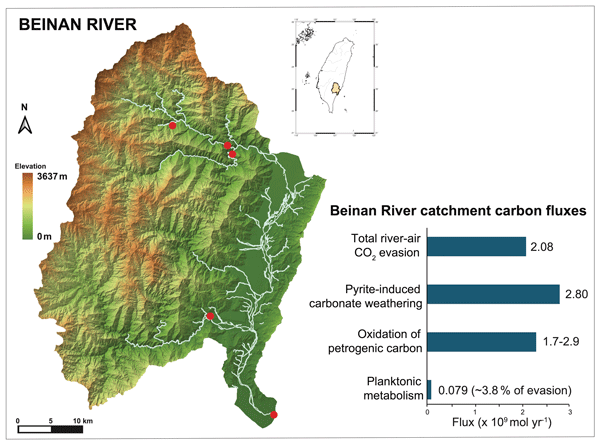
Reply 4: Thank you for the comment. We have updated the Abstract and the main text (lines 21 and 332-334) to provide the specific percentage as requested. Based on our scaled estimates, the total microbial net emission is 7.89 x 10⁷ mol yr-1 (summed from individual tributaries in Table S5). When compared to the total annual CO2 emission across the catchment calculated in Table S6 (average of 2.08 x 10⁹ mol yr-1 across the five sampling campaigns), the microbial contribution represents approximately 3.8% of the total catchment-scale CO2 evasion. We have replaced ‘several percent’ with ‘approximately 3.8%’ to be more precise.
Comment 5: Line 38 landscape controlled or is it more topographically controlled?”
Reply 5: Thank you for the comment. We have modified the sentence (line 42) to state that CO2 flux is primarily topographically controlled in this study. In the upstream reaches of the Beinan River, the steep topographic relief and rugged channel morphology increase turbulence and gas transfer velocities, leading to the higher CO2 evasion rates observed compared to the lower-gradient downstream reaches.
Comment 6: Line 68 term “individual metabolisms” needs more clarification.
Reply 6: Thank you for the comment. We have clarified the term “individual metabolism” in the revised manuscript (lines 74-77). It refers to the distinct metabolic pathways of carbon transformation quantified in this study, including photoautotrophy (light-dependent DIC fixation), chemoautotrophy (dark DIC fixation), and heterotrophy (mineralization of dissolved organic carbon).
Comment 7: Lines 59-61 The information in this sentence is essential why this study in a rapid uplifting area is so different from the dominant body of literature in this field which is performed on the cratonic continent. While this relation between tectonics and torrential precipitation is a probably obvious for the authors this is not evident for everyone. It would help the storyline if this is relation between tectonics and dynamic, turbid high energy river systems is more explicit.
The expected deviations from the general bentic and hyporheic processes due to the turbid and dynamic river systems can be formulated more explicitely in hypothesis which will give ther reader more guidelines for interpretation in the result section.
Reply 7: Thank you for the comment. We have revised the Introduction (lines 72-74) to explicitly contrast our study system with the cratonic continental systems commonly addressed in the literature. We hypothesized that the intense geological and hydrological impacts of a rapid-uplift area create a physically unstable river environment. In such high-energy systems, the planktonic community constitutes a measurable and vital component of aquatic metabolism. Nevertheless, our incubation experiments only determine the metabolic activities and assemblages of planktonic communities. To constrain benthic and hyporheic processes and metabolic activities, oxygen sensors have to be deployed in the river channel. Once the activities of whole river metabolisms are deduced, the sum of metabolic activities in benthic and hyporheic processes can be constrained by subtracting the activities of planktonic metabolisms (like this study) from the whole activities. The deployment of sensors in turbid environments like those during high water time in Taiwan would be logistically challenging and beyond the scope of the current study.
Comment 8: Line 107-108, The selection of the 5 sample locations along the Beinan rver and tributaries is not explained. Which criteria were used to determine these sample sites? Likewise no argumentation is provided for the selection of sample moments/ timing. As the dynamic nature of the Beinan river is a part of the research objective the regular bi-monthly sampling scheme is surprising. One would expect a focus on events ( hot moments) and baseline moments.
Reply 8: Thank you for the comment. We have revised the text (lines 119-124) to explicitly state that the five stations were chosen to represent individual sub-basins of the catchment and a topographic gradient that captures the transition from metamorphic headwater tributaries to the main stem. This sampling design allows us to observe how shifts in lithology and catchment characteristics influence microbial community structure and metabolic rates.
Regarding the sampling frequency, while we acknowledge the importance of “hot moments” (e.g., extreme storm events), our objective was to establish a systematic seasonal baseline to evaluate metabolic stability across the hydrologic year in such a dynamic system. The bi-monthly scheme was designed to capture the first-order seasonal transition between the dry (January - May) and wet (August) seasons of southeastern Taiwan. As discussed in reply 2, performing in situ isotope labeling incubations during peak storm discharge presents substantial logistical and safety challenges. Notably, the August 2020 sampling coincided with high-turbidity conditions, providing a valuable “event-like” data point to contrast with lower-flow baseline periods (Figure S1). While event-focused sampling would enable us to resolve the highly temporal variations in metabolic activity in response to extreme hydrological and geomorphic processes, our current sampling design and interval offer the characterization of the metabolic activities representative for the investigated sub-basins over a yearly time scale. We are aware that the current dataset represents temporal snapshots of the planktonic metabolisms in a highly dynamic catchment. A long-term plan (probably at a decadal scale) of sampling and analysis would better resolve the variation in ecosystem function and activity and how hydrological and geological processes shape such variations.
Comment 9: Line 115. The use of cellulose membranes is not common practice and strongly discouraged in research on carbon dynamics due to the risks of contamination. Especially for DOC determination. The same is true for the use of polypropylene sample containers (risk of DOC contamination).
Reply 9: Thank you for the comments on these technical details. We have clarified the materials for sampling and processing in the revised manuscript (lines 130-134) to correct these typos. The filters used were actually made of Supor® (Hydrophilic Polyethersulfone, PES), not cellulose. PES is a low-protein-binding material widely preferred in aquatic biogeochemistry for its minimal organic leaching and high flow rates. DOC samples were collected and stored in high-density polyethylene (HDPE) bottles, rather than polypropylene. To ensure data quality, all HDPE bottles were pre-cleaned (acid-washed and triple-rinsed with Milli-Q water). We also conducted procedural blanks by processing Milli-Q through the entire filtration and storage assembly. The resulting DOC concentrations in these blanks were consistently below the limit of detection, confirming that our materials did not introduce carbon contamination.
Comment 10: Line 386: is this influenced or correlation based?
Reply 10: Thank you for the comment. The statement regarding the relationship between DIC uptake rates and environmental variables (TSM, POC, δ¹³C-POC, and ammonium) was based on Pearson correlation analysis (p < 0.05). To be more precise, we have rewritten the sentence (line 429) to state that these rates were significantly correlated with these parameters, rather than ‘influenced’ by them.
Comment 11: Figure 3 needs a more elaborate figure caption.
Reply 11: Thank you for the comment. We have significantly expanded the figure caption to clearly define the metabolic pathways represented in each panel: light/dark DIC uptake (autotrophy) and amino acid uptake/catabolism (heterotrophy). We have also added a note explaining that the error bars represent the standard deviation of triplicate measurements.
-
AC3: 'Further Reply on RC1', Jhennien Chen, 25 May 2026
Further Reply 1:
The original Reply 1 was prepared during the initial revision round (responding to Reviewer 1’s comments). In the subsequent editorial revision round (responding to the editor’s Comment 17, 22, and 23), additional changes have been made to the manuscript that affect the content described above. The first category of changes involves statistical additions. PERMANOVA on Bray-Curtis dissimilarity confirms that community composition is significantly structured by site (R2 = 0.30, p = 0.001), and CCA with envfit identifies TSM, POC, δ¹³C-POC, and DOC as significant environmental drivers (all p < 0.01; Fig. 5). These analyses reinforce the ecological argument for retaining the diversity data, but were not yet performed at the time the original Reply 1 was written. The second category involves wording adjustments in the manuscript to match the new test results. The phrase “significant reduction in alpha diversity during the wet season” cited in the original Reply 1 has been softened to “descriptively lower wet-season alpha diversity” in the revised Discussion (Section 4.6), because Kruskal-Wallis tests did not detect significant differences among sites or between seasons (all p > 0.08). The “complementary seasonal shift“ framing at CWL01 has likewise been softened to “apparent seasonal shifts”. The two metabolic scenarios outlined in Reply 1, seasonal sensitivity at high-sediment sites (MLL01, LY04) and metabolic versatility at CWL01, remain intact in the revised Discussion.
Further Reply 2 and Reply 8:
The sampling strategy described in Reply 2 is now organized into two parts of the revised manuscript, with site selection in Section 2.1 and sampling timing in Section 2.2.
Further reply 11:
The Figure 3 caption has been further elaborated since the original Reply 11. In response to Reviewer 2 Comment 15, insets on a logarithmic scale have been added to panels (b) and (c) to display low values clearly, and the replication level has been clarified to specify n = 3 for light DIC and amino acid incubations and n = 1 for dark DIC incubations. In response to the editor’s Comment 21, statistical annotations have been added directly to the figure. Lowercase letters (a, ab, b) above bars in panel (a) indicate significant among-site differences in August (Kruskal-Wallis with Dunn’s post-hoc test), and asterisks following site names indicate significant within-site temporal variation (Kruskal-Wallis). These additions extend the caption elaboration beyond what was described in the original Reply 11.
Citation: https://doi.org/10.5194/egusphere-2025-5904-AC3
-
AC3: 'Further Reply on RC1', Jhennien Chen, 25 May 2026
-
AC1: 'Reply on RC1', Jhennien Chen, 06 Apr 2026
-
RC2: 'Comment on egusphere-2025-5904', Anonymous Referee #2, 16 Mar 2026
The manuscript describes the role of microbial C assimilation and respiration along a Taiwanese river continuum.
The experimental work was conducted at seven timepoints for five locations. For four of them, phototrophy and autotrophy were determined using 13-DIC and two of these also quantified heterotrophy using two 13C-labelled amino acids (1 x summer, 1 x winter). These detailed 13C studies are complemented by environmental parameters and geochemical analyses at all campaigns and 16S rRNA analyses at five. The combination of 13C-labelling and genomic analyses represents highly complementary methodology that can bring new insight into the contribution of the riverine microbial community to CO2 flux from such a system.
Major concerns
The manuscript lacks hypotheses and the introduction and later discussion would benefit from, especially to interlink the different datasets.
The labelling design for the DIC aims to enrich to ~5% of the DIC pool, which is consistent with wider stable isotope probing approaches to provide sufficient enrichment while minimising perturbation of the system by excess increase of the pool. However, the extent of addition for the amino acids does not follow this. A final concentration of 50 µM when the DOC concentration (which is made up of much more than just free amino acids) is between 20-80 µM represents a significant increase in the pool size. While it is acknowledged that rates determined may be stimulated as a result (line 139-140) and I appreciate that rates were still often below detection limits, this very important caveat is lost later in the manuscript. This is especially important to consider when these values are then scaled up to the catchment level but could hugely overestimate actual metabolic fluxes from organic pools. These limitations need to be made much clearer both in the methodology and when you upscale these values to a catchment level.
Furthermore, there is no consideration of co-added N for the amino acids (C:N 2:1 glycine; 6:1 leucine) which may also influence the diverging processing of the two amino acids (i.e. if being utilised for N and C is largely being respired, glycine is a much more efficient resource to use than leucine). How the underlying biochemistry may control the observed rates is severely lacking, but important rationale given you select leucine to represent a conservative estimate of heterotrophic activity without any rationale other than it is lower (line 221-222). At points (e.g. Line 444-447), it is implied there is direct uptake but there is no evidence to support this. Finally have the authors considered that only one C position was labelled for both amino acid forms?
Minor comments:
The abstract needs to expand briefly on the rationale behind this work.
Line 11: “issue” is vague – is problem or unknown more precise?
Line 15: higher rates of what? Both hetero and autotrophy? Add some values / relative differences of these rates into the abstract.
Line 72: states that the Beinan River has some of the highest sediment exports and weathering rates in Taiwan. It would be beneficial to put this on a larger context beyond country-specific for an international journal.
Line 74: why were leucine and glycine selected?
Line 154: Should be ICP-MS
Line 178: Formatting of equation is strange
Line 183-184: Why was the instream δ13C not measured? This is an important end member.
Line 250: TSM should be defined at first time of use in main text (only defined in footnote of subsequent table).
Line 254: “smaller” to indicate more negative delta values should be replaced by terminology like “more depleted” as is used in other areas of the MS.
Line 255-256: This states that ammonium was higher in the wet season than the dry season however this was not significant based on Table 2 – please clarify. If it is the case it is as some sites, they could be bold in the table rather than just the heading to provide these site-specific differences.
Figure 3: due to some very high values, it is very difficult to see the low values in panel b and c; in caption state replication level and what the error bars represent (standard error of the mean? Standard deviation?). Also need to state limit of detection.
The statistical analyses need to be improved as only applied to river chemistry data.
Line 356: You call this organic matter degradation – but you have only looked at final mineralisation step of these processes. Depolymerisation is generally considered the rate limiting step, so the fluxes quantified only reflect one, generally very rapid, stage of organic matter degradation.
Line 359-370: There are a lot of assumptions or suggestions here just for ammonium concentrations which are point measurements only that is limited to determine in situ production especially when high additions of organic nitrogen may influence ammonification rates. The production rates are more potential rather than true so this caveat must be extended to residence times.
Line 401-410: were there any links with the community observed i.e. riverine vs. soil? More primary producers downstream where input from surrounding catchment is relatively less and more processed/recalcitrant therefore rely more on primary producers? Currently only consider the nutrients as a control here but community may also reflect this and provide additional support to this suggestion.
Citation: https://doi.org/10.5194/egusphere-2025-5904-RC2 -
AC2: 'Reply on RC2', Jhennien Chen, 06 Apr 2026
Major comment
Comment 1: The manuscript lacks hypotheses and the introduction and later discussion would benefit from, especially to interlink the different datasets.
Reply 1: Thank you for the comment. We have restructured the final paragraph of the Introduction to integrate testable hypotheses with the more explicit objectives. Specifically, we hypothesized that i) the seasonal transition to the wet season (characterized by higher temperatures, elevated nutrient availability, and increased particulate organic matter loading) would broadly shift planktonic metabolic activity, particularly phototrophic/autotrophic and heterotrophic production and respiration; and ii) these seasonal hydrological changes would be also reflected in shifts in microbial community composition; iii) in this physically unstable, chronically turbid catchment, frequent sediment mobility would drive temporal variability in planktonic metabolic rates and their relative contribution to the riverine CO2 evasion.
Comment 2: The labelling design for the DIC aims to enrich to ~5% of the DIC pool, which is consistent with wider stable isotope probing approaches to provide sufficient enrichment while minimising perturbation of the system by excess increase of the pool. However, the extent of addition for the amino acids does not follow this. A final concentration of 50 µM when the DOC concentration (which is made up of much more than just free amino acids) is between 20-80 µM represents a significant increase in the pool size. While it is acknowledged that rates determined may be stimulated as a result (line 139-140) and I appreciate that rates were still often below detection limits, this very important caveat is lost later in the manuscript. This is especially important to consider when these values are then scaled up to the catchment level but could hugely overestimate actual metabolic fluxes from organic pools. These limitations need to be made much clearer both in the methodology and when you upscale these values to a catchment level.
Reply 2: Thank you for the comment. The relationship between substrate concentration and microbial activity has been formulated by Michaelis-Menten kinetics (Wright and Hobbie 1966) and applied to numerous laboratory and field studies. In this framework, the uptake or metabolic rate (V) is a saturating function of substrate concentration [S]: V = Vmax ∙ [S]/ (Km + [S]). Km is the [S] at which the reaction rate is half of Vmax. When [S] >> Km, V approaches Vmax regardless of further increase in concentration, and the community operates near its maximum metabolic capacity. When [S] << Km, V scales nearly linearly with [S] and better reflects possible rates for the target setting. The critical question, therefore, is whether such a relationship and its embedded parameters can be universally applied or valid for most natural settings.
We set out to examine and compare the previously studied examples with our settings. By searching for the literature, we found out that published Km values for low-molecular-weight organic substrates in freshwater and marine systems are consistently in the sub-µM to low-µM range. For example, Brailsford et al. (2019) reported Km values of 1.41 µM for amino acid mixtures with a corresponding Vmax of 0.0004 µmol ml-1 h-1 (4.8 mg-C m-3 h-1) for oligotrophic river water. Boysen et al. (2022) reported half-saturation constant (Kt+S) of 11-79 nM for glycine betaine in oligotrophic North Pacific communities, with Vmax of 0.36 - 0.56 nM h-1 (0.022 - 0.034 mg-C m-3 h-1). By applying the relationships for these two settings, our added substrate concentrations (50 µM) well exceeded the Km values for both cases. Therefore, the projected rates would all reach respective Vmax values. Our highest uptake rates spanned from 0.49 mg-C m-3 h-1 for glycine to 0.12 mg-C m-3 h-1 for leucine, a range falling between these two reported Vmax values by a great margin. The results suggest that the reported kinetics cannot accurately project our field conditions. Alternatively, our rates were input into the kinetic relationships to derive the possible effective substrate concentrations for the target metabolisms. Since our rates were much greater and less than the Vmax values for marine and freshwater settings, respectively, such computation practice can only be applied to the freshwater kinetics. Our calculation revealed that the potential effective substrate concentrations were 0.16 µM for glycine and 0.036 µM for leucine. Such a range of substrate concentrations was well below our added concentrations, suggesting that our experimental setting may not stimulate the target metabolic activity as generally thought.
Nevertheless, the comparison between our results with previous studies suggests a likelihood that our amendment of amino acids may not necessarily stimulate microbial activity. However, the comparison also highlights that each system or setting may be inherited with its specific kinetic relationships. A dedicated experiment amended with a series of substrate concentrations and rate measurements is required. We therefore cannot confidently assert that our measured rates approximate true in situ fluxes, and we agree with the reviewer that the catchment-scale estimates could be reframed since the experimental constraints could be placed as the maximum potential metabolic rates. That is to say, the relative contribution of water column metabolic rate to the total CO2 evasion would be even less than our original estimates.
We have incorporated these lines of discussion into the revised form in section 4.5 (lines 541-553) to justify the amended concentration and its implications for the contribution of planktonic metabolic rates to the catchment-scale CO2 evasion.
Comment 3: Furthermore, there is no consideration of co-added N for the amino acids (C:N 2:1 glycine; 6:1 leucine) which may also influence the diverging processing of the two amino acids (i.e. if being utilised for N and C is largely being respired, glycine is a much more efficient resource to use than leucine). How the underlying biochemistry may control the observed rates is severely lacking, but important rationale given you select leucine to represent a conservative estimate of heterotrophic activity without any rationale other than it is lower (line 221-222). At points (e.g. Line 444-447), it is implied there is direct uptake but there is no evidence to support this. Finally have the authors considered that only one C position was labelled for both amino acid forms?
Reply 3: Thank you for the comment raising the consideration of difference in C:N ratio between the two amino acids (2:1 for glycine and 6:1 for leucine). While both molecules provide a single nitrogen atom, glycine provides substantially higher nitrogen-to-carbon density. In principle, this stoichiometric advantage makes glycine a more efficient nitrogen source in nitrogen-limited systems, as bacteria can acquire nitrogen while respiring fewer carbon bonds. However, dissolved inorganic nitrogen concentrations in the Beinan River (TIN: 5.7 - 30.6 µM; NH4+: 2.6 - 4.9 µM in average, Table 1) suggest that strict nitrogen limitation is unlikely to be the sole driver of glycine preference in this system. Instead, the observed preference likely reflects the greater metabolic efficiency of glycine-centered pathways: the reductive glycine pathway (rGlyP) supports biomass yields up to 17% higher than other carbon assimilation cycles (Dronsella et al., 2025). Furthermore, the glycine cleavage system (GCS) enables rapid, streamlined energy generation from a simple 2-carbon substrate (Kikuchi et al., 2008). Thus, while favorable C:N stoichiometry may contribute under episodically nitrogen-limited conditions, the metabolic efficiency of glycine metabolism provides a more consistent explanation for the observed preference. We have incorporated this discussion into the manuscript (Discussion section 4.4, lines 508-519).
The contrasting metabolic fate of leucine further supports its use as a conservative baseline for heterotrophic activity. In aquatic microbial ecology, leucine is the standard proxy for bacterial protein synthesis (Kirchman et al., 1985; Kirchman, 2001). As a branched-chain amino acid, leucine catabolism requires at least six enzymatic reactions: transamination to ⍺-ketoisocaproate, oxidative decarboxylation to isovaleryl-CoA, followed by sequential dehydrogenation, carboxylation, hydration, and cleavage steps to ultimately yield acetyl-CoA and acetoacetate for entry into the TCA cycle (Massey et al., 1976; Brosnan and Brosnan, 2006) - requiring substantial enzymatic machinery including biotin-dependent carboxylases and multiple CoA-dependent enzymes. Consequently, bacteria typically prioritize leucine incorporation into proteins rather than respiratory oxidation (Kirchman, 2001). This anabolic preference means that leucine-based rate estimates are inherently conservative relative to glycine. By scaling catchment CO2 evasion estimates using these lower leucine-derived rates, we provided a minimum boundary for the contribution of planktonic metabolism to the total carbon flux, ensuring the implications were not overestimated by transient responses to high substrate availability. The rationale for choosing leucine has been stated in the Discussion (lines 515-519).
Regarding the labeling position, we are well aware that only the C-1 (carboxyl) position was 13C-labeled for both amino acids (indicated in line 202). The C-1 carboxyl group is typically the first carbon released as CO2 during initial catabolic steps, including oxidative deamination and decarboxylation reactions (Massey et al., 1976; Kikuchi et al., 2008). Therefore, our 13C-DIC measurements specifically track the initial oxidative decarboxylation potential of these substrates, representing the immediate respiratory capacity of the microbial community. Our 13C-biomass measurements also track incorporation of the C-1 position into cellular material; however, if cells preferentially remove the carboxyl group before assimilating the remaining carbon skeleton, assimilation rates may represent minimum estimates. Altogether, as glycine is more readily metabolized and carboxyl positioned carbon is efficiently channeled into the production of CO2, the incubations amended with these two amino acids offer to bracket the possible range of metabolic activity for natural communities. We note that the selection of substrates at specific concentrations for incubations very likely deviates the detection from true rates. In fact, static incubations like this were conducted under conditions different from the field variation and setting at various degrees (e.g., constant luminance intensity and exemption of water flowing so the nutrient and substrate concentrations were not fixed). We were limited to mimic every parameters that may precisely fit in situ conditions. We have clarified the implications of C-1 labeling in the Materials and Methods section (lines 151-152).
Minor comment
Comment 4: The abstract needs to expand briefly on the rationale behind this work.
Reply 4: Thank you for the comment. We have expanded the abstract to provide a clearer rationale. We now explicitly state that in high-energy tectonic catchments, physical instability and turbidity likely constrain planktonic metabolic processes, which makes the quantification of contribution of planktonic metabolisms a critical but missing piece of the regional carbon budget.
Comment 5: Line 11: “issue” is vague – is problem or unknown more precise?
Reply 5: Thank you for the comment. We have revised the sentence to remove the vague term “issue”.
Comment 6: Line 15: higher rates of what? Both hetero and autotrophy? Add some values / relative differences of these rates into the abstract.
Reply 6: Thank you for the comment. We have revised the abstract to clarify what “higher rates” were referred to and to include representative values: Autotrophic DIC uptake rates ranged from 0.03 - 1.98 mg-C m-3 h-1, with higher values observed in the wet season. Heterotrophic amino acid assimilation rates were comparatively lower (0.004-0.49 mg-C m-3 h-1), yet heterotrophic catabolic rates were dramatically higher than autotrophic rates by one to two orders of magnitude (4.6 - 154.5 mg-C m-3 h-1), indicating that the riverine microbial community is strongly heterotrophic and driven primarily by respiratory carbon oxidation rather than biosynthesis. We have revised the abstract to state that heterotrophic catabolic rates exceeded autotrophic carbon fixation rates by one to two orders of magnitude, with both processes showing higher activity in the wet season than the dry season.
Comment 7: Line 72: states that the Beinan River has some of the highest sediment exports and weathering rates in Taiwan. It would be beneficial to put this on a larger context beyond country-specific for an international journal.
Reply 7: Thank you for the comment. We have revised the Introduction (lines 80-83) to place the Beinan River in a global context. We highlighted that the sediment yields in this system exceed the global average by one to two orders of magnitude (Hilton and West 2020), characterizing it as a critical global hotspot for land-to-ocean carbon transport.
Comment 8: Line 74: why were leucine and glycine selected?
Reply 8: Thank you for the question. Glycine and leucine were selected because they represent dissolved free amino acids (DFAA), the most readily bioavailable fraction of the dissolved organic matter (DOM) pool, which can be directly transported across cell membranes without requiring extracellular enzymatic hydrolysis (Kirchman, 2001). Beyond this general rationale, these two amino acids were specifically chosen because they represent contrasting ends of heterotrophic metabolism. Leucine is the established standard proxy for bacterial protein synthesis in aquatic microbial ecology (Kirchman et al., 1985; Kirchman, 2001), and its complex catabolic pathway makes it predominantly anabolic, providing a conservative lower bound for heterotrophic activity. Glycine, as the simplest amino acid with a favorable C:N ratio (2:1 vs. 6:1 for leucine), can be rapidly processed through streamlined pathways including the glycine cleavage system (GCS) and reductive glycine pathway (rGlyP) (Kikuchi et al., 2008; Dronsella et al., 2025), making it representative of the more labile, rapidly cycling fraction of the DFAA pool. Together, the two substrates allow us to bracket the range of heterotrophic strategies - from conservative protein synthesis to rapid catabolic turnover - within the riverine microbial community. We have incorporated part of this argument into the text.
Comment 9: Line 154: Should be ICP-MS
Reply 9: Thank you for this correction. We have corrected the text (line 177) to use the standard abbreviation ICP-MS.
Comment 10: Line 178: Formatting of equation is strange
Reply 10: Thank you for the comment. We have revised the formatting of the equation (line 201) to ensure it follows standard typesetting conventions. The new layout clearly displays the fraction components and the relationship between isotopic enrichment in the various carbon pools, making the calculation of uptake and catabolic rates more intuitive for the reader.
Comment 11: Line 183-184: Why was the instream δ13C not measured? This is an important end member.
Reply 11: Organic degradation imparts limited isotopic fractionation on the products, such as DOC and DIC. Therefore, their isotopic compositions resemble those of parental organic matter. In our system, major sources of organic matter are C3 plants and petrogenic organic carbon. Their isotopic compositions ranged from –29 to –25 permil (Lamb et al., 2006) and from –22 to –20 permil (Lien et al., 2025), respectively. Since petrogenic organic matter is more recalcitrant or polymerized, its degradation and conversion to DOC and DIC would be much slower when compared with soil organic matter. Its export to the river would also take a longer and more strenuous path through subsurface rock fabrics and geological structures in metamorphic terranes like in this study. Therefore, only the DOC pool produced from C3 plants is assumed to be linked to the biologically available pool related to this incubation experiment. Based on this, we consider and assume that the isotopic compositions of the DOC pool in our setting would resemble the typical C3 plant.
Comment 12: Line 250: TSM should be defined at first time of use in main text (only defined in footnote of subsequent table).
Reply 12: Thank you very much for the comment. We have revised the manuscript (line 278) to define TSM (total suspended matter) at its first occurrence in the main text. This ensures the abbreviation is clearly established before its subsequent use in the Results and Discussion sections.
Comment 13: Line 254: “smaller” to indicate more negative delta values should be replaced by terminology like “more depleted” as is used in other areas of the MS.
Reply 13: “Smaller” is referred to the delta values, while “more depleted” is referred to the relative abundances of 13C and 12C in the designated entity. Either way is accepted and suitable in terminology usage. Nevertheless, we have revised this (line 282) to accommodate the convention commonly used by part of the isotope community.
Comment 14: Line 255-256: This states that ammonium was higher in the wet season than the dry season however this was not significant based on Table 2 – please clarify. If it is the case it is as some sites, they could be bold in the table rather than just the heading to provide these site-specific differences.
Reply 14: Thank you very much for identifying this discrepancy. This was an error when formatting Table 2. The ammonium concentrations were indeed significantly different between the wet and dry seasons across the catchment, as confirmed by a Wilcoxon test (p < 0.05). We have revised the header in Table 2 to accurately reflect this statistical significance.
Comment 15: Figure 3: due to some very high values, it is very difficult to see the low values in panel b and c; in caption state replication level and what the error bars represent (standard error of the mean? Standard deviation?). Also need to state limit of detection.
The statistical analyses need to be improved as only applied to river chemistry data.
Reply 15: Thank you for the comments. We have revised Figure 3 accordingly. To better present the low values in panels (b) and (c), we have added insets showing the same data on a logarithmic scale. This allows both the high and low values to be clearly visualized. We also updated the caption to state the replication level (n=3 for all light and amino acid incubations) and to clarify that error bars represent standard deviation. For panel (b), dark incubations were conducted with a single measurement per site per date (n=1). Values below zero were not shown in the figure. The statistical analyses have been conducted for the data, and annotated specifically in the figure. Relevant methodological details, statistical analyses, and interpretation of these patterns have been incorporated in the revised manuscript.
Comment 16: Line 356: You call this organic matter degradation – but you have only looked at final mineralisation step of these processes. Depolymerisation is generally considered the rate limiting step, so the fluxes quantified only reflect one, generally very rapid, stage of organic matter degradation.
Reply 16: Thank you for this clarification. We agree that our incubation-derived rates specifically capture the terminal mineralization of dissolved free amino acids rather than the complete organic matter degradation process including depolymerization. The rates cited at line 356 were used as a proxy to support the broader inference of in situ organic degradation, which is primarily evidenced by the geochemical signatures in river water - particularly the elevated ammonium concentrations in the wet season - rather than being claimed as direct measurements of bulk organic matter degradation. We have revised the text to clarify that these rates reflect amino acid mineralization specifically, representing one component of the overall heterotrophic degradation process, and that the rate-limiting depolymerization step is not directly constrained by our measurements (lines 395-396).
Comment 17: Line 359-370: There are a lot of assumptions or suggestions here just for ammonium concentrations which are point measurements only that is limited to determine in situ production especially when high additions of organic nitrogen may influence ammonification rates. The production rates are more potential rather than true so this caveat must be extended to residence times.
Reply 17: Thank you for the comment. Ammonium concentrations reported here indeed represent point measurements. It can be produced from the degradation of soils and petrogenic organic matter on hillslopes or within the river water. As the transit of river water from upstream to downstream is rapid, the in situ degradation for the production of ammonium within river water would be likely limited. Instead, its production and accumulation in the pores of soil and fractures of rock are volumetrically advantageous over the riverine degradative metabolisms. During high water periods, high hydraulic gradients and runoff enable more efficient transport and export of the ammonium pool into the river, enhancing riverine ammonium concentrations. It is also likely that higher ammonium abundances may stimulate autotrophic ammonium oxidation. However, we do not have definitive evidence to attribute the observed higher DIC rate to the enhanced nitrification activity. The estimate of residence time required to generate the observed ammonium concentration would be even longer if our utilized degradation rates are lower than our measurements. Nevertheless, our quantitative assessment on the potential residence time of in situ production of ammonium from degradation of suspended particulates was based on parameters we collected in this study. While the likelihood of in situ production of riverine ammonium within the river water is low, we are not able to completely rule out this speculation. We have revised the discussion to acknowledge that the residence time calculations are based on the observed production rates and therefore represent lower-bound estimates rather than definitive constraints on in situ nitrogen accumulation (lines 402-406).
Comment 18: Line 401-410: were there any links with the community observed i.e. riverine vs. soil? More primary producers downstream where input from surrounding catchment is relatively less and more processed/recalcitrant therefore rely more on primary producers? Currently only consider the nutrients as a control here but community may also reflect this and provide additional support to this suggestion.
Reply 18: Thank you for the comment. We agree that riverine organic matter downstream may have experienced multiple processes of degradation along the transit. Therefore, they would become more recalcitrant, precluding themselves from further utilization or respiration. Under this context, heterotrophy downstream could be better sustained with the proliferation of in situ phototrophy in downstream. Examination of the 16S rRNA gene community data (Fig. 4b) reveals that BNE is predominantly characterized by heterotrophic taxa - particularly Bacteroidota, Firmicutes, and Gammaproteobacteria - throughout most sampling periods, rather than showing elevated abundance of primary producers such as Cyanobacteria. Therefore, it would be challenging to directly attribute such a DNA-based community composition to the stimulation of phototrophic activity driven by the limited accessibility of recalcitrant organic matter for heterotrophy. We acknowledge that the potential disconnect between community composition and measured rates at BNE - as noted in Section 4.6 - suggests that numerically abundant community members are not equivalently metabolically expressed, and that RNA-based analyses would be needed to identify the truly active phototrophic populations. Regarding the potential influence of soil-derived vs. riverine communities and upstream inputs from agriculture and human activity, while these are plausible contributors to the nutrient accumulation pattern observed at BNE, our current dataset does not include sufficient spatial resolution of terrestrial inputs to quantitatively constrain these contributions. We noted this as a direction for future investigation.
References
Boysen, A. K., Durham, B. P., Kumler, W., Key, R. S., Heal, K. R., Carlson, L. T., Groussman, R. D., Armbrust, E. V., and Ingalls, A. E.: Glycine betaine uptake and metabolism in marine microbial communities, Environmental Microbiology, 24, 2380–2403, https://doi.org/10.1111/1462-2920.16020, 2022.
Brailsford, F. L., Glanville, H. C., Golyshin, P. N., Johnes, P. J., Yates, C. A., and Jones, D. L.: Microbial uptake kinetics of dissolved organic carbon (DOC) compound groups from river water and sediments, Sci Rep, 9, 11229, https://doi.org/10.1038/s41598-019-47749-6, 2019.
Brosnan, J. T. and Brosnan, M. E.: Branched-Chain Amino Acids: Enzyme and Substrate Regulation, The Journal of Nutrition, 136, 207S-211S, https://doi.org/10.1093/jn/136.1.207S, 2006.
Dronsella, B., Orsi, E., Schulz-Mirbach, H., Benito-Vaquerizo, S., Yilmaz, S., Glatter, T., Bar-Even, A., Erb, T. J., and Claassens, N. J.: One-carbon fixation via the synthetic reductive glycine pathway exceeds yield of the Calvin cycle, Nat Microbiol, 10, 646–653, https://doi.org/10.1038/s41564-025-01941-9, 2025.
Kikuchi, G., Motokawa, Y., Yoshida, T., and Hiraga, K.: Glycine cleavage system: reaction mechanism, physiological significance, and hyperglycinemia, Proc. Jpn. Acad., Ser. B, 84, 246–263, https://doi.org/10.2183/pjab.84.246, 2008.
Kirchman, D.: Measuring bacterial biomass production and growth rates from leucine incorporation in natural aquatic environments, in: Methods in Microbiology, vol. 30, Elsevier, 227–237, https://doi.org/10.1016/S0580-9517(01)30047-8, 2001.
Kirchman, D., K’nees, E., and Hodson, R.: Leucine incorporation and its potential as a measure of protein synthesis by bacteria in natural aquatic systems, Appl Environ Microbiol, 49, 599–607, https://doi.org/10.1128/aem.49.3.599-607.1985, 1985.
Dronsella, B., Orsi, E., Schulz-Mirbach, H., Benito-Vaquerizo, S., Yilmaz, S., Glatter, T., Bar-Even, A., Erb, T. J., and Claassens, N. J.: One-carbon fixation via the synthetic reductive glycine pathway exceeds yield of the Calvin cycle, Nat Microbiol, 10, 646–653, https://doi.org/10.1038/s41564-025-01941-9, 2025.
Hilton, R. G. and West, A. J.: Mountains, erosion and the carbon cycle, Nat. Rev. Earth Environ., 1, 284–299, https://doi.org/10.1038/s43017-020-0058-6, 2020.
Kikuchi, G., Motokawa, Y., Yoshida, T., and Hiraga, K.: Glycine cleavage system: reaction mechanism, physiological significance, and hyperglycinemia, Proc. Jpn. Acad., Ser. B, 84, 246–263, https://doi.org/10.2183/pjab.84.246, 2008.
Kirchman, D.: Measuring bacterial biomass production and growth rates from leucine incorporation in natural aquatic environments, in: Methods in Microbiology, vol. 30, Elsevier, 227–237, https://doi.org/10.1016/S0580-9517(01)30047-8, 2001.
Kirchman, D., K’nees, E., and Hodson, R.: Leucine incorporation and its potential as a measure of protein synthesis by bacteria in natural aquatic systems, Appl Environ Microbiol, 49, 599–607, https://doi.org/10.1128/aem.49.3.599-607.1985, 1985.
Lamb, A. L., Wilson, G. P., and Leng, M. J.: A review of coastal palaeoclimate and relative sea-level reconstructions using δ13C and C/N ratios in organic material, Earth-Science Reviews, 75, 29–57, https://doi.org/10.1016/j.earscirev.2005.10.003, 2006.
Lien, W.-Y., Chen, C.-T., Lee, Y.-H., Su, C.-C., Wang, P.-L., and Lin, L.-H.: Two-stage oxidation of petrogenic organic carbon in a rapidly exhuming small mountainous catchment, Commun. Earth Environ., 6, 45, https://doi.org/10.1038/s43247-025-02015-8, 2025.
Massey, L. K., Sokatch, J. R., and Conrad, R. S.: Branched-Chain Amino Acid Catabolism in Bacteria, BACTERIOL. REV., 40, 1976.
Wright, R. T. and Hobbie, J. E.: Use of glucose and acetate by bacteria and algae in aquatic ecosystems. Ecol., 47, 447–464, https://doi.org/10.2307/1932984, 1966.
-
AC4: 'Further Reply on RC2', Jhennien Chen, 25 May 2026
Comment 10:
Line 178: Formatting of equation is strange
Further Reply 10:
The equation cited in Reply 10 has been further revised in the editorial round. In response to the editor’s Comment 15, the original combined equation has been split into two separate equations (Eq. 3 for ρ_AA_uptake and Eq. 4 for ρ_AA_catabolic), so that each rate quantity has its own equation as a subject. In response to the editor’s Comment 6, the metabolic-rate symbol has been changed from R to ρ throughout the equations to avoid notational conflict with R used for the isotope ratio in Eq. 1. The calculation logic remains the same as in the originally reformatted equation.
Comment 14:
Line 255-256: This states that ammonium was higher in the wet season than the dry season however this was not significant based on Table 2 – please clarify. If it is the case it is as some sites, they could be bold in the table rather than just the heading to provide these site-specific differences.
Further Reply 14:
The statistical test cited in the original Reply 14 has been changed in response to the editor’s Comment 20. The Wilcoxon test has been replaced with a linear mixed-effects model with site as a random intercept. The substantive conclusion is unchanged. Ammonium concentrations remain significantly higher in the wet season than the dry season (LME on log10-transformed values, p < 0.001). Table 2 and Table S1 have been updated to reflect the new test method.
Comment 15:
Figure 3: due to some very high values, it is very difficult to see the low values in panel b and c; in caption state replication level and what the error bars represent (standard error of the mean? Standard deviation?). Also need to state limit of detection.
The statistical analyses need to be improved as only applied to river chemistry data.
Further Reply 15:
Two further changes have been made since the original Reply 15. First, Figure 3 now includes statistical annotations directly on the figure. Lowercase letters (a, ab, b) above bars in panel (a) indicate significant among-site differences in August DIC uptake (Kruskal-Wallis with Dunn’s post-hoc test), and asterisks following site names indicate significant within-site temporal variation (Kruskal-Wallis). The caption also reports the among-site test results for panel (c) glycine uptake (BNE distinct from other sites by pairwise Kruskal-Wallis test) and (d) catabolic rates (no significant among-site differences; H = 5.70, p = 0.23). These figure-level additions address the editor’s Comment 21. Second, the broader statistical coverage anticipated in Reply 15 has been substantially expanded, with linear mixed-effects models applied to seasonal differences in environmental parameters (Editor Comment 20). Methodological details and test statistics are reported in the revised Methods and Tables 2 and S1.
Comment 17:Line 359-370: There are a lot of assumptions or suggestions here just for ammonium concentrations which are point measurements only that is limited to determine in situ production especially when high additions of organic nitrogen may influence ammonification rates. The production rates are more potential rather than true so this caveat must be extended to residence times.
Further Reply 17:
The discussion cited in Reply 17 has been further revised in response to the editor’s Comment 24. The specific residence-time arithmetic has been removed from the manuscript.Revised content has also been added to focus the discussion on the mechanisms driving wet-season ammonium elevation, including a sentence on the temperature mechanism (~6 ˚C warmer wet-season water) and a sentence describing the downstream gradient in mean ammonium concentration.
Citation: https://doi.org/10.5194/egusphere-2025-5904-AC4
-
AC4: 'Further Reply on RC2', Jhennien Chen, 25 May 2026
-
AC2: 'Reply on RC2', Jhennien Chen, 06 Apr 2026
-
EC1: 'Comment on egusphere-2025-5904', Lishan Ran, 13 Apr 2026
Dear authors,
Please find below additional comments from another (3rd) reviewer whose comments cannot be submitted because the discussion system has been closed. Please also respond to these comments below. Thank you.
GENERAL COMMENTS
This manuscript documents a field study conducted along the Beinan River in eastern Taiwan. The authors attempted to provide a novel account of microbial processes within the water column and consider how these processes contribute to catchment-wide carbon cycling and emission patterns. In general, ideas are presented clearly throughout the manuscript. However, a more comprehensive consideration of all the relevant biogeochemical processes (e.g. benthic metabolism and biodegradation of suspended particulate organic carbon) should be included. More details are required in certain parts of the text, particularly in the methodology section. Some comparisons in the results section are currently qualitative, and appropriate statistical tests should be reported to provide stronger quantitative evidence. Moreover, spatial (longitudinal) variations, or their lack, should be further addressed in the discussion. These concerns need to be addressed before I can fully support publication.
SPECIFIC COMMENTS
Line 1: The study only considers microbial activities in the water column. The title should specify ‘roles of pelagic (or planktonic) microbes’ or ‘roles of microbes in the water column’ instead of simply stating ‘microbial role’.
Line 18: Give a precise percentage instead of simply saying ‘several percent’.
Line 20: Microbes that metabolise sulphur or nitrogen can also be heterotrophs (e.g. sulphate reduction or denitrification). Please specify which sulphur or nitrogen metabolic pathways are being referred to here.
Lines 66 to 68: This sentence (not substantiated by any references) cannot justify why planktonic processes would dominate in this system. Excluding benthic metabolism constitutes a striking omission. Many previous studies have found that, at least in upland streams, benthic processes contribute a much greater proportion to whole-stream metabolism than planktonic processes (e.g. https://doi.org/10.1029/2024WR039373). As presented later in Table 2, the upstream sites had TSM around 10 mg/L, particularly in the dry season. The water was therefore not very turbid, and sunlight should be able to reach the benthic algae growing on coarse stream bed sediments. Even if no benthic data were collected, the authors should compare their planktonic results to known rates of benthic activities from nearby or similar streams.
Section 2.1: Are there human activities in the catchment? What different land use or land cover types are there? This information can be included in Figure 1.
Lines 107 to 108: What are the physical characteristics of these five sites (e.g. gradients, channel widths and depths, sedimentary characteristics, flow rates)? To what extent was the most downstream site influenced by seawater? How and why were these sites selected? Can the authors provide field photos of the study sites? These can help readers understand whether benthic processes are really (un)important.
Line 109: Please provide quantitative river discharge information for each sampling month.
Lines 116 to 117: Since the procedures for measuring these chemicals are only described later in the text, it is not necessary to list all of them out here.
Line 131: Why were these two amino acids selected in particular?
Lines 136 to 137: Why did the 13C-enriched DIC need to have lower concentrations than the natural environment?
Line 140: More information about the incubation experiments needs to be given. Where were the experiments conducted? In the field (as suggested by the title of Section 2.2), or in the lab? How many replicates were there for each site in each sampling month? What volume of water was incubated? Was there any headspace in the incubation container?
Line 141: Did all set-ups receive light? Figure 2 suggests that some samples were incubated in darkness, but this information was not stated in the main text.
Line 142: Why were all samples incubated under room temperature instead of field temperature? Temperature heavily influences metabolism. How could in situ rates be approximated if the natural water temperature was not used? Moreover, if temperature was kept constant, how could seasonal variation in metabolic rates be revealed?
Figure 2: Did the authors consider the biodegradation of suspended POC as well? If not, why not? Decomposition of POC in the water column can also produce carbon dioxide.
Line 178: Equation 3 is better split into two equations. Since ‘RAA-uptake’ and ‘RAA-catabolic’ are going to be the major results presented, they should be the subjects of the two equations respectively.
Line 179: The letter ‘R’ was already used in Line 174. Please use another symbol.
Line 211: Specify which statistical tests were conducted. What was the purpose of each test? And what were the variables being used in each test?
Line 222: How was each ‘sub-catchment’ defined? How many ‘sub-catchments’ are there? Do they correspond to the five study sites? If so, each study site would represent what area? Please justify why data from one single sampling site could be extrapolated to the entire (sub-)catchment.
Line 225: Use the singular form after ‘each’.
Line 251: This is the first time that the Wilcoxon test is mentioned. It should have been described earlier in the methods section.
Line 261: Why was the t-test used here? Moreover, what statistical test was used to compare the sites? There were five sites, so neither the Wilcoxon test nor the t-test should be used. In any case, information should have been given in the methods section.
Lines 272, 273, 282, 283, 285 to 287, 298 to 300, 306 to 308, 316 to 321: Were statistical tests conducted to evaluate quantitatively where (or when) the measured variables (e.g. rates, biotic indices, relative abundances of the microbial taxa) were higher?
Line 323: Can the authors use statistical tests (e.g. PERMANOVA or ANOSIM) to quantitatively compare the microbial communities?
Figure 5: Please present statistical results for the significant correlations.
Lines 359 to 362: I do not find this discussion necessary. Clearly, organic matter degradation within the water column would not be the only process leading to ammonium input. The discussion should focus on the mechanisms causing ammonium concentrations to be higher during the wet season. Other than high erosion rates, could higher temperatures also lead to faster organic matter degradation? Moreover, did ammonium concentrations increase in the downstream direction? The (lack of) spatial trends should also be discussed.
Lines 385 to 386: New data should not be presented in the discussion. These correlation analyses are important and should be included in the main text earlier.
Lines 388 to 389: Did any statistical tests help classify DIC rates into those categories? Good that there is an attempt to compare the sites, but the discussion that follows does not completely explain why there was such a difference between the two groups of sites. For example, why did phototrophy contribute to a higher proportion of DIC uptake at CWL01, DL, and BNE? Moreover, the authors should try to compare planktonic and benthic rates here. I suspect that biofilms growing on coarse stream bed substrates at MLL01 and LY04 (upland sites) would exhibit significant rates of photosynthesis.
Line 409: Please use ‘did not’ instead of the abbreviated form in scientific writing.
Sections 4.3 and 4.4: Please discuss spatial trends in lithoautotrophy and heterotrophy as well.
Line 455: The word ‘expanding’ is incorrectly spelt as ‘expending’.
Line 479: Do the authors mean that a relatively higher proportion was diverted to assimilation during the wet season?
Lines 483 to 484: This is an overstatement because benthic primary production was not considered.
Line 489: Clearly, this study focuses solely on planktonic processes and should not even be taken as an estimate of river metabolism (i.e. not even a conservative one).
Line 490: Planktonic production of carbon dioxide would be what percentage of benthic production? Please provide a quantitative comparison.
Lines 495 to 496: True, but how often was this river system dominated by high flows?’
Lines 496 to 498: This is a speculation not supported by primary data or previous studies.
Lines 499 to 514: Comparison with other NEP values does not seem very meaningful as this study only focused on the water column.
Line 513: Either ‘limit’ or ‘limited’ but not ‘limite’.
Section 4.6: I recommend integrating this section into Sections 4.1 to 4.4, so that readers can better understand which microbes were responsible for which biogeochemical transformations. Currently, this section reads more like a descriptive results section, and there is insufficient interpretation of why spatial and temporal variations in microbial communities were observed.
Conclusions: What were the limitations of this study? Any suggestions for future research? Implications for environmental management? After all, why is it important to understand microbial processes within the water column?
Citation: https://doi.org/10.5194/egusphere-2025-5904-EC1 -
AC5: 'Reply on EC1', Jhennien Chen, 25 May 2026
GENERAL COMMENTS
This manuscript documents a field study conducted along the Beinan River in eastern Taiwan. The authors attempted to provide a novel account of microbial processes within the water column and consider how these processes contribute to catchment-wide carbon cycling and emission patterns. In general, ideas are presented clearly throughout the manuscript. However, a more comprehensive consideration of all the relevant biogeochemical processes (e.g. benthic metabolism and biodegradation of suspended particulate organic carbon) should be included. More details are required in certain parts of the text, particularly in the methodology section. Some comparisons in the results section are currently qualitative, and appropriate statistical tests should be reported to provide stronger quantitative evidence. Moreover, spatial (longitudinal) variations, or their lack, should be further addressed in the discussion. These concerns need to be addressed before I can fully support publication.
Reply to general comment:
We thank the editor for the constructive overview and for guiding both the general and specific issues. The four broad concerns have been addressed through substantial revisions across the manuscript.
- Comprehensive consideration of biogeochemical processes. The Introduction and Discussion have been revised to make planktonic-specific framing explicit, with benthic and hyporheic processes now acknowledged as important contributors to whole-stream metabolism in many upland systems. A literature-based comparison of our planktonic metabolic rates with published respiration rates from morphologically comparable upland streams has been added in Section 4.5 (Replies 4, 26, 31, 33). The Conclusions and several discussion passages have been revised accordingly (Replies 31, 32, 34, 35, 39). POC biodegradation as a parallel water-column heterotrophic pathway is now explicitly acknowledged (Reply 14).
- Methodology details. Section 2 has been expanded with detailed descriptions of the incubation experiments, including the bottle materials, substrate concentrations, light and temperature conditions, incubation duration, and rationale for substrate selection (Replies 8-13).
- Statistical tests for previously qualitative comparisons. Quantitative tests have been added throughout: linear mixed-effects models for seasonal differences in environmental parameters (Reply 20), PERMANOVA for community composition (Reply 22), envfit for environmental drivers of community structure (Reply 23), Kruskal-Wallis for alpha diversity (Reply 17), and Kruskal-Wallis with Dunn’s post-hoc tests for among-site differences in metabolic rates (Reply 21). All test statistics are reported in the Results, figure captions, and revised Methods.
- Spatial (longitudinal) variations. Spatial trends have been added or strengthened in both the Results and the Discussion. The downstream gradient in ammonium concentrations is discussed in Section 4.1 (Reply 24); site-specific patterns of lithoautotrophy and heterotrophy are addressed in Sections 4.3 and 4.4.
Together with the specific revisions detailed in our point-by-point responses below, these changes substantially improve the comprehensiveness, methodological transparency, statistical rigor, and spatial discussion of the manuscript.
SPECIFIC COMMENTS
Comment 1:
Line 1: The study only considers microbial activities in the water column. The title should specify ‘roles of pelagic (or planktonic) microbes’ or ‘roles of microbes in the water column’ instead of simply stating ‘microbial role’.
Reply 1:
Thank you for the comment. We have revised the title to “Roles of planktonic metabolism in CO2 fluxes along the river-estuary continuum in a rapidly uplifting catchment of eastern Taiwan” to accurately reflect the scope of the study.
Comment 2:Line 18: Give a precise percentage instead of simply saying ‘several percent’.
Reply 2:
Thank you for the comment. This concern was also raised by Reviewer 1 (comment 4), and we have addressed it by replacing the vague “several percent” with the specific value “approximately 3.8%” in the Abstract. This value was derived from the scaled estimates in which the total planktonic microbial net emission (7.89 x 10⁷ mol yr-1, summed from individual tributaries in Table S5) was compared against the total catchment-scale CO2 evasion (average of 2.08 x 10⁹ mol yr-1 across the five sampling campaigns; Table S6). The corresponding calculation and its interpretation are now described in the Results section.
Comment 3:
Line 20: Microbes that metabolise sulphur or nitrogen can also be heterotrophs (e.g. sulphate reduction or denitrification). Please specify which sulphur or nitrogen metabolic pathways are being referred to here.
Reply 3:
Thank you for the comment. In our system, the taxa driving the wet season community shift at the mountainous sites are chemolithoautotrophic sulfur- and ammonia/nitrite-oxidizers that couple the oxidation of reduced sulfur and nitrogen compounds (sulfide/thiosulfate, ammonium, nitrite) to most likely oxygen consumption with CO2 fixation via the Calvin-Benson-Bassham cycle. Specifically, the dominant wet-season members identified in our 16S rRNA gene dataset include sulfur-oxidizing Thiobacillus, Sulfuricurvum, Sulfurovum, Sulfurifustis, and Thiothrix, together with ammonia/nitrite-oxidizing Nitrosomonas, Nitrosopumilus, and Nitrospira. Canonical heterotrophic sulfate reducers or denitrifiers were not observed as significant community members. This specific interpretation is already elaborated in the Discussion (section 4.3) and stated in the Conclusion, where these taxa are explicitly classified as lithoautotrophs. The statement has been revised in the Abstract and in Conclusion.
Comment 4:
Lines 66 to 68: This sentence (not substantiated by any references) cannot justify why planktonic processes would dominate in this system. Excluding benthic metabolism constitutes a striking omission. Many previous studies have found that, at least in upland streams, benthic processes contribute a much greater proportion to whole-stream metabolism than planktonic processes (e.g. https://doi.org/10.1029/2024WR039373). As presented later in Table 2, the upstream sites had TSM around 10 mg/L, particularly in the dry season. The water was therefore not very turbid, and sunlight should be able to reach the benthic algae growing on coarse stream bed sediments. Even if no benthic data were collected, the authors should compare their planktonic results to known rates of benthic activities from nearby or similar streams.
Reply 4:
Thank you for the comment. Our intended meaning in lines 66-68 was that, within the methodological framework of this study (closed 13C-labeling incubations of river water), the planktonic compartment is the target component directly quantified for its activity — not that planktonic processes dominate the total aquatic metabolic flux in this catchment. The experiment was designed specifically to isolate water-column metabolic activity, not to resolve benthic or hyporheic processes. We acknowledge, however, that the original wording “…the primary measurable component of aquatic metabolism” is ambiguous and can be recognized as a claim about relative magnitude across compartments, which was not our intent. We also acknowledge that the dry-season upstream TSM values (~10 mg L-1) are low enough that light can reach the stream bed, so benthic primary production is not physically precluded in all of our sampling conditions, and that benthic metabolism is in principle measurable with other established approaches (e.g., open-channel O2 mass balance, benthic chambers, sediment-core incubations) that lie outside the experimental scope of this study.
We have revised the manuscript accordingly. The revised statement in Introduction explicitly acknowledges that benthic and hyporheic compartments are widely recognized as important contributors to whole-stream metabolism in many upland systems, reframes the planktonic compartment as the component methodologically accessible to closed-bottle isotope labeling, and restates the hypothesis as a testable proposition about seasonally variable planktonic activity rather than an assertion of planktonic dominance.
Further discussion has been added in section 4.5 that places our planktonic rates in context with rates reported for morphologically comparable upland streams. For comparison, we relied on studies reporting direct measurements of gross primary production (GPP) and ecosystem respiration (ER). Our measured autotrophic DIC uptake rates (0.03-1.98 mg C m-3 h-1) correspond to approximately 4 x 10⁻⁴ to 2 x 10⁻² g C m-2 d-1 for a representative mean depth of ~0.5 m, which is one to two orders of magnitude lower than benthic gross primary production typically reported for clear upland streams (~0.1 to several g C m-2 d-1; Hall et al., 2015; Bernhardt et al., 2022). Planktonic autotrophy in the Beinan River is therefore clearly a minor contributor relative to benthic primary production in comparable clear upland systems. Our measured planktonic heterotrophic catabolic rates (0.055-1.85 g C m-2 d-1 on an areal basis), in contrast, fall within the typical range of total ecosystem respiration reported for upland streams (~0.5 to several g C m-2 d-1; Battin et al., 2008; Hall et al., 2015; Bernhardt et al., 2022). Because ecosystem respiration in those studies encompasses planktonic, benthic, and hyporheic contributions rather than separating them, our planktonic-only rates suggest that the planktonic compartment can be a substantial fraction of total stream respiration. More detailed measurements are warranted to validate whether different compartments of the Beinan river systems contribute to the net carbon export in a pattern resembling other similar catchments.
Comment 5:
Section 2.1: Are there human activities in the catchment? What different land use or land cover types are there? This information can be included in Figure 1.
Reply 5:
Thank you for the comment. We have revised the content in Section 2.1 and updated Figure 1 to include a land-use/land-cover panel (Fig. 1b), derived from the National Land Use Investigation dataset (National Land Surveying and Mapping Center, Ministry of the Interior, Taiwan). The Beinan catchment is located in eastern Taiwan and, in contrast to the more densely urbanized and cultivated catchments of western Taiwan, the landscape is dominated by steep, forested mountain terrain in its upper and middle reaches. Agricultural and populated areas are concentrated in a narrow band along the lower Longitudinal Valley and the coastal alluvial plain near the estuary.
Comment 6:
Lines 107 to 108: What are the physical characteristics of these five sites (e.g. gradients, channel widths and depths, sedimentary characteristics, flow rates)? To what extent was the most downstream site influenced by seawater? How and why were these sites selected? Can the authors provide field photos of the study sites? These can help readers understand whether benthic processes are really (un)important.
Reply 6:
Thank you for the comment. The rationale for selecting the five sampling sites has been added in response to Reviewer 1 (Reviewer 1’s Comment 8; revised text at lines 124-139). Comprehensive physical and chemical characteristics for each campaign is tabulated in Table S1. In response to the editor’s request for a fuller physical characterization, we have additionally expanded Section 2.1 with a descriptive paragraph on channel characteristics, substrate, and hydraulic setting. We also added in situ salinity and surface flow velocity as new columns in Table S1. Finally, we included field photographs of all five sampling sites as a new supplementary figure (Fig. S2).
The five sites were selected to facilitate the retrieval of microbial characteristics of major tributaries that span over a morphological transition with different lithological units and types of land use. MLL01 is located in the upper tributary headwaters of the Beinan catchment and is characterized by a steep, boulder-dominated channel within a forested valley where sediments are generated primarily from the slate belt. CWL01 and DL are mid-catchment sites on the upper main stem and an adjacent tributary, respectively, both with coarse-grained beds, and extensive exposure of gravel bars during low flow. Both sites received sediments composed of primarily schist and slate with minor contributions of marble and metasandstone. LY04 is on the lower tributary, where the channel broadens into a wider, cobble-bed reach flanked by agricultural terraces. BNE is at the river mouth of the Beinan River.
Regarding the seawater influence, in situ salinity at BNE ranged from 0.29-0.59 ppt across all seven campaigns (updated Table S1), a range only marginally higher than the upstream freshwater sites (0.22-0.52 ppt) and well below brackish-water levels. Consistent with this, the major-ion chemistry in Table S1 shows Cl- at BNE of 0.22-0.28 mM and Na+ of 0.65-0.77 mM, a range several orders of magnitude below ambient seawater values (~550 mM Cl-, ~470 mM Na+), and comparable to or lower than values observed at upstream freshwater sites. Together these two independent lines of evidence indicate that BNE was dominated by riverine freshwater in all sampled campaigns and that seawater intrusion was negligible. We therefore interpret results from BNE as representing the freshwater end of the river-estuary continuum under the sampled conditions, rather than a fully mixed estuarine environment. Panel E of Figure S2 shows BNE and its engineered wave-dissipating tetrapod structures immediately inshore of the river mouth. Revised sentences have been added to Section 2.1.
Comment 7:
Line 109: Please provide quantitative river discharge information for each sampling month.
Reply 7:
Thank you for the comment. We have compiled quantitative river discharge data from the Water Resources Agency (WRA) Hydrological Yearbook for the 2020-2021 sampling period and added these as a new column in Table S1.
Of the WRA gauging stations operating in the Beinan catchment during the sampling period, three correspond to our sampling sites and provide daily mean discharge on each sampling date, including station 2200H011 (Taitung Bridge) on the main stem at BNE; station 2200H021 (Dalun) located in the lower reach of Dalun River immediately above its confluence with Xinwulu River and in close proximity to our DL sampling site; and station 2200H029 (Luming Bridge) on Luye River at LY04. The full station-by-campaign discharge values are now tabulated in Table S1.
For the two other sites (MLL01 and CWL01), no WRA gauging stations are deployed in their immediate sub-basins, and direct discharge values are therefore not available. We have added a sentence acknowledging this limitation, and directed readers to the monthly precipitation panels in Figure S1 at the hydrological context for these two sites.
Comment 8:
Lines 116 to 117: Since the procedures for measuring these chemicals are only described later in the text, it is not necessary to list all of them out here.
Reply 8:
Thank you for the comment. The list at lines 116-117 is part of the sampling procedure description rather than analytical methods to indicate the dissolved-phase parameters obtained from the same 0.22 µm PES filtration aliquot. We have therefore retained the category-level list, but we agree that the parenthetical detail of nutrient species is redundant and have been removed.
Comment 9:
Line 131: Why were these two amino acids selected in particular?
Reply 9:
Thank you for the comment. The rationale was addressed in our response to Reviewer 2 (Comment 8) and discussed in Section 4.4. In brief, glycine and leucine are dissolved free amino acids (DFAA), the most bioavailable fraction of dissolved organic matter (Kirchman, 2001). The two were selected to capture contrasting heterotrophic strategies. Leucine is the standard proxy for bacterial protein synthesis (Kirchman et al., 1985) and reflects predominantly anabolic activity. Glycine, the simplest amino acid (C:N = 2:1), is processed through rapid catabolic pathways and represents the labile, fast-cycling DFAA pool. Together, these two substrates bracket the range of heterotrophic strategies within the riverine microbial community.
Comment 10:
Lines 136 to 137: Why did the 13C-enriched DIC need to have lower concentrations than the natural environment?
Reply 10:
Thank you for the question. The 13C-DIC tracer was added at a concentration substantially below the ambient DIC pool to avoid the substrate stimulation under most incubation conditions, so the measured 13C uptake rates would resemble more closely the rates manifested by natural populations. The wording has been revised to express this quantitatively as a ~5% enrichment of the ambient DIC pool.
Comment 11:
Line 140: More information about the incubation experiments needs to be given. Where were the experiments conducted? In the field (as suggested by the title of Section 2.2), or in the lab? How many replicates were there for each site in each sampling month? What volume of water was incubated? Was there any headspace in the incubation container?
Reply 11:
Thank you for the comment. We have expanded Section 2.2 to provide the experimental details, and added a conceptual schematic of the setup as Figure 2.
- Location. Water collection, 13C-labelled substrate addition, and the incubation itself were carried out at the field accommodation where the team was based during each campaign. Filtration was performed immediately at the end of each incubation.
- Replication. Triplicate incubations (n=3) were prepared for the light 13C-DIC autotrophy and for both amino acid heterotrophy treatments (13C-glycine and 13C-leucine). The dark 13C-DIC condition was conducted as a single incubation (n=1) per site per sampling campaign. Each site therefore received 10 simultaneous bottles: 3 light and 1 dark for 13C-DIC autotrophy, 3 dark for 13C-glycine heterotrophy, and 3 dark bottles for 13C-leucine heterotrophy. A T0 sample (1L of substrate-amended water filtered immediately after substrate addition and before incubation) was also processed for each incubation as the initial reference point.
- Volume. Six liters of river water were collected per substrate type. For 13C-DIC autotrophy, the 6 L bag was split between the 3 light incubation bottles and the 1 dark incubation bottle. For incubations with two heterotrophy substrates (13C-glycine and 13C-leucine), incubations of each substrate were performed on individual 6 L bags. The total volume of water collected for incubations added up to 18 L (three 6 L bags ) per site per campaign. After substrate addition (6 mL of 50 mM stock per 6 L bag, final concentration 50 µM), the amended water was distributed into 1L HDPE incubation bottles (transparent for the light 13C-DIC bottles, and opaque for the dark 13C-DIC bottle and the heterotrophy treatments).
- Headspace. All bottles were completely filled to eliminate headspace and prevent gas exchange during the incubation.
Comment 12:
Line 141: Did all set-ups receive light? Figure 2 suggests that some samples were incubated in darkness, but this information was not stated in the main text.
Reply 12:
Thank you for your question. Not all setups were subject to light. For the 13C-DIC autotrophy incubation, three transparent (light) HDPE bottles and one opaque (dark) HDPE bottle were prepared per site per campaign. The light bottles were incubated under constant artificial illumination at ~18,000 lux, monitored by a HOBO Pendant MX logger, while the dark bottle was incubated alongside in the dark. For the 13C-amino-acid heterotrophy incubations (glycine and leucine), three opaque HDPE bottles were prepared per substrate and incubated under dark condition only.
Comment 13:
Line 142: Why were all samples incubated under room temperature instead of field temperature? Temperature heavily influences metabolism. How could in situ rates be approximated if the natural water temperature was not used? Moreover, if temperature was kept constant, how could seasonal variation in metabolic rates be revealed?
Reply 13:
Thank you for the question. We agree that temperature influences metabolism and that lab-temperature incubations cannot replicate in situ rates. The original phrase “room temperature” at line 142 was intended to refer to the ambient temperature of the field site rather than to any lab-controlled value, but we recognize that this could be recognized either way. Therefore, the text has been revised.
Specifically, autotrophy bottles were placed in a flowing tap-water bath at the field accommodation for the duration of the incubation, both to dissipate heat from the lighting unit and to keep bottle temperature close to ambient surface water temperature; local tap-water temperature was similar to ambient surface water temperature, within a few degrees. Heterotrophy bottles were incubated under the same condition. We acknowledge that the incubated temperatures were neither constant nor the same as field value even though the difference may be small. Therefore, the target metabolic activity can be impacted at various degrees, depending on whether the target metabolisms or community members are sensitive to the incubated temperature range. It is also likely that the small difference in temperature described above is far smaller than the seasonal range across campaigns (ambient water temperature varied from 12.3 ˚C in January to 30.4 ˚C in August; Table S1). Therefore, we consider that our incubation setting still approximate the field condition to the greatest degree we can achieve.
Comment 14:
Figure 2: Did the authors consider the biodegradation of suspended POC as well? If not, why not? Decomposition of POC in the water column can also produce carbon dioxide.
Reply 14:
Thank you for the comment. We agree that biodegradation of suspended POC is a real process that contributes to water-column CO2 production and that we did not directly measure it in this study. To be precise about what the experimental design captures, the 13C-DIC autotrophy incubations measure the rate of DIC fixation into newly produced suspended POC, observed as 13C incorporation into the filter-retained particulate fraction. The 13C-amino-acid heterotrophy incubations measure two complementary processes within the same incubation: assimilation of labeled DOC into bacterial biomass, captured as 13C-POC on the filter, and respiration of labeled DOC to CO2, captured as 13C-DIC in the filtrate. What the design does not directly probe is decomposition of pre-existing (12C-dominated) suspended POC to CO2, which would require either a longer-term incubation tracking 12CO2 accumulation or a separate 13C-labeled POC tracer experiment. The measured planktonic heterotrophic rates therefore reflect uptake of labile dissolved organic substrates rather than the full suite of water-column heterotrophic processes.
We have extended the scope-limitation discussion in Section 4.5 to explicitly include suspended-POC decomposition as a parallel pathway not captured by our design. This reinforces the conservative framing already adopted there: our reported planktonic rates likely underestimate total water-column CO2 production, and the actual contribution of planktonic metabolism to whole-catchment CO2 evasion is therefore likely greater than the <5% currently reported. As the degradation rates for POC are likely less than for labile DOC, this further supports the conclusion that planktonic metabolism plays a minor role in catchment CO2 evasion, which is dominated by chemical weathering and petrogenic carbon fixation.
Comment 15:
Line 178: Equation 3 is better split into two equations. Since ‘RAA-uptake’ and ‘RAA-catabolic’ are going to be the major results presented, they should be the subjects of the two equations respectively.
Reply 15:
Thank you for the comment. The equation has been split into two separate equations to make the methods clearer. The explanation of the equation has been revised accordingly.
Comment 16:
Line 179: The letter ‘R’ was already used in Line 174. Please use another symbol.
Reply 16:
Thank you for the comment. We have kept R for the isotope ratio and replaced the metabolic rate R with ρ (rho), which is the standard notation for substrate uptake and production rates in aquatic microbiology. The change has been applied consistently across the three relevant equations including ρDIC_uptake (Eq. 2), ρAA_uptake (Eq. 3), ρAA_catabolic (Eq. 4).
Comment 17:
Line 211: Specify which statistical tests were conducted. What was the purpose of each test? And what were the variables being used in each test?
Reply 17:
Thank you for the comment. We have revised the Methods paragraph to specify each test, its purpose, and the variables involved.
Briefly, alpha diversity indices (observed ASVs, Chao1, Shannon index) were compared among sites and between seasons using Kruskal-Wallis tests. Beta diversity, based on Bray-Curtis dissimilarity of the normalized ASV table, was tested using permutational multivariate analysis of variance (PERMANOVA, vegan package, 999 permutations) with site and season as predictors. Relationships between community composition and environmental variables were examined by canonical correspondence analysis (CCA), with the significance of each geochemical vector assessed by envfit (999 permutations). The revised statistics paragraph appears in Section 2.4, and the new test results are reported in the Results.
Comment 18:
Line 222: How was each ‘sub-catchment’ defined? How many ‘sub-catchments’ are there? Do they correspond to the five study sites? If so, each study site would represent what area? Please justify why data from one single sampling site could be extrapolated to the entire (sub-)catchment.
Reply 18:
Thank you for these questions. We have revised the content to define “sub-catchment” explicitly and to clarify the basis for catchment-scale extrapolation. Each of the five sampling sites was treated as the outlet of a sub-catchment. Among these five sites or sub-catchments, MLL01 is encompassed within CWL01, while BNE represents the most downstream site of the whole Beinan catchment. Therefore, the area for CWL01 was specified as the whole sub-catchment area minus the area for MLL01. The area for BNE was computed as the whole Beinan catchment area minus the areas of LY04 and mountainous sub-catchment for the main stem. Therefore, the five sub-catchments are: MLL01 (~26 km2), CWL01 (~600 km2), DL on Dalun Creek (~300 km2), LY04 on Luye Creek (~502 km2), and BNE on the lower main stem (~11 km2). Together these account for ~1,439 km2, or 91%, of the 1,584 km2 Beinan basin; the remaining ~9% corresponds to minor tributaries that were not directly sampled. River surface area for each sub-catchment was assumed to be 0.47% of its catchment area following Raymond et al. (2013). The measured per-site areal flux was then multiplied by the corresponding sub-catchment river surface area to obtain the annual sub-catchment yield. Finally, the total catchment yield was calculated as the sum of the five sub-catchment fields (Table S5).
Regarding extrapolation from a single sampling point, we acknowledge that one site per sub-catchment cannot resolve within-reach heterogeneity. As the flow along the mountainous region is rapid, it is perceivable that planktonic communities and geochemical characteristics are well mixed along the flow path. Therefore, our sampling and incubation results may have captured the integrated average metabolic activity over the target sub-catchment. We note this limitation in the revised Methods and discuss its implications in Section 4.5.
Comment 19:
Line 225: Use the singular form after ‘each’.
Reply 19:
Thank you for the comment. The sentence has been corrected to use the singular form after “each” (line 280).
Comment 20:
Line 251: This is the first time that the Wilcoxon test is mentioned. It should have been described earlier in the methods section.
Line 261: Why was the t-test used here? Moreover, what statistical test was used to compare the sites? There were five sites, so neither the Wilcoxon test nor the t-test should be used. In any case, information should have been given in the methods section.
Reply 20:
Thank you for these comments. Indeed, the Wilcoxon test was not described in the original Methods, and a 2-group test on samples pooled across five distinct sites does not appropriately handle the repeated-measures structure of our sampling design.
We have re-analyzed the geochemical data using linear mixed-effects models (R packages lme4 and lmerTest), with season as a fixed effect and site as a random intercept. Strongly skewed variables (TSM, POC, Chl a, NH4+) were log10-transformed prior to analysis. The corresponding method description has been added to Section 2.3. The revised analysis confirms significant wet-vs-dry differences for water temperature, pH, TSM, POC, δ13C-POC, DOC, Chl a, NH4+, sulphate, sodium, and calcium (all p < 0.05). The original text, Tables 2 and S1 have been updated accordingly.
Comment 21:
Lines 272, 273, 282, 283, 285 to 287, 298 to 300, 306 to 308, 316 to 321: Were statistical tests conducted to evaluate quantitatively where (or when) the measured variables (e.g. rates, biotic indices, relative abundances of the microbial taxa) were higher?
Reply 21:
Thank you for these comments. We agree that several comparative claims in the original Results were not supported by formal statistical tests. We note that Reviewer 2 raised a related concern about the presentation of the metabolic rates in Figure 3 (Comment 15), and the figure has been substantially revised in response to that comment. We have addressed the editor’s comments systematically as follows.
For DIC uptake (original lines 272-273, Fig. 3a), among-site differences in August were tested by Kruskal-Wallis (H=18.15, p = 0.001) followed by Dunn’s pairwise post-hoc tests, and within-site temporal variation was tested by Kruskal-Wallis at each site. Both sets of test results are now indicated in Fig. 3a (lowercase letters and asterisks, respectively) and referenced in the revised text (lines 358-360). For amino acid uptake and catabolic rates (original lines 282-283 and 285-287; Fig. 3c, d), among-site differences were also tested by Kruskal-Wallis. Glycine uptake did not reach overall significance, but pairwise tests identified BNE as distinct from the other sites, and catabolic rates showed no significance among-site differences (H=5.70, p = 0.23). These results are now stated in Fig. 3 caption and the Results. Pairwise comparisons across time points and substrate (August v.s. January, glycine v.s. leucine) were not tested, because a two-sample rank test with three replicates per group cannot reach statistical significance. The corresponding text has been revised accordingly.
For gene abundance (original lines 298-300; Fig. S2), only a single biological sample was obtained from each site at a specific time. So formal statistical tests on seasonal effect were not feasible. The text has been revised to be descriptive and the limitation is now stated at lines 391-392. For alpha diversity (original lines 306-308; Fig. 4a), Kruskal-Wallis tests on observed ASVs, Chao1, and Shannon indices did not reveal significant differences among sites or between seasons (all p > 0.08). The Results text has been revised to state these statistics and to acknowledge that the observed site- and season-level patterns are descriptive trends rather than statistically significant differences. For phylum-level abundances (original lines 316-321; Fig. 4b), statements comparing phylum abundances between seasons have been revised accordingly.
Although the alpha diversity and phylum-level patterns are now reported as descriptive trends, the community data remain statistically sound. Community composition is significantly structured by site (PERMANOVA, see reply 22) and shaped by significant environmental drivers (CCA with envfit, p < 0.01; Fig. 5). The community data therefore can be used to link environmental conditions with metabolic function in the catchment (see also Reply to Reviewer 1, Comment 1).
Comment 22:
Line 323: Can the authors use statistical tests (e.g. PERMANOVA or ANOSIM) to quantitatively compare the microbial communities?
Reply 22:
Thank you for the suggestion. We have added PERMANOVA on the Bray-Curtis dissimilarity matrix to quantitatively compare microbial communities. Site explained a substantial portion of community variation (F4,19 = 2.01, R2= 0.30, p = 0.001), while the seasonal effect was marginal (F1,22 = 1.29, R2 = 0.06, p = 0.087). The joint model (site + season) explained 35% of total variance (p = 0.001). These results indicate that microbial community composition along Beinan catchment is structured primarily by site rather than by season.
Comment 23:
Figure 5: Please present statistical results for the significant correlations.
Reply 23:
Thank you for the suggestion. We have updated the Figure 5 caption to report the statistical results for each significant environmental vector. Using envfit on the CCA ordination (9999 permutations, set.seed [42] for reproducibility), four geochemical parameters were significantly correlated with community composition at p < 0.05: TSM (r2 = 0.94, p = 0.006), POC (r2 = 0.96, p = 0.007), DOC (r2 = 0.62, p = 0.011), and δ¹³C-POC (r2 = 0.65, p = 0.035).
Comment 24:
Lines 359 to 362: I do not find this discussion necessary. Clearly, organic matter degradation within the water column would not be the only process leading to ammonium input. The discussion should focus on the mechanisms causing ammonium concentrations to be higher during the wet season. Other than high erosion rates, could higher temperatures also lead to faster organic matter degradation? Moreover, did ammonium concentrations increase in the downstream direction? The (lack of) spatial trends should also be discussed.
Reply 24:
Thank you for these comments. We note that Reviewer 2 also commented on this discussion (Comment 17). To reconcile both sets of feedback, the residence-time arithmetic has been removed. We have added a sentence on the temperature mechanism (~6 ˚C warmer wet-season water) and a sentence describing the downstream gradient in mean ammonium concentration, which rises from 2.6 µM at the headwater site MLL01 to 4.9 µM at the river mouth BNE.
Comment 25:
Lines 385 to 386: New data should not be presented in the discussion. These correlation analyses are important and should be included in the main text earlier.
Reply 25:
Thank you for the comment. The corresponding methods are now stated in Section 2.3 and a summary paragraph reporting the significant correlations (p < 0.01) has been added to the Results
The original lines 385-386 in the Discussion have been condensed to a single sentence cross-referencing the Results, so that the subsequent interpretation was based on previously established findings rather than newly presented data.
Comment 26:
Lines 388 to 389: Did any statistical tests help classify DIC rates into those categories? Good that there is an attempt to compare the sites, but the discussion that follows does not completely explain why there was such a difference between the two groups of sites. For example, why did phototrophy contribute to a higher proportion of DIC uptake at CWL01, DL, and BNE? Moreover, the authors should try to compare planktonic and benthic rates here. I suspect that biofilms growing on coarse stream bed substrates at MLL01 and LY04 (upland sites) would exhibit significant rates of photosynthesis.
Reply 26:
Thank you for these comments. We acknowledge that the two-pattern classification of DIC rates was based on visual inspection of Fig. 3a, b rather than a formal statistical test. Formal pairwise tests of light versus dark DIC uptake within each site were not feasible because the dark incubations were not replicated (n=1 per site/season), in contrast to the light incubation (n=3 per site/season). Section 4.2 has accordingly been revised to describe the two patterns as a qualitative grouping. Regarding why phototrophy contributed a larger proportion of DIC uptake at CWL01, DL, and BNE, the contrast is driven by differences in light availability, and we have added a sentence to Section 4.2 stating this. At MLL01 and LY04, the wet-season TSM reached ~157 and ~499 mg L-1, respectively, a level sufficient to substantially attenuate light penetration through the water column (Stanley et al., 2010). At CWL01, DL, and BNE, wet-season TSM was much lower (~4-106 mg L-1), allowing deeper light penetration. Nutrient supply reinforces the same contrast. As reported in Section 4.2 and shown in Fig. S3, the phototrophic component of DIC uptake (light-minus-dark) correlates positively with NO3- + NO2-, PO42-, and DOC (Fig. S3), and these nutrients are highest at the downstream sites. Phototrophy at CWL01, DL, and BNE is therefore favored by both better light availability and higher nutrient supply.
The concern on benthic comparison overlaps with the earlier Comment 4. As detailed in our Reply 4, we have added a literature-based comparison of our planktonic rates with published rates from morphologically comparable upland streams in Section 4.5. The comparison reveals contrasting patterns for autotrophy and heterotrophy. Our planktonic autotrophic DIC uptake is one to two orders of magnitude lower than typical benthic gross primary production for clear upland streams (Hall et al., 2015; Bernhardt et al., 2022), consistent with your expectation that significant photosynthesis at MLL01 and LY04 may occur in the benthic compartment that is not captured by our planktonic incubations. By contrast, our planktonic heterotrophic catabolic rates (0.055-1.85 g-C m-2 d-1) fall within the typical range of total ecosystem respiration reported for upland streams. Because ecosystem respiration in those studies integrates planktonic, benthic, and hyporheic contributions, our planktonic-only rates suggest that the planktonic compartment can be a substantial fraction of total stream respiration. Because net catchment CO2 emission is driven primarily by respiration rather than by photosynthesis, the planktonic compartment may therefore play a more important role in CO2 evasion than the autotrophy comparison alone would suggest.
Comment 27:
Line 409: Please use ‘did not’ instead of the abbreviated form in scientific writing.
Reply 27:
Thank you for the comment. The sentence has been modified accordingly (line 505).
Comment 28:
Sections 4.3 and 4.4: Please discuss spatial trends in lithoautotrophy and heterotrophy as well.
Reply 28:
Thank you for the comment. The content in Section 4.3 and 4.4 has been revised, and discuss the spatial trends in lithoautotrophy and heterotrophy. Briefly, Dark DIC uptake was elevated only at the high-sediment-load sites LY04 and MLL01. This pattern is consistent with the control of catchment geology, namely the high erosion of slate formations, rather than with the upstream-downstream position along the river. The spatial patterns of heterotrophy are described as substrate-specific. Glycine uptake is linked to nutrients released by particulate degradation, which accumulate along the flow and peak at the estuary site BNE. Leucine uptake is instead more favorable at the upstream sites, where TSM concentrations are higher and particle-attached populations are larger.
Comment 29:
Line 455: The word ‘expanding’ is incorrectly spelt as ‘expending’.
Reply 29:
Thank you for the comment. The word has been corrected (line 554).
Comment 30:
Line 479: Do the authors mean that a relatively higher proportion was diverted to assimilation during the wet season?
Reply 30:
Thank you for the question. The interpretation is correct. As shown in Table S2 and Fig. S5, the catabolic-to-assimilation ratios were lower in August than in January at most sites, indicating that a relatively higher proportion of the fed amino acids was diverted to assimilation during the wet season compared to the dry season.
Comment 31:
Lines 483 to 484: This is an overstatement because benthic primary production was not considered.
Reply 31:
Thank you for the comment. The remainder of the paragraph already restricts the conclusions to the planktonic compartment, acknowledges that benthic and hyporheic processes were not measured, and includes the comparison with published rates described in Reply 4 (Comment 4). As elaborated in that comparison, planktonic autotrophy is one to two orders of magnitude lower than typical benthic gross primary production in clear upland streams (Hall et al., 2015; Bernhardt et al., 2022), while planktonic heterotrophic respiration falls within the range of total ecosystem respiration reported for comparable upland systems (which integrates planktonic, benthic, and hyporheic contributions). The planktonic compartment may therefore contribute meaningfully to total stream CO2 production.
Comment 32:
Line 489: Clearly, this study focuses solely on planktonic processes and should not even be taken as an estimate of river metabolism (i.e. not even a conservative one).
Reply 32:
Thank you for the comment. We note that the original sentence at line 489 implied the planktonic measurements were an (conservative) estimate of total river metabolism. We have revised the sentence to make explicit that the current results constrain only the planktonic component and would not be interpreted as an estimate of total river metabolism. The sentence has been revised in Section 4.5. The adjustment is consistent with the scope clarifications in Reply 4 (Comment 4) and Reply 31 (Comment 31).
Comment 33:
Line 490: Planktonic production of carbon dioxide would be what percentage of benthic production? Please provide a quantitative comparison.
Reply 33:
Thank you for the question. A quantitative comparison was added in Section 4.5 in response to the earlier Comment 4. Briefly, our planktonic heterotrophic catabolic rates correspond to 0.055-1.85 g-C m-2 d-1, which falls within the typical range of total ecosystem respiration reported for morphologically comparable upland streams (~0.5 to several g-C m-2 d-1; Battin et al., 2008; Hall et al., 2015; Bernhardt et al., 2022). Because ecosystem respiration in those studies integrates planktonic, benthic, and hyporheic contributions rather than separating them, a direct planktonic-to-benthic percentage cannot be derived from the literature. However, the fact that our planktonic-only rates fall within the typical total-ER range suggests that the planktonic compartment can constitute a substantial fraction of total stream respiration in such systems. Because net catchment CO2 emission is driven primarily by respiration rather than by photosynthesis, the planktonic compartment may play a more important role in CO2 evasion than the autotrophy along would suggest. We note that direct quantitative partitioning at our sites was not possible because benthic rates were not measured in this study.
Comment 34:
Lines 495 to 496: True, but how often was this river system dominated by high flows?’
Reply 34:
Thank you for this question. In typical years, high-flow events driven by typhoons and sustained monsoon precipitation occur frequently throughout the wet season (June to November) in the Beinan catchment, with multiple events per year that can elevate discharge by 5-10× above baseline (Wang et al., 2024). We also note that the 2020-2021 sampling period coincided with an unusually dry year (described in Section 2.1) and therefore captured relatively few high-flow events.
Comment 35:
Lines 496 to 498: This is a speculation not supported by primary data or previous studies.
Reply 35:
Thank you for the comment. The sentence has been revised to remove the speculation and provide quantitative support in Section 4.5. The argument is placed on the order-of-magnitude difference between our measured planktonic CO2 production and the combined weathering plus petrogenic CO2 fluxes. This statement is supported by our measurements, weathering and petrogenic fluxes from the cited studies, and by the literature-based benthic comparison in Section 4.5.
Comment 36:
Lines 499 to 514: Comparison with other NEP values does not seem very meaningful as this study only focused on the water column.
Reply 36:
Thank you for the comment. We agree that our value and the published NEP fractions are not strictly comparable. Section 4.5 has been revised to state this limitation explicitly. It notes that the current estimates constrain only the planktonic component of river metabolism, that the benthic and hyporheic zones were not measured, and that the results should not be interpreted as an estimate of total river metabolism. The value is referred to throughout as a net planktonic CO2 exchange fraction rather than a whole-stream NEP.
Comment 37:
Line 513: Either ‘limit’ or ‘limited’ but not ‘limite’.
Reply 37:
Thank you for your comment. The word has been corrected to “limit” in line 648.
Comment 38:
Section 4.6: I recommend integrating this section into Sections 4.1 to 4.4, so that readers can better understand which microbes were responsible for which biogeochemical transformations. Currently, this section reads more like a descriptive results section, and there is insufficient interpretation of why spatial and temporal variations in microbial communities were observed.
Reply 38:
Thank you for this recommendation. We considered carefully whether to integrate Section 4.6 into Section 4.1 to 4.4 and chose to retain Section 4.6 as a unified section. The description on community composition and structure has its own structural logic, organized by site-level patterns and seasonal turnover that are conveyed more coherently as a unified section than when distributed across the process-level sections. Splitting the community discussion into four sections would also substantially lengthen each of those sections and fragment the site-by-site community interpretation. Section 4.6 has also been revised to strengthen the interpretive content. Each site’s community pattern is explicitly tied to the corresponding biogeochemical activity. The section also discusses the abundance-activity decoupling observed at MLL01 and LY04 (where lithoautotrophs were numerically abundant during the dry season but dark DIC uptake rates were low). Together, these changes preserve the structural coherence of the discussion on community composition and structure while making the taxa-function links more explicit.
Comment 39:
Conclusions: What were the limitations of this study? Any suggestions for future research? Implications for environmental management? After all, why is it important to understand microbial processes within the water column?
Reply 39:
Thank you for these comments. The Conclusions section has been expanded to address the raised points. Methodological limitations, including the maximum-potential nature of the amino acid-based heterotrophic rates and the single-site representation per sub-catchment, are discussed in the relevant sections of the Discussion. The Conclusions briefly acknowledge them with a cross-reference. Future research directions include high-frequency event-driven monitoring, kinetic experiments to constrain in situ substrate uptake, RNA-based approaches to identify actively metabolizing community members, and parallel benthic and hyporheic measurements. From a management perspective, catchment-scale CO2 budgets in steep mountainous systems are dominated by weathering reactions and petrogenic carbon oxidation rather than by biological metabolism, suggesting that measurement and modeling efforts in such systems should prioritize the geological and chemical pathways. Characterization of the water-column compartment nonetheless remains essential for tracking upstream microbial and geochemical signals through the river system and for predicting downstream fluxes to estuarine environments.
Reference
Alley, W. M., Healy, R. W., LaBaugh, J. W., and Reilly, T. E.: Flow and Storage in Groundwater Systems, Science, 296, 1985–1990, https://doi.org/10.1126/science.1067123, 2002.
Battin, T. J., Kaplan, L. A., Findlay, S., Hopkinson, C. S., Marti, E., Packman, A. I., Newbold, J. D., and Sabater, F.: Biophysical controls on organic carbon fluxes in fluvial networks, Nature Geosci, 1, 95–100, https://doi.org/10.1038/ngeo101, 2008.
Bernhardt, E. S., Savoy, P., Vlah, M. J., Appling, A. P., Koenig, L. E., Hall, R. O., Arroita, M., Blaszczak, J. R., Carter, A. M., Cohen, M., Harvey, J. W., Heffernan, J. B., Helton, A. M., Hosen, J. D., Kirk, L., McDowell, W. H., Stanley, E. H., Yackulic, C. B., and Grimm, N. B.: Light and flow regimes regulate the metabolism of rivers, Proc. Natl. Acad. Sci. U.S.A., 119, e2121976119, https://doi.org/10.1073/pnas.2121976119, 2022.
Calmels, D., Galy, A., Hovius, N., Bickle, M., West, A. J., Chen, M.-C., and Chapman, H.: Contribution of deep groundwater to the weathering budget in a rapidly eroding mountain belt, Taiwan, Earth and Planetary Science Letters, 303, 48–58, https://doi.org/10.1016/j.epsl.2010.12.032, 2011.
Hall, R. O., Yackulic, C. B., Kennedy, T. A., Yard, M. D., Rosi-Marshall, E. J., Voichick, N., and Behn, K. E.: Turbidity, light, temperature, and hydropeaking control primary productivity in the Colorado River, Grand Canyon: Semimechanistic modeling of daily GPP, Limnol. Oceanogr., 60, 512–526, https://doi.org/10.1002/lno.10031, 2015.
Kirchman, D.: Measuring bacterial biomass production and growth rates from leucine incorporation in natural aquatic environments, in: Methods in Microbiology, vol. 30, Elsevier, 227–237, https://doi.org/10.1016/S0580-9517(01)30047-8, 2001.
Kirchman, D., K’nees, E., and Hodson, R.: Leucine incorporation and its potential as a measure of protein synthesis by bacteria in natural aquatic systems, Appl Environ Microbiol, 49, 599–607, https://doi.org/10.1128/aem.49.3.599-607.1985, 1985.
Raymond, P. A., Hartmann, J., Lauerwald, R., Sobek, S., McDonald, C., Hoover, M., Butman, D., Striegl, R., Mayorga, E., Humborg, C., Kortelainen, P., Dürr, H., Meybeck, M., Ciais, P., and Guth, P.: Global carbon dioxide emissions from inland waters, Nature, 503, 355–359, https://doi.org/10.1038/nature12760, 2013.
Roche, K., Dentz, M., Samolis, R., Hixson, J. L., González-Pinzón, R., Herzog, S. P., Kim, J., Ward, A. S., and Bolster, D.: Quantifying benthic biolayer contributions to whole-stream reactivity by unifying surface and subsurface observations: field evidence and theory, https://doi.org/10.22541/essoar.173170006.67575057/v1, 20 November 2025.
Stanley, E. H., Powers, S. M., and Lottig, N. R.: The evolving legacy of disturbance in stream ecology: concepts, contributions, and coming challenges, Journal of the North American Benthological Society, 29, 67–83, https://doi.org/10.1899/08-027.1, 2010.
Wang, P.-L., Tu, T.-H., Lin, L.-H., Chou, H.-L., Wang, Y.-J., Chen, J.-N., Wang, L.-Y., Chang, J.-M., Chu, M.-F., Hsu, Y.-C., Chang, C.-P., Wu, Y.-M., Lin, Y.-T., and Ke, C.-C.: Microbial communities modulate chemical weathering and carbon dioxide cycling in an active orogen in Taiwan, Commun Earth Environ, 5, 174, https://doi.org/10.1038/s43247-024-01345-3, 2024.
-
AC5: 'Reply on EC1', Jhennien Chen, 25 May 2026
Peer review completion


Interactive discussion
Status: closed
-
RC1: 'Comment on egusphere-2025-5904', Anonymous Referee #1, 20 Feb 2026
Review Biogeosciences 2025-5904
Microbial role in CO2 fluxes along the river-estuary continuum in a rapidly uplifting catchment of eastern Taiwan.
Chen et al.
This manuscript describes the role of microbial CO2 fluxes along a river-estuary continuum in Taiwan. The specific situation with an uplifting catchment because of active tectonics is identified as a unique feature of this catchment study.
This study can reduce the bias towards river continuum studies in low altitude; temperate catchment as opposed to mountainous catchments. However, apart from better data coverage of CO2 exchange from mountainous catchments it is important to stress that insights this study, performed in a unique tectonic situation and related dynamic turbid river systems can bring new insights to the current field of river metabolism studies.
The study aims to disentangle assimilation rates and respiration rates of different metabolisms with 13C labelling techniques using DIC and amino acids. Furthermore, microbial community compositions were determined based on 16S rRNA gene tags. Sampling took place at different sampling sites in the Beinan river system. Specific metabolic rates were measured during four of seven field campaigns.
The results of this study give an indication of the size of the yearly CO2 evasion of the whole catchment and show seasonal shifts in the dominant metabolism in upstream systems waters between the wet and dry season.
General comments
This is a nice and thorough study on metabolic rates in dynamic turbid river systems in a tectonic active area. The use of isotopic labelling of DIC and amino acids in combination with environmental parameter measured in field campaigns and characterisation of the microbial community composition is an impressive achievement. Although at some point it is questionable if all this information in one paper is contributing to the communication of the main message and findings (e.g. are alpha diversity, Shannon index beta diversity needed?). The storyline can be strengthened in the intro and discussion if more focussed hypothesis are formulated.
The objective of this study was to get insights in the role of microbial CO2 fluxes at catchment scale and disentangling the metabolic processes of autotrophic and heterotrophic CO2 exchange in these understudied dynamic mountainous river systems in contrast to the more stable low-land catchments. The sampling strategy and major findings reported (seasonal shifts in metabolic wet-vs dry), although nice, do not seem to fully comply with my view of a study major strength to determine the effect of event-based flushes of groundwater and sediments on CO2 fluxes.
Furthermore, while Wang et al 2024 identified the effects of hot springs on the enrichment of waters with bicarbonate in the same sample locations in the tectonic active Beinan catchment this is not mentioned in this study. Is this not relevant in the total CO2 flux or is it included?
What about redox situation in the streams influenced by tectonics? Is CH4 exchange not relevant?
Specific comments
Abstract line 18 “several percent” please be more specific here. 107mol yr-1 from microbial origin vs annual total emission across the catchment 2,6 .109 ? (Line 295)
Line 38 landscape controlled or is it more topographically controlled?
Line 68 term “individual metabolisms” needs more clarification.
Lines 59-61 The information in this sentence is essential why this study in a rapid uplifting area is so different from the dominant body of literature in this field which is performed on the cratonic continent. While this relation between tectonics and torrential precipitation is a probably obvious for the authors this is not evident for everyone. It would help the storyline if this is relation between tectonics and dynamic, turbid high energy river systems is more explicit.
The expected deviations from the general bentic and hyporheic processes due to the turbid and dynamic river systems can be formulated more explicitely in hypothesis which will give ther reader more guidelines for interpretation in the result section.
Line 107-108, The selection of the 5 sample locations along the Beinan rver and tributaries is not explained. Which criteria were used to determine these sample sites? Likewise no argumentation is provided for the selection of sample moments/ timing. As the dynamic nature of the Beinan river is a part of the research objective the regular bi-monthly sampling scheme is surprising. One would expect a focus on events ( hot moments) and baseline moments.
Line 115. The use of cellulose membranes is not common practice and strongly discouraged in research on carbon dynamics due to the risks of contamination. Especially for DOC determination. The same is true for the use of polypropylene sample containers (risk of DOC contamination).
Line 386: is this influenced or correlation based?
Technical corrections
Figure 3 needs a more elaborate figure caption.
Citation: https://doi.org/10.5194/egusphere-2025-5904-RC1 -
AC1: 'Reply on RC1', Jhennien Chen, 06 Apr 2026
General comments
Comment1: This is a nice and thorough study on metabolic rates in dynamic turbid river systems in a tectonic active area. The use of isotopic labelling of DIC and amino acids in combination with environmental parameter measured in field campaigns and characterisation of the microbial community composition is an impressive achievement. Although at some point it is questionable if all this information in one paper is contributing to the communication of the main message and findings (e.g. are alpha diversity, Shannon index beta diversity needed?). The storyline can be strengthened in the intro and discussion if more focussed hypothesis are formulated.
Reply 1: Thank you for the reviewer’s constructive feedback regarding the focus and storyline of the manuscript. While we agree that the metabolic rates are the primary focus of this study, we have chosen to retain the diversity data (Fig. 4a) as it provides critical evidence for the ecological resilience and metabolic stability of specific sites within this dynamic river system. To address the concern, we have revised the Introduction to provide a better cohesive narrative, specifically investigating whether extreme physical disturbances drive community shifts or if inherent resilience allows for stable carbon transformation. In the revised Discussion (section 4.6), we used these diversity indices to explain two distinct metabolic scenarios: i) seasonal sensitivity at high-sediment MLL01 and LY04 where significant reduction in alpha diversity during the wet season provides the ecological context for more variable metabolic rates; and ii) metabolic versatility at CWL01, where high baseline diversity and a complementary seasonal shift between Cyanobacteria and lithoautotrophs allow for stable carbon transformations despite high turbidity. The revised content (also in the Result, lines 345-348) makes the diversity indices from descriptive statistics into essential mechanistic context for the Beinan River’s carbon cycle.
Comment 2: The objective of this study was to get insights in the role of microbial CO2 fluxes at catchment scale and disentangling the metabolic processes of autotrophic and heterotrophic CO2 exchange in these understudied dynamic mountainous river systems in contrast to the more stable low-land catchments. The sampling strategy and major findings reported (seasonal shifts in metabolic wet-vs dry), although nice, do not seem to fully comply with my view of a study major strength to determine the effect of event-based flushes of groundwater and sediments on CO2 fluxes.
Furthermore, while Wang et al 2024 identified the effects of hot springs on the enrichment of waters with bicarbonate in the same sample locations in the tectonic active Beinan catchment this is not mentioned in this study. Is this not relevant in the total CO2 flux or is it included?
Reply 2: Thank you for the comment on the dynamic nature of the Beinan catchment and the role of groundwater and hot spring inputs. Regarding the sampling strategy, we agree that capturing discrete event-based flushes such as storm-triggered pulses of groundwater and sediment would be an ideal approach when studying CO2 fluxes in mountainous systems. However, the logistical and safety constraints of performing in situ isotope labeling incubations during such extreme flow events is often a challenging consideration to acquire a representative sample. In the mountainous catchments in Taiwan, the high-energy wet season effectively represents a series of frequent event-based flushes that maintain the chronically high turbidity and sediment mobility we observed. Our bi-monthly sampling scheme was designed to establish a systematic seasonal baseline to evaluate metabolic stability across the hydrologic year, capturing the distinct transition between the dry (January - May) and wet (August) seasons of southeastern Taiwan. Notably, the August 2020 sampling coincided with high-turbidity conditions (Fig. S1), providing a representative data point analogous to ‘event-like’ conditions that can be directly contrasted with the lower-flow baseline periods. The sampling strategy has been further clarified in the revised manuscript (lines 120 - 124).
Regarding the potential influence of hot spring inputs, we have carefully evaluated our physicochemical dataset (Table S1) for signatures of hot spring inputs across all sites and seven field campaigns. We observed no localized anomalies in water temperature (T), suggesting that geothermal inputs are primarily limited to the hot spring outcrops, not a prevalent distribution across the whole flow path. While some geochemical signatures (e.g., Cs ions) are sensitive to the detection of hot springs or subsurface high-temperature water-rock interactions in the region (Wang et al., 2024), water chemistry data revealed limited overall contribution of hot spring-sourced ions regardless of seasons. Furthermore, our molecular analyses did not detect a substantial presence of populations specifically originating from hot environments or groundwater. Taken together, geochemical and microbial community data indicate that hot spring or groundwater does not impose a high volumetric contribution to the river water, community composition, metabolism, or even CO2 emission. Their contribution would be more significant at the intersection between hot fluid and river water. Nevertheless, the level of hot spring or groundwater contribution to river metabolism and community composition cannot be quantitatively constrained with the current experimental and sampling framework, and beyond the scope of the current investigation.
Comment 3: What about redox situation in the streams influenced by tectonics? Is CH4 exchange not relevant?”
Reply 3: Thank you for the question regarding the redox status and the potential relevance of CH4 exchange. Our unpublished in situ measurements conducted later (2023-2025) indicate that the Beinan River remains in a consistently oxidizing state, with oxidation-reduction potentials (ORP) staying positive across all sites (+18 to +238 mV). This is consistent with the fact that in such high-energy, turbulent mountainous streams, the steep topography facilitates rapid and continuous re-aeration, maintaining aerobic conditions throughout the water column. Methanogenesis typically requires strongly reducing conditions (negative ORP), which are absent in this system due to the lack of stagnant zones and frequent sediment scouring. Furthermore, the chronically low organic substrate availability in this catchment further limits the potential for microbial fermentation. Consequently, we consider CH4 exchange to be a negligible component of the total carbon efflux compared to the dominant CO2 evasion. Overall, the fundamental physical characteristics of the Beinan River - its steep gradient, high turbulence, and frequent sediment scouring - have enabled persistently aerobic conditions through time across the catchment.
Specific comments
Comment 4: Abstract line 18 “several percent” please be more specific here. 107mol yr-1 from microbial origin vs annual total emission across the catchment 2,6 .109 ? (Line 295).”
Reply 4: Thank you for the comment. We have updated the Abstract and the main text (lines 21 and 332-334) to provide the specific percentage as requested. Based on our scaled estimates, the total microbial net emission is 7.89 x 10⁷ mol yr-1 (summed from individual tributaries in Table S5). When compared to the total annual CO2 emission across the catchment calculated in Table S6 (average of 2.08 x 10⁹ mol yr-1 across the five sampling campaigns), the microbial contribution represents approximately 3.8% of the total catchment-scale CO2 evasion. We have replaced ‘several percent’ with ‘approximately 3.8%’ to be more precise.
Comment 5: Line 38 landscape controlled or is it more topographically controlled?”
Reply 5: Thank you for the comment. We have modified the sentence (line 42) to state that CO2 flux is primarily topographically controlled in this study. In the upstream reaches of the Beinan River, the steep topographic relief and rugged channel morphology increase turbulence and gas transfer velocities, leading to the higher CO2 evasion rates observed compared to the lower-gradient downstream reaches.
Comment 6: Line 68 term “individual metabolisms” needs more clarification.
Reply 6: Thank you for the comment. We have clarified the term “individual metabolism” in the revised manuscript (lines 74-77). It refers to the distinct metabolic pathways of carbon transformation quantified in this study, including photoautotrophy (light-dependent DIC fixation), chemoautotrophy (dark DIC fixation), and heterotrophy (mineralization of dissolved organic carbon).
Comment 7: Lines 59-61 The information in this sentence is essential why this study in a rapid uplifting area is so different from the dominant body of literature in this field which is performed on the cratonic continent. While this relation between tectonics and torrential precipitation is a probably obvious for the authors this is not evident for everyone. It would help the storyline if this is relation between tectonics and dynamic, turbid high energy river systems is more explicit.
The expected deviations from the general bentic and hyporheic processes due to the turbid and dynamic river systems can be formulated more explicitely in hypothesis which will give ther reader more guidelines for interpretation in the result section.
Reply 7: Thank you for the comment. We have revised the Introduction (lines 72-74) to explicitly contrast our study system with the cratonic continental systems commonly addressed in the literature. We hypothesized that the intense geological and hydrological impacts of a rapid-uplift area create a physically unstable river environment. In such high-energy systems, the planktonic community constitutes a measurable and vital component of aquatic metabolism. Nevertheless, our incubation experiments only determine the metabolic activities and assemblages of planktonic communities. To constrain benthic and hyporheic processes and metabolic activities, oxygen sensors have to be deployed in the river channel. Once the activities of whole river metabolisms are deduced, the sum of metabolic activities in benthic and hyporheic processes can be constrained by subtracting the activities of planktonic metabolisms (like this study) from the whole activities. The deployment of sensors in turbid environments like those during high water time in Taiwan would be logistically challenging and beyond the scope of the current study.
Comment 8: Line 107-108, The selection of the 5 sample locations along the Beinan rver and tributaries is not explained. Which criteria were used to determine these sample sites? Likewise no argumentation is provided for the selection of sample moments/ timing. As the dynamic nature of the Beinan river is a part of the research objective the regular bi-monthly sampling scheme is surprising. One would expect a focus on events ( hot moments) and baseline moments.
Reply 8: Thank you for the comment. We have revised the text (lines 119-124) to explicitly state that the five stations were chosen to represent individual sub-basins of the catchment and a topographic gradient that captures the transition from metamorphic headwater tributaries to the main stem. This sampling design allows us to observe how shifts in lithology and catchment characteristics influence microbial community structure and metabolic rates.
Regarding the sampling frequency, while we acknowledge the importance of “hot moments” (e.g., extreme storm events), our objective was to establish a systematic seasonal baseline to evaluate metabolic stability across the hydrologic year in such a dynamic system. The bi-monthly scheme was designed to capture the first-order seasonal transition between the dry (January - May) and wet (August) seasons of southeastern Taiwan. As discussed in reply 2, performing in situ isotope labeling incubations during peak storm discharge presents substantial logistical and safety challenges. Notably, the August 2020 sampling coincided with high-turbidity conditions, providing a valuable “event-like” data point to contrast with lower-flow baseline periods (Figure S1). While event-focused sampling would enable us to resolve the highly temporal variations in metabolic activity in response to extreme hydrological and geomorphic processes, our current sampling design and interval offer the characterization of the metabolic activities representative for the investigated sub-basins over a yearly time scale. We are aware that the current dataset represents temporal snapshots of the planktonic metabolisms in a highly dynamic catchment. A long-term plan (probably at a decadal scale) of sampling and analysis would better resolve the variation in ecosystem function and activity and how hydrological and geological processes shape such variations.
Comment 9: Line 115. The use of cellulose membranes is not common practice and strongly discouraged in research on carbon dynamics due to the risks of contamination. Especially for DOC determination. The same is true for the use of polypropylene sample containers (risk of DOC contamination).
Reply 9: Thank you for the comments on these technical details. We have clarified the materials for sampling and processing in the revised manuscript (lines 130-134) to correct these typos. The filters used were actually made of Supor® (Hydrophilic Polyethersulfone, PES), not cellulose. PES is a low-protein-binding material widely preferred in aquatic biogeochemistry for its minimal organic leaching and high flow rates. DOC samples were collected and stored in high-density polyethylene (HDPE) bottles, rather than polypropylene. To ensure data quality, all HDPE bottles were pre-cleaned (acid-washed and triple-rinsed with Milli-Q water). We also conducted procedural blanks by processing Milli-Q through the entire filtration and storage assembly. The resulting DOC concentrations in these blanks were consistently below the limit of detection, confirming that our materials did not introduce carbon contamination.
Comment 10: Line 386: is this influenced or correlation based?
Reply 10: Thank you for the comment. The statement regarding the relationship between DIC uptake rates and environmental variables (TSM, POC, δ¹³C-POC, and ammonium) was based on Pearson correlation analysis (p < 0.05). To be more precise, we have rewritten the sentence (line 429) to state that these rates were significantly correlated with these parameters, rather than ‘influenced’ by them.
Comment 11: Figure 3 needs a more elaborate figure caption.
Reply 11: Thank you for the comment. We have significantly expanded the figure caption to clearly define the metabolic pathways represented in each panel: light/dark DIC uptake (autotrophy) and amino acid uptake/catabolism (heterotrophy). We have also added a note explaining that the error bars represent the standard deviation of triplicate measurements.
-
AC3: 'Further Reply on RC1', Jhennien Chen, 25 May 2026
Further Reply 1:
The original Reply 1 was prepared during the initial revision round (responding to Reviewer 1’s comments). In the subsequent editorial revision round (responding to the editor’s Comment 17, 22, and 23), additional changes have been made to the manuscript that affect the content described above. The first category of changes involves statistical additions. PERMANOVA on Bray-Curtis dissimilarity confirms that community composition is significantly structured by site (R2 = 0.30, p = 0.001), and CCA with envfit identifies TSM, POC, δ¹³C-POC, and DOC as significant environmental drivers (all p < 0.01; Fig. 5). These analyses reinforce the ecological argument for retaining the diversity data, but were not yet performed at the time the original Reply 1 was written. The second category involves wording adjustments in the manuscript to match the new test results. The phrase “significant reduction in alpha diversity during the wet season” cited in the original Reply 1 has been softened to “descriptively lower wet-season alpha diversity” in the revised Discussion (Section 4.6), because Kruskal-Wallis tests did not detect significant differences among sites or between seasons (all p > 0.08). The “complementary seasonal shift“ framing at CWL01 has likewise been softened to “apparent seasonal shifts”. The two metabolic scenarios outlined in Reply 1, seasonal sensitivity at high-sediment sites (MLL01, LY04) and metabolic versatility at CWL01, remain intact in the revised Discussion.
Further Reply 2 and Reply 8:
The sampling strategy described in Reply 2 is now organized into two parts of the revised manuscript, with site selection in Section 2.1 and sampling timing in Section 2.2.
Further reply 11:
The Figure 3 caption has been further elaborated since the original Reply 11. In response to Reviewer 2 Comment 15, insets on a logarithmic scale have been added to panels (b) and (c) to display low values clearly, and the replication level has been clarified to specify n = 3 for light DIC and amino acid incubations and n = 1 for dark DIC incubations. In response to the editor’s Comment 21, statistical annotations have been added directly to the figure. Lowercase letters (a, ab, b) above bars in panel (a) indicate significant among-site differences in August (Kruskal-Wallis with Dunn’s post-hoc test), and asterisks following site names indicate significant within-site temporal variation (Kruskal-Wallis). These additions extend the caption elaboration beyond what was described in the original Reply 11.
Citation: https://doi.org/10.5194/egusphere-2025-5904-AC3
-
AC3: 'Further Reply on RC1', Jhennien Chen, 25 May 2026
-
AC1: 'Reply on RC1', Jhennien Chen, 06 Apr 2026
-
RC2: 'Comment on egusphere-2025-5904', Anonymous Referee #2, 16 Mar 2026
The manuscript describes the role of microbial C assimilation and respiration along a Taiwanese river continuum.
The experimental work was conducted at seven timepoints for five locations. For four of them, phototrophy and autotrophy were determined using 13-DIC and two of these also quantified heterotrophy using two 13C-labelled amino acids (1 x summer, 1 x winter). These detailed 13C studies are complemented by environmental parameters and geochemical analyses at all campaigns and 16S rRNA analyses at five. The combination of 13C-labelling and genomic analyses represents highly complementary methodology that can bring new insight into the contribution of the riverine microbial community to CO2 flux from such a system.
Major concerns
The manuscript lacks hypotheses and the introduction and later discussion would benefit from, especially to interlink the different datasets.
The labelling design for the DIC aims to enrich to ~5% of the DIC pool, which is consistent with wider stable isotope probing approaches to provide sufficient enrichment while minimising perturbation of the system by excess increase of the pool. However, the extent of addition for the amino acids does not follow this. A final concentration of 50 µM when the DOC concentration (which is made up of much more than just free amino acids) is between 20-80 µM represents a significant increase in the pool size. While it is acknowledged that rates determined may be stimulated as a result (line 139-140) and I appreciate that rates were still often below detection limits, this very important caveat is lost later in the manuscript. This is especially important to consider when these values are then scaled up to the catchment level but could hugely overestimate actual metabolic fluxes from organic pools. These limitations need to be made much clearer both in the methodology and when you upscale these values to a catchment level.
Furthermore, there is no consideration of co-added N for the amino acids (C:N 2:1 glycine; 6:1 leucine) which may also influence the diverging processing of the two amino acids (i.e. if being utilised for N and C is largely being respired, glycine is a much more efficient resource to use than leucine). How the underlying biochemistry may control the observed rates is severely lacking, but important rationale given you select leucine to represent a conservative estimate of heterotrophic activity without any rationale other than it is lower (line 221-222). At points (e.g. Line 444-447), it is implied there is direct uptake but there is no evidence to support this. Finally have the authors considered that only one C position was labelled for both amino acid forms?
Minor comments:
The abstract needs to expand briefly on the rationale behind this work.
Line 11: “issue” is vague – is problem or unknown more precise?
Line 15: higher rates of what? Both hetero and autotrophy? Add some values / relative differences of these rates into the abstract.
Line 72: states that the Beinan River has some of the highest sediment exports and weathering rates in Taiwan. It would be beneficial to put this on a larger context beyond country-specific for an international journal.
Line 74: why were leucine and glycine selected?
Line 154: Should be ICP-MS
Line 178: Formatting of equation is strange
Line 183-184: Why was the instream δ13C not measured? This is an important end member.
Line 250: TSM should be defined at first time of use in main text (only defined in footnote of subsequent table).
Line 254: “smaller” to indicate more negative delta values should be replaced by terminology like “more depleted” as is used in other areas of the MS.
Line 255-256: This states that ammonium was higher in the wet season than the dry season however this was not significant based on Table 2 – please clarify. If it is the case it is as some sites, they could be bold in the table rather than just the heading to provide these site-specific differences.
Figure 3: due to some very high values, it is very difficult to see the low values in panel b and c; in caption state replication level and what the error bars represent (standard error of the mean? Standard deviation?). Also need to state limit of detection.
The statistical analyses need to be improved as only applied to river chemistry data.
Line 356: You call this organic matter degradation – but you have only looked at final mineralisation step of these processes. Depolymerisation is generally considered the rate limiting step, so the fluxes quantified only reflect one, generally very rapid, stage of organic matter degradation.
Line 359-370: There are a lot of assumptions or suggestions here just for ammonium concentrations which are point measurements only that is limited to determine in situ production especially when high additions of organic nitrogen may influence ammonification rates. The production rates are more potential rather than true so this caveat must be extended to residence times.
Line 401-410: were there any links with the community observed i.e. riverine vs. soil? More primary producers downstream where input from surrounding catchment is relatively less and more processed/recalcitrant therefore rely more on primary producers? Currently only consider the nutrients as a control here but community may also reflect this and provide additional support to this suggestion.
Citation: https://doi.org/10.5194/egusphere-2025-5904-RC2 -
AC2: 'Reply on RC2', Jhennien Chen, 06 Apr 2026
Major comment
Comment 1: The manuscript lacks hypotheses and the introduction and later discussion would benefit from, especially to interlink the different datasets.
Reply 1: Thank you for the comment. We have restructured the final paragraph of the Introduction to integrate testable hypotheses with the more explicit objectives. Specifically, we hypothesized that i) the seasonal transition to the wet season (characterized by higher temperatures, elevated nutrient availability, and increased particulate organic matter loading) would broadly shift planktonic metabolic activity, particularly phototrophic/autotrophic and heterotrophic production and respiration; and ii) these seasonal hydrological changes would be also reflected in shifts in microbial community composition; iii) in this physically unstable, chronically turbid catchment, frequent sediment mobility would drive temporal variability in planktonic metabolic rates and their relative contribution to the riverine CO2 evasion.
Comment 2: The labelling design for the DIC aims to enrich to ~5% of the DIC pool, which is consistent with wider stable isotope probing approaches to provide sufficient enrichment while minimising perturbation of the system by excess increase of the pool. However, the extent of addition for the amino acids does not follow this. A final concentration of 50 µM when the DOC concentration (which is made up of much more than just free amino acids) is between 20-80 µM represents a significant increase in the pool size. While it is acknowledged that rates determined may be stimulated as a result (line 139-140) and I appreciate that rates were still often below detection limits, this very important caveat is lost later in the manuscript. This is especially important to consider when these values are then scaled up to the catchment level but could hugely overestimate actual metabolic fluxes from organic pools. These limitations need to be made much clearer both in the methodology and when you upscale these values to a catchment level.
Reply 2: Thank you for the comment. The relationship between substrate concentration and microbial activity has been formulated by Michaelis-Menten kinetics (Wright and Hobbie 1966) and applied to numerous laboratory and field studies. In this framework, the uptake or metabolic rate (V) is a saturating function of substrate concentration [S]: V = Vmax ∙ [S]/ (Km + [S]). Km is the [S] at which the reaction rate is half of Vmax. When [S] >> Km, V approaches Vmax regardless of further increase in concentration, and the community operates near its maximum metabolic capacity. When [S] << Km, V scales nearly linearly with [S] and better reflects possible rates for the target setting. The critical question, therefore, is whether such a relationship and its embedded parameters can be universally applied or valid for most natural settings.
We set out to examine and compare the previously studied examples with our settings. By searching for the literature, we found out that published Km values for low-molecular-weight organic substrates in freshwater and marine systems are consistently in the sub-µM to low-µM range. For example, Brailsford et al. (2019) reported Km values of 1.41 µM for amino acid mixtures with a corresponding Vmax of 0.0004 µmol ml-1 h-1 (4.8 mg-C m-3 h-1) for oligotrophic river water. Boysen et al. (2022) reported half-saturation constant (Kt+S) of 11-79 nM for glycine betaine in oligotrophic North Pacific communities, with Vmax of 0.36 - 0.56 nM h-1 (0.022 - 0.034 mg-C m-3 h-1). By applying the relationships for these two settings, our added substrate concentrations (50 µM) well exceeded the Km values for both cases. Therefore, the projected rates would all reach respective Vmax values. Our highest uptake rates spanned from 0.49 mg-C m-3 h-1 for glycine to 0.12 mg-C m-3 h-1 for leucine, a range falling between these two reported Vmax values by a great margin. The results suggest that the reported kinetics cannot accurately project our field conditions. Alternatively, our rates were input into the kinetic relationships to derive the possible effective substrate concentrations for the target metabolisms. Since our rates were much greater and less than the Vmax values for marine and freshwater settings, respectively, such computation practice can only be applied to the freshwater kinetics. Our calculation revealed that the potential effective substrate concentrations were 0.16 µM for glycine and 0.036 µM for leucine. Such a range of substrate concentrations was well below our added concentrations, suggesting that our experimental setting may not stimulate the target metabolic activity as generally thought.
Nevertheless, the comparison between our results with previous studies suggests a likelihood that our amendment of amino acids may not necessarily stimulate microbial activity. However, the comparison also highlights that each system or setting may be inherited with its specific kinetic relationships. A dedicated experiment amended with a series of substrate concentrations and rate measurements is required. We therefore cannot confidently assert that our measured rates approximate true in situ fluxes, and we agree with the reviewer that the catchment-scale estimates could be reframed since the experimental constraints could be placed as the maximum potential metabolic rates. That is to say, the relative contribution of water column metabolic rate to the total CO2 evasion would be even less than our original estimates.
We have incorporated these lines of discussion into the revised form in section 4.5 (lines 541-553) to justify the amended concentration and its implications for the contribution of planktonic metabolic rates to the catchment-scale CO2 evasion.
Comment 3: Furthermore, there is no consideration of co-added N for the amino acids (C:N 2:1 glycine; 6:1 leucine) which may also influence the diverging processing of the two amino acids (i.e. if being utilised for N and C is largely being respired, glycine is a much more efficient resource to use than leucine). How the underlying biochemistry may control the observed rates is severely lacking, but important rationale given you select leucine to represent a conservative estimate of heterotrophic activity without any rationale other than it is lower (line 221-222). At points (e.g. Line 444-447), it is implied there is direct uptake but there is no evidence to support this. Finally have the authors considered that only one C position was labelled for both amino acid forms?
Reply 3: Thank you for the comment raising the consideration of difference in C:N ratio between the two amino acids (2:1 for glycine and 6:1 for leucine). While both molecules provide a single nitrogen atom, glycine provides substantially higher nitrogen-to-carbon density. In principle, this stoichiometric advantage makes glycine a more efficient nitrogen source in nitrogen-limited systems, as bacteria can acquire nitrogen while respiring fewer carbon bonds. However, dissolved inorganic nitrogen concentrations in the Beinan River (TIN: 5.7 - 30.6 µM; NH4+: 2.6 - 4.9 µM in average, Table 1) suggest that strict nitrogen limitation is unlikely to be the sole driver of glycine preference in this system. Instead, the observed preference likely reflects the greater metabolic efficiency of glycine-centered pathways: the reductive glycine pathway (rGlyP) supports biomass yields up to 17% higher than other carbon assimilation cycles (Dronsella et al., 2025). Furthermore, the glycine cleavage system (GCS) enables rapid, streamlined energy generation from a simple 2-carbon substrate (Kikuchi et al., 2008). Thus, while favorable C:N stoichiometry may contribute under episodically nitrogen-limited conditions, the metabolic efficiency of glycine metabolism provides a more consistent explanation for the observed preference. We have incorporated this discussion into the manuscript (Discussion section 4.4, lines 508-519).
The contrasting metabolic fate of leucine further supports its use as a conservative baseline for heterotrophic activity. In aquatic microbial ecology, leucine is the standard proxy for bacterial protein synthesis (Kirchman et al., 1985; Kirchman, 2001). As a branched-chain amino acid, leucine catabolism requires at least six enzymatic reactions: transamination to ⍺-ketoisocaproate, oxidative decarboxylation to isovaleryl-CoA, followed by sequential dehydrogenation, carboxylation, hydration, and cleavage steps to ultimately yield acetyl-CoA and acetoacetate for entry into the TCA cycle (Massey et al., 1976; Brosnan and Brosnan, 2006) - requiring substantial enzymatic machinery including biotin-dependent carboxylases and multiple CoA-dependent enzymes. Consequently, bacteria typically prioritize leucine incorporation into proteins rather than respiratory oxidation (Kirchman, 2001). This anabolic preference means that leucine-based rate estimates are inherently conservative relative to glycine. By scaling catchment CO2 evasion estimates using these lower leucine-derived rates, we provided a minimum boundary for the contribution of planktonic metabolism to the total carbon flux, ensuring the implications were not overestimated by transient responses to high substrate availability. The rationale for choosing leucine has been stated in the Discussion (lines 515-519).
Regarding the labeling position, we are well aware that only the C-1 (carboxyl) position was 13C-labeled for both amino acids (indicated in line 202). The C-1 carboxyl group is typically the first carbon released as CO2 during initial catabolic steps, including oxidative deamination and decarboxylation reactions (Massey et al., 1976; Kikuchi et al., 2008). Therefore, our 13C-DIC measurements specifically track the initial oxidative decarboxylation potential of these substrates, representing the immediate respiratory capacity of the microbial community. Our 13C-biomass measurements also track incorporation of the C-1 position into cellular material; however, if cells preferentially remove the carboxyl group before assimilating the remaining carbon skeleton, assimilation rates may represent minimum estimates. Altogether, as glycine is more readily metabolized and carboxyl positioned carbon is efficiently channeled into the production of CO2, the incubations amended with these two amino acids offer to bracket the possible range of metabolic activity for natural communities. We note that the selection of substrates at specific concentrations for incubations very likely deviates the detection from true rates. In fact, static incubations like this were conducted under conditions different from the field variation and setting at various degrees (e.g., constant luminance intensity and exemption of water flowing so the nutrient and substrate concentrations were not fixed). We were limited to mimic every parameters that may precisely fit in situ conditions. We have clarified the implications of C-1 labeling in the Materials and Methods section (lines 151-152).
Minor comment
Comment 4: The abstract needs to expand briefly on the rationale behind this work.
Reply 4: Thank you for the comment. We have expanded the abstract to provide a clearer rationale. We now explicitly state that in high-energy tectonic catchments, physical instability and turbidity likely constrain planktonic metabolic processes, which makes the quantification of contribution of planktonic metabolisms a critical but missing piece of the regional carbon budget.
Comment 5: Line 11: “issue” is vague – is problem or unknown more precise?
Reply 5: Thank you for the comment. We have revised the sentence to remove the vague term “issue”.
Comment 6: Line 15: higher rates of what? Both hetero and autotrophy? Add some values / relative differences of these rates into the abstract.
Reply 6: Thank you for the comment. We have revised the abstract to clarify what “higher rates” were referred to and to include representative values: Autotrophic DIC uptake rates ranged from 0.03 - 1.98 mg-C m-3 h-1, with higher values observed in the wet season. Heterotrophic amino acid assimilation rates were comparatively lower (0.004-0.49 mg-C m-3 h-1), yet heterotrophic catabolic rates were dramatically higher than autotrophic rates by one to two orders of magnitude (4.6 - 154.5 mg-C m-3 h-1), indicating that the riverine microbial community is strongly heterotrophic and driven primarily by respiratory carbon oxidation rather than biosynthesis. We have revised the abstract to state that heterotrophic catabolic rates exceeded autotrophic carbon fixation rates by one to two orders of magnitude, with both processes showing higher activity in the wet season than the dry season.
Comment 7: Line 72: states that the Beinan River has some of the highest sediment exports and weathering rates in Taiwan. It would be beneficial to put this on a larger context beyond country-specific for an international journal.
Reply 7: Thank you for the comment. We have revised the Introduction (lines 80-83) to place the Beinan River in a global context. We highlighted that the sediment yields in this system exceed the global average by one to two orders of magnitude (Hilton and West 2020), characterizing it as a critical global hotspot for land-to-ocean carbon transport.
Comment 8: Line 74: why were leucine and glycine selected?
Reply 8: Thank you for the question. Glycine and leucine were selected because they represent dissolved free amino acids (DFAA), the most readily bioavailable fraction of the dissolved organic matter (DOM) pool, which can be directly transported across cell membranes without requiring extracellular enzymatic hydrolysis (Kirchman, 2001). Beyond this general rationale, these two amino acids were specifically chosen because they represent contrasting ends of heterotrophic metabolism. Leucine is the established standard proxy for bacterial protein synthesis in aquatic microbial ecology (Kirchman et al., 1985; Kirchman, 2001), and its complex catabolic pathway makes it predominantly anabolic, providing a conservative lower bound for heterotrophic activity. Glycine, as the simplest amino acid with a favorable C:N ratio (2:1 vs. 6:1 for leucine), can be rapidly processed through streamlined pathways including the glycine cleavage system (GCS) and reductive glycine pathway (rGlyP) (Kikuchi et al., 2008; Dronsella et al., 2025), making it representative of the more labile, rapidly cycling fraction of the DFAA pool. Together, the two substrates allow us to bracket the range of heterotrophic strategies - from conservative protein synthesis to rapid catabolic turnover - within the riverine microbial community. We have incorporated part of this argument into the text.
Comment 9: Line 154: Should be ICP-MS
Reply 9: Thank you for this correction. We have corrected the text (line 177) to use the standard abbreviation ICP-MS.
Comment 10: Line 178: Formatting of equation is strange
Reply 10: Thank you for the comment. We have revised the formatting of the equation (line 201) to ensure it follows standard typesetting conventions. The new layout clearly displays the fraction components and the relationship between isotopic enrichment in the various carbon pools, making the calculation of uptake and catabolic rates more intuitive for the reader.
Comment 11: Line 183-184: Why was the instream δ13C not measured? This is an important end member.
Reply 11: Organic degradation imparts limited isotopic fractionation on the products, such as DOC and DIC. Therefore, their isotopic compositions resemble those of parental organic matter. In our system, major sources of organic matter are C3 plants and petrogenic organic carbon. Their isotopic compositions ranged from –29 to –25 permil (Lamb et al., 2006) and from –22 to –20 permil (Lien et al., 2025), respectively. Since petrogenic organic matter is more recalcitrant or polymerized, its degradation and conversion to DOC and DIC would be much slower when compared with soil organic matter. Its export to the river would also take a longer and more strenuous path through subsurface rock fabrics and geological structures in metamorphic terranes like in this study. Therefore, only the DOC pool produced from C3 plants is assumed to be linked to the biologically available pool related to this incubation experiment. Based on this, we consider and assume that the isotopic compositions of the DOC pool in our setting would resemble the typical C3 plant.
Comment 12: Line 250: TSM should be defined at first time of use in main text (only defined in footnote of subsequent table).
Reply 12: Thank you very much for the comment. We have revised the manuscript (line 278) to define TSM (total suspended matter) at its first occurrence in the main text. This ensures the abbreviation is clearly established before its subsequent use in the Results and Discussion sections.
Comment 13: Line 254: “smaller” to indicate more negative delta values should be replaced by terminology like “more depleted” as is used in other areas of the MS.
Reply 13: “Smaller” is referred to the delta values, while “more depleted” is referred to the relative abundances of 13C and 12C in the designated entity. Either way is accepted and suitable in terminology usage. Nevertheless, we have revised this (line 282) to accommodate the convention commonly used by part of the isotope community.
Comment 14: Line 255-256: This states that ammonium was higher in the wet season than the dry season however this was not significant based on Table 2 – please clarify. If it is the case it is as some sites, they could be bold in the table rather than just the heading to provide these site-specific differences.
Reply 14: Thank you very much for identifying this discrepancy. This was an error when formatting Table 2. The ammonium concentrations were indeed significantly different between the wet and dry seasons across the catchment, as confirmed by a Wilcoxon test (p < 0.05). We have revised the header in Table 2 to accurately reflect this statistical significance.
Comment 15: Figure 3: due to some very high values, it is very difficult to see the low values in panel b and c; in caption state replication level and what the error bars represent (standard error of the mean? Standard deviation?). Also need to state limit of detection.
The statistical analyses need to be improved as only applied to river chemistry data.
Reply 15: Thank you for the comments. We have revised Figure 3 accordingly. To better present the low values in panels (b) and (c), we have added insets showing the same data on a logarithmic scale. This allows both the high and low values to be clearly visualized. We also updated the caption to state the replication level (n=3 for all light and amino acid incubations) and to clarify that error bars represent standard deviation. For panel (b), dark incubations were conducted with a single measurement per site per date (n=1). Values below zero were not shown in the figure. The statistical analyses have been conducted for the data, and annotated specifically in the figure. Relevant methodological details, statistical analyses, and interpretation of these patterns have been incorporated in the revised manuscript.
Comment 16: Line 356: You call this organic matter degradation – but you have only looked at final mineralisation step of these processes. Depolymerisation is generally considered the rate limiting step, so the fluxes quantified only reflect one, generally very rapid, stage of organic matter degradation.
Reply 16: Thank you for this clarification. We agree that our incubation-derived rates specifically capture the terminal mineralization of dissolved free amino acids rather than the complete organic matter degradation process including depolymerization. The rates cited at line 356 were used as a proxy to support the broader inference of in situ organic degradation, which is primarily evidenced by the geochemical signatures in river water - particularly the elevated ammonium concentrations in the wet season - rather than being claimed as direct measurements of bulk organic matter degradation. We have revised the text to clarify that these rates reflect amino acid mineralization specifically, representing one component of the overall heterotrophic degradation process, and that the rate-limiting depolymerization step is not directly constrained by our measurements (lines 395-396).
Comment 17: Line 359-370: There are a lot of assumptions or suggestions here just for ammonium concentrations which are point measurements only that is limited to determine in situ production especially when high additions of organic nitrogen may influence ammonification rates. The production rates are more potential rather than true so this caveat must be extended to residence times.
Reply 17: Thank you for the comment. Ammonium concentrations reported here indeed represent point measurements. It can be produced from the degradation of soils and petrogenic organic matter on hillslopes or within the river water. As the transit of river water from upstream to downstream is rapid, the in situ degradation for the production of ammonium within river water would be likely limited. Instead, its production and accumulation in the pores of soil and fractures of rock are volumetrically advantageous over the riverine degradative metabolisms. During high water periods, high hydraulic gradients and runoff enable more efficient transport and export of the ammonium pool into the river, enhancing riverine ammonium concentrations. It is also likely that higher ammonium abundances may stimulate autotrophic ammonium oxidation. However, we do not have definitive evidence to attribute the observed higher DIC rate to the enhanced nitrification activity. The estimate of residence time required to generate the observed ammonium concentration would be even longer if our utilized degradation rates are lower than our measurements. Nevertheless, our quantitative assessment on the potential residence time of in situ production of ammonium from degradation of suspended particulates was based on parameters we collected in this study. While the likelihood of in situ production of riverine ammonium within the river water is low, we are not able to completely rule out this speculation. We have revised the discussion to acknowledge that the residence time calculations are based on the observed production rates and therefore represent lower-bound estimates rather than definitive constraints on in situ nitrogen accumulation (lines 402-406).
Comment 18: Line 401-410: were there any links with the community observed i.e. riverine vs. soil? More primary producers downstream where input from surrounding catchment is relatively less and more processed/recalcitrant therefore rely more on primary producers? Currently only consider the nutrients as a control here but community may also reflect this and provide additional support to this suggestion.
Reply 18: Thank you for the comment. We agree that riverine organic matter downstream may have experienced multiple processes of degradation along the transit. Therefore, they would become more recalcitrant, precluding themselves from further utilization or respiration. Under this context, heterotrophy downstream could be better sustained with the proliferation of in situ phototrophy in downstream. Examination of the 16S rRNA gene community data (Fig. 4b) reveals that BNE is predominantly characterized by heterotrophic taxa - particularly Bacteroidota, Firmicutes, and Gammaproteobacteria - throughout most sampling periods, rather than showing elevated abundance of primary producers such as Cyanobacteria. Therefore, it would be challenging to directly attribute such a DNA-based community composition to the stimulation of phototrophic activity driven by the limited accessibility of recalcitrant organic matter for heterotrophy. We acknowledge that the potential disconnect between community composition and measured rates at BNE - as noted in Section 4.6 - suggests that numerically abundant community members are not equivalently metabolically expressed, and that RNA-based analyses would be needed to identify the truly active phototrophic populations. Regarding the potential influence of soil-derived vs. riverine communities and upstream inputs from agriculture and human activity, while these are plausible contributors to the nutrient accumulation pattern observed at BNE, our current dataset does not include sufficient spatial resolution of terrestrial inputs to quantitatively constrain these contributions. We noted this as a direction for future investigation.
References
Boysen, A. K., Durham, B. P., Kumler, W., Key, R. S., Heal, K. R., Carlson, L. T., Groussman, R. D., Armbrust, E. V., and Ingalls, A. E.: Glycine betaine uptake and metabolism in marine microbial communities, Environmental Microbiology, 24, 2380–2403, https://doi.org/10.1111/1462-2920.16020, 2022.
Brailsford, F. L., Glanville, H. C., Golyshin, P. N., Johnes, P. J., Yates, C. A., and Jones, D. L.: Microbial uptake kinetics of dissolved organic carbon (DOC) compound groups from river water and sediments, Sci Rep, 9, 11229, https://doi.org/10.1038/s41598-019-47749-6, 2019.
Brosnan, J. T. and Brosnan, M. E.: Branched-Chain Amino Acids: Enzyme and Substrate Regulation, The Journal of Nutrition, 136, 207S-211S, https://doi.org/10.1093/jn/136.1.207S, 2006.
Dronsella, B., Orsi, E., Schulz-Mirbach, H., Benito-Vaquerizo, S., Yilmaz, S., Glatter, T., Bar-Even, A., Erb, T. J., and Claassens, N. J.: One-carbon fixation via the synthetic reductive glycine pathway exceeds yield of the Calvin cycle, Nat Microbiol, 10, 646–653, https://doi.org/10.1038/s41564-025-01941-9, 2025.
Kikuchi, G., Motokawa, Y., Yoshida, T., and Hiraga, K.: Glycine cleavage system: reaction mechanism, physiological significance, and hyperglycinemia, Proc. Jpn. Acad., Ser. B, 84, 246–263, https://doi.org/10.2183/pjab.84.246, 2008.
Kirchman, D.: Measuring bacterial biomass production and growth rates from leucine incorporation in natural aquatic environments, in: Methods in Microbiology, vol. 30, Elsevier, 227–237, https://doi.org/10.1016/S0580-9517(01)30047-8, 2001.
Kirchman, D., K’nees, E., and Hodson, R.: Leucine incorporation and its potential as a measure of protein synthesis by bacteria in natural aquatic systems, Appl Environ Microbiol, 49, 599–607, https://doi.org/10.1128/aem.49.3.599-607.1985, 1985.
Dronsella, B., Orsi, E., Schulz-Mirbach, H., Benito-Vaquerizo, S., Yilmaz, S., Glatter, T., Bar-Even, A., Erb, T. J., and Claassens, N. J.: One-carbon fixation via the synthetic reductive glycine pathway exceeds yield of the Calvin cycle, Nat Microbiol, 10, 646–653, https://doi.org/10.1038/s41564-025-01941-9, 2025.
Hilton, R. G. and West, A. J.: Mountains, erosion and the carbon cycle, Nat. Rev. Earth Environ., 1, 284–299, https://doi.org/10.1038/s43017-020-0058-6, 2020.
Kikuchi, G., Motokawa, Y., Yoshida, T., and Hiraga, K.: Glycine cleavage system: reaction mechanism, physiological significance, and hyperglycinemia, Proc. Jpn. Acad., Ser. B, 84, 246–263, https://doi.org/10.2183/pjab.84.246, 2008.
Kirchman, D.: Measuring bacterial biomass production and growth rates from leucine incorporation in natural aquatic environments, in: Methods in Microbiology, vol. 30, Elsevier, 227–237, https://doi.org/10.1016/S0580-9517(01)30047-8, 2001.
Kirchman, D., K’nees, E., and Hodson, R.: Leucine incorporation and its potential as a measure of protein synthesis by bacteria in natural aquatic systems, Appl Environ Microbiol, 49, 599–607, https://doi.org/10.1128/aem.49.3.599-607.1985, 1985.
Lamb, A. L., Wilson, G. P., and Leng, M. J.: A review of coastal palaeoclimate and relative sea-level reconstructions using δ13C and C/N ratios in organic material, Earth-Science Reviews, 75, 29–57, https://doi.org/10.1016/j.earscirev.2005.10.003, 2006.
Lien, W.-Y., Chen, C.-T., Lee, Y.-H., Su, C.-C., Wang, P.-L., and Lin, L.-H.: Two-stage oxidation of petrogenic organic carbon in a rapidly exhuming small mountainous catchment, Commun. Earth Environ., 6, 45, https://doi.org/10.1038/s43247-025-02015-8, 2025.
Massey, L. K., Sokatch, J. R., and Conrad, R. S.: Branched-Chain Amino Acid Catabolism in Bacteria, BACTERIOL. REV., 40, 1976.
Wright, R. T. and Hobbie, J. E.: Use of glucose and acetate by bacteria and algae in aquatic ecosystems. Ecol., 47, 447–464, https://doi.org/10.2307/1932984, 1966.
-
AC4: 'Further Reply on RC2', Jhennien Chen, 25 May 2026
Comment 10:
Line 178: Formatting of equation is strange
Further Reply 10:
The equation cited in Reply 10 has been further revised in the editorial round. In response to the editor’s Comment 15, the original combined equation has been split into two separate equations (Eq. 3 for ρ_AA_uptake and Eq. 4 for ρ_AA_catabolic), so that each rate quantity has its own equation as a subject. In response to the editor’s Comment 6, the metabolic-rate symbol has been changed from R to ρ throughout the equations to avoid notational conflict with R used for the isotope ratio in Eq. 1. The calculation logic remains the same as in the originally reformatted equation.
Comment 14:
Line 255-256: This states that ammonium was higher in the wet season than the dry season however this was not significant based on Table 2 – please clarify. If it is the case it is as some sites, they could be bold in the table rather than just the heading to provide these site-specific differences.
Further Reply 14:
The statistical test cited in the original Reply 14 has been changed in response to the editor’s Comment 20. The Wilcoxon test has been replaced with a linear mixed-effects model with site as a random intercept. The substantive conclusion is unchanged. Ammonium concentrations remain significantly higher in the wet season than the dry season (LME on log10-transformed values, p < 0.001). Table 2 and Table S1 have been updated to reflect the new test method.
Comment 15:
Figure 3: due to some very high values, it is very difficult to see the low values in panel b and c; in caption state replication level and what the error bars represent (standard error of the mean? Standard deviation?). Also need to state limit of detection.
The statistical analyses need to be improved as only applied to river chemistry data.
Further Reply 15:
Two further changes have been made since the original Reply 15. First, Figure 3 now includes statistical annotations directly on the figure. Lowercase letters (a, ab, b) above bars in panel (a) indicate significant among-site differences in August DIC uptake (Kruskal-Wallis with Dunn’s post-hoc test), and asterisks following site names indicate significant within-site temporal variation (Kruskal-Wallis). The caption also reports the among-site test results for panel (c) glycine uptake (BNE distinct from other sites by pairwise Kruskal-Wallis test) and (d) catabolic rates (no significant among-site differences; H = 5.70, p = 0.23). These figure-level additions address the editor’s Comment 21. Second, the broader statistical coverage anticipated in Reply 15 has been substantially expanded, with linear mixed-effects models applied to seasonal differences in environmental parameters (Editor Comment 20). Methodological details and test statistics are reported in the revised Methods and Tables 2 and S1.
Comment 17:Line 359-370: There are a lot of assumptions or suggestions here just for ammonium concentrations which are point measurements only that is limited to determine in situ production especially when high additions of organic nitrogen may influence ammonification rates. The production rates are more potential rather than true so this caveat must be extended to residence times.
Further Reply 17:
The discussion cited in Reply 17 has been further revised in response to the editor’s Comment 24. The specific residence-time arithmetic has been removed from the manuscript.Revised content has also been added to focus the discussion on the mechanisms driving wet-season ammonium elevation, including a sentence on the temperature mechanism (~6 ˚C warmer wet-season water) and a sentence describing the downstream gradient in mean ammonium concentration.
Citation: https://doi.org/10.5194/egusphere-2025-5904-AC4
-
AC4: 'Further Reply on RC2', Jhennien Chen, 25 May 2026
-
AC2: 'Reply on RC2', Jhennien Chen, 06 Apr 2026
-
EC1: 'Comment on egusphere-2025-5904', Lishan Ran, 13 Apr 2026
Dear authors,
Please find below additional comments from another (3rd) reviewer whose comments cannot be submitted because the discussion system has been closed. Please also respond to these comments below. Thank you.
GENERAL COMMENTS
This manuscript documents a field study conducted along the Beinan River in eastern Taiwan. The authors attempted to provide a novel account of microbial processes within the water column and consider how these processes contribute to catchment-wide carbon cycling and emission patterns. In general, ideas are presented clearly throughout the manuscript. However, a more comprehensive consideration of all the relevant biogeochemical processes (e.g. benthic metabolism and biodegradation of suspended particulate organic carbon) should be included. More details are required in certain parts of the text, particularly in the methodology section. Some comparisons in the results section are currently qualitative, and appropriate statistical tests should be reported to provide stronger quantitative evidence. Moreover, spatial (longitudinal) variations, or their lack, should be further addressed in the discussion. These concerns need to be addressed before I can fully support publication.
SPECIFIC COMMENTS
Line 1: The study only considers microbial activities in the water column. The title should specify ‘roles of pelagic (or planktonic) microbes’ or ‘roles of microbes in the water column’ instead of simply stating ‘microbial role’.
Line 18: Give a precise percentage instead of simply saying ‘several percent’.
Line 20: Microbes that metabolise sulphur or nitrogen can also be heterotrophs (e.g. sulphate reduction or denitrification). Please specify which sulphur or nitrogen metabolic pathways are being referred to here.
Lines 66 to 68: This sentence (not substantiated by any references) cannot justify why planktonic processes would dominate in this system. Excluding benthic metabolism constitutes a striking omission. Many previous studies have found that, at least in upland streams, benthic processes contribute a much greater proportion to whole-stream metabolism than planktonic processes (e.g. https://doi.org/10.1029/2024WR039373). As presented later in Table 2, the upstream sites had TSM around 10 mg/L, particularly in the dry season. The water was therefore not very turbid, and sunlight should be able to reach the benthic algae growing on coarse stream bed sediments. Even if no benthic data were collected, the authors should compare their planktonic results to known rates of benthic activities from nearby or similar streams.
Section 2.1: Are there human activities in the catchment? What different land use or land cover types are there? This information can be included in Figure 1.
Lines 107 to 108: What are the physical characteristics of these five sites (e.g. gradients, channel widths and depths, sedimentary characteristics, flow rates)? To what extent was the most downstream site influenced by seawater? How and why were these sites selected? Can the authors provide field photos of the study sites? These can help readers understand whether benthic processes are really (un)important.
Line 109: Please provide quantitative river discharge information for each sampling month.
Lines 116 to 117: Since the procedures for measuring these chemicals are only described later in the text, it is not necessary to list all of them out here.
Line 131: Why were these two amino acids selected in particular?
Lines 136 to 137: Why did the 13C-enriched DIC need to have lower concentrations than the natural environment?
Line 140: More information about the incubation experiments needs to be given. Where were the experiments conducted? In the field (as suggested by the title of Section 2.2), or in the lab? How many replicates were there for each site in each sampling month? What volume of water was incubated? Was there any headspace in the incubation container?
Line 141: Did all set-ups receive light? Figure 2 suggests that some samples were incubated in darkness, but this information was not stated in the main text.
Line 142: Why were all samples incubated under room temperature instead of field temperature? Temperature heavily influences metabolism. How could in situ rates be approximated if the natural water temperature was not used? Moreover, if temperature was kept constant, how could seasonal variation in metabolic rates be revealed?
Figure 2: Did the authors consider the biodegradation of suspended POC as well? If not, why not? Decomposition of POC in the water column can also produce carbon dioxide.
Line 178: Equation 3 is better split into two equations. Since ‘RAA-uptake’ and ‘RAA-catabolic’ are going to be the major results presented, they should be the subjects of the two equations respectively.
Line 179: The letter ‘R’ was already used in Line 174. Please use another symbol.
Line 211: Specify which statistical tests were conducted. What was the purpose of each test? And what were the variables being used in each test?
Line 222: How was each ‘sub-catchment’ defined? How many ‘sub-catchments’ are there? Do they correspond to the five study sites? If so, each study site would represent what area? Please justify why data from one single sampling site could be extrapolated to the entire (sub-)catchment.
Line 225: Use the singular form after ‘each’.
Line 251: This is the first time that the Wilcoxon test is mentioned. It should have been described earlier in the methods section.
Line 261: Why was the t-test used here? Moreover, what statistical test was used to compare the sites? There were five sites, so neither the Wilcoxon test nor the t-test should be used. In any case, information should have been given in the methods section.
Lines 272, 273, 282, 283, 285 to 287, 298 to 300, 306 to 308, 316 to 321: Were statistical tests conducted to evaluate quantitatively where (or when) the measured variables (e.g. rates, biotic indices, relative abundances of the microbial taxa) were higher?
Line 323: Can the authors use statistical tests (e.g. PERMANOVA or ANOSIM) to quantitatively compare the microbial communities?
Figure 5: Please present statistical results for the significant correlations.
Lines 359 to 362: I do not find this discussion necessary. Clearly, organic matter degradation within the water column would not be the only process leading to ammonium input. The discussion should focus on the mechanisms causing ammonium concentrations to be higher during the wet season. Other than high erosion rates, could higher temperatures also lead to faster organic matter degradation? Moreover, did ammonium concentrations increase in the downstream direction? The (lack of) spatial trends should also be discussed.
Lines 385 to 386: New data should not be presented in the discussion. These correlation analyses are important and should be included in the main text earlier.
Lines 388 to 389: Did any statistical tests help classify DIC rates into those categories? Good that there is an attempt to compare the sites, but the discussion that follows does not completely explain why there was such a difference between the two groups of sites. For example, why did phototrophy contribute to a higher proportion of DIC uptake at CWL01, DL, and BNE? Moreover, the authors should try to compare planktonic and benthic rates here. I suspect that biofilms growing on coarse stream bed substrates at MLL01 and LY04 (upland sites) would exhibit significant rates of photosynthesis.
Line 409: Please use ‘did not’ instead of the abbreviated form in scientific writing.
Sections 4.3 and 4.4: Please discuss spatial trends in lithoautotrophy and heterotrophy as well.
Line 455: The word ‘expanding’ is incorrectly spelt as ‘expending’.
Line 479: Do the authors mean that a relatively higher proportion was diverted to assimilation during the wet season?
Lines 483 to 484: This is an overstatement because benthic primary production was not considered.
Line 489: Clearly, this study focuses solely on planktonic processes and should not even be taken as an estimate of river metabolism (i.e. not even a conservative one).
Line 490: Planktonic production of carbon dioxide would be what percentage of benthic production? Please provide a quantitative comparison.
Lines 495 to 496: True, but how often was this river system dominated by high flows?’
Lines 496 to 498: This is a speculation not supported by primary data or previous studies.
Lines 499 to 514: Comparison with other NEP values does not seem very meaningful as this study only focused on the water column.
Line 513: Either ‘limit’ or ‘limited’ but not ‘limite’.
Section 4.6: I recommend integrating this section into Sections 4.1 to 4.4, so that readers can better understand which microbes were responsible for which biogeochemical transformations. Currently, this section reads more like a descriptive results section, and there is insufficient interpretation of why spatial and temporal variations in microbial communities were observed.
Conclusions: What were the limitations of this study? Any suggestions for future research? Implications for environmental management? After all, why is it important to understand microbial processes within the water column?
Citation: https://doi.org/10.5194/egusphere-2025-5904-EC1 -
AC5: 'Reply on EC1', Jhennien Chen, 25 May 2026
GENERAL COMMENTS
This manuscript documents a field study conducted along the Beinan River in eastern Taiwan. The authors attempted to provide a novel account of microbial processes within the water column and consider how these processes contribute to catchment-wide carbon cycling and emission patterns. In general, ideas are presented clearly throughout the manuscript. However, a more comprehensive consideration of all the relevant biogeochemical processes (e.g. benthic metabolism and biodegradation of suspended particulate organic carbon) should be included. More details are required in certain parts of the text, particularly in the methodology section. Some comparisons in the results section are currently qualitative, and appropriate statistical tests should be reported to provide stronger quantitative evidence. Moreover, spatial (longitudinal) variations, or their lack, should be further addressed in the discussion. These concerns need to be addressed before I can fully support publication.
Reply to general comment:
We thank the editor for the constructive overview and for guiding both the general and specific issues. The four broad concerns have been addressed through substantial revisions across the manuscript.
- Comprehensive consideration of biogeochemical processes. The Introduction and Discussion have been revised to make planktonic-specific framing explicit, with benthic and hyporheic processes now acknowledged as important contributors to whole-stream metabolism in many upland systems. A literature-based comparison of our planktonic metabolic rates with published respiration rates from morphologically comparable upland streams has been added in Section 4.5 (Replies 4, 26, 31, 33). The Conclusions and several discussion passages have been revised accordingly (Replies 31, 32, 34, 35, 39). POC biodegradation as a parallel water-column heterotrophic pathway is now explicitly acknowledged (Reply 14).
- Methodology details. Section 2 has been expanded with detailed descriptions of the incubation experiments, including the bottle materials, substrate concentrations, light and temperature conditions, incubation duration, and rationale for substrate selection (Replies 8-13).
- Statistical tests for previously qualitative comparisons. Quantitative tests have been added throughout: linear mixed-effects models for seasonal differences in environmental parameters (Reply 20), PERMANOVA for community composition (Reply 22), envfit for environmental drivers of community structure (Reply 23), Kruskal-Wallis for alpha diversity (Reply 17), and Kruskal-Wallis with Dunn’s post-hoc tests for among-site differences in metabolic rates (Reply 21). All test statistics are reported in the Results, figure captions, and revised Methods.
- Spatial (longitudinal) variations. Spatial trends have been added or strengthened in both the Results and the Discussion. The downstream gradient in ammonium concentrations is discussed in Section 4.1 (Reply 24); site-specific patterns of lithoautotrophy and heterotrophy are addressed in Sections 4.3 and 4.4.
Together with the specific revisions detailed in our point-by-point responses below, these changes substantially improve the comprehensiveness, methodological transparency, statistical rigor, and spatial discussion of the manuscript.
SPECIFIC COMMENTS
Comment 1:
Line 1: The study only considers microbial activities in the water column. The title should specify ‘roles of pelagic (or planktonic) microbes’ or ‘roles of microbes in the water column’ instead of simply stating ‘microbial role’.
Reply 1:
Thank you for the comment. We have revised the title to “Roles of planktonic metabolism in CO2 fluxes along the river-estuary continuum in a rapidly uplifting catchment of eastern Taiwan” to accurately reflect the scope of the study.
Comment 2:Line 18: Give a precise percentage instead of simply saying ‘several percent’.
Reply 2:
Thank you for the comment. This concern was also raised by Reviewer 1 (comment 4), and we have addressed it by replacing the vague “several percent” with the specific value “approximately 3.8%” in the Abstract. This value was derived from the scaled estimates in which the total planktonic microbial net emission (7.89 x 10⁷ mol yr-1, summed from individual tributaries in Table S5) was compared against the total catchment-scale CO2 evasion (average of 2.08 x 10⁹ mol yr-1 across the five sampling campaigns; Table S6). The corresponding calculation and its interpretation are now described in the Results section.
Comment 3:
Line 20: Microbes that metabolise sulphur or nitrogen can also be heterotrophs (e.g. sulphate reduction or denitrification). Please specify which sulphur or nitrogen metabolic pathways are being referred to here.
Reply 3:
Thank you for the comment. In our system, the taxa driving the wet season community shift at the mountainous sites are chemolithoautotrophic sulfur- and ammonia/nitrite-oxidizers that couple the oxidation of reduced sulfur and nitrogen compounds (sulfide/thiosulfate, ammonium, nitrite) to most likely oxygen consumption with CO2 fixation via the Calvin-Benson-Bassham cycle. Specifically, the dominant wet-season members identified in our 16S rRNA gene dataset include sulfur-oxidizing Thiobacillus, Sulfuricurvum, Sulfurovum, Sulfurifustis, and Thiothrix, together with ammonia/nitrite-oxidizing Nitrosomonas, Nitrosopumilus, and Nitrospira. Canonical heterotrophic sulfate reducers or denitrifiers were not observed as significant community members. This specific interpretation is already elaborated in the Discussion (section 4.3) and stated in the Conclusion, where these taxa are explicitly classified as lithoautotrophs. The statement has been revised in the Abstract and in Conclusion.
Comment 4:
Lines 66 to 68: This sentence (not substantiated by any references) cannot justify why planktonic processes would dominate in this system. Excluding benthic metabolism constitutes a striking omission. Many previous studies have found that, at least in upland streams, benthic processes contribute a much greater proportion to whole-stream metabolism than planktonic processes (e.g. https://doi.org/10.1029/2024WR039373). As presented later in Table 2, the upstream sites had TSM around 10 mg/L, particularly in the dry season. The water was therefore not very turbid, and sunlight should be able to reach the benthic algae growing on coarse stream bed sediments. Even if no benthic data were collected, the authors should compare their planktonic results to known rates of benthic activities from nearby or similar streams.
Reply 4:
Thank you for the comment. Our intended meaning in lines 66-68 was that, within the methodological framework of this study (closed 13C-labeling incubations of river water), the planktonic compartment is the target component directly quantified for its activity — not that planktonic processes dominate the total aquatic metabolic flux in this catchment. The experiment was designed specifically to isolate water-column metabolic activity, not to resolve benthic or hyporheic processes. We acknowledge, however, that the original wording “…the primary measurable component of aquatic metabolism” is ambiguous and can be recognized as a claim about relative magnitude across compartments, which was not our intent. We also acknowledge that the dry-season upstream TSM values (~10 mg L-1) are low enough that light can reach the stream bed, so benthic primary production is not physically precluded in all of our sampling conditions, and that benthic metabolism is in principle measurable with other established approaches (e.g., open-channel O2 mass balance, benthic chambers, sediment-core incubations) that lie outside the experimental scope of this study.
We have revised the manuscript accordingly. The revised statement in Introduction explicitly acknowledges that benthic and hyporheic compartments are widely recognized as important contributors to whole-stream metabolism in many upland systems, reframes the planktonic compartment as the component methodologically accessible to closed-bottle isotope labeling, and restates the hypothesis as a testable proposition about seasonally variable planktonic activity rather than an assertion of planktonic dominance.
Further discussion has been added in section 4.5 that places our planktonic rates in context with rates reported for morphologically comparable upland streams. For comparison, we relied on studies reporting direct measurements of gross primary production (GPP) and ecosystem respiration (ER). Our measured autotrophic DIC uptake rates (0.03-1.98 mg C m-3 h-1) correspond to approximately 4 x 10⁻⁴ to 2 x 10⁻² g C m-2 d-1 for a representative mean depth of ~0.5 m, which is one to two orders of magnitude lower than benthic gross primary production typically reported for clear upland streams (~0.1 to several g C m-2 d-1; Hall et al., 2015; Bernhardt et al., 2022). Planktonic autotrophy in the Beinan River is therefore clearly a minor contributor relative to benthic primary production in comparable clear upland systems. Our measured planktonic heterotrophic catabolic rates (0.055-1.85 g C m-2 d-1 on an areal basis), in contrast, fall within the typical range of total ecosystem respiration reported for upland streams (~0.5 to several g C m-2 d-1; Battin et al., 2008; Hall et al., 2015; Bernhardt et al., 2022). Because ecosystem respiration in those studies encompasses planktonic, benthic, and hyporheic contributions rather than separating them, our planktonic-only rates suggest that the planktonic compartment can be a substantial fraction of total stream respiration. More detailed measurements are warranted to validate whether different compartments of the Beinan river systems contribute to the net carbon export in a pattern resembling other similar catchments.
Comment 5:
Section 2.1: Are there human activities in the catchment? What different land use or land cover types are there? This information can be included in Figure 1.
Reply 5:
Thank you for the comment. We have revised the content in Section 2.1 and updated Figure 1 to include a land-use/land-cover panel (Fig. 1b), derived from the National Land Use Investigation dataset (National Land Surveying and Mapping Center, Ministry of the Interior, Taiwan). The Beinan catchment is located in eastern Taiwan and, in contrast to the more densely urbanized and cultivated catchments of western Taiwan, the landscape is dominated by steep, forested mountain terrain in its upper and middle reaches. Agricultural and populated areas are concentrated in a narrow band along the lower Longitudinal Valley and the coastal alluvial plain near the estuary.
Comment 6:
Lines 107 to 108: What are the physical characteristics of these five sites (e.g. gradients, channel widths and depths, sedimentary characteristics, flow rates)? To what extent was the most downstream site influenced by seawater? How and why were these sites selected? Can the authors provide field photos of the study sites? These can help readers understand whether benthic processes are really (un)important.
Reply 6:
Thank you for the comment. The rationale for selecting the five sampling sites has been added in response to Reviewer 1 (Reviewer 1’s Comment 8; revised text at lines 124-139). Comprehensive physical and chemical characteristics for each campaign is tabulated in Table S1. In response to the editor’s request for a fuller physical characterization, we have additionally expanded Section 2.1 with a descriptive paragraph on channel characteristics, substrate, and hydraulic setting. We also added in situ salinity and surface flow velocity as new columns in Table S1. Finally, we included field photographs of all five sampling sites as a new supplementary figure (Fig. S2).
The five sites were selected to facilitate the retrieval of microbial characteristics of major tributaries that span over a morphological transition with different lithological units and types of land use. MLL01 is located in the upper tributary headwaters of the Beinan catchment and is characterized by a steep, boulder-dominated channel within a forested valley where sediments are generated primarily from the slate belt. CWL01 and DL are mid-catchment sites on the upper main stem and an adjacent tributary, respectively, both with coarse-grained beds, and extensive exposure of gravel bars during low flow. Both sites received sediments composed of primarily schist and slate with minor contributions of marble and metasandstone. LY04 is on the lower tributary, where the channel broadens into a wider, cobble-bed reach flanked by agricultural terraces. BNE is at the river mouth of the Beinan River.
Regarding the seawater influence, in situ salinity at BNE ranged from 0.29-0.59 ppt across all seven campaigns (updated Table S1), a range only marginally higher than the upstream freshwater sites (0.22-0.52 ppt) and well below brackish-water levels. Consistent with this, the major-ion chemistry in Table S1 shows Cl- at BNE of 0.22-0.28 mM and Na+ of 0.65-0.77 mM, a range several orders of magnitude below ambient seawater values (~550 mM Cl-, ~470 mM Na+), and comparable to or lower than values observed at upstream freshwater sites. Together these two independent lines of evidence indicate that BNE was dominated by riverine freshwater in all sampled campaigns and that seawater intrusion was negligible. We therefore interpret results from BNE as representing the freshwater end of the river-estuary continuum under the sampled conditions, rather than a fully mixed estuarine environment. Panel E of Figure S2 shows BNE and its engineered wave-dissipating tetrapod structures immediately inshore of the river mouth. Revised sentences have been added to Section 2.1.
Comment 7:
Line 109: Please provide quantitative river discharge information for each sampling month.
Reply 7:
Thank you for the comment. We have compiled quantitative river discharge data from the Water Resources Agency (WRA) Hydrological Yearbook for the 2020-2021 sampling period and added these as a new column in Table S1.
Of the WRA gauging stations operating in the Beinan catchment during the sampling period, three correspond to our sampling sites and provide daily mean discharge on each sampling date, including station 2200H011 (Taitung Bridge) on the main stem at BNE; station 2200H021 (Dalun) located in the lower reach of Dalun River immediately above its confluence with Xinwulu River and in close proximity to our DL sampling site; and station 2200H029 (Luming Bridge) on Luye River at LY04. The full station-by-campaign discharge values are now tabulated in Table S1.
For the two other sites (MLL01 and CWL01), no WRA gauging stations are deployed in their immediate sub-basins, and direct discharge values are therefore not available. We have added a sentence acknowledging this limitation, and directed readers to the monthly precipitation panels in Figure S1 at the hydrological context for these two sites.
Comment 8:
Lines 116 to 117: Since the procedures for measuring these chemicals are only described later in the text, it is not necessary to list all of them out here.
Reply 8:
Thank you for the comment. The list at lines 116-117 is part of the sampling procedure description rather than analytical methods to indicate the dissolved-phase parameters obtained from the same 0.22 µm PES filtration aliquot. We have therefore retained the category-level list, but we agree that the parenthetical detail of nutrient species is redundant and have been removed.
Comment 9:
Line 131: Why were these two amino acids selected in particular?
Reply 9:
Thank you for the comment. The rationale was addressed in our response to Reviewer 2 (Comment 8) and discussed in Section 4.4. In brief, glycine and leucine are dissolved free amino acids (DFAA), the most bioavailable fraction of dissolved organic matter (Kirchman, 2001). The two were selected to capture contrasting heterotrophic strategies. Leucine is the standard proxy for bacterial protein synthesis (Kirchman et al., 1985) and reflects predominantly anabolic activity. Glycine, the simplest amino acid (C:N = 2:1), is processed through rapid catabolic pathways and represents the labile, fast-cycling DFAA pool. Together, these two substrates bracket the range of heterotrophic strategies within the riverine microbial community.
Comment 10:
Lines 136 to 137: Why did the 13C-enriched DIC need to have lower concentrations than the natural environment?
Reply 10:
Thank you for the question. The 13C-DIC tracer was added at a concentration substantially below the ambient DIC pool to avoid the substrate stimulation under most incubation conditions, so the measured 13C uptake rates would resemble more closely the rates manifested by natural populations. The wording has been revised to express this quantitatively as a ~5% enrichment of the ambient DIC pool.
Comment 11:
Line 140: More information about the incubation experiments needs to be given. Where were the experiments conducted? In the field (as suggested by the title of Section 2.2), or in the lab? How many replicates were there for each site in each sampling month? What volume of water was incubated? Was there any headspace in the incubation container?
Reply 11:
Thank you for the comment. We have expanded Section 2.2 to provide the experimental details, and added a conceptual schematic of the setup as Figure 2.
- Location. Water collection, 13C-labelled substrate addition, and the incubation itself were carried out at the field accommodation where the team was based during each campaign. Filtration was performed immediately at the end of each incubation.
- Replication. Triplicate incubations (n=3) were prepared for the light 13C-DIC autotrophy and for both amino acid heterotrophy treatments (13C-glycine and 13C-leucine). The dark 13C-DIC condition was conducted as a single incubation (n=1) per site per sampling campaign. Each site therefore received 10 simultaneous bottles: 3 light and 1 dark for 13C-DIC autotrophy, 3 dark for 13C-glycine heterotrophy, and 3 dark bottles for 13C-leucine heterotrophy. A T0 sample (1L of substrate-amended water filtered immediately after substrate addition and before incubation) was also processed for each incubation as the initial reference point.
- Volume. Six liters of river water were collected per substrate type. For 13C-DIC autotrophy, the 6 L bag was split between the 3 light incubation bottles and the 1 dark incubation bottle. For incubations with two heterotrophy substrates (13C-glycine and 13C-leucine), incubations of each substrate were performed on individual 6 L bags. The total volume of water collected for incubations added up to 18 L (three 6 L bags ) per site per campaign. After substrate addition (6 mL of 50 mM stock per 6 L bag, final concentration 50 µM), the amended water was distributed into 1L HDPE incubation bottles (transparent for the light 13C-DIC bottles, and opaque for the dark 13C-DIC bottle and the heterotrophy treatments).
- Headspace. All bottles were completely filled to eliminate headspace and prevent gas exchange during the incubation.
Comment 12:
Line 141: Did all set-ups receive light? Figure 2 suggests that some samples were incubated in darkness, but this information was not stated in the main text.
Reply 12:
Thank you for your question. Not all setups were subject to light. For the 13C-DIC autotrophy incubation, three transparent (light) HDPE bottles and one opaque (dark) HDPE bottle were prepared per site per campaign. The light bottles were incubated under constant artificial illumination at ~18,000 lux, monitored by a HOBO Pendant MX logger, while the dark bottle was incubated alongside in the dark. For the 13C-amino-acid heterotrophy incubations (glycine and leucine), three opaque HDPE bottles were prepared per substrate and incubated under dark condition only.
Comment 13:
Line 142: Why were all samples incubated under room temperature instead of field temperature? Temperature heavily influences metabolism. How could in situ rates be approximated if the natural water temperature was not used? Moreover, if temperature was kept constant, how could seasonal variation in metabolic rates be revealed?
Reply 13:
Thank you for the question. We agree that temperature influences metabolism and that lab-temperature incubations cannot replicate in situ rates. The original phrase “room temperature” at line 142 was intended to refer to the ambient temperature of the field site rather than to any lab-controlled value, but we recognize that this could be recognized either way. Therefore, the text has been revised.
Specifically, autotrophy bottles were placed in a flowing tap-water bath at the field accommodation for the duration of the incubation, both to dissipate heat from the lighting unit and to keep bottle temperature close to ambient surface water temperature; local tap-water temperature was similar to ambient surface water temperature, within a few degrees. Heterotrophy bottles were incubated under the same condition. We acknowledge that the incubated temperatures were neither constant nor the same as field value even though the difference may be small. Therefore, the target metabolic activity can be impacted at various degrees, depending on whether the target metabolisms or community members are sensitive to the incubated temperature range. It is also likely that the small difference in temperature described above is far smaller than the seasonal range across campaigns (ambient water temperature varied from 12.3 ˚C in January to 30.4 ˚C in August; Table S1). Therefore, we consider that our incubation setting still approximate the field condition to the greatest degree we can achieve.
Comment 14:
Figure 2: Did the authors consider the biodegradation of suspended POC as well? If not, why not? Decomposition of POC in the water column can also produce carbon dioxide.
Reply 14:
Thank you for the comment. We agree that biodegradation of suspended POC is a real process that contributes to water-column CO2 production and that we did not directly measure it in this study. To be precise about what the experimental design captures, the 13C-DIC autotrophy incubations measure the rate of DIC fixation into newly produced suspended POC, observed as 13C incorporation into the filter-retained particulate fraction. The 13C-amino-acid heterotrophy incubations measure two complementary processes within the same incubation: assimilation of labeled DOC into bacterial biomass, captured as 13C-POC on the filter, and respiration of labeled DOC to CO2, captured as 13C-DIC in the filtrate. What the design does not directly probe is decomposition of pre-existing (12C-dominated) suspended POC to CO2, which would require either a longer-term incubation tracking 12CO2 accumulation or a separate 13C-labeled POC tracer experiment. The measured planktonic heterotrophic rates therefore reflect uptake of labile dissolved organic substrates rather than the full suite of water-column heterotrophic processes.
We have extended the scope-limitation discussion in Section 4.5 to explicitly include suspended-POC decomposition as a parallel pathway not captured by our design. This reinforces the conservative framing already adopted there: our reported planktonic rates likely underestimate total water-column CO2 production, and the actual contribution of planktonic metabolism to whole-catchment CO2 evasion is therefore likely greater than the <5% currently reported. As the degradation rates for POC are likely less than for labile DOC, this further supports the conclusion that planktonic metabolism plays a minor role in catchment CO2 evasion, which is dominated by chemical weathering and petrogenic carbon fixation.
Comment 15:
Line 178: Equation 3 is better split into two equations. Since ‘RAA-uptake’ and ‘RAA-catabolic’ are going to be the major results presented, they should be the subjects of the two equations respectively.
Reply 15:
Thank you for the comment. The equation has been split into two separate equations to make the methods clearer. The explanation of the equation has been revised accordingly.
Comment 16:
Line 179: The letter ‘R’ was already used in Line 174. Please use another symbol.
Reply 16:
Thank you for the comment. We have kept R for the isotope ratio and replaced the metabolic rate R with ρ (rho), which is the standard notation for substrate uptake and production rates in aquatic microbiology. The change has been applied consistently across the three relevant equations including ρDIC_uptake (Eq. 2), ρAA_uptake (Eq. 3), ρAA_catabolic (Eq. 4).
Comment 17:
Line 211: Specify which statistical tests were conducted. What was the purpose of each test? And what were the variables being used in each test?
Reply 17:
Thank you for the comment. We have revised the Methods paragraph to specify each test, its purpose, and the variables involved.
Briefly, alpha diversity indices (observed ASVs, Chao1, Shannon index) were compared among sites and between seasons using Kruskal-Wallis tests. Beta diversity, based on Bray-Curtis dissimilarity of the normalized ASV table, was tested using permutational multivariate analysis of variance (PERMANOVA, vegan package, 999 permutations) with site and season as predictors. Relationships between community composition and environmental variables were examined by canonical correspondence analysis (CCA), with the significance of each geochemical vector assessed by envfit (999 permutations). The revised statistics paragraph appears in Section 2.4, and the new test results are reported in the Results.
Comment 18:
Line 222: How was each ‘sub-catchment’ defined? How many ‘sub-catchments’ are there? Do they correspond to the five study sites? If so, each study site would represent what area? Please justify why data from one single sampling site could be extrapolated to the entire (sub-)catchment.
Reply 18:
Thank you for these questions. We have revised the content to define “sub-catchment” explicitly and to clarify the basis for catchment-scale extrapolation. Each of the five sampling sites was treated as the outlet of a sub-catchment. Among these five sites or sub-catchments, MLL01 is encompassed within CWL01, while BNE represents the most downstream site of the whole Beinan catchment. Therefore, the area for CWL01 was specified as the whole sub-catchment area minus the area for MLL01. The area for BNE was computed as the whole Beinan catchment area minus the areas of LY04 and mountainous sub-catchment for the main stem. Therefore, the five sub-catchments are: MLL01 (~26 km2), CWL01 (~600 km2), DL on Dalun Creek (~300 km2), LY04 on Luye Creek (~502 km2), and BNE on the lower main stem (~11 km2). Together these account for ~1,439 km2, or 91%, of the 1,584 km2 Beinan basin; the remaining ~9% corresponds to minor tributaries that were not directly sampled. River surface area for each sub-catchment was assumed to be 0.47% of its catchment area following Raymond et al. (2013). The measured per-site areal flux was then multiplied by the corresponding sub-catchment river surface area to obtain the annual sub-catchment yield. Finally, the total catchment yield was calculated as the sum of the five sub-catchment fields (Table S5).
Regarding extrapolation from a single sampling point, we acknowledge that one site per sub-catchment cannot resolve within-reach heterogeneity. As the flow along the mountainous region is rapid, it is perceivable that planktonic communities and geochemical characteristics are well mixed along the flow path. Therefore, our sampling and incubation results may have captured the integrated average metabolic activity over the target sub-catchment. We note this limitation in the revised Methods and discuss its implications in Section 4.5.
Comment 19:
Line 225: Use the singular form after ‘each’.
Reply 19:
Thank you for the comment. The sentence has been corrected to use the singular form after “each” (line 280).
Comment 20:
Line 251: This is the first time that the Wilcoxon test is mentioned. It should have been described earlier in the methods section.
Line 261: Why was the t-test used here? Moreover, what statistical test was used to compare the sites? There were five sites, so neither the Wilcoxon test nor the t-test should be used. In any case, information should have been given in the methods section.
Reply 20:
Thank you for these comments. Indeed, the Wilcoxon test was not described in the original Methods, and a 2-group test on samples pooled across five distinct sites does not appropriately handle the repeated-measures structure of our sampling design.
We have re-analyzed the geochemical data using linear mixed-effects models (R packages lme4 and lmerTest), with season as a fixed effect and site as a random intercept. Strongly skewed variables (TSM, POC, Chl a, NH4+) were log10-transformed prior to analysis. The corresponding method description has been added to Section 2.3. The revised analysis confirms significant wet-vs-dry differences for water temperature, pH, TSM, POC, δ13C-POC, DOC, Chl a, NH4+, sulphate, sodium, and calcium (all p < 0.05). The original text, Tables 2 and S1 have been updated accordingly.
Comment 21:
Lines 272, 273, 282, 283, 285 to 287, 298 to 300, 306 to 308, 316 to 321: Were statistical tests conducted to evaluate quantitatively where (or when) the measured variables (e.g. rates, biotic indices, relative abundances of the microbial taxa) were higher?
Reply 21:
Thank you for these comments. We agree that several comparative claims in the original Results were not supported by formal statistical tests. We note that Reviewer 2 raised a related concern about the presentation of the metabolic rates in Figure 3 (Comment 15), and the figure has been substantially revised in response to that comment. We have addressed the editor’s comments systematically as follows.
For DIC uptake (original lines 272-273, Fig. 3a), among-site differences in August were tested by Kruskal-Wallis (H=18.15, p = 0.001) followed by Dunn’s pairwise post-hoc tests, and within-site temporal variation was tested by Kruskal-Wallis at each site. Both sets of test results are now indicated in Fig. 3a (lowercase letters and asterisks, respectively) and referenced in the revised text (lines 358-360). For amino acid uptake and catabolic rates (original lines 282-283 and 285-287; Fig. 3c, d), among-site differences were also tested by Kruskal-Wallis. Glycine uptake did not reach overall significance, but pairwise tests identified BNE as distinct from the other sites, and catabolic rates showed no significance among-site differences (H=5.70, p = 0.23). These results are now stated in Fig. 3 caption and the Results. Pairwise comparisons across time points and substrate (August v.s. January, glycine v.s. leucine) were not tested, because a two-sample rank test with three replicates per group cannot reach statistical significance. The corresponding text has been revised accordingly.
For gene abundance (original lines 298-300; Fig. S2), only a single biological sample was obtained from each site at a specific time. So formal statistical tests on seasonal effect were not feasible. The text has been revised to be descriptive and the limitation is now stated at lines 391-392. For alpha diversity (original lines 306-308; Fig. 4a), Kruskal-Wallis tests on observed ASVs, Chao1, and Shannon indices did not reveal significant differences among sites or between seasons (all p > 0.08). The Results text has been revised to state these statistics and to acknowledge that the observed site- and season-level patterns are descriptive trends rather than statistically significant differences. For phylum-level abundances (original lines 316-321; Fig. 4b), statements comparing phylum abundances between seasons have been revised accordingly.
Although the alpha diversity and phylum-level patterns are now reported as descriptive trends, the community data remain statistically sound. Community composition is significantly structured by site (PERMANOVA, see reply 22) and shaped by significant environmental drivers (CCA with envfit, p < 0.01; Fig. 5). The community data therefore can be used to link environmental conditions with metabolic function in the catchment (see also Reply to Reviewer 1, Comment 1).
Comment 22:
Line 323: Can the authors use statistical tests (e.g. PERMANOVA or ANOSIM) to quantitatively compare the microbial communities?
Reply 22:
Thank you for the suggestion. We have added PERMANOVA on the Bray-Curtis dissimilarity matrix to quantitatively compare microbial communities. Site explained a substantial portion of community variation (F4,19 = 2.01, R2= 0.30, p = 0.001), while the seasonal effect was marginal (F1,22 = 1.29, R2 = 0.06, p = 0.087). The joint model (site + season) explained 35% of total variance (p = 0.001). These results indicate that microbial community composition along Beinan catchment is structured primarily by site rather than by season.
Comment 23:
Figure 5: Please present statistical results for the significant correlations.
Reply 23:
Thank you for the suggestion. We have updated the Figure 5 caption to report the statistical results for each significant environmental vector. Using envfit on the CCA ordination (9999 permutations, set.seed [42] for reproducibility), four geochemical parameters were significantly correlated with community composition at p < 0.05: TSM (r2 = 0.94, p = 0.006), POC (r2 = 0.96, p = 0.007), DOC (r2 = 0.62, p = 0.011), and δ¹³C-POC (r2 = 0.65, p = 0.035).
Comment 24:
Lines 359 to 362: I do not find this discussion necessary. Clearly, organic matter degradation within the water column would not be the only process leading to ammonium input. The discussion should focus on the mechanisms causing ammonium concentrations to be higher during the wet season. Other than high erosion rates, could higher temperatures also lead to faster organic matter degradation? Moreover, did ammonium concentrations increase in the downstream direction? The (lack of) spatial trends should also be discussed.
Reply 24:
Thank you for these comments. We note that Reviewer 2 also commented on this discussion (Comment 17). To reconcile both sets of feedback, the residence-time arithmetic has been removed. We have added a sentence on the temperature mechanism (~6 ˚C warmer wet-season water) and a sentence describing the downstream gradient in mean ammonium concentration, which rises from 2.6 µM at the headwater site MLL01 to 4.9 µM at the river mouth BNE.
Comment 25:
Lines 385 to 386: New data should not be presented in the discussion. These correlation analyses are important and should be included in the main text earlier.
Reply 25:
Thank you for the comment. The corresponding methods are now stated in Section 2.3 and a summary paragraph reporting the significant correlations (p < 0.01) has been added to the Results
The original lines 385-386 in the Discussion have been condensed to a single sentence cross-referencing the Results, so that the subsequent interpretation was based on previously established findings rather than newly presented data.
Comment 26:
Lines 388 to 389: Did any statistical tests help classify DIC rates into those categories? Good that there is an attempt to compare the sites, but the discussion that follows does not completely explain why there was such a difference between the two groups of sites. For example, why did phototrophy contribute to a higher proportion of DIC uptake at CWL01, DL, and BNE? Moreover, the authors should try to compare planktonic and benthic rates here. I suspect that biofilms growing on coarse stream bed substrates at MLL01 and LY04 (upland sites) would exhibit significant rates of photosynthesis.
Reply 26:
Thank you for these comments. We acknowledge that the two-pattern classification of DIC rates was based on visual inspection of Fig. 3a, b rather than a formal statistical test. Formal pairwise tests of light versus dark DIC uptake within each site were not feasible because the dark incubations were not replicated (n=1 per site/season), in contrast to the light incubation (n=3 per site/season). Section 4.2 has accordingly been revised to describe the two patterns as a qualitative grouping. Regarding why phototrophy contributed a larger proportion of DIC uptake at CWL01, DL, and BNE, the contrast is driven by differences in light availability, and we have added a sentence to Section 4.2 stating this. At MLL01 and LY04, the wet-season TSM reached ~157 and ~499 mg L-1, respectively, a level sufficient to substantially attenuate light penetration through the water column (Stanley et al., 2010). At CWL01, DL, and BNE, wet-season TSM was much lower (~4-106 mg L-1), allowing deeper light penetration. Nutrient supply reinforces the same contrast. As reported in Section 4.2 and shown in Fig. S3, the phototrophic component of DIC uptake (light-minus-dark) correlates positively with NO3- + NO2-, PO42-, and DOC (Fig. S3), and these nutrients are highest at the downstream sites. Phototrophy at CWL01, DL, and BNE is therefore favored by both better light availability and higher nutrient supply.
The concern on benthic comparison overlaps with the earlier Comment 4. As detailed in our Reply 4, we have added a literature-based comparison of our planktonic rates with published rates from morphologically comparable upland streams in Section 4.5. The comparison reveals contrasting patterns for autotrophy and heterotrophy. Our planktonic autotrophic DIC uptake is one to two orders of magnitude lower than typical benthic gross primary production for clear upland streams (Hall et al., 2015; Bernhardt et al., 2022), consistent with your expectation that significant photosynthesis at MLL01 and LY04 may occur in the benthic compartment that is not captured by our planktonic incubations. By contrast, our planktonic heterotrophic catabolic rates (0.055-1.85 g-C m-2 d-1) fall within the typical range of total ecosystem respiration reported for upland streams. Because ecosystem respiration in those studies integrates planktonic, benthic, and hyporheic contributions, our planktonic-only rates suggest that the planktonic compartment can be a substantial fraction of total stream respiration. Because net catchment CO2 emission is driven primarily by respiration rather than by photosynthesis, the planktonic compartment may therefore play a more important role in CO2 evasion than the autotrophy comparison alone would suggest.
Comment 27:
Line 409: Please use ‘did not’ instead of the abbreviated form in scientific writing.
Reply 27:
Thank you for the comment. The sentence has been modified accordingly (line 505).
Comment 28:
Sections 4.3 and 4.4: Please discuss spatial trends in lithoautotrophy and heterotrophy as well.
Reply 28:
Thank you for the comment. The content in Section 4.3 and 4.4 has been revised, and discuss the spatial trends in lithoautotrophy and heterotrophy. Briefly, Dark DIC uptake was elevated only at the high-sediment-load sites LY04 and MLL01. This pattern is consistent with the control of catchment geology, namely the high erosion of slate formations, rather than with the upstream-downstream position along the river. The spatial patterns of heterotrophy are described as substrate-specific. Glycine uptake is linked to nutrients released by particulate degradation, which accumulate along the flow and peak at the estuary site BNE. Leucine uptake is instead more favorable at the upstream sites, where TSM concentrations are higher and particle-attached populations are larger.
Comment 29:
Line 455: The word ‘expanding’ is incorrectly spelt as ‘expending’.
Reply 29:
Thank you for the comment. The word has been corrected (line 554).
Comment 30:
Line 479: Do the authors mean that a relatively higher proportion was diverted to assimilation during the wet season?
Reply 30:
Thank you for the question. The interpretation is correct. As shown in Table S2 and Fig. S5, the catabolic-to-assimilation ratios were lower in August than in January at most sites, indicating that a relatively higher proportion of the fed amino acids was diverted to assimilation during the wet season compared to the dry season.
Comment 31:
Lines 483 to 484: This is an overstatement because benthic primary production was not considered.
Reply 31:
Thank you for the comment. The remainder of the paragraph already restricts the conclusions to the planktonic compartment, acknowledges that benthic and hyporheic processes were not measured, and includes the comparison with published rates described in Reply 4 (Comment 4). As elaborated in that comparison, planktonic autotrophy is one to two orders of magnitude lower than typical benthic gross primary production in clear upland streams (Hall et al., 2015; Bernhardt et al., 2022), while planktonic heterotrophic respiration falls within the range of total ecosystem respiration reported for comparable upland systems (which integrates planktonic, benthic, and hyporheic contributions). The planktonic compartment may therefore contribute meaningfully to total stream CO2 production.
Comment 32:
Line 489: Clearly, this study focuses solely on planktonic processes and should not even be taken as an estimate of river metabolism (i.e. not even a conservative one).
Reply 32:
Thank you for the comment. We note that the original sentence at line 489 implied the planktonic measurements were an (conservative) estimate of total river metabolism. We have revised the sentence to make explicit that the current results constrain only the planktonic component and would not be interpreted as an estimate of total river metabolism. The sentence has been revised in Section 4.5. The adjustment is consistent with the scope clarifications in Reply 4 (Comment 4) and Reply 31 (Comment 31).
Comment 33:
Line 490: Planktonic production of carbon dioxide would be what percentage of benthic production? Please provide a quantitative comparison.
Reply 33:
Thank you for the question. A quantitative comparison was added in Section 4.5 in response to the earlier Comment 4. Briefly, our planktonic heterotrophic catabolic rates correspond to 0.055-1.85 g-C m-2 d-1, which falls within the typical range of total ecosystem respiration reported for morphologically comparable upland streams (~0.5 to several g-C m-2 d-1; Battin et al., 2008; Hall et al., 2015; Bernhardt et al., 2022). Because ecosystem respiration in those studies integrates planktonic, benthic, and hyporheic contributions rather than separating them, a direct planktonic-to-benthic percentage cannot be derived from the literature. However, the fact that our planktonic-only rates fall within the typical total-ER range suggests that the planktonic compartment can constitute a substantial fraction of total stream respiration in such systems. Because net catchment CO2 emission is driven primarily by respiration rather than by photosynthesis, the planktonic compartment may play a more important role in CO2 evasion than the autotrophy along would suggest. We note that direct quantitative partitioning at our sites was not possible because benthic rates were not measured in this study.
Comment 34:
Lines 495 to 496: True, but how often was this river system dominated by high flows?’
Reply 34:
Thank you for this question. In typical years, high-flow events driven by typhoons and sustained monsoon precipitation occur frequently throughout the wet season (June to November) in the Beinan catchment, with multiple events per year that can elevate discharge by 5-10× above baseline (Wang et al., 2024). We also note that the 2020-2021 sampling period coincided with an unusually dry year (described in Section 2.1) and therefore captured relatively few high-flow events.
Comment 35:
Lines 496 to 498: This is a speculation not supported by primary data or previous studies.
Reply 35:
Thank you for the comment. The sentence has been revised to remove the speculation and provide quantitative support in Section 4.5. The argument is placed on the order-of-magnitude difference between our measured planktonic CO2 production and the combined weathering plus petrogenic CO2 fluxes. This statement is supported by our measurements, weathering and petrogenic fluxes from the cited studies, and by the literature-based benthic comparison in Section 4.5.
Comment 36:
Lines 499 to 514: Comparison with other NEP values does not seem very meaningful as this study only focused on the water column.
Reply 36:
Thank you for the comment. We agree that our value and the published NEP fractions are not strictly comparable. Section 4.5 has been revised to state this limitation explicitly. It notes that the current estimates constrain only the planktonic component of river metabolism, that the benthic and hyporheic zones were not measured, and that the results should not be interpreted as an estimate of total river metabolism. The value is referred to throughout as a net planktonic CO2 exchange fraction rather than a whole-stream NEP.
Comment 37:
Line 513: Either ‘limit’ or ‘limited’ but not ‘limite’.
Reply 37:
Thank you for your comment. The word has been corrected to “limit” in line 648.
Comment 38:
Section 4.6: I recommend integrating this section into Sections 4.1 to 4.4, so that readers can better understand which microbes were responsible for which biogeochemical transformations. Currently, this section reads more like a descriptive results section, and there is insufficient interpretation of why spatial and temporal variations in microbial communities were observed.
Reply 38:
Thank you for this recommendation. We considered carefully whether to integrate Section 4.6 into Section 4.1 to 4.4 and chose to retain Section 4.6 as a unified section. The description on community composition and structure has its own structural logic, organized by site-level patterns and seasonal turnover that are conveyed more coherently as a unified section than when distributed across the process-level sections. Splitting the community discussion into four sections would also substantially lengthen each of those sections and fragment the site-by-site community interpretation. Section 4.6 has also been revised to strengthen the interpretive content. Each site’s community pattern is explicitly tied to the corresponding biogeochemical activity. The section also discusses the abundance-activity decoupling observed at MLL01 and LY04 (where lithoautotrophs were numerically abundant during the dry season but dark DIC uptake rates were low). Together, these changes preserve the structural coherence of the discussion on community composition and structure while making the taxa-function links more explicit.
Comment 39:
Conclusions: What were the limitations of this study? Any suggestions for future research? Implications for environmental management? After all, why is it important to understand microbial processes within the water column?
Reply 39:
Thank you for these comments. The Conclusions section has been expanded to address the raised points. Methodological limitations, including the maximum-potential nature of the amino acid-based heterotrophic rates and the single-site representation per sub-catchment, are discussed in the relevant sections of the Discussion. The Conclusions briefly acknowledge them with a cross-reference. Future research directions include high-frequency event-driven monitoring, kinetic experiments to constrain in situ substrate uptake, RNA-based approaches to identify actively metabolizing community members, and parallel benthic and hyporheic measurements. From a management perspective, catchment-scale CO2 budgets in steep mountainous systems are dominated by weathering reactions and petrogenic carbon oxidation rather than by biological metabolism, suggesting that measurement and modeling efforts in such systems should prioritize the geological and chemical pathways. Characterization of the water-column compartment nonetheless remains essential for tracking upstream microbial and geochemical signals through the river system and for predicting downstream fluxes to estuarine environments.
Reference
Alley, W. M., Healy, R. W., LaBaugh, J. W., and Reilly, T. E.: Flow and Storage in Groundwater Systems, Science, 296, 1985–1990, https://doi.org/10.1126/science.1067123, 2002.
Battin, T. J., Kaplan, L. A., Findlay, S., Hopkinson, C. S., Marti, E., Packman, A. I., Newbold, J. D., and Sabater, F.: Biophysical controls on organic carbon fluxes in fluvial networks, Nature Geosci, 1, 95–100, https://doi.org/10.1038/ngeo101, 2008.
Bernhardt, E. S., Savoy, P., Vlah, M. J., Appling, A. P., Koenig, L. E., Hall, R. O., Arroita, M., Blaszczak, J. R., Carter, A. M., Cohen, M., Harvey, J. W., Heffernan, J. B., Helton, A. M., Hosen, J. D., Kirk, L., McDowell, W. H., Stanley, E. H., Yackulic, C. B., and Grimm, N. B.: Light and flow regimes regulate the metabolism of rivers, Proc. Natl. Acad. Sci. U.S.A., 119, e2121976119, https://doi.org/10.1073/pnas.2121976119, 2022.
Calmels, D., Galy, A., Hovius, N., Bickle, M., West, A. J., Chen, M.-C., and Chapman, H.: Contribution of deep groundwater to the weathering budget in a rapidly eroding mountain belt, Taiwan, Earth and Planetary Science Letters, 303, 48–58, https://doi.org/10.1016/j.epsl.2010.12.032, 2011.
Hall, R. O., Yackulic, C. B., Kennedy, T. A., Yard, M. D., Rosi-Marshall, E. J., Voichick, N., and Behn, K. E.: Turbidity, light, temperature, and hydropeaking control primary productivity in the Colorado River, Grand Canyon: Semimechanistic modeling of daily GPP, Limnol. Oceanogr., 60, 512–526, https://doi.org/10.1002/lno.10031, 2015.
Kirchman, D.: Measuring bacterial biomass production and growth rates from leucine incorporation in natural aquatic environments, in: Methods in Microbiology, vol. 30, Elsevier, 227–237, https://doi.org/10.1016/S0580-9517(01)30047-8, 2001.
Kirchman, D., K’nees, E., and Hodson, R.: Leucine incorporation and its potential as a measure of protein synthesis by bacteria in natural aquatic systems, Appl Environ Microbiol, 49, 599–607, https://doi.org/10.1128/aem.49.3.599-607.1985, 1985.
Raymond, P. A., Hartmann, J., Lauerwald, R., Sobek, S., McDonald, C., Hoover, M., Butman, D., Striegl, R., Mayorga, E., Humborg, C., Kortelainen, P., Dürr, H., Meybeck, M., Ciais, P., and Guth, P.: Global carbon dioxide emissions from inland waters, Nature, 503, 355–359, https://doi.org/10.1038/nature12760, 2013.
Roche, K., Dentz, M., Samolis, R., Hixson, J. L., González-Pinzón, R., Herzog, S. P., Kim, J., Ward, A. S., and Bolster, D.: Quantifying benthic biolayer contributions to whole-stream reactivity by unifying surface and subsurface observations: field evidence and theory, https://doi.org/10.22541/essoar.173170006.67575057/v1, 20 November 2025.
Stanley, E. H., Powers, S. M., and Lottig, N. R.: The evolving legacy of disturbance in stream ecology: concepts, contributions, and coming challenges, Journal of the North American Benthological Society, 29, 67–83, https://doi.org/10.1899/08-027.1, 2010.
Wang, P.-L., Tu, T.-H., Lin, L.-H., Chou, H.-L., Wang, Y.-J., Chen, J.-N., Wang, L.-Y., Chang, J.-M., Chu, M.-F., Hsu, Y.-C., Chang, C.-P., Wu, Y.-M., Lin, Y.-T., and Ke, C.-C.: Microbial communities modulate chemical weathering and carbon dioxide cycling in an active orogen in Taiwan, Commun Earth Environ, 5, 174, https://doi.org/10.1038/s43247-024-01345-3, 2024.
-
AC5: 'Reply on EC1', Jhennien Chen, 25 May 2026
Peer review completion
Journal article(s) based on this preprint
Viewed
| HTML | XML | Total | Supplement | BibTeX | EndNote | |
|---|---|---|---|---|---|---|
| 1,474 | 1,030 | 205 | 2,709 | 228 | 151 | 161 |
- HTML: 1,474
- PDF: 1,030
- XML: 205
- Total: 2,709
- Supplement: 228
- BibTeX: 151
- EndNote: 161
Viewed (geographical distribution)
| Country | # | Views | % |
|---|
| Total: | 0 |
| HTML: | 0 |
| PDF: | 0 |
| XML: | 0 |
- 1
Jhen-Nien Chen
Pei-En Chen
Yu-Shiang Yen
Tzu-Hsuan Tu
Lu-Yu Wang
Wan-Yin Lien
Yueh-Ting Lin

The requested preprint has a corresponding peer-reviewed final revised paper. You are encouraged to refer to the final revised version.
- Preprint
(6364 KB) - Metadata XML
-
Supplement
(6178 KB) - BibTeX
- EndNote
- Final revised paper
Review Biogeosciences 2025-5904
Microbial role in CO2 fluxes along the river-estuary continuum in a rapidly uplifting catchment of eastern Taiwan.
Chen et al.
This manuscript describes the role of microbial CO2 fluxes along a river-estuary continuum in Taiwan. The specific situation with an uplifting catchment because of active tectonics is identified as a unique feature of this catchment study.
This study can reduce the bias towards river continuum studies in low altitude; temperate catchment as opposed to mountainous catchments. However, apart from better data coverage of CO2 exchange from mountainous catchments it is important to stress that insights this study, performed in a unique tectonic situation and related dynamic turbid river systems can bring new insights to the current field of river metabolism studies.
The study aims to disentangle assimilation rates and respiration rates of different metabolisms with 13C labelling techniques using DIC and amino acids. Furthermore, microbial community compositions were determined based on 16S rRNA gene tags. Sampling took place at different sampling sites in the Beinan river system. Specific metabolic rates were measured during four of seven field campaigns.
The results of this study give an indication of the size of the yearly CO2 evasion of the whole catchment and show seasonal shifts in the dominant metabolism in upstream systems waters between the wet and dry season.
General comments
This is a nice and thorough study on metabolic rates in dynamic turbid river systems in a tectonic active area. The use of isotopic labelling of DIC and amino acids in combination with environmental parameter measured in field campaigns and characterisation of the microbial community composition is an impressive achievement. Although at some point it is questionable if all this information in one paper is contributing to the communication of the main message and findings (e.g. are alpha diversity, Shannon index beta diversity needed?). The storyline can be strengthened in the intro and discussion if more focussed hypothesis are formulated.
The objective of this study was to get insights in the role of microbial CO2 fluxes at catchment scale and disentangling the metabolic processes of autotrophic and heterotrophic CO2 exchange in these understudied dynamic mountainous river systems in contrast to the more stable low-land catchments. The sampling strategy and major findings reported (seasonal shifts in metabolic wet-vs dry), although nice, do not seem to fully comply with my view of a study major strength to determine the effect of event-based flushes of groundwater and sediments on CO2 fluxes.
Furthermore, while Wang et al 2024 identified the effects of hot springs on the enrichment of waters with bicarbonate in the same sample locations in the tectonic active Beinan catchment this is not mentioned in this study. Is this not relevant in the total CO2 flux or is it included?
What about redox situation in the streams influenced by tectonics? Is CH4 exchange not relevant?
Specific comments
Abstract line 18 “several percent” please be more specific here. 107mol yr-1 from microbial origin vs annual total emission across the catchment 2,6 .109 ? (Line 295)
Line 38 landscape controlled or is it more topographically controlled?
Line 68 term “individual metabolisms” needs more clarification.
Lines 59-61 The information in this sentence is essential why this study in a rapid uplifting area is so different from the dominant body of literature in this field which is performed on the cratonic continent. While this relation between tectonics and torrential precipitation is a probably obvious for the authors this is not evident for everyone. It would help the storyline if this is relation between tectonics and dynamic, turbid high energy river systems is more explicit.
The expected deviations from the general bentic and hyporheic processes due to the turbid and dynamic river systems can be formulated more explicitely in hypothesis which will give ther reader more guidelines for interpretation in the result section.
Line 107-108, The selection of the 5 sample locations along the Beinan rver and tributaries is not explained. Which criteria were used to determine these sample sites? Likewise no argumentation is provided for the selection of sample moments/ timing. As the dynamic nature of the Beinan river is a part of the research objective the regular bi-monthly sampling scheme is surprising. One would expect a focus on events ( hot moments) and baseline moments.
Line 115. The use of cellulose membranes is not common practice and strongly discouraged in research on carbon dynamics due to the risks of contamination. Especially for DOC determination. The same is true for the use of polypropylene sample containers (risk of DOC contamination).
Line 386: is this influenced or correlation based?
Technical corrections
Figure 3 needs a more elaborate figure caption.