
the Creative Commons Attribution 4.0 License.
the Creative Commons Attribution 4.0 License.
 | 11 Dec 2025
Droughts in South East Europe (SEE): current picture, tendencies and impact
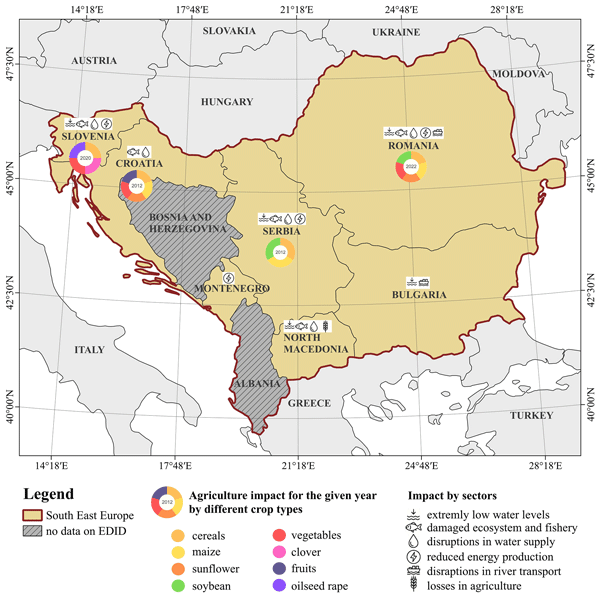
Abstract. Droughts are among the major challenges facing Europe and pose a significant threat to food security on a continental scale. The shifting of climatic zones is forcing societies to adopt measures to cope with climate extremes. However, the pace of adaptation is much slower than the rate of change observed over the past decade. The most developed economies in Europe are already progressing toward implementing strategies aligned with the Sustainable Development Goals. One of the key scientific objectives is to support this adaptation by providing data-driven decision-making tools at both regional and national levels. At the same time, in some European countries, the understanding of drought remains uncertain. Even basic hazard assessments lack coherence, and methodologically sound and systematic vulnerability assessments are often entirely absent. This paper aims to uncover the drought research agenda over the past ten years for nine countries in Southeast Europe. Using a structured query in the SCOPUS database, we attempted to systematize scientific knowledge on drought exposure in the region and identify “white spots” and gaps in knowledge at both country and regional levels. Our findings show a significant increase in the number of research papers focused on various aspects of drought in these nine countries over the last decade. However, for Montenegro, Albania, Slovenia, and North Macedonia, only one or two papers were found. On the other hand, due to the complexity of drought phenomena—including the wide range of indicators, seasonality, methodologies, and aspects studied—it is extremely difficult to form a comprehensive picture for well-represented countries like Romania and Serbia. To enhance understanding of drought trends in the region over the past ten years, our review incorporates the CDI assessment. The CDI v4 dataset, provided by the Copernicus Drought Observatory, serves as the main unified tool for drought monitoring across Europe. The analysis revealed similar temporal patterns across the region, with some differences in outliers, such as historical droughts. As additional context, we included drought impact data gathered from the newly published EDID database. This supplementary information helps us understand the “inheritance” of drought impacts along major rivers and their variability.
-
Notice on discussion status
The requested preprint has a corresponding peer-reviewed final revised paper. You are encouraged to refer to the final revised version.
-
Preprint
(1118 KB)
-
The requested preprint has a corresponding peer-reviewed final revised paper. You are encouraged to refer to the final revised version.
- Preprint
(1118 KB) - Metadata XML
- BibTeX
- EndNote
- Final revised paper


Journal article(s) based on this preprint
Droughts pose a major threat to Europe’s food security, yet adaptation lags behind rapid climate shifts. This paper reviews ten years of drought research in nine Southeast European countries using SCOPUS data, identifying major gaps—especially in Montenegro, Albania, Slovenia, and North Macedonia. Using CDI v4 and EDID data, it highlights regional drought patterns and the legacy of drought impacts.
Interactive discussion
Status: closed
-
RC1: 'Comment on egusphere-2025-5881', Anonymous Referee #1, 14 Jan 2026
-
AC1: 'Reply on RC1', Mirjana Radulović, 29 Jan 2026
Thank you for the insightful and encouraging review of our work. We appreciate the recognition of our efforts to bridge the gap between physical climate analysis and socio-economic governance within the SEE region. Your confirmation that this study serves as a valuable reference for both researchers and policymakers is deeply appreciated.
- In the revised version of the paper, we replaced “agenda” with “landscape”.
- In the new version of the paper, we added the following sentence: “A nature-positive economy is a regenerative economic system that shifts from exploiting natural resources to protecting and restoring ecosystems, hence integrates nature into business through sustainable managing.”
Citation: https://doi.org/10.5194/egusphere-2025-5881-AC1
-
AC1: 'Reply on RC1', Mirjana Radulović, 29 Jan 2026
-
RC2: 'Comment on egusphere-2025-5881', Michał Habel, 17 Jan 2026
The manuscript addresses a highly relevant and timely problem and provides a substantial amount of valuable and up-to-date information. Overall, it is a strong and well-constructed study, and there are no major conceptual or methodological weaknesses that would undermine its scientific quality. My comments are therefore of a minor and mainly clarifying nature and focus on the following points:
-
I suggest limiting the use of acronyms in the abstract to an absolute minimum. Wherever possible, full names should be used (e.g., CDI, EDID), with abbreviations introduced and explained later in the methodology section. This would significantly improve the readability and accessibility of the abstract for a broader audience.
-
Does restricting the literature search exclusively to the SCOPUS database not risk systematically omitting important national and regional publications, including reports from governmental or agricultural institutions, documents related to farmer cooperation, and studies published in national languages?
-
Since the Combined Drought Indicator is primarily designed to capture vegetation stress, to what extent can it be reliably interpreted as a proxy for hydrological drought or for socio-economic drought impacts? Some clarification of this conceptual limitation would strengthen the interpretation of the results.
Citation: https://doi.org/10.5194/egusphere-2025-5881-RC2 -
AC2: 'Reply on RC2', Mirjana Radulović, 29 Jan 2026
We sincerely thank the reviewer for their encouraging comments regarding the scientific quality of our work. It is gratifying to receive such positive feedback on the study's construction and its contribution to this timely problem. We have carefully addressed all minor points raised to ensure every detail is fully clarified for the reader.
- In the revised version of the paper, we explained all the abbreviations in the first mention in the abstract.
- Initially, we considered the approach that you suggested, with the studies published in national languages and governmental reports. However, due to the vast heterogeneity of the level of development between the countries and thus different quantity and quality of the results, we used the SCOPUS database to have a structured query and be able to compare between countries.
- As it was explained in the official documentation of the CDI v4, it is calculated based on the Standardized Precipitation Index (SPI), the Soil Moisture Index Anomaly (SMA), and the Fraction of Absorbed Photosynthetically Active Radiation (FAPAR) anomaly. In CDI v4, a new Soil Moisture Index Anomaly input dataset is based on the European Flood Awareness System (EFAS) v5, partly representing hydrological drought (https://drought.emergency.copernicus.eu/data/factsheets/factsheet_combinedDroughtIndicator_v4.pdf)
Citation: https://doi.org/10.5194/egusphere-2025-5881-AC2
-


Interactive discussion
Status: closed
-
RC1: 'Comment on egusphere-2025-5881', Anonymous Referee #1, 14 Jan 2026
The paper provides a comprehensive regional synthesis of drought patterns, impacts, and research gaps across nine countries in Southeast Europe (Albania, Bosnia and Herzegovina, Bulgaria, Croatia, Montenegro, North Macedonia, Romania, Serbia, and Slovenia). The authors integrate bibliometric analysis, Copernicus CDI v4 drought data, and impact assessments from the European Drought Impact Database (EDID) to characterize the region’s drought tendencies and vulnerabilities between 2012–2024. The study stands out for bridging scientific literature review, quantitative drought monitoring, and socio-economic impact assessment, effectively positioning itself as one of the first region-wide syntheses of drought science and governance in SEE.
This paper makes a substantial contribution to regional understanding of drought, bridging the gap between physical climate analysis and socio-economic impact research in Southeast Europe. It provides not only a valuable reference for policymakers but also a solid empirical foundation for future integrated drought risk assessments.
Minor changes:
L10-15 “This paper aims to uncover the drought research agenda … “, maybe agenda is not most appropriate word, maybe something like a “… drought research landscape … “, or something similar
L35-40 Can you explain or describe differently the phrase “nature-positive economy “
Citation: https://doi.org/10.5194/egusphere-2025-5881-RC1 -
AC1: 'Reply on RC1', Mirjana Radulović, 29 Jan 2026
Thank you for the insightful and encouraging review of our work. We appreciate the recognition of our efforts to bridge the gap between physical climate analysis and socio-economic governance within the SEE region. Your confirmation that this study serves as a valuable reference for both researchers and policymakers is deeply appreciated.
- In the revised version of the paper, we replaced “agenda” with “landscape”.
- In the new version of the paper, we added the following sentence: “A nature-positive economy is a regenerative economic system that shifts from exploiting natural resources to protecting and restoring ecosystems, hence integrates nature into business through sustainable managing.”
Citation: https://doi.org/10.5194/egusphere-2025-5881-AC1
-
AC1: 'Reply on RC1', Mirjana Radulović, 29 Jan 2026
-
RC2: 'Comment on egusphere-2025-5881', Michał Habel, 17 Jan 2026
The manuscript addresses a highly relevant and timely problem and provides a substantial amount of valuable and up-to-date information. Overall, it is a strong and well-constructed study, and there are no major conceptual or methodological weaknesses that would undermine its scientific quality. My comments are therefore of a minor and mainly clarifying nature and focus on the following points:
-
I suggest limiting the use of acronyms in the abstract to an absolute minimum. Wherever possible, full names should be used (e.g., CDI, EDID), with abbreviations introduced and explained later in the methodology section. This would significantly improve the readability and accessibility of the abstract for a broader audience.
-
Does restricting the literature search exclusively to the SCOPUS database not risk systematically omitting important national and regional publications, including reports from governmental or agricultural institutions, documents related to farmer cooperation, and studies published in national languages?
-
Since the Combined Drought Indicator is primarily designed to capture vegetation stress, to what extent can it be reliably interpreted as a proxy for hydrological drought or for socio-economic drought impacts? Some clarification of this conceptual limitation would strengthen the interpretation of the results.
Citation: https://doi.org/10.5194/egusphere-2025-5881-RC2 -
AC2: 'Reply on RC2', Mirjana Radulović, 29 Jan 2026
We sincerely thank the reviewer for their encouraging comments regarding the scientific quality of our work. It is gratifying to receive such positive feedback on the study's construction and its contribution to this timely problem. We have carefully addressed all minor points raised to ensure every detail is fully clarified for the reader.
- In the revised version of the paper, we explained all the abbreviations in the first mention in the abstract.
- Initially, we considered the approach that you suggested, with the studies published in national languages and governmental reports. However, due to the vast heterogeneity of the level of development between the countries and thus different quantity and quality of the results, we used the SCOPUS database to have a structured query and be able to compare between countries.
- As it was explained in the official documentation of the CDI v4, it is calculated based on the Standardized Precipitation Index (SPI), the Soil Moisture Index Anomaly (SMA), and the Fraction of Absorbed Photosynthetically Active Radiation (FAPAR) anomaly. In CDI v4, a new Soil Moisture Index Anomaly input dataset is based on the European Flood Awareness System (EFAS) v5, partly representing hydrological drought (https://drought.emergency.copernicus.eu/data/factsheets/factsheet_combinedDroughtIndicator_v4.pdf)
Citation: https://doi.org/10.5194/egusphere-2025-5881-AC2
-
Peer review completion


Journal article(s) based on this preprint
Droughts pose a major threat to Europe’s food security, yet adaptation lags behind rapid climate shifts. This paper reviews ten years of drought research in nine Southeast European countries using SCOPUS data, identifying major gaps—especially in Montenegro, Albania, Slovenia, and North Macedonia. Using CDI v4 and EDID data, it highlights regional drought patterns and the legacy of drought impacts.
Viewed
| HTML | XML | Total | BibTeX | EndNote | |
|---|---|---|---|---|---|
| 884 | 563 | 79 | 1,526 | 66 | 115 |
- HTML: 884
- PDF: 563
- XML: 79
- Total: 1,526
- BibTeX: 66
- EndNote: 115
Viewed (geographical distribution)
| Country | # | Views | % |
|---|
| Total: | 0 |
| HTML: | 0 |
| PDF: | 0 |
| XML: | 0 |
- 1
Maria Kireeva
Mirjana Radulović
Gordan Mimić
Marthe Wens
Tijana Nikolić-Lugonja
The requested preprint has a corresponding peer-reviewed final revised paper. You are encouraged to refer to the final revised version.
- Preprint
(1118 KB) - Metadata XML
Droughts pose a major threat to Europe’s food security, yet adaptation lags behind rapid climate shifts. This paper reviews ten years of drought research in nine Southeast European countries using SCOPUS data, identifying major gaps—especially in Montenegro, Albania, Slovenia, and North Macedonia. Using CDI v4 and EDID data, it highlights regional drought patterns and the legacy of drought impacts.
Droughts pose a major threat to Europe’s food security, yet adaptation lags behind...
The paper provides a comprehensive regional synthesis of drought patterns, impacts, and research gaps across nine countries in Southeast Europe (Albania, Bosnia and Herzegovina, Bulgaria, Croatia, Montenegro, North Macedonia, Romania, Serbia, and Slovenia). The authors integrate bibliometric analysis, Copernicus CDI v4 drought data, and impact assessments from the European Drought Impact Database (EDID) to characterize the region’s drought tendencies and vulnerabilities between 2012–2024. The study stands out for bridging scientific literature review, quantitative drought monitoring, and socio-economic impact assessment, effectively positioning itself as one of the first region-wide syntheses of drought science and governance in SEE.
This paper makes a substantial contribution to regional understanding of drought, bridging the gap between physical climate analysis and socio-economic impact research in Southeast Europe. It provides not only a valuable reference for policymakers but also a solid empirical foundation for future integrated drought risk assessments.
Minor changes:
L10-15 “This paper aims to uncover the drought research agenda … “, maybe agenda is not most appropriate word, maybe something like a “… drought research landscape … “, or something similar
L35-40 Can you explain or describe differently the phrase “nature-positive economy “