
the Creative Commons Attribution 4.0 License.
the Creative Commons Attribution 4.0 License.
 | 15 Dec 2025
A drone-based sampling platform for vertically resolved chemical characterization of aerosol particles using chemical ionization mass spectrometry
Abstract. Aerosol concentrations and chemical composition exhibit strong spatial variability within the planetary boundary layer (PBL), driven by dynamic mixing, vertical development, and removal processes. Yet, vertically resolved measurements of particle-phase composition remain scarce. Here we present a drone-based platform for filter sampling of aerosol particles within the PBL, coupled with real-time meteorological sensing (temperature, relative humidity, wind speed and direction). This approach enhances spatial flexibility for targeted particle collection while enabling subsequent semi-online/offline chemical analysis with a chemical ionization time-of-flight mass spectrometer with a Filter Inlet for Gases and AEROsols (FIGAERO-CIMS). We deployed the platform at an urban site, where its meteorological sensors were validated against tower-based measurements and its particle sampling efficiency was benchmarked against a ground-based filter sampler. The sampling efficiency of the drone-based setup is demonstrated to be sufficient even under relatively clean atmospheric conditions (PM2.5 ~2 µg m-3), and is consistent with ground-based sampling with negligible interference from flight operations on collection. In addition, the thermal desorption profiles of individual species with the FIGAERO inlet, which offers a direct measurement of the volatility, exhibit high consistency between the drone-based and ground-based setups. Finally, we demonstrate its capability to resolve vertical gradients in aerosol molecular composition during PBL evolution. This study highlights the potential of unmanned aerial vehicle (UAV) based filter sampling to extend the spatial reach of aerosol chemical characterization using advanced mass spectrometry, providing a versatile tool to understand boundary layer dynamics and aerosol formation and evolution.
-
Notice on discussion status
The requested preprint has a corresponding peer-reviewed final revised paper. You are encouraged to refer to the final revised version.
-
Preprint
(4180 KB)
-
Supplement
(1305 KB)
-
The requested preprint has a corresponding peer-reviewed final revised paper. You are encouraged to refer to the final revised version.
- Preprint
(4180 KB) - Metadata XML
-
Supplement
(1305 KB) - BibTeX
- EndNote
- Final revised paper


Journal article(s) based on this preprint
Interactive discussion
Status: closed
-
RC1: 'Comment on egusphere-2025-5857', Anonymous Referee #1, 16 Jan 2026
- AC1: 'Reply on RC1', Cheng Wu, 13 Apr 2026
-
RC2: 'Comment on egusphere-2025-5857', Anonymous Referee #2, 26 Jan 2026
This study presents the development and validation of a UAV-based sampling platform designed for vertically resolved chemical sampling of aerosol particles within the planetary boundary layer (PBL). The primary goal of this platform is to address the spatial flexibility limitations associated with traditional fixed-site monitoring or manned aircraft. The system employs a DJI Matrice 350 drone to collect particulate matter onto a PTFE filter membrane, which has an outer diameter of 25 mm and a deposition diameter of 9 mm. Once the UAV lands, these filter membranes can be directly analyzed using the FIGAERO-CIMS system. Several concerns need to be addressed before publication.
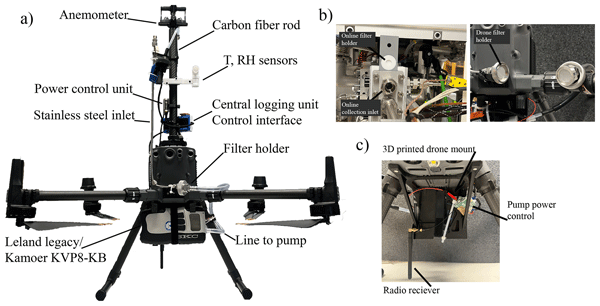
- As shown in Figure 1, it seems that no size-selective inlet was used. Please clarify whether TSP samples are collected and explain why TSP sampling is preferred over PM2.5.
- The demonstration study was conducted at night. The filter holder lacked a solar radiation shield, so sampling during the day could result in the loss of volatile components due to heat absorption by the filter holder. The author needs to clarify whether the system is intended solely for nighttime sampling.
- In section 2.5 the authors state that “The filter sampling period was ~1.5 hours”. Does this refer to the sample shown in Figure 7? How many flights were conducted to achieve the 1.5-hour sampling?
- The author should provide a lookup table enabling users to determine the recommended minimum sampling duration for each PM2.5 concentration level based on local typical OA concentration ratios. This ensures sufficient sample volume is collected to meet the CIMS detection limit. PM2.5 measurements can be conducted by equipping UAVs with a scattering-based PM sensor (e.g., Plantower). The workflow is now as follows: first, obtain the PM sensor reading at the desired height; then, determine the sampling duration threshold from the lookup table. This allows users to quickly determine the necessary filter sampling times on-site.
- Please specify the total sampling duration for each sample shown in Table S1.
- Please also include RH and T comparison scatter plots in Figure 2.
- Please clarify whether the drone sample shown in Figure 7 was collected when hovering at a height of 120 m or during ascending and descending.
Citation: https://doi.org/10.5194/egusphere-2025-5857-RC2 - AC2: 'Reply on RC2', Cheng Wu, 13 Apr 2026
Peer review completion


Interactive discussion
Status: closed
-
RC1: 'Comment on egusphere-2025-5857', Anonymous Referee #1, 16 Jan 2026
Review of “A drone-based sampling platform for vertically resolved chemical characterization of aerosol particles using chemical ionization mass spectrometry” by Håkansson et al.
General comments:
The authors present a drone-based aerosol filter sampling platform designed to collect particulate matter in the planetary boundary layer for subsequent analysis using FIGAERO-CIMS. The platform integrates particle sampling together with real-time meteorological sensing (temperature, relative humidity, wind speed/direction, pressure). The authors validate the meteorological sensor performance by comparison against a stationary tower system, and assess potential drone-rotor impacts on particle sampling by comparing drone-based vs ground-based co-located filter sampling under “hovering” and “grounded” conditions. Finally, the authors demonstrate the platform’s capability in a case study where strong nocturnal stratification leads to clear vertical differences in aerosol concentration and molecular composition. Overall, the work addresses a meaningful instrumentation gap: molecular-level aerosol composition and volatility information measured with height resolution within the boundary layer remains scarce, and this platform provides a flexible way to expand spatial sampling coverage for FIGAERO-CIMS analysis. The manuscript is well suited for Atmospheric Measurement Techniques and will be valuable to the community.I have some general comments and questions. First, it is not fully clear what the intended purpose and practical advantages are for operating the system in “semi-online mode” compared to “offline mode”. The manuscript introduces semi-online and offline sampling early in the text, but the distinctions between these modes (and why semi-online mode is useful and/or necessary) could be explained more clearly and earlier in Section 2.2.
Second, it would be helpful if the authors specify and explain the aerosol size range that is effectively collected by the drone-based method. The manuscript would benefit from clarifying whether this configuration should be interpreted as approximately “PM2.5-like,” “PM1-like,” or closer to total suspended particulate, and from briefly discussing potential inlet losses and how these might affect the measured chemical composition, especially for larger particles.
Third, given that this work relies on filter collection followed by FIGAERO thermal desorption (semi-online/offline), I encourage the authors to provide a brief discussion of potential sampling/handling artifacts (e.g., evaporation of semi-volatiles, adsorption of gas-phase species onto filters, and possible reactions during storage) and how these artifacts are minimized or quantified.
I also have a few specific questions and comments.
Specific comments:
1. Line 1: “exhibits” should be “exhibit”
2. Figure 1: There seems to be a 90-degree angle right before the filter holder, which would increase particle losses, especially for larger particles. Have the authors considered moving the filter holder before the 90-degree bend to minimize particle loss?
3. Line 87: It seems that “diameter mm” should be “mm diameter”
4. Line 88-89: There is a grammar issue in the sentence beginning with “The online …”
5. Line 128: Please clarify what is meant by “offset by 52-minute”. Do you wait for 52 minutes after finishing the first sample before analyzing the second one?
6. Line 199: It would be helpful to briefly explain what “potential temperature” is and why it is used here instead of temperature, for general readers.
7. Line 200: “T” or “potential T”?
8. Figure 3: Please specify what the error bars represent in the caption.
9. Line 221-222: It appears something may be missing inside the bracket, or the bracket may not be formatted correctlyCitation: https://doi.org/10.5194/egusphere-2025-5857-RC1 - AC1: 'Reply on RC1', Cheng Wu, 13 Apr 2026
-
RC2: 'Comment on egusphere-2025-5857', Anonymous Referee #2, 26 Jan 2026
This study presents the development and validation of a UAV-based sampling platform designed for vertically resolved chemical sampling of aerosol particles within the planetary boundary layer (PBL). The primary goal of this platform is to address the spatial flexibility limitations associated with traditional fixed-site monitoring or manned aircraft. The system employs a DJI Matrice 350 drone to collect particulate matter onto a PTFE filter membrane, which has an outer diameter of 25 mm and a deposition diameter of 9 mm. Once the UAV lands, these filter membranes can be directly analyzed using the FIGAERO-CIMS system. Several concerns need to be addressed before publication.
- As shown in Figure 1, it seems that no size-selective inlet was used. Please clarify whether TSP samples are collected and explain why TSP sampling is preferred over PM2.5.
- The demonstration study was conducted at night. The filter holder lacked a solar radiation shield, so sampling during the day could result in the loss of volatile components due to heat absorption by the filter holder. The author needs to clarify whether the system is intended solely for nighttime sampling.
- In section 2.5 the authors state that “The filter sampling period was ~1.5 hours”. Does this refer to the sample shown in Figure 7? How many flights were conducted to achieve the 1.5-hour sampling?
- The author should provide a lookup table enabling users to determine the recommended minimum sampling duration for each PM2.5 concentration level based on local typical OA concentration ratios. This ensures sufficient sample volume is collected to meet the CIMS detection limit. PM2.5 measurements can be conducted by equipping UAVs with a scattering-based PM sensor (e.g., Plantower). The workflow is now as follows: first, obtain the PM sensor reading at the desired height; then, determine the sampling duration threshold from the lookup table. This allows users to quickly determine the necessary filter sampling times on-site.
- Please specify the total sampling duration for each sample shown in Table S1.
- Please also include RH and T comparison scatter plots in Figure 2.
- Please clarify whether the drone sample shown in Figure 7 was collected when hovering at a height of 120 m or during ascending and descending.
Citation: https://doi.org/10.5194/egusphere-2025-5857-RC2 - AC2: 'Reply on RC2', Cheng Wu, 13 Apr 2026
Peer review completion
Journal article(s) based on this preprint
Viewed
| HTML | XML | Total | Supplement | BibTeX | EndNote | |
|---|---|---|---|---|---|---|
| 1,864 | 1,372 | 217 | 3,453 | 285 | 227 | 295 |
- HTML: 1,864
- PDF: 1,372
- XML: 217
- Total: 3,453
- Supplement: 285
- BibTeX: 227
- EndNote: 295
Viewed (geographical distribution)
| Country | # | Views | % |
|---|
| Total: | 0 |
| HTML: | 0 |
| PDF: | 0 |
| XML: | 0 |
- 1
Leo Håkansson
Epameinondas Tsiligiannis

The requested preprint has a corresponding peer-reviewed final revised paper. You are encouraged to refer to the final revised version.
- Preprint
(4180 KB) - Metadata XML
-
Supplement
(1305 KB) - BibTeX
- EndNote
- Final revised paper
Review of “A drone-based sampling platform for vertically resolved chemical characterization of aerosol particles using chemical ionization mass spectrometry” by Håkansson et al.
General comments:
The authors present a drone-based aerosol filter sampling platform designed to collect particulate matter in the planetary boundary layer for subsequent analysis using FIGAERO-CIMS. The platform integrates particle sampling together with real-time meteorological sensing (temperature, relative humidity, wind speed/direction, pressure). The authors validate the meteorological sensor performance by comparison against a stationary tower system, and assess potential drone-rotor impacts on particle sampling by comparing drone-based vs ground-based co-located filter sampling under “hovering” and “grounded” conditions. Finally, the authors demonstrate the platform’s capability in a case study where strong nocturnal stratification leads to clear vertical differences in aerosol concentration and molecular composition. Overall, the work addresses a meaningful instrumentation gap: molecular-level aerosol composition and volatility information measured with height resolution within the boundary layer remains scarce, and this platform provides a flexible way to expand spatial sampling coverage for FIGAERO-CIMS analysis. The manuscript is well suited for Atmospheric Measurement Techniques and will be valuable to the community.
I have some general comments and questions. First, it is not fully clear what the intended purpose and practical advantages are for operating the system in “semi-online mode” compared to “offline mode”. The manuscript introduces semi-online and offline sampling early in the text, but the distinctions between these modes (and why semi-online mode is useful and/or necessary) could be explained more clearly and earlier in Section 2.2.
Second, it would be helpful if the authors specify and explain the aerosol size range that is effectively collected by the drone-based method. The manuscript would benefit from clarifying whether this configuration should be interpreted as approximately “PM2.5-like,” “PM1-like,” or closer to total suspended particulate, and from briefly discussing potential inlet losses and how these might affect the measured chemical composition, especially for larger particles.
Third, given that this work relies on filter collection followed by FIGAERO thermal desorption (semi-online/offline), I encourage the authors to provide a brief discussion of potential sampling/handling artifacts (e.g., evaporation of semi-volatiles, adsorption of gas-phase species onto filters, and possible reactions during storage) and how these artifacts are minimized or quantified.
I also have a few specific questions and comments.
Specific comments:
1. Line 1: “exhibits” should be “exhibit”
2. Figure 1: There seems to be a 90-degree angle right before the filter holder, which would increase particle losses, especially for larger particles. Have the authors considered moving the filter holder before the 90-degree bend to minimize particle loss?
3. Line 87: It seems that “diameter mm” should be “mm diameter”
4. Line 88-89: There is a grammar issue in the sentence beginning with “The online …”
5. Line 128: Please clarify what is meant by “offset by 52-minute”. Do you wait for 52 minutes after finishing the first sample before analyzing the second one?
6. Line 199: It would be helpful to briefly explain what “potential temperature” is and why it is used here instead of temperature, for general readers.
7. Line 200: “T” or “potential T”?
8. Figure 3: Please specify what the error bars represent in the caption.
9. Line 221-222: It appears something may be missing inside the bracket, or the bracket may not be formatted correctly