
the Creative Commons Attribution 4.0 License.
the Creative Commons Attribution 4.0 License.
 | 05 Dec 2025
Exceptional wildfire smoke over Greece in summer 2023: a synergistic study of aerosol optical-microphysical and UVB radiative impacts
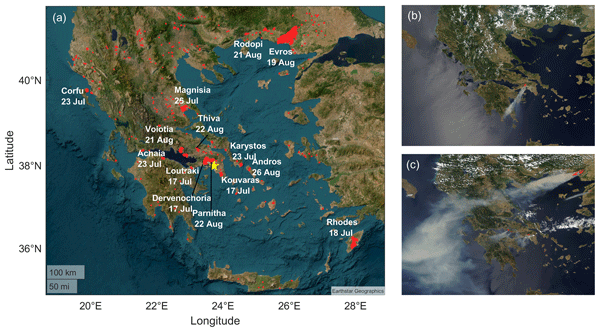
Abstract. During summer 2023, Greece experienced one of its most severe wildfire seasons in recent decades, with widespread fires across Evros, Rodopi, Attica, the Peloponnese, and several islands. This study investigates the aerosol optical and microphysical properties, as well as the impact on ground-level ultraviolet-B (UVB) radiation over Athens, focusing on two major wildfire episodes (18–21 July and 22–25 August). A synergistic approach was deployed, combining satellite imagery (MODIS), FLEXPART simulations, ground-based remote sensing, and in situ aerosol and radiation measurements. Elevated aerosol optical depths (AOD) up to 1.2, high fine-mode fractions (> 0.85), and Ångström exponents above 1.5 indicated a strong dominance of fine biomass burning aerosols. The Single scattering albedo (SSA) ranged from 0.85 to 0.98, showing enhanced absorption during biomass burning periods and weaker absorption when smoke was mixed with dust. At 320 nm, dust presence resulted in stronger absorption, with SSA below 0.8 for pure dust cases compared to smoke mixtures. Particle linear depolarization ratios (PLDR), varied between 0.03 and 0.20, with higher values (~0.10–0.20) reflecting the presence of non-spherical dust particles, and lower values (~0.03–0.08) indicating spherical smoke particles. Ground-level UVB irradiance decreased by up to 50 % during peak smoke episodes, highlighting strong aerosol radiative impacts. Concurrently, PM10 and PM2.5 concentrations increased to 94 and 49 µg m-3, respectively, while organic aerosols peaked at 22.77 µg m-3, consistent with intense fire activity. FLEXPART simulations confirmed long-range transport of smoke from active fire regions, with additional contributions from regional pollution and Saharan dust.
-
Notice on discussion status
The requested preprint has a corresponding peer-reviewed final revised paper. You are encouraged to refer to the final revised version.
-
Preprint
(3836 KB)
-
Supplement
(483 KB)
-
The requested preprint has a corresponding peer-reviewed final revised paper. You are encouraged to refer to the final revised version.
- Preprint
(3836 KB) - Metadata XML
-
Supplement
(483 KB) - BibTeX
- EndNote
- Final revised paper


Journal article(s) based on this preprint
Interactive discussion
Status: closed
-
RC1: 'Comment on egusphere-2025-5856', Anonymous Referee #1, 04 Jan 2026
The comment was uploaded in the form of a supplement: https://egusphere.copernicus.org/preprints/2025/egusphere-2025-5856/egusphere-2025-5856-RC1-supplement.pdfCitation: https://doi.org/
10.5194/egusphere-2025-5856-RC1 - AC2: 'Reply on RC1', Marilena Gidarakou, 28 Feb 2026
-
RC2: 'Comment on egusphere-2025-5856', Anonymous Referee #2, 10 Jan 2026
The manuscript documents the exceptional aerosol conditions over Athens during the summer 2023 Greek wildfire season, focusing on two major episodes (18–21 July and 22–25 August). It combines MODIS fire detections, FLEXPART retroplume simulations, multi-wavelength Raman/polarization lidar, AERONET sun–sky–lunar photometry, in-situ PM/BC and ACSM chemistry, and Brewer UV spectral measurements to characterize aerosol vertical structure, optical/microphysical properties, and the associated impact on surface UV at 320 nm (treated as a proxy for UV-B). Reported conditions include AOD up to ~1.2, high fine-mode fractions, SSA spanning ~0.85–0.98, PLDR variability consistent with smoke–dust mixing, and surface 320-nm irradiance reductions up to ~50% during peak smoke.
My recommendation is major revision. The dataset and the synergistic concept are strong, but several central methodological choices (especially the UV/SSA retrieval setup, cloud screening, and uncertainty propagation across the chain) are not yet documented or stress-tested enough to support some of the stronger interpretations.
- The paper equates 320-nm irradiance with “UV-B impact” but does not demonstrate how well 320 nm tracks band-integrated UV-B (290–315 nm) variability under changing ozone and aerosol conditions.
- The UV closure relies on cloud-free simulations, yet the lidar time–height plots clearly show cloud formation during key windows; without explicit cloud/thin-cloud screening rules and the retained time stamps, the UV comparisons are hard to trust.
- The SSA(320) retrieval uncertainty is treated mainly via ±5% irradiance bounds, but AOD(320), surface albedo, aerosol vertical distribution, and phase function (dust vs smoke) can easily dominate the error budget; some structured sensitivity tests (or an error propagation table) are needed.
- AOD extrapolation to 320 nm using Ångström behavior (e.g., 340–440 nm) can be biased in coarse-mode/dust or mixed cases (spectral curvature); the “~0.05 agreement” should be broken down by event type (smoke / dust / mixed), not just pooled statistics.
- There is an internal tension that needs clarification: the manuscript states the least UV attenuation occurs on the dust day (23 July), while also retrieving very low SSA(320) ~0.75–0.8 for dust; it is not clear whether the comparison is for global vs direct vs diffuse irradiance and whether residual cloud effects or geometry explain this.
- The microphysical inversion assumes a wavelength-independent complex refractive index across 355–1064 nm; this is a strong assumption for smoke (possible brown carbon) and dust, and its effect on retrieved mi, Reff, etc. should be quantified.
- Treating particles as spheres for PLDR<10% and spheroids otherwise is too binary for mixed layers; at minimum, show threshold sensitivity (e.g., 5/10/15%) or discuss a continuous mixing approach.
- POLIPHON mass profiles depend on fixed parameters (e.g., smoke density 1.35 g cm-3, variability allowances, “non-collocated still effective”); this may be reasonable for stable dust, but wildfire plumes are temporally/vertically variable—please justify applicability for the smoke cases and propagate these choices into uncertainty bars.
- FLEXPART configuration needs better alignment with observations: if aerosol layers reach ~5–6 km but the release layer is limited to 0–4 km, source attribution may be incomplete; sensitivity to release height and back-trajectory duration should be demonstrated.
- The smoke/dust/mixed attribution is mostly qualitative across multiple indicators (AE, FMF, PLDR, LR); a single reproducible classification rule (even simple thresholds with rationale) would make the “synergy” claim much stronger.
- Lidar-retrieved and AERONET-retrieved effective radius differ substantially; the discussion currently stops at “different sensitivities,” but the paper should compare layer-integrated vs column quantities and explain whether the discrepancy affects downstream radiative interpretation.
- Statements about “strong absorption” lean heavily on retrieved mi and UV-SSA; please tighten the cross-validation with independent constraints (AERONET SSA variability, eBC source apportionment, and ACSM organics) so the absorption narrative is not driven by one retrieval stream.
The manuscript links elevated free-tropospheric smoke layers (2–5 km) with surface PM/chemistry peaks, but the coupling mechanism is not demonstrated; a short analysis using BLH, timing consistency, and evidence for downward mixing would help separate transported impacts from local/BL contributions.
Citation: https://doi.org/10.5194/egusphere-2025-5856-RC2 - AC1: 'Reply on RC2', Marilena Gidarakou, 28 Feb 2026


Interactive discussion
Status: closed
-
RC1: 'Comment on egusphere-2025-5856', Anonymous Referee #1, 04 Jan 2026
The comment was uploaded in the form of a supplement: https://egusphere.copernicus.org/preprints/2025/egusphere-2025-5856/egusphere-2025-5856-RC1-supplement.pdf
- AC2: 'Reply on RC1', Marilena Gidarakou, 28 Feb 2026
-
RC2: 'Comment on egusphere-2025-5856', Anonymous Referee #2, 10 Jan 2026
The manuscript documents the exceptional aerosol conditions over Athens during the summer 2023 Greek wildfire season, focusing on two major episodes (18–21 July and 22–25 August). It combines MODIS fire detections, FLEXPART retroplume simulations, multi-wavelength Raman/polarization lidar, AERONET sun–sky–lunar photometry, in-situ PM/BC and ACSM chemistry, and Brewer UV spectral measurements to characterize aerosol vertical structure, optical/microphysical properties, and the associated impact on surface UV at 320 nm (treated as a proxy for UV-B). Reported conditions include AOD up to ~1.2, high fine-mode fractions, SSA spanning ~0.85–0.98, PLDR variability consistent with smoke–dust mixing, and surface 320-nm irradiance reductions up to ~50% during peak smoke.
My recommendation is major revision. The dataset and the synergistic concept are strong, but several central methodological choices (especially the UV/SSA retrieval setup, cloud screening, and uncertainty propagation across the chain) are not yet documented or stress-tested enough to support some of the stronger interpretations.
- The paper equates 320-nm irradiance with “UV-B impact” but does not demonstrate how well 320 nm tracks band-integrated UV-B (290–315 nm) variability under changing ozone and aerosol conditions.
- The UV closure relies on cloud-free simulations, yet the lidar time–height plots clearly show cloud formation during key windows; without explicit cloud/thin-cloud screening rules and the retained time stamps, the UV comparisons are hard to trust.
- The SSA(320) retrieval uncertainty is treated mainly via ±5% irradiance bounds, but AOD(320), surface albedo, aerosol vertical distribution, and phase function (dust vs smoke) can easily dominate the error budget; some structured sensitivity tests (or an error propagation table) are needed.
- AOD extrapolation to 320 nm using Ångström behavior (e.g., 340–440 nm) can be biased in coarse-mode/dust or mixed cases (spectral curvature); the “~0.05 agreement” should be broken down by event type (smoke / dust / mixed), not just pooled statistics.
- There is an internal tension that needs clarification: the manuscript states the least UV attenuation occurs on the dust day (23 July), while also retrieving very low SSA(320) ~0.75–0.8 for dust; it is not clear whether the comparison is for global vs direct vs diffuse irradiance and whether residual cloud effects or geometry explain this.
- The microphysical inversion assumes a wavelength-independent complex refractive index across 355–1064 nm; this is a strong assumption for smoke (possible brown carbon) and dust, and its effect on retrieved mi, Reff, etc. should be quantified.
- Treating particles as spheres for PLDR<10% and spheroids otherwise is too binary for mixed layers; at minimum, show threshold sensitivity (e.g., 5/10/15%) or discuss a continuous mixing approach.
- POLIPHON mass profiles depend on fixed parameters (e.g., smoke density 1.35 g cm-3, variability allowances, “non-collocated still effective”); this may be reasonable for stable dust, but wildfire plumes are temporally/vertically variable—please justify applicability for the smoke cases and propagate these choices into uncertainty bars.
- FLEXPART configuration needs better alignment with observations: if aerosol layers reach ~5–6 km but the release layer is limited to 0–4 km, source attribution may be incomplete; sensitivity to release height and back-trajectory duration should be demonstrated.
- The smoke/dust/mixed attribution is mostly qualitative across multiple indicators (AE, FMF, PLDR, LR); a single reproducible classification rule (even simple thresholds with rationale) would make the “synergy” claim much stronger.
- Lidar-retrieved and AERONET-retrieved effective radius differ substantially; the discussion currently stops at “different sensitivities,” but the paper should compare layer-integrated vs column quantities and explain whether the discrepancy affects downstream radiative interpretation.
- Statements about “strong absorption” lean heavily on retrieved mi and UV-SSA; please tighten the cross-validation with independent constraints (AERONET SSA variability, eBC source apportionment, and ACSM organics) so the absorption narrative is not driven by one retrieval stream.
The manuscript links elevated free-tropospheric smoke layers (2–5 km) with surface PM/chemistry peaks, but the coupling mechanism is not demonstrated; a short analysis using BLH, timing consistency, and evidence for downward mixing would help separate transported impacts from local/BL contributions.
Citation: https://doi.org/10.5194/egusphere-2025-5856-RC2 - AC1: 'Reply on RC2', Marilena Gidarakou, 28 Feb 2026
Peer review completion
Journal article(s) based on this preprint
Viewed
| HTML | XML | Total | Supplement | BibTeX | EndNote | |
|---|---|---|---|---|---|---|
| 430 | 313 | 37 | 780 | 47 | 41 | 40 |
- HTML: 430
- PDF: 313
- XML: 37
- Total: 780
- Supplement: 47
- BibTeX: 41
- EndNote: 40
Viewed (geographical distribution)
| Country | # | Views | % |
|---|
| Total: | 0 |
| HTML: | 0 |
| PDF: | 0 |
| XML: | 0 |
- 1
Marilena Gidarakou
Alexandros Papayannis
Maria Mylonaki
Eleni Kralli
Kostas Eleftheratos
Ilias Fountoulakis
Olga Zografou
Evangelia Diapouli
Maria I. Gini
Stergios Vratolis
Konstantinos Granakis
Konstantinos Eleftheriadis
Nikolaos Evangeliou
Christine Groot Zwaaftink
Eugenia Giagka
Marios-Andreas Zagklis
Igor Veselovskii
The requested preprint has a corresponding peer-reviewed final revised paper. You are encouraged to refer to the final revised version.
- Preprint
(3836 KB) - Metadata XML
-
Supplement
(483 KB) - BibTeX
- EndNote
- Final revised paper