
the Creative Commons Attribution 4.0 License.
the Creative Commons Attribution 4.0 License.
 | 15 Dec 2025
Evaluating Long-term Seasonal Variability of Aerosol Optical Properties in Colorado
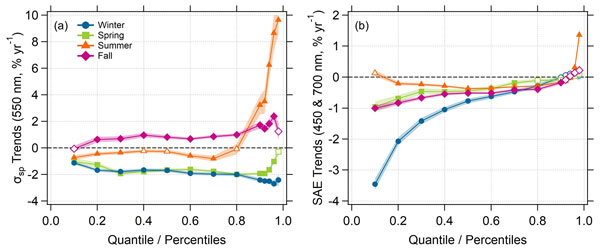
Abstract. Aerosol particles resulting from both wildfires and dust events introduce considerable uncertainty into both climate research and public health assessments. These challenges are becoming particularly evident in the western U.S. To gain a deeper understanding of western U.S. aerosol properties, we analyzed 13 years (2011–2024) of surface in-situ aerosol optical data from Storm Peak Laboratory (SPL) in northwestern Colorado, and 6 years (2019–2024) of surface in-situ aerosol optical data from Table Mountain (BOS) in central Colorado. The aerosol optical properties at both sites demonstrate a strong summer wildfire smoke signal (peaking in August) and evidence of springtime dust events. BOS exhibited higher aerosol loading than SPL, particularly during spring and winter, consistent with the proximity of BOS to urban sources and its lower elevation. While the general patterns observed for SPL are consistent with a previous climatological analysis (covering the period 2011–2016) for the site, the longer SPL dataset used here shows that there has been a significant increase in extreme wildfire smoke events for 2017–2024 relative to 2011–2016. Both summer and fall exhibit statistically significant increasing trends in the upper percentiles of scattering coefficient with trends of 10 ± 1 % yr-1 at the 98th percentile in the summer and 2.4 ± 0.4 % yr-1 at the 96th percentile in the fall. Co-variability among some of the aerosol optical properties is used to further identify aerosol types and temporal patterns, demonstrating similarities between the two sites.
Competing interests: At least one of the (co-)authors is a member of the editorial board of Atmospheric Chemistry and Physics.
Publisher's note: Copernicus Publications remains neutral with regard to jurisdictional claims made in the text, published maps, institutional affiliations, or any other geographical representation in this paper. While Copernicus Publications makes every effort to include appropriate place names, the final responsibility lies with the authors. Views expressed in the text are those of the authors and do not necessarily reflect the views of the publisher.-
Notice on discussion status
The requested preprint has a corresponding peer-reviewed final revised paper. You are encouraged to refer to the final revised version.
-
Preprint
(1230 KB)
-
Supplement
(3352 KB)
-
The requested preprint has a corresponding peer-reviewed final revised paper. You are encouraged to refer to the final revised version.
- Preprint
(1230 KB) - Metadata XML
-
Supplement
(3352 KB) - BibTeX
- EndNote
- Final revised paper


Journal article(s) based on this preprint
Interactive discussion
Status: closed
-
RC1: 'Comment on egusphere-2025-5845', Anonymous Referee #1, 07 Jan 2026
- AC1: 'Reply on RC1', Erin Boedicker, 10 Mar 2026
-
RC2: 'Comment on egusphere-2025-5845', Anonymous Referee #2, 09 Jan 2026
Review of Boedicker et al, Evaluating long-term seasonal variability of aerosol optical properties in Colorado
This paper discusses seasonal variability, climatology, and long-term trends in aerosol optical properties measured at two sites in Colorado: a high elevation remote site, and another nearer to the urban Front Range. Results show similar seasonality in aerosol optical properties, suggesting regional and long-range transport affect these sites, although magnitudes of aerosol loading are higher at the lower elevation site, consistent with additional urban influence. Trend analysis suggests that the highest aerosol scattering coefficients have increased in summer and fall, consistent that extreme wildfire events are influencing the haziest days. This paper is well-written and the analysis is sound. The authors do a great job of compiling and summarizing a large amount of data. I recommend publication after addressing comments below.
Overall comments:
The authors use relationships between optical properties to try and identify aerosol types and composition. They could take advantage of long-term composition data near these sites from the IMPROVE and CSN networks. These data have been reported in Hand et al (2024, https://doi.org/10.1029/2024JD042579) and may help place the results of this paper into the context of what has been reported for the aerosol composition in this same region and to discuss whether their results appear consistent with measured composition.
Have the authors compared size-related optical properties to each other? For example, the ratio of scattering a 1 um to 10 um compared to SAE? Or BFR
“Data” are commonly referred to in the plural within scientific literature, but there are many instances in this paper where it is referred to as the singular. Consider using the plural consistently.
When referring to trends, it is helpful to refer to a trend as “negative” (or “positive”) rather than “decreasing” (or “increasing”) because the trend itself is a rate. For example, for decreasing light scattering, the trend is negative. Consider replacing these instances in the text.
Organizational comment: It might be useful to reorganize the paper so that the trend analysis comes at the end. In this way the reader can contextualize the patterns observed in the data to how they have changed over time.
Figures: It would help to increase the font on the axis labels. It’s difficult to see the difference between the subscripts for “sp” and “ap” for scattering and absorption, respectively.
Other Comments
Line 75: The Storm Peak Laboratory and Table Mountain Field Site acronyms have been previously introduced and so could be used here.
Line 79: Define GAW
Line 104: Aerodynamic diameter is usually greater than physical diameter (Dp ~ Dae*SQRT((Chi/rho_p)), where Dp is physical diameter, Dae is aerodynamic diameter, Chi is shape factor, and rho_p is particle density.
Line 111: Acronyms for light scattering and backscattering have been introduced and can be substituted here.
Line 115: What are the uncertainties in scattering and absorption?
Line 138: Change “wavelength” to “wavelengths”
Line 139: Was this filtering also applied to analyses of light scattering and absorption, or only for calculated properties? Uncertainties in these calculated values could be calculated by propagating uncertainties in scattering and absorption. It would be helpful to provide these uncertainties, especially given the map of aerosol types shown later.
Line 170: What completeness criteria did the authors apply to calculate the parameters used in the trends? As well as in the climatological properties?
Line 173-174: Explicitly mention what is shown in Figure 2 and 3 (rather than group them together in the text).
Line 175: Add “respectively” after “BOS”
Line 207: It appears contradictory that in Lines 199-200 the authors state that during the May event limited upward and westward transport to SPL occurred.
Line 220: Why isn’t May included?
Line 227: Presumably all the light scattering data used for these trends are for RH<40% so the impacts of RH on scattering are not influencing these trends. Did the authors investigate these trends as a function of RH even below 40%? It is important to remind the reader that these trends are for aerosol properties considered to be “dry”.
Line 237: Trends in SAE in spring are ~0. If dust has decreased, wouldn’t SAE likely increase? Since winter and spring trends diverge over the 80th percentile (and presumably the increase in spring is related to dust) wouldn’t you expect to see this in the SAE? Do you see this impact on other size-related parameters?
Line 240: Light scattering in winter is quite low (according to Figure 3). What is the uncertainty in SAE during these months? Are the trends in the lowest percentiles reliable?
Line 248: “Consistent attributable” appears to be a typo.
Line 275: These have been defined and the acronyms could be used here.
Line 275: and also for fall for BFR.
Line 286: The acronym could be used here.
Line 298: What do the authors mean by “anthropogenic biomass burning”?
Line 303: Figure S11 shows number of hours- number of hours of what?
Line 323: Can the authors explain why the particles have become less absorbing but there appears to be more smoke in the later period?
Line 325: Is the SPL site influenced by residential wood combustion in Steamboat?
Line 377 and associated discussions of clusters: Please include the cluster number after each mention as it’s easier to find on the plot.
Line 381: Figure S16: This seems like a step change for all seasons. Does this make sense that BC dominates all seasons and all seasons see this change?
Line 428/9: The acronyms for scattering can be used here.
Figure Captions
Figure 2: Add “a” and “b” in the caption. Include that these data in (a) and (b) correspond to RH< 40%.
Figure 3: Include the years in the caption.
Figure 4: Provide years for trends and include RH < 40%. Here the significance is given by alpha but the rest of the text it is referred to as a p-value (like line 167).
Figure 1: Change S14 to S12.
Figure S7: Include the location in the caption.
Figure S8: Include (a), (b), etc in the caption. What is the difference between a-b and c-d?
Figure S11: Captions states “histogram” but axis reads “# of hours” ?
Citation: https://doi.org/10.5194/egusphere-2025-5845-RC2 - AC2: 'Reply on RC2', Erin Boedicker, 10 Mar 2026
Peer review completion


Interactive discussion
Status: closed
-
RC1: 'Comment on egusphere-2025-5845', Anonymous Referee #1, 07 Jan 2026
Comments on « Evaluating long-term seasonal variability of aerosol optical properties in Colorado” from Boedicker et al.
Five and fourteen years of aerosol in-situ data at BOS and SPL, respectively, were analyzed in this study to infer the climatology of aerosol in remote sites of Colorado. If BOS is situated in the vicinity of cities, SPL is a remote high-altitude station with less influence of aerosol from the planetary boundary layer. The study presents the diurnal and seasonal cycles of parameters measured by the nephelometer and filter-based absorption photometers and discusses the impact of dust and wildfires and shows that BB influence is increasing due to climate changes.
Major comments:
- Structure of the paper: As reflected in some minor comments, wildfires influence is largely cited in §3.1 and 3.2, whereas the dust influence is more emphasized in §3.3. My impression they are the two main aerosol types apart from “standard ambient aerosols” and that they should be discussed at the same time in the three sections. Second, I wonder if the paper would be more coherent is structured in the following order: 1. the classification using optical properties (à description of measured aerosol types), 2. Climatology (all seasonal and diurnal cycles) and 3. Trend. Perhaps, the § 3.3.1 should be merged to some extent in present §1 on climatology since seasonality is described in both sections. Similarly, §3.3.2 on variability and also trends (see next comment) should also be used as introduction to §2 describing the QR trend analysis.
- Trend analysis:
- The study comprises a long-term trend analysis with the QR method but also often mentions trends from visual inspection of the time series (e.g. Fig. 7, S6, S8, S15, S16 and related descriptions) or by comparing two periods (Fig. 5, S2, S10, Table S7, and related descriptions). A clear distinction should be made between the statistical analysis and the visual inspection/period comparison. As already mentioned in the point concerning the structure of the paper, I think that the statistical analysis should be moved to the end to confirm the previous descriptions in §3.3.2.
- The statistical QR method is applied to the scattering coefficients and the SAE, but not on the absorption coefficients, on AAE, SSA and SSAAE. I’m wondering why since the two main aerosol categories (wildfires and dust) largely impact the absorption of light. I recommend to add these trends if possible.
- L87: SPL measurements start in 1981. Why are 1981-2010 data not used in this study?
- QR is not a largely used method for long-term trend analysis in atmospheric sciences so that it could be somewhat better described. One important point is the potential prerequisites on the data for QR analysis.
- I have also further questions regarding the uncertainty: You report in Tables S5 and S6 an error/uncertainty. Could you briefly explain how it is calculated? These uncertainties are quite low also for the largest slopes that correspond to the most extreme percentiles. Is the uncertainty of the determination of extreme percentiles (e.g. the 0.98 percentile) similar the one of the median? Is the uncertainty of the determination of the percentile considered to compute the uncertainty of the slope? Considering the scattering coefficient in summer, I would be pleased to see a plot of 0.98 percentiles with the slope. I’m wondering if the large slope is mostly defined by the very high 2020 and 2021 values. Finally, these uncertainties could perhaps also be reported on Fig. 4.
- Dust: With the used parameters, dust detection by negative SSA Ångström exponent is applicable and should allow to determine dust influence, at least for the remote station of SPL. It would allow a more detailed climatology with an estimate of the dust influence frequency, its seasonal cycle. This information can also help with the interpretation of the AAE-SAE figures. One question related to dust concerns the sharp increase in dust load in spring in BOS (Fig. S15) that is not visible in SPL. Do you have any explanation?
Minor comments:
- L52-56: add a word on the potential use of REM observations ?
- L61-64: Does the higher aerosol scattering and absorption coefficient patterns in the summertime relate only to increased wildfire? Does the high convective boundary layer (CBL) in summer associated with thermal wind system have no effect at SPL? Are dust events the only atmospheric aerosol leading to lower scattering Ångström exponent ?
- L156: Please, explain what is the difference between BC and smoke: does smoke contains no BC ?
- L167: Perhaps it is nice to mention that it corresponds to a 95% confidence level.
- L176-178: the seasonal cycle with maxima in summer is easily explained and is similar to other mountain sites. BOS is however approximately at the same altitude as Boulder and Denver, where the higher CBL in summer should decrease the PM concentration if the PM sources are not higher in summer. The diurnal cycles (Fig. S5) are also similar at both sites apart in January. Could you please provide an explanation for BOS cycles.
- L188-190: yes, but stations near cities often have diurnal cycles bounded to vehicles’ emissions (morning and late afternoon) as well as BB due to heating in winter (visible in Nov-Jan in BOS). Why are the maxima in the middle of the day at BOS from spring to fall? If the summer maximum can relate to wildfires, there is no reason that wildfires have diurnal maximum.
- L187: are upvalley wind also contributing to the SPL diurnal variability in summer or only upslope wind?
- 2c: there is clearly a high burned area in Colorado explaining the 2018 and 2020 high PM load in summer. The 2021 scattering and absorption maxima are, however, not correlated with the burned acres. Please comment.
- L208-209 and Fig. S6: I do not agree with this conclusion. 2020 and 2021 have a much higher rate of hours over the 50 Mm-1 threshold, but it is not obvious (and should be statistically demonstrated) that the number of hours over the threshold is higher in 2022-2024 than 2011-2019.
- L250: when is the dust season in BOS and SPL? From L277 spring seems to be the dust season. Is there a trend of dust due to droughts? What are the sources of dust? Fig. 12 a and b have lower SAE and higher AAE with higher scattering in spring, that can correspond to dust events. Do you observe an inversion of the SSAAE during dust?
- 4b: do the lower SAE quantiles correspond to negative SAE?
- S9: months with the greatest SSA correspond to the largest wildfires activities (July and August). How do you explain this? If BB are produced in Colorado (e.g. clearly visible in 2020), is the explanation of aged smoke aerosol (L287) correct? Usually, the mentioned gaseous coating is found to produce a lensing effect that increases the absorption of the light. The interpretation of AAE seasonal cycle (L297) with a mixture of anthropogenic BB and BC in summer is also difficult to bound to the SSA seasonal cycle.
- L310: a QR analysis of AAE could help investigating the increase of AAE with time.
- L338: remove ‘,’ after two
- L391-392: the shift towards large particles can be caused by either an increase in dust contribution or a decrease in ambient aerosol contributions. Please comment.
- 7: figure caption should be AAE vs SAE. Could you please also mention either on the figures or on the y-axis that a-b are for March-May and c-d for June-September ?
- Table S5: quantile =0.1 in Spring: 0.0.3 to correct
- S8: what is the difference between bottom and top (namely between a/b and c/d)?
Citation: https://doi.org/10.5194/egusphere-2025-5845-RC1 - AC1: 'Reply on RC1', Erin Boedicker, 10 Mar 2026
-
RC2: 'Comment on egusphere-2025-5845', Anonymous Referee #2, 09 Jan 2026
Review of Boedicker et al, Evaluating long-term seasonal variability of aerosol optical properties in Colorado
This paper discusses seasonal variability, climatology, and long-term trends in aerosol optical properties measured at two sites in Colorado: a high elevation remote site, and another nearer to the urban Front Range. Results show similar seasonality in aerosol optical properties, suggesting regional and long-range transport affect these sites, although magnitudes of aerosol loading are higher at the lower elevation site, consistent with additional urban influence. Trend analysis suggests that the highest aerosol scattering coefficients have increased in summer and fall, consistent that extreme wildfire events are influencing the haziest days. This paper is well-written and the analysis is sound. The authors do a great job of compiling and summarizing a large amount of data. I recommend publication after addressing comments below.
Overall comments:
The authors use relationships between optical properties to try and identify aerosol types and composition. They could take advantage of long-term composition data near these sites from the IMPROVE and CSN networks. These data have been reported in Hand et al (2024, https://doi.org/10.1029/2024JD042579) and may help place the results of this paper into the context of what has been reported for the aerosol composition in this same region and to discuss whether their results appear consistent with measured composition.
Have the authors compared size-related optical properties to each other? For example, the ratio of scattering a 1 um to 10 um compared to SAE? Or BFR
“Data” are commonly referred to in the plural within scientific literature, but there are many instances in this paper where it is referred to as the singular. Consider using the plural consistently.
When referring to trends, it is helpful to refer to a trend as “negative” (or “positive”) rather than “decreasing” (or “increasing”) because the trend itself is a rate. For example, for decreasing light scattering, the trend is negative. Consider replacing these instances in the text.
Organizational comment: It might be useful to reorganize the paper so that the trend analysis comes at the end. In this way the reader can contextualize the patterns observed in the data to how they have changed over time.
Figures: It would help to increase the font on the axis labels. It’s difficult to see the difference between the subscripts for “sp” and “ap” for scattering and absorption, respectively.
Other Comments
Line 75: The Storm Peak Laboratory and Table Mountain Field Site acronyms have been previously introduced and so could be used here.
Line 79: Define GAW
Line 104: Aerodynamic diameter is usually greater than physical diameter (Dp ~ Dae*SQRT((Chi/rho_p)), where Dp is physical diameter, Dae is aerodynamic diameter, Chi is shape factor, and rho_p is particle density.
Line 111: Acronyms for light scattering and backscattering have been introduced and can be substituted here.
Line 115: What are the uncertainties in scattering and absorption?
Line 138: Change “wavelength” to “wavelengths”
Line 139: Was this filtering also applied to analyses of light scattering and absorption, or only for calculated properties? Uncertainties in these calculated values could be calculated by propagating uncertainties in scattering and absorption. It would be helpful to provide these uncertainties, especially given the map of aerosol types shown later.
Line 170: What completeness criteria did the authors apply to calculate the parameters used in the trends? As well as in the climatological properties?
Line 173-174: Explicitly mention what is shown in Figure 2 and 3 (rather than group them together in the text).
Line 175: Add “respectively” after “BOS”
Line 207: It appears contradictory that in Lines 199-200 the authors state that during the May event limited upward and westward transport to SPL occurred.
Line 220: Why isn’t May included?
Line 227: Presumably all the light scattering data used for these trends are for RH<40% so the impacts of RH on scattering are not influencing these trends. Did the authors investigate these trends as a function of RH even below 40%? It is important to remind the reader that these trends are for aerosol properties considered to be “dry”.
Line 237: Trends in SAE in spring are ~0. If dust has decreased, wouldn’t SAE likely increase? Since winter and spring trends diverge over the 80th percentile (and presumably the increase in spring is related to dust) wouldn’t you expect to see this in the SAE? Do you see this impact on other size-related parameters?
Line 240: Light scattering in winter is quite low (according to Figure 3). What is the uncertainty in SAE during these months? Are the trends in the lowest percentiles reliable?
Line 248: “Consistent attributable” appears to be a typo.
Line 275: These have been defined and the acronyms could be used here.
Line 275: and also for fall for BFR.
Line 286: The acronym could be used here.
Line 298: What do the authors mean by “anthropogenic biomass burning”?
Line 303: Figure S11 shows number of hours- number of hours of what?
Line 323: Can the authors explain why the particles have become less absorbing but there appears to be more smoke in the later period?
Line 325: Is the SPL site influenced by residential wood combustion in Steamboat?
Line 377 and associated discussions of clusters: Please include the cluster number after each mention as it’s easier to find on the plot.
Line 381: Figure S16: This seems like a step change for all seasons. Does this make sense that BC dominates all seasons and all seasons see this change?
Line 428/9: The acronyms for scattering can be used here.
Figure Captions
Figure 2: Add “a” and “b” in the caption. Include that these data in (a) and (b) correspond to RH< 40%.
Figure 3: Include the years in the caption.
Figure 4: Provide years for trends and include RH < 40%. Here the significance is given by alpha but the rest of the text it is referred to as a p-value (like line 167).
Figure 1: Change S14 to S12.
Figure S7: Include the location in the caption.
Figure S8: Include (a), (b), etc in the caption. What is the difference between a-b and c-d?
Figure S11: Captions states “histogram” but axis reads “# of hours” ?
Citation: https://doi.org/10.5194/egusphere-2025-5845-RC2 - AC2: 'Reply on RC2', Erin Boedicker, 10 Mar 2026
Peer review completion
Journal article(s) based on this preprint
Viewed
| HTML | XML | Total | Supplement | BibTeX | EndNote | |
|---|---|---|---|---|---|---|
| 1,535 | 804 | 210 | 2,549 | 404 | 201 | 206 |
- HTML: 1,535
- PDF: 804
- XML: 210
- Total: 2,549
- Supplement: 404
- BibTeX: 201
- EndNote: 206
Viewed (geographical distribution)
| Country | # | Views | % |
|---|
| Total: | 0 |
| HTML: | 0 |
| PDF: | 0 |
| XML: | 0 |
- 1
Erin K. Boedicker
Andre Bergeron
Gerardo Carrillo-Cardenas
Dominik Kulakowski
John Rogan
Elisabeth Andrews

The requested preprint has a corresponding peer-reviewed final revised paper. You are encouraged to refer to the final revised version.
- Preprint
(1230 KB) - Metadata XML
-
Supplement
(3352 KB) - BibTeX
- EndNote
- Final revised paper
Comments on « Evaluating long-term seasonal variability of aerosol optical properties in Colorado” from Boedicker et al.
Five and fourteen years of aerosol in-situ data at BOS and SPL, respectively, were analyzed in this study to infer the climatology of aerosol in remote sites of Colorado. If BOS is situated in the vicinity of cities, SPL is a remote high-altitude station with less influence of aerosol from the planetary boundary layer. The study presents the diurnal and seasonal cycles of parameters measured by the nephelometer and filter-based absorption photometers and discusses the impact of dust and wildfires and shows that BB influence is increasing due to climate changes.
Major comments:
Minor comments: