
the Creative Commons Attribution 4.0 License.
the Creative Commons Attribution 4.0 License.
 | 16 Dec 2025
Quasi-Lagrangian observations of cloud transitions during the initial phase of marine cold air outbreaks in the Arctic – Part 2: Vertical cloud structure
Abstract. The aim of this work is to study the vertical distribution of microphysical cloud properties, in particular the thermodynamic phase partitioning and the cloud droplet size, in low-level mixed-phase clouds during marine cold air outbreaks in the Arctic. For this purpose, high resolution observations of the initial phase of a strong marine cold air outbreak in the Fram Strait collected with the hyperspectral and polarized imaging systems specMACS during the airborne HALO–(𝒜𝒞)3 campaign are analyzed. Pseudo-vertical profiles of the cloud thermodynamic phase generally showed increasing ice fractions with increasing height and decreasing temperature, except for a geometrically thin layer at the cloud top, which was more liquid-dominated. The measurements indicated that ice formation occurred preferentially at the coldest temperatures. In addition, the effective radius of the liquid cloud droplets increased with height, as expected. The observed vertical evolution of the liquid cloud droplets could be successfully modeled by an entraining parcel model. The good agreement between measured and calculated vertical profiles of the cloud droplet effect radius and additional information based on in situ measurements indicated that the influence of collision-coalescence and ice processes, such as riming, the Wegener-Bergeron-Findeisen mechanism, and ice formation through heterogeneous freezing, on the liquid cloud droplets was small for the observed clouds. The presented analyses and data can help to improve the representation of low-level Arctic mixed-phase clouds in models and to further our understanding of these clouds and the related microphysical processes.
Competing interests: Bernhard Mayer is member of the editorial board of AMT
Publisher's note: Copernicus Publications remains neutral with regard to jurisdictional claims made in the text, published maps, institutional affiliations, or any other geographical representation in this paper. While Copernicus Publications makes every effort to include appropriate place names, the final responsibility lies with the authors. Views expressed in the text are those of the authors and do not necessarily reflect the views of the publisher.-
Notice on discussion status
The requested preprint has a corresponding peer-reviewed final revised paper. You are encouraged to refer to the final revised version.
-
Preprint
(13709 KB)
-
The requested preprint has a corresponding peer-reviewed final revised paper. You are encouraged to refer to the final revised version.
- Preprint
(13709 KB) - Metadata XML
- BibTeX
- EndNote
- Final revised paper


Journal article(s) based on this preprint
Interactive discussion
Status: closed
-
RC1: 'Comment on egusphere-2025-5832', Anonymous Referee #1, 13 Jan 2026
- AC1: 'Reply on RC1', Anna Weber, 12 Mar 2026
-
RC2: 'Comment on egusphere-2025-5832', Anonymous Referee #2, 10 Feb 2026
The authors investigate a marine cold-air outbreak event over the Norwegian Sea that was probed during a field campaign. They used multi-spectral retrievals to obtain several cloud properties and derive additional ones that indicate cloud condensate phase. Based on the quasi-Lagrangian flight pattern and variations in cloud-top heights, the authors translate observational products into vertical profiles as a function of downwind distance, which allow to infer cloud evolution. The authors infer that cloud-tops are dominated by liquid condensate, that ice production occurs at the coldest temperature, and that mixed-phase processes were largely absent. I think the authors need to better justify the tools and to better explain what assumptions were used to arrive at their conclusions. Given the many concerns listed below, I recommend returning the manuscript for resubmission.
Major concerns
Value of ice index – the index is introduced as a source of “qualitative information” (l. 106), but then largely used in this paper to make quantitative arguments, which later serve in a discussion to rule out certain processes. I’m highly skeptical that this index is valuable enough to rule out frozen hydrometeors. The authors should conduct thorough sensitivity tests (e.g., run ice index retrievals on forward-simulated signals using idealized profiles) that convince the reader that quantitative information can be gained here. The authors suggest to study phase inference using model data – I agree and think it should be done prior to this work. It would also be good to list any previous applications of ice index and introduce them in more detail. The above work will particularly useful when considering these results as benchmark for models (ll. 444-446) that may not easily mimic ice index for comparison.
Value of ice fraction – the authors should provide more information here that answers the following questions: (1) how did the authors decide whether to retrieve ice optical depth for a pixel or not? (2) If a pixel is categorized as ice or liquid, does that mean all condensate is assumed to be of that phase? (3) In light of the strong mixed-phase nature of MCAOs, what are the uncertainties connected to ice fraction based on the decisions in (1) and (2) and can it be reliably used for phase portioning?
A sense of contradiction – The authors introduce MCAOs as typically having a liquid cloud-top layer and then apply the Lensky/Rosenfeld method that used the range in cloud-tops and their temperature to obtain pseudo-profiles of ice fraction and index. If liquid layers are expected at every cloud-top, how come liquid tops are only found for the lower temperatures (i.e., the upper end of the cloud-top height range)?
Another sense of contradiction – in Fig. 4, the authors show increasing ice index and decreasing ice fraction closer to the cloud tops. While the authors argue there are penetration depth issues with the spectral retrieval, this should only result in vertical shift of the latter product, but still not explain the general discrepancy between both metrics. Since a liquid-dominated top is one of the main findings of the paper, the authors should investigate any disagreement that may cast doubt onto their finding.
The convective nature of MCAOs – I’m worried the authors applied methods that require stratiform conditions. For instance, (1) passive retrievals work with plain-parallel assumptions and their use in convective-natured MCAOs (that are initially fairly broken and of smaller cell size – i.e., can we rely on all pixels?) introduced errors and (2) dropsondes may sample a mix of cloudy and clear areas in between, failing to provide a comprehensive picture and thereby affecting the parcel model application. The authors should make sure to quantify any such error sources and propagate them into Fig. 5.
Abstract, discussion, and conclusions contain several statements that lack context and express a higher degree of certainty than shown (largely due to the above concerns). I provided a few examples below and think the authors should revisit similar statements throughout the paper:
- “pure liquid water clouds” (l. 422) – what is this finding based on and what are the chances that this information is incomplete?
- Absence or irrelevance of collision-coalescence (ll. 437-438, also ll. 388-391) – this appears to be based on a single study, that rules out small droplets from riming. While larger drops have a greater riming efficiency, there should still be a chance for smaller drops to participate in riming, too (e.g., Saleeby and Cotton, 2008).
Minor concerns
l. 35 Please add a reference here. It is my understanding that relatively quiescent Arctic clouds have such liquid layer on top and would not expect this for marine cold-air outbreaks.
ll. 36-38 Is the WBF process typically dominant? I think past studies have mostly hinted at riming.
ll. 38-39 Can MCAOs be treated like other Arctic clouds? I’m also not sure why “However,” was used here.
ll. 208-209 It’s good to be more specific here to clearly show the reader what the authors are referring to.
ll. 219-220 I think the authors should turn such information into error bars in Fig. 2.
ll. 224-225 I think the authors should include this figure into the supporting information.
ll. 250ff. It’s not clear whether mixed-phase pixels were excluded here and, if not excluded, how the authors dealt with them.
Fig. 2 – is not clear where the great temperature range stems from? Do cloud-top temperatures at “0-15 min” really span -25 to -10 degC? Looking at Fig. 3, temperature between 250 and 500 m cloud-tops should span -23 to -20 degC. In fact, Fig. 3 shows that -25 degC is not measured at all in the lowest 2 km (i.e., the first 300+ min according to Fig. 4).
Fig. 5 – The authors should use the uncertainties in their discussion (ll. 316-325) to create error bars here.
All figures – it would be good to list the various observational products used in each Figure's caption. For example, where did the droplet number concentrations in Fig. 6 stem from?
References
Saleeby, S. M. and Cotton, W. R.: A Binned Approach to Cloud-Droplet Riming Implemented in a Bulk Microphysics Model, J. Appl. Meteor. Clim., 47, 694–703, https://doi.org/10.1175/2007JAMC1664.1, 2008.
Citation: https://doi.org/10.5194/egusphere-2025-5832-RC2 - AC2: 'Reply on RC2', Anna Weber, 12 Mar 2026
Peer review completion


Interactive discussion
Status: closed
-
RC1: 'Comment on egusphere-2025-5832', Anonymous Referee #1, 13 Jan 2026
This study by Weber et al. investigates the vertical distribution of microphysical cloud properties and its evolution during the early stage of a marine cloud air outbreak observed during the HALO-(AC)3 measurement campaign. The manuscript is interesting to read, well aligned with the scope of the journal, and presents clear results and conclusions that are highly relevant and useful to the community investigating mixed-phase clouds and their evolution during marine cold air outbreaks. Overall, the manuscript is well written and well structured.
I recommend this paper for publication after a minor revision. Below there is a list of comments for the authors to consider.
Comments:
Line 113: “had to used” change to “had to be used”
Line 139: I think it is good to add here that “the backward trajectories were computed from ERA5 wind fields using Lagranto”, so that readers do not need to consult Weber et al.(2025a) to obtain this information.
Section 3.1: The discussion about the ice fraction shown in Figure 2 (Section 3.1) is focused on the mean values. However, there is a large spread in the values of the ice fraction (from 0 to 1) for a given brightness temperature. Can the authors comment on this feature? Is it possible to give some estimation regarding the cloud ice characteristics (i.e. number concentration, size or effective radius) when the ice fraction is 1. It is mentioned that there is a four orders of magnitude difference between the measured ice and cloud droplet number concentrations. I was wondering whether this difference is reduced when the ice fraction is 1.
Line 241: “contraction” change to “contradiction”?
Line 268: “combing” change to “combining”
Figure 5: What is WGS84 (in the y-axis label)?
Section 3.2: In this section, the order in which the results are presented feels somewhat strange to me. After introducing Figure 5 and describing the main features of the measured profiles of the effective radius of liquid cloud droplets, line 264 states that the measured and modelled profiles shown in Figure 5 will be compared. However, the discussion then shifts to explaining the results shown in Figure 6, before finally returning to the comparison of the profiles in Figure 5 at the end of the section. I personally didn’t like very much these transitions between Figures 5 and 6.
I think it would be better to briefly state at the beginning of the section that the goal is to analyze and compare the vertical and temporal evolution of the effective radius of liquid cloud droplets based on measurements and parcel model calculations. Then you can clarify that the parcel model calculations require knowledge of the cloud droplet number concentration. In consequence you want to introduce first the results shown in Figure 6, followed later by the description and comparison of the profiles in Figure 5.
Line 273: Are these decoupled clouds associated to the synoptic situation and possibly forming before the air mass is advected over the ocean, or are they related with some other local atmospheric conditions?
Line 345: “Collision and coalescence is relevant” change to “Collision and coalescence are relevant”
Lines 435-439 Can the authors comment on whether the results and conclusions presented in these lines are likely to be specific to this case or representative of cold air outbreaks in general? Related to this, are there previous studies on cold air outbreaks that have reported results and reached conclusions that are consistent with, or in contrast to, those presented here?
Citation: https://doi.org/10.5194/egusphere-2025-5832-RC1 - AC1: 'Reply on RC1', Anna Weber, 12 Mar 2026
-
RC2: 'Comment on egusphere-2025-5832', Anonymous Referee #2, 10 Feb 2026
The authors investigate a marine cold-air outbreak event over the Norwegian Sea that was probed during a field campaign. They used multi-spectral retrievals to obtain several cloud properties and derive additional ones that indicate cloud condensate phase. Based on the quasi-Lagrangian flight pattern and variations in cloud-top heights, the authors translate observational products into vertical profiles as a function of downwind distance, which allow to infer cloud evolution. The authors infer that cloud-tops are dominated by liquid condensate, that ice production occurs at the coldest temperature, and that mixed-phase processes were largely absent. I think the authors need to better justify the tools and to better explain what assumptions were used to arrive at their conclusions. Given the many concerns listed below, I recommend returning the manuscript for resubmission.
Major concerns
Value of ice index – the index is introduced as a source of “qualitative information” (l. 106), but then largely used in this paper to make quantitative arguments, which later serve in a discussion to rule out certain processes. I’m highly skeptical that this index is valuable enough to rule out frozen hydrometeors. The authors should conduct thorough sensitivity tests (e.g., run ice index retrievals on forward-simulated signals using idealized profiles) that convince the reader that quantitative information can be gained here. The authors suggest to study phase inference using model data – I agree and think it should be done prior to this work. It would also be good to list any previous applications of ice index and introduce them in more detail. The above work will particularly useful when considering these results as benchmark for models (ll. 444-446) that may not easily mimic ice index for comparison.
Value of ice fraction – the authors should provide more information here that answers the following questions: (1) how did the authors decide whether to retrieve ice optical depth for a pixel or not? (2) If a pixel is categorized as ice or liquid, does that mean all condensate is assumed to be of that phase? (3) In light of the strong mixed-phase nature of MCAOs, what are the uncertainties connected to ice fraction based on the decisions in (1) and (2) and can it be reliably used for phase portioning?
A sense of contradiction – The authors introduce MCAOs as typically having a liquid cloud-top layer and then apply the Lensky/Rosenfeld method that used the range in cloud-tops and their temperature to obtain pseudo-profiles of ice fraction and index. If liquid layers are expected at every cloud-top, how come liquid tops are only found for the lower temperatures (i.e., the upper end of the cloud-top height range)?
Another sense of contradiction – in Fig. 4, the authors show increasing ice index and decreasing ice fraction closer to the cloud tops. While the authors argue there are penetration depth issues with the spectral retrieval, this should only result in vertical shift of the latter product, but still not explain the general discrepancy between both metrics. Since a liquid-dominated top is one of the main findings of the paper, the authors should investigate any disagreement that may cast doubt onto their finding.
The convective nature of MCAOs – I’m worried the authors applied methods that require stratiform conditions. For instance, (1) passive retrievals work with plain-parallel assumptions and their use in convective-natured MCAOs (that are initially fairly broken and of smaller cell size – i.e., can we rely on all pixels?) introduced errors and (2) dropsondes may sample a mix of cloudy and clear areas in between, failing to provide a comprehensive picture and thereby affecting the parcel model application. The authors should make sure to quantify any such error sources and propagate them into Fig. 5.
Abstract, discussion, and conclusions contain several statements that lack context and express a higher degree of certainty than shown (largely due to the above concerns). I provided a few examples below and think the authors should revisit similar statements throughout the paper:
- “pure liquid water clouds” (l. 422) – what is this finding based on and what are the chances that this information is incomplete?
- Absence or irrelevance of collision-coalescence (ll. 437-438, also ll. 388-391) – this appears to be based on a single study, that rules out small droplets from riming. While larger drops have a greater riming efficiency, there should still be a chance for smaller drops to participate in riming, too (e.g., Saleeby and Cotton, 2008).
Minor concerns
l. 35 Please add a reference here. It is my understanding that relatively quiescent Arctic clouds have such liquid layer on top and would not expect this for marine cold-air outbreaks.
ll. 36-38 Is the WBF process typically dominant? I think past studies have mostly hinted at riming.
ll. 38-39 Can MCAOs be treated like other Arctic clouds? I’m also not sure why “However,” was used here.
ll. 208-209 It’s good to be more specific here to clearly show the reader what the authors are referring to.
ll. 219-220 I think the authors should turn such information into error bars in Fig. 2.
ll. 224-225 I think the authors should include this figure into the supporting information.
ll. 250ff. It’s not clear whether mixed-phase pixels were excluded here and, if not excluded, how the authors dealt with them.
Fig. 2 – is not clear where the great temperature range stems from? Do cloud-top temperatures at “0-15 min” really span -25 to -10 degC? Looking at Fig. 3, temperature between 250 and 500 m cloud-tops should span -23 to -20 degC. In fact, Fig. 3 shows that -25 degC is not measured at all in the lowest 2 km (i.e., the first 300+ min according to Fig. 4).
Fig. 5 – The authors should use the uncertainties in their discussion (ll. 316-325) to create error bars here.
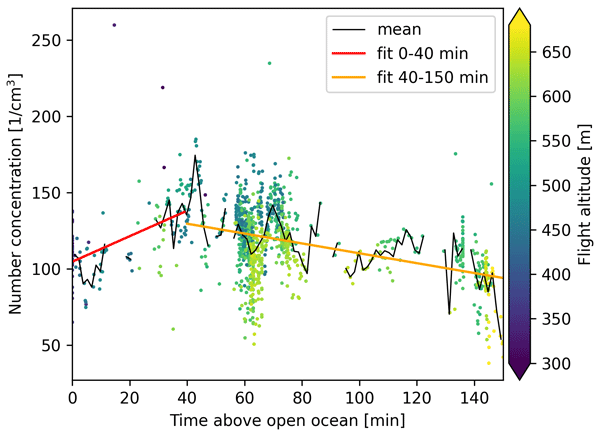
All figures – it would be good to list the various observational products used in each Figure's caption. For example, where did the droplet number concentrations in Fig. 6 stem from?
References
Saleeby, S. M. and Cotton, W. R.: A Binned Approach to Cloud-Droplet Riming Implemented in a Bulk Microphysics Model, J. Appl. Meteor. Clim., 47, 694–703, https://doi.org/10.1175/2007JAMC1664.1, 2008.
Citation: https://doi.org/10.5194/egusphere-2025-5832-RC2 - AC2: 'Reply on RC2', Anna Weber, 12 Mar 2026
Peer review completion
Journal article(s) based on this preprint
Viewed
| HTML | XML | Total | BibTeX | EndNote | |
|---|---|---|---|---|---|
| 1,501 | 840 | 200 | 2,541 | 245 | 178 |
- HTML: 1,501
- PDF: 840
- XML: 200
- Total: 2,541
- BibTeX: 245
- EndNote: 178
Viewed (geographical distribution)
| Country | # | Views | % |
|---|
| Total: | 0 |
| HTML: | 0 |
| PDF: | 0 |
| XML: | 0 |
- 1
Cited


Anna Weber

Fabian Hoffmann
Bernhard Mayer
The requested preprint has a corresponding peer-reviewed final revised paper. You are encouraged to refer to the final revised version.
- Preprint
(13709 KB) - Metadata XML
This study by Weber et al. investigates the vertical distribution of microphysical cloud properties and its evolution during the early stage of a marine cloud air outbreak observed during the HALO-(AC)3 measurement campaign. The manuscript is interesting to read, well aligned with the scope of the journal, and presents clear results and conclusions that are highly relevant and useful to the community investigating mixed-phase clouds and their evolution during marine cold air outbreaks. Overall, the manuscript is well written and well structured.
I recommend this paper for publication after a minor revision. Below there is a list of comments for the authors to consider.
Comments:
Line 113: “had to used” change to “had to be used”
Line 139: I think it is good to add here that “the backward trajectories were computed from ERA5 wind fields using Lagranto”, so that readers do not need to consult Weber et al.(2025a) to obtain this information.
Section 3.1: The discussion about the ice fraction shown in Figure 2 (Section 3.1) is focused on the mean values. However, there is a large spread in the values of the ice fraction (from 0 to 1) for a given brightness temperature. Can the authors comment on this feature? Is it possible to give some estimation regarding the cloud ice characteristics (i.e. number concentration, size or effective radius) when the ice fraction is 1. It is mentioned that there is a four orders of magnitude difference between the measured ice and cloud droplet number concentrations. I was wondering whether this difference is reduced when the ice fraction is 1.
Line 241: “contraction” change to “contradiction”?
Line 268: “combing” change to “combining”
Figure 5: What is WGS84 (in the y-axis label)?
Section 3.2: In this section, the order in which the results are presented feels somewhat strange to me. After introducing Figure 5 and describing the main features of the measured profiles of the effective radius of liquid cloud droplets, line 264 states that the measured and modelled profiles shown in Figure 5 will be compared. However, the discussion then shifts to explaining the results shown in Figure 6, before finally returning to the comparison of the profiles in Figure 5 at the end of the section. I personally didn’t like very much these transitions between Figures 5 and 6.
I think it would be better to briefly state at the beginning of the section that the goal is to analyze and compare the vertical and temporal evolution of the effective radius of liquid cloud droplets based on measurements and parcel model calculations. Then you can clarify that the parcel model calculations require knowledge of the cloud droplet number concentration. In consequence you want to introduce first the results shown in Figure 6, followed later by the description and comparison of the profiles in Figure 5.
Line 273: Are these decoupled clouds associated to the synoptic situation and possibly forming before the air mass is advected over the ocean, or are they related with some other local atmospheric conditions?
Line 345: “Collision and coalescence is relevant” change to “Collision and coalescence are relevant”
Lines 435-439 Can the authors comment on whether the results and conclusions presented in these lines are likely to be specific to this case or representative of cold air outbreaks in general? Related to this, are there previous studies on cold air outbreaks that have reported results and reached conclusions that are consistent with, or in contrast to, those presented here?