
the Creative Commons Attribution 4.0 License.
the Creative Commons Attribution 4.0 License.
 | 17 Dec 2025
Tropical tropopause ozone modulated by tropopause height
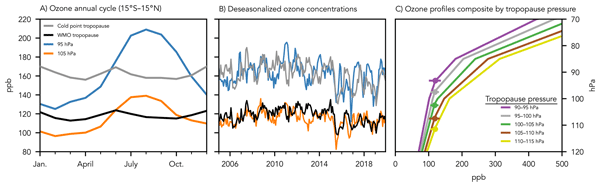
Abstract. Ozone is a key radiative species near the tropical tropopause, which acts as a gateway to the stratosphere for ascending air. Ozone concentrations at fixed heights in this region fluctuate seasonally and interannually as the strength of stratospheric upwelling varies, influencing local temperatures and stratospheric composition. Models ranging in complexity suggest that an accelerated stratospheric circulation, along with tropospheric expansion, could reduce tropical lower stratospheric ozone following surface warming. These modes of variability are often equated with variability at the tropical tropopause; however, tropopause height varies seasonally and interannually, and it is expected to rise as Earth’s surface warms. Here, we explore how tropical tropopause ozone varies when considering changes to tropopause pressure. We first examine 15 years of observations to distinguish variability at the tropical tropopause ozone from fixed pressure levels on annual-to-interannual timescales. We show that changes to tropopause pressure drive the annual cycle of ozone mixing ratios at the tropical tropopause to be substantially smaller and out of phase from those at 95 or 105 hPa. We then investigate how tropical tropopause ozone responds to surface warming under a range of forcing scenarios using output from the Chemistry-Climate Modeling Initiative (CCMI). We find that pressure-dependent ozone production coupled with tropospheric expansion leads tropical tropopause ozone variability to remain distinct from fixed pressure levels following surface warming, with divergent trends in the strongest forcing scenario. Finally, we show that increases to tropical tropopause ozone correspond with local warming in CCMI projections, while tropospheric expansion increases lower stratospheric ozone.
Competing interests: The author has declared that there are no competing interests.
Publisher's note: Copernicus Publications remains neutral with regard to jurisdictional claims made in the text, published maps, institutional affiliations, or any other geographical representation in this paper. While Copernicus Publications makes every effort to include appropriate place names, the final responsibility lies with the authors. Views expressed in the text are those of the authors and do not necessarily reflect the views of the publisher.-
Notice on discussion status
The requested preprint has a corresponding peer-reviewed final revised paper. You are encouraged to refer to the final revised version.
-
Preprint
(2187 KB)
-
Supplement
(608 KB)
-
The requested preprint has a corresponding peer-reviewed final revised paper. You are encouraged to refer to the final revised version.
- Preprint
(2187 KB) - Metadata XML
-
Supplement
(608 KB) - BibTeX
- EndNote
- Final revised paper


Journal article(s) based on this preprint
Interactive discussion
Status: closed
- RC1: 'Comment on egusphere-2025-5794', Anonymous Referee #1, 06 Jan 2026
-
RC2: 'Comment on egusphere-2025-5794', Anonymous Referee #2, 21 Jan 2026
Review of "Tropical tropopause ozone modulated by tropopause height" by Stephen Bourguet
This novel study explores how tropical tropopause ozone varies when taking into
account changes to tropopause pressure. The author examines the 2005-2019
period, for which MLS ozone assimilation data are available and chooses two
fixed pressure levels (95 and 105 hPa). In addition, output from the
Chemistry-Climate Modeling Initiative (CCMI) is used to investigate how tropical
tropopause ozone responds to surface warming under prescribed scenarios.Overall, the manuscript is well written and provides a scrupulous analysis of how
variability in tropical tropopause ozone arises from the interplay
between dynamical transport, chemical production, and changes in tropopause
height, and potential relationship with ENSO and the QBO.Specific comments
Figure 7: Is there a physical reason to assume a linear dependence? Would a
logarithmic function provide a better fit to the data?In the code [1], the qbo_70hpa array starts with data from 2004, but it is later
indexed as qbo_70hpa[0:180] and plotted with a time axis starting in 2005, which
appears inconsistent.[1] https://github.com/sjbourguet/Tropopause_ozone/blob/main/MERRA2_Figs_2_3_4.ipynb
Technical corrections
Line 58: "2005–2019. (...)" maybe the dot after parentheses?
Line 60, 121, Fig.1 caption: a space between the degree sign and S/N.
Line 67: "15 Januaries, 15 Februaries, etc..." -> The ellipsis looks redundant
in combination with "etc."Line 88: Non-breaking space (~) for "Eq." and "1".
Line 129: Non-breaking space (~) for "95" and "hPa".
Line 142: Non-breaking space (~) for "Fig." and "1b".
Line 199: Non-breaking space (~) for "Fig." and "4a,b".
Line 205, 222, 223, 243, 247: A space between the value and "%"?
Figure 5 caption: Non-breaking space (~) for "100" and "hPa", a space between
the degree sign and S/N.Citation: https://doi.org/10.5194/egusphere-2025-5794-RC2 -
AC1: 'Comment on egusphere-2025-5794', Stephen Bourguet, 08 Feb 2026
I thank both reviewers for their thoughtful and constructive feedback. The manuscript is improved following their suggestions. Please see my point-by-point response to the reviews below, with the reviewers’ text in black and my responses in bold.
Reviewer 1
General comments
This new study examines how ozone variability at the tropical tropopause differs from changes at nearby fixed pressure levels and why this distinction matters for understanding present and future climate change. Using 2005–2019 MERRA2-GMI data and an ozone budget framework, the author shows that seasonal and interannual ozone variability at the tropopause is weaker and often out of phase with that at fixed pressure levels because changes in tropopause height counteract stratospheric upwelling. An additional budget term associated with tropopause pressure changes is required to explain observed tropopause ozone variability. Analysis of CCMI model projections further indicates that, under surface warming, tropical tropopause ozone trends remain distinct from those at fixed pressure levels and can increase under strong forcing due primarily to enhanced ozone production from tropospheric expansion, with implications for tropopause temperatures, stratospheric water vapor, and lower stratospheric ozone.
The study is carefully designed and presents sound, robust, and well-supported results that advance understanding of ozone variability at the tropical tropopause. The manuscript is clearly written, well structured, and concise, making the scientific arguments easy to follow. The topic is well within the scope of Atmospheric Chemistry and Physics and is relevant to ongoing discussions of tropopause processes and climate change. Overall, only a few minor clarifications may be required, the paper appears to be very close to being suitable for publication.
Thank you for your generous review!
Specific comments
line 7: The abstract only refers to “observations” in a generic sense. For clarity, it would be helpful to be more specific about the data source used here (e.g., MERRA-2/MERRA2-GMI reanalysis). Explicitly naming the dataset would better inform readers about the observational basis of the analysis.
Thank you for making this suggestion. I have modified the abstract accordingly at Line 7:“We first examine 15 years of MERRA-2 reanalysis data to distinguish variability at the tropical tropopause from nearby fixed pressure levels on annual-to-interannual timescales.”
Line 9: The choice of the fixed pressure levels (95 and 105 hPa) used for comparison with the tropopause is not explained. A brief justification for selecting these levels (e.g., their proximity to the mean tropical tropopause or data availability) would help clarify the rationale.
This is an important point, and I thank you for pushing for greater clarity on it. The word “nearby” is now included to inform the reader of the pressure levels’ relation to the tropopause. The sentence at Line 9 now reads:“We first examine 15 years of MERRA-2 reanalysis data to distinguish variability at the tropical tropopause from nearby fixed pressure levels on annual-to-interannual timescales.”
line 47: The manuscript states that the WMO lapse-rate tropopause “follows an objective definition.” While the WMO criterion is indeed a standardized and widely used operational definition, its historical development appears to be based on community consensus rather than on a uniquely derived physical or mechanistic argument. As such, the term “objective” may be somewhat misleading. The author may wish to clarify this wording (e.g., by referring to the WMO tropopause as a standardized or operational definition) or briefly explain what is meant by “objective” in this context.
Thank you for identifying this mistake in my terminology. You are correct that “objective” may be misleading, while “standardized” is more appropriate. I have changed this in the manuscript accordingly.line 55: The choice of the 2005–2019 period, coinciding with the availability of MLS ozone profile assimilation, is very reasonable and well motivated. However, since MERRA-2 also incorporates other ozone-related observations (e.g., column ozone products) and is evaluated against additional limb-sounding datasets (such as ACE-FTS or MIPAS), the author may wish to clarify whether MLS is the primary constraint motivating this period selection, or briefly acknowledge the role of other datasets in the reanalysis.
Thank you for pushing for greater clarity on this choice of data. It is correct that MERRA-2 also incorporates total column ozone from Aura, and I agree that the agreement with independent satellite measurements should be included. The manuscript has been updated accordingly (Line 55):“From October 2004 onwards, MERRA2 assimilates ozone profiles and total column ozone retrieved by the microwave limb sounder and ozone monitoring instrument aboard NASA’s Earth Observing System Aura satellite (Froidevaux et al., 2008; Livesey et al., 2015). Agreement with independent satellite and ozonesonde measurements is improved after this period (Wargan et al., 2017); thus, we set our study period to be 2005–2019.”
line 74: The ozone budget includes chemical and advective tendencies only. Since MERRA2-GMI also provides moist process and turbulence tendencies, it would be helpful to briefly state whether these terms were examined and found to be negligible near the tropical tropopause, or explain why they are omitted from the budget.
This is an important detail, and I thank you for pushing for greater clarity on it. The MERRA2-GMI tendencies due to moist processes and turbulence are about 3 to 5 orders of magnitude smaller than the chemical and dynamic tendencies. I have now included this detail in the manuscript (paragraph beginning at Line 71):“We established and evaluated an ozone budget near the tropical tropopause to isolate the contributions of underlying drivers to ozone variability. As the magnitudes of the MERRA2-GMI turbulence and moist process tendencies are about 0.002% and 0.2% of the chemical or advective tendencies at 100 hPa, we carried out this budget analysis using only the chemical and dynamic terms. This is consistent with past work showing that the dominant balance of the ozone budget near the tropical tropopause is between chemical production and the advection of ozone-poor air from the troposphere (Perliski et al., 1989).”
line 144: For the multiple linear regression analysis using ENSO and QBO indices, it would be helpful to clarify whether the predictors were detrended or lagged, and whether autocorrelation in the ozone time series was accounted for when assessing the regression fit and significance.
Thank you for this suggestion, the analysis has now been updated to better account for autocorrelation in the ozone time series. Specifically, I now note that the MLR coefficient of determination accounts for AR(1) autocorrelation. The updated paragraph beginning at Line 145:Interannual variability in ozone mixing ratios is similar in magnitude at the tropical tropopause and nearby pressure levels (Fig. 1b). However, variability at fixed pressures does not fully explain that at the tropopause –– the Pearson correlation coefficient between deseasonalized ozone at the WMO (cold point) tropopause and at 105 (95) hPa is 0.31 (0.24). Two underlying modes of climate variability, the El Niño-Southern Oscillation (ENSO) and Quasi-Bienniel Oscillation (QBO), are also more strongly correlated with interannual ozone variability at fixed pressure levels (Fig. 2). In addition, the correlation between tropopause ozone and the QBO index is improved when lagged by 6 months (r = 0.36 and 0.43 for WMO and cold point tropopauses, respectively; not shown), while the correlations between 95 and 105 hPa ozone and the QBO are maximized with no lag. Furthermore, multiple linear regression models of ozone variability with ENSO and QBO indices as predictors exhibit higher coefficients of determination at 95 and 105 hPa (r2 = 0.21, 0.17) than at the tropopause (r2 = 0.003 at both the cold point and WMO tropopause). Note that these coefficients account for temporal autocorrelation (AR(1)) in the ozone time series and are therefore lower than the square of the correlation coefficients shown in Fig. 2. Lastly, the deseasonalized WMO tropopause pressure correlates with deseasonalized ozone at 105 hPa with a coefficient of r = 0.64 (r = 0.72 between the cold point tropopause pressure and 95 hPa ozone), reflecting the influence of upwelling strength, but the tropopause pressure shows a weak negative correlation with ozone at the tropopause itself (r = –0.06 and –0.20 for WMO and cold point tropopauses). These results indicate that different mechanisms may drive ozone variability at the tropical tropopause and at nearby fixed pressure levels.
Technical corrections
line 145: The phrase “multiple linear regressions fit” is potentially misleading. If a single model with multiple predictors was used, “multiple linear regression” would be the more standard terminology.
Thank you for identifying this potentially misleading phrase. Four multiple linear regression models were used in this work. As noted in my response to the previous comment, the manuscript has been updated with improved clarity.Reviewer 2
This novel study explores how tropical tropopause ozone varies when taking into account changes to tropopause pressure. The author examines the 2005-2019 period, for which MLS ozone assimilation data are available and chooses two fixed pressure levels (95 and 105 hPa). In addition, output from the Chemistry-Climate Modeling Initiative (CCMI) is used to investigate how tropical tropopause ozone responds to surface warming under prescribed scenarios. Overall, the manuscript is well written and provides a scrupulous analysis of how variability in tropical tropopause ozone arises from the interplay between dynamical transport, chemical production, and changes in tropopause height, and potential relationship with ENSO and the QBO.
Thank you for your generous review!
Specific comments
Figure 7: Is there a physical reason to assume a linear dependence? Would a logarithmic function provide a better fit to the data?
This is an interesting point. It may be appropriate to consider logarithmic scaling if the changes to ozone were much larger (e.g., if ozone were to double or more), but the changes here are at most ~30%, with the majority of models exhibiting a 15% increase or less. It is therefore reasonable to assume that temperature response would be approximately linear.In the code [1], the qbo_70hpa array starts with data from 2004, but it is later indexed as qbo_70hpa[0:180] and plotted with a time axis starting in 2005, which appears inconsistent. [1] https://github.com/sjbourguet/Tropopause_ozone/blob/main/MERRA2_Figs_2_3_4.ipynb
Thank you for identifying this error in my code. This has now been updated on GitHub, and the corresponding figure has been updated in the manuscript.Technical corrections
Thank you for your attention to detail. Each technical correction has been implemented in the updated manuscript.Line 58: "2005–2019. (...)" maybe the dot after parentheses?
Line 60, 121, Fig.1 caption: a space between the degree sign and S/N.
Line 67: "15 Januaries, 15 Februaries, etc..." -> The ellipsis looks redundant in combination with "etc."
Line 88: Non-breaking space (~) for "Eq." and "1".
Line 129: Non-breaking space (~) for "95" and "hPa".
Line 142: Non-breaking space (~) for "Fig." and "1b".
Line 199: Non-breaking space (~) for "Fig." and "4a,b".
Line 205, 222, 223, 243, 247: A space between the value and "%"?
Figure 5 caption: Non-breaking space (~) for "100" and "hPa", a space between the degree sign and S/N.
Citation: https://doi.org/10.5194/egusphere-2025-5794-AC1


Interactive discussion
Status: closed
-
RC1: 'Comment on egusphere-2025-5794', Anonymous Referee #1, 06 Jan 2026
Review of “Tropical tropopause ozone modulated by tropopause height” by Stephen Bourguet
General comments
This new study examines how ozone variability at the tropical tropopause differs from changes at nearby fixed pressure levels and why this distinction matters for understanding present and future climate change. Using 2005–2019 MERRA2-GMI data and an ozone budget framework, the author shows that seasonal and interannual ozone variability at the tropopause is weaker and often out of phase with that at fixed pressure levels because changes in tropopause height counteract stratospheric upwelling. An additional budget term associated with tropopause pressure changes is required to explain observed tropopause ozone variability. Analysis of CCMI model projections further indicates that, under surface warming, tropical tropopause ozone trends remain distinct from those at fixed pressure levels and can increase under strong forcing due primarily to enhanced ozone production from tropospheric expansion, with implications for tropopause temperatures, stratospheric water vapor, and lower stratospheric ozone.
The study is carefully designed and presents sound, robust, and well-supported results that advance understanding of ozone variability at the tropical tropopause. The manuscript is clearly written, well structured, and concise, making the scientific arguments easy to follow. The topic is well within the scope of Atmospheric Chemistry and Physics and is relevant to ongoing discussions of tropopause processes and climate change. Overall, only a few minor clarifications may be required, the paper appears to be very close to being suitable for publication.
Specific comments
line 7: The abstract only refers to “observations” in a generic sense. For clarity, it would be helpful to be more specific about the data source used here (e.g., MERRA-2/MERRA2-GMI reanalysis). Explicitly naming the dataset would better inform readers about the observational basis of the analysis.
line 9: The choice of the fixed pressure levels (95 and 105 hPa) used for comparison with the tropopause is not explained. A brief justification for selecting these levels (e.g., their proximity to the mean tropical tropopause or data availability) would help clarify the rationale.
line 47: The manuscript states that the WMO lapse-rate tropopause “follows an objective definition.” While the WMO criterion is indeed a standardized and widely used operational definition, its historical development appears to be based on community consensus rather than on a uniquely derived physical or mechanistic argument. As such, the term “objective” may be somewhat misleading. The author may wish to clarify this wording (e.g., by referring to the WMO tropopause as a standardized or operational definition) or briefly explain what is meant by “objective” in this context.
line 55: The choice of the 2005–2019 period, coinciding with the availability of MLS ozone profile assimilation, is very reasonable and well motivated. However, since MERRA-2 also incorporates other ozone-related observations (e.g., column ozone products) and is evaluated against additional limb-sounding datasets (such as ACE-FTS or MIPAS), the author may wish to clarify whether MLS is the primary constraint motivating this period selection, or briefly acknowledge the role of other datasets in the reanalysis.
line 74: The ozone budget includes chemical and advective tendencies only. Since MERRA2-GMI also provides moist process and turbulence tendencies, it would be helpful to briefly state whether these terms were examined and found to be negligible near the tropical tropopause, or explain why they are omitted from the budget.
line 144: For the multiple linear regression analysis using ENSO and QBO indices, it would be helpful to clarify whether the predictors were detrended or lagged, and whether autocorrelation in the ozone time series was accounted for when assessing the regression fit and significance.
Technical corrections
line 145: The phrase “multiple linear regressions fit” is potentially misleading. If a single model with multiple predictors was used, “multiple linear regression” would be the more standard terminology.
Citation: https://doi.org/10.5194/egusphere-2025-5794-RC1 -
RC2: 'Comment on egusphere-2025-5794', Anonymous Referee #2, 21 Jan 2026
Review of "Tropical tropopause ozone modulated by tropopause height" by Stephen Bourguet
This novel study explores how tropical tropopause ozone varies when taking into
account changes to tropopause pressure. The author examines the 2005-2019
period, for which MLS ozone assimilation data are available and chooses two
fixed pressure levels (95 and 105 hPa). In addition, output from the
Chemistry-Climate Modeling Initiative (CCMI) is used to investigate how tropical
tropopause ozone responds to surface warming under prescribed scenarios.Overall, the manuscript is well written and provides a scrupulous analysis of how
variability in tropical tropopause ozone arises from the interplay
between dynamical transport, chemical production, and changes in tropopause
height, and potential relationship with ENSO and the QBO.Specific comments
Figure 7: Is there a physical reason to assume a linear dependence? Would a
logarithmic function provide a better fit to the data?In the code [1], the qbo_70hpa array starts with data from 2004, but it is later
indexed as qbo_70hpa[0:180] and plotted with a time axis starting in 2005, which
appears inconsistent.[1] https://github.com/sjbourguet/Tropopause_ozone/blob/main/MERRA2_Figs_2_3_4.ipynb
Technical corrections
Line 58: "2005–2019. (...)" maybe the dot after parentheses?
Line 60, 121, Fig.1 caption: a space between the degree sign and S/N.
Line 67: "15 Januaries, 15 Februaries, etc..." -> The ellipsis looks redundant
in combination with "etc."Line 88: Non-breaking space (~) for "Eq." and "1".
Line 129: Non-breaking space (~) for "95" and "hPa".
Line 142: Non-breaking space (~) for "Fig." and "1b".
Line 199: Non-breaking space (~) for "Fig." and "4a,b".
Line 205, 222, 223, 243, 247: A space between the value and "%"?
Figure 5 caption: Non-breaking space (~) for "100" and "hPa", a space between
the degree sign and S/N.Citation: https://doi.org/10.5194/egusphere-2025-5794-RC2 -
AC1: 'Comment on egusphere-2025-5794', Stephen Bourguet, 08 Feb 2026
I thank both reviewers for their thoughtful and constructive feedback. The manuscript is improved following their suggestions. Please see my point-by-point response to the reviews below, with the reviewers’ text in black and my responses in bold.
Reviewer 1
General comments
This new study examines how ozone variability at the tropical tropopause differs from changes at nearby fixed pressure levels and why this distinction matters for understanding present and future climate change. Using 2005–2019 MERRA2-GMI data and an ozone budget framework, the author shows that seasonal and interannual ozone variability at the tropopause is weaker and often out of phase with that at fixed pressure levels because changes in tropopause height counteract stratospheric upwelling. An additional budget term associated with tropopause pressure changes is required to explain observed tropopause ozone variability. Analysis of CCMI model projections further indicates that, under surface warming, tropical tropopause ozone trends remain distinct from those at fixed pressure levels and can increase under strong forcing due primarily to enhanced ozone production from tropospheric expansion, with implications for tropopause temperatures, stratospheric water vapor, and lower stratospheric ozone.
The study is carefully designed and presents sound, robust, and well-supported results that advance understanding of ozone variability at the tropical tropopause. The manuscript is clearly written, well structured, and concise, making the scientific arguments easy to follow. The topic is well within the scope of Atmospheric Chemistry and Physics and is relevant to ongoing discussions of tropopause processes and climate change. Overall, only a few minor clarifications may be required, the paper appears to be very close to being suitable for publication.
Thank you for your generous review!
Specific comments
line 7: The abstract only refers to “observations” in a generic sense. For clarity, it would be helpful to be more specific about the data source used here (e.g., MERRA-2/MERRA2-GMI reanalysis). Explicitly naming the dataset would better inform readers about the observational basis of the analysis.
Thank you for making this suggestion. I have modified the abstract accordingly at Line 7:“We first examine 15 years of MERRA-2 reanalysis data to distinguish variability at the tropical tropopause from nearby fixed pressure levels on annual-to-interannual timescales.”
Line 9: The choice of the fixed pressure levels (95 and 105 hPa) used for comparison with the tropopause is not explained. A brief justification for selecting these levels (e.g., their proximity to the mean tropical tropopause or data availability) would help clarify the rationale.
This is an important point, and I thank you for pushing for greater clarity on it. The word “nearby” is now included to inform the reader of the pressure levels’ relation to the tropopause. The sentence at Line 9 now reads:“We first examine 15 years of MERRA-2 reanalysis data to distinguish variability at the tropical tropopause from nearby fixed pressure levels on annual-to-interannual timescales.”
line 47: The manuscript states that the WMO lapse-rate tropopause “follows an objective definition.” While the WMO criterion is indeed a standardized and widely used operational definition, its historical development appears to be based on community consensus rather than on a uniquely derived physical or mechanistic argument. As such, the term “objective” may be somewhat misleading. The author may wish to clarify this wording (e.g., by referring to the WMO tropopause as a standardized or operational definition) or briefly explain what is meant by “objective” in this context.
Thank you for identifying this mistake in my terminology. You are correct that “objective” may be misleading, while “standardized” is more appropriate. I have changed this in the manuscript accordingly.line 55: The choice of the 2005–2019 period, coinciding with the availability of MLS ozone profile assimilation, is very reasonable and well motivated. However, since MERRA-2 also incorporates other ozone-related observations (e.g., column ozone products) and is evaluated against additional limb-sounding datasets (such as ACE-FTS or MIPAS), the author may wish to clarify whether MLS is the primary constraint motivating this period selection, or briefly acknowledge the role of other datasets in the reanalysis.
Thank you for pushing for greater clarity on this choice of data. It is correct that MERRA-2 also incorporates total column ozone from Aura, and I agree that the agreement with independent satellite measurements should be included. The manuscript has been updated accordingly (Line 55):“From October 2004 onwards, MERRA2 assimilates ozone profiles and total column ozone retrieved by the microwave limb sounder and ozone monitoring instrument aboard NASA’s Earth Observing System Aura satellite (Froidevaux et al., 2008; Livesey et al., 2015). Agreement with independent satellite and ozonesonde measurements is improved after this period (Wargan et al., 2017); thus, we set our study period to be 2005–2019.”
line 74: The ozone budget includes chemical and advective tendencies only. Since MERRA2-GMI also provides moist process and turbulence tendencies, it would be helpful to briefly state whether these terms were examined and found to be negligible near the tropical tropopause, or explain why they are omitted from the budget.
This is an important detail, and I thank you for pushing for greater clarity on it. The MERRA2-GMI tendencies due to moist processes and turbulence are about 3 to 5 orders of magnitude smaller than the chemical and dynamic tendencies. I have now included this detail in the manuscript (paragraph beginning at Line 71):“We established and evaluated an ozone budget near the tropical tropopause to isolate the contributions of underlying drivers to ozone variability. As the magnitudes of the MERRA2-GMI turbulence and moist process tendencies are about 0.002% and 0.2% of the chemical or advective tendencies at 100 hPa, we carried out this budget analysis using only the chemical and dynamic terms. This is consistent with past work showing that the dominant balance of the ozone budget near the tropical tropopause is between chemical production and the advection of ozone-poor air from the troposphere (Perliski et al., 1989).”
line 144: For the multiple linear regression analysis using ENSO and QBO indices, it would be helpful to clarify whether the predictors were detrended or lagged, and whether autocorrelation in the ozone time series was accounted for when assessing the regression fit and significance.
Thank you for this suggestion, the analysis has now been updated to better account for autocorrelation in the ozone time series. Specifically, I now note that the MLR coefficient of determination accounts for AR(1) autocorrelation. The updated paragraph beginning at Line 145:Interannual variability in ozone mixing ratios is similar in magnitude at the tropical tropopause and nearby pressure levels (Fig. 1b). However, variability at fixed pressures does not fully explain that at the tropopause –– the Pearson correlation coefficient between deseasonalized ozone at the WMO (cold point) tropopause and at 105 (95) hPa is 0.31 (0.24). Two underlying modes of climate variability, the El Niño-Southern Oscillation (ENSO) and Quasi-Bienniel Oscillation (QBO), are also more strongly correlated with interannual ozone variability at fixed pressure levels (Fig. 2). In addition, the correlation between tropopause ozone and the QBO index is improved when lagged by 6 months (r = 0.36 and 0.43 for WMO and cold point tropopauses, respectively; not shown), while the correlations between 95 and 105 hPa ozone and the QBO are maximized with no lag. Furthermore, multiple linear regression models of ozone variability with ENSO and QBO indices as predictors exhibit higher coefficients of determination at 95 and 105 hPa (r2 = 0.21, 0.17) than at the tropopause (r2 = 0.003 at both the cold point and WMO tropopause). Note that these coefficients account for temporal autocorrelation (AR(1)) in the ozone time series and are therefore lower than the square of the correlation coefficients shown in Fig. 2. Lastly, the deseasonalized WMO tropopause pressure correlates with deseasonalized ozone at 105 hPa with a coefficient of r = 0.64 (r = 0.72 between the cold point tropopause pressure and 95 hPa ozone), reflecting the influence of upwelling strength, but the tropopause pressure shows a weak negative correlation with ozone at the tropopause itself (r = –0.06 and –0.20 for WMO and cold point tropopauses). These results indicate that different mechanisms may drive ozone variability at the tropical tropopause and at nearby fixed pressure levels.
Technical corrections
line 145: The phrase “multiple linear regressions fit” is potentially misleading. If a single model with multiple predictors was used, “multiple linear regression” would be the more standard terminology.
Thank you for identifying this potentially misleading phrase. Four multiple linear regression models were used in this work. As noted in my response to the previous comment, the manuscript has been updated with improved clarity.Reviewer 2
This novel study explores how tropical tropopause ozone varies when taking into account changes to tropopause pressure. The author examines the 2005-2019 period, for which MLS ozone assimilation data are available and chooses two fixed pressure levels (95 and 105 hPa). In addition, output from the Chemistry-Climate Modeling Initiative (CCMI) is used to investigate how tropical tropopause ozone responds to surface warming under prescribed scenarios. Overall, the manuscript is well written and provides a scrupulous analysis of how variability in tropical tropopause ozone arises from the interplay between dynamical transport, chemical production, and changes in tropopause height, and potential relationship with ENSO and the QBO.
Thank you for your generous review!
Specific comments
Figure 7: Is there a physical reason to assume a linear dependence? Would a logarithmic function provide a better fit to the data?
This is an interesting point. It may be appropriate to consider logarithmic scaling if the changes to ozone were much larger (e.g., if ozone were to double or more), but the changes here are at most ~30%, with the majority of models exhibiting a 15% increase or less. It is therefore reasonable to assume that temperature response would be approximately linear.In the code [1], the qbo_70hpa array starts with data from 2004, but it is later indexed as qbo_70hpa[0:180] and plotted with a time axis starting in 2005, which appears inconsistent. [1] https://github.com/sjbourguet/Tropopause_ozone/blob/main/MERRA2_Figs_2_3_4.ipynb
Thank you for identifying this error in my code. This has now been updated on GitHub, and the corresponding figure has been updated in the manuscript.Technical corrections
Thank you for your attention to detail. Each technical correction has been implemented in the updated manuscript.Line 58: "2005–2019. (...)" maybe the dot after parentheses?
Line 60, 121, Fig.1 caption: a space between the degree sign and S/N.
Line 67: "15 Januaries, 15 Februaries, etc..." -> The ellipsis looks redundant in combination with "etc."
Line 88: Non-breaking space (~) for "Eq." and "1".
Line 129: Non-breaking space (~) for "95" and "hPa".
Line 142: Non-breaking space (~) for "Fig." and "1b".
Line 199: Non-breaking space (~) for "Fig." and "4a,b".
Line 205, 222, 223, 243, 247: A space between the value and "%"?
Figure 5 caption: Non-breaking space (~) for "100" and "hPa", a space between the degree sign and S/N.
Citation: https://doi.org/10.5194/egusphere-2025-5794-AC1
Peer review completion


Journal article(s) based on this preprint
Viewed
| HTML | XML | Total | Supplement | BibTeX | EndNote | |
|---|---|---|---|---|---|---|
| 218 | 106 | 23 | 347 | 29 | 41 | 31 |
- HTML: 218
- PDF: 106
- XML: 23
- Total: 347
- Supplement: 29
- BibTeX: 41
- EndNote: 31
Viewed (geographical distribution)
| Country | # | Views | % |
|---|
| Total: | 0 |
| HTML: | 0 |
| PDF: | 0 |
| XML: | 0 |
- 1
The requested preprint has a corresponding peer-reviewed final revised paper. You are encouraged to refer to the final revised version.
- Preprint
(2187 KB) - Metadata XML
-
Supplement
(608 KB) - BibTeX
- EndNote
- Final revised paper
Review of “Tropical tropopause ozone modulated by tropopause height” by Stephen Bourguet
General comments
This new study examines how ozone variability at the tropical tropopause differs from changes at nearby fixed pressure levels and why this distinction matters for understanding present and future climate change. Using 2005–2019 MERRA2-GMI data and an ozone budget framework, the author shows that seasonal and interannual ozone variability at the tropopause is weaker and often out of phase with that at fixed pressure levels because changes in tropopause height counteract stratospheric upwelling. An additional budget term associated with tropopause pressure changes is required to explain observed tropopause ozone variability. Analysis of CCMI model projections further indicates that, under surface warming, tropical tropopause ozone trends remain distinct from those at fixed pressure levels and can increase under strong forcing due primarily to enhanced ozone production from tropospheric expansion, with implications for tropopause temperatures, stratospheric water vapor, and lower stratospheric ozone.
The study is carefully designed and presents sound, robust, and well-supported results that advance understanding of ozone variability at the tropical tropopause. The manuscript is clearly written, well structured, and concise, making the scientific arguments easy to follow. The topic is well within the scope of Atmospheric Chemistry and Physics and is relevant to ongoing discussions of tropopause processes and climate change. Overall, only a few minor clarifications may be required, the paper appears to be very close to being suitable for publication.
Specific comments
line 7: The abstract only refers to “observations” in a generic sense. For clarity, it would be helpful to be more specific about the data source used here (e.g., MERRA-2/MERRA2-GMI reanalysis). Explicitly naming the dataset would better inform readers about the observational basis of the analysis.
line 9: The choice of the fixed pressure levels (95 and 105 hPa) used for comparison with the tropopause is not explained. A brief justification for selecting these levels (e.g., their proximity to the mean tropical tropopause or data availability) would help clarify the rationale.
line 47: The manuscript states that the WMO lapse-rate tropopause “follows an objective definition.” While the WMO criterion is indeed a standardized and widely used operational definition, its historical development appears to be based on community consensus rather than on a uniquely derived physical or mechanistic argument. As such, the term “objective” may be somewhat misleading. The author may wish to clarify this wording (e.g., by referring to the WMO tropopause as a standardized or operational definition) or briefly explain what is meant by “objective” in this context.
line 55: The choice of the 2005–2019 period, coinciding with the availability of MLS ozone profile assimilation, is very reasonable and well motivated. However, since MERRA-2 also incorporates other ozone-related observations (e.g., column ozone products) and is evaluated against additional limb-sounding datasets (such as ACE-FTS or MIPAS), the author may wish to clarify whether MLS is the primary constraint motivating this period selection, or briefly acknowledge the role of other datasets in the reanalysis.
line 74: The ozone budget includes chemical and advective tendencies only. Since MERRA2-GMI also provides moist process and turbulence tendencies, it would be helpful to briefly state whether these terms were examined and found to be negligible near the tropical tropopause, or explain why they are omitted from the budget.
line 144: For the multiple linear regression analysis using ENSO and QBO indices, it would be helpful to clarify whether the predictors were detrended or lagged, and whether autocorrelation in the ozone time series was accounted for when assessing the regression fit and significance.
Technical corrections
line 145: The phrase “multiple linear regressions fit” is potentially misleading. If a single model with multiple predictors was used, “multiple linear regression” would be the more standard terminology.