
the Creative Commons Attribution 4.0 License.
the Creative Commons Attribution 4.0 License.
 | 10 Dec 2025
Assimilation of synthetic radar backscatters at Ku-band improves SWE estimates
Abstract. In cold regions, snow serves as the primary water source for downstream rivers and lakes. Accurate gridded snow water equivalent (SWE) estimation is hindered by the sparse ground observation network and the low resolution of satellite passive microwave products. To address this, Environment and Climate change Canada (ECCC), the Canadian Space Agency (CSA), and Natural Resources Canada (NRCan) are developing the Terrestrial Snow Mass Mission (TSMM), a dual Ku-band satellite mission designed to measure backscatter at 13.5 GHz and 17.25 GHz across the Northern Hemisphere at a 500-m spatial resolution with a weekly temporal resolution. This study assesses the feasibility of assimilating Ku-band backscatter to enhance SWE estimates in a synthetic experiment. We used the Soil-Vegetation-Snow version 2 (SVS2) land surface model, which incorporates the snowpack model Crocus, coupled with the Snow Microwave Radiative Transfer model (SMRT). Observations extracted at weekly intervals from synthetic truths (SWE and backscatter) were assimilated with a particle filter in point-scale at three sites spanning different Canadian climates (Arctic, humid continental, Alpine) over three winter seasons. Meteorological forcing derived from the high-resolution Canadian meteorological model was perturbed to generate ensembles of snow simulations for assimilation. Results indicate that assimilating backscatter observations reduced the mean continuous ranked probability score (CRPS) of SWE estimates by up to 32 % at the Arctic and humid continental climate sites compared to the open-loop ensemble, performing similarly to the assimilation of SWE with an observation error larger than 20 %. Assimilating backscatter observations at the Alpine site only improved the SWE estimates by 5 % as backscatter signals seemed to lose sensitivity to SWE values greater than ~300 kg m−2 in our experimental setup. Assimilating backscatter and SWE observations also improved the estimations of vertical profiles of snow density and specific surface area. These findings demonstrate the potential of direct assimilation of Ku-band backscatter to enhance both estimates of SWE and snowpack properties.
Competing interests: Chris Derksen is chief editor for The Cryosphere
Publisher's note: Copernicus Publications remains neutral with regard to jurisdictional claims made in the text, published maps, institutional affiliations, or any other geographical representation in this paper. While Copernicus Publications makes every effort to include appropriate place names, the final responsibility lies with the authors. Views expressed in the text are those of the authors and do not necessarily reflect the views of the publisher.-
Notice on discussion status
The requested preprint has a corresponding peer-reviewed final revised paper. You are encouraged to refer to the final revised version.
-
Preprint
(16183 KB)
-
Supplement
(4131 KB)
-
The requested preprint has a corresponding peer-reviewed final revised paper. You are encouraged to refer to the final revised version.
- Preprint
(16183 KB) - Metadata XML
-
Supplement
(4131 KB) - BibTeX
- EndNote
- Final revised paper


Journal article(s) based on this preprint
Interactive discussion
Status: closed
-
RC1: 'Comment on egusphere-2025-5790', Anonymous Referee #1, 22 Dec 2025
-
AC1: 'Reply on RC1', Nicolas Leroux, 13 Mar 2026
The comment was uploaded in the form of a supplement: https://egusphere.copernicus.org/preprints/2025/egusphere-2025-5790/egusphere-2025-5790-AC1-supplement.pdf
-
AC1: 'Reply on RC1', Nicolas Leroux, 13 Mar 2026
-
RC2: 'Comment on egusphere-2025-5790', Ross Palomaki, 06 Jan 2026
The comment was uploaded in the form of a supplement: https://egusphere.copernicus.org/preprints/2025/egusphere-2025-5790/egusphere-2025-5790-RC2-supplement.pdf
-
AC2: 'Reply on RC2', Nicolas Leroux, 13 Mar 2026
The comment was uploaded in the form of a supplement: https://egusphere.copernicus.org/preprints/2025/egusphere-2025-5790/egusphere-2025-5790-AC2-supplement.pdf
-
AC2: 'Reply on RC2', Nicolas Leroux, 13 Mar 2026
Peer review completion


Interactive discussion
Status: closed
-
RC1: 'Comment on egusphere-2025-5790', Anonymous Referee #1, 22 Dec 2025
In this paper, the authors conducted an important research to explore the data assimilation potential of the TSMM mission of Canada, which provides dual-Ku backscatter measurements in weekly intervals.
However, firstly, the authors didn't clearly present whether all weekly backscatter coefficients were input together to constrain the entire snow season, or the snow process was updated at weekly steps.
If it is the first case, previous studies would not recommend perturbing the seasonal pattern of snowfalls. Instead, an adjustable constant multiplication factor will be applied to the entire snow season.
The current assumption cannot enumerate all possibilities in the meteorological forcing errors for the entire snow season. Therefore, instead, it adds great noise into the SWE and backscatter ensembles (e.g., Fig.2h), which have made DA really difficult.
Due to the reasons mentioned above, the presented ensembles alone in Fig.2 fail to convince me that dual-Ku backscatter can work well to constrain SWE uncertainty, although it indeed could.
The simulations also have other problems: usually, if the snowpack is deeper, the snow will tend to melt more slowly under the same energy input (air temperature+radiation). It is unrealistic that the spread of snow-off dates is so narrow in Rogers Pass, which is even narrower than the very shallow snow at TVC in Fig.2(k). It should be noted that the largest and the smallest peak SWEs for Rogers Pass differ by over 300 mm, whereas that for TVC is only 20 mm. Therefore, I guess there is also some problem in the snow process modeling. If the snow-off dates are correctly simulated, even fractional snow cover from optical sensors can be used for DA; backscatter should be more powerful.
More points are listed as follows:
Major points:
- Abs: In "Results indicate that assimilating backscatter observations reduced the mean continuous ranked probability score (CRPS) of SWE estimates by up to 32 % at the Arctic and humid continental climate sites compared to the open-loop ensemble, performing similarly to the assimilation of SWE with an observation error larger than 20 %", what is the source of the SWE directly assimilated?
- Line 150: I feel, the temporal evolution equation (1) for meteorological forcing error is needed only if the observations are inputted into DA sequentially.
- Follow point 2, and for lines 179-180: sequential assimilation had one problem in assimilating backscatter when new snowfall happens to occur at the observation time. It is related to the limited response of backscatter to small fresh snow particles, until the snow grains start to grow. How to avoid this problem?
- Line 160: Although it may not be important, however, I feel additive perturbations may be more suitable for wind speed and shortwave radiation.
- Line 170: Do you mean the autocorrelation of the error of HRDPS compared to the observations?
- Line 192, Is Derksen et al.(2021) an indirect citation? Please clarify if this citation refers to more backscatter experiments in Canada or measurement experience.
- Fig.2, the authors could try to enlarge the backscatter time series for Rogers Pass and Powassan. The separation between different ensemble runs is too small.
- Lines 240-262, This is a new term. The authors are suggested to explain the cumulative distribution function clearly. In addition, what does a higher CRPS stand for?
- Line 456, usually assimilating microwave observations directly should perform better. This is because the snow process model adds another group of constraints between snow depth and snow microstructure in addition to that from microwave observations, driven by the temperature gradient within the snow profile. Could you please check the correlation between snow depth (or SWE) and the snow microstructure parameter at some representative temporal points?
- Line 465: for the saturation of backscatter for SWE>300 kg/m3, while your statement in general is true, it was not supported by the comparison between (a) and (c) in Fig. 2. The spread of backscattering from Jan to March is larger at Rogers Pass than Powassan.
- Also for Fig. 2(c)-(f), the simulated backscatter is questionable in mid-Jan and mid-Feb. The jumps of backscatter for these 3 to 4 ensembles are difficult to explain.
- Fig.4, it is the systematic bias of SWE, instead of uncertainties that will greatly influence the SWE DA result. Therefore, I think the current comparison between the backscatter and the SWE assimilations is unfair.
- Line 224, what is the criterion to select THE particleS with the highest weights? How many samples were selected, and how were they combined to produce the final estimate?
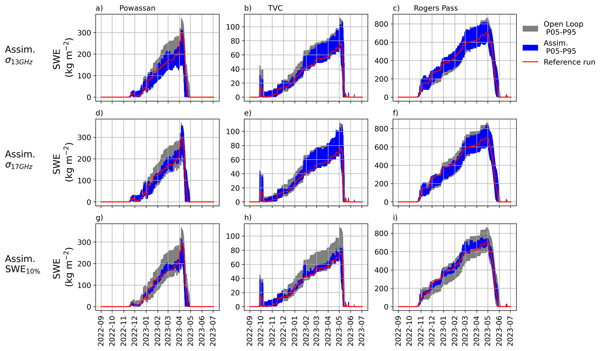
- In Fig.3b&3e, the spread of SWE was not narrowed down greatly using backscatter for this very shallow and backscatter-sensitive snowpack, because the ensembles are too noisy for this site (Fig.2h).
- Fig.2: Should the reference run be a single curve for each case?
- Line 390-395: It means if the SWE error retrieved from radar drops below 30%, assimilating backscatter directly will be unnecessary. However, in my experience, this is not true.
- Lines 413-414, it is true that at a single time step, the sensitivity of MODIS-reflectance is limited to shallow snow, because only in this case, the light can penetrate through the snow medium and be influenced by the low-reflectance background beneath the snow. However, it is the time series of MODIS reflecting snow-off date (or snowmelt process) that makes it workable for deeper snowpacks.
- Line 426, for the higher sensitivity to meteorological forcing (MF) uncertainties in the early snow season, is it because the snow is an accumulated result of snowfalls, and the noises of MF have not been "smoothed" before the mid snow season?
- Line 614, the information for Madore et al.(2023) is not complete.
Minor points:
- Lines 207-209: Fig. 2 shows ...
- Line 212: reached a plateau - reads not academic.
- Line 448: 10? or, 100?
- Line 457: on par?
Citation: https://doi.org/10.5194/egusphere-2025-5790-RC1 -
AC1: 'Reply on RC1', Nicolas Leroux, 13 Mar 2026
The comment was uploaded in the form of a supplement: https://egusphere.copernicus.org/preprints/2025/egusphere-2025-5790/egusphere-2025-5790-AC1-supplement.pdf
-
RC2: 'Comment on egusphere-2025-5790', Ross Palomaki, 06 Jan 2026
The comment was uploaded in the form of a supplement: https://egusphere.copernicus.org/preprints/2025/egusphere-2025-5790/egusphere-2025-5790-RC2-supplement.pdf
-
AC2: 'Reply on RC2', Nicolas Leroux, 13 Mar 2026
The comment was uploaded in the form of a supplement: https://egusphere.copernicus.org/preprints/2025/egusphere-2025-5790/egusphere-2025-5790-AC2-supplement.pdf
-
AC2: 'Reply on RC2', Nicolas Leroux, 13 Mar 2026
Peer review completion
Journal article(s) based on this preprint
Model code and software
Code of the Soil Vegetation and Snow version 2 (SVS2) coupled with the Snow Microwave Radiative Transfer model (SMRT) within the The Multiple Snow Data Assimilation System (MuSA) N. R. Leroux et al. https://doi.org/10.5281/zenodo.17662807
Viewed
| HTML | XML | Total | Supplement | BibTeX | EndNote | |
|---|---|---|---|---|---|---|
| 2,054 | 2,053 | 169 | 4,276 | 351 | 141 | 174 |
- HTML: 2,054
- PDF: 2,053
- XML: 169
- Total: 4,276
- Supplement: 351
- BibTeX: 141
- EndNote: 174
Viewed (geographical distribution)
| Country | # | Views | % |
|---|
| Total: | 0 |
| HTML: | 0 |
| PDF: | 0 |
| XML: | 0 |
- 1
Nicolas R. Leroux

Vincent Vionnet
Courtney Bayer
Julien Meloche
Arlan Dirkson
Franck Lespinas
Mark Buehner
Marco Carrera
Benoit Montpetit
Bernard Bilodeau
Maria Abrahamowicz
Chris Derksen
The requested preprint has a corresponding peer-reviewed final revised paper. You are encouraged to refer to the final revised version.
- Preprint
(16183 KB) - Metadata XML
-
Supplement
(4131 KB) - BibTeX
- EndNote
- Final revised paper
In this paper, the authors conducted an important research to explore the data assimilation potential of the TSMM mission of Canada, which provides dual-Ku backscatter measurements in weekly intervals.
However, firstly, the authors didn't clearly present whether all weekly backscatter coefficients were input together to constrain the entire snow season, or the snow process was updated at weekly steps.
If it is the first case, previous studies would not recommend perturbing the seasonal pattern of snowfalls. Instead, an adjustable constant multiplication factor will be applied to the entire snow season.
The current assumption cannot enumerate all possibilities in the meteorological forcing errors for the entire snow season. Therefore, instead, it adds great noise into the SWE and backscatter ensembles (e.g., Fig.2h), which have made DA really difficult.
Due to the reasons mentioned above, the presented ensembles alone in Fig.2 fail to convince me that dual-Ku backscatter can work well to constrain SWE uncertainty, although it indeed could.
The simulations also have other problems: usually, if the snowpack is deeper, the snow will tend to melt more slowly under the same energy input (air temperature+radiation). It is unrealistic that the spread of snow-off dates is so narrow in Rogers Pass, which is even narrower than the very shallow snow at TVC in Fig.2(k). It should be noted that the largest and the smallest peak SWEs for Rogers Pass differ by over 300 mm, whereas that for TVC is only 20 mm. Therefore, I guess there is also some problem in the snow process modeling. If the snow-off dates are correctly simulated, even fractional snow cover from optical sensors can be used for DA; backscatter should be more powerful.
More points are listed as follows:
Major points:
Minor points: