
the Creative Commons Attribution 4.0 License.
the Creative Commons Attribution 4.0 License.
 | 17 Dec 2025
The lapse rate and the cold point tropopause in the Asian Summer Monsoon anticyclone
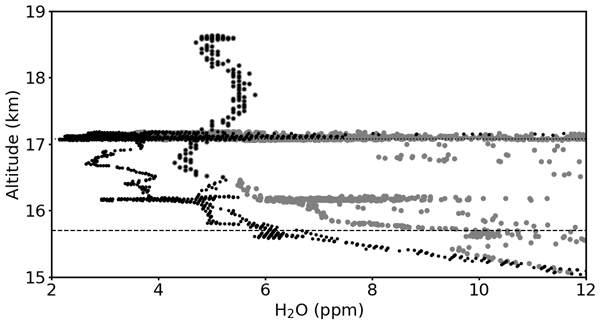
Abstract. Tropospheric and stratospheric airmasses are separated by the tropopause. Here we investigate the lapse rate tropopause and the cold point tropopause in the Asian summer monsoon anticyclone (ASMA) based on high-altitude airborne measurements in summer 2017. We find that, in the ASMA, the lapse rate tropopause, and not the cold point, constitutes a good estimate of the upper boundary of the well mixed tropospheric air mass. On average the cold point is located about 1 km above the lapse rate tropopause and is about about 3 K colder with the pressure lower by about 12 hPa. Above the cold point tropopause molar water vapour mixing ratios range between ∼3 and 10 ppm. Molar ozone mixing ratios increase substantially with altitude; between the lapse rate tropopause and the cold point tropopause molar ozone mixing ratios are in the range of 50–200 ppb. There is slow, diabatic, upward transport in the vicinity of the lapse rate tropopause and above. Hydration patches above the cold point tropopause were observed with water vapour mixing ratios of ≲ 10 ppm. No indication of substantial dehydration above the cold point tropopause in the ASMA was found in the observations. For strong convection (flight on 10 August 2017) there is substantial dehydration at the cold point tropopause (indicated by high values of total water, ice particle occurrence, and strong supersaturation). Above the cold point tropopause, under such conditions, neither ice particle occurrence, nor enhanced molar mixing ratios of water vapour (above ≲ 6 ppm) are observed.
Competing interests: At least one of the (co-)authors is a member of the editorial board of Atmospheric Chemistry and Physics.
Publisher's note: Copernicus Publications remains neutral with regard to jurisdictional claims made in the text, published maps, institutional affiliations, or any other geographical representation in this paper. While Copernicus Publications makes every effort to include appropriate place names, the final responsibility lies with the authors. Views expressed in the text are those of the authors and do not necessarily reflect the views of the publisher.-
Notice on discussion status
The requested preprint has a corresponding peer-reviewed final revised paper. You are encouraged to refer to the final revised version.
-
Preprint
(1302 KB)
-
Supplement
(500 KB)
-
The requested preprint has a corresponding peer-reviewed final revised paper. You are encouraged to refer to the final revised version.
- Preprint
(1302 KB) - Metadata XML
-
Supplement
(500 KB) - BibTeX
- EndNote
- Final revised paper


Journal article(s) based on this preprint
Interactive discussion
Status: closed
- RC1: 'Comment on egusphere-2025-5761', Anonymous Referee #1, 12 Jan 2026
-
RC2: 'Comment on egusphere-2025-5761', Anonymous Referee #2, 20 Jan 2026
The comment was uploaded in the form of a supplement: https://egusphere.copernicus.org/preprints/2025/egusphere-2025-5761/egusphere-2025-5761-RC2-supplement.pdf
-
AC1: 'Reply to R1', Rolf Müller, 06 Feb 2026
The comment was uploaded in the form of a supplement: https://egusphere.copernicus.org/preprints/2025/egusphere-2025-5761/egusphere-2025-5761-AC1-supplement.pdf
-
AC2: 'Reply to R2', Rolf Müller, 06 Feb 2026
The comment was uploaded in the form of a supplement: https://egusphere.copernicus.org/preprints/2025/egusphere-2025-5761/egusphere-2025-5761-AC2-supplement.pdf


Interactive discussion
Status: closed
-
RC1: 'Comment on egusphere-2025-5761', Anonymous Referee #1, 12 Jan 2026
See uploaded file. One item that could be noted en passant is the fact that across the whole Eurasian continent, the midlatitude tropopause falls lower from west to east: it is higher on the Atlantic coast than on the Pacific coast, in the long term mean. As is the humidity.
-
RC2: 'Comment on egusphere-2025-5761', Anonymous Referee #2, 20 Jan 2026
The comment was uploaded in the form of a supplement: https://egusphere.copernicus.org/preprints/2025/egusphere-2025-5761/egusphere-2025-5761-RC2-supplement.pdf
-
AC1: 'Reply to R1', Rolf Müller, 06 Feb 2026
The comment was uploaded in the form of a supplement: https://egusphere.copernicus.org/preprints/2025/egusphere-2025-5761/egusphere-2025-5761-AC1-supplement.pdf
-
AC2: 'Reply to R2', Rolf Müller, 06 Feb 2026
The comment was uploaded in the form of a supplement: https://egusphere.copernicus.org/preprints/2025/egusphere-2025-5761/egusphere-2025-5761-AC2-supplement.pdf
Peer review completion


Journal article(s) based on this preprint
Viewed
| HTML | XML | Total | Supplement | BibTeX | EndNote | |
|---|---|---|---|---|---|---|
| 284 | 129 | 41 | 454 | 52 | 47 | 45 |
- HTML: 284
- PDF: 129
- XML: 41
- Total: 454
- Supplement: 52
- BibTeX: 47
- EndNote: 45
Viewed (geographical distribution)
| Country | # | Views | % |
|---|
| Total: | 0 |
| HTML: | 0 |
| PDF: | 0 |
| XML: | 0 |
- 1
Bärbel Vogel
Martina Krämer
Christian Rolf
Nicole Spelten
Fabrizio Ravegnani
The requested preprint has a corresponding peer-reviewed final revised paper. You are encouraged to refer to the final revised version.
- Preprint
(1302 KB) - Metadata XML
-
Supplement
(500 KB) - BibTeX
- EndNote
- Final revised paper
See uploaded file. One item that could be noted en passant is the fact that across the whole Eurasian continent, the midlatitude tropopause falls lower from west to east: it is higher on the Atlantic coast than on the Pacific coast, in the long term mean. As is the humidity.