
the Creative Commons Attribution 4.0 License.
the Creative Commons Attribution 4.0 License.
 | 15 Dec 2025
Scenario-driven ozone projections and associated impact on mortality over Africa with an integrated machine learning framework
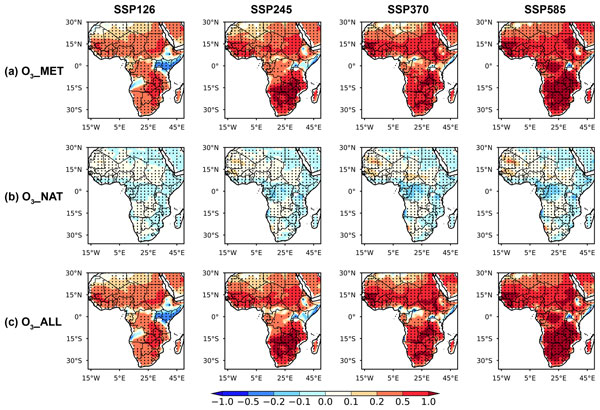
Abstract. Ozone (O3), a major tropospheric air pollutant, poses significant threats to public health and ecosystems, especially across Africa, where O3 concentrations have experienced pronounced increases in recent decades. This study employs an interpretable machine learning (ML) model integrated with multi-source data to predict near-surface O3 levels over Africa from 2020 to 2050 driven by climate change under four Shared Socioeconomic Pathways (SSPs). We quantitatively investigate the respective roles of climate-driven changes in meteorological conditions and biogenic isoprene emissions in affecting future O3 variations. Results reveal that as a NOx-limited region, increased biogenic isoprene emissions contribute to a slight reduction in O3 levels (< 0.5 ppb). Conversely, favorable meteorological conditions elevate O3 levels over Africa, with a maximum projected increase of 2.0 ppb in 2050 relative to 2020, dominating the O3 variations driven by climate change. The low-emission SSP scenarios are projected to prompt less increases in O3 levels than the high-emission SSPs. Moreover, elevated air temperatures associated with global warming magnify the health burden across Africa, as O3 pollution acts as an additional stressor in a warming climate. This highlights the urgency for robust air pollution control and climate mitigation strategies to alleviate future health impacts in Africa.
Competing interests: At least one of the (co-)authors is a member of the editorial board of Atmospheric Chemistry and Physics. The peer-review process was guided by an independent editor, and the authors also have no other competing interests to declare.
Publisher's note: Copernicus Publications remains neutral with regard to jurisdictional claims made in the text, published maps, institutional affiliations, or any other geographical representation in this paper. While Copernicus Publications makes every effort to include appropriate place names, the final responsibility lies with the authors. Views expressed in the text are those of the authors and do not necessarily reflect the views of the publisher.-
Notice on discussion status
The requested preprint has a corresponding peer-reviewed final revised paper. You are encouraged to refer to the final revised version.
-
Preprint
(3371 KB)
-
Supplement
(3543 KB)
-
The requested preprint has a corresponding peer-reviewed final revised paper. You are encouraged to refer to the final revised version.
- Preprint
(3371 KB) - Metadata XML
-
Supplement
(3543 KB) - BibTeX
- EndNote
- Final revised paper


Journal article(s) based on this preprint
Interactive discussion
Status: closed
-
RC1: 'Comment on egusphere-2025-5734', Anonymous Referee #1, 07 Jan 2026
-
AC1: 'Reply on RC1', Huimin Li, 21 May 2026
The comment was uploaded in the form of a supplement: https://egusphere.copernicus.org/preprints/2025/egusphere-2025-5734/egusphere-2025-5734-AC1-supplement.pdf
-
AC1: 'Reply on RC1', Huimin Li, 21 May 2026
-
RC2: 'Comment on egusphere-2025-5734', Anonymous Referee #2, 16 Apr 2026
The manuscript’s novelty is not yet convincingly established. Several of the stated innovations appear to be incremental combinations of existing data sources and standard analytical tools rather than clearly original methodological contributions. There are multiple global ozone projections under the CMIP6 scenarios employing Climate Chemistry models as well as data-driven methods, such as Li et al., 2026; Ni et al., 2026; Ma et al., 2026; Brown et al., 2022. The current manuscript did not provide enough innovations to construct ozone concentration datasets at either global or regional scale. Meanwhile, it looks like a repetitive work of their own work which applied similar ML techniques in studying global ozone changes under the same CMIP6 sceanrios (Ni et al., 2026)
References:
Brown, F., Folberth, G. A., Sitch, S., Bauer, S., Bauters, M., Boeckx, P., Cheesman, A. W., Deushi, M., Dos Santos Vieira, I., Galy-Lacaux, C., Haywood, J., Keeble, J., Mercado, L. M., O'Connor, F. M., Oshima, N., Tsigaridis, K., and Verbeeck, H.: The ozone–climate penalty over South America and Africa by 2100, Atmos. Chem. Phys., 22, 12331–12352, https://doi.org/10.5194/acp-22-12331-2022, 2022.
Ma, Y., Abraham, N. L., Versick, S., Ruhnke, R., Schneidereit, A., Niemeier, U., et al. (2026). mloz: A highly efficient machine learning-based ozone parameterization for climate sensitivity simulations. Journal of Advances in Modeling Earth Systems, 18, e2025MS005459. https://doi.org/10.1029/2025MS005459Yiqian Ni, Yang Yang, Hailong Wang, Pinya Wang, Ke Li, Lei Chen, Jia Zhu, Baojie Li, and Hong Liao, Environmental Science & Technology 2026 60 (4), 3135-3147, DOI: 10.1021/acs.est.5c11992Citation: https://doi.org/10.5194/egusphere-2025-5734-RC2 -
AC2: 'Reply on RC2', Huimin Li, 21 May 2026
The comment was uploaded in the form of a supplement: https://egusphere.copernicus.org/preprints/2025/egusphere-2025-5734/egusphere-2025-5734-AC2-supplement.pdf
-
AC2: 'Reply on RC2', Huimin Li, 21 May 2026
Peer review completion


Interactive discussion
Status: closed
-
RC1: 'Comment on egusphere-2025-5734', Anonymous Referee #1, 07 Jan 2026
This study focuses on the critical environmental and health issue of near-surface ozone pollution in Africa. To address the scarcity of ground-based observational data across the continent, it integrates GEOS-Chem simulations, CMIP6 multi-model data, and a Random Forest (RF) model to construct a research framework with both interpretability and predictability. Innovatively, the study quantifies the independent contributions of climate-driven changes in meteorological conditions and biogenic isoprene emissions to ozone concentrations, thereby illuminating the compound health risks confronting Africa in the context of global warming. The manuscript is detailed, well-structured, and features clear conclusions, making it suitable for publication in the journal Atmospheric Chemistry and Physics. Here are some suggestions for the authors to improve the manuscript.
- Why did this study choose a hybrid approach combining a random forest model with a chemical transport model (CTM), rather than directly using a multi-model ensemble mean of machine learning models or a single CTM for long-term projections? What specific advantages does this hybrid modeling framework offer for this research?
- The article mentions that most regions in Africa are in a "NOx-limited" regime. In such an environment, why does an increase in biogenic isoprene emissions lead to a slight decrease in ozone concentrations?
- The study designed two experiments, O3_MET and O3_ALL, to distinguish the contributions of meteorology and biogenic emissions. In the random forest model, how did the authors ensure that fixing one set of variables does not introduce prediction bias due to autocorrelation among features?
- Under high-emission scenarios (e.g., SSP5-8.5), which specific changes in meteorological factors (such as radiation, humidity, and cloud cover) enhance the "ozone climate penalty" effect?
- The results indicate that the impact of rising temperatures on mortality in Africa is far greater than that of ozone concentrations. Is this difference primarily due to variations in the sensitivity of exposure-response functions, or is it determined by the increased frequency of future extreme heat events?
- The study used multiple CMIP6 model datasets. Why were these particular models selected?
- What key input data did the GEOS-Chem model primarily provide during the machine learning training phase?
- The authors adopt a "single-year verification" strategy, designating the period 2000–2009 and 2011–2019 as the training set, with 2010 serving as the sole test year. This approach may fail to fully assess the model’s generalizability across different time periods and climate backgrounds. Ozone concentrations are significantly influenced by interannual meteorological fluctuations, and a single test year cannot cover diverse interannual variability scenarios, potentially underestimating the uncertainty of the model’s projections for future interannual fluctuations. Please supplement the core rationale for selecting 2010 as the exclusive test year. Have more stringent temporal cross-validation methods been implemented (e.g., setting multiple independent test years, time segment splitting such as 2010–2014, or rolling window validation) to evaluate the model’s robustness?
- SHAP analysis reveals that certain factors contribute most significantly to predicting biogenic isoprene emissions. Why are these factors particularly influential?
- Which geographical region in Africa is predicted to experience the most significant increase in biogenic isoprene emissions, and why?
- Apart from temperature and isoprene, what other factors may influence future ozone concentrations under climate change? What are the main sources of uncertainty mentioned in the article, particularly regarding assumptions about land use and population density?
- To improve the accuracy of regional predictions, what enhancements does the author suggest could be made in machine learning or chemical transport modeling in the future?
Citation: https://doi.org/10.5194/egusphere-2025-5734-RC1 -
AC1: 'Reply on RC1', Huimin Li, 21 May 2026
The comment was uploaded in the form of a supplement: https://egusphere.copernicus.org/preprints/2025/egusphere-2025-5734/egusphere-2025-5734-AC1-supplement.pdf
-
RC2: 'Comment on egusphere-2025-5734', Anonymous Referee #2, 16 Apr 2026
The manuscript’s novelty is not yet convincingly established. Several of the stated innovations appear to be incremental combinations of existing data sources and standard analytical tools rather than clearly original methodological contributions. There are multiple global ozone projections under the CMIP6 scenarios employing Climate Chemistry models as well as data-driven methods, such as Li et al., 2026; Ni et al., 2026; Ma et al., 2026; Brown et al., 2022. The current manuscript did not provide enough innovations to construct ozone concentration datasets at either global or regional scale. Meanwhile, it looks like a repetitive work of their own work which applied similar ML techniques in studying global ozone changes under the same CMIP6 sceanrios (Ni et al., 2026)
References:
Brown, F., Folberth, G. A., Sitch, S., Bauer, S., Bauters, M., Boeckx, P., Cheesman, A. W., Deushi, M., Dos Santos Vieira, I., Galy-Lacaux, C., Haywood, J., Keeble, J., Mercado, L. M., O'Connor, F. M., Oshima, N., Tsigaridis, K., and Verbeeck, H.: The ozone–climate penalty over South America and Africa by 2100, Atmos. Chem. Phys., 22, 12331–12352, https://doi.org/10.5194/acp-22-12331-2022, 2022.
Ma, Y., Abraham, N. L., Versick, S., Ruhnke, R., Schneidereit, A., Niemeier, U., et al. (2026). mloz: A highly efficient machine learning-based ozone parameterization for climate sensitivity simulations. Journal of Advances in Modeling Earth Systems, 18, e2025MS005459. https://doi.org/10.1029/2025MS005459Yiqian Ni, Yang Yang, Hailong Wang, Pinya Wang, Ke Li, Lei Chen, Jia Zhu, Baojie Li, and Hong Liao, Environmental Science & Technology 2026 60 (4), 3135-3147, DOI: 10.1021/acs.est.5c11992Citation: https://doi.org/10.5194/egusphere-2025-5734-RC2 -
AC2: 'Reply on RC2', Huimin Li, 21 May 2026
The comment was uploaded in the form of a supplement: https://egusphere.copernicus.org/preprints/2025/egusphere-2025-5734/egusphere-2025-5734-AC2-supplement.pdf
-
AC2: 'Reply on RC2', Huimin Li, 21 May 2026
Peer review completion
Journal article(s) based on this preprint
Viewed
| HTML | XML | Total | Supplement | BibTeX | EndNote | |
|---|---|---|---|---|---|---|
| 1,397 | 642 | 193 | 2,232 | 369 | 180 | 216 |
- HTML: 1,397
- PDF: 642
- XML: 193
- Total: 2,232
- Supplement: 369
- BibTeX: 180
- EndNote: 216
Viewed (geographical distribution)
| Country | # | Views | % |
|---|
| Total: | 0 |
| HTML: | 0 |
| PDF: | 0 |
| XML: | 0 |
- 1
Huimin Li

Hailong Wang
The requested preprint has a corresponding peer-reviewed final revised paper. You are encouraged to refer to the final revised version.
- Preprint
(3371 KB) - Metadata XML
-
Supplement
(3543 KB) - BibTeX
- EndNote
- Final revised paper
This study focuses on the critical environmental and health issue of near-surface ozone pollution in Africa. To address the scarcity of ground-based observational data across the continent, it integrates GEOS-Chem simulations, CMIP6 multi-model data, and a Random Forest (RF) model to construct a research framework with both interpretability and predictability. Innovatively, the study quantifies the independent contributions of climate-driven changes in meteorological conditions and biogenic isoprene emissions to ozone concentrations, thereby illuminating the compound health risks confronting Africa in the context of global warming. The manuscript is detailed, well-structured, and features clear conclusions, making it suitable for publication in the journal Atmospheric Chemistry and Physics. Here are some suggestions for the authors to improve the manuscript.