
the Creative Commons Attribution 4.0 License.
the Creative Commons Attribution 4.0 License.
 | 17 Dec 2025
Explainable Machine Learning diagnosis of Ozone Formation Sensitivity in China: Spatiotemporal Evolution and Driver Attribution
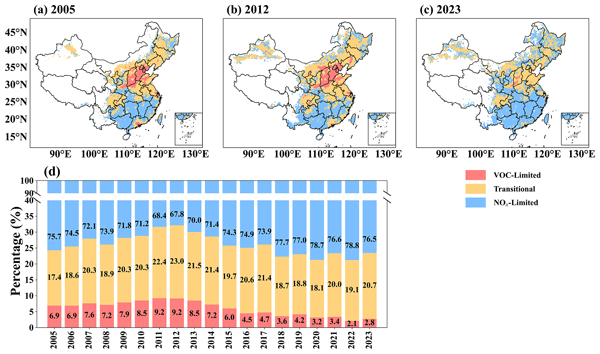
Abstract. Accurate diagnosis of ozone (O3) formation sensitivity (OFS) is crucial for effective control strategies, but a long-term, observation-based, interpretable assessment disentangling the roles of meteorology and emissions at the national scale is lacking. This study integrates OMI tropospheric columns of nitrogen dioxide (NO2) and formaldehyde (HCHO) from 2005 to 2023, using the HCHO/NO2 ratio (FNR) as a proxy to track the spatiotemporal evolution of OFS in China. We develop an explainable machine learning framework coupling Random Forest (RF) and SHapley Additive exPlanations (SHAP) to quantify the contributions of meteorology and emissions at regional scales. Our findings reveal a policy-driven phase reversal in OFS: from 2005 to 2012, rising NO2 columns shifted much of China from NOx-limited to VOC-limited or transitional regimes. Post-2013, the Clean Air Actions led to a decline in NO2 and a modest increase in HCHO, triggering a nationwide return to NOx-limited conditions, especially in eastern China. Regionally, the Sichuan Basin (SCB) remained NOx-limited, the Pearl River Delta (PRD) transitioned rapidly to NOx-limited, and the Beijing-Tianjin-Hebei (BTH), Yangtze River Delta (YRD), and Fenwei Plain (FWP) showed gradual shifts from VOC- to NOx-limited regimes. SHAP analysis identifies temperature and surface shortwave radiation as dominant meteorological drivers, while emission patterns vary regionally: non-methane volatile organic compounds (NMVOCs) dominate in BTH, NOx in PRD, and carbon monoxide (CO) amplifies radical cycling in FWP, YRD, and SCB. These results support a “climate-dominated, emission-modulated” framework for OFS restructuring, offering a transferable diagnostic tool for differentiated O3 control strategies.
-
Notice on discussion status
The requested preprint has a corresponding peer-reviewed final revised paper. You are encouraged to refer to the final revised version.
-
Preprint
(2166 KB)
-
Supplement
(388 KB)
-
The requested preprint has a corresponding peer-reviewed final revised paper. You are encouraged to refer to the final revised version.
- Preprint
(2166 KB) - Metadata XML
-
Supplement
(388 KB) - BibTeX
- EndNote
- Final revised paper


Journal article(s) based on this preprint
Interactive discussion
Status: closed
- RC1: 'Comment on egusphere-2025-5732', Anonymous Referee #2, 06 Jan 2026
-
RC2: 'Comment on egusphere-2025-5732', Anonymous Referee #1, 07 Jan 2026
The manuscript tackles a central issue in China’s “post-PM₂.₅ era”: how ozone formation sensitivity (OFS) evolves under the combined influence of emission controls and climate variability. The long-term, national-scale framework based on satellite precursors (OMI NO₂ and HCHO, 2005–2023), together with the integration of an indicator approach (FNR = HCHO/NO₂) and explainable machine learning (RF–SHAP), is compelling and potentially valuable for informing differentiated ozone-control strategies. Overall, the study is clearly structured and well-written. Methods are technically robust. The topic and findings are highly relevant to atmospheric chemistry and broadly align with the scope and scientific standards of Atmospheric Chemistry and Physics.
Nevertheless, several issues should be addressed before the manuscript can be considered suitable for publication in ACP.
Specific comments
- Using policy issuance/implementation (e.g., 2013) as the breakpoint for phase division is reasonable. However, incorporating a formal change-point analysis (e.g., Pettitt test or a Bayesian change-point method) would substantially strengthen the argument by demonstrating whether NO₂, FNR, and/or the regime area fractions exhibit statistically significant structural shifts around 2013. This would make the “policy-driven phase reversal” claim more robust, more publishable, and less open to challenge.
- FNR thresholds (VOC-limited < 1; NOₓ-limited > 2) may vary across seasons, regions, and chemical environments. I recommend adding a clearer statement and discussion, preferably in the Conclusions, on the uncertainty and potential variability of these thresholds, and how such variability might influence regime classification and inferred trends.
- While the manuscript cites relevant literature, a more explicit comparison with previous findings would better contextualize the novelty and contribution of this work. For example, how do the identified meteorological drivers and their relative importance compare with those reported in other regions with similar climatic conditions or under comparable emission-control trajectories?
Technical comments
- The manuscript describes filtering HCHO pixels with cloud fraction > 30% and anomalous values (> 1.0 × 10¹⁷ molec cm-2), followed by a 3 × 3 moving average. However, it does not specify how cloud fraction is obtained (e.g., from an OMI cloud mask/cloud product) or how “anomalous values” are defined (e.g., statistical outliers versus physically implausible retrievals). In addition, resampling HCHO (0.1° × 0.1°) to the NO2 grid (0.25° × 0.25°) may introduce spatial-averaging biases; please clarify the resampling method (e.g., nearest neighbor, bilinear interpolation, area-weighted averaging). These details are important for reproducibility and for interpreting the robustness of the derived trends and regimes.
- Figure 2d shows high HCHO values over the western China, including the Qinghai-Tibet Plateau. Is it artificial from satellite retrieval? If not, what’s the possible source? In addition, the contour color of the small panel is not consistent with the main figure. Please clarify.
- The caption of Figure 2 states 2013–2020, whereas the analysis elsewhere emphasizes 2013–2023. Please revise to ensure consistency and confirm that the stated MK–Sen time window matches the actual analysis period.
- Please standardize the unit notation for NO2 and HCHO columns (e.g., “molec cm-2” or “molecules cm-2”) throughout the manuscript and clarify at first mention that FNR is dimensionless.
- Providing “last access” information (e.g., “last access: 6 September 2025”) is helpful. I suggest also reporting the product version and/or DOI wherever applicable and ensuring consistent formatting and completeness across the manuscript (Methods, Data availability, and any Supplement).
Citation: https://doi.org/10.5194/egusphere-2025-5732-RC2 - AC1: 'Responses to all referee comments', Weihua Chen, 13 Apr 2026
Peer review completion


Interactive discussion
Status: closed
-
RC1: 'Comment on egusphere-2025-5732', Anonymous Referee #2, 06 Jan 2026
Review: Explainable Machine Learning diagnosis of Ozone Formation Sensitivity in China: Spatiotemporal Evolution and Driver Attribution
Summary:
This paper develops an explainable classification machine learning model with FRN-divided ozone photochemical regimes as a label to quantify the impact of meteorology and emissions on the ozone formation regimes (VOC-limited, NOx-limited, and transitional regimes). The authors provide a comprehensive assessment of the spatiotemporal evolution, seasonality, and the COVID-19 lockdown response of OFS over China, and reveal an apparent two-stage regime shift during 2005-2024. However, the core methodological logic is not fully convincing. Because the regimes are derived solely from the satellite HCHO/NO2 ratio and a prescribed threshold, they do not explicitly encode meteorological effects. ML attribution therefore quantifies drivers of an FNR-based classification proxy rather than providing a physically grounded diagnosis of OFS. This disconnect weakens the manuscript’s ability to address the key gap stated in the Introduction regarding meteorological impacts on OFS. Moreover, FNR thresholds are known to be region-dependent. Applying the uniform national thresholds potentially introduces non-negligible uncertainty, affecting OFS analysis. Therefore, the authors should clarify the conceptual rationale of this framework and demonstrate robustness to threshold/label uncertainty before it can be considered for publication.
Specific comments:
- Title and claimed contribution (OFS diagnosis vs ML attribution): The title is “Explainable Machine Learning diagnosis of Ozone Formation Sensitivity in China”, however, OFS is diagnosed using the FNR approach, while the machine learning component is primarily used for driver attribution. The title should therefore be revised to avoid misleading readers about the role of ML in OFS diagnosis. Relatedly, the statement in L39 (“Robust identification of OFS”) does not appear to be a contribution of this study. The main contribution is the attribution analysis, not the identification/diagnosis itself.
- A major concern is the conceptual linkage between the FNR-based OFS diagnosis and the subsequent attribution to meteorology and emissions. The OFS derived from FNR is diagnosed purely from satellite-observed precursor ratios (HCHO/NO2) and does not explicitly account for meteorological influences. Yet later, the manuscript attributes this OFS to both meteorology and emissions. While the implementation and some results may appear plausible, the causal/diagnostic logic is unclear: OFSFNR is, by definition, only a function of two precursors plus a chosen threshold, so it is not obvious how this framework can address the stated problem in L70-71 or the key gap raised in the Introduction (4th paragraph) regarding meteorological impacts on OFS. More broadly, OFS is already a relatively simple regime concept. The current ML framework appears to “complexify” it without a clear practical payoff. The authors should clarify the design rationale of this modeling/analysis framework and explicitly explain how it can diagnose meteorological impacts on OFS if the OFS metric itself is precursor-ratio-based.
- Use of a fixed national FNR threshold and resulting uncertainty: The authors use a single fixed FNR threshold (1 and 2) to classify ozone formation regimes across China. However, previous studies suggest that the appropriate FNR thresholds are higher in several major Chinese megacities than in other regions. Applying a non-local (uniform) threshold can bias regime classification and may artificially reduce inferred O3 sensitivity to VOCs, especially at the national scale (Ren et al., ACP, 2022, https://doi.org/10.5194/acp-22-15035-2022.). This threshold-related uncertainty is non-negligible. I recommend estimating region-specific thresholds by connecting satellite HCHO/NO2 to ground-based O3 responses (e.g., using observed O3-precursor relationships) and then reassessing the regime classification and subsequent analyses.
- In L21, “non-methane volatile organic compounds” appears only once in the abstract; the abbreviation is unnecessary and can be removed.
- In L79, please specify the criteria used to define the “five ozone-prone urban clusters” and provide justification for this particular regional delineation (why these clusters).
- In L97, the threshold defining “anomalously large HCHO columns” (> 1.0 × 10¹⁷ molec cm⁻2) should be justified. Even if this follows prior work, the manuscript should briefly explain the reasoning/physical basis for this cutoff.
- L154: For model evaluation, I suggest training the model using 2005-2020 data and performing an independent validation using 2021-2023. This split would more accurately demonstrate model generalization.
- In the Results, the unit formatting “molec.cm-2” is unusual. Please revise to a standard format with a space, e.g., “molec cm-2” consistently throughout.
- In L212, the FNR trend over the Sichuan Basin (SCB) does not appear statistically significant; describing it as “a modest upward trend” seems inaccurate. It would be more appropriate to state that no significant trend is observed. Additionally, SCB does not seem to be analyzed with the same two-stage trend framework used elsewhere. Visual inspection suggests a decrease during ~2005-2011 and an increase during ~2013-2023, with 2012 resembling an outlier/break point. The authors should justify the staging choice for SCB and apply a consistent approach. Finally, since SCB is discussed first in the text, it would be clearer to label it as panel (a) rather than panel (d).
- In L216, the statement “driven primarily by substantial NOx reductions from road traffic and industrial sources” appears to lack direct supporting evidence in the manuscript (data or references).
- Given the threshold uncertainty raised in Comment #3, the conclusions in Section 3.2 should be treated as provisional. A reanalysis after adopting region-specific (or otherwise justified) thresholds is necessary to confirm the robustness of the reported regime shifts.
- In Section 3.3, the ML validation results in Table S2 should be explicitly mentioned and cited in the main text; otherwise the reader cannot easily assess model performance and credibility.
- For Fig. 7, please provide a more detailed explanation of what is shown: which class/output the SHAP values correspond to (especially when it comes to classification); whether the plotted values are the mean of SHAP values or mean(|SHAP|); and how the aggregation is performed across samples.
- In L323 (“gradual shifts in climate, e.g., warming, increased solar radiation, and changes in stability”) and L328 (“the complex composition of residential heating, solvent use, and industrial emissions”), I could not find direct evidence or datasets in the manuscript supporting these claims. Please provide supporting analyses/references, or revise these statements to align with the evidence presented.
- In L358, SHAP values decompose contributions relative to an expected output (base value). Because the manuscript fits separate models for different regions (each with its own baseline and data distribution), the absolute magnitudes of SHAP values are not directly comparable across regions. Please revise this part of the discussion and, if cross-region comparisons are intended, adopt a method that ensures comparability (e.g., reporting relative importance within each region).
- The conclusion in L382 (“dominance of slowly varying meteorological drivers”) seems inconsistent with the narrative across Sections 3.2 and 3.3. Section 3.2 emphasizes anthropogenic precursor reductions driving a shift from VOC-limited to NOx-limited regimes, whereas Section 3.3 claims meteorology contributes >60% and dominates OFS changes. Moreover, Section 3.3 appears to provide only an overall (time-aggregated) attribution. To reconcile these results, the authors should add time-resolved attribution analyses that track meteorology vs emissions contributions over time, in a way that directly corresponds to the trend/stage analyses in Section 3.2.
Citation: https://doi.org/10.5194/egusphere-2025-5732-RC1 -
RC2: 'Comment on egusphere-2025-5732', Anonymous Referee #1, 07 Jan 2026
The manuscript tackles a central issue in China’s “post-PM₂.₅ era”: how ozone formation sensitivity (OFS) evolves under the combined influence of emission controls and climate variability. The long-term, national-scale framework based on satellite precursors (OMI NO₂ and HCHO, 2005–2023), together with the integration of an indicator approach (FNR = HCHO/NO₂) and explainable machine learning (RF–SHAP), is compelling and potentially valuable for informing differentiated ozone-control strategies. Overall, the study is clearly structured and well-written. Methods are technically robust. The topic and findings are highly relevant to atmospheric chemistry and broadly align with the scope and scientific standards of Atmospheric Chemistry and Physics.
Nevertheless, several issues should be addressed before the manuscript can be considered suitable for publication in ACP.
Specific comments
- Using policy issuance/implementation (e.g., 2013) as the breakpoint for phase division is reasonable. However, incorporating a formal change-point analysis (e.g., Pettitt test or a Bayesian change-point method) would substantially strengthen the argument by demonstrating whether NO₂, FNR, and/or the regime area fractions exhibit statistically significant structural shifts around 2013. This would make the “policy-driven phase reversal” claim more robust, more publishable, and less open to challenge.
- FNR thresholds (VOC-limited < 1; NOₓ-limited > 2) may vary across seasons, regions, and chemical environments. I recommend adding a clearer statement and discussion, preferably in the Conclusions, on the uncertainty and potential variability of these thresholds, and how such variability might influence regime classification and inferred trends.
- While the manuscript cites relevant literature, a more explicit comparison with previous findings would better contextualize the novelty and contribution of this work. For example, how do the identified meteorological drivers and their relative importance compare with those reported in other regions with similar climatic conditions or under comparable emission-control trajectories?
Technical comments
- The manuscript describes filtering HCHO pixels with cloud fraction > 30% and anomalous values (> 1.0 × 10¹⁷ molec cm-2), followed by a 3 × 3 moving average. However, it does not specify how cloud fraction is obtained (e.g., from an OMI cloud mask/cloud product) or how “anomalous values” are defined (e.g., statistical outliers versus physically implausible retrievals). In addition, resampling HCHO (0.1° × 0.1°) to the NO2 grid (0.25° × 0.25°) may introduce spatial-averaging biases; please clarify the resampling method (e.g., nearest neighbor, bilinear interpolation, area-weighted averaging). These details are important for reproducibility and for interpreting the robustness of the derived trends and regimes.
- Figure 2d shows high HCHO values over the western China, including the Qinghai-Tibet Plateau. Is it artificial from satellite retrieval? If not, what’s the possible source? In addition, the contour color of the small panel is not consistent with the main figure. Please clarify.
- The caption of Figure 2 states 2013–2020, whereas the analysis elsewhere emphasizes 2013–2023. Please revise to ensure consistency and confirm that the stated MK–Sen time window matches the actual analysis period.
- Please standardize the unit notation for NO2 and HCHO columns (e.g., “molec cm-2” or “molecules cm-2”) throughout the manuscript and clarify at first mention that FNR is dimensionless.
- Providing “last access” information (e.g., “last access: 6 September 2025”) is helpful. I suggest also reporting the product version and/or DOI wherever applicable and ensuring consistent formatting and completeness across the manuscript (Methods, Data availability, and any Supplement).
Citation: https://doi.org/10.5194/egusphere-2025-5732-RC2 - AC1: 'Responses to all referee comments', Weihua Chen, 13 Apr 2026
Peer review completion
Journal article(s) based on this preprint
Viewed
| HTML | XML | Total | Supplement | BibTeX | EndNote | |
|---|---|---|---|---|---|---|
| 2,030 | 1,185 | 167 | 3,382 | 281 | 263 | 232 |
- HTML: 2,030
- PDF: 1,185
- XML: 167
- Total: 3,382
- Supplement: 281
- BibTeX: 263
- EndNote: 232
Viewed (geographical distribution)
| Country | # | Views | % |
|---|
| Total: | 0 |
| HTML: | 0 |
| PDF: | 0 |
| XML: | 0 |
- 1
Cited


Jinglan Lin
Liqing Wu
Chujun Chen
Yongkang Wu
Rui Lin
Xuemei Wang

The requested preprint has a corresponding peer-reviewed final revised paper. You are encouraged to refer to the final revised version.
- Preprint
(2166 KB) - Metadata XML
-
Supplement
(388 KB) - BibTeX
- EndNote
- Final revised paper
Review: Explainable Machine Learning diagnosis of Ozone Formation Sensitivity in China: Spatiotemporal Evolution and Driver Attribution
Summary:
This paper develops an explainable classification machine learning model with FRN-divided ozone photochemical regimes as a label to quantify the impact of meteorology and emissions on the ozone formation regimes (VOC-limited, NOx-limited, and transitional regimes). The authors provide a comprehensive assessment of the spatiotemporal evolution, seasonality, and the COVID-19 lockdown response of OFS over China, and reveal an apparent two-stage regime shift during 2005-2024. However, the core methodological logic is not fully convincing. Because the regimes are derived solely from the satellite HCHO/NO2 ratio and a prescribed threshold, they do not explicitly encode meteorological effects. ML attribution therefore quantifies drivers of an FNR-based classification proxy rather than providing a physically grounded diagnosis of OFS. This disconnect weakens the manuscript’s ability to address the key gap stated in the Introduction regarding meteorological impacts on OFS. Moreover, FNR thresholds are known to be region-dependent. Applying the uniform national thresholds potentially introduces non-negligible uncertainty, affecting OFS analysis. Therefore, the authors should clarify the conceptual rationale of this framework and demonstrate robustness to threshold/label uncertainty before it can be considered for publication.
Specific comments: