
the Creative Commons Attribution 4.0 License.
the Creative Commons Attribution 4.0 License.
 | 16 Dec 2025
Annual cycle of surface-coupling effects on Arctic mixed-phase clouds during MOSAiC
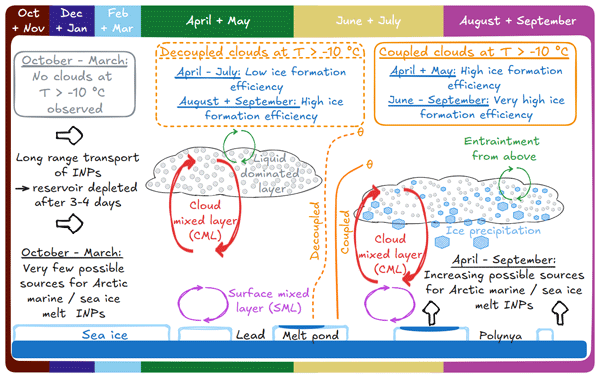
Abstract. Persistent mixed-phase clouds frequently occurred in the Arctic and have significant impacts on the Arctic climate. The surface mixed-layer (SML) coupling status of these clouds impacts their microphysical properties. During an Arctic summer cruise in 2017, surface-coupled clouds were observed to contain ice more often than decoupled clouds at low-supercooling temperatures. Here, an annual cycle of Arctic mixed-phase cloud ice-formation temperatures is presented for the Arctic ice-drift experiment Multidisciplinary drifting Observatory for the Study of Arctic Climate (MOSAiC) in 2019 and 2020. From October until March no clouds with cloud minimum temperatures above −10 °C were observed. From April to September an increased fraction of ice-containing clouds was observed for clouds with minimum temperatures between −7.5 °C and −5 °C (between 40% and 70%). Between April and July SML-coupled clouds with a minimum temperature above −7.5 °C showed an enhanced fraction of ice-containing clouds, compared to decoupled clouds (2–3 times higher). Also, SML-coupled clouds were 2–4 times more likely to be observed during this period. In August + September the ratio of coupled-to-decoupled ice-containing clouds reduced to 1.3, due to a higher frequency of occurrence of ice-containing decoupled clouds. Using surface-based ice-nucleating particle (INP) measurements the observed phenomena could likely be attributed to the presence of INPs active above −15 °C at the surface. Analysis of sea-ice concentration in the surrounding region, the distance to the ice edge, and the travel time along the back-trajectories to the marginal ice zone supports this finding.
Competing interests: At least one of the (co-)authors is a member of the editorial board of Atmospheric Chemistry and Physics. The peer-review process was guided by an independent editor, and the authors also have no other competing interests to declare.
Publisher's note: Copernicus Publications remains neutral with regard to jurisdictional claims made in the text, published maps, institutional affiliations, or any other geographical representation in this paper. While Copernicus Publications makes every effort to include appropriate place names, the final responsibility lies with the authors. Views expressed in the text are those of the authors and do not necessarily reflect the views of the publisher.-
Notice on discussion status
The requested preprint has a corresponding peer-reviewed final revised paper. You are encouraged to refer to the final revised version.
-
Preprint
(11081 KB)
-
The requested preprint has a corresponding peer-reviewed final revised paper. You are encouraged to refer to the final revised version.
- Preprint
(11081 KB) - Metadata XML
- BibTeX
- EndNote
- Final revised paper


Journal article(s) based on this preprint
Interactive discussion
Status: closed
-
RC1: 'Comment on egusphere-2025-5708', Anonymous Referee #2, 26 Dec 2025
- AC1: 'Reply on RC1', Hannes Griesche, 23 Apr 2026
-
RC2: 'Comment on egusphere-2025-5708', Anonymous Referee #1, 12 Feb 2026
Review of “Annual cycle of surface-coupling effects on Arctic mixed-phase clouds during MOSAiC” by Griesche et al., for publication in Atmospheric Chemistry and Physics
Summary
This manuscript provides a highly detailed analysis of surface coupling on cloud properties during the MOSAiC campaign. The introduction is highly detailed though some spots can be shortened without taking away from the overall message. Another strength of the manuscript is the high number of recent (2020-2025) references – clearly demonstrating that the authors are current on the science surrounding this topic, and after checking each of those references, it is clear the authors have established a novel research idea and approach for the present study. A strength of this manuscript is the quality of the figures and tables. Each figure is very clear and easy to read, while supporting relevant key results or discussion points in the text. The core result of the paper is convincing and robust: It’s very clear from the results that observed liquid clouds are very frequently associated with surface coupling, while many ice containing clouds are from decoupled states. INPs have some seasonality with a peak in Summer and likely explain some observed cases where coupled clouds contain more ice in T > -15C cases. The authors also take care to acknowledge limitations of their work such as, for example, realizing that clouds decoupled from the surface may have previously been coupled before, and that partitioning by time and coupling state would have yielded inconclusive results due to the limited number of samples for each bin. While I think the key scientific findings are novel and robust, the writing and communication of the results was cumbersome in some sections of the manuscript. I made many suggestions in the specific comments already, but I think this manuscript could be shortened by at least ~5% in length while still conveying all of the key findings accurately and concisely. The reduction in text may also be helpful for the additional figures I’ve suggested adding to the text – namely 1-2 to provide additional detail and support for results on the trajectory analysis, and an additional figure partitioning Figure 8 into “lowest vs. highest” INP states for each of the coupled vs. decoupled states to reveal any INP sensitivity (or lack thereof) to the coupling state.
Overall, I think this will make an excellent contribution to Atmospheric Chemistry and Physics given the clear fundamental difference in observed cloud properties as a function of surface coupling, and the novel use of INPs to further explain the occurrence of observed ice in coupled vs. decouple states. However, I believe this manuscript needs a major revision first to expand core details around some of the analysis (methods) techniques, which could be addressed through some additional figure suggestions below, as well as improve the writing of the manuscript for conciseness and clarity (I have made many specific comments below).
General Comments
- Paragraphs 1 and 2 in the introduction contain a lot of good background information discussing why mixed-phase clouds are persistent, the processes by which mixed-phase cloud particles exist, and some discussion of the seasonality of Arctic cloud properties. I think these two paragraphs, however, could be reorganized somewhat to discuss surface-atmosphere coupling much earlier, and how resulting processes are tied to surface coupling.
- Section 2 would benefit from having multiple subsections to organize the descriptions of the various datasets (e.g., (A) OCEANET, (B) INP Data, (C) Radiosonde Data).
- Section 3.1 of the text was a bit hard to follow. The authors refer to Jimenez et al. (2020) as the source of the method, but it’s not clear how or why thresholds or values are determined (e.g., why “δ should therefore not exceed a value of 0.03”). This section could benefit from additional detail and perhaps could be organized better by adding a list of (say) 3-5 bullet points clearly outlining the lidar-based algorithm.
- Trajectory analysis is one of the key analysis methods but lacks description in the methods. An example figure with details on, for example, typical altitudes of the liquid base height, how HYSPLIT was initialized, and if an ensemble of points around the MOSAiC site was used. Even for small areas (say, 2x2 km) the origin of parcels can come from a very wide area of the Arctic – this detail is critical for the overall interpretation of the stated results, especially for ensuring that a 1-2 km horizontal distance initiation offset of HYSPLIT doesn’t result in a parcel trajectory that’s 50-100 km or more away from the original parcel’s origin point for the same amount of time. I think adding a figure or 2 into the results showing the HYSPLIT results would be very beneficial.
- Lead and melt pond fraction are frequently referenced in the results, however, it’s unclear to me how significant this detail is with respect to more obvious analysis points (namely the role of sea-ice concentration on the results). In principle the idea of why they are important make sense (especially in the cited references), but I think the authors need to make a more convincing argument why lead and melt fraction is significant to the conclusions drawn. Can a figure be created partitioning the INP results based on very low lead and/or melt fraction vs. characteristically high lead and/or melt fraction (with statistical significance testing)?
Specific Comments
L2: “an Arctic summer cruise”. Also, the sentence starting with “During an Arctic summer cruise…” from L2-4 in the abstract seems to come out of left field, and I’m not sure this motivational detail is needed here.
L6: comma needed after “March” and “September”
L8: comma needed after “July”
L44: For this paragraph, I’d include 1-2 sentences tying the importance of INP measurements to surface coupling (for example: to the audience not familiar with INPs, are certain INPs more likely to be sourced from the surface than the free troposphere?).
L70: Do you mean “deeper” instead of “higher”?
L110: Comma needed after “radar”.
L116-117: INP filter and trajectory discussion is quite central to your analysis, hence, I think calling it “supporting information” undermines its importance. You could just say “Additionally, methods centered around the use of INP measurements, air parcel trajectories, and sea-ice concentration are discussed.”.
L120: “… aboard the Polarstern…”
Figure 1: Is it necessary to state that the map was created with PyGMT? Unless it was adapted from another manuscript, this detail may be unnecessary.
L137-139: It would be useful to state somewhere in here what size INPs can be collected by these filters.
L139: The way this is written, it sounds like the expedition took place at Colorado State University. Unless you meant to say “the filters were analyzed after the expedition at Colorado State University”?
L147: This is a fairly important detail. 1-2 more sentences to describe the Cloudnet target classification would be helpful. Or, state here that the Cloudnet algorithm will be described in more detail in the next (Methodology) section.
L153: “introduced in the following and all…” did you mean to say “following paragraphs”? or something else?
L160-162: Suggested rewrite: “The lidar, due to its sensitivity to the number of particles in a sample volume, was primarily used for the identification of liquid-dominated layers. The procedure for detecting liquid-dominated layers follows Jimenez et al. (2020), which relied on normalized attenuated backscatter.
L167: Just say “… profiles were used to avoid misclassification of backscatter signals…”
L169: What is the significance of the 0.03 value for d?
L173-174: This is a pretty important detail that should come near the beginning of the paragraph (screening for liquid near the lidar to see if the profile should be analyzed).
L175: If you take my suggestion for L160-162, I might suggest moving any info as to why you didn’t use the cloud radar to the end of this paragraph.
L187: I’d say “…derived from the closest radiosonde profile within 6 hours of the observed cloud profile.” And then eliminate the next sentence.
L199: consider saying “… the clouds were further analyzed based on their coupling state.”
Section 3.4: I’d reword the title slightly to “INP concentration, parcel trajectory analysis, and surface properties” and further sub-divide this section into an (A), (B) and (C) for INP, trajectory analysis and surface properties subsections respectively.
L216-218: The trajectory analysis description needs much more detail. An example figure would be great to add here as well.
L219: no comma needed after (SIC).
Results section: After reading this, I think the first 4 paragraphs could go under a new Section 4.1 titled “Campaign overview of surface conditions, INP measurements and Sea-ice concentration during MOSAiC”
L229: “An overview of atmospheric and surface properties at the Polarstern site during MOSAiC is shown in Fig. 2.”. Also, you can eliminate the sentence stating “Depicted are different parameters…”.
L239: Is Dada et al. (2022) referring to the 1st, 2nd or 3rd WAI event?
L247: It would be helpful to the casual reader to quickly describe (perhaps 1 sentence) what characteristic INP values are and what they represent (e.g., is 5 x 10⁻⁴ L a large amount? What’s considered high versus low?)
L287-288: This is an oddly worded sentence. What does “detected ice more frequent than periods were observed” mean?
L292: “… for each respective temperature interval…”
L299: what is “The respective signal” referring to?
Figure 8: I certainly understand and agree with why you cannot do a combined temporal vs coupling state analysis as in Figure 5, but could you potentially remake a version of this figure showing, for each coupling state, the coupled vs. decoupled states for the top 30% of INP concentrations vs. bottom 30% of INP concentrations? Doing a figure in this way might reveal the sensitivity (or lack thereof) of INPs on the coupling state, even though you’d be eliminating 40% of the data as I’ve proposed here.
L354: “too sparse”
L383: “Another limiting factor was…”
L389-401: This is a very interesting result, but the Discussion section is not the right place to introduce this point. Move this to the results section, and add a subsection to the Methods section describing the EDR data and how it’s derived.
L448: Change “are also” to “include”
L479: “… could yet be quantified.”
L480: “field campaigns”
L482-483: “… have a different cloud radiative effect.”
Citation: https://doi.org/10.5194/egusphere-2025-5708-RC2 - AC2: 'Reply on RC2', Hannes Griesche, 23 Apr 2026
Peer review completion


Interactive discussion
Status: closed
-
RC1: 'Comment on egusphere-2025-5708', Anonymous Referee #2, 26 Dec 2025
This manuscript examines parts of the annual cycle of cloud temperatures and the relative occurrence of ice during the MOSAiC expedition using bimonthly partitioning. The authors combine remote sensing (PollyXT, KAZR) with surface-based INP measurements to associate ice occurrence with primary ice nucleation and long-range INP transport, while dissecting the data by cloud-coupling state. I think the results showing differences in the ice occurrence fraction between coupled and decoupled cases are mostly robust. However, I have major concerns about parts of the methodology: the writing is mediocre (many sentences are difficult to understand), the literature review is lacking, and some references to the literature are inaccurate, leading to misleading statements and undermining the analysis's credibility.
Specific comments:
- Methodology and Inaccurate references for methodological approaches:
- IWC detectability threshold: In l. 178-179, it is stated that ice detectability by the lidar is determined "by considering the lowest detectable IWC from a lidar of 10-6 kg m-3 (Buhl et al., 2016)." I do not know where the authors found this threshold. Looking at Buhl et al., 2016, IWC values of 10-8 kg m-3 and lower are clearly seen in Fig. 7. (the case of smaller ice corresponding to smaller reflectivity contours), but perhaps there’s something I’ve missed.
- Volume depolarization threshold of 0.03 for ice: based on l. 178, looking at Griesche et al. (2021), I do not see any derivation of the 0.03 threshold, other than a very similar quote, which is honestly misleading. It is true that, in theory, very small depolarization values are expected for liquids, but this requires consistent calibration and very accurate corrections and does not account for the occurrence of drizzle (larger non-spherical drops resulting in slightly higher depolarization - see earlier works of Sassen and Platt). A slight deviation in the deadtime correction, for example, could result in high depolarization around the cloud base region and, hence, a false positive for ice. I know the PollyXT is a wonderful instrument, but given the harsh conditions of that remote deployment, I doubt that assumption holds throughout the expedition, though I could be wrong.
- The previous bullet combined with the apparent PollyXT data, which, unless I misinterpreted it, seems off (as demonstrated in Fig. 3):
- Backscatter units appear closer to sr-1 m-1 than sr-1 mM-1, though if that is the case, I'd expect values closer to 1e-3 around the liquid cloud peak return (e.g., Thorsen and Fu, 2015, https://doi.org/10.1175/JTECH-D-14-00178.1). Given the Raman capabilities of the PollyXT, I would expect to see the derived backscatter cross-section field, which is more informative than the attenuated backscatter.
- Depolarization field: missing depolarization values in-cloud, above cloud base but below the backscatter peak, are shown in Fig. 3b. Those are quite concerning, as I would have expected the cross-polar signal to be strong enough to generate a robust signal. If the NaN (or inf) values were the result of near-zero cross-pol values, then I would not have expected the depolarization to start showing again above a certain depth. Are the elevated values above the NaN region the result of a lack of implementation of multiple-scattering corrections? A very low SNR would likely have resulted in noise rather than a consistent pattern. The problematic depolarization signal around cloud base makes me very uncomfortable with the depolarization-only determination of ice, let alone the extremely small threshold of 0.03. This makes me think that the ice periods are overestimated throughout the analysis period (the radar analysis towards the end, for that matter, might be picking up on some supercooled drizzle, or not - see my penultimate comment of this review).
- Trajectory analysis: This analysis is prone to errors when considering single trajectories (no ensembles), and results are very inconclusive, giving the feeling of “cherry picking”:
- The authors describe in l. 216-218 the use of 10-day back-trajectories. I doubt that 10-day back trajectories are robust, especially over the polar regions. I believe that a small shift of a few kilometers, or even hundreds of meters, in the starting coordinates could result in major offsets. See the recent literature on the topic, e.g., from ARM.
- “weakly coupled” (l. 335-337): I am not familiar with such a "weakly coupled" category. Looking at Silber and Shupe (2022), I do not see any reference to such a "weakly coupled" category. I do see that they used an equivalent ratio value of 5 and not 2, as used here, and their justification was the near-surface uncertainty in ERA5 (model output) over the polar regions, whereas here, real observations over the PolarStern are used, so I do not see a proper justification for this category.
- The trajectory analysis results (Fig. 9 and related discussion): Fig. 9a appear inconclusive when considering the ice occurrence fluctuations vs. temperature (as opposed to Fig. 5 and mostly Fig. 8, where coupled cases consistently have higher ice fractions), and could be merely the result of confounders (e.g., time of year and icebreaker position integrated in Fig. 5). Because of this inconsistency, I tend to doubt the results in Fig. 9b, though the explanation in the text does make some sense. That said, note that the number of samples in Fig. 9b are significantly less balanced at T > -15 C, which could strongly influence the apparent agreement albeit the travel time partitioning.
- Also, given the results in Fig. 10, how would this figure (9) look if you apply the trajectory partitioning on the radar-based definition?
- Overeach statements, for example:
- INPs vs. trajectory time in l. 244-246 - Eyeballing Fig. 2, this correlation appears coincidental and not more. There are times with an apparent sharp increase in INPC commensurate (or not) with trajectory travel times. More rigorous analysis is required to support this claim and conclusion.
- INP concentration change discussed in l. 247-251: I do not think that more than a 2 orders-of-magnitude increase is "moderate". Moreover, they are at the very least equivalent to the June-July increase when examining the figure in detail.
- Conclusions, specifically l. 478-480 (see my final comment below).
- Writing – the text contains many sentences that are difficult to understand (some examples: l. 21-22, l. 290-291), the introduction lacks a clear storyline (the intro often reads like a collection of anecdotes on GW effects, etc.), there’s a frequent change of tense within paragraphs (e.g., l. 31-43), and many typos are found throughout the text (e.g., “during a Arctic”; l. 2, a repeating term “my means" in l. 161 and 175 – what does it mean?). The Introduction’s literature survey is lacking references to older works, giving the impression that the vast majority of findings are from the last 4-6 years. What about the extensive works of Tjernström, J. Curry, and more on ACI, Arctic atmosphere's thermodynamic profile, coupling state, etc.? I understand the focus on MOSAiC findings, but Arctic science existed before (SHEBA, etc.).
- l. 14 - "along the back-trajectories" - which back trajectories? More information is needed here. Trajectories were not mentioned until now.
- l. 23. - "initiated by an INP" - you mean "initiated by INPs"?
- The continuous reference to INPs as singular throughout the text results in incorrect English when referring to "an INP". At some point in the text this changes and INPs are referred to in the plural form.
- l. 44 - "INPs of different composition trigger ice formation at different temperatures." - is that accurate? INPs are more likely to activate at different temperatures depending on composition, with the likelihood increasing at lower temperatures, but the text does not reflect that.
- l. 71 - "which is capped by a temperature inversion" - while this is typically true, temperature inversions are NOT ALWAYS the case (see earlier work mentioned above), or do the authors have a specific definition for a temperature inversion?
- l. 83 - "decoupled from the WVT" - you mean decoupled from the sea ice leads?
- l. 112 - define HYSPLIT and provide reference (likely Stein et al.). This is provided later in the text but should be stated here.
- Fig. 1 - provide lat/lon information (what latitude does the inner circle denote? Some ticks, at the very least, are missing for longitude).
- l. 133 - "another remote-sensing site" - you mean remote sensing facility? Or perhaps a remote sensing platform?
- Table 1: Some of the information appears to be misleading: Can't the volume depolarization ratio exceed 0.5? What about KAZR Ze? can't it exceed +20 dBZ? I doubt that is the case.
- Table 2 - Equation for decoupling height is inconsistent with the text description (l. 189-191).
- l. 150. was --> were
- l. 170 - 1e-5 sr-1 mM-1? So you use a threshold of 1e-8 sr-1 km-1 for liquid? I doubt it. Perhaps 1e-2 sr-1 km -1?
- l. 271-273 - again, I could be missing something here, but the results in Buhl et al. support the detection of ice throughout the depicted period, considering the reflectivity values.
- The observations in Fig. 3 seem somewhat off:
- panel a - backscatter units (see major comment above)
- panel b - Missing depolarization values in-cloud (see major comment above)
- panel c - why is the cloud base not shown here as well? It is critical here for case evaluation. Also, see my other comment concerning ice detection.
- panel d - I agree with your deduction of liquid only between 19-23 UTC. It all appears to indicate drizzle below cloud base, but why does Cloudnet classify it as ice? Is it purely a detectable echo at temperatures below 0 °C?
- Also, no letters for panels
- Also, the cloud base curve should be thinner (or smoothed) to enable lidar data evaluation of more pixels
- l. 282 - In general, is the fraction of ice-containing clouds an accurate term? I mean, what happens in multi-layer cases? Perhaps you mean the fraction of ice-containing clouds among the lowest liquid clouds, or a similar definition? I think you already refer to this entire analysis as focusing on the lowest liquid clouds, but only towards the very end of the manuscript. This should be stated earlier, much closer to the beginning (and perhaps even in the abstract)
- l. 293 - define how the uncertainty is calculated? Based on Seifert et al., I presume this is simply the standard error, which may or may not represent the _actual_ uncertainty. Given that the definition is rather simple, why not simply provide it “in full”?
- l. 318 onward - until now the discussion was about coupled-decoupled but now it is in terms of free-tropospheric clouds. I recommend choosing a fixed terminology and using it throughout the text.
- l. 350 - without INPs active at T > -15 C - so no INPs whatsoever, or just very small values? Based on Fig. 2d, and as one would expect, there are always INPs, even if at very small concentrations.
- Also, no clouds were observed at all or do you mean ice-containing clouds were not observed?
- l. 394-395 and Table 3 - EDR in log10 of what units? Specify.
- l. 405-409 - I agree that it is more likely to detect sporadic ice crystals with a Ka-band radar than with a lidar, but how did you determine the radar echoes are necessarily precipitating ice and not supercooled drizzle for example?
- Conclusions: in l.478-480 - This is indeed an apparent connection, but only an associative one. Recommend stating "associative" since without appropriate modeling accounting for these processes, one can suggest this connection, but not state that it is proven. Tone down.
Citation: https://doi.org/10.5194/egusphere-2025-5708-RC1 - AC1: 'Reply on RC1', Hannes Griesche, 23 Apr 2026
- Methodology and Inaccurate references for methodological approaches:
-
RC2: 'Comment on egusphere-2025-5708', Anonymous Referee #1, 12 Feb 2026
Review of “Annual cycle of surface-coupling effects on Arctic mixed-phase clouds during MOSAiC” by Griesche et al., for publication in Atmospheric Chemistry and Physics
Summary
This manuscript provides a highly detailed analysis of surface coupling on cloud properties during the MOSAiC campaign. The introduction is highly detailed though some spots can be shortened without taking away from the overall message. Another strength of the manuscript is the high number of recent (2020-2025) references – clearly demonstrating that the authors are current on the science surrounding this topic, and after checking each of those references, it is clear the authors have established a novel research idea and approach for the present study. A strength of this manuscript is the quality of the figures and tables. Each figure is very clear and easy to read, while supporting relevant key results or discussion points in the text. The core result of the paper is convincing and robust: It’s very clear from the results that observed liquid clouds are very frequently associated with surface coupling, while many ice containing clouds are from decoupled states. INPs have some seasonality with a peak in Summer and likely explain some observed cases where coupled clouds contain more ice in T > -15C cases. The authors also take care to acknowledge limitations of their work such as, for example, realizing that clouds decoupled from the surface may have previously been coupled before, and that partitioning by time and coupling state would have yielded inconclusive results due to the limited number of samples for each bin. While I think the key scientific findings are novel and robust, the writing and communication of the results was cumbersome in some sections of the manuscript. I made many suggestions in the specific comments already, but I think this manuscript could be shortened by at least ~5% in length while still conveying all of the key findings accurately and concisely. The reduction in text may also be helpful for the additional figures I’ve suggested adding to the text – namely 1-2 to provide additional detail and support for results on the trajectory analysis, and an additional figure partitioning Figure 8 into “lowest vs. highest” INP states for each of the coupled vs. decoupled states to reveal any INP sensitivity (or lack thereof) to the coupling state.
Overall, I think this will make an excellent contribution to Atmospheric Chemistry and Physics given the clear fundamental difference in observed cloud properties as a function of surface coupling, and the novel use of INPs to further explain the occurrence of observed ice in coupled vs. decouple states. However, I believe this manuscript needs a major revision first to expand core details around some of the analysis (methods) techniques, which could be addressed through some additional figure suggestions below, as well as improve the writing of the manuscript for conciseness and clarity (I have made many specific comments below).
General Comments
- Paragraphs 1 and 2 in the introduction contain a lot of good background information discussing why mixed-phase clouds are persistent, the processes by which mixed-phase cloud particles exist, and some discussion of the seasonality of Arctic cloud properties. I think these two paragraphs, however, could be reorganized somewhat to discuss surface-atmosphere coupling much earlier, and how resulting processes are tied to surface coupling.
- Section 2 would benefit from having multiple subsections to organize the descriptions of the various datasets (e.g., (A) OCEANET, (B) INP Data, (C) Radiosonde Data).
- Section 3.1 of the text was a bit hard to follow. The authors refer to Jimenez et al. (2020) as the source of the method, but it’s not clear how or why thresholds or values are determined (e.g., why “δ should therefore not exceed a value of 0.03”). This section could benefit from additional detail and perhaps could be organized better by adding a list of (say) 3-5 bullet points clearly outlining the lidar-based algorithm.
- Trajectory analysis is one of the key analysis methods but lacks description in the methods. An example figure with details on, for example, typical altitudes of the liquid base height, how HYSPLIT was initialized, and if an ensemble of points around the MOSAiC site was used. Even for small areas (say, 2x2 km) the origin of parcels can come from a very wide area of the Arctic – this detail is critical for the overall interpretation of the stated results, especially for ensuring that a 1-2 km horizontal distance initiation offset of HYSPLIT doesn’t result in a parcel trajectory that’s 50-100 km or more away from the original parcel’s origin point for the same amount of time. I think adding a figure or 2 into the results showing the HYSPLIT results would be very beneficial.
- Lead and melt pond fraction are frequently referenced in the results, however, it’s unclear to me how significant this detail is with respect to more obvious analysis points (namely the role of sea-ice concentration on the results). In principle the idea of why they are important make sense (especially in the cited references), but I think the authors need to make a more convincing argument why lead and melt fraction is significant to the conclusions drawn. Can a figure be created partitioning the INP results based on very low lead and/or melt fraction vs. characteristically high lead and/or melt fraction (with statistical significance testing)?
Specific Comments
L2: “an Arctic summer cruise”. Also, the sentence starting with “During an Arctic summer cruise…” from L2-4 in the abstract seems to come out of left field, and I’m not sure this motivational detail is needed here.
L6: comma needed after “March” and “September”
L8: comma needed after “July”
L44: For this paragraph, I’d include 1-2 sentences tying the importance of INP measurements to surface coupling (for example: to the audience not familiar with INPs, are certain INPs more likely to be sourced from the surface than the free troposphere?).
L70: Do you mean “deeper” instead of “higher”?
L110: Comma needed after “radar”.
L116-117: INP filter and trajectory discussion is quite central to your analysis, hence, I think calling it “supporting information” undermines its importance. You could just say “Additionally, methods centered around the use of INP measurements, air parcel trajectories, and sea-ice concentration are discussed.”.
L120: “… aboard the Polarstern…”
Figure 1: Is it necessary to state that the map was created with PyGMT? Unless it was adapted from another manuscript, this detail may be unnecessary.
L137-139: It would be useful to state somewhere in here what size INPs can be collected by these filters.
L139: The way this is written, it sounds like the expedition took place at Colorado State University. Unless you meant to say “the filters were analyzed after the expedition at Colorado State University”?
L147: This is a fairly important detail. 1-2 more sentences to describe the Cloudnet target classification would be helpful. Or, state here that the Cloudnet algorithm will be described in more detail in the next (Methodology) section.
L153: “introduced in the following and all…” did you mean to say “following paragraphs”? or something else?
L160-162: Suggested rewrite: “The lidar, due to its sensitivity to the number of particles in a sample volume, was primarily used for the identification of liquid-dominated layers. The procedure for detecting liquid-dominated layers follows Jimenez et al. (2020), which relied on normalized attenuated backscatter.
L167: Just say “… profiles were used to avoid misclassification of backscatter signals…”
L169: What is the significance of the 0.03 value for d?
L173-174: This is a pretty important detail that should come near the beginning of the paragraph (screening for liquid near the lidar to see if the profile should be analyzed).
L175: If you take my suggestion for L160-162, I might suggest moving any info as to why you didn’t use the cloud radar to the end of this paragraph.
L187: I’d say “…derived from the closest radiosonde profile within 6 hours of the observed cloud profile.” And then eliminate the next sentence.
L199: consider saying “… the clouds were further analyzed based on their coupling state.”
Section 3.4: I’d reword the title slightly to “INP concentration, parcel trajectory analysis, and surface properties” and further sub-divide this section into an (A), (B) and (C) for INP, trajectory analysis and surface properties subsections respectively.
L216-218: The trajectory analysis description needs much more detail. An example figure would be great to add here as well.
L219: no comma needed after (SIC).
Results section: After reading this, I think the first 4 paragraphs could go under a new Section 4.1 titled “Campaign overview of surface conditions, INP measurements and Sea-ice concentration during MOSAiC”
L229: “An overview of atmospheric and surface properties at the Polarstern site during MOSAiC is shown in Fig. 2.”. Also, you can eliminate the sentence stating “Depicted are different parameters…”.
L239: Is Dada et al. (2022) referring to the 1st, 2nd or 3rd WAI event?
L247: It would be helpful to the casual reader to quickly describe (perhaps 1 sentence) what characteristic INP values are and what they represent (e.g., is 5 x 10⁻⁴ L a large amount? What’s considered high versus low?)
L287-288: This is an oddly worded sentence. What does “detected ice more frequent than periods were observed” mean?
L292: “… for each respective temperature interval…”
L299: what is “The respective signal” referring to?
Figure 8: I certainly understand and agree with why you cannot do a combined temporal vs coupling state analysis as in Figure 5, but could you potentially remake a version of this figure showing, for each coupling state, the coupled vs. decoupled states for the top 30% of INP concentrations vs. bottom 30% of INP concentrations? Doing a figure in this way might reveal the sensitivity (or lack thereof) of INPs on the coupling state, even though you’d be eliminating 40% of the data as I’ve proposed here.
L354: “too sparse”
L383: “Another limiting factor was…”
L389-401: This is a very interesting result, but the Discussion section is not the right place to introduce this point. Move this to the results section, and add a subsection to the Methods section describing the EDR data and how it’s derived.
L448: Change “are also” to “include”
L479: “… could yet be quantified.”
L480: “field campaigns”
L482-483: “… have a different cloud radiative effect.”
Citation: https://doi.org/10.5194/egusphere-2025-5708-RC2 - AC2: 'Reply on RC2', Hannes Griesche, 23 Apr 2026
Peer review completion
Journal article(s) based on this preprint
Viewed
| HTML | XML | Total | BibTeX | EndNote | |
|---|---|---|---|---|---|
| 1,861 | 1,111 | 229 | 3,201 | 261 | 254 |
- HTML: 1,861
- PDF: 1,111
- XML: 229
- Total: 3,201
- BibTeX: 261
- EndNote: 254
Viewed (geographical distribution)
| Country | # | Views | % |
|---|
| Total: | 0 |
| HTML: | 0 |
| PDF: | 0 |
| XML: | 0 |
- 1
Hannes Jascha Griesche

Ronny Engelmann
Martin Radenz
Julian Hofer
Dietrich Althausen
Albert Ansmann
Kevin Barry
Jessie Creamean
Cristofer Jimenez
Patric Seifert
The requested preprint has a corresponding peer-reviewed final revised paper. You are encouraged to refer to the final revised version.
- Preprint
(11081 KB) - Metadata XML
This manuscript examines parts of the annual cycle of cloud temperatures and the relative occurrence of ice during the MOSAiC expedition using bimonthly partitioning. The authors combine remote sensing (PollyXT, KAZR) with surface-based INP measurements to associate ice occurrence with primary ice nucleation and long-range INP transport, while dissecting the data by cloud-coupling state. I think the results showing differences in the ice occurrence fraction between coupled and decoupled cases are mostly robust. However, I have major concerns about parts of the methodology: the writing is mediocre (many sentences are difficult to understand), the literature review is lacking, and some references to the literature are inaccurate, leading to misleading statements and undermining the analysis's credibility.
Specific comments: