
the Creative Commons Attribution 4.0 License.
the Creative Commons Attribution 4.0 License.
 | 23 Dec 2025
Daily Drought Prediction in the Huaihe River Basin Using VMD-informer-LSTM
Abstract. Accurate drought prediction is a key challenge in water resource management and agricultural planning. This study proposes a novel drought prediction framework that integrates Variational Mode Decomposition (VMD), Informer, and Long Short-Term Memory (LSTM) networks to enhance hydrological drought forecasting in the Huaihe River Basin, China. The VMD-Informer-LSTM model decomposes complex non-stationary drought sequences into multi-scale components, effectively extracting long-term trends and short-term fluctuations. Results show that the model outperforms LSTM, Transformer-LSTM, and Informer-LSTM, improving R², RMSE, MAE, and MAPE by 28.4 %, 46.2 %, 46.5 %, and 50.8 %, respectively, over the baseline LSTM. When the prediction period is 30 days, the VMD-Informer-LSTM achieves the highest prediction accuracy. During the 120–180 day prediction period, the prediction accuracy of all models declines, with drought intensity generally underestimated. Misclassifications are mainly concentrated in the transition zones between humid and semi-humid regions, with higher error frequency in semi-humid areas. Prediction accuracy is highest in the upstream and downstream regions, followed by the Yishuisi River Basin, while the midstream region performs poorly due to human interference. Shapley Additive Explanations (SHAP) further reveal that precipitation and temperature are the dominant meteorological drivers, jointly accounting for nearly half of the model’s predictive power. These results confirm that the VMD-Informer-LSTM provides the most accurate predictions among the tested models, offering valuable support for drought risk assessment and water resource management in the Huaihe River Basin and other similar regions.
-
Notice on discussion status
The requested preprint has a corresponding peer-reviewed final revised paper. You are encouraged to refer to the final revised version.
-
Preprint
(11521 KB)
-
The requested preprint has a corresponding peer-reviewed final revised paper. You are encouraged to refer to the final revised version.
- Preprint
(11521 KB) - Metadata XML
- BibTeX
- EndNote
- Final revised paper


Journal article(s) based on this preprint
Interactive discussion
Status: closed
-
RC1: 'Comment on egusphere-2025-5645', Anonymous Referee #1, 29 Dec 2025
-
AC1: 'Reply on RC1', Li min, 14 Feb 2026
This paper presents an innovative hybrid model combining VMD, Informer, and LSTM for daily drought prediction in the Huaihe River Basin. The methodological approach is innovative, integrating signal decomposition with advanced deep learning architectures for drought prediction. However, the manuscript has several critical issues related to experiment design, methodological justification, and interpretation of results, which must be addressed before it can be considered for publication.
1.The study is fundamentally built on the DEDI index, derived from ERA5 reanalysis-based actual evapotranspiration (AET). This choice introduces a significant, and largely unacknowledged, source of bias and uncertainty. The ERA5 model, like most land surface models, does not explicitly represent irrigation, a dominant human activity in the agriculturally intensive Huaihe River Basin. This omission likely leads to a systematic overestimation of drought severity during growing seasons.
Reply: Thank you for your valuable comments. Regarding the issue you raised about the ERA5 data not explicitly considering irrigation, we understand the limitations of this data, particularly in agricultural regions like the Huaihe River Basin, where the impact of irrigation on soil moisture and drought conditions is crucial. However, we chose to use ERA5 data primarily due to its high spatio-temporal resolution and the availability of long-term time series data, which makes it highly suitable for climate-driven drought analysis.
In fact, several studies have demonstrated the effectiveness of the ERA5 and ERA5-Land datasets in regions such as the Huaihe River Basin. For example, (Gao et al., 2023) studied the distribution characteristics of cloud water resources (CWRs) using ERA5 data in the Huaihe River Basin and effectively assessed the relationship between water vapor distribution and climate change in the region using this high-resolution reanalysis data. Their research shows that ERA5 data provides an effective description of the hydrometeorological processes in the region, which has been validated and proven to be applicable to regional drought and water resources studies. (Liu et al., 2025) analyzed the recovery characteristics of agricultural drought in the Huaihe River Basin using ERA5-Land data, evaluating drought recovery time and water demand using soil moisture index (SWDI) and precipitation index (WAPI). They noted that ERA5-Land soil moisture data showed significant accuracy in agricultural drought assessment, further proving the effectiveness of ERA5-Land data in spatial and temporal distribution and prediction during the drought recovery phase. Even without irrigation data, ERA5-Land was able to capture the dynamic changes in regional drought. (Zhang et al., 2021)utilized ERA5-Land data and the standardized soil moisture index (SWDI) to assess agricultural drought in four provinces of southern China. The results showed that the dataset efficiently evaluated soil moisture deficits and accurately reflected drought intensity and extent. These studies collectively demonstrate that ERA5 data has high accuracy and reliability in analyzing regionally climate-driven droughts.
Gao, J., Feng, J., Cao, Y., & Zheng, X. (2023). Evaluation of Cloud Water Resources in the Huaihe River Basin Based on ERA5 Data. ATMOSPHERE, 14(8), 1253. https://doi.org/10.3390/atmos14081253
Liu, J., Zhu, Y., Horton, R., Lü, H., Ahmed, N., Fu, Y., Xu, Y., Chen, T., & Yao, Y. (2025). Agricultural drought recovery characteristics and water requirement for rapid drought recovery in the Huai River Basin, China. Journal of Hydrology: Regional Studies, 59, 102396. https://doi.org/10.1016/j.ejrh.2025.102396
Zhang, R., Lu, L., Ye, Z., Huang, F., Li, J., Wei, L., Mao, T., Xiong, Z., & Wei, S. (2021). Assessment of Agricultural Drought Using Soil Water Deficit Index Based on ERA5-Land Soil Moisture Data in Four Southern Provinces of China. AGRICULTURE-BASEL, 11(5), 411. https://doi.org/10.3390/agriculture11050411
Zhang, X., Duan, Y., Duan, J., Chen, L., Jian, D., Lv, M., Yang, Q., & Ma, Z. (2022). A daily drought index-based regional drought forecasting using the Global Forecast System model outputs over China. ATMOSPHERIC RESEARCH, 273, 106166. https://doi.org/10.1016/j.atmosres.2022.106166
2.The most severe shortcoming is the complete absence of validation against independent observational data.The entire modeling pipeline—from DEDI calculation to model training and evaluation—operates within the only ERA5 reanalysis. There is no validation against independent observational data (e.g., in-situ soil moisture, streamflow, reservoir levels, or satellite-based drought indices like SMAP soil moisture or GRACE terrestrial water storage). Consequently, the reported high performance may indicate skillful fitting to the internal structures of the reanalysis product rather than a predictive capability for real-world drought events.
Reply: Thank you for your valuable comments. We acknowledge that modeling and evaluation based solely on a single reanalysis data source (ERA5) indeed limits the model's direct validation ability for real drought processes. This limitation has been clearly identified as one of the important constraints of this study in the discussion section of the revised manuscript.
In this study, ERA5 reanalysis data was chosen primarily for its comprehensive advantages in temporal continuity, spatial consistency, and multi-meteorological variable synergy. ERA5 has been widely used in global and regional hydrometeorological studies and has demonstrated good stability and reliability for key variables such as evapotranspiration, precipitation, and soil moisture. As a result, it is often used as the data foundation for constructing regional drought indices and methodological studies. In global-scale studies, Xu et al. (2024) used ERA5 data for global-scale drought prediction, demonstrating that ERA5 data can effectively predict drought events worldwide. Filipović et al. (2021) constructed a regional soil moisture prediction system using ERA5 data and drought predictions through the LSTM model, proving ERA5’s independent application capability in local drought forecasting. Gupta et al. (2024) proposed a deep learning model based on ERA5 data for global drought prediction, highlighting the potential and value of ERA5 data in global drought forecasting.
In a regional study, Gao et al. (2023) conducted a spatiotemporal analysis of cloud water resources in the Huaihe River Basin using ERA5 data, showing that ERA5 can effectively capture variations in cloud water resources, providing reliable data support for water resource management and drought prediction in the region. Zhang et al. (2021) used ERA5-Land data to construct a Soil Moisture Deficit Index (SWDI) for evaluating agricultural drought in the Huaihe River Basin, and through comparison with other data sources, validated the applicability of ERA5-Land data to drought analysis for the region. Additionally, Li et al. (2025) modelled hydrological drought in the Huaihe River Basin using ERA5 data, and the study demonstrated that ERA5 data can effectively predict drought events in the region, proving its applicability.
Therefore, we will clearly state in the discussion section of the revised manuscript that future research will combine ground observational data and multi-source remote sensing/reanalysis products to further systematically test the model's practical applicability, uncertainty, and cross-dataset generalization capabilities.
Xu, L., Zhang, X., Wu, T., Yu, H., Du, W., & Chen, N. (2024). Global prediction of flash drought using machine learning. Geophysical Research Letters, 51(21). https://doi.org/10.1029/2024GL111134.
Filipović, N., Brdar, S., Mimić, G., Marko, O., & Crnojević, V. (2021). Regional soil moisture prediction system based on Long Short‑Term Memory network. Biosystems Engineering. https://doi.org/10.1016/j.biosystemseng.2021.11.019
Gupta, B. B., Gaurav, A., Attar, R. W., Arya, V., Bansal, S., Alhomoud, A., & Chui, K. T. (2024). Advance drought prediction through rainfall forecasting with hybrid deep learning model. SCIENTIFIC REPORTS, 14(1), 30459. https://doi.org/10.1038/s41598-024-80099-6
Zhang, R., Lu, L., Ye, Z., Huang, F., Li, J., Wei, L., Mao, T., Xiong, Z., & Wei, S. (2021). Assessment of Agricultural Drought Using Soil Water Deficit Index Based on ERA5-Land Soil Moisture Data in Four Southern Provinces of China. AGRICULTURE-BASEL, 11(5), 411. https://doi.org/10.3390/agriculture11050411
Li, M., Yao, Y., Feng, Z., and Ou, M.: Hydrological drought prediction and its influencing features analysis based on a machine learning model, Nat. Hazards Earth Syst. Sci., 25, 4299–4316, https://doi.org/10.5194/nhess-25-4299-2025, 2025.
Gao, J., Feng, J., Cao, Y., & Zheng, X. (2023). Evaluation of Cloud Water Resources in the Huaihe River Basin Based on ERA5 Data. ATMOSPHERE, 14(8), 1253. https://doi.org/10.3390/atmos14081253
3.The paper reports predictive skill at lead times (up to 180 days) that far exceed the theoretical limit of deterministic weather prediction (~2 weeks), yet fails to provide a coherent physical rationale. It is unclear what physical memory mechanisms the model is leveraging for predictions at 30-180 days. Is it capturing real hydrological memory (e.g., from deep soil moisture, groundwater) or merely fitting to statistical autocorrelation and the annual cycle?
Reply: Thank you for your valuable comments. Regarding the issue of 180-day forecasting capability, we believe that the model's forecasting ability does not fall under deterministic weather forecasting. The model's predictive power arises from the time accumulation characteristics of the drought process itself and the extraction of multi-time-scale information. Existing studies (such as the VMD-CNNBiLSTM framework) have shown that drought index sequences can be decomposed into different frequency components using variational mode decomposition, where the low-frequency components represent slow changes and the drought background state has strong temporal memory. Based on this, deep learning models mainly learn the continuity and evolution trends of drought states rather than specific meteorological events. Therefore, the model's forecasting ability on medium- to long-term scales is more akin to "drought state prediction" rather than traditional weather forecasting.
Su, T., Liu, D., Cui, X., Dou, X., Lei, B., Cheng, X., Yuan, M., & Chen, R. (2024). Prediction of DEDI index for meteorological drought with the VMD-CBiLSTM hybrid model. JOURNAL OF HYDROLOGY, 641, 131805. https://doi.org/10.1016/j.jhydrol.2024.131805
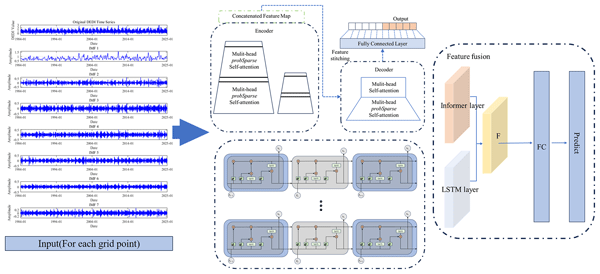
4.The critical parameters for VMD—the number of modes (K) and the penalty factor (α)—are not justified. How were they determined (e.g., using center frequency observations, energy loss ratio)? Their arbitrary selection affects all subsequent analysis. The architecture of the "dual-branch parallel" Informer-LSTM fusion is described only at a high level. How exactly are the outputs from the Informer (global trends) and LSTM (local dynamics) combined (e.g., concatenation, weighted averaging)? A detailed diagram or formula is needed.
Reply: Thank you for your valuable comments. We appreciate the reviewer’s attention to the choice of VMD parameters. Regarding the selection of key parameters in variational mode decomposition (VMD), the penalty coefficient α and the number of modes K were not arbitrarily set, but rather determined by referring to existing mature studies and considering the characteristics of the data in this study.
In this study, the penalty coefficient α (bandwidth constraint parameter) was empirically chosen based on the length of the time series. Its value range was set to 1.5–2.0 times the sample length, and the final value of 1.75 times the sample length was selected as the consistent parameter for this study. This setting aims to balance frequency band separation ability and mode stability. The penalty coefficient α controls the bandwidth of each mode: when α is small, the bandwidth of each IMF component is large, which may cause spectral overlap between different modes, leading to some IMF components containing signals from other components and weakening the physical interpretability of mode decomposition. On the other hand, when α is too large, the bandwidth is overly compressed, making the decomposition results more sensitive to noise. Additionally, the number of modes K (i.e., the number of IMF components) was determined based on the frequency distribution characteristics of the decomposed signals. In this study, K was uniformly set to 7 to ensure that the main frequency information of the original DEDI sequence could be fully decomposed and retained, while avoiding the redundancy caused by excessive decomposition. This parameter combination demonstrated stable decomposition effects and predictive performance in preliminary experiments with multiple representative grid points.
We also used a parallel approach with Informer and LSTM. By using two parallel branches, the model is able to perform information extraction and processing: the Informer branch handles global temporal patterns and is effective at processing long time-series data, while the LSTM branch handles local temporal patterns, capturing short-term dependencies and dynamic changes in sequence data. The feature vectors from both the Informer and LSTM branches are then concatenated along the feature dimension and input into a fully connected layer for nonlinear mapping and fusion. This fusion method allows the model to leverage both the global information extraction capability of Informer and the local temporal relationship modeling ability of LSTM.
The figure above shows the parallel operation of the Informer and LSTM branches, without any formulas.
Su, T., Liu, D., Cui, X., Dou, X., Lei, B., Cheng, X., Yuan, M., & Chen, R. (2024). Prediction of DEDI index for meteorological drought with the VMD-CBiLSTM hybrid model. JOURNAL OF HYDROLOGY, 641, 131805. https://doi.org/10.1016/j.jhydrol.2024.131805
- The current discussion is primarily a restatement of results.It must be expanded to include:Strengths of the proposed approach,Limitations and Weaknesses and A clearer illustration of the forecast value and potential applications.
Reply: Thank you for your valuable comments. We realize that the discussion section currently mainly repeats the results, lacking a clear explanation of the advantages, limitations, forecasting value, and potential applications of the method. During the revision process, we expanded the discussion section to include the following: 1. Elucidation of the advantages of the proposed method, highlighting its innovation and effectiveness in drought forecasting. Specifically, the VMD-Informer-LSTM framework and the "decomposition-parallel modeling-feature fusion" strategy show significant advantages for drought prediction. Specifically, VMD effectively reduces the complexity of the original sequence, allowing the separation and individual modeling of features across different time scales; the parallel structure of Informer and LSTM focuses on modeling long-term background state changes and short-term fluctuations, allowing the model to capture both the continuity of the drought process and its stage-specific fluctuations. 2. Discussion of the limitations and weaknesses of the method. Specifically, (1) The current framework is based solely on the ERA5 reanalysis data and does not incorporate independent ground observation data or multi-source remote sensing data for external validation. (2) The model currently uses one-dimensional time series at each grid point as the modeling object and does not explicitly capture the spatial propagation of drought nor systematically assess prediction uncertainty. 3. Forecasting value, potential applications, and future research directions. Specifically, the framework proposed in this paper has potential application value in analyzing drought evolution trends. This method could provide a reference for medium- and long-term regulation and risk prediction of water resources at the basin scale, especially in predicting medium- and long-term drought states, which has significant theoretical and practical value. Future work will further incorporate multi-source observation data and develop spatiotemporal coupling and uncertainty modeling methods to improve the model's practical applicability and reliability.
Specific Comments
(1)Figure 5: The x-axis label should be changed from "Time" or sample number to a standard calendar date format (e.g., YYYY-MM or YYYY).
Reply: Thank you for your valuable comments. We have made revisions to Figure 5 based on your feedback. The original x-axis, which was labeled with "Time" or sample numbers, has been uniformly replaced with a standard calendar time format (e.g., YYYY-MM) to make the figure more intuitive and standardized. The relevant changes are reflected in the revised manuscript in Figure 5 and in its corresponding description.
(2)Figure 7 and 8: As noted, these figures convey largely redundant information (scatter plots and line charts of the same 180-day predictions). Consider consolidating them into a single, more informative multi-panel figure or moving one to the supplementary material.
Reply: Thank you for your valuable comments. We agree that there is some redundancy in the information presented in Figure 7 and Figure 8. Based on your suggestion, we have made adjustments to the figures. Figure 7 has been moved to the supplementary materials to avoid redundancy in the main text, while retaining the necessary comparative information. In the revised manuscript, the main results figures are kept in the main text, and the corresponding supplementary figures are provided in the supplementary materials.
(3)Ensure all figure captions are descriptive and consistent, following the format of Figs. 1, 5, etc.
Reply: Thank you for your valuable comments. We have systematically reviewed and revised the captions for all figures in the manuscript. The format of the captions has been unified, and necessary explanatory information has been added to ensure consistency in both description and style with Figure 1, Figure 5, and others. These revisions have been completed in the revised manuscript.
-
AC1: 'Reply on RC1', Li min, 14 Feb 2026
-
RC2: 'Comment on egusphere-2025-5645', Anonymous Referee #2, 20 Jan 2026
The authors present an innovative framework integrating Variational Mode Decomposition (VMD), Informer, and Long Short-Term Memory (LSTM) networks for long-term drought prediction in the Huaihe River Basin, China. The manuscript is well-structured, providing a clear explanation of the models and the indices used. The inclusion of SHAP (SHapley Additive exPlanations) to evaluate decision-making—identifying precipitation and temperature as dominant factors—adds significant value to the interpretability of the model.
However, several critical methodological concerns and limitations regarding data dependency and spatial representation must be addressed before the manuscript can be considered for publication.
Major Revisions
The model is trained and validated exclusively using ERA5 reanalysis data, including the DEDI index, which is itself formulated from ERA5 variables. This presents a significant limitation: the model may simply be learning the internal mathematical structure of the ERA5 atmospheric model rather than actual drought dynamics.
The authors must discuss how this dependency might amplify inherent biases within ERA5. For the results to be credible for public policy or operational use, the framework should be validated against observed in-situ station data to prove its real-world reliability.
Methodological Clarity:
- Point Selection: The process for the "systematic selection" of the 108 control points is unclear. The authors should explicitly define the criteria or algorithms used to ensure these points are representative of the basin’s hydro-climatic diversity.
- Spatial Connectivity: It is not specified whether these 108 grid points are treated as independent time series or if the model accounts for spatial interconnectivity. If the model treats them as isolated units, it ignores the spatial propagation of drought—a critical limitation that adds uncertainty to the findings.
- It is recommended that a workflow be incorporated in order to facilitate a better comprehension of the methodology.
Model Robustness and Generalization: To demonstrate the model’s true forecasting potential, the following points should be addressed:
- Evaluate the model’s response to significant historical drought events that were excluded from the calibration period. This is essential to assess performance under extreme, "out-of-sample" conditions.
- Provide a technical justification for using the DEDI index derived from ERA5 data instead of more physically robust or internationally standardized methods, such as the FAO-56 Penman-Monteith equations for evapotranspiration.
- Justify why other high-resolution satellite or hybrid datasets (e.g., AgERA5, CHIRPS, IMERG, or MODIS) were not used to provide a more robust benchmarking of the results.
The current framework seems to overlook terrain characteristics (topography, land cover, soil type). Due to the resolution used, a single pixel may cover multiple climatic zones or land uses. The authors should discuss how this loss of sub-grid heterogeneity limits the model's accuracy in representing spatial drought reality.
Minor Revisions
- Figures 7 and 9 are currently non-intuitive. I recommend incorporating more descriptive labels or legends within the images and expanding the captions to ensure they are self-explanatory for the reader.
- Please provide a brief but detailed summary of the training/validation/testing split and the hyperparameter tuning process to ensure reproducibility.
Citation: https://doi.org/10.5194/egusphere-2025-5645-RC2 -
AC2: 'Reply on RC2', Li min, 14 Feb 2026
The authors present an innovative framework integrating Variational Mode Decomposition (VMD), Informer, and Long Short-Term Memory (LSTM) networks for long-term drought prediction in the Huaihe River Basin, China. The manuscript is well-structured, providing a clear explanation of the models and the indices used. The inclusion of SHAP (SHapley Additive exPlanations) to evaluate decision-making—identifying precipitation and temperature as dominant factors—adds significant value to the interpretability of the model.
However, several critical methodological concerns and limitations regarding data dependency and spatial representation must be addressed before the manuscript can be considered for publication.
Major Revisions
The model is trained and validated exclusively using ERA5 reanalysis data, including the DEDI index, which is itself formulated from ERA5 variables. This presents a significant limitation: the model may simply be learning the internal mathematical structure of the ERA5 atmospheric model rather than actual drought dynamics.
The authors must discuss how this dependency might amplify inherent biases within ERA5. For the results to be credible for public policy or operational use, the framework should be validated against observed in-situ station data to prove its real-world reliability.
Reply: Thank you for your valuable comments. We refer to several studies that use ERA5 data, which confirm the effectiveness and reliability of using ERA5 data in the Huaihe River Basin and similar regions, thus supporting our model application. For example, Gao et al. (2023) conducted a spatio-temporal analysis of cloud water resources in the Huaihe River Basin using ERA5 data, showing that ERA5 can effectively capture spatial variations in the region. Also, Zhang et al. (2021) constructed a Soil Moisture Deficit Index (SWDI) based on ERA5-Land data to assess agricultural drought in the Huaihe River Basin, validating the applicability of ERA5-Land data to drought analysis in this region. Furthermore, Li et al. (2025) studied hydrological drought modeling in the Huaihe River Basin using ERA5 data, demonstrating that ERA5 data performs excellently in drought forecasting for the basin. These studies collectively demonstrate that the use of ERA5 data in the Huaihe River Basin is feasible and effective.
Moreover, the application of ERA5 data to global-scale drought forecasting has also been validated. For instance, Xu et al. (2024) and Gupta et al. (2024) applied ERA5 data for drought prediction at the global and regional scales, respectively, proving that ERA5 data can effectively predict drought events even without ground-based observational data.
It should be noted that the statistical tests above do not eliminate the potential systemic biases in the ERA5 reanalysis data itself, but at least from the perspective of the time series structure, they demonstrate that the research object in this study is not a purely random process. In response to the reviewer’ s further concerns about data source dependence, we have added a discussion of the limitations of this issue to the revised manuscript and explicitly stated that future work will combine ground station observational data and multi-source remote sensing/reanalysis products for independent validation.
Xu, L., Zhang, X., Wu, T., Yu, H., Du, W., & Chen, N. (2024). Global prediction of flash drought using machine learning. Geophysical Research Letters, 51(21). https://doi.org/10.1029/2024GL111134.
Gupta, B. B., Gaurav, A., Attar, R. W., Arya, V., Bansal, S., Alhomoud, A., & Chui, K. T. (2024). Advance drought prediction through rainfall forecasting with hybrid deep learning model. SCIENTIFIC REPORTS, 14(1), 30459. https://doi.org/10.1038/s41598-024-80099-6
Zhang, R., Lu, L., Ye, Z., Huang, F., Li, J., Wei, L., Mao, T., Xiong, Z., & Wei, S. (2021). Assessment of Agricultural Drought Using Soil Water Deficit Index Based on ERA5-Land Soil Moisture Data in Four Southern Provinces of China. AGRICULTURE-BASEL, 11(5), 411. https://doi.org/10.3390/agriculture11050411
Li, M., Yao, Y., Feng, Z., and Ou, M.: Hydrological drought prediction and its influencing features analysis based on a machine learning model, Nat. Hazards Earth Syst. Sci., 25, 4299–4316, https://doi.org/10.5194/nhess-25-4299-2025, 2025.
Gao, J., Feng, J., Cao, Y., & Zheng, X. (2023). Evaluation of Cloud Water Resources in the Huaihe River Basin Based on ERA5 Data. ATMOSPHERE, 14(8), 1253. https://doi.org/10.3390/atmos14081253
Methodological Clarity:
Point Selection: The process for the "systematic selection" of the 108 control points is unclear. The authors should explicitly define the criteria or algorithms used to ensure these points are representative of the basin’s hydro-climatic diversity.Spatial Connectivity: It is not specified whether these 108 grid points are treated as independent time series or if the model accounts for spatial interconnectivity. If the model treats them as isolated units, it ignores the spatial propagation of drought—a critical limitation that adds uncertainty to the findings.It is recommended that a workflow be incorporated in order to facilitate a better comprehension of the methodology.
Reply: Thank you for your valuable comments. The 108 control points used in this study were not manually or subjectively selected, but rather were the entire set of valid grid points that fall within the boundaries of the Huaihe River Basin after clipping the ERA5 DEDI data at the study resolution. Specifically, the procedure was as follows: first, the original grid data was clipped using the basin boundary mask, and then all grid points with centers located within the basin were retained. Therefore, these 108 points constitute a complete spatial sample of the study area at the current resolution, rather than sparse or selective sampling, and naturally cover the main climatic and hydrological gradients within the basin.
We thank the reviewer for pointing out this critical issue. In the current framework, each grid point is modeled as independent one-dimensional time series. The proposed VMD–Informer–LSTM focuses on capturing the long-term temporal dependencies of individual time series and does not explicitly incorporate spatial connectivity or spatial propagation processes. In other words, the modeling objective of this paper is a "point-based temporal prediction problem" rather than a complete spatio-temporal coupling model. To address this, we have added the following clarification in the methods section: "Each grid point is treated as an independent one-dimensional time series, with a focus on modeling its long-term temporal dependencies." We fully acknowledge that droughts exhibit significant spatial propagation and spatial correlation characteristics, and the current framework's failure to explicitly model this process is a limitation of this study. We have added the following to the discussion section of the revised manuscript: "This study has not explicitly modelled the spatial propagation process of droughts, which is one of the limitations of this research. Future work will introduce spatiotemporal coupling models for further improvement." We have also indicated that we will consider incorporating structures such as ConvLSTM, graph neural networks, or spatiotemporal transformers to model the spatiotemporal propagation process of droughts. The revised flowchart is shown below.
Model Robustness and Generalization: To demonstrate the model’s true forecasting potential, the following points should be addressed:Evaluate the model’s response to significant historical drought events that were excluded from the calibration period. This is essential to assess performance under extreme, "out-of-sample" conditions.Provide a technical justification for using the DEDI index derived from ERA5 data instead of more physically robust or internationally standardized methods, such as the FAO-56 Penman-Monteith equations for evapotranspiration.Justify why other high-resolution satellite or hybrid datasets (e.g., AgERA5, CHIRPS, IMERG, or MODIS) were not used to provide a more robust benchmarking of the results.
Reply: Thank you for your valuable comments. We sincerely appreciate this very helpful recommendation. We fully agree that independent testing of extreme drought events is crucial for assessing the model’s generalization ability. However, it is important to note that the primary goal of this study is to validate the feasibility and effectiveness of the VMD–Informer–LSTM framework in long-term drought sequence forecasting (methodological proof-of-concept), rather than performing event-level reconstruction or scenario replay analysis for specific historical events. In the current data division framework, the model has been trained and tested using a strict time-series forward split method to avoid information leakage. Independent leave-out testing for specific extreme drought events (event-based cross-validation) would require a redesign of the sample construction strategy and experimental system, which would constitute an independent and systematic study. We clearly identified "independent generalization testing based on historical extreme drought events" as an important direction for future research in the discussion section of the revised manuscript.
The main consideration for choosing the DEDI index in this study is that it can be stable constructed based on ERA5 reanalysis data under long time series and complete spatial coverage conditions, and it has already been proven in previous studies (Zhang et al., 2022a; Zhang et al., 2022b) to effectively characterize regional drought evolution characteristics. In comparison, drought indices strictly based on the FAO-56 Penman–Monteith method for evapotranspiration or drought often have higher data dependency on ground meteorological variables and surface parameters (such as wind speed, radiation, crop parameters, etc.), leading to greater uncertainty in constructing long-term time series and ensuring consistency across the entire basin. The aim of this study is to validate the capacity of the proposed VMD–Informer–LSTM framework for medium- and long-term drought index forecasting. Therefore, DEDI is used as a representative variable for drought characterization in this study.
Thank you again for this very valuable suggestion. We fully agree that multi-data-source comparative validation is important for assessing the model’s robustness. However, the focus of this study is mainly on proposing and validating an innovative long-term drought forecasting modeling framework (methodological framework), rather than conducting systematic comparative evaluation of multiple data products. It should be noted that systematically extending this framework to multi-source data such as CHIRPS, IMERG, MODIS, or AgERA5, and performing rigorous consistency comparison and cross-validation, would constitute a large-scale independent research effort. Due to the limitations of the study’s scope and workload, this aspect has not been covered in this paper.
Zhang, X., Duan, Y., Duan, J., Chen, L., Jian, D., Lv, M., and Ma, Z. 2022a. A daily drought index-based regional drought forecasting using the Global Forecast System model outputs over China, Atmospheric Research, 273, 106166, https://doi.org/10.1016/j.atmosres.2022.106166
Zhang X, Duan Y, Duan J, Jian D, Ma Z. 2022b. A daily drought index based on evapotranspiration and its application in regional drought analyses. Science China Earth Sciences, 65(2): 317–336, https://doi.org/10.1007/s11430-021-9822-y
The current framework seems to overlook terrain characteristics (topography, land cover, soil type). Due to the resolution used, a single pixel may cover multiple climatic zones or land uses. The authors should discuss how this loss of sub-grid heterogeneity limits the model's accuracy in representing spatial drought reality.
Reply: Thank you for your valuable comments. We fully agree that, at the current spatial resolution, the individual grid cells of ERA5 reanalysis data essentially reflect the "area-averaged state" of the region, and the sub-grid scale heterogeneity, such as terrain variations, land use types, and soil differences, is inevitably smoothed. This issue is not only present in our study but is also a common challenge faced in all regional-scale studies based on reanalysis or medium-to-low resolution climate data, where scale mismatches occur. It should be noted that the main goal of this study is to validate the feasibility of the VMD–Informer–LSTM framework in addressing the problem of "long-term forecasting of regional drought index time series," rather than to model the fine-scale underlying processes within the basin. Therefore, the modeling object in this study is essentially the "composite drought state representation" at the grid scale, rather than the local differences at the sub-grid scale. We fully recognize that ignoring sub-grid scale heterogeneity may introduce uncertainties, particularly in areas with complex terrain or highly fragmented underlying surfaces. This is an important limitation of this study. We have clearly added this issue to the discussion section of the revised manuscript and pointed out that future work will consider integrating higher-resolution remote sensing data (such as land cover, soil moisture, DEM) or outputs from regional climate/hydrological models. These sub-surface characteristics will be incorporated as exogenous variables or introduced through spatiotemporal coupling models to further enhance the model's ability to represent real spatial drought processes.
Minor Revisions
Figures 7 and 9 are currently non-intuitive. I recommend incorporating more descriptive labels or legends within the images and expanding the captions to ensure they are self-explanatory for the reader. Please provide a brief but detailed summary of the training/validation/testing split and the hyperparameter tuning process to ensure reproducibility.
Reply: Thank you for your valuable comments. Regarding the readability of Figure 7 and Figure 9, we have made systematic adjustments based on your feedback. First, the original Figure 7 has been moved to the supplementary materials (now Figure S1) and no longer appears in the main text to avoid redundancy in the figures. Accordingly, the original Figure 9 has been renumbered as Figure 8 in the main text.
For the original Figure 9 (now Figure 8), we have enhanced its self-explanatory nature by modifying and specifying the figure title and caption. Specifically, Figure 8 has been revised to: "Figure 8 Taylor diagrams comparing the performance of different models for DEDI prediction in the Huaihe River Basin at different lead times: (a) 7 days; (b) 15 days; (c) 30 days; (d) 60 days; (e) 120 days; (f) 180 days," and the caption clearly indicates that each subplot corresponds to the forecast lead times of 7, 15, 30, 60, 120, and 180 days. Through these adjustments, the meaning of the relevant figures in the main text is now intuitive and clear. Readers can understand the comparison purpose without additional explanation. The corresponding changes have been reflected in the revised manuscript.
Specific image modifications are as follows:
(a)
(b)
(c)
(d)
Figure 7 Line charts of different models' 180 - day predictions in four Huaihe River Basin Regions: (a) Upstream; (b) Midstream; (c) Downstream; (d) Yi Shu Si River
Figure 8 Taylor diagrams comparing the performance of different models for DEDI prediction in the Huaihe River Basin at different lead times: (a) 7 days; (b) 15 days; (c) 30 days; (d) 60 days; (e) 120 days; (f) 180 days.
We have added and clarified the model training, validation, and test set partitioning method, as well as the hyperparameter tuning process in subsection 3.5 "VMD-Informer-LSTM" of the revised manuscript to enhance the reproducibility of the study. Specifically, for each grid point's DEDI time series, a strict temporal split is applied: the training period covers data from 1984-1-1 to 2024-7-3, while the testing period spans from 2024-7-4 to 2024-12-31, to evaluate the model’s performance on unseen data in the subsequent 180-day forecast period. This approach ensures that the model is trained on historical data and tested on future data, avoiding any potential information leakage.
Regarding the model's hyperparameter settings, we employ the Bayesian Optimization method to automatically search for key hyperparameters (such as hidden layer dimensions, learning rate, batch size, VMD decomposition parameters, etc.) within a predefined parameter space. Each candidate parameter combination is evaluated based on validation set performance, with the objective function being the minimization of validation error. The most appropriate parameter combination is then selected for model training and testing.
-
RC3: 'Comment on egusphere-2025-5645', Anonymous Referee #3, 28 Jan 2026
This manuscript proposes a hybrid VMD–Informer–LSTM framework for daily hydrological drought prediction in the Huaihe River Basin using the DEDI index derived from ERA5. The topic is relevant, and the combination of signal decomposition and deep learning architectures is timely. The authors present extensive experiments across different lead times and regions, and the results indicate consistent improvements over benchmark models. However, the manuscript needs further revision before it can be published.
- The VMD step is critical to the model’s performance, yet important details are missing:
How was the number of modes (K) selected?
Were K and the penalty parameter α fixed for all grid points, or tuned adaptively?
Was sensitivity analysis performed to assess how VMD parameters affect prediction skill?
- The manuscript does not clearly describe: The train/validation/test split strategy (temporal split vs. random split). Whether hyperparameters were tuned using an independent validation set. And was the model tested on unseen data?
Did the author use in-situ measurements? What does “Observed data” mean, is it in-situ measurements? If so, please clarify the data source.
- Discussion is a mixed of map results and its discussion. Please put the maps result to Section results, and expand the discussion content.
Minor comments
- Some figures (e.g. Figs. 7–9) are information-dense and difficult to read at journal scale. Consider simplifying or merging panels.
- In line 170, please explain why 0.25°?
- In line 317, please explain “an average” refer to average of what.
- In Fig 7, please explain what are x-axis and y-axis values for.
- Figure 11 should use same color with different gradients for three columns. It’s more comparable.
Citation: https://doi.org/10.5194/egusphere-2025-5645-RC3 -
AC3: 'Reply on RC3', Li min, 14 Feb 2026
This manuscript proposes a hybrid VMD–Informer–LSTM framework for daily hydrological drought prediction in the Huaihe River Basin using the DEDI index derived from ERA5. The topic is relevant, and the combination of signal decomposition and deep learning architectures is timely. The authors present extensive experiments across different lead times and regions, and the results indicate consistent improvements over benchmark models. However, the manuscript needs further revision before it can be published.
The VMD step is critical to the model’s performance, yet important details are missing: How was the number of modes (K) selected? Were K and the penalty parameter α fixed for all grid points, or tuned adaptively? Was sensitivity analysis performed to assess how VMD parameters affect prediction skill?
Reply: Thank you for your valuable comments. We agree that the number of modes (K) and the penalty parameter (α) have a significant impact on the quality of VMD decomposition and subsequent forecasting performance. The setting of these two parameters in this study was not arbitrary, but was based on existing research experience and combined with the characteristics of the data length.
In this study, we referred to previous VMD studies based on DEDI (e.g., Su et al., 2024). The penalty coefficient α (bandwidth constraint parameter) was empirically chosen based on the time series length, with a range set to 1.5–2.0 times the sample length. The final value of 1.75 times the sample length was selected as the consistent parameter for this study. This setting aims to balance frequency band separation ability and mode stability. The penalty coefficient α controls the bandwidth size of each mode: when α is small, the bandwidth of each IMF component is large, and an excessively large bandwidth may lead to spectral overlap between different modes, causing some IMF components to contain signals from other components, thus weakening the physical interpretability of the mode decomposition. On the other hand, when α is too large, the bandwidth is overly compressed, making the decomposition results more sensitive to noise. Additionally, the number of modes (K), which refers to the number of IMF components, was determined based on the frequency distribution characteristics of the decomposed signals. In this study, K was uniformly set to 7 to ensure that the main frequency information of the original DEDI sequence could be fully decomposed and retained, while avoiding redundancy from excessive decomposition. This parameter combination showed stable decomposition results and forecasting performance in preliminary experiments with multiple representative grid points.
To avoid introducing spatial overfitting risks from tuning parameters for individual grid points, while ensuring consistency and reproducibility of the method, the same set of VMD parameters (K and α) was uniformly applied across all grid points in the entire basin, rather than performing point-by-point adaptive tuning.
It should be noted that this study did not conduct a systematic sensitivity analysis of the VMD parameters. The main goal of this research is to validate the methodological feasibility of the VMD–Informer–LSTM framework for long-term drought index forecasting (methodological proof-of-concept), rather than to fine-tune the VMD parameters themselves or conduct a comparative study of parameter sensitivity. The parameter selection strategy has been further explained in the methods section of the revised manuscript to enhance transparency and reproducibility of the method. A systematic evaluation of the sensitivity of VMD parameters and their impact on forecasting performance will be a valuable direction for future research.
Su, T., Liu, D., Cui, X., Dou, X., Lei, B., Cheng, X., Yuan, M., & Chen, R. (2024). Prediction of DEDI index for meteorological drought with the VMD-CBiLSTM hybrid model. JOURNAL OF HYDROLOGY, 641, 131805. https://doi.org/10.1016/j.jhydrol.2024.131805
The manuscript does not clearly describe: The train/validation/test split strategy (temporal split vs. random split). Whether hyperparameters were tuned using an independent validation set. And was the model tested on unseen data?
Reply: Thank you to the reviewer for pointing out the unclear explanation regarding the dataset division and model training process. We have supplemented and clarified the division strategy for the training, validation, and test sets, as well as the hyperparameter tuning process, in the revised methodology section to enhance the transparency and reproducibility of the study.
Specifically, for the DEDI time series of each grid point, we strictly performed forward splitting according to the time sequence, rather than random splitting, to avoid any future data leakage issues. We used 40 years of daily data, aiming to leverage the richness of long-term historical data to improve the model's stability and accuracy. Specifically, the training period is from 1984-1-1 to 2024-7-3, while the test period is from 2024-7-4 to 2024-12-31, mainly for evaluating the model's predictive ability on unseen data for the following 180 days. This division ensures that the model uses historical data during training and evaluates its ability to predict future data during testing.
During the model training process, we used Bayesian Optimization in the hyperparameter tuning to automatically search for key hyperparameters (such as network structure parameters, learning rate, batch size, etc.) within a predefined parameter space, with validation set error minimization as the optimization objective. The final optimal parameter combination was used to retrain the model on the training set and evaluate its performance on future data segments which are temporary independent of the training phase.
It should be noted that the training set, validation set, and test set in this study all come from the same ERA5-DEDI data system. Therefore, the evaluation in this study is focused on the out-of-time prediction capability within the consistent data system, rather than cross-data source validation.
Did the author use in-situ measurements? What does “Observed data” mean, is it in-situ measurements? If so, please clarify the data source.
Reply: Thank you for pointing out the ambiguity in this statement. No in-situ measurements were used in this study. The term "Observed data" in the manuscript actually refers to ERA5 reanalysis data (i.e., data used as a reference field/control sequence).
We agree that the term "Observed data" in the original manuscript may cause confusion. To avoid any misunderstandings, we have made unified modifications and clarifications in the revised manuscript, explicitly referring to it as "ERA5 reanalysis data." Additionally, in the Data and Methods section, we have clarified that the research is entirely based on the ERA5 reanalysis data system, with no independent site observational data introduced. The relevant explanation has been added to the revised manuscript.
Discussion is a mixed of map results and its discussion. Please put the maps result to Section results, and expand the discussion content.
Reply: Thank you for the valuable comments from the reviewer. I acknowledge that in the original manuscript, the "Results" and "Discussion" sections were mixed together, which led to a lack of clarity in the structure. The reviewer's comment is completely correct, and we have made corresponding revisions to the paper. We have split the original "4 Results and Discussion" section into separate "4 Results" and "5 Discussion" sections. Specifically, we moved the map-based results, such as Figures 11 and 12, from the original manuscript to the "Results" section, while only Figure 13 remained in the "Discussion" section. Additionally, we have substantively expanded and rewritten the "Discussion" section. Instead of reiterating specific results, we now provide a comprehensive discussion of the research work, adding and systematically elaborating on the advantages, limitations, and shortcomings of the proposed method, as well as the model's applicability and potential value. These changes have been reflected in the corresponding chapters of the revised manuscript.
The specific additions are as follows:
The results show that the VMD–Informer–LSTM model exhibits high prediction accuracy within the 30–90 day forecast period at the time scale, while the prediction accuracy decreases during the longer forecast period of 120–180 days. Spatially, the prediction results for the upstream and downstream regions show the highest consistency with the observed values, followed by the Yishuisi River region, with the midstream region showing relatively weaker performance.
In summary, the VMD–Informer–LSTM framework proposed in this study demonstrates significant advantages in handling drought index series with prominent non-stationarity and multi-time scale features, using a multi-scale modeling strategy of "decomposition—parallel modeling—feature fusion." On the one hand, VMD effectively reduces the complexity of the original series, allowing for the separation of variation features at different time scales and modeling them individually. On the other hand, the parallel structure of Informer and LSTM focuses on capturing long-term background state changes and short-term fluctuations, enabling the model to represent both the persistence and phase-specific fluctuations of the drought process.
However, it should still be noted that there are certain limitations in this study: Moreover, the model evaluation in this study is based solely on "unseen data" in terms of time (i.e., future periods after the training samples), rather than independent generalization validation across data sources or independent observations. The current framework is entirely built on ERA5 reanalysis data and has not yet introduced independent ground-based observations or multi-source remote sensing data for external validation. Additionally, the model focuses on one-dimensional time series at each grid point and does not explicitly capture the spatial propagation of drought nor systematically assess prediction uncertainty. Therefore, the work in this study should be viewed as a methodological validation for long-term drought state forecasting rather than a tool that can directly replace operational forecasting systems. Nevertheless, the framework still holds potential application value in assessing drought background evolution trends on seasonal to sub-seasonal scales and can provide references for mid- to long-term water resource regulation and risk assessment at the basin scale. Future research will further incorporate multi-source observational data and develop spatiotemporal coupling and uncertainty modeling methods to enhance the model's practical applicability and reliability.
Minor comments
Some figures (e.g. Figs. 7–9) are information-dense and difficult to read at journal scale. Consider simplifying or merging panels.
In line 170, please explain why 0.25°?
In line 317, please explain “an average” refer to average of what.
In Fig 7, please explain what are x-axis and y-axis values for.
Figure 11 should use same color with different gradients for three columns. It’s more comparable.
Some figures (e.g. Figs. 7–9) are information-dense and difficult to read at journal scale. Consider simplifying or merging panels.
Reply: Thank you for your suggestions. We agree that some figures in the original manuscript (such as Figures 7–9) are quite information-dense and may affect readability at the journal's page size. Based on your feedback, we have made adjustments to the relevant figures. Specifically, the original Figure 7 has been moved to the supplementary materials (provided as an auxiliary figure) to reduce information overload in the main text and to make the figures in the main text more concise and focused on the core results. Through these adjustments, the overall readability of the figures in the main text has been improved. These changes have been reflected in the revised manuscript.
In line 170, please explain why 0.25°?
Reply: Thank you for your question. Regarding the choice of a 0.25° spatial resolution, this study primarily considers a balance between data availability, computational cost, and the needs of regional-scale modeling. ERA5 reanalysis data itself provide stable and consistent 0.25° resolution products, which have been widely adopted in numerous regional and global-scale hydrometeorological and drought studies as a mature and reliable working resolution.
For research at the scale of the Huaihe River Basin, a 0.25° resolution is well-suited to capture the spatial variation of regional droughts while ensuring that the sample size is sufficiently large, avoiding the significant computational overhead and instability issues that can arise with higher resolutions. Therefore, we chose the 0.25° resolution as a compromise between spatial detail representation and computational feasibility.
In line 317, please explain “an average” refer to average of what.?
Reply: Thank you for pointing out the lack of clarity in this statement. The term "an average" in the text refers to the spatial average of the model evaluation results for all grid points within the Huaihe River Basin. Specifically, in this study, the model was independently trained and run for each of the 108 grid points (0.25° × 0.25°) within the basin. For each grid point, prediction results and corresponding evaluation metrics were obtained. These evaluation results from the 108 grid points were then spatially averaged to derive the "average" performance metrics reported in the manuscript. This clarification has been added to the main text.
In Fig 7, please explain what are x-axis and y-axis values for.
Reply: Thank you for the reminder. The original Figure 7 (now moved to Supplementary Material Figure S1) shows a density scatter plot comparing the predicted values from different models with the ERA5-DEDI reference values for each sub-region of the Huaihe River Basin. The x-axis represents the DEDI reference values calculated from ERA5 reanalysis data, while the y-axis represents the corresponding model’s predicted DEDI values. The gray diagonal line represents the ideal 1:1 line where the predicted values would exactly match the reference values. The color in the plot indicates the density distribution of the sample points.
Figure 11 should use same color with different gradients for three columns. It’s more comparable.
Reply: Thank you for the reviewer’s suggestion regarding the visualization of the figures. We understand that using a unified color scheme helps enhance intuitive comparisons between different columns. However, in Figure 11, the error metrics for different time phases (entire forecast period, first 90 days, last 90 days) have significant differences in their numerical ranges, especially in the last 90 days, where the error magnitude increases noticeably.
If the same color scale range and gradient were used for all three columns, the spatial differences in the first two phases would be compressed into a very narrow color range, thus weakening the discernibility of the spatial distribution details. Therefore, we adopted an adaptive color scale range for each time phase to ensure that the spatial difference structures within each column could be clearly presented, while also helping the reader better understand the relative changes in error levels across different time periods.
It should be noted that quantitative comparison between different phases is mainly done through statistical metrics (not just color visual intensity). We believe that the current visualization approach strikes a reasonable balance between "spatial distribution readability" and "inter-phase comparison explanation."


Interactive discussion
Status: closed
-
RC1: 'Comment on egusphere-2025-5645', Anonymous Referee #1, 29 Dec 2025
This paper presents an innovative hybrid model combining VMD, Informer, and LSTM for daily drought prediction in the Huaihe River Basin. The methodological approach is innovative, integrating signal decomposition with advanced deep learning architectures for drought prediction. However, the manuscript has several critical issues related to experiment design, methodological justification, and interpretation of results, which must be addressed before it can be considered for publication.
- The study is fundamentally built on the DEDI index, derived from ERA5 reanalysis-based actual evapotranspiration (AET). This choice introduces a significant, and largely unacknowledged, source of bias and uncertainty. The ERA5 model, like most land surface models, does not explicitly represent irrigation, a dominant human activity in the agriculturally intensive Huaihe River Basin. This omission likely leads to a systematic overestimation of drought severity during growing seasons.
- The most severe shortcoming is the complete absence of validation against independent observational data.The entire modeling pipeline—from DEDI calculation to model training and evaluation—operates within the only ERA5 reanalysis. There is no validation against independent observational data (e.g., in-situ soil moisture, streamflow, reservoir levels, or satellite-based drought indices like SMAP soil moisture or GRACE terrestrial water storage). Consequently, the reported high performance may indicate skillful fitting to the internal structures of the reanalysis product rather than a predictive capability for real-world drought events.
- The paper reports predictive skill at lead times (up to 180 days) that far exceed the theoretical limit of deterministic weather prediction (~2 weeks), yet fails to provide a coherent physical rationale. It is unclear what physical memory mechanisms the model is leveraging for predictions at 30-180 days. Is it capturing real hydrological memory (e.g., from deep soil moisture, groundwater) or merely fitting to statistical autocorrelation and the annual cycle?
- The critical parameters for VMD—the number of modes (K) and the penalty factor (α)—are not justified. How were they determined (e.g., using center frequency observations, energy loss ratio)? Their arbitrary selection affects all subsequent analysis. The architecture of the "dual-branch parallel" Informer-LSTM fusion is described only at a high level. How exactly are the outputs from the Informer (global trends) and LSTM (local dynamics) combined (e.g., concatenation, weighted averaging)? A detailed diagram or formula is needed.
- The current discussion is primarily a restatement of results.It must be expanded to include:Strengths of the proposed approach,Limitations and Weaknesses and A clearer illustration of the forecast value and potential applications.
Specific Comments
- Figure 5: The x-axis label should be changed from "Time" or sample number to a standard calendar date format (e.g., YYYY-MM or YYYY).
- Figure 7 and 8: As noted, these figures convey largely redundant information (scatter plots and line charts of the same 180-day predictions). Consider consolidating them into a single, more informative multi-panel figure or moving one to the supplementary material.
- Ensure all figure captions are descriptive and consistent, following the format of Figs. 1, 5, etc.
Citation: https://doi.org/10.5194/egusphere-2025-5645-RC1 -
AC1: 'Reply on RC1', Li min, 14 Feb 2026
This paper presents an innovative hybrid model combining VMD, Informer, and LSTM for daily drought prediction in the Huaihe River Basin. The methodological approach is innovative, integrating signal decomposition with advanced deep learning architectures for drought prediction. However, the manuscript has several critical issues related to experiment design, methodological justification, and interpretation of results, which must be addressed before it can be considered for publication.
1.The study is fundamentally built on the DEDI index, derived from ERA5 reanalysis-based actual evapotranspiration (AET). This choice introduces a significant, and largely unacknowledged, source of bias and uncertainty. The ERA5 model, like most land surface models, does not explicitly represent irrigation, a dominant human activity in the agriculturally intensive Huaihe River Basin. This omission likely leads to a systematic overestimation of drought severity during growing seasons.
Reply: Thank you for your valuable comments. Regarding the issue you raised about the ERA5 data not explicitly considering irrigation, we understand the limitations of this data, particularly in agricultural regions like the Huaihe River Basin, where the impact of irrigation on soil moisture and drought conditions is crucial. However, we chose to use ERA5 data primarily due to its high spatio-temporal resolution and the availability of long-term time series data, which makes it highly suitable for climate-driven drought analysis.
In fact, several studies have demonstrated the effectiveness of the ERA5 and ERA5-Land datasets in regions such as the Huaihe River Basin. For example, (Gao et al., 2023) studied the distribution characteristics of cloud water resources (CWRs) using ERA5 data in the Huaihe River Basin and effectively assessed the relationship between water vapor distribution and climate change in the region using this high-resolution reanalysis data. Their research shows that ERA5 data provides an effective description of the hydrometeorological processes in the region, which has been validated and proven to be applicable to regional drought and water resources studies. (Liu et al., 2025) analyzed the recovery characteristics of agricultural drought in the Huaihe River Basin using ERA5-Land data, evaluating drought recovery time and water demand using soil moisture index (SWDI) and precipitation index (WAPI). They noted that ERA5-Land soil moisture data showed significant accuracy in agricultural drought assessment, further proving the effectiveness of ERA5-Land data in spatial and temporal distribution and prediction during the drought recovery phase. Even without irrigation data, ERA5-Land was able to capture the dynamic changes in regional drought. (Zhang et al., 2021)utilized ERA5-Land data and the standardized soil moisture index (SWDI) to assess agricultural drought in four provinces of southern China. The results showed that the dataset efficiently evaluated soil moisture deficits and accurately reflected drought intensity and extent. These studies collectively demonstrate that ERA5 data has high accuracy and reliability in analyzing regionally climate-driven droughts.
Gao, J., Feng, J., Cao, Y., & Zheng, X. (2023). Evaluation of Cloud Water Resources in the Huaihe River Basin Based on ERA5 Data. ATMOSPHERE, 14(8), 1253. https://doi.org/10.3390/atmos14081253
Liu, J., Zhu, Y., Horton, R., Lü, H., Ahmed, N., Fu, Y., Xu, Y., Chen, T., & Yao, Y. (2025). Agricultural drought recovery characteristics and water requirement for rapid drought recovery in the Huai River Basin, China. Journal of Hydrology: Regional Studies, 59, 102396. https://doi.org/10.1016/j.ejrh.2025.102396
Zhang, R., Lu, L., Ye, Z., Huang, F., Li, J., Wei, L., Mao, T., Xiong, Z., & Wei, S. (2021). Assessment of Agricultural Drought Using Soil Water Deficit Index Based on ERA5-Land Soil Moisture Data in Four Southern Provinces of China. AGRICULTURE-BASEL, 11(5), 411. https://doi.org/10.3390/agriculture11050411
Zhang, X., Duan, Y., Duan, J., Chen, L., Jian, D., Lv, M., Yang, Q., & Ma, Z. (2022). A daily drought index-based regional drought forecasting using the Global Forecast System model outputs over China. ATMOSPHERIC RESEARCH, 273, 106166. https://doi.org/10.1016/j.atmosres.2022.106166
2.The most severe shortcoming is the complete absence of validation against independent observational data.The entire modeling pipeline—from DEDI calculation to model training and evaluation—operates within the only ERA5 reanalysis. There is no validation against independent observational data (e.g., in-situ soil moisture, streamflow, reservoir levels, or satellite-based drought indices like SMAP soil moisture or GRACE terrestrial water storage). Consequently, the reported high performance may indicate skillful fitting to the internal structures of the reanalysis product rather than a predictive capability for real-world drought events.
Reply: Thank you for your valuable comments. We acknowledge that modeling and evaluation based solely on a single reanalysis data source (ERA5) indeed limits the model's direct validation ability for real drought processes. This limitation has been clearly identified as one of the important constraints of this study in the discussion section of the revised manuscript.
In this study, ERA5 reanalysis data was chosen primarily for its comprehensive advantages in temporal continuity, spatial consistency, and multi-meteorological variable synergy. ERA5 has been widely used in global and regional hydrometeorological studies and has demonstrated good stability and reliability for key variables such as evapotranspiration, precipitation, and soil moisture. As a result, it is often used as the data foundation for constructing regional drought indices and methodological studies. In global-scale studies, Xu et al. (2024) used ERA5 data for global-scale drought prediction, demonstrating that ERA5 data can effectively predict drought events worldwide. Filipović et al. (2021) constructed a regional soil moisture prediction system using ERA5 data and drought predictions through the LSTM model, proving ERA5’s independent application capability in local drought forecasting. Gupta et al. (2024) proposed a deep learning model based on ERA5 data for global drought prediction, highlighting the potential and value of ERA5 data in global drought forecasting.
In a regional study, Gao et al. (2023) conducted a spatiotemporal analysis of cloud water resources in the Huaihe River Basin using ERA5 data, showing that ERA5 can effectively capture variations in cloud water resources, providing reliable data support for water resource management and drought prediction in the region. Zhang et al. (2021) used ERA5-Land data to construct a Soil Moisture Deficit Index (SWDI) for evaluating agricultural drought in the Huaihe River Basin, and through comparison with other data sources, validated the applicability of ERA5-Land data to drought analysis for the region. Additionally, Li et al. (2025) modelled hydrological drought in the Huaihe River Basin using ERA5 data, and the study demonstrated that ERA5 data can effectively predict drought events in the region, proving its applicability.
Therefore, we will clearly state in the discussion section of the revised manuscript that future research will combine ground observational data and multi-source remote sensing/reanalysis products to further systematically test the model's practical applicability, uncertainty, and cross-dataset generalization capabilities.
Xu, L., Zhang, X., Wu, T., Yu, H., Du, W., & Chen, N. (2024). Global prediction of flash drought using machine learning. Geophysical Research Letters, 51(21). https://doi.org/10.1029/2024GL111134.
Filipović, N., Brdar, S., Mimić, G., Marko, O., & Crnojević, V. (2021). Regional soil moisture prediction system based on Long Short‑Term Memory network. Biosystems Engineering. https://doi.org/10.1016/j.biosystemseng.2021.11.019
Gupta, B. B., Gaurav, A., Attar, R. W., Arya, V., Bansal, S., Alhomoud, A., & Chui, K. T. (2024). Advance drought prediction through rainfall forecasting with hybrid deep learning model. SCIENTIFIC REPORTS, 14(1), 30459. https://doi.org/10.1038/s41598-024-80099-6
Zhang, R., Lu, L., Ye, Z., Huang, F., Li, J., Wei, L., Mao, T., Xiong, Z., & Wei, S. (2021). Assessment of Agricultural Drought Using Soil Water Deficit Index Based on ERA5-Land Soil Moisture Data in Four Southern Provinces of China. AGRICULTURE-BASEL, 11(5), 411. https://doi.org/10.3390/agriculture11050411
Li, M., Yao, Y., Feng, Z., and Ou, M.: Hydrological drought prediction and its influencing features analysis based on a machine learning model, Nat. Hazards Earth Syst. Sci., 25, 4299–4316, https://doi.org/10.5194/nhess-25-4299-2025, 2025.
Gao, J., Feng, J., Cao, Y., & Zheng, X. (2023). Evaluation of Cloud Water Resources in the Huaihe River Basin Based on ERA5 Data. ATMOSPHERE, 14(8), 1253. https://doi.org/10.3390/atmos14081253
3.The paper reports predictive skill at lead times (up to 180 days) that far exceed the theoretical limit of deterministic weather prediction (~2 weeks), yet fails to provide a coherent physical rationale. It is unclear what physical memory mechanisms the model is leveraging for predictions at 30-180 days. Is it capturing real hydrological memory (e.g., from deep soil moisture, groundwater) or merely fitting to statistical autocorrelation and the annual cycle?
Reply: Thank you for your valuable comments. Regarding the issue of 180-day forecasting capability, we believe that the model's forecasting ability does not fall under deterministic weather forecasting. The model's predictive power arises from the time accumulation characteristics of the drought process itself and the extraction of multi-time-scale information. Existing studies (such as the VMD-CNNBiLSTM framework) have shown that drought index sequences can be decomposed into different frequency components using variational mode decomposition, where the low-frequency components represent slow changes and the drought background state has strong temporal memory. Based on this, deep learning models mainly learn the continuity and evolution trends of drought states rather than specific meteorological events. Therefore, the model's forecasting ability on medium- to long-term scales is more akin to "drought state prediction" rather than traditional weather forecasting.
Su, T., Liu, D., Cui, X., Dou, X., Lei, B., Cheng, X., Yuan, M., & Chen, R. (2024). Prediction of DEDI index for meteorological drought with the VMD-CBiLSTM hybrid model. JOURNAL OF HYDROLOGY, 641, 131805. https://doi.org/10.1016/j.jhydrol.2024.131805
4.The critical parameters for VMD—the number of modes (K) and the penalty factor (α)—are not justified. How were they determined (e.g., using center frequency observations, energy loss ratio)? Their arbitrary selection affects all subsequent analysis. The architecture of the "dual-branch parallel" Informer-LSTM fusion is described only at a high level. How exactly are the outputs from the Informer (global trends) and LSTM (local dynamics) combined (e.g., concatenation, weighted averaging)? A detailed diagram or formula is needed.
Reply: Thank you for your valuable comments. We appreciate the reviewer’s attention to the choice of VMD parameters. Regarding the selection of key parameters in variational mode decomposition (VMD), the penalty coefficient α and the number of modes K were not arbitrarily set, but rather determined by referring to existing mature studies and considering the characteristics of the data in this study.
In this study, the penalty coefficient α (bandwidth constraint parameter) was empirically chosen based on the length of the time series. Its value range was set to 1.5–2.0 times the sample length, and the final value of 1.75 times the sample length was selected as the consistent parameter for this study. This setting aims to balance frequency band separation ability and mode stability. The penalty coefficient α controls the bandwidth of each mode: when α is small, the bandwidth of each IMF component is large, which may cause spectral overlap between different modes, leading to some IMF components containing signals from other components and weakening the physical interpretability of mode decomposition. On the other hand, when α is too large, the bandwidth is overly compressed, making the decomposition results more sensitive to noise. Additionally, the number of modes K (i.e., the number of IMF components) was determined based on the frequency distribution characteristics of the decomposed signals. In this study, K was uniformly set to 7 to ensure that the main frequency information of the original DEDI sequence could be fully decomposed and retained, while avoiding the redundancy caused by excessive decomposition. This parameter combination demonstrated stable decomposition effects and predictive performance in preliminary experiments with multiple representative grid points.
We also used a parallel approach with Informer and LSTM. By using two parallel branches, the model is able to perform information extraction and processing: the Informer branch handles global temporal patterns and is effective at processing long time-series data, while the LSTM branch handles local temporal patterns, capturing short-term dependencies and dynamic changes in sequence data. The feature vectors from both the Informer and LSTM branches are then concatenated along the feature dimension and input into a fully connected layer for nonlinear mapping and fusion. This fusion method allows the model to leverage both the global information extraction capability of Informer and the local temporal relationship modeling ability of LSTM.
The figure above shows the parallel operation of the Informer and LSTM branches, without any formulas.
Su, T., Liu, D., Cui, X., Dou, X., Lei, B., Cheng, X., Yuan, M., & Chen, R. (2024). Prediction of DEDI index for meteorological drought with the VMD-CBiLSTM hybrid model. JOURNAL OF HYDROLOGY, 641, 131805. https://doi.org/10.1016/j.jhydrol.2024.131805
- The current discussion is primarily a restatement of results.It must be expanded to include:Strengths of the proposed approach,Limitations and Weaknesses and A clearer illustration of the forecast value and potential applications.
Reply: Thank you for your valuable comments. We realize that the discussion section currently mainly repeats the results, lacking a clear explanation of the advantages, limitations, forecasting value, and potential applications of the method. During the revision process, we expanded the discussion section to include the following: 1. Elucidation of the advantages of the proposed method, highlighting its innovation and effectiveness in drought forecasting. Specifically, the VMD-Informer-LSTM framework and the "decomposition-parallel modeling-feature fusion" strategy show significant advantages for drought prediction. Specifically, VMD effectively reduces the complexity of the original sequence, allowing the separation and individual modeling of features across different time scales; the parallel structure of Informer and LSTM focuses on modeling long-term background state changes and short-term fluctuations, allowing the model to capture both the continuity of the drought process and its stage-specific fluctuations. 2. Discussion of the limitations and weaknesses of the method. Specifically, (1) The current framework is based solely on the ERA5 reanalysis data and does not incorporate independent ground observation data or multi-source remote sensing data for external validation. (2) The model currently uses one-dimensional time series at each grid point as the modeling object and does not explicitly capture the spatial propagation of drought nor systematically assess prediction uncertainty. 3. Forecasting value, potential applications, and future research directions. Specifically, the framework proposed in this paper has potential application value in analyzing drought evolution trends. This method could provide a reference for medium- and long-term regulation and risk prediction of water resources at the basin scale, especially in predicting medium- and long-term drought states, which has significant theoretical and practical value. Future work will further incorporate multi-source observation data and develop spatiotemporal coupling and uncertainty modeling methods to improve the model's practical applicability and reliability.
Specific Comments
(1)Figure 5: The x-axis label should be changed from "Time" or sample number to a standard calendar date format (e.g., YYYY-MM or YYYY).
Reply: Thank you for your valuable comments. We have made revisions to Figure 5 based on your feedback. The original x-axis, which was labeled with "Time" or sample numbers, has been uniformly replaced with a standard calendar time format (e.g., YYYY-MM) to make the figure more intuitive and standardized. The relevant changes are reflected in the revised manuscript in Figure 5 and in its corresponding description.
(2)Figure 7 and 8: As noted, these figures convey largely redundant information (scatter plots and line charts of the same 180-day predictions). Consider consolidating them into a single, more informative multi-panel figure or moving one to the supplementary material.
Reply: Thank you for your valuable comments. We agree that there is some redundancy in the information presented in Figure 7 and Figure 8. Based on your suggestion, we have made adjustments to the figures. Figure 7 has been moved to the supplementary materials to avoid redundancy in the main text, while retaining the necessary comparative information. In the revised manuscript, the main results figures are kept in the main text, and the corresponding supplementary figures are provided in the supplementary materials.
(3)Ensure all figure captions are descriptive and consistent, following the format of Figs. 1, 5, etc.
Reply: Thank you for your valuable comments. We have systematically reviewed and revised the captions for all figures in the manuscript. The format of the captions has been unified, and necessary explanatory information has been added to ensure consistency in both description and style with Figure 1, Figure 5, and others. These revisions have been completed in the revised manuscript.
-
RC2: 'Comment on egusphere-2025-5645', Anonymous Referee #2, 20 Jan 2026
The authors present an innovative framework integrating Variational Mode Decomposition (VMD), Informer, and Long Short-Term Memory (LSTM) networks for long-term drought prediction in the Huaihe River Basin, China. The manuscript is well-structured, providing a clear explanation of the models and the indices used. The inclusion of SHAP (SHapley Additive exPlanations) to evaluate decision-making—identifying precipitation and temperature as dominant factors—adds significant value to the interpretability of the model.
However, several critical methodological concerns and limitations regarding data dependency and spatial representation must be addressed before the manuscript can be considered for publication.
Major Revisions
The model is trained and validated exclusively using ERA5 reanalysis data, including the DEDI index, which is itself formulated from ERA5 variables. This presents a significant limitation: the model may simply be learning the internal mathematical structure of the ERA5 atmospheric model rather than actual drought dynamics.
The authors must discuss how this dependency might amplify inherent biases within ERA5. For the results to be credible for public policy or operational use, the framework should be validated against observed in-situ station data to prove its real-world reliability.
Methodological Clarity:
- Point Selection: The process for the "systematic selection" of the 108 control points is unclear. The authors should explicitly define the criteria or algorithms used to ensure these points are representative of the basin’s hydro-climatic diversity.
- Spatial Connectivity: It is not specified whether these 108 grid points are treated as independent time series or if the model accounts for spatial interconnectivity. If the model treats them as isolated units, it ignores the spatial propagation of drought—a critical limitation that adds uncertainty to the findings.
- It is recommended that a workflow be incorporated in order to facilitate a better comprehension of the methodology.
Model Robustness and Generalization: To demonstrate the model’s true forecasting potential, the following points should be addressed:
- Evaluate the model’s response to significant historical drought events that were excluded from the calibration period. This is essential to assess performance under extreme, "out-of-sample" conditions.
- Provide a technical justification for using the DEDI index derived from ERA5 data instead of more physically robust or internationally standardized methods, such as the FAO-56 Penman-Monteith equations for evapotranspiration.
- Justify why other high-resolution satellite or hybrid datasets (e.g., AgERA5, CHIRPS, IMERG, or MODIS) were not used to provide a more robust benchmarking of the results.
The current framework seems to overlook terrain characteristics (topography, land cover, soil type). Due to the resolution used, a single pixel may cover multiple climatic zones or land uses. The authors should discuss how this loss of sub-grid heterogeneity limits the model's accuracy in representing spatial drought reality.
Minor Revisions
- Figures 7 and 9 are currently non-intuitive. I recommend incorporating more descriptive labels or legends within the images and expanding the captions to ensure they are self-explanatory for the reader.
- Please provide a brief but detailed summary of the training/validation/testing split and the hyperparameter tuning process to ensure reproducibility.
Citation: https://doi.org/10.5194/egusphere-2025-5645-RC2 -
AC2: 'Reply on RC2', Li min, 14 Feb 2026
The authors present an innovative framework integrating Variational Mode Decomposition (VMD), Informer, and Long Short-Term Memory (LSTM) networks for long-term drought prediction in the Huaihe River Basin, China. The manuscript is well-structured, providing a clear explanation of the models and the indices used. The inclusion of SHAP (SHapley Additive exPlanations) to evaluate decision-making—identifying precipitation and temperature as dominant factors—adds significant value to the interpretability of the model.
However, several critical methodological concerns and limitations regarding data dependency and spatial representation must be addressed before the manuscript can be considered for publication.
Major Revisions
The model is trained and validated exclusively using ERA5 reanalysis data, including the DEDI index, which is itself formulated from ERA5 variables. This presents a significant limitation: the model may simply be learning the internal mathematical structure of the ERA5 atmospheric model rather than actual drought dynamics.
The authors must discuss how this dependency might amplify inherent biases within ERA5. For the results to be credible for public policy or operational use, the framework should be validated against observed in-situ station data to prove its real-world reliability.
Reply: Thank you for your valuable comments. We refer to several studies that use ERA5 data, which confirm the effectiveness and reliability of using ERA5 data in the Huaihe River Basin and similar regions, thus supporting our model application. For example, Gao et al. (2023) conducted a spatio-temporal analysis of cloud water resources in the Huaihe River Basin using ERA5 data, showing that ERA5 can effectively capture spatial variations in the region. Also, Zhang et al. (2021) constructed a Soil Moisture Deficit Index (SWDI) based on ERA5-Land data to assess agricultural drought in the Huaihe River Basin, validating the applicability of ERA5-Land data to drought analysis in this region. Furthermore, Li et al. (2025) studied hydrological drought modeling in the Huaihe River Basin using ERA5 data, demonstrating that ERA5 data performs excellently in drought forecasting for the basin. These studies collectively demonstrate that the use of ERA5 data in the Huaihe River Basin is feasible and effective.
Moreover, the application of ERA5 data to global-scale drought forecasting has also been validated. For instance, Xu et al. (2024) and Gupta et al. (2024) applied ERA5 data for drought prediction at the global and regional scales, respectively, proving that ERA5 data can effectively predict drought events even without ground-based observational data.
It should be noted that the statistical tests above do not eliminate the potential systemic biases in the ERA5 reanalysis data itself, but at least from the perspective of the time series structure, they demonstrate that the research object in this study is not a purely random process. In response to the reviewer’ s further concerns about data source dependence, we have added a discussion of the limitations of this issue to the revised manuscript and explicitly stated that future work will combine ground station observational data and multi-source remote sensing/reanalysis products for independent validation.
Xu, L., Zhang, X., Wu, T., Yu, H., Du, W., & Chen, N. (2024). Global prediction of flash drought using machine learning. Geophysical Research Letters, 51(21). https://doi.org/10.1029/2024GL111134.
Gupta, B. B., Gaurav, A., Attar, R. W., Arya, V., Bansal, S., Alhomoud, A., & Chui, K. T. (2024). Advance drought prediction through rainfall forecasting with hybrid deep learning model. SCIENTIFIC REPORTS, 14(1), 30459. https://doi.org/10.1038/s41598-024-80099-6
Zhang, R., Lu, L., Ye, Z., Huang, F., Li, J., Wei, L., Mao, T., Xiong, Z., & Wei, S. (2021). Assessment of Agricultural Drought Using Soil Water Deficit Index Based on ERA5-Land Soil Moisture Data in Four Southern Provinces of China. AGRICULTURE-BASEL, 11(5), 411. https://doi.org/10.3390/agriculture11050411
Li, M., Yao, Y., Feng, Z., and Ou, M.: Hydrological drought prediction and its influencing features analysis based on a machine learning model, Nat. Hazards Earth Syst. Sci., 25, 4299–4316, https://doi.org/10.5194/nhess-25-4299-2025, 2025.
Gao, J., Feng, J., Cao, Y., & Zheng, X. (2023). Evaluation of Cloud Water Resources in the Huaihe River Basin Based on ERA5 Data. ATMOSPHERE, 14(8), 1253. https://doi.org/10.3390/atmos14081253
Methodological Clarity:
Point Selection: The process for the "systematic selection" of the 108 control points is unclear. The authors should explicitly define the criteria or algorithms used to ensure these points are representative of the basin’s hydro-climatic diversity.Spatial Connectivity: It is not specified whether these 108 grid points are treated as independent time series or if the model accounts for spatial interconnectivity. If the model treats them as isolated units, it ignores the spatial propagation of drought—a critical limitation that adds uncertainty to the findings.It is recommended that a workflow be incorporated in order to facilitate a better comprehension of the methodology.
Reply: Thank you for your valuable comments. The 108 control points used in this study were not manually or subjectively selected, but rather were the entire set of valid grid points that fall within the boundaries of the Huaihe River Basin after clipping the ERA5 DEDI data at the study resolution. Specifically, the procedure was as follows: first, the original grid data was clipped using the basin boundary mask, and then all grid points with centers located within the basin were retained. Therefore, these 108 points constitute a complete spatial sample of the study area at the current resolution, rather than sparse or selective sampling, and naturally cover the main climatic and hydrological gradients within the basin.
We thank the reviewer for pointing out this critical issue. In the current framework, each grid point is modeled as independent one-dimensional time series. The proposed VMD–Informer–LSTM focuses on capturing the long-term temporal dependencies of individual time series and does not explicitly incorporate spatial connectivity or spatial propagation processes. In other words, the modeling objective of this paper is a "point-based temporal prediction problem" rather than a complete spatio-temporal coupling model. To address this, we have added the following clarification in the methods section: "Each grid point is treated as an independent one-dimensional time series, with a focus on modeling its long-term temporal dependencies." We fully acknowledge that droughts exhibit significant spatial propagation and spatial correlation characteristics, and the current framework's failure to explicitly model this process is a limitation of this study. We have added the following to the discussion section of the revised manuscript: "This study has not explicitly modelled the spatial propagation process of droughts, which is one of the limitations of this research. Future work will introduce spatiotemporal coupling models for further improvement." We have also indicated that we will consider incorporating structures such as ConvLSTM, graph neural networks, or spatiotemporal transformers to model the spatiotemporal propagation process of droughts. The revised flowchart is shown below.
Model Robustness and Generalization: To demonstrate the model’s true forecasting potential, the following points should be addressed:Evaluate the model’s response to significant historical drought events that were excluded from the calibration period. This is essential to assess performance under extreme, "out-of-sample" conditions.Provide a technical justification for using the DEDI index derived from ERA5 data instead of more physically robust or internationally standardized methods, such as the FAO-56 Penman-Monteith equations for evapotranspiration.Justify why other high-resolution satellite or hybrid datasets (e.g., AgERA5, CHIRPS, IMERG, or MODIS) were not used to provide a more robust benchmarking of the results.
Reply: Thank you for your valuable comments. We sincerely appreciate this very helpful recommendation. We fully agree that independent testing of extreme drought events is crucial for assessing the model’s generalization ability. However, it is important to note that the primary goal of this study is to validate the feasibility and effectiveness of the VMD–Informer–LSTM framework in long-term drought sequence forecasting (methodological proof-of-concept), rather than performing event-level reconstruction or scenario replay analysis for specific historical events. In the current data division framework, the model has been trained and tested using a strict time-series forward split method to avoid information leakage. Independent leave-out testing for specific extreme drought events (event-based cross-validation) would require a redesign of the sample construction strategy and experimental system, which would constitute an independent and systematic study. We clearly identified "independent generalization testing based on historical extreme drought events" as an important direction for future research in the discussion section of the revised manuscript.
The main consideration for choosing the DEDI index in this study is that it can be stable constructed based on ERA5 reanalysis data under long time series and complete spatial coverage conditions, and it has already been proven in previous studies (Zhang et al., 2022a; Zhang et al., 2022b) to effectively characterize regional drought evolution characteristics. In comparison, drought indices strictly based on the FAO-56 Penman–Monteith method for evapotranspiration or drought often have higher data dependency on ground meteorological variables and surface parameters (such as wind speed, radiation, crop parameters, etc.), leading to greater uncertainty in constructing long-term time series and ensuring consistency across the entire basin. The aim of this study is to validate the capacity of the proposed VMD–Informer–LSTM framework for medium- and long-term drought index forecasting. Therefore, DEDI is used as a representative variable for drought characterization in this study.
Thank you again for this very valuable suggestion. We fully agree that multi-data-source comparative validation is important for assessing the model’s robustness. However, the focus of this study is mainly on proposing and validating an innovative long-term drought forecasting modeling framework (methodological framework), rather than conducting systematic comparative evaluation of multiple data products. It should be noted that systematically extending this framework to multi-source data such as CHIRPS, IMERG, MODIS, or AgERA5, and performing rigorous consistency comparison and cross-validation, would constitute a large-scale independent research effort. Due to the limitations of the study’s scope and workload, this aspect has not been covered in this paper.
Zhang, X., Duan, Y., Duan, J., Chen, L., Jian, D., Lv, M., and Ma, Z. 2022a. A daily drought index-based regional drought forecasting using the Global Forecast System model outputs over China, Atmospheric Research, 273, 106166, https://doi.org/10.1016/j.atmosres.2022.106166
Zhang X, Duan Y, Duan J, Jian D, Ma Z. 2022b. A daily drought index based on evapotranspiration and its application in regional drought analyses. Science China Earth Sciences, 65(2): 317–336, https://doi.org/10.1007/s11430-021-9822-y
The current framework seems to overlook terrain characteristics (topography, land cover, soil type). Due to the resolution used, a single pixel may cover multiple climatic zones or land uses. The authors should discuss how this loss of sub-grid heterogeneity limits the model's accuracy in representing spatial drought reality.
Reply: Thank you for your valuable comments. We fully agree that, at the current spatial resolution, the individual grid cells of ERA5 reanalysis data essentially reflect the "area-averaged state" of the region, and the sub-grid scale heterogeneity, such as terrain variations, land use types, and soil differences, is inevitably smoothed. This issue is not only present in our study but is also a common challenge faced in all regional-scale studies based on reanalysis or medium-to-low resolution climate data, where scale mismatches occur. It should be noted that the main goal of this study is to validate the feasibility of the VMD–Informer–LSTM framework in addressing the problem of "long-term forecasting of regional drought index time series," rather than to model the fine-scale underlying processes within the basin. Therefore, the modeling object in this study is essentially the "composite drought state representation" at the grid scale, rather than the local differences at the sub-grid scale. We fully recognize that ignoring sub-grid scale heterogeneity may introduce uncertainties, particularly in areas with complex terrain or highly fragmented underlying surfaces. This is an important limitation of this study. We have clearly added this issue to the discussion section of the revised manuscript and pointed out that future work will consider integrating higher-resolution remote sensing data (such as land cover, soil moisture, DEM) or outputs from regional climate/hydrological models. These sub-surface characteristics will be incorporated as exogenous variables or introduced through spatiotemporal coupling models to further enhance the model's ability to represent real spatial drought processes.
Minor Revisions
Figures 7 and 9 are currently non-intuitive. I recommend incorporating more descriptive labels or legends within the images and expanding the captions to ensure they are self-explanatory for the reader. Please provide a brief but detailed summary of the training/validation/testing split and the hyperparameter tuning process to ensure reproducibility.
Reply: Thank you for your valuable comments. Regarding the readability of Figure 7 and Figure 9, we have made systematic adjustments based on your feedback. First, the original Figure 7 has been moved to the supplementary materials (now Figure S1) and no longer appears in the main text to avoid redundancy in the figures. Accordingly, the original Figure 9 has been renumbered as Figure 8 in the main text.
For the original Figure 9 (now Figure 8), we have enhanced its self-explanatory nature by modifying and specifying the figure title and caption. Specifically, Figure 8 has been revised to: "Figure 8 Taylor diagrams comparing the performance of different models for DEDI prediction in the Huaihe River Basin at different lead times: (a) 7 days; (b) 15 days; (c) 30 days; (d) 60 days; (e) 120 days; (f) 180 days," and the caption clearly indicates that each subplot corresponds to the forecast lead times of 7, 15, 30, 60, 120, and 180 days. Through these adjustments, the meaning of the relevant figures in the main text is now intuitive and clear. Readers can understand the comparison purpose without additional explanation. The corresponding changes have been reflected in the revised manuscript.
Specific image modifications are as follows:
(a)
(b)
(c)
(d)
Figure 7 Line charts of different models' 180 - day predictions in four Huaihe River Basin Regions: (a) Upstream; (b) Midstream; (c) Downstream; (d) Yi Shu Si River
Figure 8 Taylor diagrams comparing the performance of different models for DEDI prediction in the Huaihe River Basin at different lead times: (a) 7 days; (b) 15 days; (c) 30 days; (d) 60 days; (e) 120 days; (f) 180 days.
We have added and clarified the model training, validation, and test set partitioning method, as well as the hyperparameter tuning process in subsection 3.5 "VMD-Informer-LSTM" of the revised manuscript to enhance the reproducibility of the study. Specifically, for each grid point's DEDI time series, a strict temporal split is applied: the training period covers data from 1984-1-1 to 2024-7-3, while the testing period spans from 2024-7-4 to 2024-12-31, to evaluate the model’s performance on unseen data in the subsequent 180-day forecast period. This approach ensures that the model is trained on historical data and tested on future data, avoiding any potential information leakage.
Regarding the model's hyperparameter settings, we employ the Bayesian Optimization method to automatically search for key hyperparameters (such as hidden layer dimensions, learning rate, batch size, VMD decomposition parameters, etc.) within a predefined parameter space. Each candidate parameter combination is evaluated based on validation set performance, with the objective function being the minimization of validation error. The most appropriate parameter combination is then selected for model training and testing.
-
RC3: 'Comment on egusphere-2025-5645', Anonymous Referee #3, 28 Jan 2026
This manuscript proposes a hybrid VMD–Informer–LSTM framework for daily hydrological drought prediction in the Huaihe River Basin using the DEDI index derived from ERA5. The topic is relevant, and the combination of signal decomposition and deep learning architectures is timely. The authors present extensive experiments across different lead times and regions, and the results indicate consistent improvements over benchmark models. However, the manuscript needs further revision before it can be published.
- The VMD step is critical to the model’s performance, yet important details are missing:
How was the number of modes (K) selected?
Were K and the penalty parameter α fixed for all grid points, or tuned adaptively?
Was sensitivity analysis performed to assess how VMD parameters affect prediction skill?
- The manuscript does not clearly describe: The train/validation/test split strategy (temporal split vs. random split). Whether hyperparameters were tuned using an independent validation set. And was the model tested on unseen data?
Did the author use in-situ measurements? What does “Observed data” mean, is it in-situ measurements? If so, please clarify the data source.
- Discussion is a mixed of map results and its discussion. Please put the maps result to Section results, and expand the discussion content.
Minor comments
- Some figures (e.g. Figs. 7–9) are information-dense and difficult to read at journal scale. Consider simplifying or merging panels.
- In line 170, please explain why 0.25°?
- In line 317, please explain “an average” refer to average of what.
- In Fig 7, please explain what are x-axis and y-axis values for.
- Figure 11 should use same color with different gradients for three columns. It’s more comparable.
Citation: https://doi.org/10.5194/egusphere-2025-5645-RC3 -
AC3: 'Reply on RC3', Li min, 14 Feb 2026
This manuscript proposes a hybrid VMD–Informer–LSTM framework for daily hydrological drought prediction in the Huaihe River Basin using the DEDI index derived from ERA5. The topic is relevant, and the combination of signal decomposition and deep learning architectures is timely. The authors present extensive experiments across different lead times and regions, and the results indicate consistent improvements over benchmark models. However, the manuscript needs further revision before it can be published.
The VMD step is critical to the model’s performance, yet important details are missing: How was the number of modes (K) selected? Were K and the penalty parameter α fixed for all grid points, or tuned adaptively? Was sensitivity analysis performed to assess how VMD parameters affect prediction skill?
Reply: Thank you for your valuable comments. We agree that the number of modes (K) and the penalty parameter (α) have a significant impact on the quality of VMD decomposition and subsequent forecasting performance. The setting of these two parameters in this study was not arbitrary, but was based on existing research experience and combined with the characteristics of the data length.
In this study, we referred to previous VMD studies based on DEDI (e.g., Su et al., 2024). The penalty coefficient α (bandwidth constraint parameter) was empirically chosen based on the time series length, with a range set to 1.5–2.0 times the sample length. The final value of 1.75 times the sample length was selected as the consistent parameter for this study. This setting aims to balance frequency band separation ability and mode stability. The penalty coefficient α controls the bandwidth size of each mode: when α is small, the bandwidth of each IMF component is large, and an excessively large bandwidth may lead to spectral overlap between different modes, causing some IMF components to contain signals from other components, thus weakening the physical interpretability of the mode decomposition. On the other hand, when α is too large, the bandwidth is overly compressed, making the decomposition results more sensitive to noise. Additionally, the number of modes (K), which refers to the number of IMF components, was determined based on the frequency distribution characteristics of the decomposed signals. In this study, K was uniformly set to 7 to ensure that the main frequency information of the original DEDI sequence could be fully decomposed and retained, while avoiding redundancy from excessive decomposition. This parameter combination showed stable decomposition results and forecasting performance in preliminary experiments with multiple representative grid points.
To avoid introducing spatial overfitting risks from tuning parameters for individual grid points, while ensuring consistency and reproducibility of the method, the same set of VMD parameters (K and α) was uniformly applied across all grid points in the entire basin, rather than performing point-by-point adaptive tuning.
It should be noted that this study did not conduct a systematic sensitivity analysis of the VMD parameters. The main goal of this research is to validate the methodological feasibility of the VMD–Informer–LSTM framework for long-term drought index forecasting (methodological proof-of-concept), rather than to fine-tune the VMD parameters themselves or conduct a comparative study of parameter sensitivity. The parameter selection strategy has been further explained in the methods section of the revised manuscript to enhance transparency and reproducibility of the method. A systematic evaluation of the sensitivity of VMD parameters and their impact on forecasting performance will be a valuable direction for future research.
Su, T., Liu, D., Cui, X., Dou, X., Lei, B., Cheng, X., Yuan, M., & Chen, R. (2024). Prediction of DEDI index for meteorological drought with the VMD-CBiLSTM hybrid model. JOURNAL OF HYDROLOGY, 641, 131805. https://doi.org/10.1016/j.jhydrol.2024.131805
The manuscript does not clearly describe: The train/validation/test split strategy (temporal split vs. random split). Whether hyperparameters were tuned using an independent validation set. And was the model tested on unseen data?
Reply: Thank you to the reviewer for pointing out the unclear explanation regarding the dataset division and model training process. We have supplemented and clarified the division strategy for the training, validation, and test sets, as well as the hyperparameter tuning process, in the revised methodology section to enhance the transparency and reproducibility of the study.
Specifically, for the DEDI time series of each grid point, we strictly performed forward splitting according to the time sequence, rather than random splitting, to avoid any future data leakage issues. We used 40 years of daily data, aiming to leverage the richness of long-term historical data to improve the model's stability and accuracy. Specifically, the training period is from 1984-1-1 to 2024-7-3, while the test period is from 2024-7-4 to 2024-12-31, mainly for evaluating the model's predictive ability on unseen data for the following 180 days. This division ensures that the model uses historical data during training and evaluates its ability to predict future data during testing.
During the model training process, we used Bayesian Optimization in the hyperparameter tuning to automatically search for key hyperparameters (such as network structure parameters, learning rate, batch size, etc.) within a predefined parameter space, with validation set error minimization as the optimization objective. The final optimal parameter combination was used to retrain the model on the training set and evaluate its performance on future data segments which are temporary independent of the training phase.
It should be noted that the training set, validation set, and test set in this study all come from the same ERA5-DEDI data system. Therefore, the evaluation in this study is focused on the out-of-time prediction capability within the consistent data system, rather than cross-data source validation.
Did the author use in-situ measurements? What does “Observed data” mean, is it in-situ measurements? If so, please clarify the data source.
Reply: Thank you for pointing out the ambiguity in this statement. No in-situ measurements were used in this study. The term "Observed data" in the manuscript actually refers to ERA5 reanalysis data (i.e., data used as a reference field/control sequence).
We agree that the term "Observed data" in the original manuscript may cause confusion. To avoid any misunderstandings, we have made unified modifications and clarifications in the revised manuscript, explicitly referring to it as "ERA5 reanalysis data." Additionally, in the Data and Methods section, we have clarified that the research is entirely based on the ERA5 reanalysis data system, with no independent site observational data introduced. The relevant explanation has been added to the revised manuscript.
Discussion is a mixed of map results and its discussion. Please put the maps result to Section results, and expand the discussion content.
Reply: Thank you for the valuable comments from the reviewer. I acknowledge that in the original manuscript, the "Results" and "Discussion" sections were mixed together, which led to a lack of clarity in the structure. The reviewer's comment is completely correct, and we have made corresponding revisions to the paper. We have split the original "4 Results and Discussion" section into separate "4 Results" and "5 Discussion" sections. Specifically, we moved the map-based results, such as Figures 11 and 12, from the original manuscript to the "Results" section, while only Figure 13 remained in the "Discussion" section. Additionally, we have substantively expanded and rewritten the "Discussion" section. Instead of reiterating specific results, we now provide a comprehensive discussion of the research work, adding and systematically elaborating on the advantages, limitations, and shortcomings of the proposed method, as well as the model's applicability and potential value. These changes have been reflected in the corresponding chapters of the revised manuscript.
The specific additions are as follows:
The results show that the VMD–Informer–LSTM model exhibits high prediction accuracy within the 30–90 day forecast period at the time scale, while the prediction accuracy decreases during the longer forecast period of 120–180 days. Spatially, the prediction results for the upstream and downstream regions show the highest consistency with the observed values, followed by the Yishuisi River region, with the midstream region showing relatively weaker performance.
In summary, the VMD–Informer–LSTM framework proposed in this study demonstrates significant advantages in handling drought index series with prominent non-stationarity and multi-time scale features, using a multi-scale modeling strategy of "decomposition—parallel modeling—feature fusion." On the one hand, VMD effectively reduces the complexity of the original series, allowing for the separation of variation features at different time scales and modeling them individually. On the other hand, the parallel structure of Informer and LSTM focuses on capturing long-term background state changes and short-term fluctuations, enabling the model to represent both the persistence and phase-specific fluctuations of the drought process.
However, it should still be noted that there are certain limitations in this study: Moreover, the model evaluation in this study is based solely on "unseen data" in terms of time (i.e., future periods after the training samples), rather than independent generalization validation across data sources or independent observations. The current framework is entirely built on ERA5 reanalysis data and has not yet introduced independent ground-based observations or multi-source remote sensing data for external validation. Additionally, the model focuses on one-dimensional time series at each grid point and does not explicitly capture the spatial propagation of drought nor systematically assess prediction uncertainty. Therefore, the work in this study should be viewed as a methodological validation for long-term drought state forecasting rather than a tool that can directly replace operational forecasting systems. Nevertheless, the framework still holds potential application value in assessing drought background evolution trends on seasonal to sub-seasonal scales and can provide references for mid- to long-term water resource regulation and risk assessment at the basin scale. Future research will further incorporate multi-source observational data and develop spatiotemporal coupling and uncertainty modeling methods to enhance the model's practical applicability and reliability.
Minor comments
Some figures (e.g. Figs. 7–9) are information-dense and difficult to read at journal scale. Consider simplifying or merging panels.
In line 170, please explain why 0.25°?
In line 317, please explain “an average” refer to average of what.
In Fig 7, please explain what are x-axis and y-axis values for.
Figure 11 should use same color with different gradients for three columns. It’s more comparable.
Some figures (e.g. Figs. 7–9) are information-dense and difficult to read at journal scale. Consider simplifying or merging panels.
Reply: Thank you for your suggestions. We agree that some figures in the original manuscript (such as Figures 7–9) are quite information-dense and may affect readability at the journal's page size. Based on your feedback, we have made adjustments to the relevant figures. Specifically, the original Figure 7 has been moved to the supplementary materials (provided as an auxiliary figure) to reduce information overload in the main text and to make the figures in the main text more concise and focused on the core results. Through these adjustments, the overall readability of the figures in the main text has been improved. These changes have been reflected in the revised manuscript.
In line 170, please explain why 0.25°?
Reply: Thank you for your question. Regarding the choice of a 0.25° spatial resolution, this study primarily considers a balance between data availability, computational cost, and the needs of regional-scale modeling. ERA5 reanalysis data itself provide stable and consistent 0.25° resolution products, which have been widely adopted in numerous regional and global-scale hydrometeorological and drought studies as a mature and reliable working resolution.
For research at the scale of the Huaihe River Basin, a 0.25° resolution is well-suited to capture the spatial variation of regional droughts while ensuring that the sample size is sufficiently large, avoiding the significant computational overhead and instability issues that can arise with higher resolutions. Therefore, we chose the 0.25° resolution as a compromise between spatial detail representation and computational feasibility.
In line 317, please explain “an average” refer to average of what.?
Reply: Thank you for pointing out the lack of clarity in this statement. The term "an average" in the text refers to the spatial average of the model evaluation results for all grid points within the Huaihe River Basin. Specifically, in this study, the model was independently trained and run for each of the 108 grid points (0.25° × 0.25°) within the basin. For each grid point, prediction results and corresponding evaluation metrics were obtained. These evaluation results from the 108 grid points were then spatially averaged to derive the "average" performance metrics reported in the manuscript. This clarification has been added to the main text.
In Fig 7, please explain what are x-axis and y-axis values for.
Reply: Thank you for the reminder. The original Figure 7 (now moved to Supplementary Material Figure S1) shows a density scatter plot comparing the predicted values from different models with the ERA5-DEDI reference values for each sub-region of the Huaihe River Basin. The x-axis represents the DEDI reference values calculated from ERA5 reanalysis data, while the y-axis represents the corresponding model’s predicted DEDI values. The gray diagonal line represents the ideal 1:1 line where the predicted values would exactly match the reference values. The color in the plot indicates the density distribution of the sample points.
Figure 11 should use same color with different gradients for three columns. It’s more comparable.
Reply: Thank you for the reviewer’s suggestion regarding the visualization of the figures. We understand that using a unified color scheme helps enhance intuitive comparisons between different columns. However, in Figure 11, the error metrics for different time phases (entire forecast period, first 90 days, last 90 days) have significant differences in their numerical ranges, especially in the last 90 days, where the error magnitude increases noticeably.
If the same color scale range and gradient were used for all three columns, the spatial differences in the first two phases would be compressed into a very narrow color range, thus weakening the discernibility of the spatial distribution details. Therefore, we adopted an adaptive color scale range for each time phase to ensure that the spatial difference structures within each column could be clearly presented, while also helping the reader better understand the relative changes in error levels across different time periods.
It should be noted that quantitative comparison between different phases is mainly done through statistical metrics (not just color visual intensity). We believe that the current visualization approach strikes a reasonable balance between "spatial distribution readability" and "inter-phase comparison explanation."
Peer review completion


Journal article(s) based on this preprint
Viewed
| HTML | XML | Total | BibTeX | EndNote | |
|---|---|---|---|---|---|
| 2,039 | 1,096 | 215 | 3,350 | 192 | 279 |
- HTML: 2,039
- PDF: 1,096
- XML: 215
- Total: 3,350
- BibTeX: 192
- EndNote: 279
Viewed (geographical distribution)
| Country | # | Views | % |
|---|
| Total: | 0 |
| HTML: | 0 |
| PDF: | 0 |
| XML: | 0 |
- 1
Min Li
Yuhang Yao
Changman Yin
The requested preprint has a corresponding peer-reviewed final revised paper. You are encouraged to refer to the final revised version.
- Preprint
(11521 KB) - Metadata XML
This paper presents an innovative hybrid model combining VMD, Informer, and LSTM for daily drought prediction in the Huaihe River Basin. The methodological approach is innovative, integrating signal decomposition with advanced deep learning architectures for drought prediction. However, the manuscript has several critical issues related to experiment design, methodological justification, and interpretation of results, which must be addressed before it can be considered for publication.
Specific Comments