
the Creative Commons Attribution 4.0 License.
the Creative Commons Attribution 4.0 License.
 | 08 Dec 2025
Mechanism of Storm Surge Induced by Low-Pressure Systems along the Northern Coast of Kyushu, Japan
Abstract. This study aims to clarify the mechanism of storm surge caused by low-pressure systems, which differ from typical storm surges associated with typhoons and have been prominently observed along the northern coast of Kyushu, Japan. An integrated approach was employed by combining the analysis of observational data with numerical simulations using an ocean circulation model. First, based on tide gauge and wind data collected at multiple locations along the Northern Coast of Kyushu, the temporal relationship between storm surge anomalies and wind variations was evaluated. A strong correlation was identified between the rotational component of wind direction and the amplitude of the anomalies. Subsequently, numerical simulations using realistic coastal topography successfully captured the characteristics of coastal wave propagation (i.e. coastal-trapped gravity waves) generated by wind rotation and coastal geometry, and accurately reproduced both the timing and amplitude of the storm surge anomalies in the gauge. Furthermore, numerical experiments using idealized topographic meshes and simplified wind conditions quantitatively assessed how the rotation period of wind and the presence or absence of topographic features affect the resonant amplification or suppression of storm surges. In particular, it was revealed that the Goto Islands contribute to the earlier formation and amplification of storm surges, while the Korean Peninsula suppresses wave amplitude by limiting the spatial extent of wave propagation. These findings contribute to a better understanding of storm surge mechanisms anywhere in the world, including regions with similar geographic settings, and provide valuable insights for enhancing the accuracy of anomaly prediction models and strengthening disaster prevention and mitigation strategies.
-
Notice on discussion status
The requested preprint has a corresponding peer-reviewed final revised paper. You are encouraged to refer to the final revised version.
-
Preprint
(5102 KB)
-
The requested preprint has a corresponding peer-reviewed final revised paper. You are encouraged to refer to the final revised version.
- Preprint
(5102 KB) - Metadata XML
- BibTeX
- EndNote
- Final revised paper


Journal article(s) based on this preprint
Interactive discussion
Status: closed
-
RC1: 'Comment on egusphere-2025-5619', Anonymous Referee #1, 12 Jan 2026
-
AC1: 'Response to Reviewer #1', Yoshihiko Ide, 13 Feb 2026
>This is a generally well written paper on an interesting topic. Some clarification is needed on a few points
Response:
We sincerely thank the reviewer for the positive assessment of our manuscript and for the constructive comments. We have carefully revised the manuscript to address each point, as detailed below.---
>Section 2 lines 68-70 / Section 2.1.1 lines 81-82
>Why is Hakata chosen as the representative site?Response:
Hakata was chosen as the representative site because the three tide-gauge stations used along the northern coast of Kyushu are Hirado Seto, Karatsu, and Hakata, and among them Hakata is located near the central part of the northern Kyushu coast. We also note that extratropical cyclones rank at the top of the surge events at Hakata in our event screening (Table 1-3), further motivating the selection.Proposed revision in manuscript:
"Among the three tide-gauge stations where observational data were available (Hirado Seto, Karatsu, and Hakata), Hakata was selected as the representative site primarily because it is located in the central part of the northern Kyushu coast (Figure 1). As will be discussed later, the analysis confirms that major surge events at Hakata are predominantly associated with extratropical cyclones, supporting the suitability of this site selection."---
>Section 2.1.1
>I assume the reconstructed tide from pytides is used to de-tide the gauge data and provide the observed surge? Can this be made more explicitResponse:
Yes. We used pytides to reconstruct the astronomical tide via harmonic analysis, and we obtained the observed storm surge anomaly (non-tidal residual) by subtracting the reconstructed astronomical tide from the observed water level. We agree that this should be stated more explicitly, and revised Section 2.1.1 to explicitly define the de-tiding procedure, including a simple equation.Proposed revision in manuscript:
"The observed storm surge anomaly was defined as the difference between the observed sea level and the astronomical tide."---
>Section 3.1 line 188
>It is not clear why the tide has not been included – can you expand on this? I would think this is intended to only refer to the model simulation (the gauge observations must have had a tide removed?) but it uses the plural “storm surges” when there is only one event with a model simulation so this should be clarified.Response:
We agree that our previous wording was unclear, and we have revised the text to explicitly describe our simulation strategy. In the observational analysis, the time series are storm surge anomalies (non-tidal residuals) obtained by removing the reconstructed astronomical tide from the tide-gauge records (Section 2.1.1). Regarding the numerical simulations, we analyzed the period of April 2016 using two different configurations to balance computational efficiency and accuracy:
For the one-month overview (Fig. 6): We performed a simulation driven only by meteorological forcing (without astronomical tides) for the entire month of April 2016. Since this run covers a long duration, we prioritized computational efficiency to capture the overall temporal evolution of the surge anomaly.
For the specific event analysis (Fig. 7): We performed high-accuracy simulations for a few days around the target storm surge event. In this case, we included astronomical tides to account for tide-surge interactions. The surge anomaly was calculated by subtracting the result of a "tide-only" run from a "tide + meteorological forcing" run. Although this method requires two separate calculations (doubling the computational cost per time step), it was feasible and necessary for the short duration of the event to ensure precision. Finally, we corrected the wording to consistently refer to “storm surge anomaly” (singular) or “anomalies” (plural) depending on the context.Proposed revision in manuscript:
"Figure 6 shows the time series of storm surge anomalies and surface wind for the months including the three extratropical cyclone events. The simulated anomalies presented in this figure were obtained from a surge-only computation (driven solely by meteorological forcing, without astronomical tides). We confirmed that the storm surge anomaly is insensitive to tide coupling for our analysis. The differences between the surge-only and fully tide-coupled approaches are sufficiently small when examining the overall temporal evolution and large-scale variability, and they do not alter the main conclusions."
"Figure 7 provides expanded views of these periods, allowing detailed inspection of the storm surge anomaly variations and wind rotational behavior. For the simulation result shown in this figure (red dashed line in the center panel), we employed a high-accuracy approach that includes astronomical tides to account for the nonlinear interaction between the tide and the surge. The surge anomaly was calculated by subtracting the result of a tide-only run from a tide-coupled run (meteorological forcing + tides). This computationally intensive method ensures a more precise reproduction of the peak surge level compared to the surge-only calculation used for the monthly overview in Figure 6."
--->Section 5 line 484
>“The insights obtained in this study provide a physical basis for improving short-term storm surge prediction and risk assessment along the northern coast of Kyushu” – how is surge prediction currently done in this region? What improvements do you think could be made following this work?Response:
Currently, operational storm surge prediction in this region relies on numerical models forced by meteorological forecasts. However, despite their high frequency, extratropical cyclones are rarely regarded as critical in current warnings and risk assessments. Consequently, the risk posed by extratropical cyclones is often underestimated, and it is not widely known that, as shown in our historical data analysis, extratropical cyclones actually cause significant surge levels more frequently than typhoons.
This study provides a critical "physical basis" to correct this situation. By identifying the resonance mechanism between wind rotation and topography, we can significantly improve prediction processes. specifically, we can assess whether a low-pressure system has dangerous characteristics (i.e., if its wind rotation period matches the local resonant scale) before running computationally expensive high-resolution surge simulations. This allows forecasters to identify events that require "serious forecasting" and prioritize resources for detailed modeling, even if the wind speed itself does not appear catastrophic at first glance.Proposed revision in manuscript:
"Specifically, monitoring the `wind rotation period' can serve as an effective pre-screening indicator for the northern coast of Kyushu. By identifying systems with rotation periods conducive to resonance (e.g., 18–21 hours) a priori, it becomes possible to detect high-risk events early. This enables the selective application of detailed numerical simulations to dangerous low-pressure systems, allowing for the efficient assessment of risks associated with frequent extratropical cyclones."---
>Figures
>Figures 5,13,14,16,20 rely on the reader being able to distinguish between red and green lines/points. These should use different colours that are more accessible to readers with colour-blindness, or use different shaped symbols to distinguish them.Response:
Thank you for pointing out the accessibility issues. We fully agree that the previous figures relied too heavily on color distinction, particularly between red and green. In the revised manuscript, we have updated Figure 5 (as well as Figures 13, 14, 16, and 20) to ensure they are accessible to readers with color vision deficiencies. Specifically, we have:
Adopted a color-blind-friendly palette (e.g., Vermilion, Blue, Yellow, Sky Blue) to replace the problematic red-green combination. Introduced distinct marker symbols (e.g., circles, squares, triangles, diamonds) and varying line styles (solid vs. dashed) for each data series. These changes allow readers to distinguish between the lines and points based on shape and pattern, independent of color perception. The figure captions have been updated to reflect these revisions.>Figures 8,11,12,18,20 – these use a “rainbow” colour map which is generally not recommend (eg https://towardsdatascience.com/why-the-rainbow-color-map-is-problematic-23293d0937d5/). I would suggest using a different colour scale in future
Response:
We appreciate the constructive suggestion regarding scientific visualization. We have taken the opportunity to improve the current manuscript to ensure the most accurate representation of our data.
We have updated Figures 8, 11, 12, 18, and 20 to use perceptually uniform color maps (primarily 'Viridis'). This change avoids the visual artifacts associated with rainbow maps and significantly improves the readability and accessibility of the figures.>Technical/typos
>Line 136
>Either needs text inserted between “surrounding ocean areas” and the citations, or put the citations in brackets eg:“… applied to the target and surrounding ocean areas (Yamashiro et al 2016, Ide et al 2013) …”or“… applied to the target and surrounding ocean areas for example by Yamashiro et al (2016), Ide et al (2023) …”Response:
We have revised the text to correctly enclose the citations in brackets as suggested. The sentence now reads: “… applied to the target and surrounding ocean areas (Yamashiro et al. (2016), Ide et al. (2023)) …”.>Line 313
>“surge anomalies” -> “surge anomaly”
Response:
We have corrected this typo. The term “surge anomalies” has been changed to the singular form “surge anomaly” to match the context.----
One of the revised figures is provided in the Supplementary Material.
-
AC2: 'Reply on RC1', Yoshihiko Ide, 20 Mar 2026
We sincerely thank Reviewer #1 for the careful reading of our manuscript and for the valuable comments and suggestions. Before addressing the individual comments, we would like to note that we have revised some of our responses to Reviewer #1 from the previous submission so that they are fully consistent with the manuscript revisions made in response to Reviewer #2.
Before addressing the specific comments, we would like to note that we have also attached supplement_figs_#1.pdf as supplementary material to support our responses and to facilitate the reviewer’s confirmation of the revised figures and additional analyses.>This is a generally well written paper on an interesting topic. Some clarification is needed on a few points
Response:
We sincerely thank the reviewer for the positive assessment of our manuscript and for the constructive comments. We have carefully revised the manuscript to address each point, as detailed below.---
>Section 2 lines 68-70 / Section 2.1.1 lines 81-82
>Why is Hakata chosen as the representative site?Response:
Hakata was chosen as the representative site because the three tide-gauge stations used along the northern coast of Kyushu are Hirado Seto, Karatsu, and Hakata, and among them Hakata is located near the central part of the northern Kyushu coast. We also note that extratropical cyclones rank at the top of the surge events at Hakata in our event screening (Table 1 in the revised manuscript), further motivating the selection.Corresponding line number(s): Line 80-84
---
>Section 2.1.1
>I assume the reconstructed tide from pytides is used to de-tide the gauge data and provide the observed surge? Can this be made more explicitResponse:
Yes. We used pytides to reconstruct the astronomical tide via harmonic analysis, and we obtained the observed storm surge anomaly (non-tidal residual) by subtracting the reconstructed astronomical tide from the observed water level. We agree that this should be stated more explicitly, and revised Section 2.1.1 to explicitly define the de-tiding procedure, including a simple equation.Corresponding line number(s): Line 85-90
---
>Section 3.1 line 188
>It is not clear why the tide has not been included – can you expand on this? I would think this is intended to only refer to the model simulation (the gauge observations must have had a tide removed?) but it uses the plural “storm surges” when there is only one event with a model simulation so this should be clarified.Response:
We agree that our previous wording was unclear, and we have revised the manuscript to clearly distinguish the observed and simulated storm surge anomalies. In the observational analysis, the time series represent non-tidal residuals obtained by subtracting the reconstructed astronomical tide from the tide-gauge records, as described in Section 2.1.1. For the numerical simulations of the April 2016 event, we used two different configurations depending on the purpose of the analysis. For the one-month overview shown in Fig. 6, we performed a surge-only simulation driven solely by meteorological forcing, without astronomical tides, in order to examine the overall temporal evolution of the storm surge anomaly over a long period. In contrast, for the short-period event analysis shown in Fig. 7, we performed a tide-coupled simulation including astronomical tides to account for tide–surge interaction. In this case, the storm surge anomaly was extracted by subtracting the result of a tide-only run from that of the tide + meteorological forcing run. We have also revised the relevant text and figure descriptions to make it clear that the observational time series are de-tided anomalies, whereas the simulated result is shown only for the 2016 case.Corresponding line number(s): Line 168–180, 210–214, 270–277 and the caption in Figure 7
---
>Section 5 line 484
>“The insights obtained in this study provide a physical basis for improving short-term storm surge prediction and risk assessment along the northern coast of Kyushu” – how is surge prediction currently done in this region? What improvements do you think could be made following this work?Response:
We agree that the practical implications of this study should be stated more clearly. Our historical analysis showed that several extratropical cyclone events produced storm surge anomalies larger than those of Typhoon Maysak, indicating that such events can pose substantial coastal risk along the northern coast of Kyushu. The present study further demonstrates that surge amplification is strongly controlled by the resonance between the wind-rotation period and the regional topographic response. This provides a practical basis for improving short-term storm surge prediction and risk assessment. In particular, the wind rotation period can be used as a pre-screening indicator before conducting detailed high-resolution surge simulations. By identifying systems with rotation periods conducive to resonance (e.g., 12–21 hours) in advance, potentially hazardous events can be detected earlier, and computational resources can be focused on cases with elevated surge risk. We have added this implication to Section 5.Corresponding line number(s): Line 532–539
---
>Figures
>Figures 5,13,14,16,20 rely on the reader being able to distinguish between red and green lines/points. These should use different colours that are more accessible to readers with colour-blindness, or use different shaped symbols to distinguish them.Response:
Thank you for pointing out this important accessibility issue. We fully agree that the previous versions of Figures 5, 13, 14, 16, and 20 relied too heavily on color distinctions, particularly between red and green. In the revised version, we have updated these figures to improve readability for readers with color vision deficiencies. Specifically, we replaced the previous red–green combinations with a color-blind-friendly palette and introduced distinct marker symbols and line styles so that individual series can be distinguished not only by color but also by shape and pattern. For clarity during the review process, the revised figures are provided together in supplement_figs_#1.pdf.Corresponding Figures: Figures 5,13,14,16,20
---
>Figures 8,11,12,18,20 – these use a “rainbow” colour map which is generally not recommend (eg https://towardsdatascience.com/why-the-rainbow-color-map-is-problematic-23293d0937d5/). I would suggest using a different colour scale in future
Response:
Thank you for this helpful suggestion regarding figure visualization. We agree that rainbow-style colormaps are not ideal for scientific presentation because they can introduce misleading visual emphasis and reduce interpretability. In response, we revised Figures 8, 11, 12, 18, and 20 to use perceptually uniform colormaps, thereby improving both readability and accessibility. For clarity during the review process, the updated figures are provided together in supplement_figs_#1.pdf.Corresponding Figures: Figures 8,11,12,18,20
---
>Technical/typos
>Line 136
>Either needs text inserted between “surrounding ocean areas” and the citations, or put the citations in brackets eg:“… applied to the target and surrounding ocean areas (Yamashiro et al 2016, Ide et al 2013) …”or“… applied to the target and surrounding ocean areas for example by Yamashiro et al (2016), Ide et al (2023) …”Response:
We have revised the text to correctly enclose the citations in brackets as suggested. The sentence now reads: “… applied to the target and surrounding ocean areas (e.g., Yamashiro et al., 2016; Ide et al., 2023) …”.Corresponding line number(s): Line 140-142
>Line 313
>“surge anomalies” -> “surge anomaly”Response:
We have corrected this typo. The term “surge anomalies” has been changed to the singular form “surge anomaly” to match the context.Corresponding line number(s): Line 350
-
AC1: 'Response to Reviewer #1', Yoshihiko Ide, 13 Feb 2026
-
RC2: 'Comment on egusphere-2025-5619', Anonymous Referee #2, 06 Feb 2026
GENERAL COMMENTS
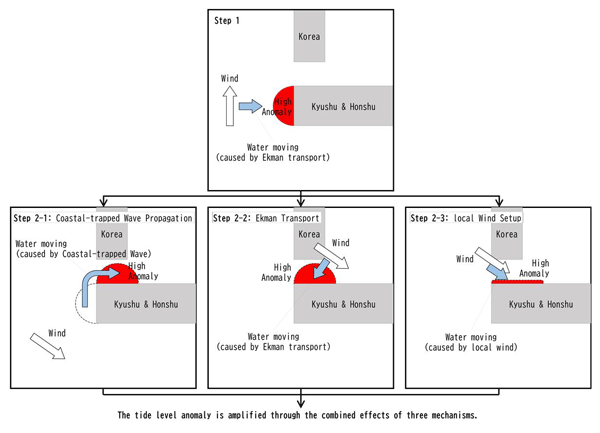
This is an interesting and relevant study of the mechanisms of storm surges induced by extratropical cyclones (characterised by almost spatially uniform wind displaying rotation over time, as opposed to more localized typhoons) along the northern coast of Kyushu, Japan. A strong element of this work is the combination of data analysis, complex numerical modelling and systematic idealized modelling. From their simulations, the authors compose a schematic illustration of the surge-generating mechanism (Fig.17), with a prominent role for rotating winds of a certain rotation period. The sensitivity with respect to some changes in geometry (including/excluding Goto Islands, Korean Peninsula) is further analysed.
Overall, the paper is well written, with a solid methodology and a convincing analysis and presentation of the results. However, before recommending publication, I need some clarification on (1) Ekman/Kelvin wave claims, (2) role of wind direction in power spectrum analysis, (3) role of spatial variations in atmospheric forcing, and (4) considerations behind the idealised model simulations.
These four major points are elaborated below. Please also consider my list of technical corrections, also touching upon phrasing and presentation style. I look forward to seeing a revised version of the manuscript.
Anonymous, 6 February 2026
SPECIFIC COMMENTS
- Claims on Ekman transport and Kelvin wave type of behaviour in this complex geometrical setting can be further substantiated by carrying out a simulation without Coriolis effect (f=0), or with smaller values of the Coriolis parameter f. However, the authors did not do this. In my opinion, such a more systematic approach is perfectly in line with the idealised model philosophy and would make the interpretation less speculative and thus more powerful. The same goes for the differences between theoretical values of Kelvin wave propagation speed and those obtained in the simulations here. To me, they seem too drastic to be attributed to bottom friction only. Additional simulations without bottom friction could help these interpretations. Please realize that – compared to classical Kelvin wave theory – these highly idealised simulations are still quite complex in terms of e.g. coastlines, water depth, wind forcing.
- I disagree with (or do not understand) the claim on capturing variations in wind direction, made in the text around Figure 8 in Section 3.2. Since only the absolute value of the power spectrum is presented (and not the temporal exchange between its real and imaginary components), it seems to deal exclusively with the magnitude of the wind vector. As a result, the analysis shown here effectively disregards wind direction, making it unable to detect wind rotations, let alone distinguish between fast and slow wind rotations (unless these rotations also display fluctuations in wind speed). Please clarify/adjust. Based on the above, I also disagree with the statements in L216-217, L230-231 and L235-236, at least how they would follow from the preceding analysis. An alternative way to phrase my point: what would the power spectrum (again, plotting only its absolute value) look like for the idealised rotating cases presented later on in Section 4.3?
- As I understand, the realistic topography simulations are forced with spatially varying wind and pressure forcing, whereas the idealised runs are forced with a spatially uniform wind field and no atmospheric pressure gradient. Is that a strong schematisation, i.e. how strong are the actual spatial variations in wind and pressure over the domain? Besides visual inspection of Figures 11 and 12, I would appreciate some discussion on this aspect in Section 5.
- Can you motivate the specific choices of including/excluding Goto Islands and including/excluding Korean Peninsula. Also, the potential effects of removing these geometric features on the atmospheric forcing (reduction of wind speed over land compared to over sea), not included, deserve some attention. Please comment.
TECHNICAL CORRECTIONS (ALSO COMMENTS ON PHRASING AND PRESENTATION)
L1 “which differ” --> “which differs” (mechanism is singular)
L13-15 Final sentence of abstract reads a bit awkward. My suggestion is to rephrase into: “These findings contribute to a better understanding of storm surge mechanisms, not only along the northern coast of Kyushu, but also in other regions around the world with similar geographic settings.”
FIGURE 1 looks nice and is helpful, but (1) land and water are both rather dark, (2) the thin red frame is hard to see on this dark background, and (3) readers not familiar with the Asian geography may welcomes a more zoomed-out version of the top figure showing a bigger surrounding region.
L68 “timing of tidal phases” --> “the timing of the storm surge with respect to high water”?
L84 “surge” --> “Surge” (start sentence with capital)
TABLES 1-3 surely contain all the relevant information, but I was struggling to extract it. Why not merge into a single table, listing all events in chronological order, and then adding for each of the three sites a set of columns displaying time/anomaly/ranking number. This would simplify and clarify matters at least to me, particularly the overview and comparison between the sites. Also, please include typhoon names to the table, particularly “Maysak” as it is explicitly mentioned in the text.
L112 “spring tide or high tide” sounds awkward to me, since spring tide may also mean extremely low water (so spring tide itself does not suggest flooding). Please rephrase.
L113 “overlapped” --> “coincided”?
L127 “z=u+iv” --> “u+iv”. I do not see the need of introducing the symbol z here, which is even confusing since z is usually a vertical coordinate (and in z_a and z_0 also used as such). My suggestion is to omit the “z=”-part as is actually also done later in the manuscript.
L133 I don’t understand what “the same physical schemes” means.
L136 Incorrect citation format; references to Yamashiro et al and Ide et al should be within brackets.
L144 I presume spin up from still water (no flow and zero elevation) at t=0?
L146 “allowing free inflow and outflow of sea level and velocity using open boundary conditions” makes no sense to me. What type of open boundary condition is applied: prescribing water level, prescribing flow velocities, or perhaps a non-reflective Riemann-type of boundary condition. Please explain.
L147 A sigma layering with only three layers sounds rather restrictive to me. Where did you put these? Please comment.
FIGURES 3-4 Scales or coordinates are missing so I cannot see how the domain sizes of the realistic and idealised simulations differ. Please add.
L155 Discrepancy in notation: C_b versus C_B
L155 What value of the representative height z_a is applied here: is that the vertical position of the lowest sigma layer?
L159 I do not understand the sentence “In the realistic topography simulations, we focused exclusively on storm surge anomalies.” Does this mean that tides were not at all included in the simulations, or that (as one would ideally expect) you subtracted tides from the water levels to obtain the storm surge anomalies. Please explain by clarifying the “focused exclusively on”.
L179 I guess the multiple cases with different rotation speeds under (3) are also spatially uniform? Please clarify and if all wind forcing patterns are spatially uniform, please state that upfront, rather than repeating it for each case. And how about the atmospheric pressure field? Is that also spatially uniform so the atmospheric pressure gradient vanishes?
FIGURE 5 does not show axis labels in the top plot. And the caption speaks of “x=0”, whereas the coordinate “x” is not mentioned in the axis label. Please adjust this. Finally, as a minor detail, with respect to what datum is “water depth” defined?
L187 (and caption of FIGURE 6) I get confused by the sentence “The storm surges shown here were computed without including astronomical tides, that is, they represent the deviations directly from non-tidal simulations.” I assume this refers to the red line (“simulated”) in the 2016 case only and not to the black lines in the top plot, which do not involve any simulations as they stem from subtracting the python-generated astronomical tide from the direct water level observations. Or am I missing the point here?
L199 “relatively lower compared to” --> “lower than in”
FIGURE 7 Please add a sentence to the caption explaining the meaning of the green boxes and that they are discussed later in Section 4.3
L206 Please extend the last sentence explaining how the discussion by Ide relates to the present study: “This point has been previously discussed by Ide et al. (2023), but ... remains unknown.”
FIGURE 8 is a clear figure, but it could perhaps be even more clear if the selected period is also shown in the left plots, e.g. using a dashed red line at T=11h (top), T=12h (middle) and T=11h again (bottom). Also, please spend a sentence in the caption explaining the meaning of the black boxes.
L251 Not sure what the added value of “extremely” is here.
L260 Although the header of section 4.2 may suggest another simulation, I guess that the simulation described here is the same as already in Section 4.1. Please clarify and perhaps consider rephrasing section headers.
L208 Please add the range of sqrt(gh)-values corresponding to this range of water depths. What I find is values from 12 – 18 m/s
L286 What do you mean with “the raised sea levels again” – levels as a verb?
L290 I think I prefer “The realistic topography simulation presented above”
L295 Awkward phrasing “in space and time”, since coastal geometry is not complex “in time”.
L307 I do not understand what you mean with “to organize”
L313 Grammar: “anomalies decreases” --> “anomaly decreases” or “anomalies decrease”
FIGURE 15, vertical axis label: why “tide” anomaly?
FIGURE 16: perhaps add in the caption that this case corresponds to the peak value of the base case in Figure 15.
L403 “the Goto Islands included case” --> “The case including the Goto Islands”
L418 I presume that the Goto Islands, as studied before, are included again in the simulations including/excluding Korean Peninsula?
FIGURE 20: perhaps use the term “flow velocity” to better distinguish from wind velocity that has been mostly discussed so far.
L433 Rossby deformation radius should be sqrt(gH)/|f|, i.e. involving the absolute value of the Coriolis parameter.
Citation: https://doi.org/10.5194/egusphere-2025-5619-RC2 -
AC3: 'Reply on RC2', Yoshihiko Ide, 20 Mar 2026
We sincerely thank the reviewer for the careful reading of our manuscript and for the positive assessment of this study. We greatly appreciate the reviewer's recognition of the combination of observational analysis, realistic numerical simulations, and systematic idealized modeling, as well as the value of the schematic interpretation of the surge-generating mechanism. We also thank the reviewer for identifying the four key points that required further clarification: (1) the interpretation related to Ekman transport and Kelvin/coastal-trapped wave behavior, (2) the role of wind direction in the rotary spectral analysis, (3) the influence of spatial variations in the atmospheric forcing, and (4) the rationale and assumptions behind the idealized model experiments. In the revised manuscript, we have carefully addressed each of these points through additional analyses, revised explanations, and clarifications in the main text and supplementary material (supplement_figs_#2.pdf). Detailed responses are provided below.
---
SPECIFIC COMMENTS
>Claims on Ekman transport and Kelvin wave type of behaviour in this complex geometrical setting can be further substantiated by carrying out a simulation without Coriolis effect (f=0), or with smaller values of the Coriolis parameter f. However, the authors did not do this. In my opinion, such a more systematic approach is perfectly in line with the idealised model philosophy and would make the interpretation less speculative and thus more powerful.
Response:
Following this suggestion, we performed a sensitivity experiment for the case shown in Figure 13 by setting the Coriolis parameter to zero (f=0), while keeping all other conditions identical. In the non-rotating case (Supplementary Fig. 1), the pronounced coastal surge anomalies observed in the rotating simulations disappeared and the associated alongshore propagation was not reproduced. In particular, at the Hakata location, offshore-directed winds maintained a quasi-steady negative surge anomaly. These results substantiate that the amplification mechanism relies on rotation-driven dynamics, consistent with Ekman transport and the coastal-trapped wave response. We have added this description to Section 4.3 (and include the full comparison in Supplementary Fig. 1).Corresponding line number(s): Line 356–360
---
>The same goes for the differences between theoretical values of Kelvin wave propagation speed and those obtained in the simulations here. To me, they seem too drastic to be attributed to bottom friction only. Additional simulations without bottom friction could help these interpretations. Please realize that – compared to classical Kelvin wave theory – these highly idealised simulations are still quite complex in terms of e.g. coastlines, water depth, wind forcing.
Response:
We greatly appreciate this insightful comment. We agree that our initial interpretation, which placed too much emphasis on bottom friction, was not sufficiently supported. In the revised manuscript, we therefore reconsidered the physical interpretation of the propagation speed in the idealized simulations. The simulated coastal propagation speed is smaller than the theoretical Kelvin-wave speed estimated from the representative shelf depth, but this difference is expected because the relation \sqrt(gH) assumes an idealized constant-depth cross-shore structure. In our idealized configuration, the water depth varies across the shelf–slope region, and the disturbance is therefore more appropriately interpreted as a coastal-trapped wave supported by the continental shelf structure. Because such waves are dispersive and their propagation characteristics depend on the shelf geometry, propagation speeds smaller than \sqrt(gH) are physically reasonable without attributing the difference primarily to bottom friction. We revised Section 4.3 accordingly.Corresponding line number(s): Line 336–345 and 513–517
---
>I disagree with (or do not understand) the claim on capturing variations in wind direction, made in the text around Figure 8 in Section 3.2. Since only the absolute value of the power spectrum is presented (and not the temporal exchange between its real and imaginary components), it seems to deal exclusively with the magnitude of the wind vector. As a result, the analysis shown here effectively disregards wind direction, making it unable to detect wind rotations, let alone distinguish between fast and slow wind rotations (unless these rotations also display fluctuations in wind speed). Please clarify/adjust. Based on the above, I also disagree with the statements in L216-217, L230-231 and L235-236, at least how they would follow from the preceding analysis. An alternative way to phrase my point: what would the power spectrum (again, plotting only its absolute value) look like for the idealised rotating cases presented later on in Section 4.3?
Response:
We are deeply grateful to the reviewer for this critical comment. It prompted us to re-examine both our analysis code and the corresponding description in the manuscript.First, our wavelet analysis is applied not to scalar wind speed but to the complex wind vector, so in principle it can detect rotational periodicity even when the wind-speed magnitude remains constant. In the original manuscript, however, we incorrectly described the analyzed quantity as u+iv. During the re-verification process triggered by this comment, we confirmed that the physically relevant quantity for the present events is the clockwise (CW) rotary component, and we corrected the manuscript accordingly to u−iv. This clarification has been added to the Methods and to the description of Figure 8.
This correction is important because the synoptic wind during the target events typically veers clockwise (southeasterly -> southerly -> southwesterly) as cyclones pass to the north of Kyushu. After correcting the analysis to focus on the CW component, the dominant periods were updated to 21 h, 12 h, and 18 h for the three cases, respectively. Although this correction did not alter our main conclusion that wind rotation is closely related to storm surge development, it improved the quantitative consistency between the observational spectral analysis and the idealized model experiments.
To further address the reviewer's concern, we also prepared supplementary validation figures. In Supplementary Fig. 2, we show an idealized rotating wind vector with constant wind speed, together with its rotary power spectrum, to demonstrate that the method detects the periodicity of directional rotation even without wind-speed fluctuations. In Supplementary Figs. 3 and 4, we provide the updated rotary spectral analysis corresponding to the revised Figure 8 and Figure 9 results. These supplementary figures help clarify that the analysis captures rotational wind variability rather than merely changes in wind-speed magnitude.
Corresponding line number(s): Lines 130–134 and 235–261
---
>As I understand, the realistic topography simulations are forced with spatially varying wind and pressure forcing, whereas the idealised runs are forced with a spatially uniform wind field and no atmospheric pressure gradient. Is that a strong schematisation, i.e. how strong are the actual spatial variations in wind and pressure over the domain? Besides visual inspection of Figures 11 and 12, I would appreciate some discussion on this aspect in Section 5.
Can you motivate the specific choices of including/excluding Goto Islands and including/excluding Korean Peninsula. Also, the potential effects of removing these geometric features on the atmospheric forcing (reduction of wind speed over land compared to over sea), not included, deserve some attention. Please comment.Response:
We appreciate the reviewer’s important comment regarding the degree of schematization in the idealized experiments. In the revised manuscript, we have clarified more explicitly that the purpose of the idealized model was not to reproduce the full spatial complexity of the atmospheric forcing, but rather to isolate the fundamental effect of temporal wind rotation under simplified topographic conditions. For this reason, all idealized simulations were forced by spatially uniform wind and spatially uniform atmospheric pressure, so that the pressure-gradient force was removed and the wind-driven response could be examined in a controlled manner. This clarification has been added to the description of the idealized model setup.We also clarified the rationale for the geometric modifications. The Goto Islands and the Korean Peninsula were selected because they are the two major topographic features most likely to alter the pathway, timing, and spatial coherence of surge propagation in the Tsushima Strait–northern Kyushu system. In the revised manuscript, we explain that the Goto Islands promote earlier formation and amplification of the surge, whereas the Korean Peninsula suppresses the response by limiting the spatial extent and coherence of the wind-driven flow. We also explicitly state that the Korean Peninsula experiments were conducted from a base configuration that already excluded the Goto Islands, to avoid ambiguity in the interpretation.
Regarding the realism of the uniform-forcing approximation, we agree that this should be discussed more clearly. The realistic simulations use fully spatially varying MSM wind and pressure fields, whereas the idealized experiments intentionally neglect those spatial variations. To help assess the validity of this approximation, we provide Supplementary Fig. 5, which compares the temporal evolution of atmospheric pressure and wind vectors at two representative locations in the domain. The supplementary comparison shows that, although local differences in wind magnitude exist, the large-scale temporal evolution of the meteorological forcing—especially the clockwise rotation of the wind associated with cyclone passage—is broadly coherent over the region. This supports the use of a spatially uniform forcing as a first-order simplification for isolating the rotation-driven mechanism. At the same time, we acknowledge that the idealized experiments do not account for feedback of the modified land geometry on the atmospheric field, such as reduced wind speed over land relative to the sea, and we now clarify that this is a limitation of the present idealized framework.
Corresponding line number(s):
Lines 181–205 for the clarified idealized forcing setup and the motivation for simplifying the geometry.
Lines 327–335 for the statement that the realistic setup is too complex and the idealized experiments are used to isolate dominant factors.
Lines 420–445 for the rationale and effect of including the Goto Islands.
Lines 467–479 for the rationale and effect of excluding the Korean Peninsula.---
>TECHNICAL CORRECTIONS (ALSO COMMENTS ON PHRASING AND PRESENTATION)
Response:
We agree with all the suggested technical corrections and phrasing improvements. We have incorporated these changes into the revised manuscript to improve clarity and readability.>L1 “which differ” --> “which differs” (mechanism is singular)
Response:
We have corrected this grammatical error. The phrase "which differ" has been revised to "which differs" to agree with the singular subject "mechanism".Corresponding line number(s): Lines 1–2
---
>L13-15 Final sentence of abstract reads a bit awkward. My suggestion is to rephrase into: “These findings contribute to a better understanding of storm surge mechanisms, not only along the northern coast of Kyushu, but also in other regions around the world with similar geographic settings.”
Response:
We appreciate this helpful suggestion. Following the reviewer’s recommendation, we have rephrased the final sentence of the abstract to improve its readability and flow. The revised sentence now reads: “These findings contribute to a better understanding of storm surge mechanisms, not only along the northern coast of Kyushu, but also in other regions around the world with similar geographic settings.”Corresponding line number(s): Lines 13–14
---
>FIGURE 1 looks nice and is helpful, but (1) land and water are both rather dark, (2) the thin red frame is hard to see on this dark background, and (3) readers not familiar with the Asian geography may welcomes a more zoomed-out version of the top figure showing a bigger surrounding region.
Response:
We appreciate the constructive feedback for improving the clarity of Figure 1. We fully agree with these suggestions and have revised the figure accordingly. Specifically, we have (1) increased the brightness of the base map to improve the contrast between land and water, (2) thickened the red frame so that it is more clearly visible, and (3) added a wider regional inset map showing Japan and the surrounding East Asian region to help readers who may be less familiar with the geography of the study area.Corresponding figure: Figure 1
---
>L68 “timing of tidal phases” --> “the timing of the storm surge with respect to high water”?
Response:
We agree that the original wording was ambiguous. Following the reviewer’s suggestion, we have revised the phrase to “the timing of the storm surge with respect to high water” to make the meaning more precise in the context of flooding risk.Corresponding line number(s): Lines 65–68
---
L84 “surge” --> “Surge” (start sentence with capital)
Response:
We have corrected the capitalization at the beginning of the sentence. The word “surge” has been revised to “Surge” as suggested.Corresponding line number(s): Lines 85–86
---
TABLES 1-3 surely contain all the relevant information, but I was struggling to extract it. Why not merge into a single table, listing all events in chronological order, and then adding for each of the three sites a set of columns displaying time/anomaly/ranking number. This would simplify and clarify matters at least to me, particularly the overview and comparison between the sites. Also, please include typhoon names to the table, particularly “Maysak” as it is explicitly mentioned in the text.
Response:
We agree with the reviewer that the original presentation in Tables 1–3 made cross-site comparison unnecessarily difficult. Following this helpful suggestion, we merged the information into a single comprehensive table in the revised manuscript (Table 1). In this table, the major storm surge events are listed in chronological order, and for each event we provide the peak time, maximum storm surge anomaly, and ranking number for Hirado Seto, Karatsu, and Hakata side-by-side. We also added the corresponding typhoon names where applicable, including Typhoon Maysak, and explicitly identified extratropical cyclone events. For additional clarity during the review process, the same information is also provided in Supplementary Fig. 6, so that the revised table structure can be easily confirmed in both the main manuscript and the supplementary material.Corresponding line number(s): Lines 105–117
---
>L112 “spring tide or high tide” sounds awkward to me, since spring tide may also mean extremely low water (so spring tide itself does not suggest flooding). Please rephrase.
Response:
We agree with the reviewer that "spring tide" refers to tidal range and does not necessarily imply high sea level. To avoid this ambiguity, we revised the phrase to "high water during spring tides."Corresponding line number(s): Lines 114–116
---
>L113 “overlapped” --> “coincided”?
Response:
We have revised “overlapped” to “coincided” as suggested.Corresponding line number(s): Lines 115–117
---
>L127 “z=u+iv” --> “u+iv”. I do not see the need of introducing the symbol z here, which is even confusing since z is usually a vertical coordinate (and in z_a and z_0 also used as such). My suggestion is to omit the “z=”-part as is actually also done later in the manuscript.
Response:
We agree with the reviewer that introducing the symbol "z" here was unnecessary and potentially confusing. We therefore removed "z=" and revised the expression to refer directly to the complex wind vector as u-iv, which is the clockwise rotary component analyzed in this study.Corresponding line number(s): Lines 130–133
---
>L133 I don’t understand what “the same physical schemes” means.
Response:
We apologize for the ambiguity. By “the same physical schemes,” we meant that the same physical parameterizations and numerical schemes were applied consistently across the simulations. To make this clearer, we revised the sentence accordingly.Corresponding line number(s): Lines 138–139
---
>L136 Incorrect citation format; references to Yamashiro et al and Ide et al should be within brackets.
Response:
We agree with the reviewer that the citation format was incorrect in this context. We have corrected the references to Yamashiro et al. and Ide et al. to be enclosed within parentheses, i.e., “(e.g., Yamashiro et al., 2016; Ide et al., 2023)” in the revised manuscript.Corresponding line number(s): Lines 140–142
---
>L144 I presume spin up from still water (no flow and zero elevation) at t=0?
Response:
Yes, your presumption is correct. All simulations were initialized from a state of rest, meaning zero surface elevation and zero flow velocity at t = 0. We have clarified this cold-start condition in the revised manuscript.Corresponding line number(s): Lines 177–180
---
>L146 “allowing free inflow and outflow of sea level and velocity using open boundary conditions” makes no sense to me. What type of open boundary condition is applied: prescribing water level, prescribing flow velocities, or perhaps a non-reflective Riemann-type of boundary condition. Please explain.
Response:
We apologize for the unclear phrasing. Specifically, we applied a prescribed surface elevation boundary condition, such that the sea-surface elevation along the open boundary was forced to follow a specified value, zeta=zeta_obc(t). Under this condition, the normal flow velocity at the boundary was determined diagnostically to satisfy the depth-integrated continuity equation. We have revised the text accordingly.Corresponding line number(s): Lines 163–165
>L147 A sigma layering with only three layers sounds rather restrictive to me. Where did you put these? Please comment.
Response:
We greatly appreciate the reviewer’s valid concern. In the revised manuscript, we clarified that the realistic topography simulations use five uniformly distributed sigma layers (sigma=0.0,−0.25,−0.5,−0.75,−1.0). Preliminary sensitivity tests with 3 to 7 layers showed that the simulated storm surge anomalies were largely insensitive to the vertical resolution, with peak values changing by only about 3%. In contrast, the idealized topography simulations were conducted using a single vertical layer (depth-averaged 2D mode) in order to isolate the fundamental physical mechanisms as clearly as possible.Corresponding line number(s): Lines 148–151 and 184-186
>FIGURES 3-4 Scales or coordinates are missing so I cannot see how the domain sizes of the realistic and idealised simulations differ. Please add.
Response:
We thank the reviewer for pointing this out. We agree that this information is essential for assessing and comparing the physical dimensions of the computational domains. In the revised manuscript, we updated Figure 3 to include latitude and longitude coordinates, and Figure 4 to include a spatial distance scale (in kilometers). These additions make the domain sizes much easier to compare between the realistic and idealized simulations.Corresponding figures: Figures 3 and 4
---
>L155 Discrepancy in notation: C_b versus C_B
Response:
We have corrected the discrepancy and unified the notation for the bottom drag coefficient to C_BCorresponding line number(s): Lines 159–163
---
>L155 What value of the representative height z_a is applied here: is that the vertical position of the lowest sigma layer?
Response:
Yes. The representative height z_a refers to the vertical distance from the seabed to the lowest sigma layer, i.e., the grid point where the bottom flow velocity is evaluated. We have added this clarification to the revised manuscript.Corresponding line number(s): Lines 159–160
---
>L159 I do not understand the sentence "In the realistic topography simulations, we focused exclusively on storm surge anomalies." Does this mean that tides were not at all included in the simulations, or that (as one would ideally expect) you subtracted tides from the water levels to obtain the storm surge anomalies. Please explain by clarifying the "focused exclusively on".
Response:
We apologize for the ambiguous phrasing. By "focused exclusively on storm surge anomalies," we meant that astronomical tides were completely excluded from the numerical simulations. The model was driven solely by meteorological forcing, and the open boundary was set to zeta_obc(t)=0. Consequently, the simulated surface elevations directly represent the pure storm surge anomalies, and no subtraction of tides from the model output was necessary. We have rewritten this part accordingly.Corresponding line number(s): Lines 168–171
---
>L179 I guess the multiple cases with different rotation speeds under (3) are also spatially uniform? Please clarify and if all wind forcing patterns are spatially uniform, please state that upfront, rather than repeating it for each case. And how about the atmospheric pressure field? Is that also spatially uniform so the atmospheric pressure gradient vanishes?
Response:
We thank the reviewer for this helpful suggestion. Yes, all idealized simulations, including the multiple cases with different rotation speeds, were forced with spatially uniform wind fields over the entire computational domain. The atmospheric pressure field was also set to a constant spatially uniform value, so that the pressure-gradient force vanished. Following the reviewer's advice, we stated these assumptions upfront in the idealized experimental setup section instead of repeating them case by case.Corresponding line number(s): Lines 199–203
---
>FIGURE 5 does not show axis labels in the top plot. And the caption speaks of “x=0”, whereas the coordinate “x” is not mentioned in the axis label. Please adjust this. Finally, as a minor detail, with respect to what datum is “water depth” defined?
Response:
We thank the reviewer for pointing out these important details, which helped us make the figure much more reader-friendly. Following your suggestions, we have updated Figure 5 to include the missing axis labels in the top plot. Specifically, we have explicitly labeled the horizontal axis with the coordinate "x" to ensure perfect consistency with the "x=0" mentioned in the caption. Additionally, we have added a sentence to the Figure 5 caption to clarify that the "water depth" and surface elevations are defined with respect to the undisturbed Mean Sea Level (MSL).Corresponding figure: Figure 5
---
>L187 (and caption of FIGURE 6) I get confused by the sentence “The storm surges shown here were computed without including astronomical tides, that is, they represent the deviations directly from non-tidal simulations.” I assume this refers to the red line (“simulated”) in the 2016 case only and not to the black lines in the top plot, which do not involve any simulations as they stem from subtracting the python-generated astronomical tide from the direct water level observations. Or am I missing the point here?
Response:
We thank the reviewer for pointing out this confusing phrasing. Your understanding is perfectly correct. The statement "computed without including astronomical tides" refers exclusively to the numerical simulation results (the red line in the 2016 case). The observed storm surge anomalies (the black lines) were indeed obtained by subtracting the predicted astronomical tides from the raw tide gauge observations.
To prevent any confusion, we have revised the text in L187 and the caption of Figure 6 to explicitly distinguish between how the observed and simulated anomalies were derived.Corresponding line number(s): Lines 210–214, and Figure 6 caption
---
>L199 “relatively lower compared to” --> “lower than in”
Response:
We have revised the phrase to “lower than in” as suggested.Corresponding line number(s): Lines 220–222.
---
>FIGURE 7 Please add a sentence to the caption explaining the meaning of the green boxes and that they are discussed later in Section 4.3
Response:
We thank the reviewer for the helpful suggestion. We have updated the caption of Figure 7 to clearly explain the meaning of the green boxes. As suggested, we have clarified that these boxes mark the pre-rotation stage, where steady southerly winds persist, providing the motivation for the idealized steady-wind experiments discussed later in Section 4.3.Corresponding figure: Figure 7
---
>L206 Please extend the last sentence explaining how the discussion by Ide relates to the present study: “This point has been previously discussed by Ide et al. (2023), but ... remains unknown.”
Response:
We thank the reviewer for this insightful comment. We agree that clarifying the connection between our previous work and the current study strengthens the motivation of this paper.
In the revised manuscript, we have extended the sentence to explicitly state that while our previous study identified the phenomenon, the specific dynamic mechanisms—particularly how the temporal rotation of the wind field amplifies the surge and its subsequent propagation—remained unresolved. We also added a concluding phrase to emphasize that addressing this specific knowledge gap is the primary focus of the present study.Corresponding line number(s): Lines 228–231
---
>FIGURE 8 is a clear figure, but it could perhaps be even more clear if the selected period is also shown in the left plots, e.g. using a dashed red line at T=11h (top), T=12h (middle) and T=11h again (bottom). Also, please spend a sentence in the caption explaining the meaning of the black boxes.
Response:
We thank the reviewer for these excellent suggestions, which significantly improve the clarity of the figure. Following your advice, we have updated Figure 8 by adding horizontal red dashed lines to the left panels at the selected periods (T=21 h for the top, T=12 h for the middle, and T=18 h for the bottom panel). This visual cue clearly links the time-period distributions on the left with the extracted time series on the right. Furthermore, we have added a sentence to the Figure 8 caption to explain the meaning of the black dashed boxes. These boxes are drawn across the entire time duration to highlight the 12–28 hour period range, indicating the specific frequency band where the wind power fluctuations closely correspond with the observed storm surge anomalies.Corresponding line number(s): Lines 247–261, and Figure 8 caption
---
>L251 Not sure what the added value of “extremely” is here.
Response:
We agree with the reviewer that the word "extremely" is subjective and does not add scientific value to the statement. We have removed it from the revised manuscript to maintain a more objective tone.Corresponding line number(s): Lines 255–261
---
>L260 Although the header of section 4.2 may suggest another simulation, I guess that the simulation described here is the same as already in Section 4.1. Please clarify and perhaps consider rephrasing section headers.
Response:
We thank the reviewer for pointing out this ambiguity. Your understanding is perfectly correct; the simulation discussed in Section 4.2 is exactly the same realistic topography simulation that was validated in Section 4.1.
To prevent any confusion, we have changed the header of Section 4.2 from "Realistic Topography Simulation" to "Spatial and Temporal Evolution of the Storm Surge" in the revised manuscript. Additionally, we have added a clarifying phrase at the beginning of Section 4.2 ("Using the same realistic simulation validated in Section 4.1,...") to explicitly state that the analysis continues to use the same simulation data.Corresponding line number(s): Lines 295–298
---
>L208 Please add the range of sqrt(gh)-values corresponding to this range of water depths. What I find is values from 12 – 18 m/s
Response:
We thank the reviewer for this helpful suggestion. We interpreted this comment as referring to the discussion of water depths of 15–35 m in Section 4.2. Adding the theoretical phase speed explicitly makes the physical context much clearer. Following your advice, we have added the corresponding range of the shallow water wave speed (sqrt(gh) ~ 12-18 m/s) to the revised manuscript.Corresponding line number(s): Lines 315–318
---
>L286 What do you mean with “the raised sea levels again” – levels as a verb?
Response:
We apologize for the grammatical error. We intended to say that sea levels rise again during this stage, and we have corrected the sentence accordingly.Corresponding line number(s): Lines 321–324
>L290 I think I prefer “The realistic topography simulation presented above”
Response:
We agree with this suggestion and have rephrased the sentence accordingly.Corresponding line number(s): Lines 327–330
---
>L295 Awkward phrasing “in space and time”, since coastal geometry is not complex “in time”.
Response:
Thank you for pointing out this awkward phrasing. As you correctly noted, the coastal geometry is complex in space, not in time. We have revised the sentence accordingly to avoid this ambiguity.Corresponding line number(s): Lines 327–335
---
>L307 I do not understand what you mean with “to organize”
Response:
We apologize for the unclear word choice. Our intention was to systematically analyze the fundamental mechanisms, and we have revised the wording accordingly.Corresponding line number(s): Lines 343–345
---
>L313 Grammar: “anomalies decreases” --> “anomaly decreases” or “anomalies decrease”
Response:
Thank you for catching this grammatical error. We have corrected it to "anomaly decreases."Corresponding line number(s): Line 350
---
>FIGURE 15, vertical axis label: why “tide” anomaly?
Response:
We apologize for the confusing label. Since our simulations do not include astronomical tides, the term "tide anomaly" was misleading. We have corrected the vertical axis label in Figure 15 to "Storm surge anomaly (m)".Corresponding figure: Figure 15
---
>FIGURE 16: perhaps add in the caption that this case corresponds to the peak value of the base case in Figure 15.
Response:
This is a helpful suggestion for linking the two figures. We have added a sentence to the caption of Figure 16 explicitly stating that this case corresponds to the peak value of the base case shown in Figure 15.Corresponding figure: Figure 16
---
>L403 “the Goto Islands included case” --> “The case including the Goto Islands”
Response:
We have corrected the phrasing as suggested.Corresponding line number(s): Lines 440–443
---
>L418 I presume that the Goto Islands, as studied before, are included again in the simulations including/excluding Korean Peninsula?
Response:
We thank the reviewer for raising this point. Actually, the Goto Islands are not included in the simulations used to evaluate the effect of the Korean Peninsula. As shown in Figure 15, the base case for this specific comparison already excludes the Goto Islands. To evaluate the impact of the Korean Peninsula, we simply removed it from this base configuration. Therefore, the Goto Islands are not included in this examination. To clarify this and prevent reader confusion, we have explicitly stated this logic in Section 4.5.2.Corresponding line number(s): Lines 467–474
---
>FIGURE 20: perhaps use the term “flow velocity” to better distinguish from wind velocity that has been mostly discussed so far.
Response:
We thank the reviewer for this very sensible suggestion. To clearly distinguish the oceanic currents from the wind velocity discussed in previous sections, we have updated the labels and legends in Figure 20 to use the term “flow velocity”. Accordingly, we have also replaced “velocity” with “flow velocity” in the caption of Figure 20 and the corresponding main text.Corresponding line number(s): Lines 475–497, and Figure 20
---
>L433 Rossby deformation radius should be sqrt(gH)/|f|, i.e. involving the absolute value of the Coriolis parameter.
Response:
Thank you for pointing out this mathematical strictness. We have added the absolute value bars to the Coriolis parameter in the text and equation.Corresponding line number(s): Lines 484–486


Interactive discussion
Status: closed
-
RC1: 'Comment on egusphere-2025-5619', Anonymous Referee #1, 12 Jan 2026
This is a generally well written paper on an interesting topic. Some clarification is needed on a few points
Section 2 lines 68-70 / Section 2.1.1 lines 81-82
Why is Hakata chosen as the representative site?
Section 2.1.1
I assume the reconstructed tide from pytides is used to de-tide the gauge data and provide the observed surge? Can this be made more explicit
Section 3.1 line 188
It is not clear why the tide has not been included – can you expand on this? I would think this is intended to only refer to the model simulation (the gauge observations must have had a tide removed?) but it uses the plural “storm surges” when there is only one event with a model simulation so this should be clarified.
Section 5 line 484
“The insights obtained in this study provide a physical basis for improving short-term storm surge prediction and risk assessment along the northern coast of Kyushu” – how is surge prediction currently done in this region? What improvements do you think could be made following this work?Figures
Figures 5,13,14,16,20 rely on the reader being able to distinguish between red and green lines/points. These should use different colours that are more accessible to readers with colour-blindness, or use different shaped symbols to distinguish them.
Figures 8,11,12,18,20 – these use a “rainbow” colour map which is generally not recommend (eg https://towardsdatascience.com/why-the-rainbow-color-map-is-problematic-23293d0937d5/). I would suggest using a different colour scale in futureTechnical/typos
Line 136
Either needs text inserted between “surrounding ocean areas” and the citations, or put the citations in brackets eg:
“… applied to the target and surrounding ocean areas (Yamashiro et al 2016, Ide et al 2013) …” or
“… applied to the target and surrounding ocean areas for example by Yamashiro et al (2016), Ide et al (2023) …”Line 313
“surge anomalies” -> “surge anomaly”Citation: https://doi.org/10.5194/egusphere-2025-5619-RC1 -
AC1: 'Response to Reviewer #1', Yoshihiko Ide, 13 Feb 2026
>This is a generally well written paper on an interesting topic. Some clarification is needed on a few points
Response:
We sincerely thank the reviewer for the positive assessment of our manuscript and for the constructive comments. We have carefully revised the manuscript to address each point, as detailed below.---
>Section 2 lines 68-70 / Section 2.1.1 lines 81-82
>Why is Hakata chosen as the representative site?Response:
Hakata was chosen as the representative site because the three tide-gauge stations used along the northern coast of Kyushu are Hirado Seto, Karatsu, and Hakata, and among them Hakata is located near the central part of the northern Kyushu coast. We also note that extratropical cyclones rank at the top of the surge events at Hakata in our event screening (Table 1-3), further motivating the selection.Proposed revision in manuscript:
"Among the three tide-gauge stations where observational data were available (Hirado Seto, Karatsu, and Hakata), Hakata was selected as the representative site primarily because it is located in the central part of the northern Kyushu coast (Figure 1). As will be discussed later, the analysis confirms that major surge events at Hakata are predominantly associated with extratropical cyclones, supporting the suitability of this site selection."---
>Section 2.1.1
>I assume the reconstructed tide from pytides is used to de-tide the gauge data and provide the observed surge? Can this be made more explicitResponse:
Yes. We used pytides to reconstruct the astronomical tide via harmonic analysis, and we obtained the observed storm surge anomaly (non-tidal residual) by subtracting the reconstructed astronomical tide from the observed water level. We agree that this should be stated more explicitly, and revised Section 2.1.1 to explicitly define the de-tiding procedure, including a simple equation.Proposed revision in manuscript:
"The observed storm surge anomaly was defined as the difference between the observed sea level and the astronomical tide."---
>Section 3.1 line 188
>It is not clear why the tide has not been included – can you expand on this? I would think this is intended to only refer to the model simulation (the gauge observations must have had a tide removed?) but it uses the plural “storm surges” when there is only one event with a model simulation so this should be clarified.Response:
We agree that our previous wording was unclear, and we have revised the text to explicitly describe our simulation strategy. In the observational analysis, the time series are storm surge anomalies (non-tidal residuals) obtained by removing the reconstructed astronomical tide from the tide-gauge records (Section 2.1.1). Regarding the numerical simulations, we analyzed the period of April 2016 using two different configurations to balance computational efficiency and accuracy:
For the one-month overview (Fig. 6): We performed a simulation driven only by meteorological forcing (without astronomical tides) for the entire month of April 2016. Since this run covers a long duration, we prioritized computational efficiency to capture the overall temporal evolution of the surge anomaly.
For the specific event analysis (Fig. 7): We performed high-accuracy simulations for a few days around the target storm surge event. In this case, we included astronomical tides to account for tide-surge interactions. The surge anomaly was calculated by subtracting the result of a "tide-only" run from a "tide + meteorological forcing" run. Although this method requires two separate calculations (doubling the computational cost per time step), it was feasible and necessary for the short duration of the event to ensure precision. Finally, we corrected the wording to consistently refer to “storm surge anomaly” (singular) or “anomalies” (plural) depending on the context.Proposed revision in manuscript:
"Figure 6 shows the time series of storm surge anomalies and surface wind for the months including the three extratropical cyclone events. The simulated anomalies presented in this figure were obtained from a surge-only computation (driven solely by meteorological forcing, without astronomical tides). We confirmed that the storm surge anomaly is insensitive to tide coupling for our analysis. The differences between the surge-only and fully tide-coupled approaches are sufficiently small when examining the overall temporal evolution and large-scale variability, and they do not alter the main conclusions."
"Figure 7 provides expanded views of these periods, allowing detailed inspection of the storm surge anomaly variations and wind rotational behavior. For the simulation result shown in this figure (red dashed line in the center panel), we employed a high-accuracy approach that includes astronomical tides to account for the nonlinear interaction between the tide and the surge. The surge anomaly was calculated by subtracting the result of a tide-only run from a tide-coupled run (meteorological forcing + tides). This computationally intensive method ensures a more precise reproduction of the peak surge level compared to the surge-only calculation used for the monthly overview in Figure 6."
--->Section 5 line 484
>“The insights obtained in this study provide a physical basis for improving short-term storm surge prediction and risk assessment along the northern coast of Kyushu” – how is surge prediction currently done in this region? What improvements do you think could be made following this work?Response:
Currently, operational storm surge prediction in this region relies on numerical models forced by meteorological forecasts. However, despite their high frequency, extratropical cyclones are rarely regarded as critical in current warnings and risk assessments. Consequently, the risk posed by extratropical cyclones is often underestimated, and it is not widely known that, as shown in our historical data analysis, extratropical cyclones actually cause significant surge levels more frequently than typhoons.
This study provides a critical "physical basis" to correct this situation. By identifying the resonance mechanism between wind rotation and topography, we can significantly improve prediction processes. specifically, we can assess whether a low-pressure system has dangerous characteristics (i.e., if its wind rotation period matches the local resonant scale) before running computationally expensive high-resolution surge simulations. This allows forecasters to identify events that require "serious forecasting" and prioritize resources for detailed modeling, even if the wind speed itself does not appear catastrophic at first glance.Proposed revision in manuscript:
"Specifically, monitoring the `wind rotation period' can serve as an effective pre-screening indicator for the northern coast of Kyushu. By identifying systems with rotation periods conducive to resonance (e.g., 18–21 hours) a priori, it becomes possible to detect high-risk events early. This enables the selective application of detailed numerical simulations to dangerous low-pressure systems, allowing for the efficient assessment of risks associated with frequent extratropical cyclones."---
>Figures
>Figures 5,13,14,16,20 rely on the reader being able to distinguish between red and green lines/points. These should use different colours that are more accessible to readers with colour-blindness, or use different shaped symbols to distinguish them.Response:
Thank you for pointing out the accessibility issues. We fully agree that the previous figures relied too heavily on color distinction, particularly between red and green. In the revised manuscript, we have updated Figure 5 (as well as Figures 13, 14, 16, and 20) to ensure they are accessible to readers with color vision deficiencies. Specifically, we have:
Adopted a color-blind-friendly palette (e.g., Vermilion, Blue, Yellow, Sky Blue) to replace the problematic red-green combination. Introduced distinct marker symbols (e.g., circles, squares, triangles, diamonds) and varying line styles (solid vs. dashed) for each data series. These changes allow readers to distinguish between the lines and points based on shape and pattern, independent of color perception. The figure captions have been updated to reflect these revisions.>Figures 8,11,12,18,20 – these use a “rainbow” colour map which is generally not recommend (eg https://towardsdatascience.com/why-the-rainbow-color-map-is-problematic-23293d0937d5/). I would suggest using a different colour scale in future
Response:
We appreciate the constructive suggestion regarding scientific visualization. We have taken the opportunity to improve the current manuscript to ensure the most accurate representation of our data.
We have updated Figures 8, 11, 12, 18, and 20 to use perceptually uniform color maps (primarily 'Viridis'). This change avoids the visual artifacts associated with rainbow maps and significantly improves the readability and accessibility of the figures.>Technical/typos
>Line 136
>Either needs text inserted between “surrounding ocean areas” and the citations, or put the citations in brackets eg:“… applied to the target and surrounding ocean areas (Yamashiro et al 2016, Ide et al 2013) …”or“… applied to the target and surrounding ocean areas for example by Yamashiro et al (2016), Ide et al (2023) …”Response:
We have revised the text to correctly enclose the citations in brackets as suggested. The sentence now reads: “… applied to the target and surrounding ocean areas (Yamashiro et al. (2016), Ide et al. (2023)) …”.>Line 313
>“surge anomalies” -> “surge anomaly”
Response:
We have corrected this typo. The term “surge anomalies” has been changed to the singular form “surge anomaly” to match the context.----
One of the revised figures is provided in the Supplementary Material.
-
AC2: 'Reply on RC1', Yoshihiko Ide, 20 Mar 2026
We sincerely thank Reviewer #1 for the careful reading of our manuscript and for the valuable comments and suggestions. Before addressing the individual comments, we would like to note that we have revised some of our responses to Reviewer #1 from the previous submission so that they are fully consistent with the manuscript revisions made in response to Reviewer #2.
Before addressing the specific comments, we would like to note that we have also attached supplement_figs_#1.pdf as supplementary material to support our responses and to facilitate the reviewer’s confirmation of the revised figures and additional analyses.>This is a generally well written paper on an interesting topic. Some clarification is needed on a few points
Response:
We sincerely thank the reviewer for the positive assessment of our manuscript and for the constructive comments. We have carefully revised the manuscript to address each point, as detailed below.---
>Section 2 lines 68-70 / Section 2.1.1 lines 81-82
>Why is Hakata chosen as the representative site?Response:
Hakata was chosen as the representative site because the three tide-gauge stations used along the northern coast of Kyushu are Hirado Seto, Karatsu, and Hakata, and among them Hakata is located near the central part of the northern Kyushu coast. We also note that extratropical cyclones rank at the top of the surge events at Hakata in our event screening (Table 1 in the revised manuscript), further motivating the selection.Corresponding line number(s): Line 80-84
---
>Section 2.1.1
>I assume the reconstructed tide from pytides is used to de-tide the gauge data and provide the observed surge? Can this be made more explicitResponse:
Yes. We used pytides to reconstruct the astronomical tide via harmonic analysis, and we obtained the observed storm surge anomaly (non-tidal residual) by subtracting the reconstructed astronomical tide from the observed water level. We agree that this should be stated more explicitly, and revised Section 2.1.1 to explicitly define the de-tiding procedure, including a simple equation.Corresponding line number(s): Line 85-90
---
>Section 3.1 line 188
>It is not clear why the tide has not been included – can you expand on this? I would think this is intended to only refer to the model simulation (the gauge observations must have had a tide removed?) but it uses the plural “storm surges” when there is only one event with a model simulation so this should be clarified.Response:
We agree that our previous wording was unclear, and we have revised the manuscript to clearly distinguish the observed and simulated storm surge anomalies. In the observational analysis, the time series represent non-tidal residuals obtained by subtracting the reconstructed astronomical tide from the tide-gauge records, as described in Section 2.1.1. For the numerical simulations of the April 2016 event, we used two different configurations depending on the purpose of the analysis. For the one-month overview shown in Fig. 6, we performed a surge-only simulation driven solely by meteorological forcing, without astronomical tides, in order to examine the overall temporal evolution of the storm surge anomaly over a long period. In contrast, for the short-period event analysis shown in Fig. 7, we performed a tide-coupled simulation including astronomical tides to account for tide–surge interaction. In this case, the storm surge anomaly was extracted by subtracting the result of a tide-only run from that of the tide + meteorological forcing run. We have also revised the relevant text and figure descriptions to make it clear that the observational time series are de-tided anomalies, whereas the simulated result is shown only for the 2016 case.Corresponding line number(s): Line 168–180, 210–214, 270–277 and the caption in Figure 7
---
>Section 5 line 484
>“The insights obtained in this study provide a physical basis for improving short-term storm surge prediction and risk assessment along the northern coast of Kyushu” – how is surge prediction currently done in this region? What improvements do you think could be made following this work?Response:
We agree that the practical implications of this study should be stated more clearly. Our historical analysis showed that several extratropical cyclone events produced storm surge anomalies larger than those of Typhoon Maysak, indicating that such events can pose substantial coastal risk along the northern coast of Kyushu. The present study further demonstrates that surge amplification is strongly controlled by the resonance between the wind-rotation period and the regional topographic response. This provides a practical basis for improving short-term storm surge prediction and risk assessment. In particular, the wind rotation period can be used as a pre-screening indicator before conducting detailed high-resolution surge simulations. By identifying systems with rotation periods conducive to resonance (e.g., 12–21 hours) in advance, potentially hazardous events can be detected earlier, and computational resources can be focused on cases with elevated surge risk. We have added this implication to Section 5.Corresponding line number(s): Line 532–539
---
>Figures
>Figures 5,13,14,16,20 rely on the reader being able to distinguish between red and green lines/points. These should use different colours that are more accessible to readers with colour-blindness, or use different shaped symbols to distinguish them.Response:
Thank you for pointing out this important accessibility issue. We fully agree that the previous versions of Figures 5, 13, 14, 16, and 20 relied too heavily on color distinctions, particularly between red and green. In the revised version, we have updated these figures to improve readability for readers with color vision deficiencies. Specifically, we replaced the previous red–green combinations with a color-blind-friendly palette and introduced distinct marker symbols and line styles so that individual series can be distinguished not only by color but also by shape and pattern. For clarity during the review process, the revised figures are provided together in supplement_figs_#1.pdf.Corresponding Figures: Figures 5,13,14,16,20
---
>Figures 8,11,12,18,20 – these use a “rainbow” colour map which is generally not recommend (eg https://towardsdatascience.com/why-the-rainbow-color-map-is-problematic-23293d0937d5/). I would suggest using a different colour scale in future
Response:
Thank you for this helpful suggestion regarding figure visualization. We agree that rainbow-style colormaps are not ideal for scientific presentation because they can introduce misleading visual emphasis and reduce interpretability. In response, we revised Figures 8, 11, 12, 18, and 20 to use perceptually uniform colormaps, thereby improving both readability and accessibility. For clarity during the review process, the updated figures are provided together in supplement_figs_#1.pdf.Corresponding Figures: Figures 8,11,12,18,20
---
>Technical/typos
>Line 136
>Either needs text inserted between “surrounding ocean areas” and the citations, or put the citations in brackets eg:“… applied to the target and surrounding ocean areas (Yamashiro et al 2016, Ide et al 2013) …”or“… applied to the target and surrounding ocean areas for example by Yamashiro et al (2016), Ide et al (2023) …”Response:
We have revised the text to correctly enclose the citations in brackets as suggested. The sentence now reads: “… applied to the target and surrounding ocean areas (e.g., Yamashiro et al., 2016; Ide et al., 2023) …”.Corresponding line number(s): Line 140-142
>Line 313
>“surge anomalies” -> “surge anomaly”Response:
We have corrected this typo. The term “surge anomalies” has been changed to the singular form “surge anomaly” to match the context.Corresponding line number(s): Line 350
-
AC1: 'Response to Reviewer #1', Yoshihiko Ide, 13 Feb 2026
-
RC2: 'Comment on egusphere-2025-5619', Anonymous Referee #2, 06 Feb 2026
GENERAL COMMENTS
This is an interesting and relevant study of the mechanisms of storm surges induced by extratropical cyclones (characterised by almost spatially uniform wind displaying rotation over time, as opposed to more localized typhoons) along the northern coast of Kyushu, Japan. A strong element of this work is the combination of data analysis, complex numerical modelling and systematic idealized modelling. From their simulations, the authors compose a schematic illustration of the surge-generating mechanism (Fig.17), with a prominent role for rotating winds of a certain rotation period. The sensitivity with respect to some changes in geometry (including/excluding Goto Islands, Korean Peninsula) is further analysed.
Overall, the paper is well written, with a solid methodology and a convincing analysis and presentation of the results. However, before recommending publication, I need some clarification on (1) Ekman/Kelvin wave claims, (2) role of wind direction in power spectrum analysis, (3) role of spatial variations in atmospheric forcing, and (4) considerations behind the idealised model simulations.
These four major points are elaborated below. Please also consider my list of technical corrections, also touching upon phrasing and presentation style. I look forward to seeing a revised version of the manuscript.
Anonymous, 6 February 2026
SPECIFIC COMMENTS
- Claims on Ekman transport and Kelvin wave type of behaviour in this complex geometrical setting can be further substantiated by carrying out a simulation without Coriolis effect (f=0), or with smaller values of the Coriolis parameter f. However, the authors did not do this. In my opinion, such a more systematic approach is perfectly in line with the idealised model philosophy and would make the interpretation less speculative and thus more powerful. The same goes for the differences between theoretical values of Kelvin wave propagation speed and those obtained in the simulations here. To me, they seem too drastic to be attributed to bottom friction only. Additional simulations without bottom friction could help these interpretations. Please realize that – compared to classical Kelvin wave theory – these highly idealised simulations are still quite complex in terms of e.g. coastlines, water depth, wind forcing.
- I disagree with (or do not understand) the claim on capturing variations in wind direction, made in the text around Figure 8 in Section 3.2. Since only the absolute value of the power spectrum is presented (and not the temporal exchange between its real and imaginary components), it seems to deal exclusively with the magnitude of the wind vector. As a result, the analysis shown here effectively disregards wind direction, making it unable to detect wind rotations, let alone distinguish between fast and slow wind rotations (unless these rotations also display fluctuations in wind speed). Please clarify/adjust. Based on the above, I also disagree with the statements in L216-217, L230-231 and L235-236, at least how they would follow from the preceding analysis. An alternative way to phrase my point: what would the power spectrum (again, plotting only its absolute value) look like for the idealised rotating cases presented later on in Section 4.3?
- As I understand, the realistic topography simulations are forced with spatially varying wind and pressure forcing, whereas the idealised runs are forced with a spatially uniform wind field and no atmospheric pressure gradient. Is that a strong schematisation, i.e. how strong are the actual spatial variations in wind and pressure over the domain? Besides visual inspection of Figures 11 and 12, I would appreciate some discussion on this aspect in Section 5.
- Can you motivate the specific choices of including/excluding Goto Islands and including/excluding Korean Peninsula. Also, the potential effects of removing these geometric features on the atmospheric forcing (reduction of wind speed over land compared to over sea), not included, deserve some attention. Please comment.
TECHNICAL CORRECTIONS (ALSO COMMENTS ON PHRASING AND PRESENTATION)
L1 “which differ” --> “which differs” (mechanism is singular)
L13-15 Final sentence of abstract reads a bit awkward. My suggestion is to rephrase into: “These findings contribute to a better understanding of storm surge mechanisms, not only along the northern coast of Kyushu, but also in other regions around the world with similar geographic settings.”
FIGURE 1 looks nice and is helpful, but (1) land and water are both rather dark, (2) the thin red frame is hard to see on this dark background, and (3) readers not familiar with the Asian geography may welcomes a more zoomed-out version of the top figure showing a bigger surrounding region.
L68 “timing of tidal phases” --> “the timing of the storm surge with respect to high water”?
L84 “surge” --> “Surge” (start sentence with capital)
TABLES 1-3 surely contain all the relevant information, but I was struggling to extract it. Why not merge into a single table, listing all events in chronological order, and then adding for each of the three sites a set of columns displaying time/anomaly/ranking number. This would simplify and clarify matters at least to me, particularly the overview and comparison between the sites. Also, please include typhoon names to the table, particularly “Maysak” as it is explicitly mentioned in the text.
L112 “spring tide or high tide” sounds awkward to me, since spring tide may also mean extremely low water (so spring tide itself does not suggest flooding). Please rephrase.
L113 “overlapped” --> “coincided”?
L127 “z=u+iv” --> “u+iv”. I do not see the need of introducing the symbol z here, which is even confusing since z is usually a vertical coordinate (and in z_a and z_0 also used as such). My suggestion is to omit the “z=”-part as is actually also done later in the manuscript.
L133 I don’t understand what “the same physical schemes” means.
L136 Incorrect citation format; references to Yamashiro et al and Ide et al should be within brackets.
L144 I presume spin up from still water (no flow and zero elevation) at t=0?
L146 “allowing free inflow and outflow of sea level and velocity using open boundary conditions” makes no sense to me. What type of open boundary condition is applied: prescribing water level, prescribing flow velocities, or perhaps a non-reflective Riemann-type of boundary condition. Please explain.
L147 A sigma layering with only three layers sounds rather restrictive to me. Where did you put these? Please comment.
FIGURES 3-4 Scales or coordinates are missing so I cannot see how the domain sizes of the realistic and idealised simulations differ. Please add.
L155 Discrepancy in notation: C_b versus C_B
L155 What value of the representative height z_a is applied here: is that the vertical position of the lowest sigma layer?
L159 I do not understand the sentence “In the realistic topography simulations, we focused exclusively on storm surge anomalies.” Does this mean that tides were not at all included in the simulations, or that (as one would ideally expect) you subtracted tides from the water levels to obtain the storm surge anomalies. Please explain by clarifying the “focused exclusively on”.
L179 I guess the multiple cases with different rotation speeds under (3) are also spatially uniform? Please clarify and if all wind forcing patterns are spatially uniform, please state that upfront, rather than repeating it for each case. And how about the atmospheric pressure field? Is that also spatially uniform so the atmospheric pressure gradient vanishes?
FIGURE 5 does not show axis labels in the top plot. And the caption speaks of “x=0”, whereas the coordinate “x” is not mentioned in the axis label. Please adjust this. Finally, as a minor detail, with respect to what datum is “water depth” defined?
L187 (and caption of FIGURE 6) I get confused by the sentence “The storm surges shown here were computed without including astronomical tides, that is, they represent the deviations directly from non-tidal simulations.” I assume this refers to the red line (“simulated”) in the 2016 case only and not to the black lines in the top plot, which do not involve any simulations as they stem from subtracting the python-generated astronomical tide from the direct water level observations. Or am I missing the point here?
L199 “relatively lower compared to” --> “lower than in”
FIGURE 7 Please add a sentence to the caption explaining the meaning of the green boxes and that they are discussed later in Section 4.3
L206 Please extend the last sentence explaining how the discussion by Ide relates to the present study: “This point has been previously discussed by Ide et al. (2023), but ... remains unknown.”
FIGURE 8 is a clear figure, but it could perhaps be even more clear if the selected period is also shown in the left plots, e.g. using a dashed red line at T=11h (top), T=12h (middle) and T=11h again (bottom). Also, please spend a sentence in the caption explaining the meaning of the black boxes.
L251 Not sure what the added value of “extremely” is here.
L260 Although the header of section 4.2 may suggest another simulation, I guess that the simulation described here is the same as already in Section 4.1. Please clarify and perhaps consider rephrasing section headers.
L208 Please add the range of sqrt(gh)-values corresponding to this range of water depths. What I find is values from 12 – 18 m/s
L286 What do you mean with “the raised sea levels again” – levels as a verb?
L290 I think I prefer “The realistic topography simulation presented above”
L295 Awkward phrasing “in space and time”, since coastal geometry is not complex “in time”.
L307 I do not understand what you mean with “to organize”
L313 Grammar: “anomalies decreases” --> “anomaly decreases” or “anomalies decrease”
FIGURE 15, vertical axis label: why “tide” anomaly?
FIGURE 16: perhaps add in the caption that this case corresponds to the peak value of the base case in Figure 15.
L403 “the Goto Islands included case” --> “The case including the Goto Islands”
L418 I presume that the Goto Islands, as studied before, are included again in the simulations including/excluding Korean Peninsula?
FIGURE 20: perhaps use the term “flow velocity” to better distinguish from wind velocity that has been mostly discussed so far.
L433 Rossby deformation radius should be sqrt(gH)/|f|, i.e. involving the absolute value of the Coriolis parameter.
Citation: https://doi.org/10.5194/egusphere-2025-5619-RC2 -
AC3: 'Reply on RC2', Yoshihiko Ide, 20 Mar 2026
We sincerely thank the reviewer for the careful reading of our manuscript and for the positive assessment of this study. We greatly appreciate the reviewer's recognition of the combination of observational analysis, realistic numerical simulations, and systematic idealized modeling, as well as the value of the schematic interpretation of the surge-generating mechanism. We also thank the reviewer for identifying the four key points that required further clarification: (1) the interpretation related to Ekman transport and Kelvin/coastal-trapped wave behavior, (2) the role of wind direction in the rotary spectral analysis, (3) the influence of spatial variations in the atmospheric forcing, and (4) the rationale and assumptions behind the idealized model experiments. In the revised manuscript, we have carefully addressed each of these points through additional analyses, revised explanations, and clarifications in the main text and supplementary material (supplement_figs_#2.pdf). Detailed responses are provided below.
---
SPECIFIC COMMENTS
>Claims on Ekman transport and Kelvin wave type of behaviour in this complex geometrical setting can be further substantiated by carrying out a simulation without Coriolis effect (f=0), or with smaller values of the Coriolis parameter f. However, the authors did not do this. In my opinion, such a more systematic approach is perfectly in line with the idealised model philosophy and would make the interpretation less speculative and thus more powerful.
Response:
Following this suggestion, we performed a sensitivity experiment for the case shown in Figure 13 by setting the Coriolis parameter to zero (f=0), while keeping all other conditions identical. In the non-rotating case (Supplementary Fig. 1), the pronounced coastal surge anomalies observed in the rotating simulations disappeared and the associated alongshore propagation was not reproduced. In particular, at the Hakata location, offshore-directed winds maintained a quasi-steady negative surge anomaly. These results substantiate that the amplification mechanism relies on rotation-driven dynamics, consistent with Ekman transport and the coastal-trapped wave response. We have added this description to Section 4.3 (and include the full comparison in Supplementary Fig. 1).Corresponding line number(s): Line 356–360
---
>The same goes for the differences between theoretical values of Kelvin wave propagation speed and those obtained in the simulations here. To me, they seem too drastic to be attributed to bottom friction only. Additional simulations without bottom friction could help these interpretations. Please realize that – compared to classical Kelvin wave theory – these highly idealised simulations are still quite complex in terms of e.g. coastlines, water depth, wind forcing.
Response:
We greatly appreciate this insightful comment. We agree that our initial interpretation, which placed too much emphasis on bottom friction, was not sufficiently supported. In the revised manuscript, we therefore reconsidered the physical interpretation of the propagation speed in the idealized simulations. The simulated coastal propagation speed is smaller than the theoretical Kelvin-wave speed estimated from the representative shelf depth, but this difference is expected because the relation \sqrt(gH) assumes an idealized constant-depth cross-shore structure. In our idealized configuration, the water depth varies across the shelf–slope region, and the disturbance is therefore more appropriately interpreted as a coastal-trapped wave supported by the continental shelf structure. Because such waves are dispersive and their propagation characteristics depend on the shelf geometry, propagation speeds smaller than \sqrt(gH) are physically reasonable without attributing the difference primarily to bottom friction. We revised Section 4.3 accordingly.Corresponding line number(s): Line 336–345 and 513–517
---
>I disagree with (or do not understand) the claim on capturing variations in wind direction, made in the text around Figure 8 in Section 3.2. Since only the absolute value of the power spectrum is presented (and not the temporal exchange between its real and imaginary components), it seems to deal exclusively with the magnitude of the wind vector. As a result, the analysis shown here effectively disregards wind direction, making it unable to detect wind rotations, let alone distinguish between fast and slow wind rotations (unless these rotations also display fluctuations in wind speed). Please clarify/adjust. Based on the above, I also disagree with the statements in L216-217, L230-231 and L235-236, at least how they would follow from the preceding analysis. An alternative way to phrase my point: what would the power spectrum (again, plotting only its absolute value) look like for the idealised rotating cases presented later on in Section 4.3?
Response:
We are deeply grateful to the reviewer for this critical comment. It prompted us to re-examine both our analysis code and the corresponding description in the manuscript.First, our wavelet analysis is applied not to scalar wind speed but to the complex wind vector, so in principle it can detect rotational periodicity even when the wind-speed magnitude remains constant. In the original manuscript, however, we incorrectly described the analyzed quantity as u+iv. During the re-verification process triggered by this comment, we confirmed that the physically relevant quantity for the present events is the clockwise (CW) rotary component, and we corrected the manuscript accordingly to u−iv. This clarification has been added to the Methods and to the description of Figure 8.
This correction is important because the synoptic wind during the target events typically veers clockwise (southeasterly -> southerly -> southwesterly) as cyclones pass to the north of Kyushu. After correcting the analysis to focus on the CW component, the dominant periods were updated to 21 h, 12 h, and 18 h for the three cases, respectively. Although this correction did not alter our main conclusion that wind rotation is closely related to storm surge development, it improved the quantitative consistency between the observational spectral analysis and the idealized model experiments.
To further address the reviewer's concern, we also prepared supplementary validation figures. In Supplementary Fig. 2, we show an idealized rotating wind vector with constant wind speed, together with its rotary power spectrum, to demonstrate that the method detects the periodicity of directional rotation even without wind-speed fluctuations. In Supplementary Figs. 3 and 4, we provide the updated rotary spectral analysis corresponding to the revised Figure 8 and Figure 9 results. These supplementary figures help clarify that the analysis captures rotational wind variability rather than merely changes in wind-speed magnitude.
Corresponding line number(s): Lines 130–134 and 235–261
---
>As I understand, the realistic topography simulations are forced with spatially varying wind and pressure forcing, whereas the idealised runs are forced with a spatially uniform wind field and no atmospheric pressure gradient. Is that a strong schematisation, i.e. how strong are the actual spatial variations in wind and pressure over the domain? Besides visual inspection of Figures 11 and 12, I would appreciate some discussion on this aspect in Section 5.
Can you motivate the specific choices of including/excluding Goto Islands and including/excluding Korean Peninsula. Also, the potential effects of removing these geometric features on the atmospheric forcing (reduction of wind speed over land compared to over sea), not included, deserve some attention. Please comment.Response:
We appreciate the reviewer’s important comment regarding the degree of schematization in the idealized experiments. In the revised manuscript, we have clarified more explicitly that the purpose of the idealized model was not to reproduce the full spatial complexity of the atmospheric forcing, but rather to isolate the fundamental effect of temporal wind rotation under simplified topographic conditions. For this reason, all idealized simulations were forced by spatially uniform wind and spatially uniform atmospheric pressure, so that the pressure-gradient force was removed and the wind-driven response could be examined in a controlled manner. This clarification has been added to the description of the idealized model setup.We also clarified the rationale for the geometric modifications. The Goto Islands and the Korean Peninsula were selected because they are the two major topographic features most likely to alter the pathway, timing, and spatial coherence of surge propagation in the Tsushima Strait–northern Kyushu system. In the revised manuscript, we explain that the Goto Islands promote earlier formation and amplification of the surge, whereas the Korean Peninsula suppresses the response by limiting the spatial extent and coherence of the wind-driven flow. We also explicitly state that the Korean Peninsula experiments were conducted from a base configuration that already excluded the Goto Islands, to avoid ambiguity in the interpretation.
Regarding the realism of the uniform-forcing approximation, we agree that this should be discussed more clearly. The realistic simulations use fully spatially varying MSM wind and pressure fields, whereas the idealized experiments intentionally neglect those spatial variations. To help assess the validity of this approximation, we provide Supplementary Fig. 5, which compares the temporal evolution of atmospheric pressure and wind vectors at two representative locations in the domain. The supplementary comparison shows that, although local differences in wind magnitude exist, the large-scale temporal evolution of the meteorological forcing—especially the clockwise rotation of the wind associated with cyclone passage—is broadly coherent over the region. This supports the use of a spatially uniform forcing as a first-order simplification for isolating the rotation-driven mechanism. At the same time, we acknowledge that the idealized experiments do not account for feedback of the modified land geometry on the atmospheric field, such as reduced wind speed over land relative to the sea, and we now clarify that this is a limitation of the present idealized framework.
Corresponding line number(s):
Lines 181–205 for the clarified idealized forcing setup and the motivation for simplifying the geometry.
Lines 327–335 for the statement that the realistic setup is too complex and the idealized experiments are used to isolate dominant factors.
Lines 420–445 for the rationale and effect of including the Goto Islands.
Lines 467–479 for the rationale and effect of excluding the Korean Peninsula.---
>TECHNICAL CORRECTIONS (ALSO COMMENTS ON PHRASING AND PRESENTATION)
Response:
We agree with all the suggested technical corrections and phrasing improvements. We have incorporated these changes into the revised manuscript to improve clarity and readability.>L1 “which differ” --> “which differs” (mechanism is singular)
Response:
We have corrected this grammatical error. The phrase "which differ" has been revised to "which differs" to agree with the singular subject "mechanism".Corresponding line number(s): Lines 1–2
---
>L13-15 Final sentence of abstract reads a bit awkward. My suggestion is to rephrase into: “These findings contribute to a better understanding of storm surge mechanisms, not only along the northern coast of Kyushu, but also in other regions around the world with similar geographic settings.”
Response:
We appreciate this helpful suggestion. Following the reviewer’s recommendation, we have rephrased the final sentence of the abstract to improve its readability and flow. The revised sentence now reads: “These findings contribute to a better understanding of storm surge mechanisms, not only along the northern coast of Kyushu, but also in other regions around the world with similar geographic settings.”Corresponding line number(s): Lines 13–14
---
>FIGURE 1 looks nice and is helpful, but (1) land and water are both rather dark, (2) the thin red frame is hard to see on this dark background, and (3) readers not familiar with the Asian geography may welcomes a more zoomed-out version of the top figure showing a bigger surrounding region.
Response:
We appreciate the constructive feedback for improving the clarity of Figure 1. We fully agree with these suggestions and have revised the figure accordingly. Specifically, we have (1) increased the brightness of the base map to improve the contrast between land and water, (2) thickened the red frame so that it is more clearly visible, and (3) added a wider regional inset map showing Japan and the surrounding East Asian region to help readers who may be less familiar with the geography of the study area.Corresponding figure: Figure 1
---
>L68 “timing of tidal phases” --> “the timing of the storm surge with respect to high water”?
Response:
We agree that the original wording was ambiguous. Following the reviewer’s suggestion, we have revised the phrase to “the timing of the storm surge with respect to high water” to make the meaning more precise in the context of flooding risk.Corresponding line number(s): Lines 65–68
---
L84 “surge” --> “Surge” (start sentence with capital)
Response:
We have corrected the capitalization at the beginning of the sentence. The word “surge” has been revised to “Surge” as suggested.Corresponding line number(s): Lines 85–86
---
TABLES 1-3 surely contain all the relevant information, but I was struggling to extract it. Why not merge into a single table, listing all events in chronological order, and then adding for each of the three sites a set of columns displaying time/anomaly/ranking number. This would simplify and clarify matters at least to me, particularly the overview and comparison between the sites. Also, please include typhoon names to the table, particularly “Maysak” as it is explicitly mentioned in the text.
Response:
We agree with the reviewer that the original presentation in Tables 1–3 made cross-site comparison unnecessarily difficult. Following this helpful suggestion, we merged the information into a single comprehensive table in the revised manuscript (Table 1). In this table, the major storm surge events are listed in chronological order, and for each event we provide the peak time, maximum storm surge anomaly, and ranking number for Hirado Seto, Karatsu, and Hakata side-by-side. We also added the corresponding typhoon names where applicable, including Typhoon Maysak, and explicitly identified extratropical cyclone events. For additional clarity during the review process, the same information is also provided in Supplementary Fig. 6, so that the revised table structure can be easily confirmed in both the main manuscript and the supplementary material.Corresponding line number(s): Lines 105–117
---
>L112 “spring tide or high tide” sounds awkward to me, since spring tide may also mean extremely low water (so spring tide itself does not suggest flooding). Please rephrase.
Response:
We agree with the reviewer that "spring tide" refers to tidal range and does not necessarily imply high sea level. To avoid this ambiguity, we revised the phrase to "high water during spring tides."Corresponding line number(s): Lines 114–116
---
>L113 “overlapped” --> “coincided”?
Response:
We have revised “overlapped” to “coincided” as suggested.Corresponding line number(s): Lines 115–117
---
>L127 “z=u+iv” --> “u+iv”. I do not see the need of introducing the symbol z here, which is even confusing since z is usually a vertical coordinate (and in z_a and z_0 also used as such). My suggestion is to omit the “z=”-part as is actually also done later in the manuscript.
Response:
We agree with the reviewer that introducing the symbol "z" here was unnecessary and potentially confusing. We therefore removed "z=" and revised the expression to refer directly to the complex wind vector as u-iv, which is the clockwise rotary component analyzed in this study.Corresponding line number(s): Lines 130–133
---
>L133 I don’t understand what “the same physical schemes” means.
Response:
We apologize for the ambiguity. By “the same physical schemes,” we meant that the same physical parameterizations and numerical schemes were applied consistently across the simulations. To make this clearer, we revised the sentence accordingly.Corresponding line number(s): Lines 138–139
---
>L136 Incorrect citation format; references to Yamashiro et al and Ide et al should be within brackets.
Response:
We agree with the reviewer that the citation format was incorrect in this context. We have corrected the references to Yamashiro et al. and Ide et al. to be enclosed within parentheses, i.e., “(e.g., Yamashiro et al., 2016; Ide et al., 2023)” in the revised manuscript.Corresponding line number(s): Lines 140–142
---
>L144 I presume spin up from still water (no flow and zero elevation) at t=0?
Response:
Yes, your presumption is correct. All simulations were initialized from a state of rest, meaning zero surface elevation and zero flow velocity at t = 0. We have clarified this cold-start condition in the revised manuscript.Corresponding line number(s): Lines 177–180
---
>L146 “allowing free inflow and outflow of sea level and velocity using open boundary conditions” makes no sense to me. What type of open boundary condition is applied: prescribing water level, prescribing flow velocities, or perhaps a non-reflective Riemann-type of boundary condition. Please explain.
Response:
We apologize for the unclear phrasing. Specifically, we applied a prescribed surface elevation boundary condition, such that the sea-surface elevation along the open boundary was forced to follow a specified value, zeta=zeta_obc(t). Under this condition, the normal flow velocity at the boundary was determined diagnostically to satisfy the depth-integrated continuity equation. We have revised the text accordingly.Corresponding line number(s): Lines 163–165
>L147 A sigma layering with only three layers sounds rather restrictive to me. Where did you put these? Please comment.
Response:
We greatly appreciate the reviewer’s valid concern. In the revised manuscript, we clarified that the realistic topography simulations use five uniformly distributed sigma layers (sigma=0.0,−0.25,−0.5,−0.75,−1.0). Preliminary sensitivity tests with 3 to 7 layers showed that the simulated storm surge anomalies were largely insensitive to the vertical resolution, with peak values changing by only about 3%. In contrast, the idealized topography simulations were conducted using a single vertical layer (depth-averaged 2D mode) in order to isolate the fundamental physical mechanisms as clearly as possible.Corresponding line number(s): Lines 148–151 and 184-186
>FIGURES 3-4 Scales or coordinates are missing so I cannot see how the domain sizes of the realistic and idealised simulations differ. Please add.
Response:
We thank the reviewer for pointing this out. We agree that this information is essential for assessing and comparing the physical dimensions of the computational domains. In the revised manuscript, we updated Figure 3 to include latitude and longitude coordinates, and Figure 4 to include a spatial distance scale (in kilometers). These additions make the domain sizes much easier to compare between the realistic and idealized simulations.Corresponding figures: Figures 3 and 4
---
>L155 Discrepancy in notation: C_b versus C_B
Response:
We have corrected the discrepancy and unified the notation for the bottom drag coefficient to C_BCorresponding line number(s): Lines 159–163
---
>L155 What value of the representative height z_a is applied here: is that the vertical position of the lowest sigma layer?
Response:
Yes. The representative height z_a refers to the vertical distance from the seabed to the lowest sigma layer, i.e., the grid point where the bottom flow velocity is evaluated. We have added this clarification to the revised manuscript.Corresponding line number(s): Lines 159–160
---
>L159 I do not understand the sentence "In the realistic topography simulations, we focused exclusively on storm surge anomalies." Does this mean that tides were not at all included in the simulations, or that (as one would ideally expect) you subtracted tides from the water levels to obtain the storm surge anomalies. Please explain by clarifying the "focused exclusively on".
Response:
We apologize for the ambiguous phrasing. By "focused exclusively on storm surge anomalies," we meant that astronomical tides were completely excluded from the numerical simulations. The model was driven solely by meteorological forcing, and the open boundary was set to zeta_obc(t)=0. Consequently, the simulated surface elevations directly represent the pure storm surge anomalies, and no subtraction of tides from the model output was necessary. We have rewritten this part accordingly.Corresponding line number(s): Lines 168–171
---
>L179 I guess the multiple cases with different rotation speeds under (3) are also spatially uniform? Please clarify and if all wind forcing patterns are spatially uniform, please state that upfront, rather than repeating it for each case. And how about the atmospheric pressure field? Is that also spatially uniform so the atmospheric pressure gradient vanishes?
Response:
We thank the reviewer for this helpful suggestion. Yes, all idealized simulations, including the multiple cases with different rotation speeds, were forced with spatially uniform wind fields over the entire computational domain. The atmospheric pressure field was also set to a constant spatially uniform value, so that the pressure-gradient force vanished. Following the reviewer's advice, we stated these assumptions upfront in the idealized experimental setup section instead of repeating them case by case.Corresponding line number(s): Lines 199–203
---
>FIGURE 5 does not show axis labels in the top plot. And the caption speaks of “x=0”, whereas the coordinate “x” is not mentioned in the axis label. Please adjust this. Finally, as a minor detail, with respect to what datum is “water depth” defined?
Response:
We thank the reviewer for pointing out these important details, which helped us make the figure much more reader-friendly. Following your suggestions, we have updated Figure 5 to include the missing axis labels in the top plot. Specifically, we have explicitly labeled the horizontal axis with the coordinate "x" to ensure perfect consistency with the "x=0" mentioned in the caption. Additionally, we have added a sentence to the Figure 5 caption to clarify that the "water depth" and surface elevations are defined with respect to the undisturbed Mean Sea Level (MSL).Corresponding figure: Figure 5
---
>L187 (and caption of FIGURE 6) I get confused by the sentence “The storm surges shown here were computed without including astronomical tides, that is, they represent the deviations directly from non-tidal simulations.” I assume this refers to the red line (“simulated”) in the 2016 case only and not to the black lines in the top plot, which do not involve any simulations as they stem from subtracting the python-generated astronomical tide from the direct water level observations. Or am I missing the point here?
Response:
We thank the reviewer for pointing out this confusing phrasing. Your understanding is perfectly correct. The statement "computed without including astronomical tides" refers exclusively to the numerical simulation results (the red line in the 2016 case). The observed storm surge anomalies (the black lines) were indeed obtained by subtracting the predicted astronomical tides from the raw tide gauge observations.
To prevent any confusion, we have revised the text in L187 and the caption of Figure 6 to explicitly distinguish between how the observed and simulated anomalies were derived.Corresponding line number(s): Lines 210–214, and Figure 6 caption
---
>L199 “relatively lower compared to” --> “lower than in”
Response:
We have revised the phrase to “lower than in” as suggested.Corresponding line number(s): Lines 220–222.
---
>FIGURE 7 Please add a sentence to the caption explaining the meaning of the green boxes and that they are discussed later in Section 4.3
Response:
We thank the reviewer for the helpful suggestion. We have updated the caption of Figure 7 to clearly explain the meaning of the green boxes. As suggested, we have clarified that these boxes mark the pre-rotation stage, where steady southerly winds persist, providing the motivation for the idealized steady-wind experiments discussed later in Section 4.3.Corresponding figure: Figure 7
---
>L206 Please extend the last sentence explaining how the discussion by Ide relates to the present study: “This point has been previously discussed by Ide et al. (2023), but ... remains unknown.”
Response:
We thank the reviewer for this insightful comment. We agree that clarifying the connection between our previous work and the current study strengthens the motivation of this paper.
In the revised manuscript, we have extended the sentence to explicitly state that while our previous study identified the phenomenon, the specific dynamic mechanisms—particularly how the temporal rotation of the wind field amplifies the surge and its subsequent propagation—remained unresolved. We also added a concluding phrase to emphasize that addressing this specific knowledge gap is the primary focus of the present study.Corresponding line number(s): Lines 228–231
---
>FIGURE 8 is a clear figure, but it could perhaps be even more clear if the selected period is also shown in the left plots, e.g. using a dashed red line at T=11h (top), T=12h (middle) and T=11h again (bottom). Also, please spend a sentence in the caption explaining the meaning of the black boxes.
Response:
We thank the reviewer for these excellent suggestions, which significantly improve the clarity of the figure. Following your advice, we have updated Figure 8 by adding horizontal red dashed lines to the left panels at the selected periods (T=21 h for the top, T=12 h for the middle, and T=18 h for the bottom panel). This visual cue clearly links the time-period distributions on the left with the extracted time series on the right. Furthermore, we have added a sentence to the Figure 8 caption to explain the meaning of the black dashed boxes. These boxes are drawn across the entire time duration to highlight the 12–28 hour period range, indicating the specific frequency band where the wind power fluctuations closely correspond with the observed storm surge anomalies.Corresponding line number(s): Lines 247–261, and Figure 8 caption
---
>L251 Not sure what the added value of “extremely” is here.
Response:
We agree with the reviewer that the word "extremely" is subjective and does not add scientific value to the statement. We have removed it from the revised manuscript to maintain a more objective tone.Corresponding line number(s): Lines 255–261
---
>L260 Although the header of section 4.2 may suggest another simulation, I guess that the simulation described here is the same as already in Section 4.1. Please clarify and perhaps consider rephrasing section headers.
Response:
We thank the reviewer for pointing out this ambiguity. Your understanding is perfectly correct; the simulation discussed in Section 4.2 is exactly the same realistic topography simulation that was validated in Section 4.1.
To prevent any confusion, we have changed the header of Section 4.2 from "Realistic Topography Simulation" to "Spatial and Temporal Evolution of the Storm Surge" in the revised manuscript. Additionally, we have added a clarifying phrase at the beginning of Section 4.2 ("Using the same realistic simulation validated in Section 4.1,...") to explicitly state that the analysis continues to use the same simulation data.Corresponding line number(s): Lines 295–298
---
>L208 Please add the range of sqrt(gh)-values corresponding to this range of water depths. What I find is values from 12 – 18 m/s
Response:
We thank the reviewer for this helpful suggestion. We interpreted this comment as referring to the discussion of water depths of 15–35 m in Section 4.2. Adding the theoretical phase speed explicitly makes the physical context much clearer. Following your advice, we have added the corresponding range of the shallow water wave speed (sqrt(gh) ~ 12-18 m/s) to the revised manuscript.Corresponding line number(s): Lines 315–318
---
>L286 What do you mean with “the raised sea levels again” – levels as a verb?
Response:
We apologize for the grammatical error. We intended to say that sea levels rise again during this stage, and we have corrected the sentence accordingly.Corresponding line number(s): Lines 321–324
>L290 I think I prefer “The realistic topography simulation presented above”
Response:
We agree with this suggestion and have rephrased the sentence accordingly.Corresponding line number(s): Lines 327–330
---
>L295 Awkward phrasing “in space and time”, since coastal geometry is not complex “in time”.
Response:
Thank you for pointing out this awkward phrasing. As you correctly noted, the coastal geometry is complex in space, not in time. We have revised the sentence accordingly to avoid this ambiguity.Corresponding line number(s): Lines 327–335
---
>L307 I do not understand what you mean with “to organize”
Response:
We apologize for the unclear word choice. Our intention was to systematically analyze the fundamental mechanisms, and we have revised the wording accordingly.Corresponding line number(s): Lines 343–345
---
>L313 Grammar: “anomalies decreases” --> “anomaly decreases” or “anomalies decrease”
Response:
Thank you for catching this grammatical error. We have corrected it to "anomaly decreases."Corresponding line number(s): Line 350
---
>FIGURE 15, vertical axis label: why “tide” anomaly?
Response:
We apologize for the confusing label. Since our simulations do not include astronomical tides, the term "tide anomaly" was misleading. We have corrected the vertical axis label in Figure 15 to "Storm surge anomaly (m)".Corresponding figure: Figure 15
---
>FIGURE 16: perhaps add in the caption that this case corresponds to the peak value of the base case in Figure 15.
Response:
This is a helpful suggestion for linking the two figures. We have added a sentence to the caption of Figure 16 explicitly stating that this case corresponds to the peak value of the base case shown in Figure 15.Corresponding figure: Figure 16
---
>L403 “the Goto Islands included case” --> “The case including the Goto Islands”
Response:
We have corrected the phrasing as suggested.Corresponding line number(s): Lines 440–443
---
>L418 I presume that the Goto Islands, as studied before, are included again in the simulations including/excluding Korean Peninsula?
Response:
We thank the reviewer for raising this point. Actually, the Goto Islands are not included in the simulations used to evaluate the effect of the Korean Peninsula. As shown in Figure 15, the base case for this specific comparison already excludes the Goto Islands. To evaluate the impact of the Korean Peninsula, we simply removed it from this base configuration. Therefore, the Goto Islands are not included in this examination. To clarify this and prevent reader confusion, we have explicitly stated this logic in Section 4.5.2.Corresponding line number(s): Lines 467–474
---
>FIGURE 20: perhaps use the term “flow velocity” to better distinguish from wind velocity that has been mostly discussed so far.
Response:
We thank the reviewer for this very sensible suggestion. To clearly distinguish the oceanic currents from the wind velocity discussed in previous sections, we have updated the labels and legends in Figure 20 to use the term “flow velocity”. Accordingly, we have also replaced “velocity” with “flow velocity” in the caption of Figure 20 and the corresponding main text.Corresponding line number(s): Lines 475–497, and Figure 20
---
>L433 Rossby deformation radius should be sqrt(gH)/|f|, i.e. involving the absolute value of the Coriolis parameter.
Response:
Thank you for pointing out this mathematical strictness. We have added the absolute value bars to the Coriolis parameter in the text and equation.Corresponding line number(s): Lines 484–486
Peer review completion


Journal article(s) based on this preprint
Viewed
| HTML | XML | Total | BibTeX | EndNote | |
|---|---|---|---|---|---|
| 537 | 338 | 72 | 947 | 47 | 45 |
- HTML: 537
- PDF: 338
- XML: 72
- Total: 947
- BibTeX: 47
- EndNote: 45
Viewed (geographical distribution)
| Country | # | Views | % |
|---|
| Total: | 0 |
| HTML: | 0 |
| PDF: | 0 |
| XML: | 0 |
- 1
Yoshihiko Ide
Shinichiro Ozaki
Masaru Yamashiro
The requested preprint has a corresponding peer-reviewed final revised paper. You are encouraged to refer to the final revised version.
- Preprint
(5102 KB) - Metadata XML
This is a generally well written paper on an interesting topic. Some clarification is needed on a few points
Section 2 lines 68-70 / Section 2.1.1 lines 81-82
Why is Hakata chosen as the representative site?
Section 2.1.1
I assume the reconstructed tide from pytides is used to de-tide the gauge data and provide the observed surge? Can this be made more explicit
Section 3.1 line 188
It is not clear why the tide has not been included – can you expand on this? I would think this is intended to only refer to the model simulation (the gauge observations must have had a tide removed?) but it uses the plural “storm surges” when there is only one event with a model simulation so this should be clarified.
Section 5 line 484
“The insights obtained in this study provide a physical basis for improving short-term storm surge prediction and risk assessment along the northern coast of Kyushu” – how is surge prediction currently done in this region? What improvements do you think could be made following this work?
Figures
Figures 5,13,14,16,20 rely on the reader being able to distinguish between red and green lines/points. These should use different colours that are more accessible to readers with colour-blindness, or use different shaped symbols to distinguish them.
Figures 8,11,12,18,20 – these use a “rainbow” colour map which is generally not recommend (eg https://towardsdatascience.com/why-the-rainbow-color-map-is-problematic-23293d0937d5/). I would suggest using a different colour scale in future
Technical/typos
Line 136
Either needs text inserted between “surrounding ocean areas” and the citations, or put the citations in brackets eg:
“… applied to the target and surrounding ocean areas (Yamashiro et al 2016, Ide et al 2013) …” or
“… applied to the target and surrounding ocean areas for example by Yamashiro et al (2016), Ide et al (2023) …”
Line 313
“surge anomalies” -> “surge anomaly”