
the Creative Commons Attribution 4.0 License.
the Creative Commons Attribution 4.0 License.
 | 20 Nov 2025
Fluvio-alluvial source-sink relationships at the Skeleton Coast of northern Namibia
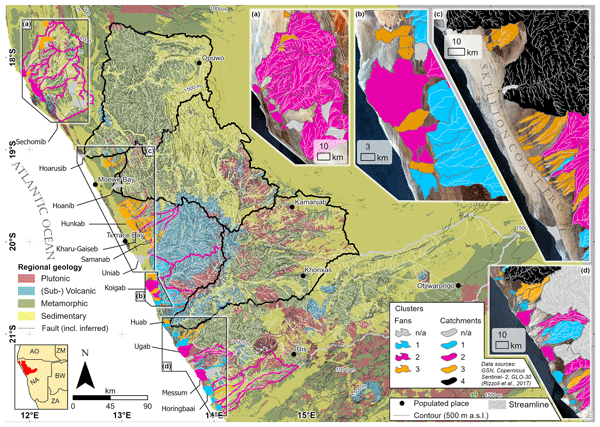
Abstract. The hyperarid Skeleton Coast of Namibia hosts a diverse suite of alluvial landforms, often shaped by varying degrees of lateral and distal confinement primarily through fan coalescence, the Atlantic Ocean, and the Skeleton Coast Erg. Considerable heterogeneity also characterises the source areas, as reflected in catchment morphometry, lithology, and coast-perpendicular moisture gradients, where larger inland-draining catchments intercept more precipitation. On the regional scale, this heterogeneity blurs source-sink relationships between alluvial landforms and catchments, despite overall geomorphic drainage maturity which could imply similar efficacy in source-sink communication.
To disentangle these patterns, we mapped 67 drainage systems and obtained a dataset including (hydro-) morphometric, climatic, and geologic parameters for these systems. An exploratory data analysis framework combining cluster and partial correlation analysis was applied on these datasets. Three distinct clusters were identified for both alluvial landforms and catchments, which match only weakly. The clearest source-sink coupling is attributed to a cluster of near-coastline fans, spanning much of the study area but with a spatial focus on its northern portion. By contrast, the majority of alluvial landforms form bajadas strongly influenced by the Skeleton Coast Erg, where distal confinement masks simple morphometric scaling.
Our results highlight fan confinement as the main driver affecting source-sink relationships at the Skeleton Coast. Fan morphometry appears to be more decisive than catchment properties, with fan gradient (<1° on average) emerging as a reliable discriminator. No robust climatic or lithological control on fan morphometry could be identified, although Sentinel-1 radar backscatter indicates more stable fan surfaces south of the Skeleton Coast Erg.
Overall, the Skeleton Coast represents a low-dynamics dryland margin where fan gradient provides the most meaningful parameter for source–sink analysis. Least-confined fans show the strongest coupling and thus constitute promising targets for paleoenvironmental reconstruction, while environmental conditions in the southern portion of the study area may have so far provided the most favourable conditions for long-term archive preservation.
-
Notice on discussion status
The requested preprint has a corresponding peer-reviewed final revised paper. You are encouraged to refer to the final revised version.
-
Preprint
(4092 KB)
-
The requested preprint has a corresponding peer-reviewed final revised paper. You are encouraged to refer to the final revised version.
- Preprint
(4092 KB) - Metadata XML
- BibTeX
- EndNote
- Final revised paper


Journal article(s) based on this preprint
Interactive discussion
Status: closed
- RC1: 'Comment on egusphere-2025-5607', Anonymous Referee #1, 12 Feb 2026
-
RC2: 'Comment on egusphere-2025-5607', Anonymous Referee #2, 30 May 2026
This paper “fluvio-alluvial source-sink relationships at the Skelton Coast of northern Namibia” asks relevant scientific questions, with the aim to “resolve the heterogeneity of both fan and catchment characteristics”, via applying cluster analysis to a large number of geomorphometric and geological and ‘climatic’ variables for “some number” of fans and their associated upstream catchments. I say “some number” because although the number 67 appears as a headline in the abstract, this is not the number that were analysed, and not the number of catchments-fans that were compared to consider the source region and the sink region. It gets quite confusing on reading the paper how many landforms have actually been analysed in the cluster analysis. Somewhere it says 52 landforms that could be delineated confidently, and then when the reader looks at Figure 4, they see n=60 for catchments and n=47 for alluvial landforms. But in the text is says n=38 for the fan dataset after removing outliers. And later again (page 27) the reader is told n=41 drainage system pairs could be matched between catchment and fan clusters. The main message about the number of these fan-catchment systems that are analysed in the paper needs to be consistent throughout the paper. Is it 41 or 38? (it isn’t the headline of 67).
Another aim is expressed at the end of the section 2 about investigating source-sink coupling and identifying driers of fan evolution. I think the aim(s) should all be in one place in the paper, and towards the end of the introduction. The leading aim is the exploration of heterogeneity, and this leads to being able to explore any patterns in the way the source (catchment) and sink (alluvial fan) might be connected/coupled.
I think the exploration of the heterogeneous fans and associated upstream catchments is the focus of the paper, and that a revised title would be more clearly accessible to the reader. I think that many readers will come to a “source-sink” relationship term in the current title with the idea that sediment is being traced/tracked through a system, instead of what I think this paper is designed to do, which is explore controls on why different fans/groups of fans look different to each other, and furthermore see how this yields an insight into a connection between fan source regions (the catchment) and the fan as a sink. So, would something like: “The nature, and potential controls over, alluvial fan and fluvial catchment heterogeneity in the Skeleton Coast of northern Namibia.”
The cluster analysis is a valid methodology to explore this topic. Whilst the methods are clearly outlined, the climate variables are a bit problematic. Within the climatic variables, one appears as a surprise – low cloud cover frequency. What is the proposed connection with landscape-forming processes here? Some explanation for the reader would help them to follow. A larger-scale conundrum is the limitation/caveat of using modern-day climatological variables, given the time over which these landforms have formed/developed. Different climatic conditions in the past may have left an imprint on the fans. Indeed, elsewhere in the paper the authors suggest that alluvial fan deposits may represent valuable archives for the Quaternary (lines 229), so they are indeed assuming that climatic variables will have changed though the time these features accumulate. Given all of this, should the modern-day climatological variables be included at all? The authors start to interrogate this in section 5.1 “Cluster analysis performance” with “whereas climate variables may reflect shorter-term conditions”. Perhaps what would be most interesting is to apply the same methodology without the modern-day climate variables and see what emerges.
Looking at Appendix B2, it becomes clear that those catchments with >50% of the catchment in volcanic bedrock all fall in cluster 2. And of those catchments with >50% in sedimentary bedrock, 66.6% fall in cluster 2 (then 5/24 in cluster 2, 4/24 in cluster 4). It is therefore surprising that geology (and particularly G1c, G4c) do not appear in Table 4 in the main manuscript. Why is that the case? I cannot follow this in the paper.
Outside of the questions about how to best apply the methodology to this interesting research problem, there are some observations about references/citations, where there is a more appropriate choice of citation to be made for modern climate and for potential patterns of change in the Quaternary. For example:
(1) where discussing tropical-temperate troughs (line 169). Heine (2004) is not an appropriate reference here. These are: Harrison, 1984; Todd and Washington, 1998; Hart et al., 2010; Macron et al., 2014
Harrison, M.S.J., 1984. A Generalized Classification of South African Summer Rain-Bearing Synoptic Systems. J. Climatol. 4, 547–560. https://doi.org/10.1002/joc.3370040510
Todd, M., Washington, R., 1999. Circulation Anomalies Associated With Tropical-Temperate Troughs in Southern Africa and the South West Indian Ocean. Clim. Dyn. 15(1), 937-951. http://dx.doi.org/10.1007/s003820050323
Hart, N.C.G., Reason, C.J.C., Fauchereau, N., 2010. Tropical-Extratropical Interactions Over Southern Africa: Three Cases of Heavy Summer Season Rainfall. Month. Weather Rev. 138, 2608–2623. https://doi.org/10.1175/2010MWR3070.1
Macron, C., Phil, B., Richard, Y., Bessafi, M., 2014. How do Tropical Temperate Troughs Form and Develop over Southern Africa? J. Clim. 27(4), 1633-1647. https://doi.org/10.1175/JCLI-D-13-00175.1
(2) Where discussing possible shifts in wind regime (around lines 657-659). Krapf et al. (2005) is not appropriate fit here. There is no age control in this paper and no mention of wind direction. I think the idea of a “fundamental” shift of wind regime since the LGM is entirely speculative and not linked to any supporting data. I’d strongly advise the authors to revise this claim.
I hope the authors find these thoughts and suggestions useful. And the opportunity to revise the manuscript and revise the cluster analysis.
Citation: https://doi.org/10.5194/egusphere-2025-5607-RC2 -
AC1: 'Response to Anonymous Referee #1 and #2', Joel Mohren, 25 Jun 2026
Dear Anonymous Referee #1 and #2,
We would like to express our gratitude for your in-depth reviews of our manuscript. In some cases, you both made comments on similar topics. For clarity, and so that all changes to the manuscript are presented at once, we attach a single document that contains our responses to the comments from both reviewers.
Best regards,
The authors
Peer review completion


Interactive discussion
Status: closed
-
RC1: 'Comment on egusphere-2025-5607', Anonymous Referee #1, 12 Feb 2026
Mohren et al. map 67 fluvio-alluvial systems along the Skeleton Coast as an attempt to understand how morphometry, climate, and geology diagnose source-to-sink coupling. The main results are that fan confinement is a first-order control, the fan and catchment clusters match weakly, and fan gradient (<1°) is the most reliable discriminator of coupling, with limited climatic/lithologic signal at regional scale. I think the paper is important and worthy of publication after addressing the following comments.
- It is unclear to me how the fog/low-cloud dataset over 2015–2017 is expected to imprint a climatic signal on morphometry of these fluvio-alluvial systems, which likely integrate much longer timescales. More broadly, the climate variables used here represent present-day climatologies, so I think the “limited climatic signal” result should be framed as “limited signal from modern climatologies,” rather than evidence that climate was unimportant during formation. Is it possible to: 1) justify why modern gradients are expected to reflect the formative interval, and/or 2) discuss or test against available paleoclimatic proxies/chronologies for the region to evaluate whether past climatic changes may have left an imprint on these fans?
- I think treating the sink mainly as an expression of area in this confined setting might not be accurate. If confinement exists, deposition will tend to stack rather than spread over a larger area. In that case, correlating catchment metrics with fan area will naturally give weak correlations even if the system is strongly connected. I suggest a sensitivity analysis using a simple volume/thickness proxy for the sink. If this is difficult, I would at least state this explicitly as a limitation and explain that weak correlations may reflect the choice of sink metric (area) under confinement, rather than weak source-to-sink coupling.
- The overall manuscript leans heavily on confinement by ocean/coalescence/erg as the reason relationships blur. But I would also mention alternative explanations, or at least clarify the mechanisms. For example, confinement can blur the measurements because it reduces avulsion freedom and leads to thicker stacking (not measured) and different distributary behavior, rather than simply reducing fan area. So, I would explicitly mention this as a limitation: that the morphometric measurements (especially area-based metrics) could be impacted by confinement in a way that weakens correlations, even if the source-to-sink system is strongly connected.
I hope the authors find these helpful.
Citation: https://doi.org/10.5194/egusphere-2025-5607-RC1 -
RC2: 'Comment on egusphere-2025-5607', Anonymous Referee #2, 30 May 2026
This paper “fluvio-alluvial source-sink relationships at the Skelton Coast of northern Namibia” asks relevant scientific questions, with the aim to “resolve the heterogeneity of both fan and catchment characteristics”, via applying cluster analysis to a large number of geomorphometric and geological and ‘climatic’ variables for “some number” of fans and their associated upstream catchments. I say “some number” because although the number 67 appears as a headline in the abstract, this is not the number that were analysed, and not the number of catchments-fans that were compared to consider the source region and the sink region. It gets quite confusing on reading the paper how many landforms have actually been analysed in the cluster analysis. Somewhere it says 52 landforms that could be delineated confidently, and then when the reader looks at Figure 4, they see n=60 for catchments and n=47 for alluvial landforms. But in the text is says n=38 for the fan dataset after removing outliers. And later again (page 27) the reader is told n=41 drainage system pairs could be matched between catchment and fan clusters. The main message about the number of these fan-catchment systems that are analysed in the paper needs to be consistent throughout the paper. Is it 41 or 38? (it isn’t the headline of 67).
Another aim is expressed at the end of the section 2 about investigating source-sink coupling and identifying driers of fan evolution. I think the aim(s) should all be in one place in the paper, and towards the end of the introduction. The leading aim is the exploration of heterogeneity, and this leads to being able to explore any patterns in the way the source (catchment) and sink (alluvial fan) might be connected/coupled.
I think the exploration of the heterogeneous fans and associated upstream catchments is the focus of the paper, and that a revised title would be more clearly accessible to the reader. I think that many readers will come to a “source-sink” relationship term in the current title with the idea that sediment is being traced/tracked through a system, instead of what I think this paper is designed to do, which is explore controls on why different fans/groups of fans look different to each other, and furthermore see how this yields an insight into a connection between fan source regions (the catchment) and the fan as a sink. So, would something like: “The nature, and potential controls over, alluvial fan and fluvial catchment heterogeneity in the Skeleton Coast of northern Namibia.”
The cluster analysis is a valid methodology to explore this topic. Whilst the methods are clearly outlined, the climate variables are a bit problematic. Within the climatic variables, one appears as a surprise – low cloud cover frequency. What is the proposed connection with landscape-forming processes here? Some explanation for the reader would help them to follow. A larger-scale conundrum is the limitation/caveat of using modern-day climatological variables, given the time over which these landforms have formed/developed. Different climatic conditions in the past may have left an imprint on the fans. Indeed, elsewhere in the paper the authors suggest that alluvial fan deposits may represent valuable archives for the Quaternary (lines 229), so they are indeed assuming that climatic variables will have changed though the time these features accumulate. Given all of this, should the modern-day climatological variables be included at all? The authors start to interrogate this in section 5.1 “Cluster analysis performance” with “whereas climate variables may reflect shorter-term conditions”. Perhaps what would be most interesting is to apply the same methodology without the modern-day climate variables and see what emerges.
Looking at Appendix B2, it becomes clear that those catchments with >50% of the catchment in volcanic bedrock all fall in cluster 2. And of those catchments with >50% in sedimentary bedrock, 66.6% fall in cluster 2 (then 5/24 in cluster 2, 4/24 in cluster 4). It is therefore surprising that geology (and particularly G1c, G4c) do not appear in Table 4 in the main manuscript. Why is that the case? I cannot follow this in the paper.
Outside of the questions about how to best apply the methodology to this interesting research problem, there are some observations about references/citations, where there is a more appropriate choice of citation to be made for modern climate and for potential patterns of change in the Quaternary. For example:
(1) where discussing tropical-temperate troughs (line 169). Heine (2004) is not an appropriate reference here. These are: Harrison, 1984; Todd and Washington, 1998; Hart et al., 2010; Macron et al., 2014
Harrison, M.S.J., 1984. A Generalized Classification of South African Summer Rain-Bearing Synoptic Systems. J. Climatol. 4, 547–560. https://doi.org/10.1002/joc.3370040510
Todd, M., Washington, R., 1999. Circulation Anomalies Associated With Tropical-Temperate Troughs in Southern Africa and the South West Indian Ocean. Clim. Dyn. 15(1), 937-951. http://dx.doi.org/10.1007/s003820050323
Hart, N.C.G., Reason, C.J.C., Fauchereau, N., 2010. Tropical-Extratropical Interactions Over Southern Africa: Three Cases of Heavy Summer Season Rainfall. Month. Weather Rev. 138, 2608–2623. https://doi.org/10.1175/2010MWR3070.1
Macron, C., Phil, B., Richard, Y., Bessafi, M., 2014. How do Tropical Temperate Troughs Form and Develop over Southern Africa? J. Clim. 27(4), 1633-1647. https://doi.org/10.1175/JCLI-D-13-00175.1
(2) Where discussing possible shifts in wind regime (around lines 657-659). Krapf et al. (2005) is not appropriate fit here. There is no age control in this paper and no mention of wind direction. I think the idea of a “fundamental” shift of wind regime since the LGM is entirely speculative and not linked to any supporting data. I’d strongly advise the authors to revise this claim.
I hope the authors find these thoughts and suggestions useful. And the opportunity to revise the manuscript and revise the cluster analysis.
Citation: https://doi.org/10.5194/egusphere-2025-5607-RC2 -
AC1: 'Response to Anonymous Referee #1 and #2', Joel Mohren, 25 Jun 2026
Dear Anonymous Referee #1 and #2,
We would like to express our gratitude for your in-depth reviews of our manuscript. In some cases, you both made comments on similar topics. For clarity, and so that all changes to the manuscript are presented at once, we attach a single document that contains our responses to the comments from both reviewers.
Best regards,
The authors
Peer review completion
Journal article(s) based on this preprint
Viewed
| HTML | XML | Total | BibTeX | EndNote | |
|---|---|---|---|---|---|
| 2,082 | 1,255 | 153 | 3,490 | 160 | 176 |
- HTML: 2,082
- PDF: 1,255
- XML: 153
- Total: 3,490
- BibTeX: 160
- EndNote: 176
Viewed (geographical distribution)
| Country | # | Views | % |
|---|
| Total: | 0 |
| HTML: | 0 |
| PDF: | 0 |
| XML: | 0 |
- 1
Joel Mohren

Janek Walk
Julian Krieger
Wolfgang Römer
Anna Nguno
Frank Lehmkuhl
The requested preprint has a corresponding peer-reviewed final revised paper. You are encouraged to refer to the final revised version.
- Preprint
(4092 KB) - Metadata XML
Mohren et al. map 67 fluvio-alluvial systems along the Skeleton Coast as an attempt to understand how morphometry, climate, and geology diagnose source-to-sink coupling. The main results are that fan confinement is a first-order control, the fan and catchment clusters match weakly, and fan gradient (<1°) is the most reliable discriminator of coupling, with limited climatic/lithologic signal at regional scale. I think the paper is important and worthy of publication after addressing the following comments.
I hope the authors find these helpful.