
the Creative Commons Attribution 4.0 License.
the Creative Commons Attribution 4.0 License.
 | 22 Dec 2025
Effect of a non-hydrostatic core-mantle boundary on the nutations of Mars
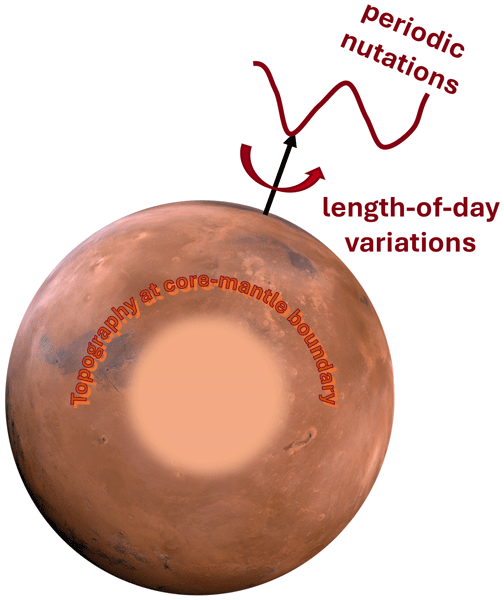
Abstract. Dynamic loads in planetary mantles have the potential to deform the core-mantle boundary (CMB). On Earth, subducting slabs primarily induce a degree 2–order 2 deformation of the CMB in the spherical harmonic (SH) reference system. On Mars, the presence of the dichotomy and of the Tharsis region could produce loading across multiple degrees and orders, including degree-1, degree 2–order 2, degree 2–order 0, and degree 3–order 3 components. Thanks to the InSight (Interior exploration using Seismic Investigations, Geodesy, and Heat Transport) mission’s radio science experiment, observations of Mars' nutations are now available. Periodic length-of-day (LOD) variations of Mars have been detected first by radio tracking the Viking landers, and InSight data have indicated the presence of a secular trend in LOD. In the case of nutations, the Martian core’s non-hydrostatic flattening plays a first-order role in determining nutation amplitudes. In this study, we explore second-order effects arising from dynamic topography at the CMB. We compute the pressure exerted on the CMB topography inside Mars' liquid core and evaluate the resulting topographic pressure torque acting on the boundary, which can influence both nutations and LOD variations. Our results show that, albeit at microarcsecond level—well below current observational thresholds, the most significant contribution to nutations arises from degree 2–order 2 component. As for LOD variations, while Earth exhibits notable contributions from inertial wave resonances, the situation on Mars is different. The planet’s tidal LOD variations have periods that are either too long or too far apart from those of inertial waves. Consequently, the associated contributions fall below the level of detectability.
-
Notice on discussion status
The requested preprint has a corresponding peer-reviewed final revised paper. You are encouraged to refer to the final revised version.
-
Preprint
(1240 KB)
-
The requested preprint has a corresponding peer-reviewed final revised paper. You are encouraged to refer to the final revised version.
- Preprint
(1240 KB) - Metadata XML
- BibTeX
- EndNote
- Final revised paper


Journal article(s) based on this preprint
Interactive discussion
Status: closed
-
RC1: 'Comment on egusphere-2025-5558', Bernhard Steinberger, 30 Jan 2026
- AC2: 'Reply on RC1', Véronique Dehant, 06 Mar 2026
- AC3: 'Reply on RC1', Véronique Dehant, 06 Mar 2026
- AC4: 'Reply on RC1', Véronique Dehant, 20 Mar 2026
-
RC2: 'Comment on egusphere-2025-5558', Anonymous Referee #2, 06 Feb 2026
This paper develops a theory for how topography on the core-mantle boundary (CMB) can induce nutations and changes to the length of day (LOD) on Mars. The authors develop a theory that predicts the frequencies of inertial waves in the liquid core, and then anticipates that these resonances can excite torques that excite nutations and changes in the length of day. The theory predicts these excitations at specific frequencies for certain spherical harmonic wavelengths. However, significant nutations and changes in LOD are not observed at these frequencies. This leads to the authors to conclude that CMB topography is not exciting nutations or LOD variations – presumably because the CMB topography is not large enough to excite the associated inertial waves.
This would be much more exciting if the result of this exercise would be to explain an observed nutation or LOD change. Thus, this paper thus presents a somewhat negative result, although it is still potentially important to publish this type of study to save others the time to look for these CMB resonances. Still, the negative result leaves the reader to wonder whether the CMB topography is too small, or if something might be missing from the theory? Given this, it would greatly help the paper to have a sort of “proof of concept” – to show that the theory indeed does predict resonances that produce nutations (or LOD variations) on another planet where the nutations are well understood, such as Earth. It seems to me that this would be relatively easy to do, so I am a bit surprised that the authors did not do this. Even if the result was negative (no nutations at the predicted frequencies) then there is enough known about the Earth that it might be possible to explain why they see a negative result based on knowledge about mantle structure (and associated CMB topography). Thus, I would be much more comfortable with this analysis if it were also applied to the Earth, where much more is known, before applying it to Mars.
Furthermore, the authors compare predicted resonant frequencies to the frequencies of nutations with known causes (annual and its sub-harmonics, see line 33). To me, this doesn’t make sense because even if these nutations are observed it would be difficult to attribute them to the CMB topography. They are essentially looking for resonant frequencies that are “hiding” behind sub-harmonics of sun-driven nutuations. Why not look for nutations in frequency ranges that are not already filled?
Some additional discussion of previous approaches to link the CMB with nutations or LOD changes would be helpful. For example, Koot et al. (2010) linked nutations on Earth with CMB coupling (viscous or topographic), but this previous analysis is not cited or discussed. Rekier et al. (2025) recently submitted a paper relating CMB topography to nutations (also on Earth), but it this is also not discussed. Similarly, LOD variations have been suggested to be caused by CMB topography on Earth (e.g., Yoshida and Hamano, 1995, Greff-Lefftz, 2011, and many other papers). Putting this work in the context of this previous work is important to include here.
The text of the paper is reasonably well written, but it relies too heavily on equations and tables to make their points. In that sense, the paper is not particularly well presented, and it would help to show figures beyond two small and black and white figures to show the main results. The paper actually incorporates a lot of other information such the power spectra of the Mars’s geoid field and the CMB topography kernels (together used to estimate the power spectra of the CMB topography on Mars). I feel that a paper with better use of figures would be more impactful.
I give more specific comments below, but given these concerns I am recommending major revisions. I think that a better testing of the theory is necessary before confirming a negative result for Mars. I also think that the authors can make better use of visual aids (figures) when presenting their work – I give some suggestions below.
Specific Comments
Line 24 – the authors start the paper by discussing the new observations of nutations on Mars. It would help to show these in a figure (amplitude vs. frequency) – then it could shown which nutations are explained and which (if any) are not. The authors could also show the frequency range where they expect to detect CMB-associated nutation.
Line 52 – the authors state the Mars is the only planet exhibiting a bi-phase terrain constrast. I think this is not true – what about the Moon? Earth has this too, but not distributed in hemispheres (although during supercontinent periods it did have this).
Line 71 – the authors mention the idea that there is a molten silicate layer at the base of the Martian mantle, and also suggest that this is interesting to consider for nutations. Yet they do not come back to this idea later in the paper – could the presence of this molten layer help to explain why the CMB topography does not induce nutations (because the topography is instead on the lower part of the solid mantle, and separated from the CMB by the molten layer?)? Can topography on the solid-liquid interface (within the mantle) generate nutations? It seems to me that they would be different than at the CMB, since the density contrast is different and they occur at a different radius.
Line 74 – here the authors refer to epsilon_l^k and epsilon_l’^k’, but none of these terms are defined (epsilon, l, k, l’, k’). It would be better not to either define these terms or save this mathematical expression for later (when it can be defined more clearly).
Line 76 – Here “small” and “higher” are relative terms and their use here is vague and undefined.
Line 81 – The spherical harmonic representation of topography is mentioned – it would help to show this (in a figure) since it is used later when estimating the cmb topography.
Line 109 – personally, I think it would help to depict the pressure torque on CMB topography in a figure. (See Fig. 2 of Rekier et al., 2025 for an example).
Line 200 – this is one of several statements like “Only the frequency of XXXX cycles/day … could affect the nutations”. It is not explained why the authors have eliminated nearly all of the resonances identified. This is part of why it would help to show the observed nutations as a function of frequency – so it is more clear why the authors can eliminate most of these frequences. (presumably the others are outside of the relevant range for nutuations?)
Line 220 – here section 2.1.3 and Table 1 presents other degrees at higher orders, but it is not mentioned if any of these might be interesting for nutations.
Line 239 – The authors make an argument that they can relate geoid anomalies at Mars’s surface to the CMB topography, based on the kernel that links them. In general, this only works for a simplified mantle flow, without lateral viscosity variations or compositional variations. On Earth, where there may be both types of heterogeneity present near the CMB, there can be (potentially large) topography on the CMB associated with isostatic topography (of the LLSVP regions), or the flow near them. See Heyn et al., 2020 for a more in-depth discussion of this topic for Earth. For Mars, much less is known so it is hard to know what to assume– still, it would help to discuss this, to give context for what the type of complexity that could be relevant for Mars.
Line 284 – Finally the first figure. This figure shows the frequencies of the nutations. However, the figure is presented poorly – it is small, and the symbols are very difficult to distinguish. It would be better to make use of color here. Furthermore, only the zero-crossings are discussed - does the vertical amplitude have any meaning? The y-axis is only labelled “y” – what does this mean and what are the units? No units are given for the x-axis either, only the symbol “sigma”. I think the authors could be more imaginative about how to present the predicted resonances, instead of simply showing the determinant. Finally, the “caption” is referred to in the caption – I think they mean “legend” here.
Line 302 – I think the authors mean “microarcsecond” instead of “microsecond” here.
Line 322 – A list of tidal frequencies is given – are these the same as the six points shown in Figure 2? It would help to label these so the tidal frequencies could be connected to these points (not so easy to relate Martian days to whatever units are used for sigma on the x-axis).
References
Greff-Lefftz, M., Length of day variations due to mantle dynamics at geological timescale, Geophysical Journal International, Volume 187, Issue 2, November 2011, Pages 595–612, https://doi.org/10.1111/j.1365-246X.2011.05169.x
Heyn, B. H., Conrad, C. P., and Trønnes, R. G., 2020, Core-mantle boundary topography and its relation to the viscosity structure of the lowermost mantle: Earth and Planetary Science Letters, v. 543, p. 116358.
Koot, L., M. Dumberry, A. Rivoldini, O. De Viron, V. Dehant, Constraints on the coupling at the core–mantle and inner core boundaries inferred from nutation observations, Geophysical Journal International, Volume 182, Issue 3, September 2010, Pages 1279–1294, https://doi.org/10.1111/j.1365-246X.2010.04711.x
Rekier et al., Constraints on Earth’ Core-Mantle boundary from nutation (arXiv: https://arxiv.org/html/2507.01671, 2025).
Yoshida, Y., and Y. Hamano (1995), Geomagnetic decadal variations caused by length-of-day variation, Physics of the Earth and Planetary Interiors, 91, 117-129, https://doi.org/10.1016/0031-9201(95)03038-X.
Citation: https://doi.org/10.5194/egusphere-2025-5558-RC2 - AC1: 'Reply on RC2', Véronique Dehant, 06 Mar 2026
- AC5: 'Reply on RC2', Véronique Dehant, 20 Mar 2026


Interactive discussion
Status: closed
-
RC1: 'Comment on egusphere-2025-5558', Bernhard Steinberger, 30 Jan 2026
Given my area of expertise, my ability to review that paper is limited to anything that relates to mantle dynamics and than is not much, unfortunately. The one part I am familiar with is on the Green's functions. On the whole, in the absence of further information, I think the approach taken - converting geoid coefficients to CMB topography coefficients assuming amplitudes of mantle loads are independent of depth - is reasonable, but of course the sensitivity kernels and hence the conversion depend on viscosity structure, and I would have preferred if that was a bit discussed, perhaps elaborating on uncertainties depending on viscosity structure, or variability for the range of possible viscosity structures.
Line 53: on degree-1 gravity: In center of mass coordinates, this is required to be zero, as also pointed out by Wieczorek et al. (2019). Also, that would mean that the approach of inferring CMB topography from gravity mentioned in the above point would not work, so it should be clarified how you get degree-1 CMB topography. Relate it to degree-1 surface topography (since that can also be computed from sensitivity kernels) or infer it from Kaula's law?
Line 66/67: "greater than in cases without a post-spinel phase transition" - I don't understand, I think the case with a larger core is the case without a post-spinel phase transition.
Line 67: What is non-hydrostatic equilibrium? Do you mean deviation from hydrostatic equilibrium?
Line 104: You start here with 1, but the introduction is not numbered. I find this a bit confusing.
Figures 1 and 2: These symbols are hard to recognize. It would be helpful to plot that figures bigger. For the Plus-signs on the axis, the horizontal line cannot be seen, so they are especially hard to be recognized. Symbols for prograde and retrograde appear to be identical, so they cannot be distinguished. What is the unit for sigma (frequency)? In Figure 1 sigma goes from 0.99 to 1.01 whereas in Figure 2 it goes from 0 to 0.09. A
Line 290-302: You write microsecond level in lines 293, 296 and 302, and microarcsecond level in line 300. Do you mean microarcsecond level in all cases? I am not sure what microsecond level would mean. Microarcsecond is a small distance, so it seems to me a measure for the size of nutations.
Figure A1: There are supposedly symbols for Earth and Mars but they appear identical, so couldn't be distinguished. Also, on each graph, there is only one symbol of each kind, it seems, whereas it should be two, if it is for Earth and Mars. Also, same comments as in Figure 1 and 2; it would be helpful to plot the figure bigger.
Minor comments:
line 21: "from the degree 2-order 2 component"
Line 65: Not "In a core" but rather "With a core"
Line 169/170: "properties of spherical harmonic properties"Citation: https://doi.org/10.5194/egusphere-2025-5558-RC1 - AC2: 'Reply on RC1', Véronique Dehant, 06 Mar 2026
- AC3: 'Reply on RC1', Véronique Dehant, 06 Mar 2026
- AC4: 'Reply on RC1', Véronique Dehant, 20 Mar 2026
-
RC2: 'Comment on egusphere-2025-5558', Anonymous Referee #2, 06 Feb 2026
This paper develops a theory for how topography on the core-mantle boundary (CMB) can induce nutations and changes to the length of day (LOD) on Mars. The authors develop a theory that predicts the frequencies of inertial waves in the liquid core, and then anticipates that these resonances can excite torques that excite nutations and changes in the length of day. The theory predicts these excitations at specific frequencies for certain spherical harmonic wavelengths. However, significant nutations and changes in LOD are not observed at these frequencies. This leads to the authors to conclude that CMB topography is not exciting nutations or LOD variations – presumably because the CMB topography is not large enough to excite the associated inertial waves.
This would be much more exciting if the result of this exercise would be to explain an observed nutation or LOD change. Thus, this paper thus presents a somewhat negative result, although it is still potentially important to publish this type of study to save others the time to look for these CMB resonances. Still, the negative result leaves the reader to wonder whether the CMB topography is too small, or if something might be missing from the theory? Given this, it would greatly help the paper to have a sort of “proof of concept” – to show that the theory indeed does predict resonances that produce nutations (or LOD variations) on another planet where the nutations are well understood, such as Earth. It seems to me that this would be relatively easy to do, so I am a bit surprised that the authors did not do this. Even if the result was negative (no nutations at the predicted frequencies) then there is enough known about the Earth that it might be possible to explain why they see a negative result based on knowledge about mantle structure (and associated CMB topography). Thus, I would be much more comfortable with this analysis if it were also applied to the Earth, where much more is known, before applying it to Mars.
Furthermore, the authors compare predicted resonant frequencies to the frequencies of nutations with known causes (annual and its sub-harmonics, see line 33). To me, this doesn’t make sense because even if these nutations are observed it would be difficult to attribute them to the CMB topography. They are essentially looking for resonant frequencies that are “hiding” behind sub-harmonics of sun-driven nutuations. Why not look for nutations in frequency ranges that are not already filled?
Some additional discussion of previous approaches to link the CMB with nutations or LOD changes would be helpful. For example, Koot et al. (2010) linked nutations on Earth with CMB coupling (viscous or topographic), but this previous analysis is not cited or discussed. Rekier et al. (2025) recently submitted a paper relating CMB topography to nutations (also on Earth), but it this is also not discussed. Similarly, LOD variations have been suggested to be caused by CMB topography on Earth (e.g., Yoshida and Hamano, 1995, Greff-Lefftz, 2011, and many other papers). Putting this work in the context of this previous work is important to include here.
The text of the paper is reasonably well written, but it relies too heavily on equations and tables to make their points. In that sense, the paper is not particularly well presented, and it would help to show figures beyond two small and black and white figures to show the main results. The paper actually incorporates a lot of other information such the power spectra of the Mars’s geoid field and the CMB topography kernels (together used to estimate the power spectra of the CMB topography on Mars). I feel that a paper with better use of figures would be more impactful.
I give more specific comments below, but given these concerns I am recommending major revisions. I think that a better testing of the theory is necessary before confirming a negative result for Mars. I also think that the authors can make better use of visual aids (figures) when presenting their work – I give some suggestions below.
Specific Comments
Line 24 – the authors start the paper by discussing the new observations of nutations on Mars. It would help to show these in a figure (amplitude vs. frequency) – then it could shown which nutations are explained and which (if any) are not. The authors could also show the frequency range where they expect to detect CMB-associated nutation.
Line 52 – the authors state the Mars is the only planet exhibiting a bi-phase terrain constrast. I think this is not true – what about the Moon? Earth has this too, but not distributed in hemispheres (although during supercontinent periods it did have this).
Line 71 – the authors mention the idea that there is a molten silicate layer at the base of the Martian mantle, and also suggest that this is interesting to consider for nutations. Yet they do not come back to this idea later in the paper – could the presence of this molten layer help to explain why the CMB topography does not induce nutations (because the topography is instead on the lower part of the solid mantle, and separated from the CMB by the molten layer?)? Can topography on the solid-liquid interface (within the mantle) generate nutations? It seems to me that they would be different than at the CMB, since the density contrast is different and they occur at a different radius.
Line 74 – here the authors refer to epsilon_l^k and epsilon_l’^k’, but none of these terms are defined (epsilon, l, k, l’, k’). It would be better not to either define these terms or save this mathematical expression for later (when it can be defined more clearly).
Line 76 – Here “small” and “higher” are relative terms and their use here is vague and undefined.
Line 81 – The spherical harmonic representation of topography is mentioned – it would help to show this (in a figure) since it is used later when estimating the cmb topography.
Line 109 – personally, I think it would help to depict the pressure torque on CMB topography in a figure. (See Fig. 2 of Rekier et al., 2025 for an example).
Line 200 – this is one of several statements like “Only the frequency of XXXX cycles/day … could affect the nutations”. It is not explained why the authors have eliminated nearly all of the resonances identified. This is part of why it would help to show the observed nutations as a function of frequency – so it is more clear why the authors can eliminate most of these frequences. (presumably the others are outside of the relevant range for nutuations?)
Line 220 – here section 2.1.3 and Table 1 presents other degrees at higher orders, but it is not mentioned if any of these might be interesting for nutations.
Line 239 – The authors make an argument that they can relate geoid anomalies at Mars’s surface to the CMB topography, based on the kernel that links them. In general, this only works for a simplified mantle flow, without lateral viscosity variations or compositional variations. On Earth, where there may be both types of heterogeneity present near the CMB, there can be (potentially large) topography on the CMB associated with isostatic topography (of the LLSVP regions), or the flow near them. See Heyn et al., 2020 for a more in-depth discussion of this topic for Earth. For Mars, much less is known so it is hard to know what to assume– still, it would help to discuss this, to give context for what the type of complexity that could be relevant for Mars.
Line 284 – Finally the first figure. This figure shows the frequencies of the nutations. However, the figure is presented poorly – it is small, and the symbols are very difficult to distinguish. It would be better to make use of color here. Furthermore, only the zero-crossings are discussed - does the vertical amplitude have any meaning? The y-axis is only labelled “y” – what does this mean and what are the units? No units are given for the x-axis either, only the symbol “sigma”. I think the authors could be more imaginative about how to present the predicted resonances, instead of simply showing the determinant. Finally, the “caption” is referred to in the caption – I think they mean “legend” here.
Line 302 – I think the authors mean “microarcsecond” instead of “microsecond” here.
Line 322 – A list of tidal frequencies is given – are these the same as the six points shown in Figure 2? It would help to label these so the tidal frequencies could be connected to these points (not so easy to relate Martian days to whatever units are used for sigma on the x-axis).
References
Greff-Lefftz, M., Length of day variations due to mantle dynamics at geological timescale, Geophysical Journal International, Volume 187, Issue 2, November 2011, Pages 595–612, https://doi.org/10.1111/j.1365-246X.2011.05169.x
Heyn, B. H., Conrad, C. P., and Trønnes, R. G., 2020, Core-mantle boundary topography and its relation to the viscosity structure of the lowermost mantle: Earth and Planetary Science Letters, v. 543, p. 116358.
Koot, L., M. Dumberry, A. Rivoldini, O. De Viron, V. Dehant, Constraints on the coupling at the core–mantle and inner core boundaries inferred from nutation observations, Geophysical Journal International, Volume 182, Issue 3, September 2010, Pages 1279–1294, https://doi.org/10.1111/j.1365-246X.2010.04711.x
Rekier et al., Constraints on Earth’ Core-Mantle boundary from nutation (arXiv: https://arxiv.org/html/2507.01671, 2025).
Yoshida, Y., and Y. Hamano (1995), Geomagnetic decadal variations caused by length-of-day variation, Physics of the Earth and Planetary Interiors, 91, 117-129, https://doi.org/10.1016/0031-9201(95)03038-X.
Citation: https://doi.org/10.5194/egusphere-2025-5558-RC2 - AC1: 'Reply on RC2', Véronique Dehant, 06 Mar 2026
- AC5: 'Reply on RC2', Véronique Dehant, 20 Mar 2026
Peer review completion


Journal article(s) based on this preprint
Viewed
| HTML | XML | Total | BibTeX | EndNote | |
|---|---|---|---|---|---|
| 820 | 521 | 98 | 1,439 | 85 | 95 |
- HTML: 820
- PDF: 521
- XML: 98
- Total: 1,439
- BibTeX: 85
- EndNote: 95
Viewed (geographical distribution)
| Country | # | Views | % |
|---|
| Total: | 0 |
| HTML: | 0 |
| PDF: | 0 |
| XML: | 0 |
- 1
Marta Folgueira López
Véronique Dehant
Mihaela Puica
Tim Van Hoolst
The requested preprint has a corresponding peer-reviewed final revised paper. You are encouraged to refer to the final revised version.
- Preprint
(1240 KB) - Metadata XML
Given my area of expertise, my ability to review that paper is limited to anything that relates to mantle dynamics and than is not much, unfortunately. The one part I am familiar with is on the Green's functions. On the whole, in the absence of further information, I think the approach taken - converting geoid coefficients to CMB topography coefficients assuming amplitudes of mantle loads are independent of depth - is reasonable, but of course the sensitivity kernels and hence the conversion depend on viscosity structure, and I would have preferred if that was a bit discussed, perhaps elaborating on uncertainties depending on viscosity structure, or variability for the range of possible viscosity structures.
Line 53: on degree-1 gravity: In center of mass coordinates, this is required to be zero, as also pointed out by Wieczorek et al. (2019). Also, that would mean that the approach of inferring CMB topography from gravity mentioned in the above point would not work, so it should be clarified how you get degree-1 CMB topography. Relate it to degree-1 surface topography (since that can also be computed from sensitivity kernels) or infer it from Kaula's law?
Line 66/67: "greater than in cases without a post-spinel phase transition" - I don't understand, I think the case with a larger core is the case without a post-spinel phase transition.
Line 67: What is non-hydrostatic equilibrium? Do you mean deviation from hydrostatic equilibrium?
Line 104: You start here with 1, but the introduction is not numbered. I find this a bit confusing.
Figures 1 and 2: These symbols are hard to recognize. It would be helpful to plot that figures bigger. For the Plus-signs on the axis, the horizontal line cannot be seen, so they are especially hard to be recognized. Symbols for prograde and retrograde appear to be identical, so they cannot be distinguished. What is the unit for sigma (frequency)? In Figure 1 sigma goes from 0.99 to 1.01 whereas in Figure 2 it goes from 0 to 0.09. A
Line 290-302: You write microsecond level in lines 293, 296 and 302, and microarcsecond level in line 300. Do you mean microarcsecond level in all cases? I am not sure what microsecond level would mean. Microarcsecond is a small distance, so it seems to me a measure for the size of nutations.
Figure A1: There are supposedly symbols for Earth and Mars but they appear identical, so couldn't be distinguished. Also, on each graph, there is only one symbol of each kind, it seems, whereas it should be two, if it is for Earth and Mars. Also, same comments as in Figure 1 and 2; it would be helpful to plot the figure bigger.
Minor comments:
line 21: "from the degree 2-order 2 component"
Line 65: Not "In a core" but rather "With a core"
Line 169/170: "properties of spherical harmonic properties"