
the Creative Commons Attribution 4.0 License.
the Creative Commons Attribution 4.0 License.
 | 08 Dec 2025
Biomarkers and diatoms as tracers of past sea ice conditions and phytoplankton communities in the southwestern Ross Sea, Antarctica: drivers and variability over the last 200 years
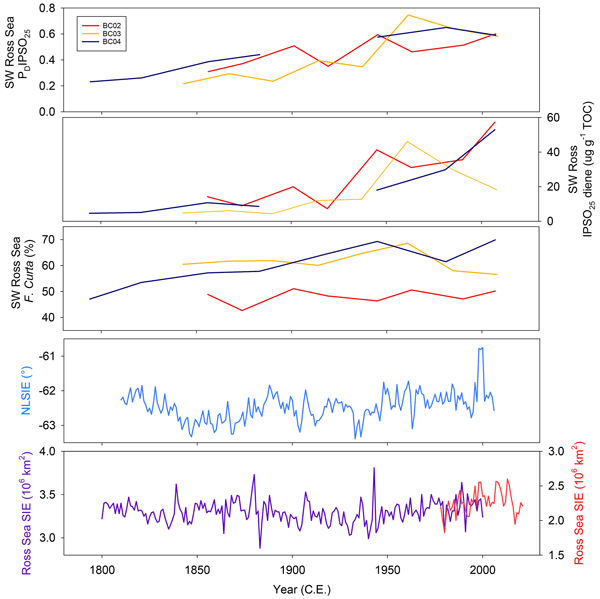
Abstract. The Ross Sea, Antarctica, is among the most seasonally productive areas globally, where different classes of phytoplankton, such as diatoms and haptophytes (Phaeocystis antarctica), play key roles in marine ecosystems and the carbon cycle. Sea ice dynamics strongly influence Ross Sea phytoplankton blooms, yet the effects of recent sea ice changes on bloom composition and productivity remain poorly constrained. Seasonally resolved observational records of past Ross Sea phytoplankton and sea ice variability are too short to understand potential future changes in sea ice extent, phytoplankton productivity and community composition, and the resulting consequences on climate. In this study, we investigated phytoplankton-derived lipid biomarkers (fatty acids, highly branched isoprenoids; HBIs, sterols) and diatom assemblages in six marine sediment core tops and three short sediment cores collected along a north-south transect spanning two seasonally recurring polynyas in McMurdo Sound and Terra Nova Bay, to assess how sea ice dynamics and phytoplankton communities drive biomarker signatures and diatom assemblages archived in sediments. For the core-tops, we find that the proportion of open-ocean diatom species and bacterial fatty acid concentrations in core top samples increases towards the southern end of the transect near McMurdo Sound, which is driven by lower summer sea ice extent, a phytoplankton community dominated by diatoms, and higher summer biomass in McMurdo Sound. In contrast, diatom assemblages shift towards sea ice-associated diatoms in the northern end of the transect, characterised by increased concentrations of sea ice diatom-derived fatty acids, sterols, and HBIs (PIPSO25), driven by greater sea ice concentrations. Similarly, Phaeocystis antarctica-derived fatty acid biomarkers increased towards the northern end of the transect, likely driven by differences in the phytoplankton community. For the short cores, we show that an exponential decrease in the fatty acid biomarker signal in the top ~20 cm of sediment is driven by processes such as bacterial biogenesis. Although phytoplankton-derived fatty acids show little change in community composition over the last 200 years, Fragilariopsis curta and PIPSO25 indicate increasing sea ice extent, accompanied by declining Chaetoceros resting spores and open ocean diatom species in the southwestern Ross Sea. Overall, our records reveal a 200-year increasing sea ice trend, consistent with existing regional sea ice extent reconstructions from ice cores. Overall, biomarkers in the southwestern Ross Sea sediment independently distinguish between pelagic diatoms, P. antarctica, and sea ice-associated diatoms, offering a valuable tool for developing decadal resolution records of sea ice and phytoplankton community changes.
Competing interests: Some authors are members of the editorial board of journal Biogeosciences.
Publisher's note: Copernicus Publications remains neutral with regard to jurisdictional claims made in the text, published maps, institutional affiliations, or any other geographical representation in this paper. While Copernicus Publications makes every effort to include appropriate place names, the final responsibility lies with the authors. Views expressed in the text are those of the authors and do not necessarily reflect the views of the publisher.-
Notice on discussion status
The requested preprint has a corresponding peer-reviewed final revised paper. You are encouraged to refer to the final revised version.
-
Preprint
(3143 KB)
-
Supplement
(172 KB)
-
The requested preprint has a corresponding peer-reviewed final revised paper. You are encouraged to refer to the final revised version.
- Preprint
(3143 KB) - Metadata XML
-
Supplement
(172 KB) - BibTeX
- EndNote
- Final revised paper


Journal article(s) based on this preprint
Interactive discussion
Status: closed
-
RC1: 'Comment on egusphere-2025-5553', Anonymous Referee #1, 23 Jan 2026
-
AC1: 'Reply on RC1', Holly Winton, 14 Jul 2026
The comment was uploaded in the form of a supplement: https://egusphere.copernicus.org/preprints/2025/egusphere-2025-5553/egusphere-2025-5553-AC1-supplement.pdf
-
AC1: 'Reply on RC1', Holly Winton, 14 Jul 2026
-
RC2: 'Comment on egusphere-2025-5553', Anonymous Referee #2, 09 Jun 2026
The work by De Jong et al. examines core tops and box cores from SW Ross Sea to study sea ice conditions and phytoplankton communities shifts during the last 200 years through a multi-proxy analysis which is guided by biomarkers and diatoms. It focusses on how the sea ice conditions have an effect on the phytoplankton blooms through time, by considering various groups of phytoplankton. The results show an increasing sea ice trend in the last 200 years, in partial agreement with other studies from the Ross Sea region, and they offer distinctive insights into the distribution of different biomarker classes in an extremely productive area.
Although the framework is interesting and the results, especially the sea ice reconstruction, are compelling, the paper requires some adjustments and improvements to clarify certain aspects and to make it more fluid for the reader.
GENERAL COMMENTS
- I would suggest changing the title as follows: “Biomarkers and diatoms as tracers of phytoplankton communities and past sea ice conditions in the Southwestern Ross Sea, Antarctica: drivers and variability over the last 200 years”.
- In the abstract, few groups are cited (Phaeocystis antarctica, Fragilariopsis curta, Chaetoceros) but the ecological role and their implications are not clear. I suggest adding a brief specification about the diatoms and/or phytoplankton groups you are considering in this study (possibly inspired to line 88, where diatoms, dinoflagellates etc., are listed) and about what these organisms represent. The abstract seems in general too technical and the references to different diatom species and specific biomarkers without context and explanation make it challenging to follow.
- Beware of keeping the same tense throughout the whole text, avoid shifting between past and present tense.
- Some things are not specified enough for age models: how are the raw 210Pb profiles? Is there any trace of bioturbation? Core-tops in gravity cores are preserved and you have evidence for that? The method section talking about this is extremely scarce and also the suppl. material is lacking critical information. Besides, there is no information on the sedimentological and lithological aspects of these cores (HD images, x-ray, etc).
- Why HBI III and IV were not used? Are they absent? Since you separated a ketone fraction, did you have the chance to look for alkenones from haptophytes blooms? From what I know they are not present, or at least not detected, in Antarctic species but it would be interesting if they were indeed present.
- Talking about decay rate to describe the vertical decrease of a certain biomarker seems odd. A downcore decrease of concentration could be of course due to decay/degradation, but at the same time concentrations can change during time, and thus at different depths, due to environmental conditions (less productivity, advection, etc). This also raise another problem, that is, it is really challenging to discriminate between different biological sources using almost only absolute concentrations, which are extremely dependent on several uncontrolled variables (same as before, productivity, advection, etc). Both these issues are not clearly mentioned and discussed in the text.
- The results section is not adequately presented. The description need to be homogenized and uniformed, otherwise it could also be a possibility to unite results and discussion sections if the editor agrees.
- In the Results data from core-tops are presented, but they are not discussed later.
- The conclusion chapter is messy and difficult to follow, without any structure nor organization. I suggest rephrasing the main conclusions in order to clarify the take home messages of this study.
SPECIFIC COMMENTS
Lines 17-20: the second sentence seems a bit redundant.
Line 23: reading this sentence, it seems that the coring locations are on a transect that directly includes the Terra Nova Bay polynya. But, according to Figure 1, the sampling locations are quite far from there. Possibly rewrite the sentence making this clearer.
Line 24: maintain the same format throughout the text, core tops or core-tops. Plus, the use of core top twice is a bit redundant.
Line 26: it’s not clear what “which” refers to, is it the increase in concentration towards McMurdo Sound? This sentence is not clear.
Line 28: put it this way, PIPSO25 seems to be one of the HBIs, while it is a proxy ratio. Maybe change it with IPSO25 or remove it directly from the sentence.
Lines 34-35: repetition of “overall”.
Line 38: I suggest inserting as soon as possible in this chapter an introduction (a table?) about the groups of phytoplankton you are considering and what group the species you cite belong. Also, it is not clear if biogenic proxies other than diatoms (whose shells preserve in the sedimentary record) have been counted as well or entirely derived from biomarker analysis. Please specify this concept already in the introduction.
Line 39: “plankton” is an uncountable noun, so I would suggest adjusting the verbs at the third person singular (Antarctic phytoplankton forms … influences). Same thing for the following lines where phytoplankton is addressed as a plural noun, i.e. line 45 (inhabits).
Line 45: if available, I suggest adding some other references.
Line 50: P. antarctica needs to be spelled out as it is its first appearance in the main text. Also, briefly specify what haptophytes are and remember that both haptophytes and diatoms are part of phytoplankton.
Line 57: here, the name of Phaeocystis antarctica is expanded, but if you expand it the first time it is cited in the text, here you can use the abbreviated form.
Line 67: add “communities” after phytoplankton.
Line 84: change “also known as ‘diene’ is suggested to be solely sourced from the diatom Berkeleya adeliensis” with “also known as ‘diene’ and suggested to be solely sourced from the sympagic diatom Berkeleya adeliensis”.
Line 88: these bacteria are intended as bacteria living in the sediments or in the water column? Please clarify this aspect and specify what type of bacteria you are referring to.
Line 96: change “paleo-biomarker records” with “biomarker paleorecords”.
Line 111: in the table the precision of year and error does not match. I would expect to read 2007 ± 2 or, for example, 2007.5 ± 1.5.
Line 117: add the location of the ESR Institute.
Line 122: the table says 1856 as the lowest age of BC02, not 1857.
Line 127: change “sediment core sites” with “sampling sites”.
Line 128: a bracket is missing after 2011. I would also move the details (6.25 km resolution, 2002-2011, Spreen et al. (2008)) at the end of this sentence. Also, how can the paper from Spreen et al. (2008) include information on sea ice cover up to 2011? This applies also to the other subsequent figures.
Line 140: change “was” with “were”.
Line 144: change "factions” with “fractions”.
Line 169: did all biomarkers identifications happen in TIC? Usually it is extremely challenging and unlikely to identify HBIs such as IPSO25 with certainty without SIM mode.
Line 188: the references listed here need to be direct, without brackets.
Line 192: HBIs were already introduced and you can use the abbreviation from there on.
Line 196: change “source differences” with “different sources”
Line 223: “the southwestern Ross Sea is dominated by diatoms rather than (Arrigo et al., 2000; Arrigo et al., 2015; McMinn et al., 2010; Noble et al., 2013) which may lead to a larger diatom source of dinosterol”. I suppose something is missing after “rather than”. Please, complete the sentence.
Lines 227-242: the different diatom groups must be described with the same style, otherwise it is not clear if every group is on the same importance level as the others. Also, it is not perfectly clear which conditions are reflected by each group. This paragraph needs to be adjusted.
Line 227: a part of the sentence is missing?
Line 229: change “with melting late in the year” with “with a late melting season”.
Line 230: F. cryophilic in italic everywhere in the text, tables and figures/captions.
Line 234: E. antarctica in italic everywhere in the text, tables and figures/captions.
Line 245: Table 2 is extremely useful and complete, but it needs an improved formatting.
Line 251: change “fatty fraction” with “fatty acid fraction”.
Line 255 and others (264, 290, 398, 403, 407, etc.): there is a space between numeric value and % symbol, then in line 259, 260, 317, 318 and others there is no space. Please uniform the style throughout the text.
Lines 263-264: I would not call “exponential” a decrease of 50% in 30 cm, maybe a rapid decrease?
Line 272: change “a typical southwestern Ross Sea sediment sample (BC02; 11-12cm)” with “a sediment sample from BC02 core (11-12 cm)”.
Line 275: “IPSO25” should be IPSO25 everywhere in the text, tables and figures/captions (the same holds true for C15 FAs, C16:0, etc), and species names must be in italic. Change “percent” with “percentage”.
Line 276: in the caption of figure 3 change “Fatty acid concentrations of saturated and unsaturated fatty acids” with “Concentrations of saturated and unsaturated fatty acids”.
Line 277: in the caption of figure 4 change “select” with “selected”.
Line 280: change “ranged between 19 and 182” with “ranged from 19 to 182”.
Line 284: the description of downcore trends does not reflect the data precisely. Sterols trends differ from one core to the other and do not seem to be consistent.
Line 290: change “northern” with “northernmost”.
Line 292: asymptotes in this case should be represented by the biomarker value, not the core depth. I would rephrase “below which it remains constant. The asymptote of IPSO25 diene is ~20-30 cm in all three sediment cores (Figure 5)” as “below which it remains constant in all three sediment cores (Figure 5)”.
Line 298: change “per cent” with “percentage”.
Line 297: in figure 5 the unit of IPSO25 should be µg g-1 TOC. Add the name of the cores in these images.
Lines 313-315: these 2 sentences are repeated.
Line 316: the decrease of F. curta group % is clear only for BC04 looking at the graph, the other trends are quite obscure.
Line 317: the increase of CRS % does not seem true for BC03 judging from the graph.
Line 318: change “represent” with “represents”.
Line 319: change “do no” with “do not”.
Line 325: in the caption of figure 6 change “select” with “selected”.
Lines 346, 365 and 383: titles here are followed by a colon, while in line 397, which I assume has the same hierarchy, the title is not followed by the colon. I would delete the colon from all the titles, possibly enhancing the four titles through the italics text rather than bold text.
Line 353: remove the first “the” from “in the any of the studied”.
Line 358: “First, show a strong affinity to particles and are efficiently scavenged from surface waters (REF)”. I suppose here a reference is missing. Please provide a reference. I suggest also to revise and rewrite the sentence in a more fluid way, adding the subject for the first part, for example: “First, PUFAs show a strong affinity to particles and are efficiently scavenged from surface waters (missing reference here); second, PUFAs are highly sensitive to microbial remineralization in the water column and sediments (Wakeham et al., 1997) and finally, they also undergo intense photo and autooxidation in the water column before reaching the seafloor (Rontani et al., 2019).”
Line 346: sterols are not mentioned as indicators of pelagic diatoms in this chapter, despite being listed as such in Table 2.
Line 369: change “with high sources of” with “with an important contribution from”.
Line 372: change “evidence for” with “indicating”.
Lines 378-380: I suggest to rewrite the sentence to avoid the repetition of Berkeleya adeliensis as follows: “IPSO25 is dominantly sourced by the sea ice diatom Berkeleya adeliensis (Belt et al., 2016), which was not identified in any of the three cores studied here despite the presence of IPSO25, consistently with other studies around Antarctica (Tesi et al., 2020).”
Line 392: change “have a varied phytoplankton community spatially and temporally” with “have a variable phytoplankton community, both spatially and temporally”.
Lines 403-404: references are needed for this; it is not straightforward that bacteria communities respond to the same productivity changes as phytoplankton communities. Some studies have been made, especially for Archaea (https://onlinelibrary.wiley.com/doi/10.1155/2019/3717239), but clear evidence is still missing.
Line 407: change “which is covered” with “an area covered”.
Line 408: add “of the year” after 40%.
Line 409: change “spring/summer” with “warm season”.
Line 410: BC02 is THE closest site to McMurdo Sound without considering GC72.
Line 411: sea ice duration? I guess you mean the site with less average sea ice concentration? Or do you mean the site where sea ice melts, on average, later during the year? Please clarify.
Line 433: as per a previous comment, the use of the term asymptote here is a bit misinterpreted, I suggest rephrasing. Maybe you could say that the asymptote starts at around 20 cm of depth?
Line 452-453: “The detection of unsaturated and branched fatty acids is consistent with another southwestern Ross Sea (Smith et al., 1986), where a range of unsaturated fatty acids were detected…”. I suppose there is a missing word, possibly “consistent with another southwestern Ross Sea site/location/study (Smith et al., 1986)”?
Line 465: change “relative abundance F. curta” with “relative abundance of F. curta”. From figure 8 it is not possible to appreciate the increasing trend of this group in BC03.
Line 466: change “F. curta is a well-established sea ice diatom proxy” with “F. curta relative abundance is a well-established sea ice diatom proxy”.
Line 470: “Here, the F. curta group suggests an overall increase in sea ice activity in the southwestern Ross Sea between 1900 CE to present. from 1900 to present”. This sentence contains some typos. Please rewrite as follows: “Here, the F. curta group suggests an overall increase in sea ice activity in the southwestern Ross Sea from 1900 CE to the present time”.
Line 471: if you intend later melting with “increased sea ice duration”, IPSO25 concentrations cannot be put directly in relation with that. Sympagic diatoms production can increase independently from sea ice melting season, and it’s mainly associated with nutrient and light availability. Besides, as you also stated earlier in this manuscript, IPSO25 seems to be mainly associated with fast ice and platelet ice, so it is not directly showing seasonal sea ice extension, even though the two things are related (see for example Belt 2018).
Line 478: what do you mean by “off the Ross Sea”?
Line 492: delete “across the Ross Sea”.
Line 496: add a comma after “coverage”: “Despite these differences in metric and spatial coverage, all records presented in Figure 8…”.
Lines 500-501: change “After this degradation fatty acid concentrations remain relatively stable” with “Proceeding downcore, after the degradation, fatty acid concentrations remain relatively stable”.
Lines 501-502: as already said in a general comment, this seems a bit far-fetched. You cannot know if the decrease in the topmost sediments is only due to degradation or if there are other factors at play.
Line 504: in the text, when indicating stratigraphic intervals, the hyphen (short dash, -) is used. This time, it is used the longer dash (–). I suggest changing this with the shorter one and generally applying this correction everywhere in the text.
Line 507: in the text you suggest that PIPSO25 calculated with dinosterol might be a better pick over the one calculated with brassicasterol and I quite agree, but why then only the latter is shown in figure 8? In panel e, the curve is not black as stated in the caption.
Line 518: please rewrite as follows “Spatial variations in biomarker composition were primarily driven by sea ice conditions and associated phytoplankton habitats, while pelagic diatoms, Phaeocystis antarctica, and sea ice diatoms exhibit distinctive biomarker signatures.”.
Line 519: remove the comma after “While”.
Line 520: remove the commas after specifically and after the closing bracket.
Line 522: rewrite and unite the sentences as follows: “Phaeocystis antarctica fossils are not preserved in marine sediments; however, …”
Line 526: rewrite the sentence as follows: “Biomarkers are also influenced by downcore degradation: fatty acids in the southwestern Ross Sea demonstrate an overall exponential decay in the top ~20 cm of the sediment cores. This degradation derives from bacterial biogenesis, demonstrated by 10-20% of branched fatty acids sourced from bacteria. Despite the degradation process, biomarkers still record the relative composition of phytoplankton groups over this period”.
Lines 529-532: rewrite as follows: “Trends in sea ice diatoms such as Fragilariopsis curta, sea ice diatom markers of HBIs and PIPSO25, reveal a 200-year trend toward increasing sea ice extent in the southwestern Ross Sea. This reconstruction is aligned with existing regional sea ice extent reconstructions derived both from sediment cores and ice cores, which show stability in the rime frame spanning from 1900 to 1950, followed by an increase in sea ice towards the present”.
Citation: https://doi.org/10.5194/egusphere-2025-5553-RC2 -
AC2: 'Reply on RC2', Holly Winton, 14 Jul 2026
The comment was uploaded in the form of a supplement: https://egusphere.copernicus.org/preprints/2025/egusphere-2025-5553/egusphere-2025-5553-AC2-supplement.pdf
Peer review completion


Interactive discussion
Status: closed
-
RC1: 'Comment on egusphere-2025-5553', Anonymous Referee #1, 23 Jan 2026
This paper represents a valuable exercise in investigating biomarkers and sea ice proxies in Ross Sea environment, important for continuing the focus on these topics first established by Thomas et al., 2019 and Ashley et al., 20021. Of particular interest is the effort to identify and organically characterize specific biomarkers of different phytoplankton groups and to use them for comparative analysis of bacterial activity in sediments.
Supplemental Pangea dataset (.xlsx) is nice while the in the Supplement Biomarker sediment (.pdf) maybe some basic description, focus on the Appleby, 2001 method, could be useful.
I’d like to point out that the general section on cores, the sedimentological and descriptive reports (cores logs, photos of laminations and a general descriptions) are underdeveloped while some important environmental evidences inserted in a paleoclimatic context are missing. In particular, the important section on polynyas, their importance and their evolution is sparse. Furthermore, some specific expertise are taken for granted, making the article highly specific and lacking in flow and descriptiveness.
While reading the final part of the article, there is some confusion in defining diatom assemblages such as 'sea ice', 'pelagic diatoms', ‘dwelling diatoms’ or 'centric open water diatoms. A quick diagram (like Table 2.), providing the Groups/assemblages and the species that define each of them, could help. Selective dissolution before and after deposition is a little underestimated.
Perhaps a more structured mathematical/statistical analyses as a Cluster Analyses and a Principal Component Analyses (PCA), could be produced on the complete datasets (at least for surface samples), aiming a more quickly highlight of the main variance groups and their correlation (most significant elements)
The general section on cores is underdeveloped, and the sedimentological and descriptive report on the environment and paleoclimatic context is sparse. In particular, the important section on polynyas and their evolution is underdeveloped. Furthermore, some skills are taken for granted, making the article highly specific and lacking in flow and description.
List of corrections/suggestions:
L14: Please, revise the Abstract after the revision, enriching it with a better paleoclimatic framework
L23: Why the Ross Sea polynyas aren’t mentioned? As they are so important for the productivity and water masses circulation in the Ross Embjment, many highlighting publications exist on this topic; some fleeting mentions are present later in the texe but it seems important mention here too. See some examples even in the .pdf: Truax et al., 2024 https://doi.org/10.1016/j.quascirev.2024.108635; Falco et la., 2024 Deep–SeaResearch, II, 218,105429
L107: Please, add the cores RX or, at least, some photos of these crude sediment laminations
L109: As GC72, GC78 and GC80 present a good core sediment record (944 cm, 821 cm and 721 cm respectively) why do you present only the surface (top) sediments? Was it not possible to submit records relating to the same box corers time gap? If not, why?
Table 1: in the Age column is CE Common Era? Equivalent to d. C.?
L118: Hard to under stand for non-experts: the transition from 210Pb to 210Posupported (to be explain) is not immediate. Please, a brief explanation from Appleby, 2001 (or in Sup Mat.) coul help in understanding the geochronological chain and methodology.
Fig. 1: ). Please highlight the presence of different polynyas (biological hotspots and important high salinity shelf areas - HSSW production areas). Is there any known morphological, atmospheric or oceanic dynamic explanation for the presence of >0.8% sea ice cover in the BC04, BC03 and GC78 cores collection area?
L153: instrument available from which Institution?
L187: Absolute Diatom Abundances (ADA) were calculated for each sample while diatoms were ….
L192: 2.7 Proxy rationale
L219: please, which species or Group, have you found them in your samples?
L222: a refuse … than what? dinoflagellates?
L230: refuse: Fragilariopsis obliquecostata
L231: do you intend the ‘Sea ice dwelling diatoms’ reported at L365? If yes, please pay attention in defining the Groups and in keeping the same definition throughout the article
L235: … and iceberg drift
L251: refuse: section 2.7
Fig. 2: maybe to specify in Sup. Mat. how chromatogram works and the meaning of ‘Retention time’ is better
Table 3: absolute diatom abundance (ADA)
Figs 4: for an easier reading, please set the name of the cores and the polynya location
L301: Please, offer the complete list of the fifty-eight species
L303: absolute diatom abundances or ADA values
L309: please, explain better in discussion, why in your opinion, ‘centric cold-water diatoms’ decrease northward
L310: is biological hotspot equivalent to the McMurdo polynya?
L311: Why not also analyze the cores, specifically the same time frame? Are there any sedimentological peculiarities in the core record?
L316: Have you considered the impact of selective dissolution (which is already active along the water column and in the 20 cm down the sediment)? CRS, spores in general and E. antartica are selectively favore dover the others (x es. F. cylindrus and ctyophilic forms) … have you found T. antartica spores or vegetative cells?
Fig. 6: For an easier reading, please set the name of the cores and the polynya location
L330: Perhapes a Cluster Analyses and a Principal Component Analyses (PCA) could be produced by putting together the biomarkers and diatom assemblages datasets (at least for surface samples). This to more quickly highlight the main variance groups and their correlation (most significant elements).
L345: In the Conclusions, you consider Phaeocystis antartica as ‘pelagic‘ but is it ‘Haptophytes’? here is not specified … better explain
L358: the reference is missing
L365: Sea ice dwelling diatoms are usually pennate diatoms, frequently characterized by the presence of raphe (Navicula sp., Pleurosigma sp., Nitzscia sp., even Fragilariopsis sp.. …) (Zhang et al., 2025; https://doi.org/10.1101/2024.11.18.624199) Do you intend F. cryophilic Group?
More controversial is to consider F. curta as ‘sea ice dwelling diatom’ since it can also be a ‘open water/seasonal ice’ transitional form but not specific dwelling into the ice, except as a seed carried by strong polar winds or as stucked into the new forming ice …. (Tetzner et al., The Cryosphere, 16, 779–798, 2022; https://doi.org/10.5194/tc-16-779-2022; Allen et al., Geosciences 2022, 12, 282. https://doi.org/10.3390/geosciences12080282)
L408: Spreen et al., 2008)
L464: Before these results, please, add some general notes on cores’ highlights and differences among the cores (Fig. 7) as ADA values, diatom and biomarker variations, photos of the laminations in BC03 and BC04 with some sedimentological/environmental comment or note (even basic)
L496: Assuming readers are familiar with Antarctic paleoenvironmental and paleoclimatic issues related to the time period examined is, in my opinion, counterproductive. This, in fact, excludes readers who are not specifically and thoroughly informed from easily understanding the study conducted. Therefore, it would be better contextualize:
As in 1950 the atmospheric CO2 concentration was approximately 311 parts per million (ppm), this data can be considered the moment in which the critical threshold of 300 ppm has been exceeded for anthropogenic factors. I think it’s worth highlighting (from climate.nasa.gov)
L503: It’s a guess: if it’s degraded, the result is not certain. Maybe better: ‘suggesting little changes in phytoplankton ….., despite increasing sea-ice influence in this coastal part of the Basin (References indicating this trend…)
Fig. 8: in c) … F. curta (%)
L515: area characterized by the variable presence of coastal polynyas (Falco et al., 2024)
L516: Suggestion:
… (with a minor error of 2 decades max). This centennial time gap (1794-2007 years) represents the time during which the atmospheric CO2 has increate since the first human Industrial Revolution and includes the final part of the colder Little Ice Age interval, during which controversial atmospheric and Ross Sea oceanic dynamics promoted polynyas evolution (Lagorio et al., 2025; Truax et al., 2024; Tesi etal., 2020; Stenni et al., 2017; Mezgec et al., 2017; Rhodes et al., 2012). BCO2, BC03 and BC04 cores offer the opportunity to analyze the biosiliceous and organic records during this period, suggesting a relatively low variability, and allow to test long-core behavior of biomarkers, bacterial activity and preservation processes.
It seems nice to highlight this for a better paleoclimatic contextualization.
L530: little repetition: Trends ….. reveal an increase in sea ice extent in the southwestern Ross Sea …
-
AC1: 'Reply on RC1', Holly Winton, 14 Jul 2026
The comment was uploaded in the form of a supplement: https://egusphere.copernicus.org/preprints/2025/egusphere-2025-5553/egusphere-2025-5553-AC1-supplement.pdf
-
AC1: 'Reply on RC1', Holly Winton, 14 Jul 2026
-
RC2: 'Comment on egusphere-2025-5553', Anonymous Referee #2, 09 Jun 2026
The work by De Jong et al. examines core tops and box cores from SW Ross Sea to study sea ice conditions and phytoplankton communities shifts during the last 200 years through a multi-proxy analysis which is guided by biomarkers and diatoms. It focusses on how the sea ice conditions have an effect on the phytoplankton blooms through time, by considering various groups of phytoplankton. The results show an increasing sea ice trend in the last 200 years, in partial agreement with other studies from the Ross Sea region, and they offer distinctive insights into the distribution of different biomarker classes in an extremely productive area.
Although the framework is interesting and the results, especially the sea ice reconstruction, are compelling, the paper requires some adjustments and improvements to clarify certain aspects and to make it more fluid for the reader.
GENERAL COMMENTS
- I would suggest changing the title as follows: “Biomarkers and diatoms as tracers of phytoplankton communities and past sea ice conditions in the Southwestern Ross Sea, Antarctica: drivers and variability over the last 200 years”.
- In the abstract, few groups are cited (Phaeocystis antarctica, Fragilariopsis curta, Chaetoceros) but the ecological role and their implications are not clear. I suggest adding a brief specification about the diatoms and/or phytoplankton groups you are considering in this study (possibly inspired to line 88, where diatoms, dinoflagellates etc., are listed) and about what these organisms represent. The abstract seems in general too technical and the references to different diatom species and specific biomarkers without context and explanation make it challenging to follow.
- Beware of keeping the same tense throughout the whole text, avoid shifting between past and present tense.
- Some things are not specified enough for age models: how are the raw 210Pb profiles? Is there any trace of bioturbation? Core-tops in gravity cores are preserved and you have evidence for that? The method section talking about this is extremely scarce and also the suppl. material is lacking critical information. Besides, there is no information on the sedimentological and lithological aspects of these cores (HD images, x-ray, etc).
- Why HBI III and IV were not used? Are they absent? Since you separated a ketone fraction, did you have the chance to look for alkenones from haptophytes blooms? From what I know they are not present, or at least not detected, in Antarctic species but it would be interesting if they were indeed present.
- Talking about decay rate to describe the vertical decrease of a certain biomarker seems odd. A downcore decrease of concentration could be of course due to decay/degradation, but at the same time concentrations can change during time, and thus at different depths, due to environmental conditions (less productivity, advection, etc). This also raise another problem, that is, it is really challenging to discriminate between different biological sources using almost only absolute concentrations, which are extremely dependent on several uncontrolled variables (same as before, productivity, advection, etc). Both these issues are not clearly mentioned and discussed in the text.
- The results section is not adequately presented. The description need to be homogenized and uniformed, otherwise it could also be a possibility to unite results and discussion sections if the editor agrees.
- In the Results data from core-tops are presented, but they are not discussed later.
- The conclusion chapter is messy and difficult to follow, without any structure nor organization. I suggest rephrasing the main conclusions in order to clarify the take home messages of this study.
SPECIFIC COMMENTS
Lines 17-20: the second sentence seems a bit redundant.
Line 23: reading this sentence, it seems that the coring locations are on a transect that directly includes the Terra Nova Bay polynya. But, according to Figure 1, the sampling locations are quite far from there. Possibly rewrite the sentence making this clearer.
Line 24: maintain the same format throughout the text, core tops or core-tops. Plus, the use of core top twice is a bit redundant.
Line 26: it’s not clear what “which” refers to, is it the increase in concentration towards McMurdo Sound? This sentence is not clear.
Line 28: put it this way, PIPSO25 seems to be one of the HBIs, while it is a proxy ratio. Maybe change it with IPSO25 or remove it directly from the sentence.
Lines 34-35: repetition of “overall”.
Line 38: I suggest inserting as soon as possible in this chapter an introduction (a table?) about the groups of phytoplankton you are considering and what group the species you cite belong. Also, it is not clear if biogenic proxies other than diatoms (whose shells preserve in the sedimentary record) have been counted as well or entirely derived from biomarker analysis. Please specify this concept already in the introduction.
Line 39: “plankton” is an uncountable noun, so I would suggest adjusting the verbs at the third person singular (Antarctic phytoplankton forms … influences). Same thing for the following lines where phytoplankton is addressed as a plural noun, i.e. line 45 (inhabits).
Line 45: if available, I suggest adding some other references.
Line 50: P. antarctica needs to be spelled out as it is its first appearance in the main text. Also, briefly specify what haptophytes are and remember that both haptophytes and diatoms are part of phytoplankton.
Line 57: here, the name of Phaeocystis antarctica is expanded, but if you expand it the first time it is cited in the text, here you can use the abbreviated form.
Line 67: add “communities” after phytoplankton.
Line 84: change “also known as ‘diene’ is suggested to be solely sourced from the diatom Berkeleya adeliensis” with “also known as ‘diene’ and suggested to be solely sourced from the sympagic diatom Berkeleya adeliensis”.
Line 88: these bacteria are intended as bacteria living in the sediments or in the water column? Please clarify this aspect and specify what type of bacteria you are referring to.
Line 96: change “paleo-biomarker records” with “biomarker paleorecords”.
Line 111: in the table the precision of year and error does not match. I would expect to read 2007 ± 2 or, for example, 2007.5 ± 1.5.
Line 117: add the location of the ESR Institute.
Line 122: the table says 1856 as the lowest age of BC02, not 1857.
Line 127: change “sediment core sites” with “sampling sites”.
Line 128: a bracket is missing after 2011. I would also move the details (6.25 km resolution, 2002-2011, Spreen et al. (2008)) at the end of this sentence. Also, how can the paper from Spreen et al. (2008) include information on sea ice cover up to 2011? This applies also to the other subsequent figures.
Line 140: change “was” with “were”.
Line 144: change "factions” with “fractions”.
Line 169: did all biomarkers identifications happen in TIC? Usually it is extremely challenging and unlikely to identify HBIs such as IPSO25 with certainty without SIM mode.
Line 188: the references listed here need to be direct, without brackets.
Line 192: HBIs were already introduced and you can use the abbreviation from there on.
Line 196: change “source differences” with “different sources”
Line 223: “the southwestern Ross Sea is dominated by diatoms rather than (Arrigo et al., 2000; Arrigo et al., 2015; McMinn et al., 2010; Noble et al., 2013) which may lead to a larger diatom source of dinosterol”. I suppose something is missing after “rather than”. Please, complete the sentence.
Lines 227-242: the different diatom groups must be described with the same style, otherwise it is not clear if every group is on the same importance level as the others. Also, it is not perfectly clear which conditions are reflected by each group. This paragraph needs to be adjusted.
Line 227: a part of the sentence is missing?
Line 229: change “with melting late in the year” with “with a late melting season”.
Line 230: F. cryophilic in italic everywhere in the text, tables and figures/captions.
Line 234: E. antarctica in italic everywhere in the text, tables and figures/captions.
Line 245: Table 2 is extremely useful and complete, but it needs an improved formatting.
Line 251: change “fatty fraction” with “fatty acid fraction”.
Line 255 and others (264, 290, 398, 403, 407, etc.): there is a space between numeric value and % symbol, then in line 259, 260, 317, 318 and others there is no space. Please uniform the style throughout the text.
Lines 263-264: I would not call “exponential” a decrease of 50% in 30 cm, maybe a rapid decrease?
Line 272: change “a typical southwestern Ross Sea sediment sample (BC02; 11-12cm)” with “a sediment sample from BC02 core (11-12 cm)”.
Line 275: “IPSO25” should be IPSO25 everywhere in the text, tables and figures/captions (the same holds true for C15 FAs, C16:0, etc), and species names must be in italic. Change “percent” with “percentage”.
Line 276: in the caption of figure 3 change “Fatty acid concentrations of saturated and unsaturated fatty acids” with “Concentrations of saturated and unsaturated fatty acids”.
Line 277: in the caption of figure 4 change “select” with “selected”.
Line 280: change “ranged between 19 and 182” with “ranged from 19 to 182”.
Line 284: the description of downcore trends does not reflect the data precisely. Sterols trends differ from one core to the other and do not seem to be consistent.
Line 290: change “northern” with “northernmost”.
Line 292: asymptotes in this case should be represented by the biomarker value, not the core depth. I would rephrase “below which it remains constant. The asymptote of IPSO25 diene is ~20-30 cm in all three sediment cores (Figure 5)” as “below which it remains constant in all three sediment cores (Figure 5)”.
Line 298: change “per cent” with “percentage”.
Line 297: in figure 5 the unit of IPSO25 should be µg g-1 TOC. Add the name of the cores in these images.
Lines 313-315: these 2 sentences are repeated.
Line 316: the decrease of F. curta group % is clear only for BC04 looking at the graph, the other trends are quite obscure.
Line 317: the increase of CRS % does not seem true for BC03 judging from the graph.
Line 318: change “represent” with “represents”.
Line 319: change “do no” with “do not”.
Line 325: in the caption of figure 6 change “select” with “selected”.
Lines 346, 365 and 383: titles here are followed by a colon, while in line 397, which I assume has the same hierarchy, the title is not followed by the colon. I would delete the colon from all the titles, possibly enhancing the four titles through the italics text rather than bold text.
Line 353: remove the first “the” from “in the any of the studied”.
Line 358: “First, show a strong affinity to particles and are efficiently scavenged from surface waters (REF)”. I suppose here a reference is missing. Please provide a reference. I suggest also to revise and rewrite the sentence in a more fluid way, adding the subject for the first part, for example: “First, PUFAs show a strong affinity to particles and are efficiently scavenged from surface waters (missing reference here); second, PUFAs are highly sensitive to microbial remineralization in the water column and sediments (Wakeham et al., 1997) and finally, they also undergo intense photo and autooxidation in the water column before reaching the seafloor (Rontani et al., 2019).”
Line 346: sterols are not mentioned as indicators of pelagic diatoms in this chapter, despite being listed as such in Table 2.
Line 369: change “with high sources of” with “with an important contribution from”.
Line 372: change “evidence for” with “indicating”.
Lines 378-380: I suggest to rewrite the sentence to avoid the repetition of Berkeleya adeliensis as follows: “IPSO25 is dominantly sourced by the sea ice diatom Berkeleya adeliensis (Belt et al., 2016), which was not identified in any of the three cores studied here despite the presence of IPSO25, consistently with other studies around Antarctica (Tesi et al., 2020).”
Line 392: change “have a varied phytoplankton community spatially and temporally” with “have a variable phytoplankton community, both spatially and temporally”.
Lines 403-404: references are needed for this; it is not straightforward that bacteria communities respond to the same productivity changes as phytoplankton communities. Some studies have been made, especially for Archaea (https://onlinelibrary.wiley.com/doi/10.1155/2019/3717239), but clear evidence is still missing.
Line 407: change “which is covered” with “an area covered”.
Line 408: add “of the year” after 40%.
Line 409: change “spring/summer” with “warm season”.
Line 410: BC02 is THE closest site to McMurdo Sound without considering GC72.
Line 411: sea ice duration? I guess you mean the site with less average sea ice concentration? Or do you mean the site where sea ice melts, on average, later during the year? Please clarify.
Line 433: as per a previous comment, the use of the term asymptote here is a bit misinterpreted, I suggest rephrasing. Maybe you could say that the asymptote starts at around 20 cm of depth?
Line 452-453: “The detection of unsaturated and branched fatty acids is consistent with another southwestern Ross Sea (Smith et al., 1986), where a range of unsaturated fatty acids were detected…”. I suppose there is a missing word, possibly “consistent with another southwestern Ross Sea site/location/study (Smith et al., 1986)”?
Line 465: change “relative abundance F. curta” with “relative abundance of F. curta”. From figure 8 it is not possible to appreciate the increasing trend of this group in BC03.
Line 466: change “F. curta is a well-established sea ice diatom proxy” with “F. curta relative abundance is a well-established sea ice diatom proxy”.
Line 470: “Here, the F. curta group suggests an overall increase in sea ice activity in the southwestern Ross Sea between 1900 CE to present. from 1900 to present”. This sentence contains some typos. Please rewrite as follows: “Here, the F. curta group suggests an overall increase in sea ice activity in the southwestern Ross Sea from 1900 CE to the present time”.
Line 471: if you intend later melting with “increased sea ice duration”, IPSO25 concentrations cannot be put directly in relation with that. Sympagic diatoms production can increase independently from sea ice melting season, and it’s mainly associated with nutrient and light availability. Besides, as you also stated earlier in this manuscript, IPSO25 seems to be mainly associated with fast ice and platelet ice, so it is not directly showing seasonal sea ice extension, even though the two things are related (see for example Belt 2018).
Line 478: what do you mean by “off the Ross Sea”?
Line 492: delete “across the Ross Sea”.
Line 496: add a comma after “coverage”: “Despite these differences in metric and spatial coverage, all records presented in Figure 8…”.
Lines 500-501: change “After this degradation fatty acid concentrations remain relatively stable” with “Proceeding downcore, after the degradation, fatty acid concentrations remain relatively stable”.
Lines 501-502: as already said in a general comment, this seems a bit far-fetched. You cannot know if the decrease in the topmost sediments is only due to degradation or if there are other factors at play.
Line 504: in the text, when indicating stratigraphic intervals, the hyphen (short dash, -) is used. This time, it is used the longer dash (–). I suggest changing this with the shorter one and generally applying this correction everywhere in the text.
Line 507: in the text you suggest that PIPSO25 calculated with dinosterol might be a better pick over the one calculated with brassicasterol and I quite agree, but why then only the latter is shown in figure 8? In panel e, the curve is not black as stated in the caption.
Line 518: please rewrite as follows “Spatial variations in biomarker composition were primarily driven by sea ice conditions and associated phytoplankton habitats, while pelagic diatoms, Phaeocystis antarctica, and sea ice diatoms exhibit distinctive biomarker signatures.”.
Line 519: remove the comma after “While”.
Line 520: remove the commas after specifically and after the closing bracket.
Line 522: rewrite and unite the sentences as follows: “Phaeocystis antarctica fossils are not preserved in marine sediments; however, …”
Line 526: rewrite the sentence as follows: “Biomarkers are also influenced by downcore degradation: fatty acids in the southwestern Ross Sea demonstrate an overall exponential decay in the top ~20 cm of the sediment cores. This degradation derives from bacterial biogenesis, demonstrated by 10-20% of branched fatty acids sourced from bacteria. Despite the degradation process, biomarkers still record the relative composition of phytoplankton groups over this period”.
Lines 529-532: rewrite as follows: “Trends in sea ice diatoms such as Fragilariopsis curta, sea ice diatom markers of HBIs and PIPSO25, reveal a 200-year trend toward increasing sea ice extent in the southwestern Ross Sea. This reconstruction is aligned with existing regional sea ice extent reconstructions derived both from sediment cores and ice cores, which show stability in the rime frame spanning from 1900 to 1950, followed by an increase in sea ice towards the present”.
Citation: https://doi.org/10.5194/egusphere-2025-5553-RC2 -
AC2: 'Reply on RC2', Holly Winton, 14 Jul 2026
The comment was uploaded in the form of a supplement: https://egusphere.copernicus.org/preprints/2025/egusphere-2025-5553/egusphere-2025-5553-AC2-supplement.pdf
Peer review completion
Journal article(s) based on this preprint
Viewed
| HTML | XML | Total | Supplement | BibTeX | EndNote | |
|---|---|---|---|---|---|---|
| 1,818 | 1,209 | 187 | 3,214 | 358 | 147 | 162 |
- HTML: 1,818
- PDF: 1,209
- XML: 187
- Total: 3,214
- Supplement: 358
- BibTeX: 147
- EndNote: 162
Viewed (geographical distribution)
| Country | # | Views | % |
|---|
| Total: | 0 |
| HTML: | 0 |
| PDF: | 0 |
| XML: | 0 |
- 1
Emma M. de Jong
Xavier Crosta
Sebastian Naeher
Bella Duncan
Johan Etourneau
Jae Il Lee
Robert McKay
V. Holly L. Winton

The requested preprint has a corresponding peer-reviewed final revised paper. You are encouraged to refer to the final revised version.
- Preprint
(3143 KB) - Metadata XML
-
Supplement
(172 KB) - BibTeX
- EndNote
- Final revised paper
This paper represents a valuable exercise in investigating biomarkers and sea ice proxies in Ross Sea environment, important for continuing the focus on these topics first established by Thomas et al., 2019 and Ashley et al., 20021. Of particular interest is the effort to identify and organically characterize specific biomarkers of different phytoplankton groups and to use them for comparative analysis of bacterial activity in sediments.
Supplemental Pangea dataset (.xlsx) is nice while the in the Supplement Biomarker sediment (.pdf) maybe some basic description, focus on the Appleby, 2001 method, could be useful.
I’d like to point out that the general section on cores, the sedimentological and descriptive reports (cores logs, photos of laminations and a general descriptions) are underdeveloped while some important environmental evidences inserted in a paleoclimatic context are missing. In particular, the important section on polynyas, their importance and their evolution is sparse. Furthermore, some specific expertise are taken for granted, making the article highly specific and lacking in flow and descriptiveness.
While reading the final part of the article, there is some confusion in defining diatom assemblages such as 'sea ice', 'pelagic diatoms', ‘dwelling diatoms’ or 'centric open water diatoms. A quick diagram (like Table 2.), providing the Groups/assemblages and the species that define each of them, could help. Selective dissolution before and after deposition is a little underestimated.
Perhaps a more structured mathematical/statistical analyses as a Cluster Analyses and a Principal Component Analyses (PCA), could be produced on the complete datasets (at least for surface samples), aiming a more quickly highlight of the main variance groups and their correlation (most significant elements)
The general section on cores is underdeveloped, and the sedimentological and descriptive report on the environment and paleoclimatic context is sparse. In particular, the important section on polynyas and their evolution is underdeveloped. Furthermore, some skills are taken for granted, making the article highly specific and lacking in flow and description.
List of corrections/suggestions:
L14: Please, revise the Abstract after the revision, enriching it with a better paleoclimatic framework
L23: Why the Ross Sea polynyas aren’t mentioned? As they are so important for the productivity and water masses circulation in the Ross Embjment, many highlighting publications exist on this topic; some fleeting mentions are present later in the texe but it seems important mention here too. See some examples even in the .pdf: Truax et al., 2024 https://doi.org/10.1016/j.quascirev.2024.108635; Falco et la., 2024 Deep–SeaResearch, II, 218,105429
L107: Please, add the cores RX or, at least, some photos of these crude sediment laminations
L109: As GC72, GC78 and GC80 present a good core sediment record (944 cm, 821 cm and 721 cm respectively) why do you present only the surface (top) sediments? Was it not possible to submit records relating to the same box corers time gap? If not, why?
Table 1: in the Age column is CE Common Era? Equivalent to d. C.?
L118: Hard to under stand for non-experts: the transition from 210Pb to 210Posupported (to be explain) is not immediate. Please, a brief explanation from Appleby, 2001 (or in Sup Mat.) coul help in understanding the geochronological chain and methodology.
Fig. 1: ). Please highlight the presence of different polynyas (biological hotspots and important high salinity shelf areas - HSSW production areas). Is there any known morphological, atmospheric or oceanic dynamic explanation for the presence of >0.8% sea ice cover in the BC04, BC03 and GC78 cores collection area?
L153: instrument available from which Institution?
L187: Absolute Diatom Abundances (ADA) were calculated for each sample while diatoms were ….
L192: 2.7 Proxy rationale
L219: please, which species or Group, have you found them in your samples?
L222: a refuse … than what? dinoflagellates?
L230: refuse: Fragilariopsis obliquecostata
L231: do you intend the ‘Sea ice dwelling diatoms’ reported at L365? If yes, please pay attention in defining the Groups and in keeping the same definition throughout the article
L235: … and iceberg drift
L251: refuse: section 2.7
Fig. 2: maybe to specify in Sup. Mat. how chromatogram works and the meaning of ‘Retention time’ is better
Table 3: absolute diatom abundance (ADA)
Figs 4: for an easier reading, please set the name of the cores and the polynya location
L301: Please, offer the complete list of the fifty-eight species
L303: absolute diatom abundances or ADA values
L309: please, explain better in discussion, why in your opinion, ‘centric cold-water diatoms’ decrease northward
L310: is biological hotspot equivalent to the McMurdo polynya?
L311: Why not also analyze the cores, specifically the same time frame? Are there any sedimentological peculiarities in the core record?
L316: Have you considered the impact of selective dissolution (which is already active along the water column and in the 20 cm down the sediment)? CRS, spores in general and E. antartica are selectively favore dover the others (x es. F. cylindrus and ctyophilic forms) … have you found T. antartica spores or vegetative cells?
Fig. 6: For an easier reading, please set the name of the cores and the polynya location
L330: Perhapes a Cluster Analyses and a Principal Component Analyses (PCA) could be produced by putting together the biomarkers and diatom assemblages datasets (at least for surface samples). This to more quickly highlight the main variance groups and their correlation (most significant elements).
L345: In the Conclusions, you consider Phaeocystis antartica as ‘pelagic‘ but is it ‘Haptophytes’? here is not specified … better explain
L358: the reference is missing
L365: Sea ice dwelling diatoms are usually pennate diatoms, frequently characterized by the presence of raphe (Navicula sp., Pleurosigma sp., Nitzscia sp., even Fragilariopsis sp.. …) (Zhang et al., 2025; https://doi.org/10.1101/2024.11.18.624199) Do you intend F. cryophilic Group?
More controversial is to consider F. curta as ‘sea ice dwelling diatom’ since it can also be a ‘open water/seasonal ice’ transitional form but not specific dwelling into the ice, except as a seed carried by strong polar winds or as stucked into the new forming ice …. (Tetzner et al., The Cryosphere, 16, 779–798, 2022; https://doi.org/10.5194/tc-16-779-2022; Allen et al., Geosciences 2022, 12, 282. https://doi.org/10.3390/geosciences12080282)
L408: Spreen et al., 2008)
L464: Before these results, please, add some general notes on cores’ highlights and differences among the cores (Fig. 7) as ADA values, diatom and biomarker variations, photos of the laminations in BC03 and BC04 with some sedimentological/environmental comment or note (even basic)
L496: Assuming readers are familiar with Antarctic paleoenvironmental and paleoclimatic issues related to the time period examined is, in my opinion, counterproductive. This, in fact, excludes readers who are not specifically and thoroughly informed from easily understanding the study conducted. Therefore, it would be better contextualize:
As in 1950 the atmospheric CO2 concentration was approximately 311 parts per million (ppm), this data can be considered the moment in which the critical threshold of 300 ppm has been exceeded for anthropogenic factors. I think it’s worth highlighting (from climate.nasa.gov)
L503: It’s a guess: if it’s degraded, the result is not certain. Maybe better: ‘suggesting little changes in phytoplankton ….., despite increasing sea-ice influence in this coastal part of the Basin (References indicating this trend…)
Fig. 8: in c) … F. curta (%)
L515: area characterized by the variable presence of coastal polynyas (Falco et al., 2024)
L516: Suggestion:
… (with a minor error of 2 decades max). This centennial time gap (1794-2007 years) represents the time during which the atmospheric CO2 has increate since the first human Industrial Revolution and includes the final part of the colder Little Ice Age interval, during which controversial atmospheric and Ross Sea oceanic dynamics promoted polynyas evolution (Lagorio et al., 2025; Truax et al., 2024; Tesi etal., 2020; Stenni et al., 2017; Mezgec et al., 2017; Rhodes et al., 2012). BCO2, BC03 and BC04 cores offer the opportunity to analyze the biosiliceous and organic records during this period, suggesting a relatively low variability, and allow to test long-core behavior of biomarkers, bacterial activity and preservation processes.
It seems nice to highlight this for a better paleoclimatic contextualization.
L530: little repetition: Trends ….. reveal an increase in sea ice extent in the southwestern Ross Sea …