
the Creative Commons Attribution 4.0 License.
the Creative Commons Attribution 4.0 License.
 | 19 Nov 2025
Contrasting organic aerosol molecular composition between the urban and agricultural environment of the Po Valley
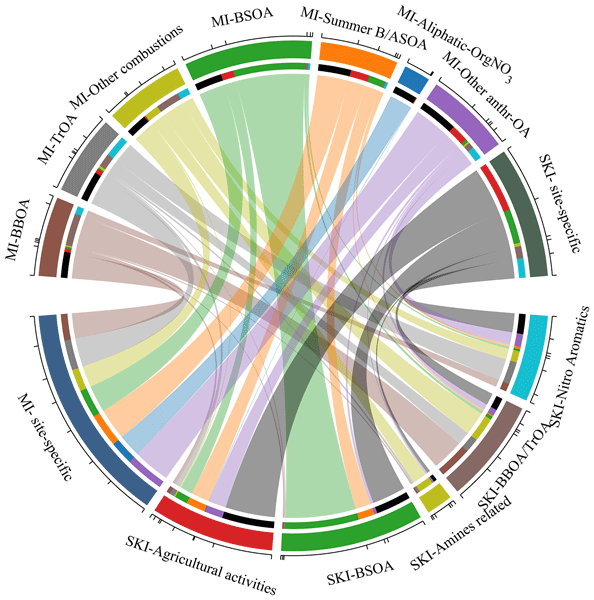
Abstract. The molecular composition of organic aerosol in the Po Valley remains largely unexplored, despite contributing approximately half of the fine aerosol mass. Molecularly-resolved analysis of the organic fraction is essential for understanding the sources and formation processes of organic aerosol in detail. Here, we investigated one year of PM2.5 filter samples from a rural agricultural and an urban environment. We used liquid chromatography and high-resolution mass spectrometry with subsequent non-target analysis of 250 samples. Time-series analysis allowed for the grouping of detected organic compounds using a clustering algorithm, enabling a tentative source attribution. The most populated clusters consist mainly of CHOand CHOS-containing compounds, attributed to oxidation products of biogenic emissions. They account 31 % and 26 % of the total intensity in the urban and agricultural sites, respectively, and peak during summer. Combustion-related clusters, enriched in nitrogen-containing compounds, contribute approximately 35 % of the total intensity at both sites. A fraction of these molecules are highly conjugated compounds that appear during winter as primary contributors to light-absorbing organic aerosol. Furthermore, we identified site-specific compound clusters, either at the urban or at the agricultural site. At the latter, we found pesticides strongly influence the overall molecular composition, peaking in May when PM2.5 concentration is at its lowest level. This suggests potential toxicological effects despite apparent good air quality conditions. Our results represent the first molecular-level characterization of organic aerosol in the Po Valley, emphasizing the need to assess its composition for a better understanding of its environmental and health impacts.
-
Notice on discussion status
The requested preprint has a corresponding peer-reviewed final revised paper. You are encouraged to refer to the final revised version.
-
Preprint
(6641 KB)
-
Supplement
(28526 KB)
-
The requested preprint has a corresponding peer-reviewed final revised paper. You are encouraged to refer to the final revised version.
- Preprint
(6641 KB) - Metadata XML
-
Supplement
(28526 KB) - BibTeX
- EndNote
- Final revised paper


Journal article(s) based on this preprint
Interactive discussion
Status: closed
-
RC1: 'Comment on egusphere-2025-5522', Anonymous Referee #1, 19 Jan 2026
The comment was uploaded in the form of a supplement: https://egusphere.copernicus.org/preprints/2025/egusphere-2025-5522/egusphere-2025-5522-RC1-supplement.pdfCitation: https://doi.org/
10.5194/egusphere-2025-5522-RC1 -
AC2: 'Reply on RC1', Luca D’Angelo, 05 Apr 2026
Dear Reviewer,
we would like to thank you for your comments and for giving us the opportunity to improve both our work and its presentation. Please find attached our detailed, point-by-point responses to your comments, along with indications of the lines where we have revised the manuscript.
-
AC2: 'Reply on RC1', Luca D’Angelo, 05 Apr 2026
-
RC2: 'Comment on egusphere-2025-5522', Anonymous Referee #2, 24 Feb 2026
The manuscript focuses on identifying the composition of organic aerosol at two sites in the Po Valley during 2021. The authors collected PM2.5 samples and analyzed them using ultra-high performance liquid chromatography paired with ultra-high resolution mass spectrometry and hierarchical clustering analysis. The study provides important insight into the differences in organic aerosol composition between a rural and an urban site over a year.
Overall the dataset and comparison between rural and urban sites in a hot spot for air pollution is important. However, the discussion has some inconsistencies with how results are discussed and could use more support in some places. The methods are also missing some information including the full method for ion chromatography.
L37-L39: This needs more description about the study referenced. What method did they use?
L64: “away” should replace “far”
L45-L70: The summary of previous studies in the region is good, but it feels like it is missing some context as to why this region is a hot spot for air pollution. Is it geographical? Or solely from large emissions?
L93: A map would be beneficial to show the relationship of the two sites to one another.
L99-105: Were the filters treated or baked before use? How were blanks collected and how often? These details are important and should be included.
L107: Please provide details or a reference for the IC method used.
L228-233: The discussion focuses heavily on CHN species, please expand on why that is and why other species are not discussed as in depth or at all.
L263-264: This sentence sounds as if the authors did not identify a second and third highest signal at SKI and instead are reporting what other studies found. The authors should clarify what their data shows.
L296-298: Please expand here. The author is discussing wintertime increases but offering summertime photochemical degradation as a possible reason.
L450-457: This section is confusing as written. The authors should clarify why they believe those fractions indicate tractor emissions.
L506: “unpolar” should be “nonpolar”
L528: Why were samples from June and December excluded? Did no samples meet the criteria? If so that seems worth a small discussion.
Citation: https://doi.org/10.5194/egusphere-2025-5522-RC2 -
AC1: 'Reply on RC2', Luca D’Angelo, 05 Apr 2026
Dear Reviewer,
we would like to thank you for your comments and for giving us the opportunity to improve both our work and its presentation. Please find attached our detailed, point-by-point responses to your comments, along with indications of the lines where we have revised the manuscript.
-
AC1: 'Reply on RC2', Luca D’Angelo, 05 Apr 2026
Peer review completion


Interactive discussion
Status: closed
-
RC1: 'Comment on egusphere-2025-5522', Anonymous Referee #1, 19 Jan 2026
The comment was uploaded in the form of a supplement: https://egusphere.copernicus.org/preprints/2025/egusphere-2025-5522/egusphere-2025-5522-RC1-supplement.pdf
-
AC2: 'Reply on RC1', Luca D’Angelo, 05 Apr 2026
Dear Reviewer,
we would like to thank you for your comments and for giving us the opportunity to improve both our work and its presentation. Please find attached our detailed, point-by-point responses to your comments, along with indications of the lines where we have revised the manuscript.
-
AC2: 'Reply on RC1', Luca D’Angelo, 05 Apr 2026
-
RC2: 'Comment on egusphere-2025-5522', Anonymous Referee #2, 24 Feb 2026
The manuscript focuses on identifying the composition of organic aerosol at two sites in the Po Valley during 2021. The authors collected PM2.5 samples and analyzed them using ultra-high performance liquid chromatography paired with ultra-high resolution mass spectrometry and hierarchical clustering analysis. The study provides important insight into the differences in organic aerosol composition between a rural and an urban site over a year.
Overall the dataset and comparison between rural and urban sites in a hot spot for air pollution is important. However, the discussion has some inconsistencies with how results are discussed and could use more support in some places. The methods are also missing some information including the full method for ion chromatography.
L37-L39: This needs more description about the study referenced. What method did they use?
L64: “away” should replace “far”
L45-L70: The summary of previous studies in the region is good, but it feels like it is missing some context as to why this region is a hot spot for air pollution. Is it geographical? Or solely from large emissions?
L93: A map would be beneficial to show the relationship of the two sites to one another.
L99-105: Were the filters treated or baked before use? How were blanks collected and how often? These details are important and should be included.
L107: Please provide details or a reference for the IC method used.
L228-233: The discussion focuses heavily on CHN species, please expand on why that is and why other species are not discussed as in depth or at all.
L263-264: This sentence sounds as if the authors did not identify a second and third highest signal at SKI and instead are reporting what other studies found. The authors should clarify what their data shows.
L296-298: Please expand here. The author is discussing wintertime increases but offering summertime photochemical degradation as a possible reason.
L450-457: This section is confusing as written. The authors should clarify why they believe those fractions indicate tractor emissions.
L506: “unpolar” should be “nonpolar”
L528: Why were samples from June and December excluded? Did no samples meet the criteria? If so that seems worth a small discussion.
Citation: https://doi.org/10.5194/egusphere-2025-5522-RC2 -
AC1: 'Reply on RC2', Luca D’Angelo, 05 Apr 2026
Dear Reviewer,
we would like to thank you for your comments and for giving us the opportunity to improve both our work and its presentation. Please find attached our detailed, point-by-point responses to your comments, along with indications of the lines where we have revised the manuscript.
-
AC1: 'Reply on RC2', Luca D’Angelo, 05 Apr 2026
Peer review completion
Journal article(s) based on this preprint
Data sets
Contrasting organic aerosol molecular composition between the urban and agricultural environment of the Po Valley Luca D'Angelo et al. https://doi.org/10.5281/zenodo.16311974
Viewed
| HTML | XML | Total | Supplement | BibTeX | EndNote | |
|---|---|---|---|---|---|---|
| 2,189 | 1,123 | 170 | 3,482 | 829 | 215 | 206 |
- HTML: 2,189
- PDF: 1,123
- XML: 170
- Total: 3,482
- Supplement: 829
- BibTeX: 215
- EndNote: 206
Viewed (geographical distribution)
| Country | # | Views | % |
|---|
| Total: | 0 |
| HTML: | 0 |
| PDF: | 0 |
| XML: | 0 |
- 1
Luca D'Angelo

Florian Ungeheuer
Jialiang Ma
Luca Ferrero
Cristina Colombi
Eleonora Cuccia
Umberto Dal Santo
Beatrice Biffi
Alexander L. Vogel
The requested preprint has a corresponding peer-reviewed final revised paper. You are encouraged to refer to the final revised version.
- Preprint
(6641 KB) - Metadata XML
-
Supplement
(28526 KB) - BibTeX
- EndNote
- Final revised paper