
the Creative Commons Attribution 4.0 License.
the Creative Commons Attribution 4.0 License.
 | 19 Nov 2025
Three-Dimensional Hollow Tubular Structure of Rocket Chemical Depletion
3.3 The evaluation of ELE Holewas changed to
3.3 The evaluation of the Electron Density Holeand
3.4 The structure of ELE Holeto
3.4 The structure of Electron Density Holebecause
ELEis not a standard abbreviation in the space physics community.
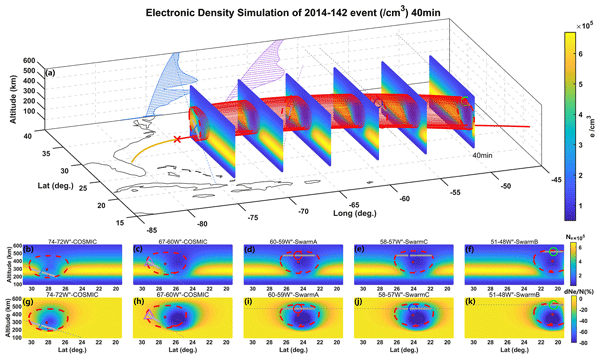
Abstract. The rocket launch process causes a series of disturbances in the ionosphere, among which a typical phenomenon is the formation of ionospheric electron density depletions caused by chemical reactions involving rocket exhaust, known as Rocket Exhausted Depletions (REDs). Current research on the REDs mainly focuses on the horizontal features observed from ground-based GNSS data. By utilizing COSMIC radio occultation data, we clearly observed the vertical structure of REDs following the launch of an ATLAS-V rocket from Cape Canaveral Air Force Station on May 22, 2014. Additionally, combining ground-based GNSS, Swarm satellite observations, and numerical simulations, we delineated, for the first time, the three-dimensional "hollow tube" structure of the REDs. Then, the spatiotemporal evolution of the REDs is analyzed, and considered to mainly consist of three stages: "rapid formation, diffusion-driven growth, and diffusion-driven recovery". The study contributes to a deeper understanding of the formation and development of artificial ionospheric plasma bubbles.
-
Notice on discussion status
The requested preprint has a corresponding peer-reviewed final revised paper. You are encouraged to refer to the final revised version.
-
Preprint
(2405 KB)
-
Supplement
(91666 KB)
-
The requested preprint has a corresponding peer-reviewed final revised paper. You are encouraged to refer to the final revised version.
- Preprint
(2405 KB) - Metadata XML
-
Supplement
(91666 KB) - BibTeX
- EndNote
- Final revised paper


Journal article(s) based on this preprint
3.3 The evaluation of ELE Holewas changed to
3.3 The evaluation of the Electron Density Holeand
3.4 The structure of ELE Holeto
3.4 The structure of Electron Density Holebecause
ELEis not a standard abbreviation in the space physics community.
Interactive discussion
Status: closed
-
RC1: 'Comment on egusphere-2025-5515', Paul Bernhardt, 19 Nov 2025
The comment was uploaded in the form of a supplement: https://egusphere.copernicus.org/preprints/2025/egusphere-2025-5515/egusphere-2025-5515-RC1-supplement.pdfCitation: https://doi.org/
10.5194/egusphere-2025-5515-RC1 -
AC1: 'Reply on RC1', Deng Chunyu, 20 Nov 2025
We sincerely appreciate and are honored to receive your insightful comments, which have significantly improved the quality and clarity of our manuscript. We have diligently addressed all the raised concerns and our detailed responses are presented as follows:
- (0) Line 23: The term “Rocket Exhausted Depletions (REDs)” is awkward and ambiguous. A better term would be “Holes in the Ionosphere from Rocket Exhaust (HIREs)”
Response:We agree that the term “Rocket Exhausted Depletions (REDs)” is awkward and ambiguous. Accordingly, we have replaced it throughout the manuscript with the clearer and more descriptive term “Holes in the Ionosphere from Rocket Exhaust (HIREs).”
- (1) Line 32: The statement “The study contributes to a deeper understanding of the formation and development of artificial ionospheric plasma bubbles.” is misleading. The word bubbles refers to equatorial structures that rise in altitude. The plasma depletions produce by rocket exhaust do not “bubble” up but just stay at a fixed altitude. Please replace “bubbles” by “hollow-tubes”.
Response: We appreciate this important clarification. To avoid confusion between the term “bubbles” and equatorial plasma bubbles, and to better reflect the structures observed in this study, we have replaced “bubbles” with “hollow-tubes” in the revised manuscript.
- (2) Line 57 has “Bernhardt et al., 1961, 2001”. Bernhardt was not writing papers in 1961. Please use the correct date and that check this paper is in the references.
Response: We sincerely apologize for the citation error. The reference to 1961 was mistakenly attributed to Bernhardt; the correct 1961 reference is Booker and is already cited elsewhere in the manuscript. We have corrected “Bernhardt et al., 1961, 2001” to “Bernhardt et al., 2001” in Line 57. During this revision, we also rechecked the references and corrected the other inconsistency.
- (3) Line 413 has “This study first utilizes COSMIC-1 occultation data to resolve the vertical structure of REDs, integrates Swarm and GNSS-TEC observations, and reconstructs its 3D hollow-tube morphology.” should be replaced with “This is the first study that utilizes COSMIC-1 occultation data to resolve the vertical structure of REDs, integrates Swarm and GNSS-TEC observations, and reconstructs its 3D hollowtube morphology.”
Response: Thank you for helping us improve the clarity of our wording. The sentence in Line 413 has been revised as suggested:“This is the first study that utilizes COSMIC-1 occultation data to resolve the vertical structure of HIREs, integrates Swa rm and GNSS-TEC observations, and reconstructs their 3D hollow-tube morphology.”
Once again, we sincerely thank the reviewer for the careful reading and constructive feedback.
-
AC1: 'Reply on RC1', Deng Chunyu, 20 Nov 2025
-
RC2: 'Comment on egusphere-2025-5515', Anonymous Referee #2, 19 Feb 2026
Comments
This paper compares the GNSS observations (both ground-based zenith TEC and radio occultation observations) to the numerical simulation of the rocket exhaust depletion (RED). RED has become an important issue given that there are almost rocket launches on daily basis in the modern era. The authors perform the observation and simulation on a specific event and their observations show clear RED effect in the ionosphere electron density. Their simulations also show very nice 3-D structure of the RED effects in the ionosphere with the clear depleted plasma structure. The literature review given by the authors is also comprehensive. Although the presented results look good as well as the literature review. There are some places require further improvements. Literature review is generally good but some important aspects were overlooked. For example, 3-D structure were previous given by Park et al. (2022) but the authors did not mention it well making a wrong impression that this study is the first one to give 3-D structure of RED, which is not true. Secondly, simulation works similar to this study were carried out by Furuya and Heki (2008) but was not well mentioned and discussed with the simulations done in this study. I think all these aspects need to be addressed seriously for evaluation of whether this study is warranted for publication. I put the specific comments as follows.
1. Lines 85-89, authors state that “Park et al. (2022) also utilized the GOLD imager, Madrigal TEC, and multiple Low-Earth-Orbit satellites, with COSMIC-2 data revealing an increase in ionospheric slab thickness at the depletion center, indirectly supporting vertical structure analysis. However, the 3D structure of rocket-exhausted electron density depletion remains unclear.” Also, in Lines 111-112, it is stated “The gridded data products derived from COSMIC occultation observations have been used in rocket‐induced depletion (RED) studies (Park et al., 2022).”
I think the authors miss out what the COSMIC-2 data were utilized in Park et al. (2022). It was the data assimilation data product of COSMIC-2, which has 3-D structure of the ionosphere. As Park et al. (2022) did provide altitudinal variations of REDs for their event, it is not for the first time the authors provide the 3-D results. In fact the Abel inversion of the electron density profile provided by the standard data output of COSMIC might be errouneous at lower altitudes (lower than ~250 km altitudes) due to its assumptions of spherical symmetry over a wide area of ionosphere (Yue et al., 2010; Liu et al., 2010). The RED generation of the density depltion on the other hand is an asymmetry density structure and therefore the actual depth/strength of the RED might not be precised using Abel inversion of the radio occultation observations. This altitude is also roughly similar to that the authors reported, so some cautious or discussion is also necessary.
Ref.
Yue, X., Schreiner, W. S., Lei, J., Sokolovskiy, S. V., Rocken, C., Hunt, D. C., and Kuo, Y.-H.: Error analysis of Abel retrieved electron density profiles from radio occultation measurements, Ann. Geophys., 28, 217–222, https://doi.org/10.5194/angeo-28-217-2010, 2010.
Liu, J. Y., C. Y. Lin, C. H. Lin, H. F. Tsai, S. C. Solomon, Y. Y. Sun, I. T. Lee, W. S. Schreiner, and Y. H. Kuo(2010), Artificial plasma cave in the low-latitude ionosphere results from the radio occultation inversion of the FORMOSAT-3/COSMIC, J. Geophys. Res., 115, A07319, doi:10.1029/2009JA015079.
2. Lines 115-116, the authors claimed that “A detailed assessment of the feasibility and reliability of COSMIC occultation data can be found in Yan et al. (2022). In this study, we utilize the electron density and total electron content (TEC).” I assume they refer to this one from their Reference list.
Yan, X., Yu, T., and Xia, C.: Limb Sounders Tracking Tsunami-Induced Perturbations from the Stratosphere to the Ionosphere. Remote Sensing, 14(21), 5543. https://doi.org/10.3390/rs14215543, 2022.
However, this one is clearly not for validation of COSMIC radio occultation, two more suitable references validating COSMIC-1 and COSMIC-2 are provided as follows.
For COSMIC-1:
Lei, J., et al. (2007), Comparison of COSMIC ionospheric measurements with ground-based observations and model predictions: Preliminary results, J. Geophys. Res., 112, A07308, doi:10.1029/2006JA012240.
COSMIC-2:
Lin, C.-Y., Lin, C. C.-H., Liu, J.-Y., Rajesh, P. K., Matsuo, T., Chou, M.-Y., et al. (2020). The early results and validation of FORMOSAT-7/COSMIC-2 space weather products: Global ionospheric specification and Ne-aided Abel electron density profile. Journal of Geophysical Research: Space Physics, 125, e2020JA028028. https://doi.org/10.1029/2020JA028028
3. In the comparison of the simulations and the observed RED, the discrepancy between observation and simulation was attributed to the background ionosphere applied in the simulation, which is from IRI. It is well understood that IRI output would not match to realistic ionosphere. But a good comparison can be made by percentage of the depletion. Also, the assumption of the H2O diffusion shall be different from reality. I think a better comparison shall be made by the authors by performing various simulation task to find out what the most suitable diffusion parameter might be for the density depletion to better agree with the observation. In this way, the authors or the readers could know how far off the assumption of diffusion given by Bernhardt (1976) to the reality. In the current version, simply compare the simulation with observation and give hypothesis to the discrepancy is actually not very helpful to better understandings of the underlying physics.
4. Furuya and Heki (2008) did perform similar simulation and compare their results to observations of GNSS-TEC. Any new insights from this study on top of Furuya and Heki (2008)? The authors may state the differences between the then study to this latest one to better describe the novelty of this study. Maybe the modeling is more comprehensive in this study? Maybe the electrodynamics is included in this study? What is the advantage of this study to the one published in 2008?
Citation: https://doi.org/10.5194/egusphere-2025-5515-RC2 -
AC2: 'Reply on RC2', Deng Chunyu, 26 Mar 2026
The comment was uploaded in the form of a supplement: https://egusphere.copernicus.org/preprints/2025/egusphere-2025-5515/egusphere-2025-5515-AC2-supplement.pdf
-
AC3: 'Reply on RC2', Deng Chunyu, 26 Mar 2026
The comment was uploaded in the form of a supplement: https://egusphere.copernicus.org/preprints/2025/egusphere-2025-5515/egusphere-2025-5515-AC3-supplement.pdf
-
AC2: 'Reply on RC2', Deng Chunyu, 26 Mar 2026


Interactive discussion
Status: closed
-
RC1: 'Comment on egusphere-2025-5515', Paul Bernhardt, 19 Nov 2025
The comment was uploaded in the form of a supplement: https://egusphere.copernicus.org/preprints/2025/egusphere-2025-5515/egusphere-2025-5515-RC1-supplement.pdf
-
AC1: 'Reply on RC1', Deng Chunyu, 20 Nov 2025
We sincerely appreciate and are honored to receive your insightful comments, which have significantly improved the quality and clarity of our manuscript. We have diligently addressed all the raised concerns and our detailed responses are presented as follows:
- (0) Line 23: The term “Rocket Exhausted Depletions (REDs)” is awkward and ambiguous. A better term would be “Holes in the Ionosphere from Rocket Exhaust (HIREs)”
Response:We agree that the term “Rocket Exhausted Depletions (REDs)” is awkward and ambiguous. Accordingly, we have replaced it throughout the manuscript with the clearer and more descriptive term “Holes in the Ionosphere from Rocket Exhaust (HIREs).”
- (1) Line 32: The statement “The study contributes to a deeper understanding of the formation and development of artificial ionospheric plasma bubbles.” is misleading. The word bubbles refers to equatorial structures that rise in altitude. The plasma depletions produce by rocket exhaust do not “bubble” up but just stay at a fixed altitude. Please replace “bubbles” by “hollow-tubes”.
Response: We appreciate this important clarification. To avoid confusion between the term “bubbles” and equatorial plasma bubbles, and to better reflect the structures observed in this study, we have replaced “bubbles” with “hollow-tubes” in the revised manuscript.
- (2) Line 57 has “Bernhardt et al., 1961, 2001”. Bernhardt was not writing papers in 1961. Please use the correct date and that check this paper is in the references.
Response: We sincerely apologize for the citation error. The reference to 1961 was mistakenly attributed to Bernhardt; the correct 1961 reference is Booker and is already cited elsewhere in the manuscript. We have corrected “Bernhardt et al., 1961, 2001” to “Bernhardt et al., 2001” in Line 57. During this revision, we also rechecked the references and corrected the other inconsistency.
- (3) Line 413 has “This study first utilizes COSMIC-1 occultation data to resolve the vertical structure of REDs, integrates Swarm and GNSS-TEC observations, and reconstructs its 3D hollow-tube morphology.” should be replaced with “This is the first study that utilizes COSMIC-1 occultation data to resolve the vertical structure of REDs, integrates Swarm and GNSS-TEC observations, and reconstructs its 3D hollowtube morphology.”
Response: Thank you for helping us improve the clarity of our wording. The sentence in Line 413 has been revised as suggested:“This is the first study that utilizes COSMIC-1 occultation data to resolve the vertical structure of HIREs, integrates Swa rm and GNSS-TEC observations, and reconstructs their 3D hollow-tube morphology.”
Once again, we sincerely thank the reviewer for the careful reading and constructive feedback.
-
AC1: 'Reply on RC1', Deng Chunyu, 20 Nov 2025
-
RC2: 'Comment on egusphere-2025-5515', Anonymous Referee #2, 19 Feb 2026
Comments
This paper compares the GNSS observations (both ground-based zenith TEC and radio occultation observations) to the numerical simulation of the rocket exhaust depletion (RED). RED has become an important issue given that there are almost rocket launches on daily basis in the modern era. The authors perform the observation and simulation on a specific event and their observations show clear RED effect in the ionosphere electron density. Their simulations also show very nice 3-D structure of the RED effects in the ionosphere with the clear depleted plasma structure. The literature review given by the authors is also comprehensive. Although the presented results look good as well as the literature review. There are some places require further improvements. Literature review is generally good but some important aspects were overlooked. For example, 3-D structure were previous given by Park et al. (2022) but the authors did not mention it well making a wrong impression that this study is the first one to give 3-D structure of RED, which is not true. Secondly, simulation works similar to this study were carried out by Furuya and Heki (2008) but was not well mentioned and discussed with the simulations done in this study. I think all these aspects need to be addressed seriously for evaluation of whether this study is warranted for publication. I put the specific comments as follows.
1. Lines 85-89, authors state that “Park et al. (2022) also utilized the GOLD imager, Madrigal TEC, and multiple Low-Earth-Orbit satellites, with COSMIC-2 data revealing an increase in ionospheric slab thickness at the depletion center, indirectly supporting vertical structure analysis. However, the 3D structure of rocket-exhausted electron density depletion remains unclear.” Also, in Lines 111-112, it is stated “The gridded data products derived from COSMIC occultation observations have been used in rocket‐induced depletion (RED) studies (Park et al., 2022).”
I think the authors miss out what the COSMIC-2 data were utilized in Park et al. (2022). It was the data assimilation data product of COSMIC-2, which has 3-D structure of the ionosphere. As Park et al. (2022) did provide altitudinal variations of REDs for their event, it is not for the first time the authors provide the 3-D results. In fact the Abel inversion of the electron density profile provided by the standard data output of COSMIC might be errouneous at lower altitudes (lower than ~250 km altitudes) due to its assumptions of spherical symmetry over a wide area of ionosphere (Yue et al., 2010; Liu et al., 2010). The RED generation of the density depltion on the other hand is an asymmetry density structure and therefore the actual depth/strength of the RED might not be precised using Abel inversion of the radio occultation observations. This altitude is also roughly similar to that the authors reported, so some cautious or discussion is also necessary.
Ref.
Yue, X., Schreiner, W. S., Lei, J., Sokolovskiy, S. V., Rocken, C., Hunt, D. C., and Kuo, Y.-H.: Error analysis of Abel retrieved electron density profiles from radio occultation measurements, Ann. Geophys., 28, 217–222, https://doi.org/10.5194/angeo-28-217-2010, 2010.
Liu, J. Y., C. Y. Lin, C. H. Lin, H. F. Tsai, S. C. Solomon, Y. Y. Sun, I. T. Lee, W. S. Schreiner, and Y. H. Kuo(2010), Artificial plasma cave in the low-latitude ionosphere results from the radio occultation inversion of the FORMOSAT-3/COSMIC, J. Geophys. Res., 115, A07319, doi:10.1029/2009JA015079.
2. Lines 115-116, the authors claimed that “A detailed assessment of the feasibility and reliability of COSMIC occultation data can be found in Yan et al. (2022). In this study, we utilize the electron density and total electron content (TEC).” I assume they refer to this one from their Reference list.
Yan, X., Yu, T., and Xia, C.: Limb Sounders Tracking Tsunami-Induced Perturbations from the Stratosphere to the Ionosphere. Remote Sensing, 14(21), 5543. https://doi.org/10.3390/rs14215543, 2022.
However, this one is clearly not for validation of COSMIC radio occultation, two more suitable references validating COSMIC-1 and COSMIC-2 are provided as follows.
For COSMIC-1:
Lei, J., et al. (2007), Comparison of COSMIC ionospheric measurements with ground-based observations and model predictions: Preliminary results, J. Geophys. Res., 112, A07308, doi:10.1029/2006JA012240.
COSMIC-2:
Lin, C.-Y., Lin, C. C.-H., Liu, J.-Y., Rajesh, P. K., Matsuo, T., Chou, M.-Y., et al. (2020). The early results and validation of FORMOSAT-7/COSMIC-2 space weather products: Global ionospheric specification and Ne-aided Abel electron density profile. Journal of Geophysical Research: Space Physics, 125, e2020JA028028. https://doi.org/10.1029/2020JA028028
3. In the comparison of the simulations and the observed RED, the discrepancy between observation and simulation was attributed to the background ionosphere applied in the simulation, which is from IRI. It is well understood that IRI output would not match to realistic ionosphere. But a good comparison can be made by percentage of the depletion. Also, the assumption of the H2O diffusion shall be different from reality. I think a better comparison shall be made by the authors by performing various simulation task to find out what the most suitable diffusion parameter might be for the density depletion to better agree with the observation. In this way, the authors or the readers could know how far off the assumption of diffusion given by Bernhardt (1976) to the reality. In the current version, simply compare the simulation with observation and give hypothesis to the discrepancy is actually not very helpful to better understandings of the underlying physics.
4. Furuya and Heki (2008) did perform similar simulation and compare their results to observations of GNSS-TEC. Any new insights from this study on top of Furuya and Heki (2008)? The authors may state the differences between the then study to this latest one to better describe the novelty of this study. Maybe the modeling is more comprehensive in this study? Maybe the electrodynamics is included in this study? What is the advantage of this study to the one published in 2008?
Citation: https://doi.org/10.5194/egusphere-2025-5515-RC2 -
AC2: 'Reply on RC2', Deng Chunyu, 26 Mar 2026
The comment was uploaded in the form of a supplement: https://egusphere.copernicus.org/preprints/2025/egusphere-2025-5515/egusphere-2025-5515-AC2-supplement.pdf
-
AC3: 'Reply on RC2', Deng Chunyu, 26 Mar 2026
The comment was uploaded in the form of a supplement: https://egusphere.copernicus.org/preprints/2025/egusphere-2025-5515/egusphere-2025-5515-AC3-supplement.pdf
-
AC2: 'Reply on RC2', Deng Chunyu, 26 Mar 2026
Peer review completion


Journal article(s) based on this preprint
3.3 The evaluation of ELE Holewas changed to
3.3 The evaluation of the Electron Density Holeand
3.4 The structure of ELE Holeto
3.4 The structure of Electron Density Holebecause
ELEis not a standard abbreviation in the space physics community.
3.3 The evaluation of ELE Holewas changed to
3.3 The evaluation of the Electron Density Holeand
3.4 The structure of ELE Holeto
3.4 The structure of Electron Density Holebecause
ELEis not a standard abbreviation in the space physics community.
Viewed
| HTML | XML | Total | Supplement | BibTeX | EndNote | |
|---|---|---|---|---|---|---|
| 831 | 510 | 85 | 1,426 | 232 | 63 | 62 |
- HTML: 831
- PDF: 510
- XML: 85
- Total: 1,426
- Supplement: 232
- BibTeX: 63
- EndNote: 62
Viewed (geographical distribution)
| Country | # | Views | % |
|---|
| Total: | 0 |
| HTML: | 0 |
| PDF: | 0 |
| XML: | 0 |
- 1
Сhunyu Deng
Хiangxiang Yan
Tao Yu
Chunliang Xia
Yifan Qi
The requested preprint has a corresponding peer-reviewed final revised paper. You are encouraged to refer to the final revised version.
- Preprint
(2405 KB) - Metadata XML
-
Supplement
(91666 KB) - BibTeX
- EndNote
- Final revised paper