
the Creative Commons Attribution 4.0 License.
the Creative Commons Attribution 4.0 License.
 | 21 Nov 2025
The potential of green infrastructure in urban pluvial flood mitigation – a scenario-based modelling study in Berlin
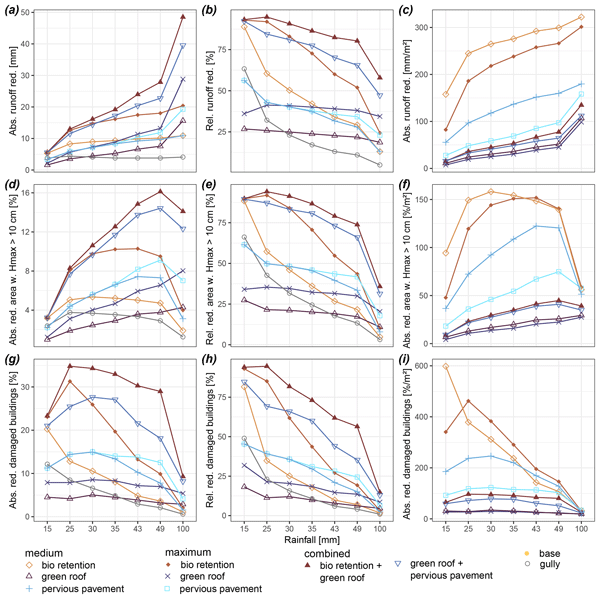
Abstract. Urban surface sealing limits infiltration and thus increases the formation of runoff during heavy rain events. Green infrastructure (GI) measures can be used to reduce urban flood risk by promoting decentralized infiltration, water storage and evapotranspiration. With a scenario-based modelling study, we investigate the impact of green infrastructure on urban runoff formation, flood water depths and the resulting damage to buildings; comparing it with the impact of the conventional drainage system. The study area is located in the city of Berlin, in a heavily sealed 3.3 km² urban catchment. Design rain storms with a duration of one hour and totals between 15 and 100 mm are considered. The green infrastructure scenarios include different spatial extents and combinations of bioretention systems, green roofs and pervious pavement. The Storm Water Management Model is used for the urban runoff generation and the 2D-hydrodynamic module of TELEMAC for surface runoff concentration. Building damage is modelled with the Flood Damage Estimation Tool, a recursive partitioning tool developed with survey data representative of building damage caused by pluvial floods. Flood mitigation is investigated regarding absolute and relative reduction and also space efficiency of the GI types. Relative flood mitigation reduces at all modelling steps with increasing rain totals. In contrast, absolute runoff reduction increases with increasing rain totals while the area with maximum water level > 10 cm decreases the most at the 49 mm event and building damage reduces most at 25–30 mm. Bioretention systems achieve the highest spatial efficiency, however, green roofs and pervious pavements do not impede the former land use.
-
Notice on discussion status
The requested preprint has a corresponding peer-reviewed final revised paper. You are encouraged to refer to the final revised version.
-
Preprint
(24942 KB)
-
The requested preprint has a corresponding peer-reviewed final revised paper. You are encouraged to refer to the final revised version.
- Preprint
(24942 KB) - Metadata XML
- BibTeX
- EndNote
- Final revised paper


Journal article(s) based on this preprint
Interactive discussion
Status: closed
-
RC1: 'Comment on egusphere-2025-5466', Anonymous Referee #1, 04 Jan 2026
- AC1: 'Reply on RC1', Sophia Dobkowitz, 30 Mar 2026
-
AC3: 'Reply on RC1', Sophia Dobkowitz, 30 Mar 2026
Publisher’s note: the content of this comment was removed on 1 April 2026 since the comment was posted by mistake.
Citation: https://doi.org/10.5194/egusphere-2025-5466-AC3
-
RC2: 'Comment on egusphere-2025-5466', Anonymous Referee #2, 02 Mar 2026
General comments
The paper is very well structured and has a very clear outline, which makes it easy to read and understand. The topic is highly relevant, as many municipalities are currently looking into the use of BGI and rainwater management as part of their adaptation to climate change and need to know the effects and impacts of such systems for planning purposes.
The author's own work is presented and evaluated in a balanced and neutral manner. The comparison with other publications is also successful, although the different methodologies are not always discussed in detail.
To further improve reading comprehension, the following points should be addressed in more detail:
- The methodological approach of working with different open source models (model chain) leads to inaccuracies in the model interfaces. How sensitive to results are these model interfaces, even if they represent a global boundary condition of the relative comparison?
- Simply taking into account the drainage contribution of the sewer system by reducing the effective precipitation is quite inaccurate. This also fails to take into account overflow effects from the sewer system to the surface. Since this cannot be quantified, it would be helpful at least to be discussed in greater detail.
Specific comments
- P1, L3 (abstract): Flood risks cannot be reduced by the influence of evapotranspiration from BGI, as correctly stated on p8, L163 (contradiction)
- P3, L59: Neumann et al. 2024 do not describe the overflow frequencies of the CSO.
- P7, L125: Citation of EN 752-2 by Sieker & Neidhart is not necessary (secondary reference)
- P7, L137: GR Soil layer > 1m is the exeption/very rare, not common.
- P8, L173: Depression storage of roads as a contribution to the sewer network (“gully absorption”) is very inaccurate (see above). How high are the contributions in each case (please supplement Appendix A if necessary)?
- P9, table 3: the berm height (surface layer) defines how quickly the BGI overflows and thus has a decisive effect on flood mitigation. Were any other values for berm height examined? It would be good to describe the sensitivity of this important parameter.
- P10, L203ff: The building damage model is only briefly described with reference to Thieken et al. 2005. However, due to the complex boundary conditions, it can be assumed that it is subject to considerable uncertainty despite extensive modeling. This should be emphasized more clearly, even if the focus is on the relative comparison of the results. Important individual aspects that are not adequately considered are e.g. the lack of cadastral information on basements.
- P11, L209, L232: In addition to water depth and flow velocity, the duration of exposure also has a major impact. The models and hazard maps only show the maximum amplitude of the flood. This is inaccurate for damage assessments.
- P17, table 4: The comparison with other studies is good and valuable. The other studies are cited and described only with a brief comment. However, where possible, it should be explained in more detail how the model boundary conditions differed in the other case studies in order to evaluate the deviations in the results more clearly.
- P21-23, Appendix A, table A1: How are the building damage categories (“low” - “very high”) quantified and categorized? Are they corresponding to the max. water level?
Citation: https://doi.org/10.5194/egusphere-2025-5466-RC2 - AC2: 'Reply on RC2', Sophia Dobkowitz, 30 Mar 2026


Interactive discussion
Status: closed
-
RC1: 'Comment on egusphere-2025-5466', Anonymous Referee #1, 04 Jan 2026
General comments:
The manuscript is very well-structured, clearly written, and addresses a highly relevant topic, namely the assessment of the effectiveness of different green infrastructure scenarios for reducing urban flooding during heavy rainfall events. Compared to other studies conducted in similar urban settings, the explicit estimation of flood damage across different scenarios is particularly interesting and valuable. The following aspects could be explained and/or discussed in more detail in order to improve overall clarity and to enable a better assessment of the plausibility of the results.
- Different levels of detail in the modelling of individual processes
The manuscript uses a detailed, multi-layered, process-based representation of green infrastructure in the SWMM hydrological model, while surface runoff is introduced into the 2D hydrodynamic model via spatially aggregated inflow points rather than distributed precipitation and infiltration. The authors are invited to briefly discuss this trade-off between process complexity and spatial abstraction and to explain why the chosen level of detail of the green infrastructure is appropriate in general, but also in particular given the simplified representation of surface runoff in the 2D model.
- Justification of different infiltration approaches
Green infrastructure elements are modelled using, among other approaches, the Green–Ampt infiltration model, whereas infiltration from permeable surfaces is represented using the Curve Number method. The authors are encouraged to briefly explain the rationale for applying different levels of process representation within the same hydrological model and to comment on the implications of this choice.
- Spatial aggregation and presentation of spatial results
- An illustrative figure showing the delineation of subcatchments and the locations of their outflows (corresponding to inflow locations in the 2D hydrodynamic model) would help to better understand the spatial representation within the modelling chain. In addition, an example illustrating the variability of runoff hydrographs among different subcatchments would be informative.
- The final results are derived from spatially explicit information (e.g. water depths, affected buildings, and the area exceeding certain water depth thresholds). However, no spatial results such as inundation extent or water depth maps are presented. Including at least one representative map is recommended to support the interpretation and plausibility of the spatial results and to facilitate understanding of the aggregated indicators (see also the specific comment on Figure 3).
Specific comments:
- 4, l. 94-96: Where are the locations of the inflow hydrographs in the 2D model?
- 5, l. 113: Please briefly specify what is meant with “simplified hydraulic methodology”
- 7, l. 126: Please indicate which duration for the 5-year precipitation event was chosen.
- 7, l. 127: Does this mean, a capacity of 16 mm every 15 minutes (i.e. 1.07 mm/min) or only during the first 15 minutes?
- 7, l. 142: BR on 10% of the area subtracted by the area covered by buildings: Has this been distributed over all residential subcatchments only or also road subcatchments?
- 7, l. 151: “we deduced the soil hydraulic parameters from this soil type”: Please give the source from which the parameter values have been taken.
- 8, Table 2: Are all GI scenarios without gullies?
- 8, l. 162: A map that shows the subcatchments (and outlet points, i.e. inflow locations for 2D model) would be helpful.
- 164: Did topography also play a role in subcatchment delineation?
- 167: “residential subcatchments as pervious except area covered by buildings”: Is this rather an overestimation of perviousness?
- 168: Is the SCS-CN method suitable here? Detailed multi-layer GI representation incl. Green-Ampt vs. simplified runoff generation using SCS-CN method for other areas; why was this combination chosen? Why not using Green-Ampt also for infiltration from pervious surfaces? (see also general comment 2).
- 9, Table 3: Please briefly explain the surface slope for BR and GR was set to1. The values for conductivity slope and conductivity are the same, please briefly explain what that physically means.
- 10, l. 184-185: Do the output hydrographs strongly differ between the subcatchments? As suggested already before, it would be good to show the inflow locations in the 2D hydrodynamic model. (Furthermore, “point source” sounds more like a pollution source; possibly “inflow hydrograph” or “inflow boundary condition” would be more suitable?)
- 207: “calibration performed well”: Please clarify if the calibration has been carried out particularly for this study area or if a more general calibration has been carried out in advance and for another study area. Please explain briefly what “relative building damage” (corresponding to the given RMSE values) mean.
- 11, l. 209, 210: “In the application the model needs the maximum water depth and velocity from the hydraulic model (from which flood intensity is derived”: Maximum water depth and maximum flow velocity do not necessarily occur at the same time, how is the flood intensity defined?
- 11, l. 232 ff: Flow velocities were not used for the damage calculation in this study, but are indicated in the flow chart in Figure 1 - this is a bit misleading; do the authors assume no effect of the flow velocity at all for this study area? What are critical thresholds of flow velocities having an impact and which (maximum) flow velocities occur in the scenarios?
- 13, Figure 3: The results indicate that, in medium scenarios, PP reduces total runoff less than BR but leads to greater reductions in flooded area and damaged buildings. Since only runoff from the hydrological model is used as input to the hydrodynamic model, this discrepancy may be due to the spatial variability of inflow hydrographs from different subcatchments. An illustrative figure showing this spatial variability would help to clarify and interpret these effects.
- 16, l. 294-295: I assume a realization on streets is more challenging, and since Knoche et al. indicated only 4.5% on streets, the PP max scenario might be very ambitious.
- 19, l . 374ff: The discrepancy between reductions in total flood volume (from other studies) and in the percentage of area exceeding a water depth of 10 cm could be attributed to strong reductions at localized hotspots with very high water depths, which have a disproportionate influence on total flood volume compared to area-based indicators using a fixed depth threshold.
- 19, l. 381: The run time of 1D drainage models is usually relatively small compared to that of 2D models, so the overall runtime is not necessarily much higher. However, the effort required for model setup can be considerably higher, particularly if no drainage model exists in advance that can be coupled to the 2D model.
- 21, Appendix A: Please clarify how the building damage categories (“low” to “very high”) are defined and how they correspond to hydraulic variables such as maximum water depth.
Citation: https://doi.org/10.5194/egusphere-2025-5466-RC1 - AC1: 'Reply on RC1', Sophia Dobkowitz, 30 Mar 2026
-
AC3: 'Reply on RC1', Sophia Dobkowitz, 30 Mar 2026
Publisher’s note: the content of this comment was removed on 1 April 2026 since the comment was posted by mistake.
Citation: https://doi.org/10.5194/egusphere-2025-5466-AC3
-
RC2: 'Comment on egusphere-2025-5466', Anonymous Referee #2, 02 Mar 2026
General comments
The paper is very well structured and has a very clear outline, which makes it easy to read and understand. The topic is highly relevant, as many municipalities are currently looking into the use of BGI and rainwater management as part of their adaptation to climate change and need to know the effects and impacts of such systems for planning purposes.
The author's own work is presented and evaluated in a balanced and neutral manner. The comparison with other publications is also successful, although the different methodologies are not always discussed in detail.
To further improve reading comprehension, the following points should be addressed in more detail:
- The methodological approach of working with different open source models (model chain) leads to inaccuracies in the model interfaces. How sensitive to results are these model interfaces, even if they represent a global boundary condition of the relative comparison?
- Simply taking into account the drainage contribution of the sewer system by reducing the effective precipitation is quite inaccurate. This also fails to take into account overflow effects from the sewer system to the surface. Since this cannot be quantified, it would be helpful at least to be discussed in greater detail.
Specific comments
- P1, L3 (abstract): Flood risks cannot be reduced by the influence of evapotranspiration from BGI, as correctly stated on p8, L163 (contradiction)
- P3, L59: Neumann et al. 2024 do not describe the overflow frequencies of the CSO.
- P7, L125: Citation of EN 752-2 by Sieker & Neidhart is not necessary (secondary reference)
- P7, L137: GR Soil layer > 1m is the exeption/very rare, not common.
- P8, L173: Depression storage of roads as a contribution to the sewer network (“gully absorption”) is very inaccurate (see above). How high are the contributions in each case (please supplement Appendix A if necessary)?
- P9, table 3: the berm height (surface layer) defines how quickly the BGI overflows and thus has a decisive effect on flood mitigation. Were any other values for berm height examined? It would be good to describe the sensitivity of this important parameter.
- P10, L203ff: The building damage model is only briefly described with reference to Thieken et al. 2005. However, due to the complex boundary conditions, it can be assumed that it is subject to considerable uncertainty despite extensive modeling. This should be emphasized more clearly, even if the focus is on the relative comparison of the results. Important individual aspects that are not adequately considered are e.g. the lack of cadastral information on basements.
- P11, L209, L232: In addition to water depth and flow velocity, the duration of exposure also has a major impact. The models and hazard maps only show the maximum amplitude of the flood. This is inaccurate for damage assessments.
- P17, table 4: The comparison with other studies is good and valuable. The other studies are cited and described only with a brief comment. However, where possible, it should be explained in more detail how the model boundary conditions differed in the other case studies in order to evaluate the deviations in the results more clearly.
- P21-23, Appendix A, table A1: How are the building damage categories (“low” - “very high”) quantified and categorized? Are they corresponding to the max. water level?
Citation: https://doi.org/10.5194/egusphere-2025-5466-RC2 - AC2: 'Reply on RC2', Sophia Dobkowitz, 30 Mar 2026
Peer review completion


Journal article(s) based on this preprint
Viewed
| HTML | XML | Total | BibTeX | EndNote | |
|---|---|---|---|---|---|
| 2,521 | 1,908 | 162 | 4,591 | 1,359 | 1,176 |
- HTML: 2,521
- PDF: 1,908
- XML: 162
- Total: 4,591
- BibTeX: 1,359
- EndNote: 1,176
Viewed (geographical distribution)
| Country | # | Views | % |
|---|
| Total: | 0 |
| HTML: | 0 |
| PDF: | 0 |
| XML: | 0 |
- 1
Sophia Dobkowitz
Leon Frederik De Vos
Deva Charan Jarajapu
Sarah Lindenlaub
Guilherme Samprogna Mohor
Omar Seleem
Axel Bronstert
The requested preprint has a corresponding peer-reviewed final revised paper. You are encouraged to refer to the final revised version.
- Preprint
(24942 KB) - Metadata XML
General comments:
The manuscript is very well-structured, clearly written, and addresses a highly relevant topic, namely the assessment of the effectiveness of different green infrastructure scenarios for reducing urban flooding during heavy rainfall events. Compared to other studies conducted in similar urban settings, the explicit estimation of flood damage across different scenarios is particularly interesting and valuable. The following aspects could be explained and/or discussed in more detail in order to improve overall clarity and to enable a better assessment of the plausibility of the results.
The manuscript uses a detailed, multi-layered, process-based representation of green infrastructure in the SWMM hydrological model, while surface runoff is introduced into the 2D hydrodynamic model via spatially aggregated inflow points rather than distributed precipitation and infiltration. The authors are invited to briefly discuss this trade-off between process complexity and spatial abstraction and to explain why the chosen level of detail of the green infrastructure is appropriate in general, but also in particular given the simplified representation of surface runoff in the 2D model.
Green infrastructure elements are modelled using, among other approaches, the Green–Ampt infiltration model, whereas infiltration from permeable surfaces is represented using the Curve Number method. The authors are encouraged to briefly explain the rationale for applying different levels of process representation within the same hydrological model and to comment on the implications of this choice.
Specific comments: