
the Creative Commons Attribution 4.0 License.
the Creative Commons Attribution 4.0 License.
 | 14 Nov 2025
A new data set of nighttime chemical heating rates in the upper mesosphere and lower thermosphere derived from SCIAMACHY OH (9–6) emissions and SABER profiles
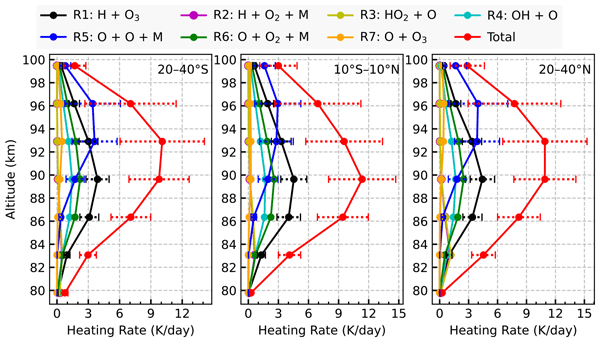
Abstract. Chemical heating from exothermic reactions is a key component of the upper mesosphere–lower thermosphere (UMLT) energy budget, yet its quantification remains uncertain. We derive a new data set of heating rates at 22:00 local time for seven major reactions using Scanning Imaging Absorption Spectrometer for Atmospheric Chartography (SCIAMACHY) OH(9–6) limb emissions, collocated with Sounding of the Atmosphere using Broadband Emission Radiometry (SABER) temperature and ozone profiles. The retrieval assumes chemical equilibrium for ozone and HOx and applies updated Einstein coefficients from HITRAN-2020. Consistent with earlier studies, the relative importance of individual reactions varies systematically with altitude: hydrogen + ozone reaction (H + O3) provides the leading contribution below ~ 92 km, whereas three-body oxygen recombination (O + O + M) dominates above this level. Other reactions make a substantial contribution across much of the 80–96 km region, accounting for roughly one-third to one-half of the total heating above ~ 86 km. The derived latitude-altitude heating structures of the dominant reactions are significantly modulated by atmospheric tides. In the equatorial zone, these heating rates exhibit a pronounced semiannual cycle that tracks seasonal changes in temperature and key reactants. Relative to previous SCIAMACHY-based estimates, the updated data set yields lower heating rates from H + O3. An uncertainty assessment indicates ~ 30 % uncertainty for H + O3 and ~ 45–60 % for O + O + M. These results refine and consolidate current understanding of chemical heating and its variability in the UMLT.
-
Notice on discussion status
The requested preprint has a corresponding peer-reviewed final revised paper. You are encouraged to refer to the final revised version.
-
Preprint
(930 KB)
-
The requested preprint has a corresponding peer-reviewed final revised paper. You are encouraged to refer to the final revised version.
- Preprint
(930 KB) - Metadata XML
- BibTeX
- EndNote
- Final revised paper


Journal article(s) based on this preprint
Interactive discussion
Status: closed
-
RC1: 'Comment on egusphere-2025-5463', Anonymous Referee #1, 08 Jan 2026
The comment was uploaded in the form of a supplement: https://egusphere.copernicus.org/preprints/2025/egusphere-2025-5463/egusphere-2025-5463-RC1-supplement.pdfCitation: https://doi.org/
10.5194/egusphere-2025-5463-RC1 - AC1: 'Reply on RC1', Xiaolin Wu, 26 Feb 2026
- AC2: 'Reply on RC1', Xiaolin Wu, 26 Feb 2026
-
RC2: 'Comment on egusphere-2025-5463', Anonymous Referee #2, 26 Jan 2026
General comments:
This is an interesting paper dealing with the determination of chemical heating rates in the mesopause region based on satellite observations with SCIAMACHY on Envisat and SABER on TIMED. The paper is very well written and I have no really major objections. I ask the authors to consider the comments listed below.
A general comment would be to add a few more sentences on the magnitude of the other relevant heating terms (diabatic solar heating, impact of breaking GW, adiabatic heating) and perhaps also radiative cooling terms. This will allow the reader to better appreciate the importance of the chemical heating in the mesopause region.
Specific comments:
Line 9: “accounting for roughly one-third to one-half of the total heating above ∼86 km.”
The total chemical heating or the total overall heating (including GW and solar?). I think you only mean the chemical heating here.
Line 21: “The stored chemical energy is subsequently released as heat through various exothermic reactions”
A certain part of it is also emitted as radiation (airglow), right?
Line 72: “covering latitudes typically from 30S to 50N and 0 to 80N”
This is a bit unclear? When are the different ranges covered?
Line 84: “the data from both instruments were processed into monthly zonal medians”
How is the "median profile" determined exactly? By taking the median at every altitude? Please explain.
Same paragraph: Due to the drifting TIMED orbit, there will only be SABER measurements on a few days per month within a 2 hour local time bin? How does this affect the analysis? It would be good to mention how many days of SABER measurements per month are used for the analysis.
Line 95: “Under optically thin conditions, the volume emission rate for a transition v→v′ depends linearly on the upper-state population and the corresponding Einstein A-coefficients.”
I’m not sure what the intention behind this statement is, but I think that the VER itself (at a specific point in the atmosphere) depends linearly on the upper-state population and the Einstein coefficients also for non optically thin conditions.
Equation (1): the equation is perhaps wrong. What are your units of “volume emission rate”. Usually the units are photons / s / cm^3. If this is the case then the factor of E_96 is wrong. Please specify the units of VER and correct, if necessary.
Equations (3) and (4): How are these equations solved? (3) depends on [HO2] and (4) on [OH]?
Line 132: “The stored energy is released back into heat through two main pathways:”
Why “back”? The chemical energy was never in the thermal energy pool, right? And: part of the chemical energy is emitted as EM-radiation (airglow).
Line 178: “The total RSS uncertainty for Reaction (R5) is estimated to be 45–60%”
Why only up to 60% if the temperature effect only already leads to uncertainties of up to 60%?
Line 188: “for the seven chemical reactions and their total, calculated using Eq. (5)”
I suggest moving “calculated using Eq. (5)” behind “for the seven chemical reactions”.
Line 203: “Further calculations show”
“Further calculations” are not something complicated but just adding the results for R1 to R4?
Same sentence: the total heating from the odd-hydrogen reactions does not decrease with altitude over the entire altitude range shown, right? And the total heating by the odd-oxygen reactions does not increase with altitude over the entire altitude range. Please limit the statement accordingly.
Figure 2, 3 etc.: I suggest mentioning in the Fig. caption that the results are for 22:00 LST, because some of the signatures are tidal (as is discussed below).
Line 226: Space missing in “atitude.In”
Line 261: “which is driven by the semiannual cycle of the migrating diurnal tide.”
It would be good to provide a reference here.
Line 293: “These discrepancies are expected, as they directly reflect the known systematic differences in atomic oxygen and hydrogen densities retrieved from SCIAMACHY and SABER, which have been analyzed in detail by Zhu and Kaufmann (2018) and Wu et al. (2025), respectively.”
Please elaborate this a bit more. How big are the differences in [O] and [H] and what are the effects on the heating rate estimates.
Citation: https://doi.org/10.5194/egusphere-2025-5463-RC2 -
AC3: 'Reply on RC2', Xiaolin Wu, 26 Feb 2026
The comment was uploaded in the form of a supplement: https://egusphere.copernicus.org/preprints/2025/egusphere-2025-5463/egusphere-2025-5463-AC3-supplement.pdf
-
AC3: 'Reply on RC2', Xiaolin Wu, 26 Feb 2026


Interactive discussion
Status: closed
-
RC1: 'Comment on egusphere-2025-5463', Anonymous Referee #1, 08 Jan 2026
The comment was uploaded in the form of a supplement: https://egusphere.copernicus.org/preprints/2025/egusphere-2025-5463/egusphere-2025-5463-RC1-supplement.pdf
- AC1: 'Reply on RC1', Xiaolin Wu, 26 Feb 2026
- AC2: 'Reply on RC1', Xiaolin Wu, 26 Feb 2026
-
RC2: 'Comment on egusphere-2025-5463', Anonymous Referee #2, 26 Jan 2026
General comments:
This is an interesting paper dealing with the determination of chemical heating rates in the mesopause region based on satellite observations with SCIAMACHY on Envisat and SABER on TIMED. The paper is very well written and I have no really major objections. I ask the authors to consider the comments listed below.
A general comment would be to add a few more sentences on the magnitude of the other relevant heating terms (diabatic solar heating, impact of breaking GW, adiabatic heating) and perhaps also radiative cooling terms. This will allow the reader to better appreciate the importance of the chemical heating in the mesopause region.
Specific comments:
Line 9: “accounting for roughly one-third to one-half of the total heating above ∼86 km.”
The total chemical heating or the total overall heating (including GW and solar?). I think you only mean the chemical heating here.
Line 21: “The stored chemical energy is subsequently released as heat through various exothermic reactions”
A certain part of it is also emitted as radiation (airglow), right?
Line 72: “covering latitudes typically from 30S to 50N and 0 to 80N”
This is a bit unclear? When are the different ranges covered?
Line 84: “the data from both instruments were processed into monthly zonal medians”
How is the "median profile" determined exactly? By taking the median at every altitude? Please explain.
Same paragraph: Due to the drifting TIMED orbit, there will only be SABER measurements on a few days per month within a 2 hour local time bin? How does this affect the analysis? It would be good to mention how many days of SABER measurements per month are used for the analysis.
Line 95: “Under optically thin conditions, the volume emission rate for a transition v→v′ depends linearly on the upper-state population and the corresponding Einstein A-coefficients.”
I’m not sure what the intention behind this statement is, but I think that the VER itself (at a specific point in the atmosphere) depends linearly on the upper-state population and the Einstein coefficients also for non optically thin conditions.
Equation (1): the equation is perhaps wrong. What are your units of “volume emission rate”. Usually the units are photons / s / cm^3. If this is the case then the factor of E_96 is wrong. Please specify the units of VER and correct, if necessary.
Equations (3) and (4): How are these equations solved? (3) depends on [HO2] and (4) on [OH]?
Line 132: “The stored energy is released back into heat through two main pathways:”
Why “back”? The chemical energy was never in the thermal energy pool, right? And: part of the chemical energy is emitted as EM-radiation (airglow).
Line 178: “The total RSS uncertainty for Reaction (R5) is estimated to be 45–60%”
Why only up to 60% if the temperature effect only already leads to uncertainties of up to 60%?
Line 188: “for the seven chemical reactions and their total, calculated using Eq. (5)”
I suggest moving “calculated using Eq. (5)” behind “for the seven chemical reactions”.
Line 203: “Further calculations show”
“Further calculations” are not something complicated but just adding the results for R1 to R4?
Same sentence: the total heating from the odd-hydrogen reactions does not decrease with altitude over the entire altitude range shown, right? And the total heating by the odd-oxygen reactions does not increase with altitude over the entire altitude range. Please limit the statement accordingly.
Figure 2, 3 etc.: I suggest mentioning in the Fig. caption that the results are for 22:00 LST, because some of the signatures are tidal (as is discussed below).
Line 226: Space missing in “atitude.In”
Line 261: “which is driven by the semiannual cycle of the migrating diurnal tide.”
It would be good to provide a reference here.
Line 293: “These discrepancies are expected, as they directly reflect the known systematic differences in atomic oxygen and hydrogen densities retrieved from SCIAMACHY and SABER, which have been analyzed in detail by Zhu and Kaufmann (2018) and Wu et al. (2025), respectively.”
Please elaborate this a bit more. How big are the differences in [O] and [H] and what are the effects on the heating rate estimates.
Citation: https://doi.org/10.5194/egusphere-2025-5463-RC2 -
AC3: 'Reply on RC2', Xiaolin Wu, 26 Feb 2026
The comment was uploaded in the form of a supplement: https://egusphere.copernicus.org/preprints/2025/egusphere-2025-5463/egusphere-2025-5463-AC3-supplement.pdf
-
AC3: 'Reply on RC2', Xiaolin Wu, 26 Feb 2026
Peer review completion


Journal article(s) based on this preprint
Viewed
| HTML | XML | Total | BibTeX | EndNote | |
|---|---|---|---|---|---|
| 800 | 331 | 94 | 1,225 | 87 | 90 |
- HTML: 800
- PDF: 331
- XML: 94
- Total: 1,225
- BibTeX: 87
- EndNote: 90
Viewed (geographical distribution)
| Country | # | Views | % |
|---|
| Total: | 0 |
| HTML: | 0 |
| PDF: | 0 |
| XML: | 0 |
- 1
Xiaolin Wu
Anne K. Smith
Martin Kaufmann
Guoying Jiang
Shuai Liu
Jiyao Xu
The requested preprint has a corresponding peer-reviewed final revised paper. You are encouraged to refer to the final revised version.
- Preprint
(930 KB) - Metadata XML